





Finding the Balance
 
The individual & the group "The positive development of a society in the absence of creative, independently thinking, critical individuals is as inconceivable as the development of an individual in the absence of the stimulus of the community."    (Albert Einstein) “ Power does not reside in institutions, not even the state or large corporations. It is located in the networks that structure society.”    (Manuel Castells)
Barbara Ganley   “ I am not a techie. I am a teacher of writing and literature.   Six years ago if anyone had told me I would be circling the globe talking about technology in the classroom, I would have laughed. Just look at me now, five years into classroom blogging: I have my own reflective-practice blog which has led me to a new community of colleagues in cyberspace and has deepened my own learning journey; my students all keep blogs, make digital stories, play with images, and podcast as they explore what it means to write effectively in the 21st century. I think my journey into the heart of Web 2.0 technology has a lot to do with teaching in a rural state, even at an affluent institution, far removed from the rest of the world. Initially I was attracted to blogs because they could bring my students to the world and the world to my students, building empathy and understanding, communication skills and connections. I was concerned by my students' willingness to hand over their whole learning plan to me as though I could wave a wand and make them learn what they needed to learn, while they actually had very little to do with it except to complete assignments and to take tests and to show up in class. I think where I teach has made me pay attention to the range in opportunity, in access and in participation of students in our state. And as I watch the world take to the internet, it has made me think about how and if the Web can enhance the lives of our students by making them critical consumers of media, active producers of content and active participants in local communities and global society.”     http://mt.middlebury.edu/middblogs/ganley/bgblogging/2006/09/a_recent_talk_on_blogging_for.html
Form
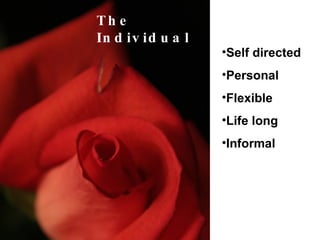
The Individual Self directed Personal  Flexible Life long Informal
 
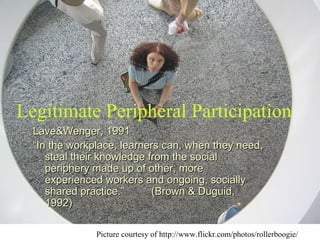
Lave&Wenger, 1991 “ In the workplace, learners can, when they need, steal their knowledge from the social periphery made up of other, more experienced workers and ongoing, socially shared practice.”  (Brown & Duguid, 1992) Legitimate Peripheral Participation Picture courtesy of http://www.flickr.com/photos/rollerboogie/
What is a  community ? “ A set of people (or agents in a more abstract sense) with some shared element…a group of people or things that live in the same area. The substance of shared element varies widely, from a situation to interest to lives and values. The term is widely used to evoke sense of collectivity.”   en. wikipedia .org/ wiki /Community
What is a Community of Practice?  “ CoPs develop around things that matter to people…. The difference  between a CoP and a team is that the shared learning and interest of its members are what keeps it together.  It is defined by knowledge rather than task. It exists because participation has value to members .  “ In their teams, they take care of projects. In their networks, they form relationships. In their CoPs they develop the knowledge that lets them do these other tasks  Etienne Wenger, 1998
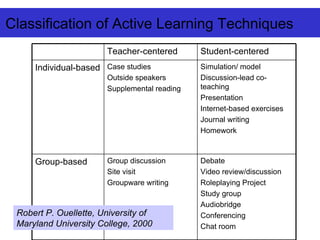
Classification of Active Learning Techniques Robert P. Ouellette, University of Maryland University College, 2000 Debate Video review/discussion Roleplaying Project Study group Audiobridge Conferencing Chat room   Group discussion Site visit Groupware writing   Group-based Simulation/ model Discussion-lead co-teaching Presentation Internet-based exercises Journal writing Homework   Case studies Outside speakers Supplemental reading   Individual-based   Student-centered   Teacher-centered
 
 
The Three Tensions  ( but sort of four…)
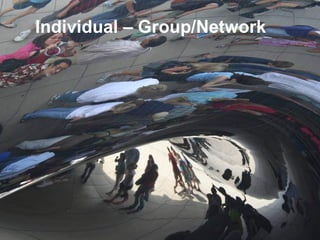
Individual – Group/Network
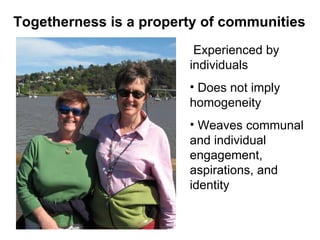
Experienced by individuals  Does not imply homogeneity Weaves communal and individual engagement, aspirations, and identity  Togetherness is a property of communities
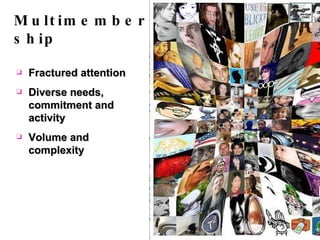
Multimembership Fractured attention Diverse needs, commitment and activity Volume and complexity
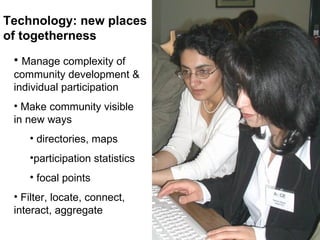
Manage complexity of community development & individual participation  Make community visible  in new ways  directories, maps participation statistics focal points Filter, locate, connect, interact, aggregate Technology: new places  of togetherness
Togetherness and separation  in time and space
Participation & Reification
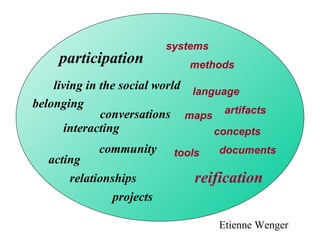
participation reification living in the social world interacting belonging acting relationships community projects conversations systems methods language maps artifacts concepts tools documents Etienne Wenger
Control < -- > Emergence
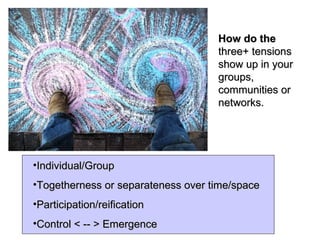
Individual/Group Togetherness or separateness over time/space Participation/reification Control < -- > Emergence How do the  three+ tensions show up in your groups, communities or networks.
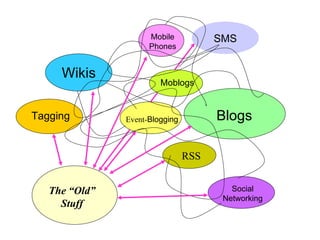
SMS Wikis Blogs RSS Event- Blogging Mobile Phones The “Old” Stuff Tagging Social Networking Moblogs
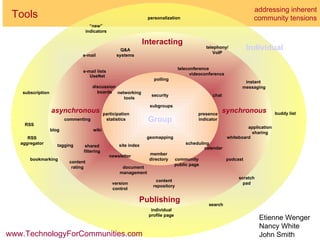
addressing inherent community tensions Tools Group asynchronous discussion  boards teleconference chat instant  messaging member directory wiki blog telephony/ VoIP individual profile page e-mail e-mail lists scratch pad RSS “ new” indicators subscription podcast content repository presence indicator buddy list security Q&A systems RSS aggregator newsletter calendar videoconference application sharing whiteboard site index participation statistics search subgroups personalization community public page version control document management UseNet content rating scheduling polling commenting networking tools tagging bookmarking shared filtering geomapping www.TechnologyForCommunities.com Etienne Wenger Nancy White John Smith Individual Interacting Publishing synchronous Group asynchronous
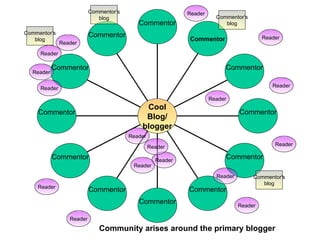
Reader Reader Reader Reader Reader Reader Reader Reader Reader Reader Reader Reader Reader Reader Reader Reader Reader Commentor’s blog Community arises around the primary blogger Commentor Commentor Commentor Commentor Commentor Commentor Commentor Commentor Commentor Commentor Commentor Commentor Cool Blog/ blogger Commentor’s blog Commentor’s blog Commentor's blog
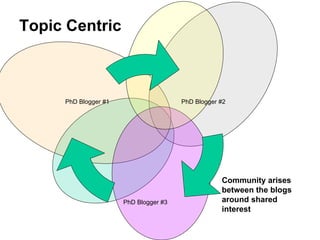
Topic Centric Community arises between the blogs around shared interest PhD Blogger #2 PhD Blogger #3 PhD Blogger #1
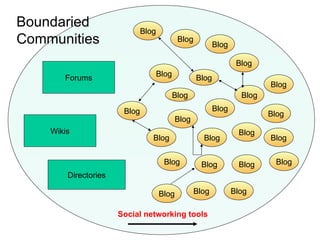
Forums Wikis Directories Blog Blog Blog Blog Blog Blog Blog Blog Blog Blog Blog Blog Blog Blog Blog Blog Blog Blog Blog Blog Blog Blog Blog Blog Social networking tools Boundaried Communities


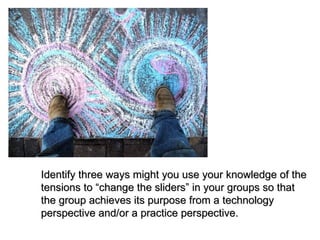
Identify three ways might you use your knowledge of the tensions to “change the sliders” in your groups so that the group achieves its purpose from a technology perspective and/or a practice perspective.
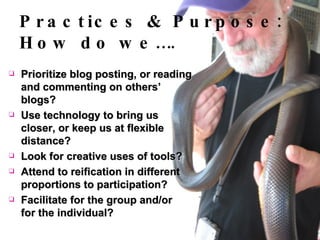
Prioritize blog posting, or reading and commenting on others’ blogs? Use technology to bring us closer, or keep us at flexible distance? Look for creative uses of tools? Attend to reification in different proportions to participation? Facilitate for the group and/or for the individual? Practices & Purpose: How do we….
 
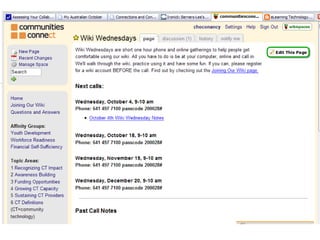
Further Resources http://australianoctober.blogspot.com http://www. fullcirc .com ,  http://www.fullcirc.com/weblog/onfacblog.htm www. fullcirc .com/community/ communitymanual . htm KM for Development  http://www.km4dev.org http://www. technologyforcommunities .com http://communitiesconnect.wikispaces.com http://www. ewenger .com http://www. learningalliances .net http:// learningnetworkedworld . blogspot .com/ http://www.km4dev.org http://www. mediablends .net/ http:// pratodialogue . wordpress .com/ http://elearnmag.org/subpage.cfm?section=best_practices&article=34-1 http://interconnected.org/home/2004/04/28/on_social_software  and  http://www. corante .com/many/archives/2004/09/30/the_seven_two_pieces_social_software_must_have. php http://groups.yahoo.com/group/ onlinefacilitation http://groups.yahoo.com/group/ comprac
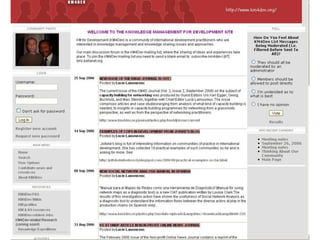
A  blog  of Nancy’s speaking tour, trip and adventure to Australia:   http:// australianoctober . blogspot .com/index.html   Nancy White   Founder, Full Circle Associates ( http://www. fullcirc .com ) [email_address]
 

Finding the Balance

  • 1.
  • 2.
  • 3.
    The individual &the group &quot;The positive development of a society in the absence of creative, independently thinking, critical individuals is as inconceivable as the development of an individual in the absence of the stimulus of the community.&quot; (Albert Einstein) “ Power does not reside in institutions, not even the state or large corporations. It is located in the networks that structure society.” (Manuel Castells)
  • 4.
    Barbara Ganley  “ I am not a techie. I am a teacher of writing and literature. Six years ago if anyone had told me I would be circling the globe talking about technology in the classroom, I would have laughed. Just look at me now, five years into classroom blogging: I have my own reflective-practice blog which has led me to a new community of colleagues in cyberspace and has deepened my own learning journey; my students all keep blogs, make digital stories, play with images, and podcast as they explore what it means to write effectively in the 21st century. I think my journey into the heart of Web 2.0 technology has a lot to do with teaching in a rural state, even at an affluent institution, far removed from the rest of the world. Initially I was attracted to blogs because they could bring my students to the world and the world to my students, building empathy and understanding, communication skills and connections. I was concerned by my students' willingness to hand over their whole learning plan to me as though I could wave a wand and make them learn what they needed to learn, while they actually had very little to do with it except to complete assignments and to take tests and to show up in class. I think where I teach has made me pay attention to the range in opportunity, in access and in participation of students in our state. And as I watch the world take to the internet, it has made me think about how and if the Web can enhance the lives of our students by making them critical consumers of media, active producers of content and active participants in local communities and global society.”     http://mt.middlebury.edu/middblogs/ganley/bgblogging/2006/09/a_recent_talk_on_blogging_for.html
  • 5.
  • 6.
    The Individual Selfdirected Personal Flexible Life long Informal
  • 7.
  • 8.
    Lave&Wenger, 1991 “In the workplace, learners can, when they need, steal their knowledge from the social periphery made up of other, more experienced workers and ongoing, socially shared practice.” (Brown & Duguid, 1992) Legitimate Peripheral Participation Picture courtesy of http://www.flickr.com/photos/rollerboogie/
  • 9.
    What is a community ? “ A set of people (or agents in a more abstract sense) with some shared element…a group of people or things that live in the same area. The substance of shared element varies widely, from a situation to interest to lives and values. The term is widely used to evoke sense of collectivity.” en. wikipedia .org/ wiki /Community
  • 10.
    What is aCommunity of Practice? “ CoPs develop around things that matter to people…. The difference between a CoP and a team is that the shared learning and interest of its members are what keeps it together. It is defined by knowledge rather than task. It exists because participation has value to members . “ In their teams, they take care of projects. In their networks, they form relationships. In their CoPs they develop the knowledge that lets them do these other tasks Etienne Wenger, 1998
  • 11.
    Classification of ActiveLearning Techniques Robert P. Ouellette, University of Maryland University College, 2000 Debate Video review/discussion Roleplaying Project Study group Audiobridge Conferencing Chat room Group discussion Site visit Groupware writing Group-based Simulation/ model Discussion-lead co-teaching Presentation Internet-based exercises Journal writing Homework Case studies Outside speakers Supplemental reading Individual-based Student-centered Teacher-centered
  • 12.
  • 13.
  • 14.
    The Three Tensions ( but sort of four…)
  • 15.
  • 16.
    Experienced by individuals Does not imply homogeneity Weaves communal and individual engagement, aspirations, and identity Togetherness is a property of communities
  • 17.
    Multimembership Fractured attentionDiverse needs, commitment and activity Volume and complexity
  • 18.
    Manage complexity ofcommunity development & individual participation Make community visible in new ways directories, maps participation statistics focal points Filter, locate, connect, interact, aggregate Technology: new places of togetherness
  • 19.
    Togetherness and separation in time and space
  • 20.
  • 21.
    participation reification livingin the social world interacting belonging acting relationships community projects conversations systems methods language maps artifacts concepts tools documents Etienne Wenger
  • 22.
    Control < --> Emergence
  • 23.
    Individual/Group Togetherness orseparateness over time/space Participation/reification Control < -- > Emergence How do the three+ tensions show up in your groups, communities or networks.
  • 24.
    SMS Wikis BlogsRSS Event- Blogging Mobile Phones The “Old” Stuff Tagging Social Networking Moblogs
  • 25.
    addressing inherent communitytensions Tools Group asynchronous discussion boards teleconference chat instant messaging member directory wiki blog telephony/ VoIP individual profile page e-mail e-mail lists scratch pad RSS “ new” indicators subscription podcast content repository presence indicator buddy list security Q&A systems RSS aggregator newsletter calendar videoconference application sharing whiteboard site index participation statistics search subgroups personalization community public page version control document management UseNet content rating scheduling polling commenting networking tools tagging bookmarking shared filtering geomapping www.TechnologyForCommunities.com Etienne Wenger Nancy White John Smith Individual Interacting Publishing synchronous Group asynchronous
  • 26.
    Reader Reader ReaderReader Reader Reader Reader Reader Reader Reader Reader Reader Reader Reader Reader Reader Reader Commentor’s blog Community arises around the primary blogger Commentor Commentor Commentor Commentor Commentor Commentor Commentor Commentor Commentor Commentor Commentor Commentor Cool Blog/ blogger Commentor’s blog Commentor’s blog Commentor's blog
  • 27.
    Topic Centric Communityarises between the blogs around shared interest PhD Blogger #2 PhD Blogger #3 PhD Blogger #1
  • 28.
    Forums Wikis DirectoriesBlog Blog Blog Blog Blog Blog Blog Blog Blog Blog Blog Blog Blog Blog Blog Blog Blog Blog Blog Blog Blog Blog Blog Blog Social networking tools Boundaried Communities
  • 29.
  • 30.
  • 31.
  • 32.
  • 33.
  • 34.
    Identify three waysmight you use your knowledge of the tensions to “change the sliders” in your groups so that the group achieves its purpose from a technology perspective and/or a practice perspective.
  • 35.
    Prioritize blog posting,or reading and commenting on others’ blogs? Use technology to bring us closer, or keep us at flexible distance? Look for creative uses of tools? Attend to reification in different proportions to participation? Facilitate for the group and/or for the individual? Practices & Purpose: How do we….
  • 36.
  • 37.
    Further Resources http://australianoctober.blogspot.comhttp://www. fullcirc .com , http://www.fullcirc.com/weblog/onfacblog.htm www. fullcirc .com/community/ communitymanual . htm KM for Development http://www.km4dev.org http://www. technologyforcommunities .com http://communitiesconnect.wikispaces.com http://www. ewenger .com http://www. learningalliances .net http:// learningnetworkedworld . blogspot .com/ http://www.km4dev.org http://www. mediablends .net/ http:// pratodialogue . wordpress .com/ http://elearnmag.org/subpage.cfm?section=best_practices&article=34-1 http://interconnected.org/home/2004/04/28/on_social_software and http://www. corante .com/many/archives/2004/09/30/the_seven_two_pieces_social_software_must_have. php http://groups.yahoo.com/group/ onlinefacilitation http://groups.yahoo.com/group/ comprac
  • 38.
    A blog of Nancy’s speaking tour, trip and adventure to Australia: http:// australianoctober . blogspot .com/index.html Nancy White Founder, Full Circle Associates ( http://www. fullcirc .com ) [email_address]
  • 39.