Practitioner Research
Professional Inquiry Planning
Tools/Methods
Paula Nottingham Updated 30/3/17
Reflective Journal
As well as making notes abut your personal
learning progress on the course, the
personal journal can be used to reflect on
your own work and experience.
You can relate your inquiry to informal
conversations that you have as a part of your
professional practice, the experience you
have had undertaking your professional role
s an insider-researcher (Costley et al.).
This use of the journal is noted in your
ethical permissions.
Inquiry Tools
Reflective Journal
Documents
Observations
Surveys
Interviews
Focus Groups
Documents
Inquiry Tools
Observations
Surveys
Interviews
Focus Groups
Documents
Reflective Journal These include papers or digital materials that
would be like talking to someone about your
area of interest – in Part 5 you looked at
ethical documents from you work for
example – these might also include policy
documents or web research about your topic
that are ‘artefacts’ that do not ‘critique’ but
represent points of view or practice.
Observations
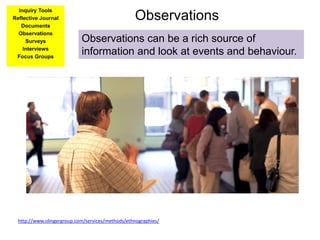
Observations can be a rich source of
information and look at events and behaviour.
http://www.olingergroup.com/services/methods/ethnographies/
Inquiry Tools
Reflective Journal
Documents
Observations
Surveys
Interviews
Focus Groups
Observations
The observation method involves the researcher in
watching, recording and analysing events of interest.
Events may be recorded, by the researcher - data may be
structured more openly or using a predetermined
framework using a observation grid to examine the number
of times that behaviour occurs or to record specific
responses or interventions.
The observer may also be a participant in the events being
studied… this participant observation about your
experience can be recorded in your journal and you can
use reflection about this experience as a part of your
inquiry. This is linked to the ideas of action research.
Observations
Data is often both qualitative (how and why) and quantitative
(how much and when). You can prepare a ‘coding framework’ or
grid that ensures data is collected within agreed boundaries of
subjectivity-objectivity.
Interactions with interviewees are noted in the analysis AND
describe how you carried out the observation – include the
insider-researcher perspective.
You can practice developing your analytical skills by observing
meetings (or similar events) in the workplace (Bell, 2005).
Analysing Observations
The data is gathered and displayed as descriptions and
quotes, you can use diagrams, charts or photographs
to show relationships/
Record what has happened sensitively and appropriately to
issues of ethics, permission and confidentiality.
You need to report an understanding of the context for
the event or meeting that was observed in order to draw
conclusions from the data.
Surveys
news.bbc.co.uk
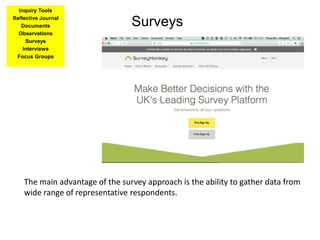
The main advantage of the survey approach is the ability to gather data from
wide range of representative respondents.
Inquiry Tools
Reflective Journal
Documents
Observations
Surveys
Interviews
Focus Groups
Surveys
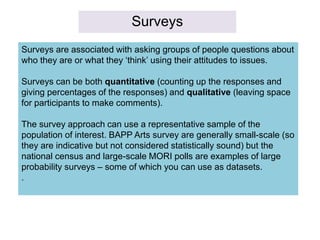
Surveys are associated with asking groups of people questions about
who they are or what they ‘think’ using their attitudes to issues.
Surveys can be both quantitative (counting up the responses and
giving percentages of the responses) and qualitative (leaving space
for participants to make comments).
The survey approach can use a representative sample of the
population of interest. BAPP Arts survey are generally small-scale (so
they are indicative but not considered statistically sound) but the
national census and large-scale MORI polls are examples of large
probability surveys – some of which you can use as datasets.
.
Surveys
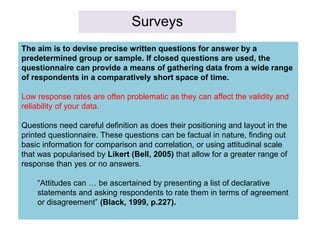
The aim is to devise precise written questions for answer by a
predetermined group or sample. If closed questions are used, the
questionnaire can provide a means of gathering data from a wide range
of respondents in a comparatively short space of time.
Low response rates are often problematic as they can affect the validity and
reliability of your data.
Questions need careful definition as does their positioning and layout in the
printed questionnaire. These questions can be factual in nature, finding out
basic information for comparison and correlation, or using attitudinal scale
that was popularised by Likert (Bell, 2005) that allow for a greater range of
response than yes or no answers.
“Attitudes can … be ascertained by presenting a list of declarative
statements and asking respondents to rate them in terms of agreement
or disagreement” (Black, 1999, p.227).
Analysing the data
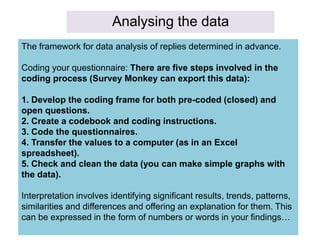
The framework for data analysis of replies determined in advance.
Coding your questionnaire: There are five steps involved in the
coding process (Survey Monkey can export this data):
1. Develop the coding frame for both pre-coded (closed) and
open questions.
2. Create a codebook and coding instructions.
3. Code the questionnaires.
4. Transfer the values to a computer (as in an Excel
spreadsheet).
5. Check and clean the data (you can make simple graphs with
the data).
Interpretation involves identifying significant results, trends, patterns,
similarities and differences and offering an explanation for them. This
can be expressed in the form of numbers or words in your findings…
(http://www.life-in-toronto.com/free-job-interview-tips.html)
Interviews
Inquiry Tools
Reflective Journal
Documents
Observations
Surveys
Interviews
Focus Groups
Interview- what is it?
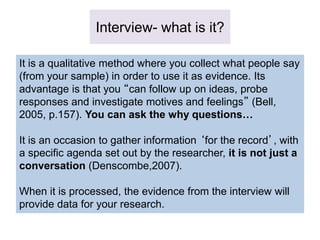
It is a qualitative method where you collect what people say
(from your sample) in order to use it as evidence. Its
advantage is that you “can follow up on ideas, probe
responses and investigate motives and feelings” (Bell,
2005, p.157). You can ask the why questions…
It is an occasion to gather information ‘for the record’, with
a specific agenda set out by the researcher, it is not just a
conversation (Denscombe,2007).
When it is processed, the evidence from the interview will
provide data for your research.
Sampling – choosing who to interview
There are a number of different ways to design a
sampling frame and this will depend on your approach
and access. Match your methods to your research
problem and work-based learning project
Purposive - choosing people who can answer the
questions using defined criteria like expertise or their
being in certain roles within the workplace (qualitative)
Representative - selection of the sample population
(quantitative and mixed - i.e. the interviews might follow a
survey) more ‘scientific’ - using a version of probability or
non-probability sampling
Types of Interview
Structured - closed questions to illicit information that can
be turned into data, like a social survey in person or for
targeted information, uses identical questions that can
be standardised
Semi-structured - broad topic questions but with some
built in flexibility, usually some standardisation
Open – usually around a general topic but where you allow
the participant to introduce subjects and/or narratives
more freely.
Developing questions and trying them out
Interview Questions - ask what you would like to know
about for your project. Think this process through.
Piloting the process - draft the questions and their
sequence. Try this out with a willing participant who can
offer you suggestions for any changes - you can also talk
about this stage with your Academic Advisor. Change
your interview process as needed.
How does this differ from professional networking? How is
it similar?
Interview Preparations
Consent Forms - the ‘researcher’ needs to ensure informed
consent from the participants – more in the campus session
on ethics
Access and/or Gatekeeper Permission – you may need to
write or email the Manager telling them what you are doing
and receive the ok to interview people
You may need a letter from Middlesex University to formalise
your agreement with the workplace, especially if
confidentiality agreements are required.
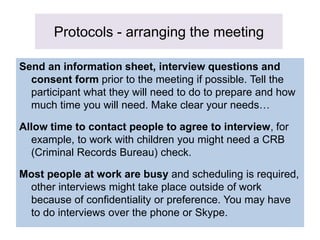
Protocols - arranging the meeting
Send an information sheet, interview questions and
consent form prior to the meeting if possible. Tell the
participant what they will need to do to prepare and how
much time you will need. Make clear your needs…
Allow time to contact people to agree to interview, for
example, to work with children you might need a CRB
(Criminal Records Bureau) check.
Most people at work are busy and scheduling is required,
other interviews might take place outside of work
because of confidentiality or preference. You may have
to do interviews over the phone or Skype.
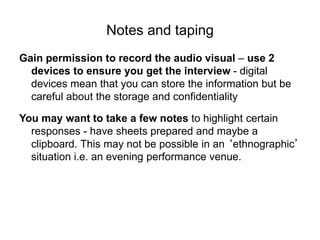
Notes and taping
Gain permission to record the audio visual – use 2
devices to ensure you get the interview - digital
devices mean that you can store the information but be
careful about the storage and confidentiality
You may want to take a few notes to highlight certain
responses - have sheets prepared and maybe a
clipboard. This may not be possible in an ‘ethnographic’
situation i.e. an evening performance venue.
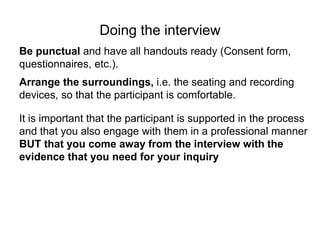
Doing the interview
Be punctual and have all handouts ready (Consent form,
questionnaires, etc.).
Arrange the surroundings, i.e. the seating and recording
devices, so that the participant is comfortable.
It is important that the participant is supported in the process
and that you also engage with them in a professional manner
BUT that you come away from the interview with the
evidence that you need for your inquiry
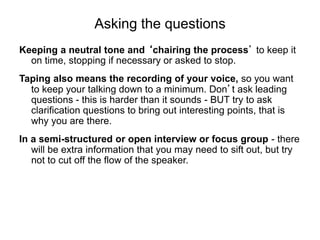
Asking the questions
Keeping a neutral tone and ‘chairing the process’ to keep it
on time, stopping if necessary or asked to stop.
Taping also means the recording of your voice, so you want
to keep your talking down to a minimum. Don’t ask leading
questions - this is harder than it sounds - BUT try to ask
clarification questions to bring out interesting points, that is
why you are there.
In a semi-structured or open interview or focus group - there
will be extra information that you may need to sift out, but try
not to cut off the flow of the speaker.
Managing data from interviews
• Generally the interview data is transcribed into written
findings.
• Quotes should be written as they are spoken, and you can
add in non-verbal responses to the text.
• Generally, this data is kept in a secure place that you describe
in your writing up, and is only viewed by the original
researcher although in some cases academic advisors may
need to check this process.
• In this case, transcriptions and tapes should be kept until the
end of the programme.
Analysing interviews
The analysis of data collected from interviews can be complex.
It has been collected within a certain context or a variety of
different ones and must be analysed with that in mind. Use
research sources to help you decide your approach…
Quotes can be selected because they typify the data (common
responses) or there might be some statements that are
significant though only said once (significant).
Analysing interviews
The qualitative researcher can categorise (code) data that has
emerged into themes, and the data may include the researchers
own ideas, impressions and interpretations that are observed.
The data is organised so that comparisons, contrasts and
evaluations can be made with the aim of finding the meaning of
the evidence presented.
Content analysis can also looks at how often words and phrases
are used to explain meaning by a systematic review of the data
that could be subjected to statistical significance testing, e.g.
categorising the positive and negative statements in a transcript
of the interview or related documents (like government policy
papers).
Focus Groups
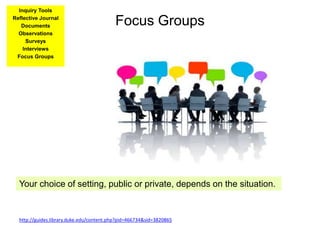
Your choice of setting, public or private, depends on the situation.
http://guides.library.duke.edu/content.php?pid=466734&sid=3820865
Inquiry Tools
Reflective Journal
Documents
Observations
Surveys
Interviews
Focus Groups
Focus Groups
Focus groups are similar to group interviews but they have a
different dynamics because of the interaction between the
participants.
“Focus groups are more likely to include members who
either have similar characteristics or experience… or are
known to have a professional concern about and knowledge
of the issues involved.” (Bell, 2005, p. 162).
Focus Groups
Focus groups can also be hard to manage so the role of the
moderator or facilitator (yourself) is an important one to
make sure to provide the ‘trigger’ topic or questions and to
channel the discussion to elicit the data needed for the
research (Denscombe, 2007, p. 179).
With focus groups you may want to have everyone identify
themselves first so that you can identify their voice - these
are more difficult to transcribe.
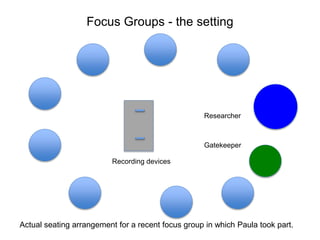
Focus Groups - the setting
Researcher
Gatekeeper
Recording devices
Actual seating arrangement for a recent focus group in which Paula took part.
Actions for after the interview or focus group
Transcription should be verbatim – including pauses,
nonverbal responses, repetitions in order to analyse
the data after the interview
If you are transcribing yourself, leave enough time
(rule of thumb is 1 hour = 8 hours of transcription)
OR transcribe only the quotes you need.
You can pay someone to do this but need to insure
confidentiality and anonymity – i.e. use pseudonyms
or name substitutes like Respondent 1, Actor 1, Actor
2 etc. or describe them by their role.

Tools methods and analysis

  • 1.
    Practitioner Research Professional InquiryPlanning Tools/Methods Paula Nottingham Updated 30/3/17
  • 2.
    Reflective Journal As wellas making notes abut your personal learning progress on the course, the personal journal can be used to reflect on your own work and experience. You can relate your inquiry to informal conversations that you have as a part of your professional practice, the experience you have had undertaking your professional role s an insider-researcher (Costley et al.). This use of the journal is noted in your ethical permissions. Inquiry Tools Reflective Journal Documents Observations Surveys Interviews Focus Groups
  • 3.
    Documents Inquiry Tools Observations Surveys Interviews Focus Groups Documents ReflectiveJournal These include papers or digital materials that would be like talking to someone about your area of interest – in Part 5 you looked at ethical documents from you work for example – these might also include policy documents or web research about your topic that are ‘artefacts’ that do not ‘critique’ but represent points of view or practice.
  • 4.
    Observations Observations can bea rich source of information and look at events and behaviour. http://www.olingergroup.com/services/methods/ethnographies/ Inquiry Tools Reflective Journal Documents Observations Surveys Interviews Focus Groups
  • 5.
    Observations The observation methodinvolves the researcher in watching, recording and analysing events of interest. Events may be recorded, by the researcher - data may be structured more openly or using a predetermined framework using a observation grid to examine the number of times that behaviour occurs or to record specific responses or interventions. The observer may also be a participant in the events being studied… this participant observation about your experience can be recorded in your journal and you can use reflection about this experience as a part of your inquiry. This is linked to the ideas of action research.
  • 6.
    Observations Data is oftenboth qualitative (how and why) and quantitative (how much and when). You can prepare a ‘coding framework’ or grid that ensures data is collected within agreed boundaries of subjectivity-objectivity. Interactions with interviewees are noted in the analysis AND describe how you carried out the observation – include the insider-researcher perspective. You can practice developing your analytical skills by observing meetings (or similar events) in the workplace (Bell, 2005).
  • 7.
    Analysing Observations The datais gathered and displayed as descriptions and quotes, you can use diagrams, charts or photographs to show relationships/ Record what has happened sensitively and appropriately to issues of ethics, permission and confidentiality. You need to report an understanding of the context for the event or meeting that was observed in order to draw conclusions from the data.
  • 8.
    Surveys news.bbc.co.uk The main advantageof the survey approach is the ability to gather data from wide range of representative respondents. Inquiry Tools Reflective Journal Documents Observations Surveys Interviews Focus Groups
  • 9.
    Surveys Surveys are associatedwith asking groups of people questions about who they are or what they ‘think’ using their attitudes to issues. Surveys can be both quantitative (counting up the responses and giving percentages of the responses) and qualitative (leaving space for participants to make comments). The survey approach can use a representative sample of the population of interest. BAPP Arts survey are generally small-scale (so they are indicative but not considered statistically sound) but the national census and large-scale MORI polls are examples of large probability surveys – some of which you can use as datasets. .
  • 10.
    Surveys The aim isto devise precise written questions for answer by a predetermined group or sample. If closed questions are used, the questionnaire can provide a means of gathering data from a wide range of respondents in a comparatively short space of time. Low response rates are often problematic as they can affect the validity and reliability of your data. Questions need careful definition as does their positioning and layout in the printed questionnaire. These questions can be factual in nature, finding out basic information for comparison and correlation, or using attitudinal scale that was popularised by Likert (Bell, 2005) that allow for a greater range of response than yes or no answers. “Attitudes can … be ascertained by presenting a list of declarative statements and asking respondents to rate them in terms of agreement or disagreement” (Black, 1999, p.227).
  • 11.
    Analysing the data Theframework for data analysis of replies determined in advance. Coding your questionnaire: There are five steps involved in the coding process (Survey Monkey can export this data): 1. Develop the coding frame for both pre-coded (closed) and open questions. 2. Create a codebook and coding instructions. 3. Code the questionnaires. 4. Transfer the values to a computer (as in an Excel spreadsheet). 5. Check and clean the data (you can make simple graphs with the data). Interpretation involves identifying significant results, trends, patterns, similarities and differences and offering an explanation for them. This can be expressed in the form of numbers or words in your findings…
  • 12.
  • 13.
    Interview- what isit? It is a qualitative method where you collect what people say (from your sample) in order to use it as evidence. Its advantage is that you “can follow up on ideas, probe responses and investigate motives and feelings” (Bell, 2005, p.157). You can ask the why questions… It is an occasion to gather information ‘for the record’, with a specific agenda set out by the researcher, it is not just a conversation (Denscombe,2007). When it is processed, the evidence from the interview will provide data for your research.
  • 14.
    Sampling – choosingwho to interview There are a number of different ways to design a sampling frame and this will depend on your approach and access. Match your methods to your research problem and work-based learning project Purposive - choosing people who can answer the questions using defined criteria like expertise or their being in certain roles within the workplace (qualitative) Representative - selection of the sample population (quantitative and mixed - i.e. the interviews might follow a survey) more ‘scientific’ - using a version of probability or non-probability sampling
  • 15.
    Types of Interview Structured- closed questions to illicit information that can be turned into data, like a social survey in person or for targeted information, uses identical questions that can be standardised Semi-structured - broad topic questions but with some built in flexibility, usually some standardisation Open – usually around a general topic but where you allow the participant to introduce subjects and/or narratives more freely.
  • 16.
    Developing questions andtrying them out Interview Questions - ask what you would like to know about for your project. Think this process through. Piloting the process - draft the questions and their sequence. Try this out with a willing participant who can offer you suggestions for any changes - you can also talk about this stage with your Academic Advisor. Change your interview process as needed. How does this differ from professional networking? How is it similar?
  • 17.
    Interview Preparations Consent Forms- the ‘researcher’ needs to ensure informed consent from the participants – more in the campus session on ethics Access and/or Gatekeeper Permission – you may need to write or email the Manager telling them what you are doing and receive the ok to interview people You may need a letter from Middlesex University to formalise your agreement with the workplace, especially if confidentiality agreements are required.
  • 18.
    Protocols - arrangingthe meeting Send an information sheet, interview questions and consent form prior to the meeting if possible. Tell the participant what they will need to do to prepare and how much time you will need. Make clear your needs… Allow time to contact people to agree to interview, for example, to work with children you might need a CRB (Criminal Records Bureau) check. Most people at work are busy and scheduling is required, other interviews might take place outside of work because of confidentiality or preference. You may have to do interviews over the phone or Skype.
  • 19.
    Notes and taping Gainpermission to record the audio visual – use 2 devices to ensure you get the interview - digital devices mean that you can store the information but be careful about the storage and confidentiality You may want to take a few notes to highlight certain responses - have sheets prepared and maybe a clipboard. This may not be possible in an ‘ethnographic’ situation i.e. an evening performance venue.
  • 20.
    Doing the interview Bepunctual and have all handouts ready (Consent form, questionnaires, etc.). Arrange the surroundings, i.e. the seating and recording devices, so that the participant is comfortable. It is important that the participant is supported in the process and that you also engage with them in a professional manner BUT that you come away from the interview with the evidence that you need for your inquiry
  • 21.
    Asking the questions Keepinga neutral tone and ‘chairing the process’ to keep it on time, stopping if necessary or asked to stop. Taping also means the recording of your voice, so you want to keep your talking down to a minimum. Don’t ask leading questions - this is harder than it sounds - BUT try to ask clarification questions to bring out interesting points, that is why you are there. In a semi-structured or open interview or focus group - there will be extra information that you may need to sift out, but try not to cut off the flow of the speaker.
  • 22.
    Managing data frominterviews • Generally the interview data is transcribed into written findings. • Quotes should be written as they are spoken, and you can add in non-verbal responses to the text. • Generally, this data is kept in a secure place that you describe in your writing up, and is only viewed by the original researcher although in some cases academic advisors may need to check this process. • In this case, transcriptions and tapes should be kept until the end of the programme.
  • 23.
    Analysing interviews The analysisof data collected from interviews can be complex. It has been collected within a certain context or a variety of different ones and must be analysed with that in mind. Use research sources to help you decide your approach… Quotes can be selected because they typify the data (common responses) or there might be some statements that are significant though only said once (significant).
  • 24.
    Analysing interviews The qualitativeresearcher can categorise (code) data that has emerged into themes, and the data may include the researchers own ideas, impressions and interpretations that are observed. The data is organised so that comparisons, contrasts and evaluations can be made with the aim of finding the meaning of the evidence presented. Content analysis can also looks at how often words and phrases are used to explain meaning by a systematic review of the data that could be subjected to statistical significance testing, e.g. categorising the positive and negative statements in a transcript of the interview or related documents (like government policy papers).
  • 25.
    Focus Groups Your choiceof setting, public or private, depends on the situation. http://guides.library.duke.edu/content.php?pid=466734&sid=3820865 Inquiry Tools Reflective Journal Documents Observations Surveys Interviews Focus Groups
  • 26.
    Focus Groups Focus groupsare similar to group interviews but they have a different dynamics because of the interaction between the participants. “Focus groups are more likely to include members who either have similar characteristics or experience… or are known to have a professional concern about and knowledge of the issues involved.” (Bell, 2005, p. 162).
  • 27.
    Focus Groups Focus groupscan also be hard to manage so the role of the moderator or facilitator (yourself) is an important one to make sure to provide the ‘trigger’ topic or questions and to channel the discussion to elicit the data needed for the research (Denscombe, 2007, p. 179). With focus groups you may want to have everyone identify themselves first so that you can identify their voice - these are more difficult to transcribe.
  • 28.
    Focus Groups -the setting Researcher Gatekeeper Recording devices Actual seating arrangement for a recent focus group in which Paula took part.
  • 29.
    Actions for afterthe interview or focus group Transcription should be verbatim – including pauses, nonverbal responses, repetitions in order to analyse the data after the interview If you are transcribing yourself, leave enough time (rule of thumb is 1 hour = 8 hours of transcription) OR transcribe only the quotes you need. You can pay someone to do this but need to insure confidentiality and anonymity – i.e. use pseudonyms or name substitutes like Respondent 1, Actor 1, Actor 2 etc. or describe them by their role.