Designs on eLearning Conference 2016
Dr Paula Nottingham
Exploring the Strategies for Online Identities in an
Arts-based Professional Practice Curriculum
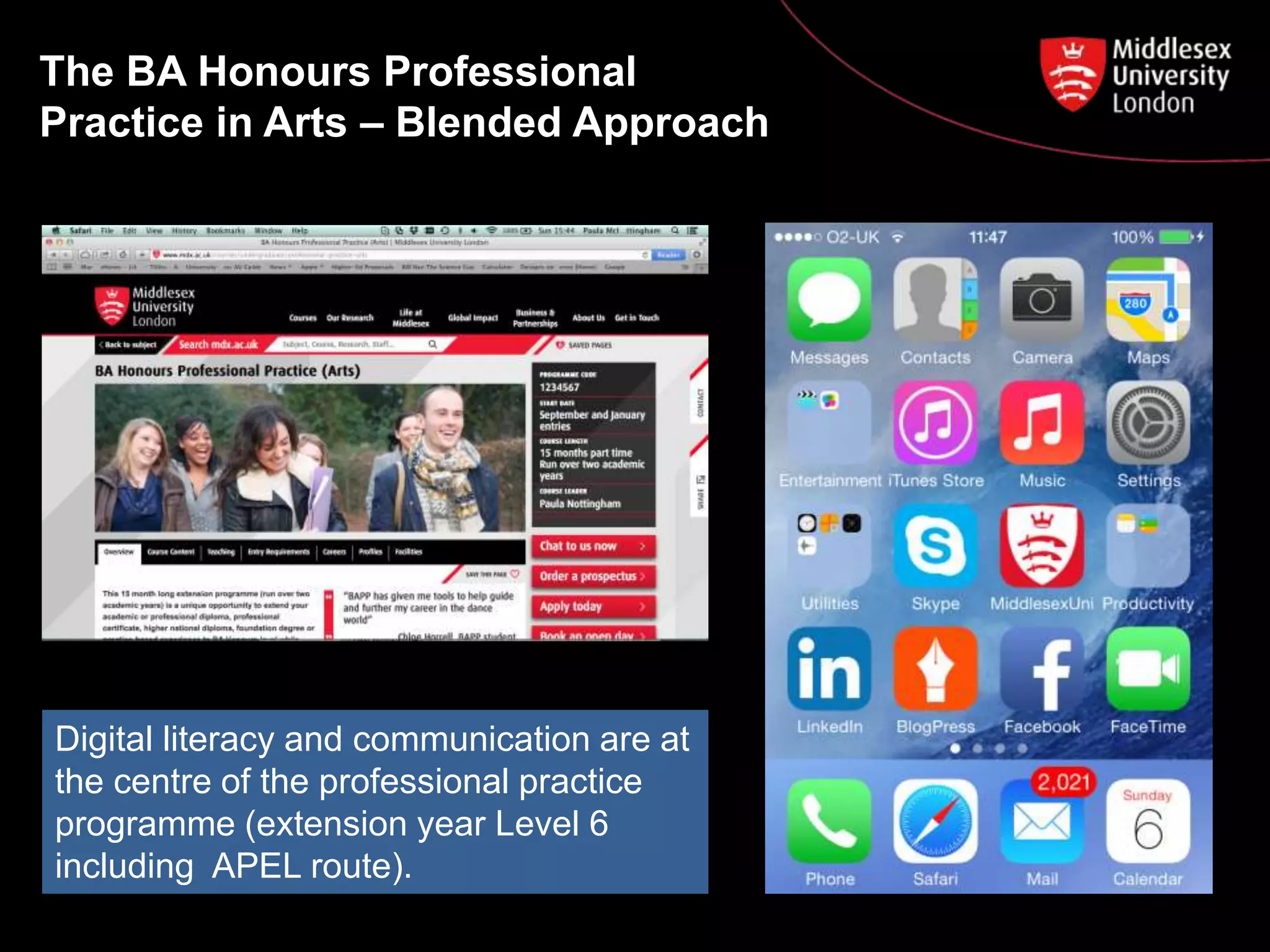
The BA Honours Professional
Practice in Arts – Blended Approach
Digital literacy and communication are at
the centre of the professional practice
programme (extension year Level 6
including APEL route).
BAPP Arts Network – using
technology for learning
BAPP Arts uses online communication through social media (blogs),
Skypes, tutorials, workplace technology, adobe connect groups, interactive
special peer groups, to stimulate flexible learning practice for work-based
learners.
Some believe that new technologies - particularly as a non-linear non-hierarchal
system for representing knowledge – offer more compatibility than print does with
constructionist pedagogy” citing Dwight and Garrison (2003) etc. (Cunningham and
Allen, 2010).
Communicating and Sharing
22 October 2016Slide 5
Learning Blog
£/$
Research into flexible learning
and facilitation
What are learning blogs? Design of curriculum versus
use and lifelong learning benefits?
Connectivity – Siemen’s 8 principles “5. Nurturing and
maintaining connections is needed to facilitate continual
learning” BAPP Arts promotes networks and engagement
BUT HOW? AND TO WHAT END? (beyond assessment!)
Professional practice as a form of ‘learner-centered’ work-
based practice (Nottingham, 2012. 2016).
• Principles from lifelong learning research/literature (Jarvis,
Holford and Griffin; Jackson)
• Transformational learning (Mezirow)
• Transdisciplinarity/arts-based research (Leavy, 2011, 2015)
• Continuing professional development (Jarvis) at a distance
(Salmon)
• Social media. cloud and mobile technology for the
professional (Conole)
• Social and cultural implications for flexible practice (Casey, J.
and Wilson)
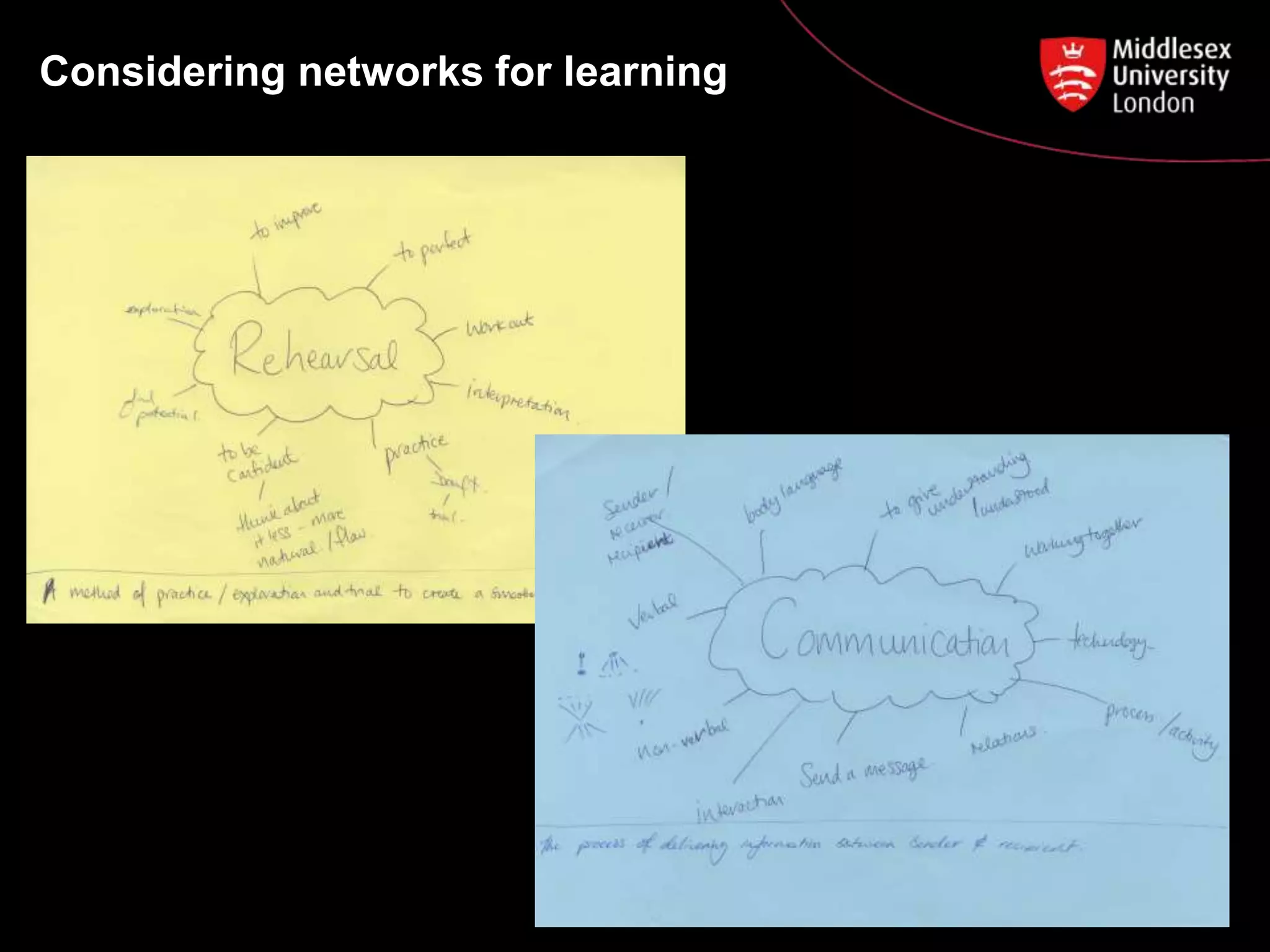
Examples: considering networks for
learning (Lave and Wenger, 1991)
Considering networks for learning
Blog example 1
Blog example 1
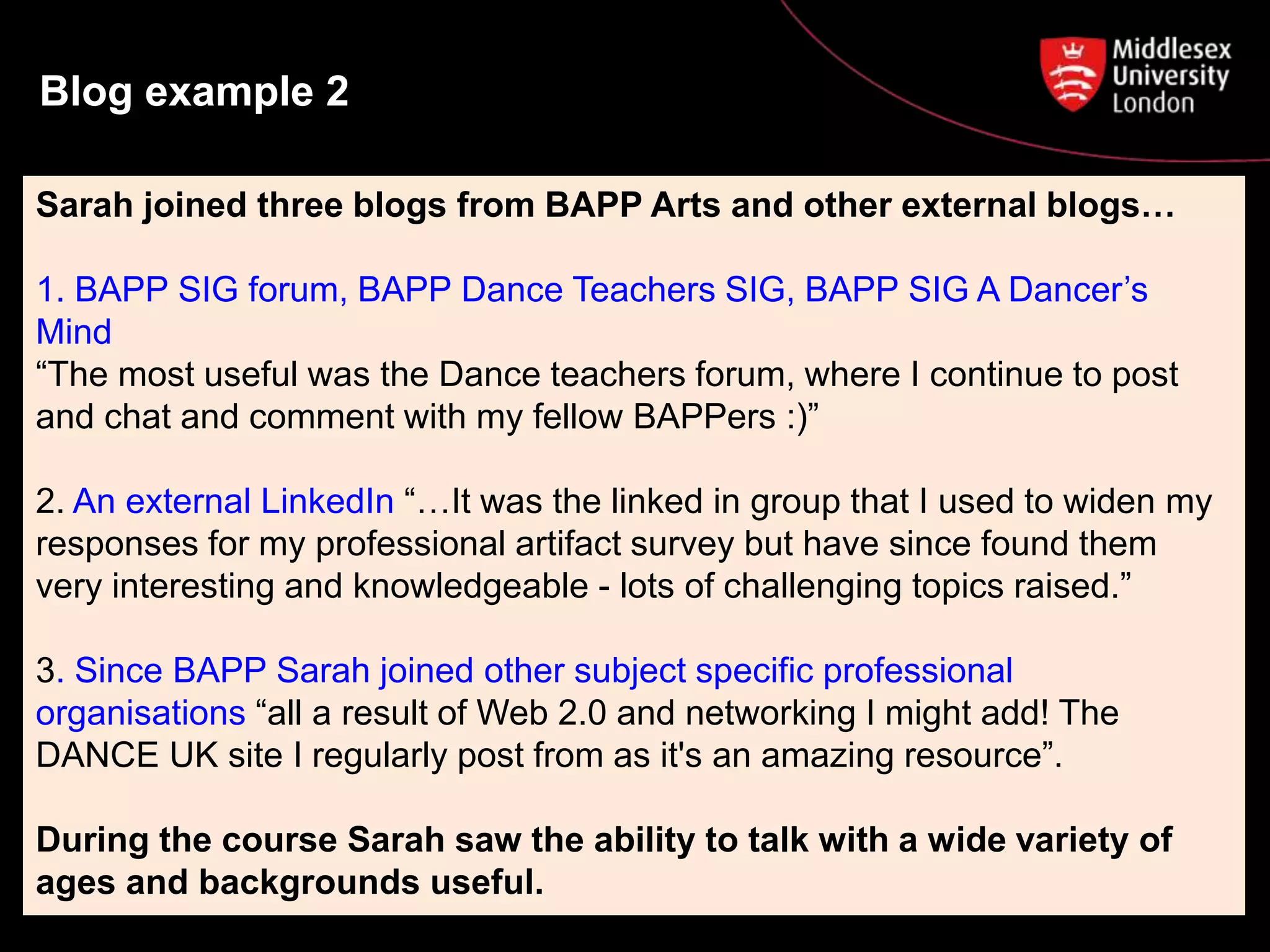
Blog example 2
Sarah joined three blogs from BAPP Arts and other external blogs…
1. BAPP SIG forum, BAPP Dance Teachers SIG, BAPP SIG A Dancer’s
Mind
“The most useful was the Dance teachers forum, where I continue to post
and chat and comment with my fellow BAPPers :)”
2. An external LinkedIn “…It was the linked in group that I used to widen my
responses for my professional artifact survey but have since found them
very interesting and knowledgeable - lots of challenging topics raised.”
3. Since BAPP Sarah joined other subject specific professional
organisations “all a result of Web 2.0 and networking I might add! The
DANCE UK site I regularly post from as it's an amazing resource”.
During the course Sarah saw the ability to talk with a wide variety of
ages and backgrounds useful.
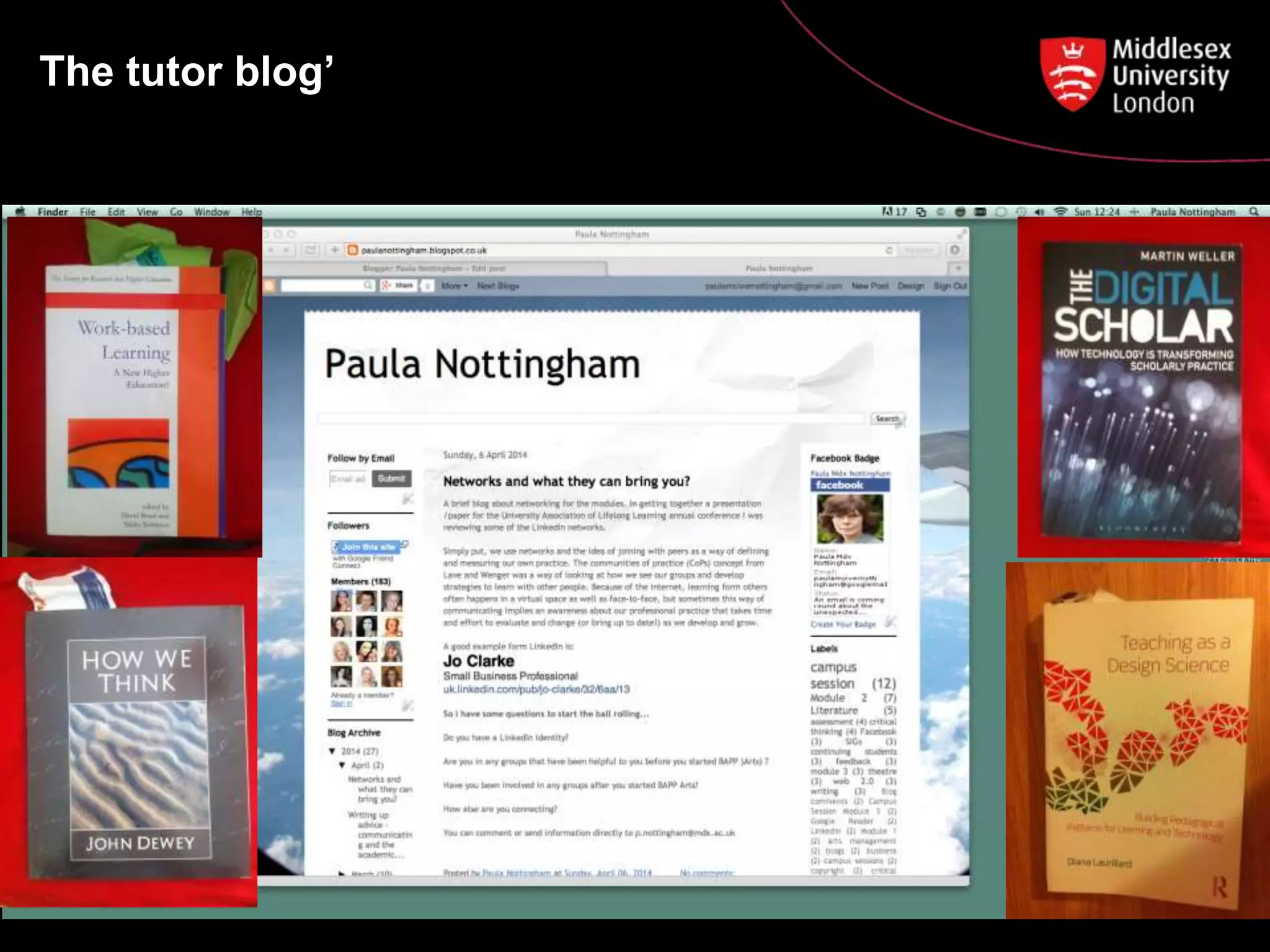
The tutor blog’
22/10/2016Slide 13
 Improve practice
 Change practice
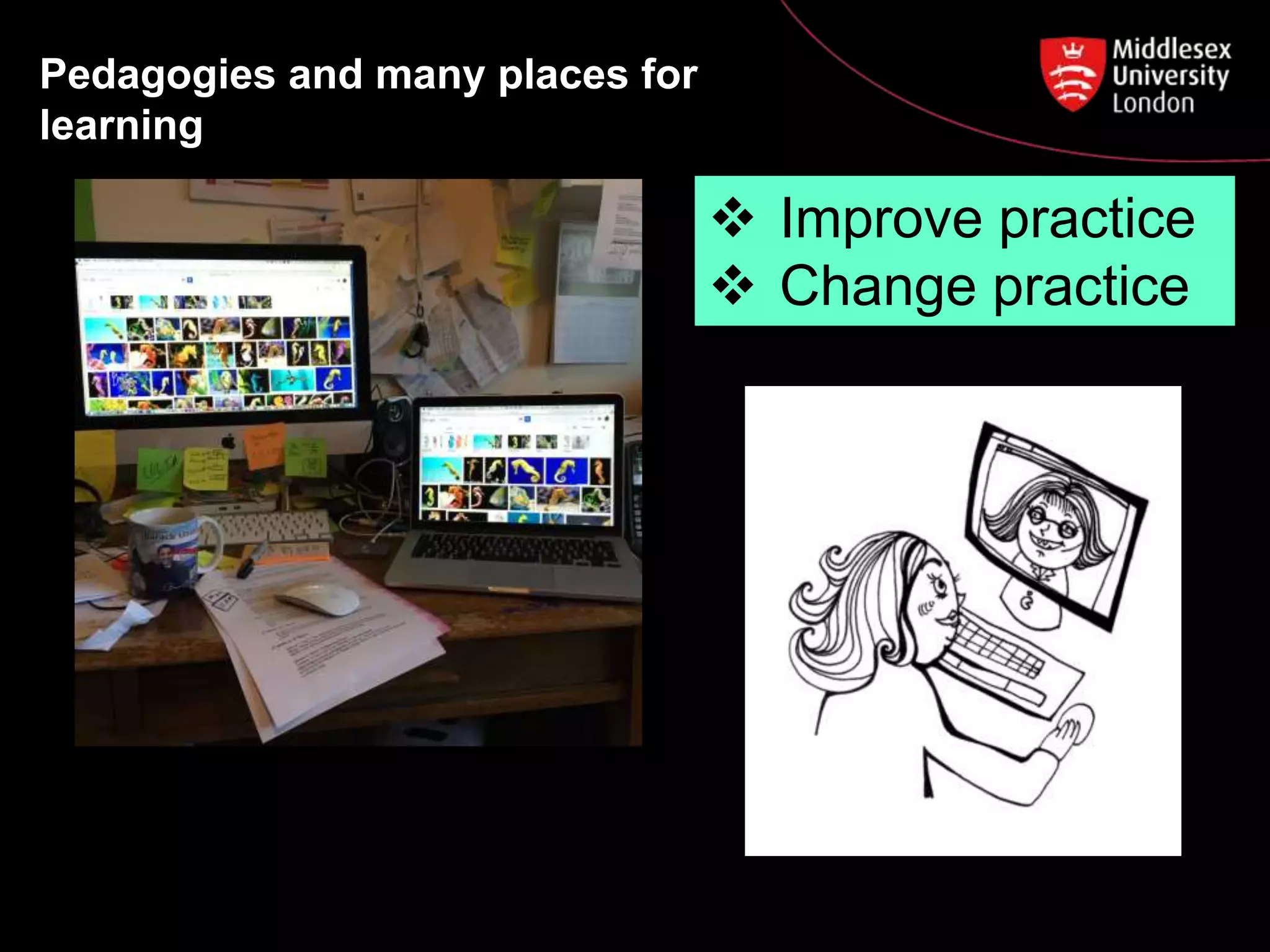
Pedagogies and many places for
learning
Analytics and evidence of engagement
“A well designed modeling environment is one that enables the learner
to learn unaided, “without being taught” Laurillard (2012, p. 186).
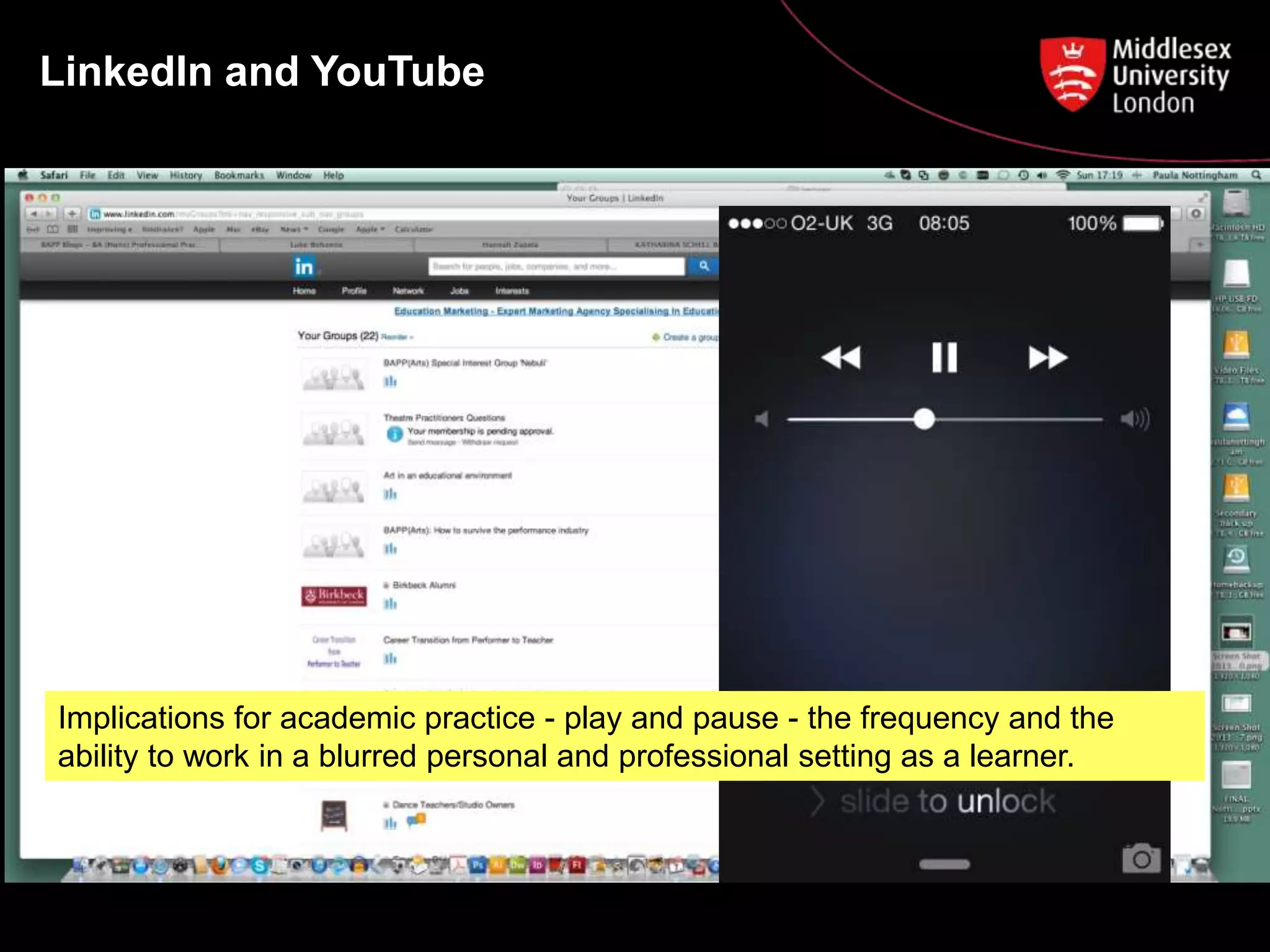
LinkedIn and YouTube
Implications for academic practice - play and pause - the frequency and the
ability to work in a blurred personal and professional setting as a learner.
Description of the project
‘Balancing Acts: Developing Online Professional Identities Using
Multimodal Communication’
Research project aims to explore:
• the use of personal and professional online identities for work-based
students
• how work-based learners perceive the role that online identities play
within professional practice
• the extent to which this understanding has been informed by online
experiences with public learning and work-related (paid or unpaid) sites
• how multimodal analysis can develop the thinking about online
professional identities
Research methods
Research methods:
The research is using content analysis of
online sites (e.g. blogs), interviews, and an
online survey to gather data.
 Ethics Permission -
yes
 Invitation to
participate sent out
 Criteria –purposive
 Selected sample of
10-20 – considers
year of degree
 Range of ages
 Mixed gender
 Content analysis
and interviews
Research interview questions
Participant Questions
What was your experience of using online/social media on BAPP Arts?
Did you keep your BAPP Arts blog up? Why?
Did you ever refer anyone to your blog?
What is your present ‘online identity’?
What type of social media do you currently use?
How do you communicate online to other organisations?
How has this changed since the course?
Who are your audiences?
What is the purpose?
Did the BAPP Arts coursework help you define your professional identity?
How?
Emerging Findings
Participants talked about
an enhanced ability to
network but negotiating
social learning could be
challenging on a
personal level. There
could be time limitations
on blogs because of
progression issues from
work.
Emerging Findings
The enhanced ability to
research using the web.
An appreciation that
expertise was important
us for critically thinking
about work and further
studies.
“it is very much work-based
learning”
Emerging Findings
The critical ability to
communicate with other
professionals
“yes I’m working at a
distance….I have the equipment
for my work from a company so
its no problem to work from
home…”
• staying in contact with
colleagues (WhatsApp)
• keeping up with software
Emerging Findings
The enhanced the ability
to self-regulate social
media.
Conclusion
22/10/2016Slide 23
Personal and Professional
Identities
Lifelong learning
Work based learning
Communication
Next Steps: completing research (6 people +), more
theory on identity, more multimodal analysis of the
online communication of learning and work sites.
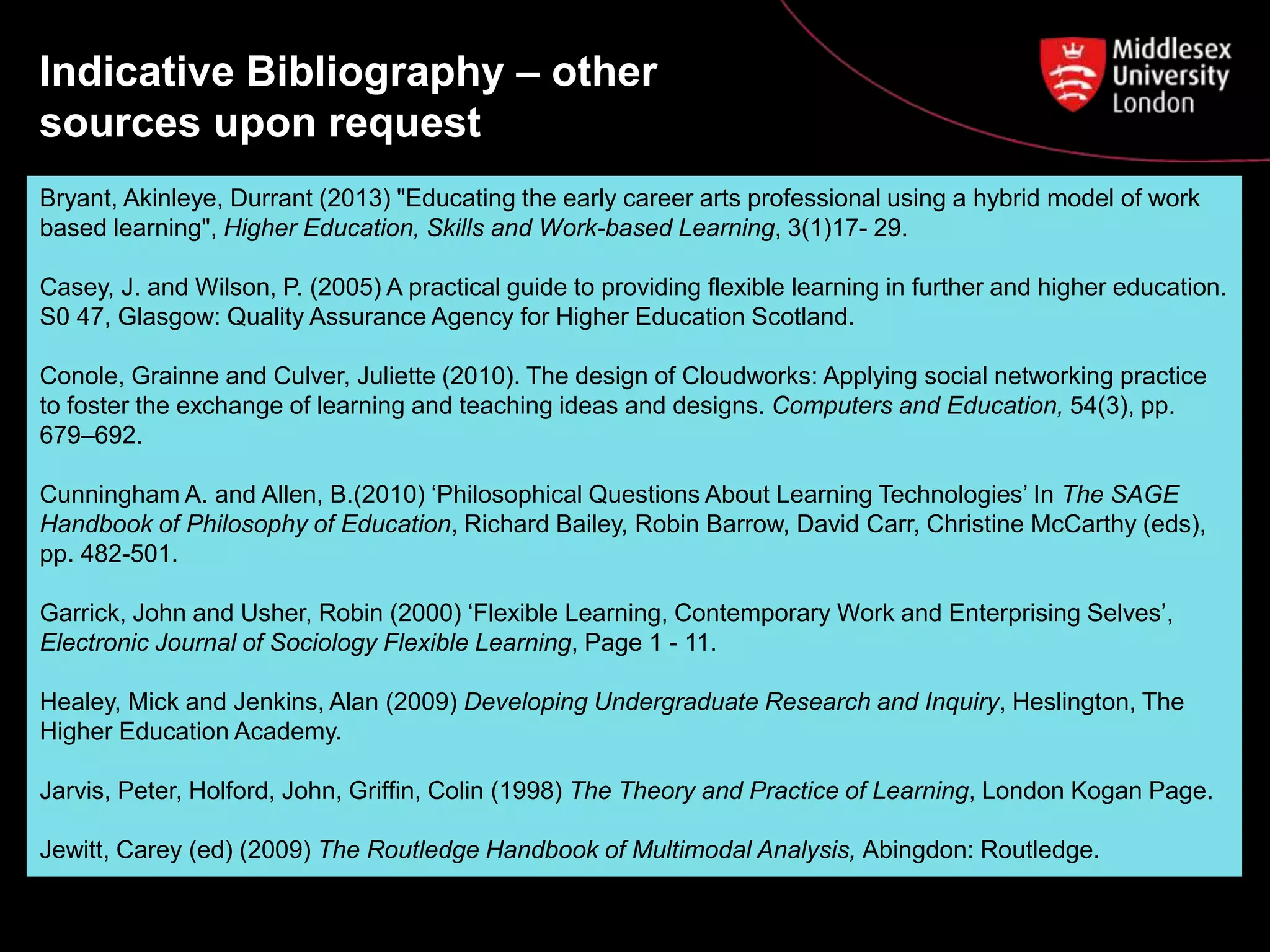
Indicative Bibliography – other
sources upon request
Bryant, Akinleye, Durrant (2013) "Educating the early career arts professional using a hybrid model of work
based learning", Higher Education, Skills and Work-based Learning, 3(1)17- 29.
Casey, J. and Wilson, P. (2005) A practical guide to providing flexible learning in further and higher education.
S0 47, Glasgow: Quality Assurance Agency for Higher Education Scotland.
Conole, Grainne and Culver, Juliette (2010). The design of Cloudworks: Applying social networking practice
to foster the exchange of learning and teaching ideas and designs. Computers and Education, 54(3), pp.
679–692.
Cunningham A. and Allen, B.(2010) ‘Philosophical Questions About Learning Technologies’ In The SAGE
Handbook of Philosophy of Education, Richard Bailey, Robin Barrow, David Carr, Christine McCarthy (eds),
pp. 482-501.
Garrick, John and Usher, Robin (2000) ‘Flexible Learning, Contemporary Work and Enterprising Selves’,
Electronic Journal of Sociology Flexible Learning, Page 1 - 11.
Healey, Mick and Jenkins, Alan (2009) Developing Undergraduate Research and Inquiry, Heslington, The
Higher Education Academy.
Jarvis, Peter, Holford, John, Griffin, Colin (1998) The Theory and Practice of Learning, London Kogan Page.
Jewitt, Carey (ed) (2009) The Routledge Handbook of Multimodal Analysis, Abingdon: Routledge.
Indicative Bibliography
Laurillard, Diane (2012) Teaching as a Design Science, London: Routledge.
Nottingham, Paula (2012) Unpublished Thesis, London: Birkbeck, University of London.
Nottingham, Paula and Akinleye, Adesola (2014) "Professional artefacts: embodying ideas in work-based
learning", Higher Education, Skills and Work-based Learning, Vol. 4 Issue: 1, pp.98 -108.
Salmon, Gilly (2003) Etivities The Key to Active Online Learning, Abingdon, RoutledgeFalmer.
Siemens, George (2005) Connectivism: A Learning Theory for the Digital Age, Available from:
http://www.itdl.org/Journal/Jan_05/article01.htm.
Smith, Peter J. (2003) ‘Workplace Learning and Flexible Delivery’, Review of Educational Research, Vol.
73, No. 1, pp. 53-88.
Tallantyre, Freda (2011) Flexible Learning Summit, Higher Education Academy.
Weller, Martin The Digital Scholar (2011) London: Bloomsbury.
Wenger, Etienne, White, Nancy and Smith, John D. (2009) Digital Habitas Stewarding Technology for
Communities, Portland, USA: CPSquare.
Contact Details:
p.nottingham@mdx.ac.uk
+44(0)7799033978
Paulanottingham (Skype)
Thank you.
Special thanks to:
Graduates BAPP Arts
+ Colleagues and past
colleagues on BAPP Arts
+ the wider community

Final to show del 21.9.16 paula nottingham

  • 1.
    Designs on eLearningConference 2016 Dr Paula Nottingham
  • 2.
    Exploring the Strategiesfor Online Identities in an Arts-based Professional Practice Curriculum
  • 3.
    The BA HonoursProfessional Practice in Arts – Blended Approach Digital literacy and communication are at the centre of the professional practice programme (extension year Level 6 including APEL route).
  • 4.
    BAPP Arts Network– using technology for learning BAPP Arts uses online communication through social media (blogs), Skypes, tutorials, workplace technology, adobe connect groups, interactive special peer groups, to stimulate flexible learning practice for work-based learners. Some believe that new technologies - particularly as a non-linear non-hierarchal system for representing knowledge – offer more compatibility than print does with constructionist pedagogy” citing Dwight and Garrison (2003) etc. (Cunningham and Allen, 2010).
  • 5.
    Communicating and Sharing 22October 2016Slide 5 Learning Blog £/$
  • 6.
    Research into flexiblelearning and facilitation What are learning blogs? Design of curriculum versus use and lifelong learning benefits? Connectivity – Siemen’s 8 principles “5. Nurturing and maintaining connections is needed to facilitate continual learning” BAPP Arts promotes networks and engagement BUT HOW? AND TO WHAT END? (beyond assessment!) Professional practice as a form of ‘learner-centered’ work- based practice (Nottingham, 2012. 2016). • Principles from lifelong learning research/literature (Jarvis, Holford and Griffin; Jackson) • Transformational learning (Mezirow) • Transdisciplinarity/arts-based research (Leavy, 2011, 2015) • Continuing professional development (Jarvis) at a distance (Salmon) • Social media. cloud and mobile technology for the professional (Conole) • Social and cultural implications for flexible practice (Casey, J. and Wilson)
  • 7.
    Examples: considering networksfor learning (Lave and Wenger, 1991)
  • 8.
  • 9.
  • 10.
  • 11.
    Blog example 2 Sarahjoined three blogs from BAPP Arts and other external blogs… 1. BAPP SIG forum, BAPP Dance Teachers SIG, BAPP SIG A Dancer’s Mind “The most useful was the Dance teachers forum, where I continue to post and chat and comment with my fellow BAPPers :)” 2. An external LinkedIn “…It was the linked in group that I used to widen my responses for my professional artifact survey but have since found them very interesting and knowledgeable - lots of challenging topics raised.” 3. Since BAPP Sarah joined other subject specific professional organisations “all a result of Web 2.0 and networking I might add! The DANCE UK site I regularly post from as it's an amazing resource”. During the course Sarah saw the ability to talk with a wide variety of ages and backgrounds useful.
  • 12.
  • 13.
    22/10/2016Slide 13  Improvepractice  Change practice Pedagogies and many places for learning
  • 14.
    Analytics and evidenceof engagement “A well designed modeling environment is one that enables the learner to learn unaided, “without being taught” Laurillard (2012, p. 186).
  • 15.
    LinkedIn and YouTube Implicationsfor academic practice - play and pause - the frequency and the ability to work in a blurred personal and professional setting as a learner.
  • 16.
    Description of theproject ‘Balancing Acts: Developing Online Professional Identities Using Multimodal Communication’ Research project aims to explore: • the use of personal and professional online identities for work-based students • how work-based learners perceive the role that online identities play within professional practice • the extent to which this understanding has been informed by online experiences with public learning and work-related (paid or unpaid) sites • how multimodal analysis can develop the thinking about online professional identities
  • 17.
    Research methods Research methods: Theresearch is using content analysis of online sites (e.g. blogs), interviews, and an online survey to gather data.  Ethics Permission - yes  Invitation to participate sent out  Criteria –purposive  Selected sample of 10-20 – considers year of degree  Range of ages  Mixed gender  Content analysis and interviews
  • 18.
    Research interview questions ParticipantQuestions What was your experience of using online/social media on BAPP Arts? Did you keep your BAPP Arts blog up? Why? Did you ever refer anyone to your blog? What is your present ‘online identity’? What type of social media do you currently use? How do you communicate online to other organisations? How has this changed since the course? Who are your audiences? What is the purpose? Did the BAPP Arts coursework help you define your professional identity? How?
  • 19.
    Emerging Findings Participants talkedabout an enhanced ability to network but negotiating social learning could be challenging on a personal level. There could be time limitations on blogs because of progression issues from work.
  • 20.
    Emerging Findings The enhancedability to research using the web. An appreciation that expertise was important us for critically thinking about work and further studies. “it is very much work-based learning”
  • 21.
    Emerging Findings The criticalability to communicate with other professionals “yes I’m working at a distance….I have the equipment for my work from a company so its no problem to work from home…” • staying in contact with colleagues (WhatsApp) • keeping up with software
  • 22.
    Emerging Findings The enhancedthe ability to self-regulate social media.
  • 23.
    Conclusion 22/10/2016Slide 23 Personal andProfessional Identities Lifelong learning Work based learning Communication Next Steps: completing research (6 people +), more theory on identity, more multimodal analysis of the online communication of learning and work sites.
  • 24.
    Indicative Bibliography –other sources upon request Bryant, Akinleye, Durrant (2013) "Educating the early career arts professional using a hybrid model of work based learning", Higher Education, Skills and Work-based Learning, 3(1)17- 29. Casey, J. and Wilson, P. (2005) A practical guide to providing flexible learning in further and higher education. S0 47, Glasgow: Quality Assurance Agency for Higher Education Scotland. Conole, Grainne and Culver, Juliette (2010). The design of Cloudworks: Applying social networking practice to foster the exchange of learning and teaching ideas and designs. Computers and Education, 54(3), pp. 679–692. Cunningham A. and Allen, B.(2010) ‘Philosophical Questions About Learning Technologies’ In The SAGE Handbook of Philosophy of Education, Richard Bailey, Robin Barrow, David Carr, Christine McCarthy (eds), pp. 482-501. Garrick, John and Usher, Robin (2000) ‘Flexible Learning, Contemporary Work and Enterprising Selves’, Electronic Journal of Sociology Flexible Learning, Page 1 - 11. Healey, Mick and Jenkins, Alan (2009) Developing Undergraduate Research and Inquiry, Heslington, The Higher Education Academy. Jarvis, Peter, Holford, John, Griffin, Colin (1998) The Theory and Practice of Learning, London Kogan Page. Jewitt, Carey (ed) (2009) The Routledge Handbook of Multimodal Analysis, Abingdon: Routledge.
  • 25.
    Indicative Bibliography Laurillard, Diane(2012) Teaching as a Design Science, London: Routledge. Nottingham, Paula (2012) Unpublished Thesis, London: Birkbeck, University of London. Nottingham, Paula and Akinleye, Adesola (2014) "Professional artefacts: embodying ideas in work-based learning", Higher Education, Skills and Work-based Learning, Vol. 4 Issue: 1, pp.98 -108. Salmon, Gilly (2003) Etivities The Key to Active Online Learning, Abingdon, RoutledgeFalmer. Siemens, George (2005) Connectivism: A Learning Theory for the Digital Age, Available from: http://www.itdl.org/Journal/Jan_05/article01.htm. Smith, Peter J. (2003) ‘Workplace Learning and Flexible Delivery’, Review of Educational Research, Vol. 73, No. 1, pp. 53-88. Tallantyre, Freda (2011) Flexible Learning Summit, Higher Education Academy. Weller, Martin The Digital Scholar (2011) London: Bloomsbury. Wenger, Etienne, White, Nancy and Smith, John D. (2009) Digital Habitas Stewarding Technology for Communities, Portland, USA: CPSquare.
  • 26.
    Contact Details: p.nottingham@mdx.ac.uk +44(0)7799033978 Paulanottingham (Skype) Thankyou. Special thanks to: Graduates BAPP Arts + Colleagues and past colleagues on BAPP Arts + the wider community