Session One Introduction to Social Media Andy Coverdale & LeRoy Hill B14 Jubilee Graduate Centre 18 January 2010
Session One: Schedule Welcome to Sessions Introduction to Social Media Activity: Discussion on Practice Academic Practice and Social Media Activity: Discussion on Identity Digital Identit(y/ies) 1pm Lunch: Further Discussion and Questions
Sessions: Overview  Session One: Monday 18 January Introduction to Social Media Session Two: Friday 5 February Blogging, Knowledge Sharing, Tagging, Aggregating and Syndicating Content Session Three: Wednesday 17 February Social Networking and Collaboration Online Resource http://www.nottingham.ac.uk/jubileegraduatecentre/training-and-events/events-resources.phtml OR:  http://tiny.cc/ruSBF  Contact [email_address] Twitter #smjgc1
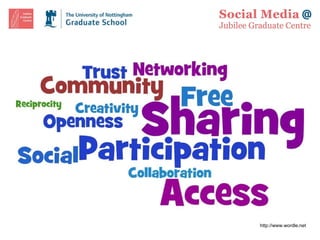
http://www.wordle.net
Social Media Overview What is social media? A social media time-line Some theories that support social media
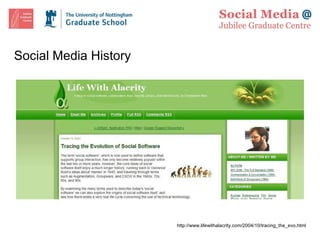
Social Media? Social Software? So what's in a word? Social Media, Social Software, Web 2.0?    "The term 'social software', which is now used to define software that supports group interaction, has only become relatively popular within the last two or more years. However, the core ideas of social software itself enjoy a much longer history, running back to Vannevar Bush's ideas about 'memex' in 1945, and traveling through terms such as Augmentation, Groupware, and CSCW in the 1960s, 70s, 80s, and 90s.” Christopher Allen:http://www.lifewithalacrity.com/2004/10/tracing_the_evo.html
So what’s with the Web 2.0? "There is much debate about what exactly is meant by Web 2.0, a term first coined by  O'Reilly Media , but broadly speaking, most definitions include the following elements: the web as platform (i.e. using it to carry out a range of tasks such as editing, image sharing, email, which previously had to be done via different software packages) the participatory web - editing and interacting with other people's web pages, rather than simply reading them the web becoming a dynamic and better-organised medium" http://www.jiscinfonet.ac.uk/infokits/social-software/definition
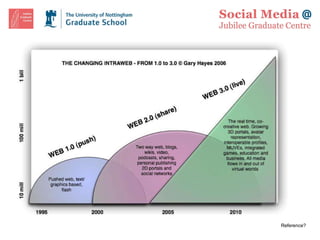
Reference?
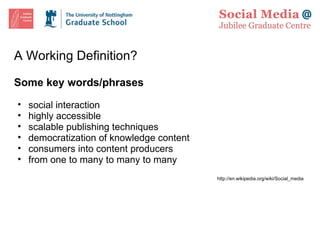
A Working Definition? Some key words/phrases social interaction highly accessible scalable publishing techniques democratization of knowledge content  consumers into content producers from one to many to many to many  http://en.wikipedia.org/wiki/Social_media
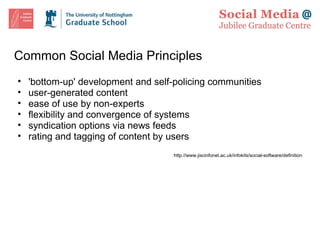
Common Social Media Principles 'bottom-up' development and self-policing communities user-generated content  ease of use by non-experts flexibility and convergence of systems syndication options via news feeds rating and tagging of content by users http://www.jiscinfonet.ac.uk/infokits/social-software/definition
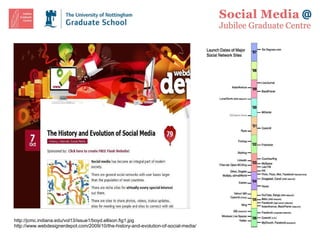
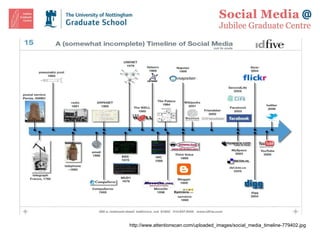
Social Media History http://www.lifewithalacrity.com/2004/10/tracing_the_evo.html
http://jcmc.indiana.edu/vol13/issue1/boyd.ellison.fig1.jpg http://www.webdesignerdepot.com/2009/10/the-history-and-evolution-of-social-media/
http://www.attentionscan.com/uploaded_images/social_media_timeline-779402.jpg
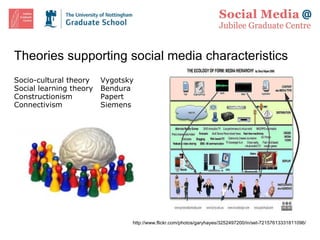
Theories supporting social media characteristics   Socio-cultural theory Vygotsky Social learning theory Bendura        Constructionism  Papert Connectivism      Siemens http://www.flickr.com/photos/garyhayes/3252497200/in/set-72157613331811096/ http:// www.guerrillasocialmedia.com/wp-content/uploads/2009/08/people-and-a-brain-300x224.jpg
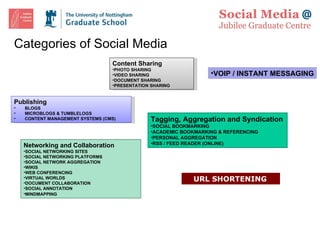
Categories of Social Media Publishing BLOGS  MICROBLOGS & TUMBLELOGS CONTENT MANAGEMENT SYSTEMS (CMS) Content Sharing  PHOTO SHARING VIDEO SHARING DOCUMENT SHARING PRESENTATION SHARING   Networking and Collaboration  SOCIAL NETWORKING SITES SOCIAL NETWORKING PLATFORMS SOCIAL NETWORK AGGREGATION WIKIS WEB CONFERENCING VIRTUAL WORLDS DOCUMENT COLLABORATION SOCIAL ANNOTATION MINDMAPPING Tagging, Aggregation and Syndication SOCIAL BOOKMARKING ACADEMIC BOOKMARKING & REFERENCING PERSONAL AGGREGATION RSS / FEED READER (ONLINE) VOIP / INSTANT MESSAGING URL SHORTENING
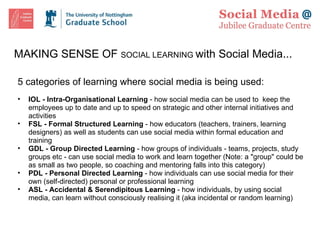
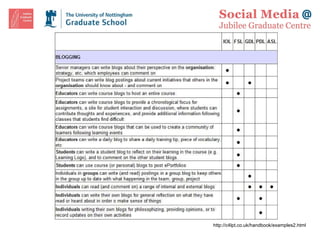
MAKING SENSE OF  SOCIAL LEARNING  with Social Media... 5 categories of learning where social media is being used: IOL - Intra-Organisational Learning  - how social media can be used to  keep the employees up to date and up to speed on strategic and other internal initiatives and activities FSL - Formal Structured Learning  - how educators (teachers, trainers, learning designers) as well as students can use social media within formal education and training GDL - Group Directed Learning  - how groups of individuals - teams, projects, study groups etc - can use social media to work and learn together (Note: a "group" could be as small as two people, so coaching and mentoring falls into this category) PDL - Personal Directed Learning  - how individuals can use social media for their own (self-directed) personal or professional learning ASL - Accidental & Serendipitous Learning  - how individuals, by using social media, can learn without consciously realising it (aka incidental or random learning)
http://c4lpt.co.uk/handbook/examples2.html
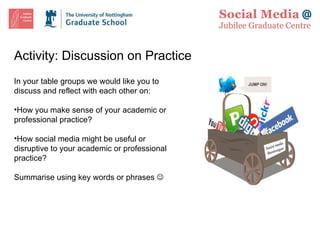
Activity: Discussion on Practice In your table groups we would like you to discuss and reflect with each other on: How you make sense of your academic or professional practice? How social media might be useful or disruptive to your academic or professional practice? Summarise using key words or phrases  
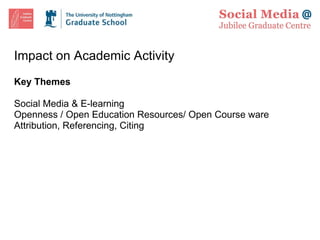
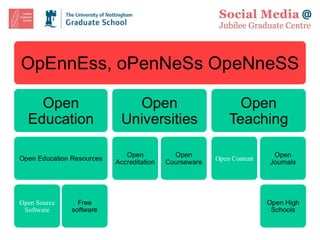
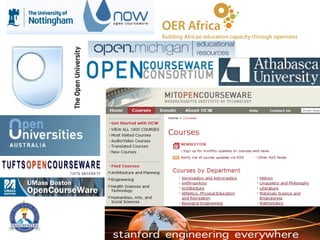
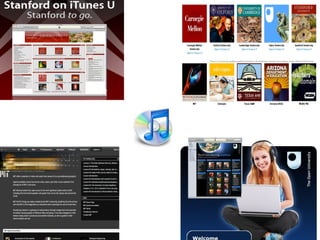
Impact on Academic Activity Key Themes Social Media & E-learning  Openness / Open Education Resources/ Open Course ware Attribution, Referencing, Citing
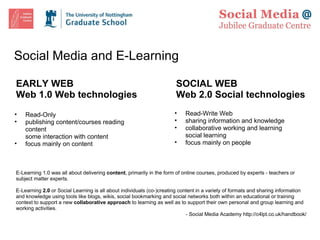
Social Media and E-Learning EARLY WEB Web 1.0 Web technologies SOCIAL WEB Web 2.0 Social technologies Read-Only publishing content/courses reading content some interaction with content  focus mainly on content Read-Write Web sharing information and knowledge collaborative working and learning social learning focus mainly on people   E-Learning 1.0 was all about delivering  content , primarily in the form of online courses, produced by experts - teachers or subject matter experts.   E-Learning  2.0  or   Social Learning   is all about individuals (co-)creating   content   in a   variety of formats and   sharing   information and knowledge using tools like blogs, wikis, social bookmarking and social networks both within an educational or training context to support a new  collaborative approach  to learning as well as to support their own personal and group learning and working activities. - Social Media Academy http://c4lpt.co.uk/handbook/


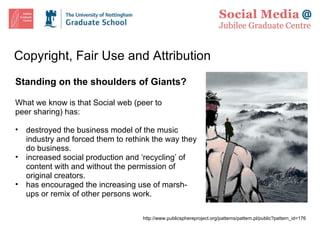
Copyright, Fair Use and Attribution Standing on the shoulders of Giants? What we know is that Social web (peer to peer sharing) has: destroyed the business model of the music industry and forced them to rethink the way they do business. increased social production and ‘recycling’ of content with and without the permission of original creators. has encouraged the increasing use of marsh-ups or remix of other persons work. http://www.publicsphereproject.org/patterns/pattern.pl/public?pattern_id=176
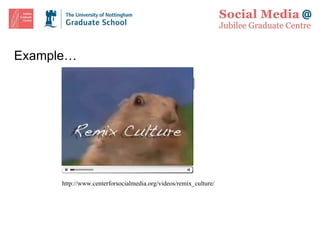
Example… http://www.centerforsocialmedia.org/videos/remix_culture/
Is Copy ever Right? Copyright is protection for creators/owners and  is there also to help promote the creation of culture. But copyright also allows individuals to create culture in a different way using existing culture. Remix culture is nothing new!
What constitutes fair use? “ Fair use is the right, in some circumstances, to quote copyrighted material without asking permission or paying for it. Fair use enables the creation of new culture, and keeps current copyright holders from being private censors.” Washington College of Law, the Center for Social Media  ( http://www.centerforsocialmedia.org/resources/fair_use )  Fair use is a copyright principle based on the belief that the public is entitled to freely use portions of copyrighted materials for purposes of commentary and criticism.  In its most general sense, a fair use is any copying of copyrighted material done for a limited purpose such as to comment upon, criticize or parody a copyrighted work.  ( http://fairuse.stanford.edu/Copyright_and_Fair_Use_Overview /chapter9/9-a.html )
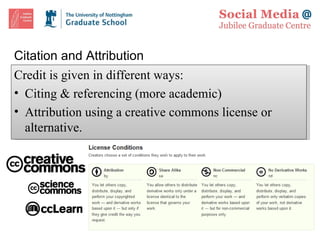
Citation and Attribution Credit is given in different ways: Citing & referencing (more academic) Attribution using a creative commons license or alternative.
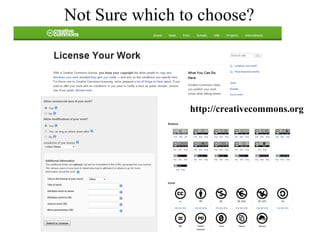
Not Sure which to choose? http://creativecommons.org
Activity: Discussion on Identity In your table groups we would like you to discuss and reflect with each other on: How you make sense of your academic or professional identity? How using social media might be useful or disruptive to your academic or professional identity? Summarise using key words or phrases  
Digital Identit(y/ies) Who are we? How do others see us? How identity shapes, and is shaped by, our use of Social Media "The persona an individual presents across all the digital communities in which he or she is represented” http://thisisme.reading.ac.uk http://www.mondoinformatico.info/wp-content/uploads/20090718trovare-nuovi-clienti.jpg
Identity: Two Perspectives Confessional Process of self-publicity / promotion  Branding of ‘self’ Formal / professional role(s) Identity is singular, stable and developmental Identity is unified across multiple domains Critical Identity is socially constructed and culturally mediated ‘ Confessional’ is determined by dominant social structure Identity is flexible – in constant flux Identity can be multiple, fragmentary and pseudonomic Identity is diversified across multiple domains http://www.okcmoa.com/~okcmoa/files/u1/Moore__2003.073.jpg
Identity in Practice Identity Dichotomies Public & Private Work & Leisure Professional / Institutional & Personal Formal & Informal Contexts Social, cultural and professional Physical, online and virtual Communities and networks Social interactions are increasingly distribute – 'networked individualism’ Multiple domains – multi-membership http://richardwiseman.files.wordpress.com/2009/05/question-mark3a.jpg
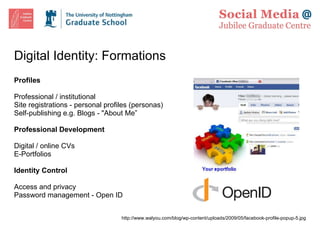
Digital Identity: Formations Profiles Professional / institutional Site registrations - personal profiles (personas) Self-publishing e.g. Blogs - "About Me” Professional Development Digital / online CVs E-Portfolios Identity Control Access and privacy Password management - Open ID http://www.walyou.com/blog/wp-content/uploads/2009/05/facebook-profile-popup-5.jpg
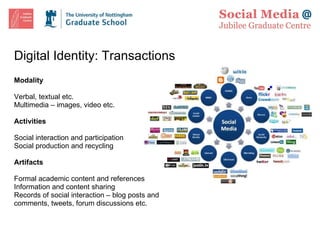
Digital Identity: Transactions Modality Verbal, textual etc. Multimedia – images, video etc. Activities Social interaction and participation Social production and recycling Artifacts Formal academic content and references Information and content sharing Records of social interaction – blog posts and comments, tweets, forum discussions etc.
Digital Identity: Visibility and Reputation Visibility ‘ Digital footprint’ New channels of academic discourse and research dissemination Web presence – academic profile Web-based academic / professional networking Reputation New models of academic peer review Academic status / reputation – physical and online environments? Activities and artifacts are increasingly searchable / traceable Individual control, ownership and intellectual property Openness, transparency and trust
Lunch: Further Discussion and Questions Graduate School Feedback Forms Please spend a few moments to fill in the feedback forms provided. Thanks. Our next session  is on  Friday 5 February: Blogging, Knowledge Sharing, Tagging, Aggregating and Syndicating Content Online Resource http://www.nottingham.ac.uk/jubileegraduatecentre/training-and-events/events-resources.phtml OR:  http://tiny.cc/ruSBF  Contact [email_address] Twitter #smjgc1
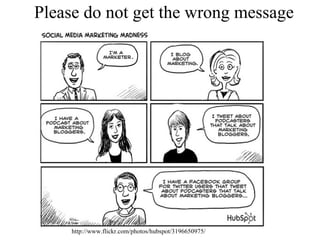
Please do not get the wrong message http://www.flickr.com/photos/hubspot/3196650975/

sm@jgc Session One

  • 1.
    Session One Introductionto Social Media Andy Coverdale & LeRoy Hill B14 Jubilee Graduate Centre 18 January 2010
  • 2.
    Session One: ScheduleWelcome to Sessions Introduction to Social Media Activity: Discussion on Practice Academic Practice and Social Media Activity: Discussion on Identity Digital Identit(y/ies) 1pm Lunch: Further Discussion and Questions
  • 3.
    Sessions: Overview Session One: Monday 18 January Introduction to Social Media Session Two: Friday 5 February Blogging, Knowledge Sharing, Tagging, Aggregating and Syndicating Content Session Three: Wednesday 17 February Social Networking and Collaboration Online Resource http://www.nottingham.ac.uk/jubileegraduatecentre/training-and-events/events-resources.phtml OR: http://tiny.cc/ruSBF Contact [email_address] Twitter #smjgc1
  • 4.
  • 5.
    Social Media OverviewWhat is social media? A social media time-line Some theories that support social media
  • 6.
    Social Media? SocialSoftware? So what's in a word? Social Media, Social Software, Web 2.0?   "The term 'social software', which is now used to define software that supports group interaction, has only become relatively popular within the last two or more years. However, the core ideas of social software itself enjoy a much longer history, running back to Vannevar Bush's ideas about 'memex' in 1945, and traveling through terms such as Augmentation, Groupware, and CSCW in the 1960s, 70s, 80s, and 90s.” Christopher Allen:http://www.lifewithalacrity.com/2004/10/tracing_the_evo.html
  • 7.
    So what’s withthe Web 2.0? "There is much debate about what exactly is meant by Web 2.0, a term first coined by O'Reilly Media , but broadly speaking, most definitions include the following elements: the web as platform (i.e. using it to carry out a range of tasks such as editing, image sharing, email, which previously had to be done via different software packages) the participatory web - editing and interacting with other people's web pages, rather than simply reading them the web becoming a dynamic and better-organised medium" http://www.jiscinfonet.ac.uk/infokits/social-software/definition
  • 8.
  • 9.
    A Working Definition?Some key words/phrases social interaction highly accessible scalable publishing techniques democratization of knowledge content  consumers into content producers from one to many to many to many  http://en.wikipedia.org/wiki/Social_media
  • 10.
    Common Social MediaPrinciples 'bottom-up' development and self-policing communities user-generated content  ease of use by non-experts flexibility and convergence of systems syndication options via news feeds rating and tagging of content by users http://www.jiscinfonet.ac.uk/infokits/social-software/definition
  • 11.
    Social Media Historyhttp://www.lifewithalacrity.com/2004/10/tracing_the_evo.html
  • 12.
  • 13.
  • 14.
    Theories supporting socialmedia characteristics Socio-cultural theory Vygotsky Social learning theory Bendura        Constructionism Papert Connectivism      Siemens http://www.flickr.com/photos/garyhayes/3252497200/in/set-72157613331811096/ http:// www.guerrillasocialmedia.com/wp-content/uploads/2009/08/people-and-a-brain-300x224.jpg
  • 15.
    Categories of SocialMedia Publishing BLOGS MICROBLOGS & TUMBLELOGS CONTENT MANAGEMENT SYSTEMS (CMS) Content Sharing PHOTO SHARING VIDEO SHARING DOCUMENT SHARING PRESENTATION SHARING Networking and Collaboration SOCIAL NETWORKING SITES SOCIAL NETWORKING PLATFORMS SOCIAL NETWORK AGGREGATION WIKIS WEB CONFERENCING VIRTUAL WORLDS DOCUMENT COLLABORATION SOCIAL ANNOTATION MINDMAPPING Tagging, Aggregation and Syndication SOCIAL BOOKMARKING ACADEMIC BOOKMARKING & REFERENCING PERSONAL AGGREGATION RSS / FEED READER (ONLINE) VOIP / INSTANT MESSAGING URL SHORTENING
  • 16.
    MAKING SENSE OF SOCIAL LEARNING with Social Media... 5 categories of learning where social media is being used: IOL - Intra-Organisational Learning - how social media can be used to  keep the employees up to date and up to speed on strategic and other internal initiatives and activities FSL - Formal Structured Learning - how educators (teachers, trainers, learning designers) as well as students can use social media within formal education and training GDL - Group Directed Learning - how groups of individuals - teams, projects, study groups etc - can use social media to work and learn together (Note: a "group" could be as small as two people, so coaching and mentoring falls into this category) PDL - Personal Directed Learning - how individuals can use social media for their own (self-directed) personal or professional learning ASL - Accidental & Serendipitous Learning - how individuals, by using social media, can learn without consciously realising it (aka incidental or random learning)
  • 17.
  • 18.
    Activity: Discussion onPractice In your table groups we would like you to discuss and reflect with each other on: How you make sense of your academic or professional practice? How social media might be useful or disruptive to your academic or professional practice? Summarise using key words or phrases 
  • 19.
    Impact on AcademicActivity Key Themes Social Media & E-learning Openness / Open Education Resources/ Open Course ware Attribution, Referencing, Citing
  • 20.
    Social Media andE-Learning EARLY WEB Web 1.0 Web technologies SOCIAL WEB Web 2.0 Social technologies Read-Only publishing content/courses reading content some interaction with content focus mainly on content Read-Write Web sharing information and knowledge collaborative working and learning social learning focus mainly on people  E-Learning 1.0 was all about delivering content , primarily in the form of online courses, produced by experts - teachers or subject matter experts.   E-Learning 2.0 or Social Learning is all about individuals (co-)creating content in a variety of formats and sharing information and knowledge using tools like blogs, wikis, social bookmarking and social networks both within an educational or training context to support a new collaborative approach to learning as well as to support their own personal and group learning and working activities. - Social Media Academy http://c4lpt.co.uk/handbook/
  • 21.
  • 22.
  • 23.
  • 24.
    Copyright, Fair Useand Attribution Standing on the shoulders of Giants? What we know is that Social web (peer to peer sharing) has: destroyed the business model of the music industry and forced them to rethink the way they do business. increased social production and ‘recycling’ of content with and without the permission of original creators. has encouraged the increasing use of marsh-ups or remix of other persons work. http://www.publicsphereproject.org/patterns/pattern.pl/public?pattern_id=176
  • 25.
  • 26.
    Is Copy everRight? Copyright is protection for creators/owners and is there also to help promote the creation of culture. But copyright also allows individuals to create culture in a different way using existing culture. Remix culture is nothing new!
  • 27.
    What constitutes fairuse? “ Fair use is the right, in some circumstances, to quote copyrighted material without asking permission or paying for it. Fair use enables the creation of new culture, and keeps current copyright holders from being private censors.” Washington College of Law, the Center for Social Media ( http://www.centerforsocialmedia.org/resources/fair_use ) Fair use is a copyright principle based on the belief that the public is entitled to freely use portions of copyrighted materials for purposes of commentary and criticism. In its most general sense, a fair use is any copying of copyrighted material done for a limited purpose such as to comment upon, criticize or parody a copyrighted work. ( http://fairuse.stanford.edu/Copyright_and_Fair_Use_Overview /chapter9/9-a.html )
  • 28.
    Citation and AttributionCredit is given in different ways: Citing & referencing (more academic) Attribution using a creative commons license or alternative.
  • 29.
    Not Sure whichto choose? http://creativecommons.org
  • 30.
    Activity: Discussion onIdentity In your table groups we would like you to discuss and reflect with each other on: How you make sense of your academic or professional identity? How using social media might be useful or disruptive to your academic or professional identity? Summarise using key words or phrases 
  • 31.
    Digital Identit(y/ies) Whoare we? How do others see us? How identity shapes, and is shaped by, our use of Social Media "The persona an individual presents across all the digital communities in which he or she is represented” http://thisisme.reading.ac.uk http://www.mondoinformatico.info/wp-content/uploads/20090718trovare-nuovi-clienti.jpg
  • 32.
    Identity: Two PerspectivesConfessional Process of self-publicity / promotion Branding of ‘self’ Formal / professional role(s) Identity is singular, stable and developmental Identity is unified across multiple domains Critical Identity is socially constructed and culturally mediated ‘ Confessional’ is determined by dominant social structure Identity is flexible – in constant flux Identity can be multiple, fragmentary and pseudonomic Identity is diversified across multiple domains http://www.okcmoa.com/~okcmoa/files/u1/Moore__2003.073.jpg
  • 33.
    Identity in PracticeIdentity Dichotomies Public & Private Work & Leisure Professional / Institutional & Personal Formal & Informal Contexts Social, cultural and professional Physical, online and virtual Communities and networks Social interactions are increasingly distribute – 'networked individualism’ Multiple domains – multi-membership http://richardwiseman.files.wordpress.com/2009/05/question-mark3a.jpg
  • 34.
    Digital Identity: FormationsProfiles Professional / institutional Site registrations - personal profiles (personas) Self-publishing e.g. Blogs - "About Me” Professional Development Digital / online CVs E-Portfolios Identity Control Access and privacy Password management - Open ID http://www.walyou.com/blog/wp-content/uploads/2009/05/facebook-profile-popup-5.jpg
  • 35.
    Digital Identity: TransactionsModality Verbal, textual etc. Multimedia – images, video etc. Activities Social interaction and participation Social production and recycling Artifacts Formal academic content and references Information and content sharing Records of social interaction – blog posts and comments, tweets, forum discussions etc.
  • 36.
    Digital Identity: Visibilityand Reputation Visibility ‘ Digital footprint’ New channels of academic discourse and research dissemination Web presence – academic profile Web-based academic / professional networking Reputation New models of academic peer review Academic status / reputation – physical and online environments? Activities and artifacts are increasingly searchable / traceable Individual control, ownership and intellectual property Openness, transparency and trust
  • 37.
    Lunch: Further Discussionand Questions Graduate School Feedback Forms Please spend a few moments to fill in the feedback forms provided. Thanks. Our next session is on Friday 5 February: Blogging, Knowledge Sharing, Tagging, Aggregating and Syndicating Content Online Resource http://www.nottingham.ac.uk/jubileegraduatecentre/training-and-events/events-resources.phtml OR: http://tiny.cc/ruSBF Contact [email_address] Twitter #smjgc1
  • 38.
    Please do notget the wrong message http://www.flickr.com/photos/hubspot/3196650975/