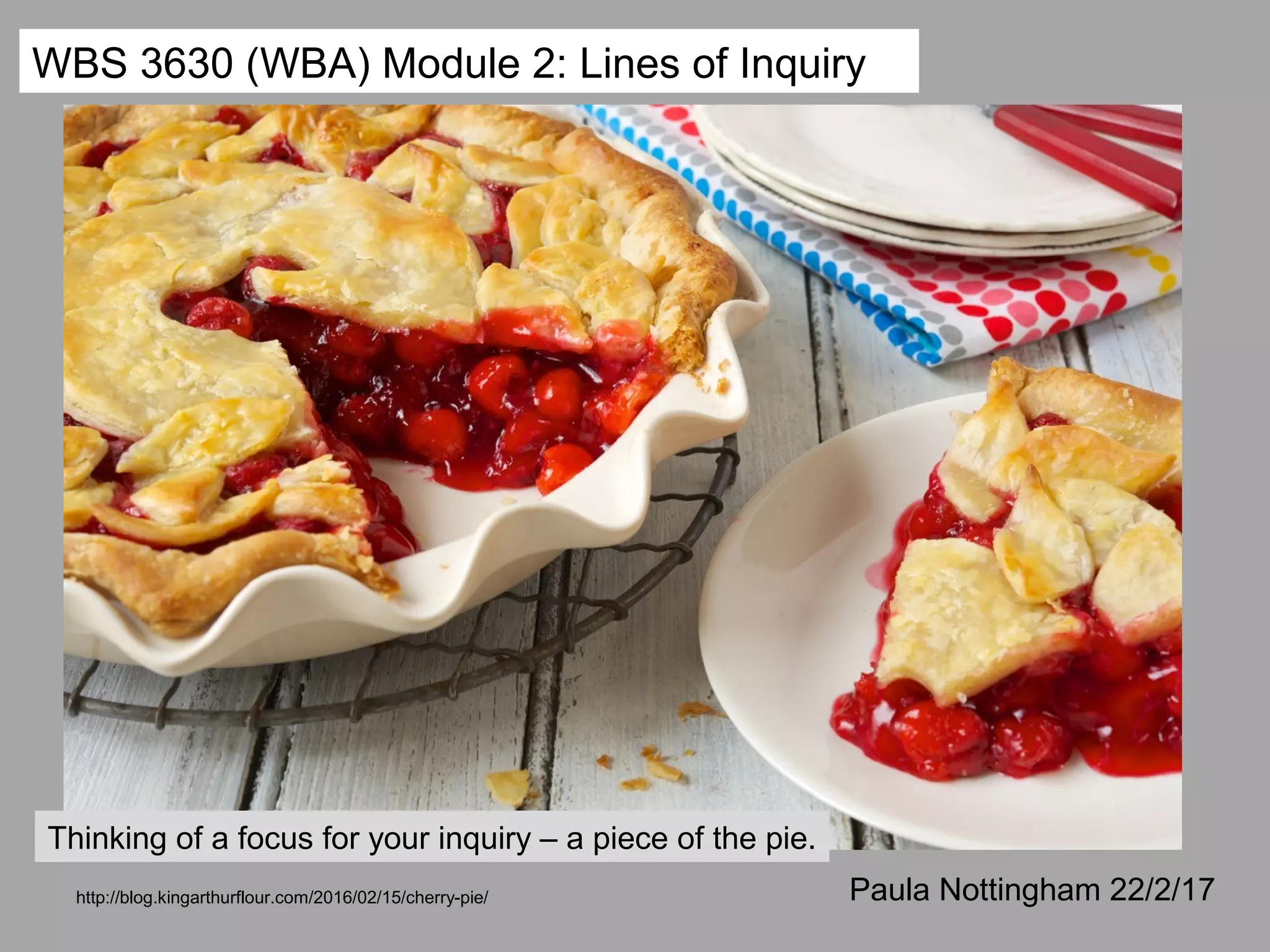
Paula Nottingham 22/2/17http://blog.kingarthurflour.com/2016/02/15/cherry-pie/
WBS 3630 (WBA) Module 2: Lines of Inquiry
Thinking of a focus for your inquiry – a piece of the pie.
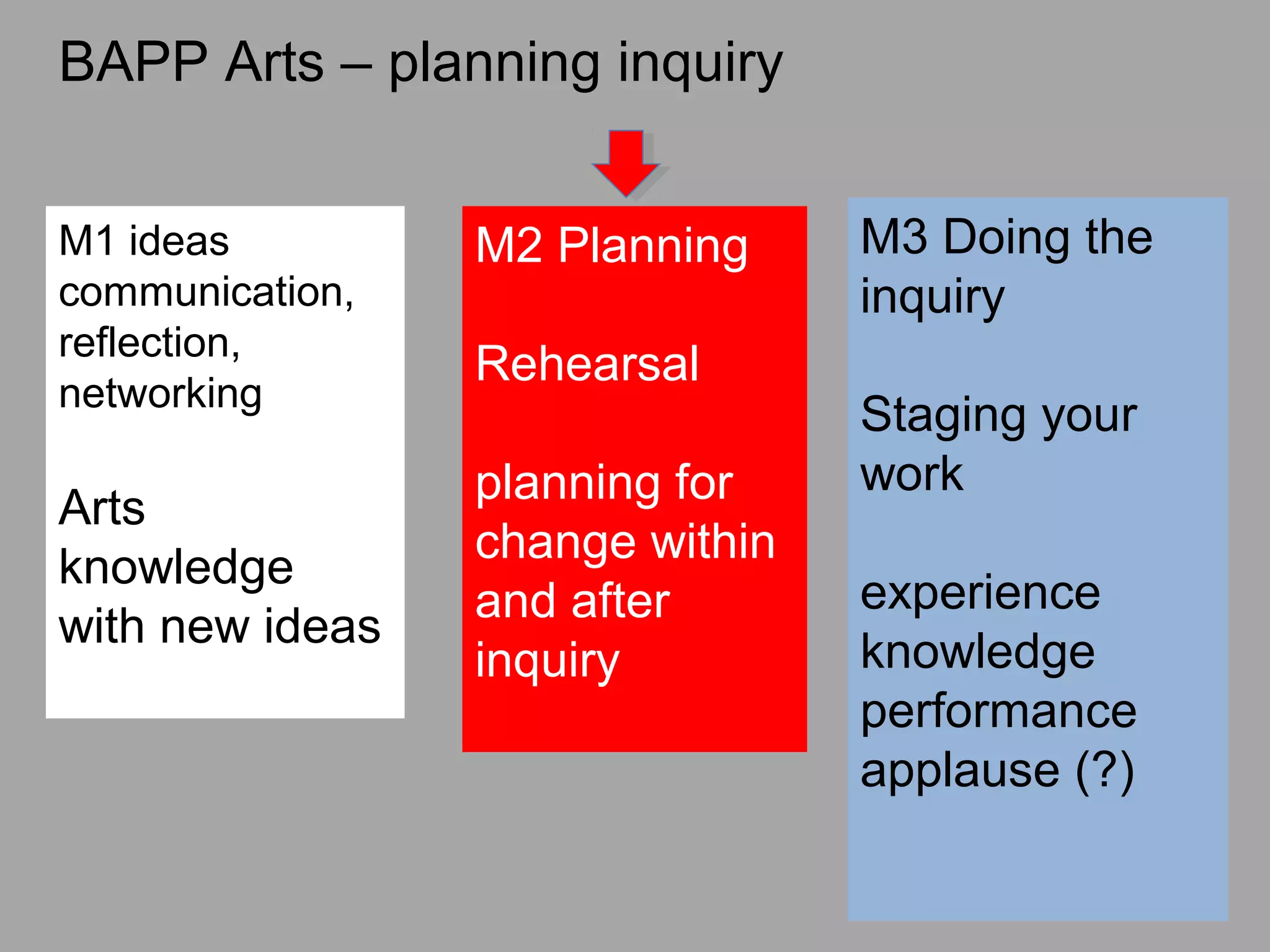
M1 ideas
communication,
reflection,
networking
Arts
knowledge
with new ideas
M2 Planning
Rehearsal
planning for
change within
and after
inquiry
M3 Doing the
inquiry
Staging your
work
experience
knowledge
performance
applause (?)
BAPP Arts – planning inquiry
http://twistedsifter.com/2013/11/terrifyingly-beautiful-photos-of-storm-clouds/
http://www.dailymail.co.uk/health/article-2567022/Seeing-rainbows-Its-time-eyes-checked.html
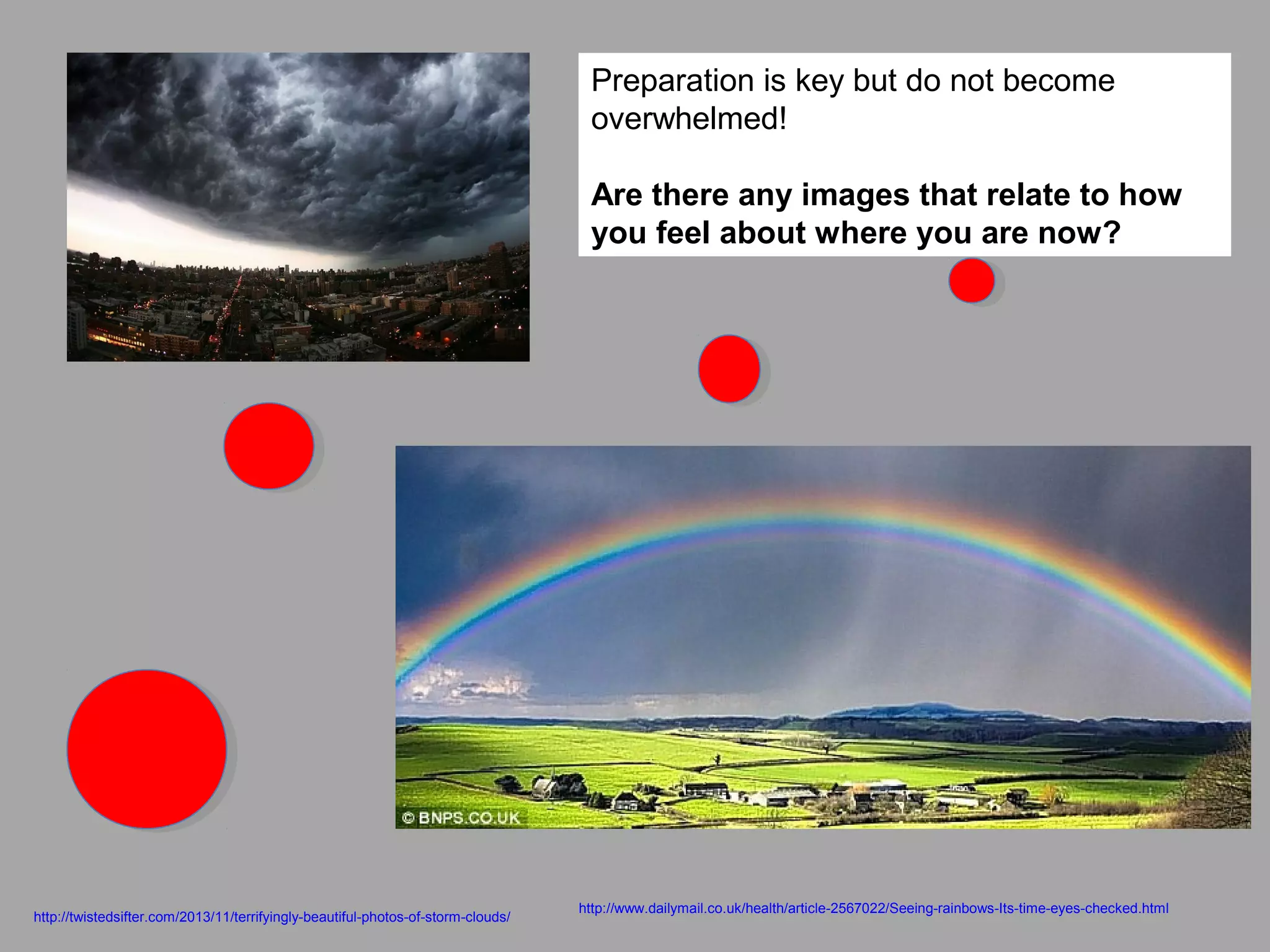
Preparation is key but do not become
overwhelmed!
Are there any images that relate to how
you feel about where you are now?
http://twistedsifter.com/2013/11/terrifyingly-beautiful-photos-of-storm-clouds/
http://www.dailymail.co.uk/health/article-2567022/Seeing-rainbows-Its-time-eyes-checked.html
Are there any images that relate to how you feel about where you are now
in your studies – leading to some inquiry questions?
Try spidergrams or
mindmapping to
visualise your
work
Try spidergrams or
mindmapping to
visualise your
work
Try mood
boards to
understand
ideas
Try mood
boards to
understand
ideas
Try
images
from
work
Try
images
from
work
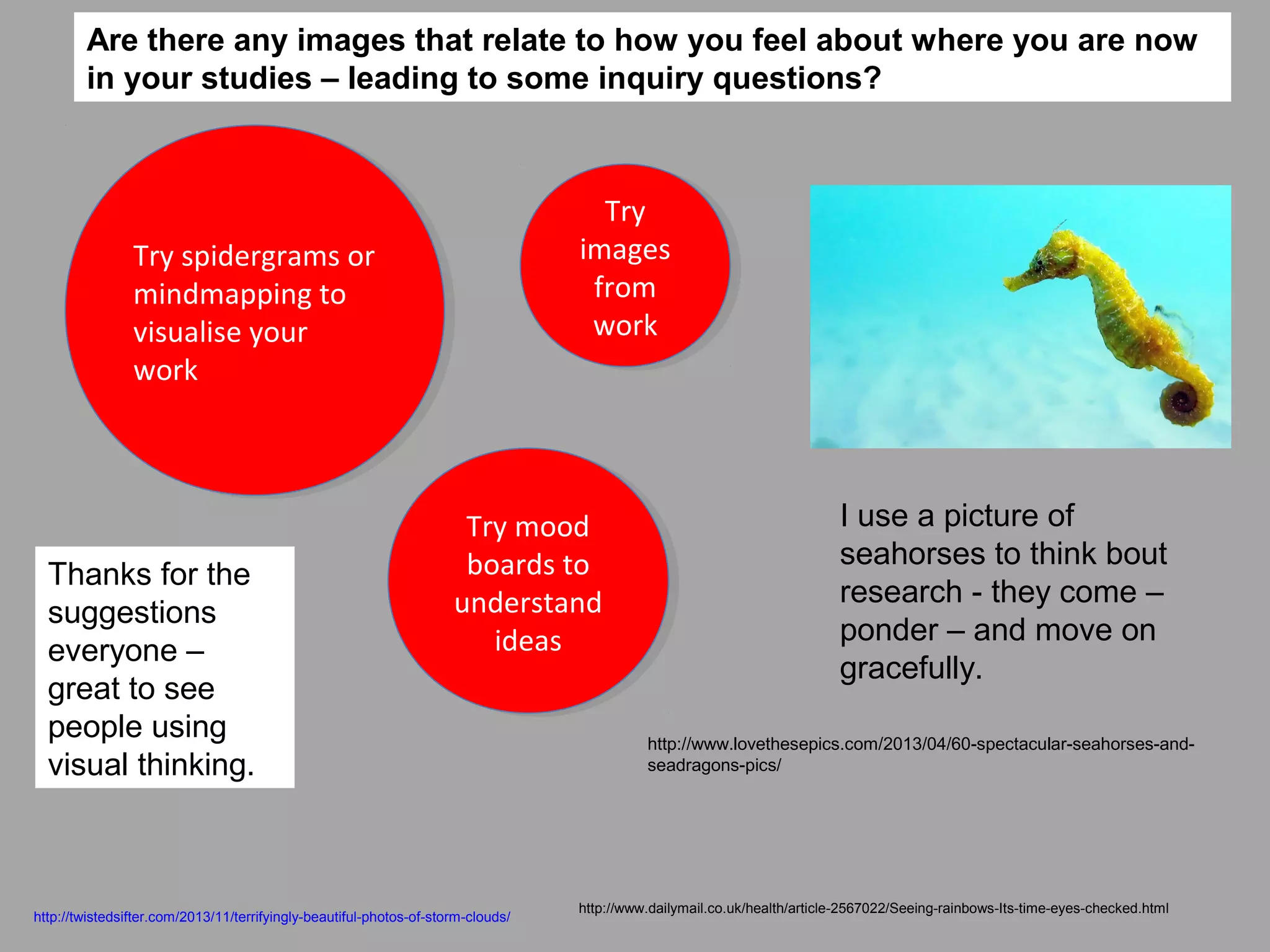
I use a picture of
seahorses to think bout
research - they come –
ponder – and move on
gracefully.
http://www.lovethesepics.com/2013/04/60-spectacular-seahorses-and-
seadragons-pics/
Thanks for the
suggestions
everyone –
great to see
people using
visual thinking.
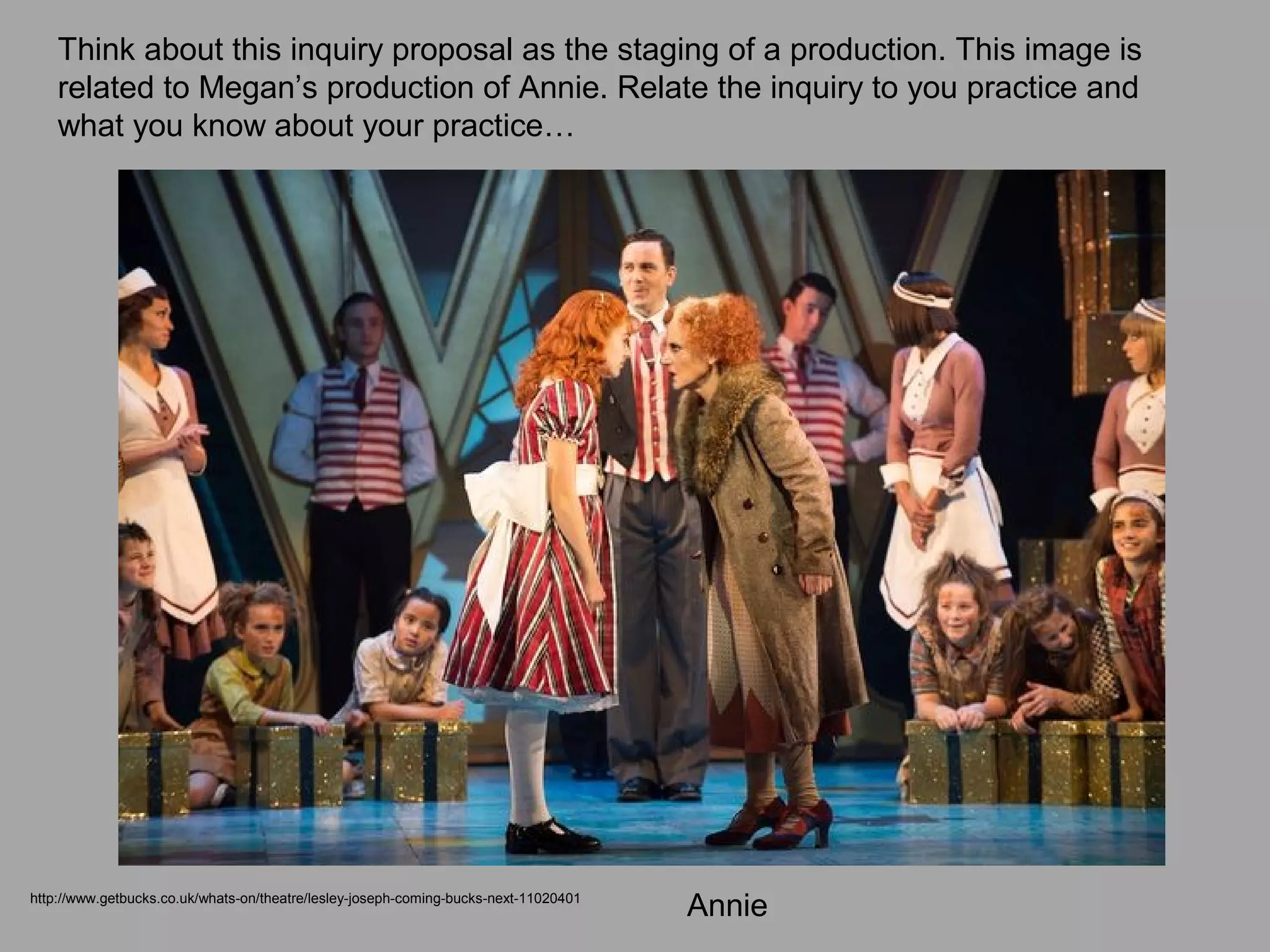
http://www.getbucks.co.uk/whats-on/theatre/lesley-joseph-coming-bucks-next-11020401
Think about this inquiry proposal as the staging of a production. This image is
related to Megan’s production of Annie. Relate the inquiry to you practice and
what you know about your practice…
Annie
How can you position yourself in the inquiry
process?
Looking at sources will help you ‘place’
yourself…
Talking to other in you special interest
groups
Constructivism tells us that we learn by fitting new
understanding and knowledge into and with, extending and
supplanting, old understanding and knowledge. …
Mezirow (1991) says learning is to bring about change or
transformation
Compare your list with others and come up with some common themes about
what you know…. these might change and may not be value-free. Try to
relate your ‘assumptions’ and the power relationships in your particular context.
What are your assumptions about your practice?
Examples?
I think everyone knows that teenagers are always
hungry....
I think people who do not march in protest rallies
just don’t care....
Remember you will need to think ‘ethically’ about your area of interest.
Others might also have assumptions about what you do…
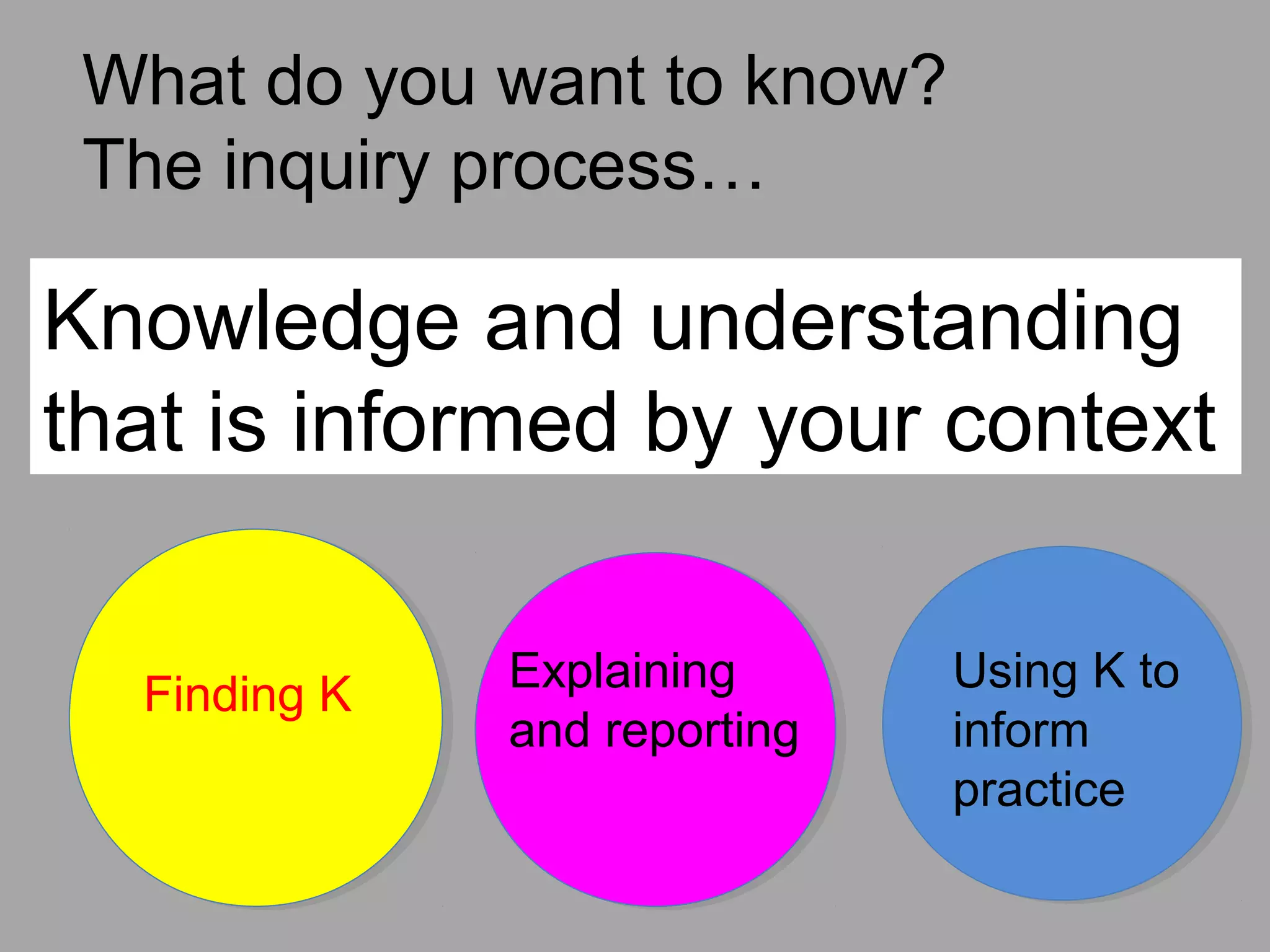
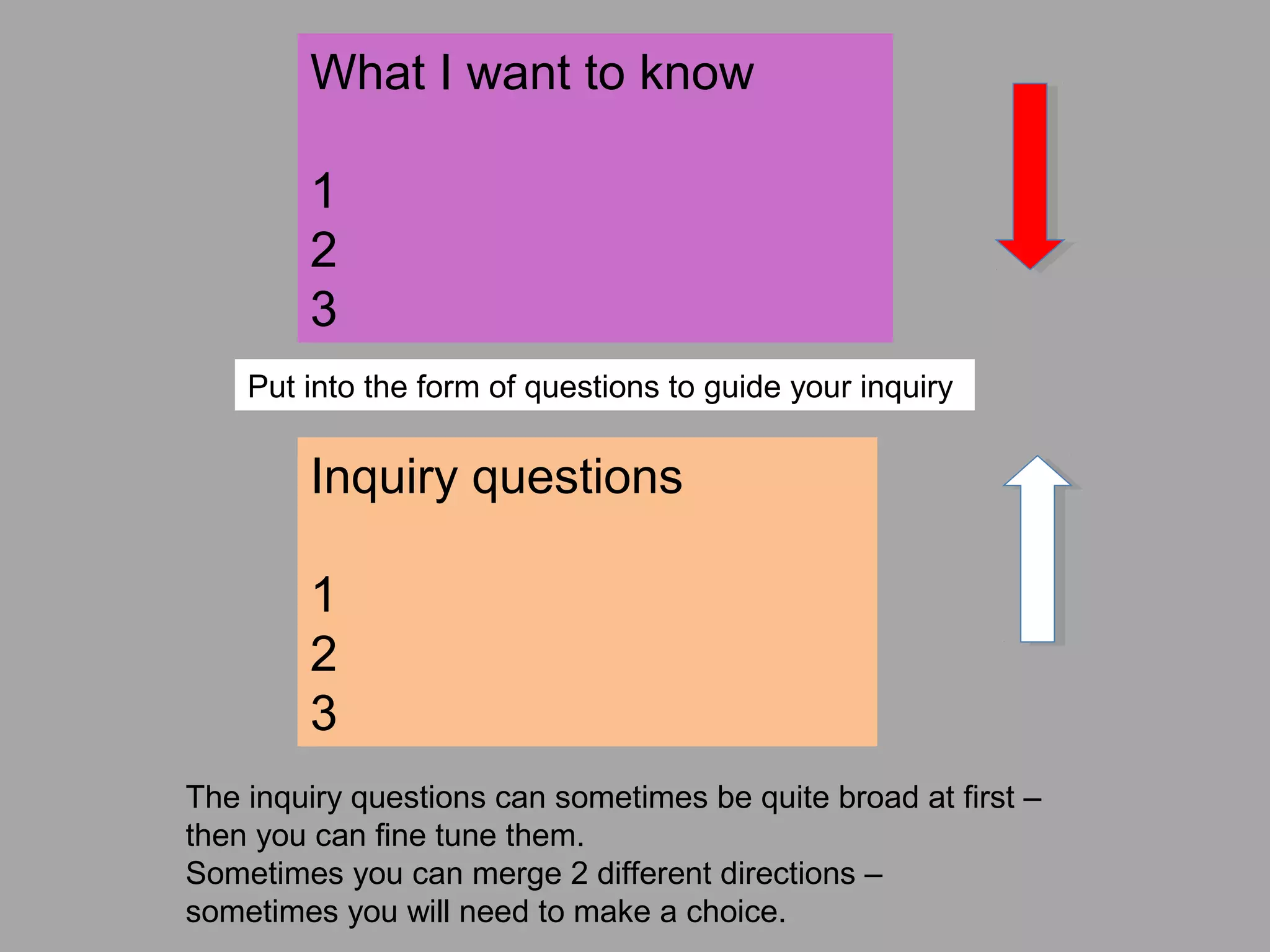
What do you want to know?
The inquiry process…
Finding K Explaining
and reporting
Using K to
inform
practice
Knowledge and understanding
that is informed by your context
What is knowledge?
Knowledge in the arts and humanities – not just skills and
competences but a structured series of engagement with a
body of knowledge or (in the case of the practical arts) a
body of practice… the ideas change with time
“[knowledge in] the arts and humanities change
continuously by virtue of their being elements of a
culture always in a condition of transformation. Thus
they transform through internal dispute, contestation,
revision of tastes and methods, discovery of recuperative
research, politics and philosophies. These subjects are
continuously in debate and discussion….”
Fry et al. A Handbook for Teaching and Learning in Higher Education ( 2003)
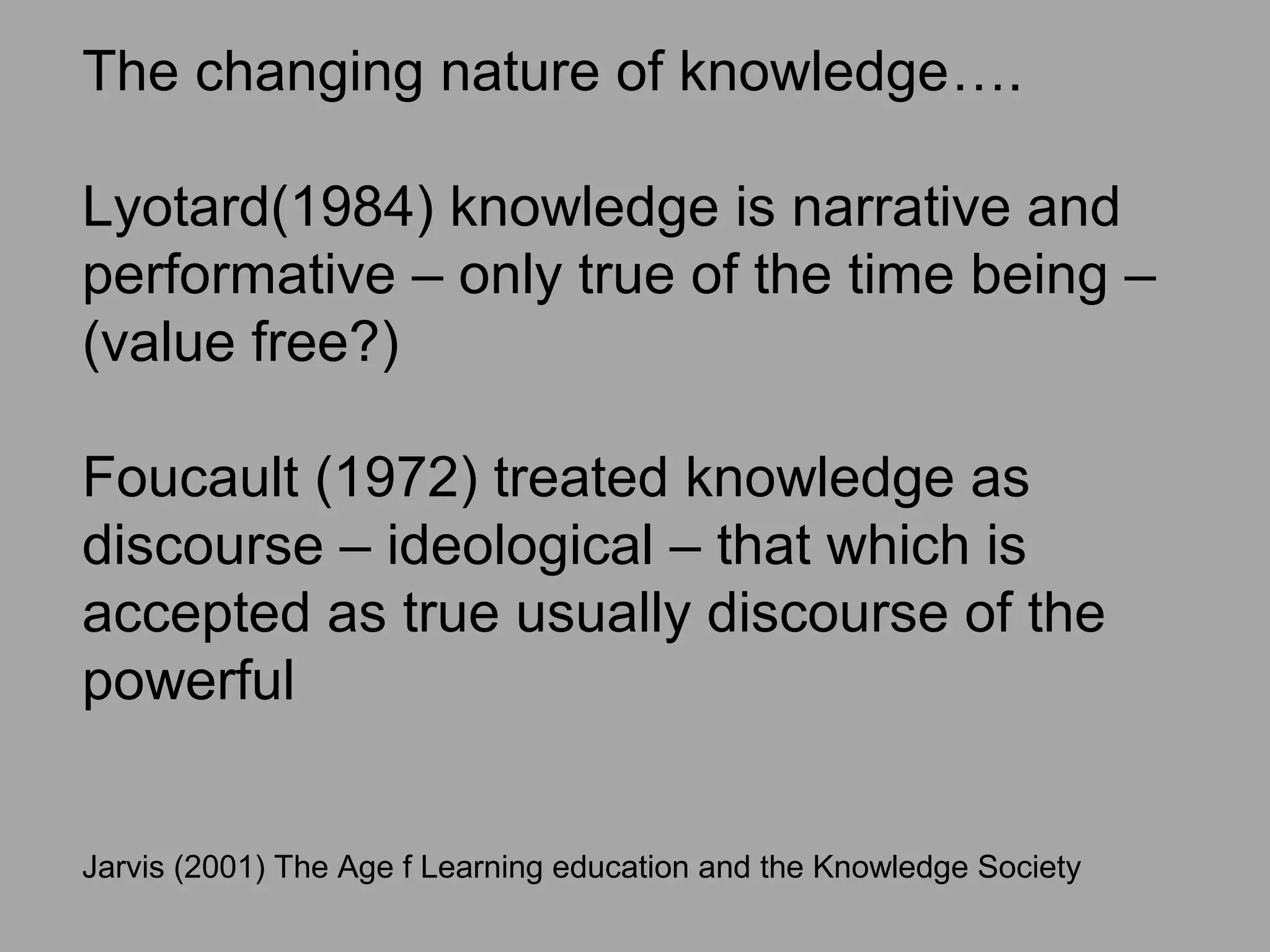
The changing nature of knowledge….
Lyotard(1984) knowledge is narrative and
performative – only true of the time being –
(value free?)
Foucault (1972) treated knowledge as
discourse – ideological – that which is
accepted as true usually discourse of the
powerful
Jarvis (2001) The Age f Learning education and the Knowledge Society
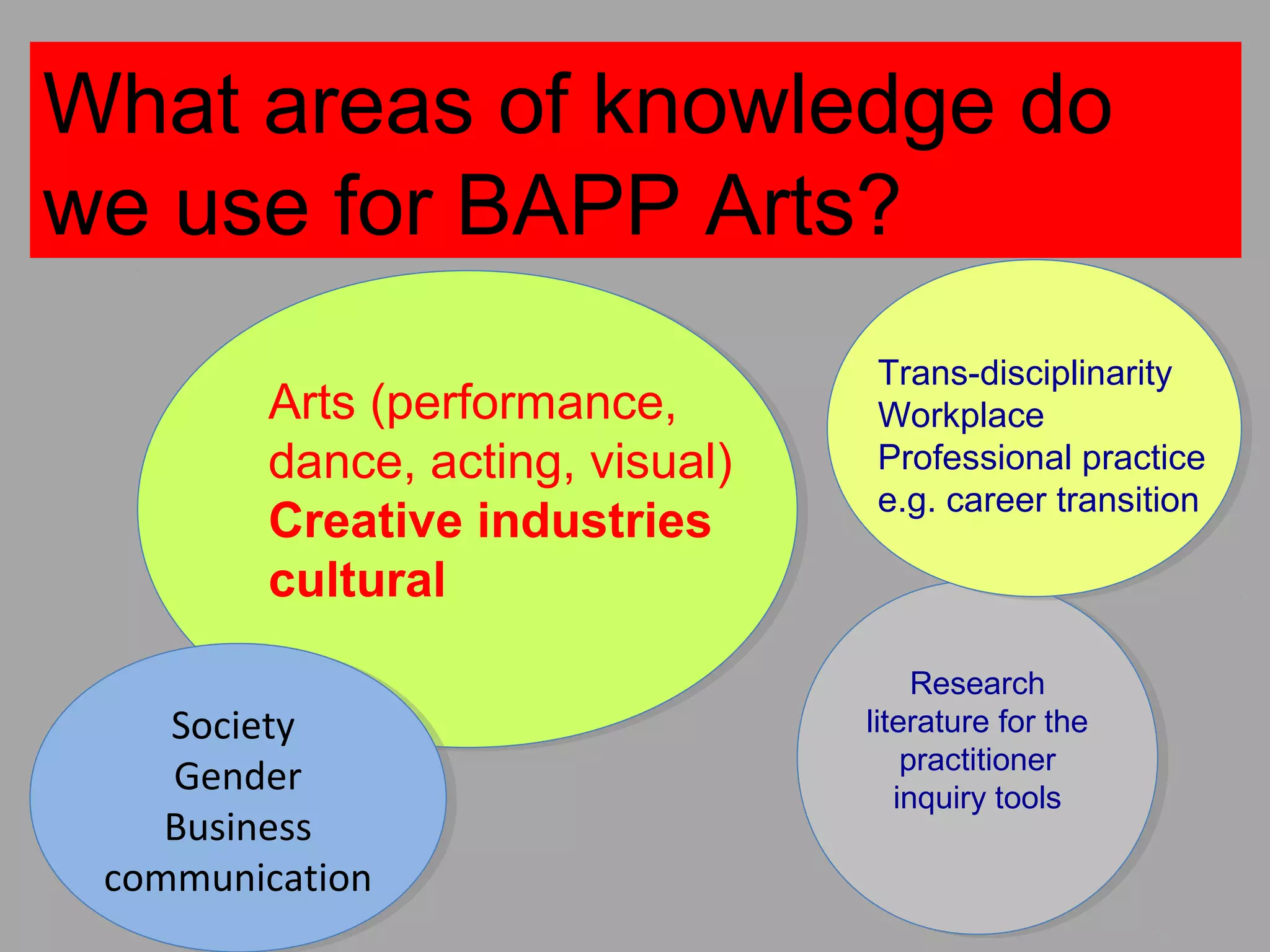
Research
literature for the
practitioner
inquiry tools
Research
literature for the
practitioner
inquiry tools
Arts (performance,
dance, acting, visual)
Creative industries
cultural
Trans-disciplinarity
Workplace
Professional practice
e.g. career transition
What areas of knowledge do
we use for BAPP Arts?
Society
Gender
Business
communication
Society
Gender
Business
communication
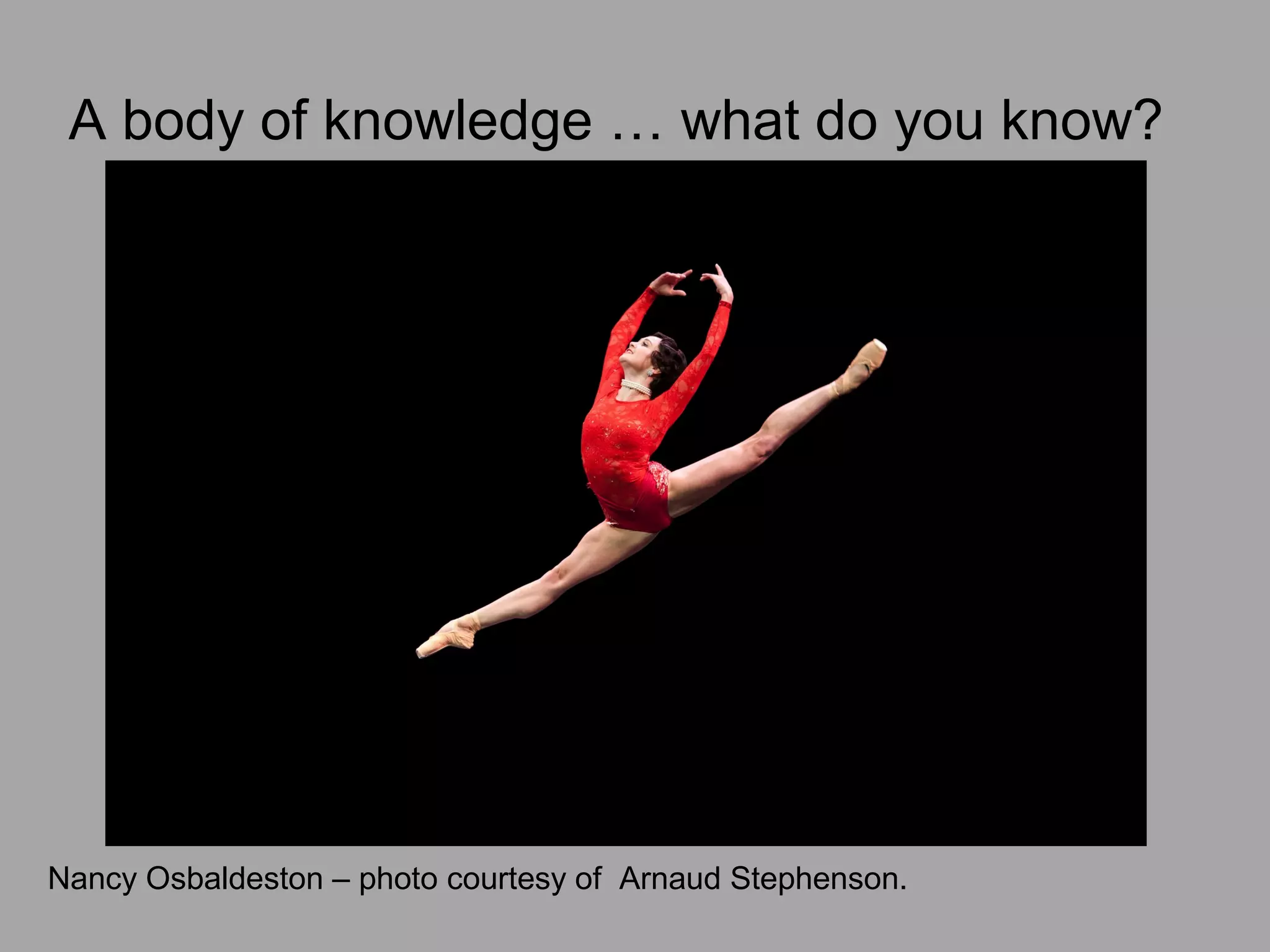
Nancy Osbaldeston – photo courtesy of Arnaud Stephenson.
A body of knowledge … what do you know?
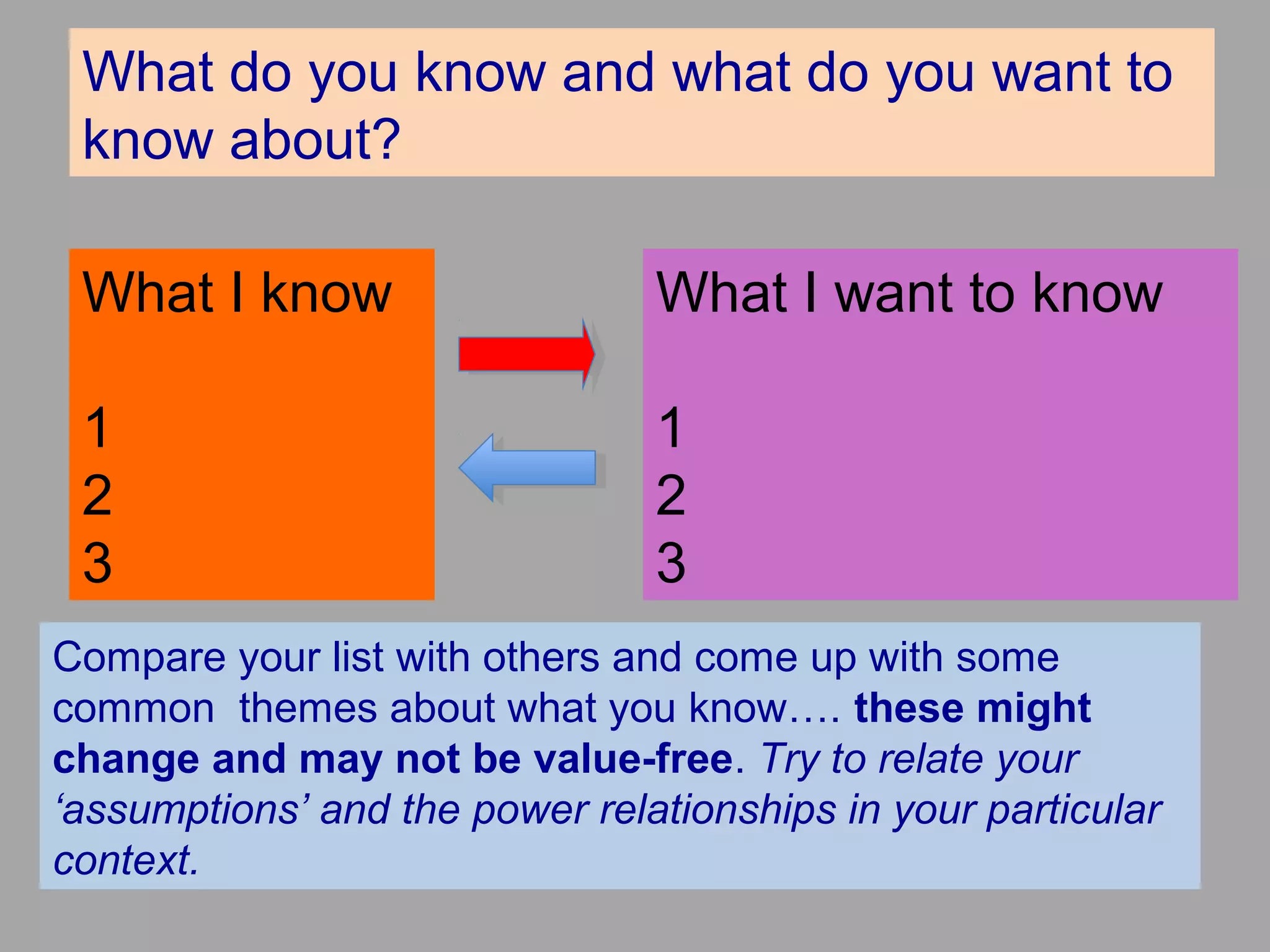
What do you know and what do you want to
know about?
What I know
1
2
3
What I want to know
1
2
3
Compare your list with others and come up with some
common themes about what you know…. these might
change and may not be value-free. Try to relate your
‘assumptions’ and the power relationships in your particular
context.
Inquiry questions
1
2
3
What I want to know
1
2
3
Put into the form of questions to guide your inquiry
The inquiry questions can sometimes be quite broad at first –
then you can fine tune them.
Sometimes you can merge 2 different directions –
sometimes you will need to make a choice.
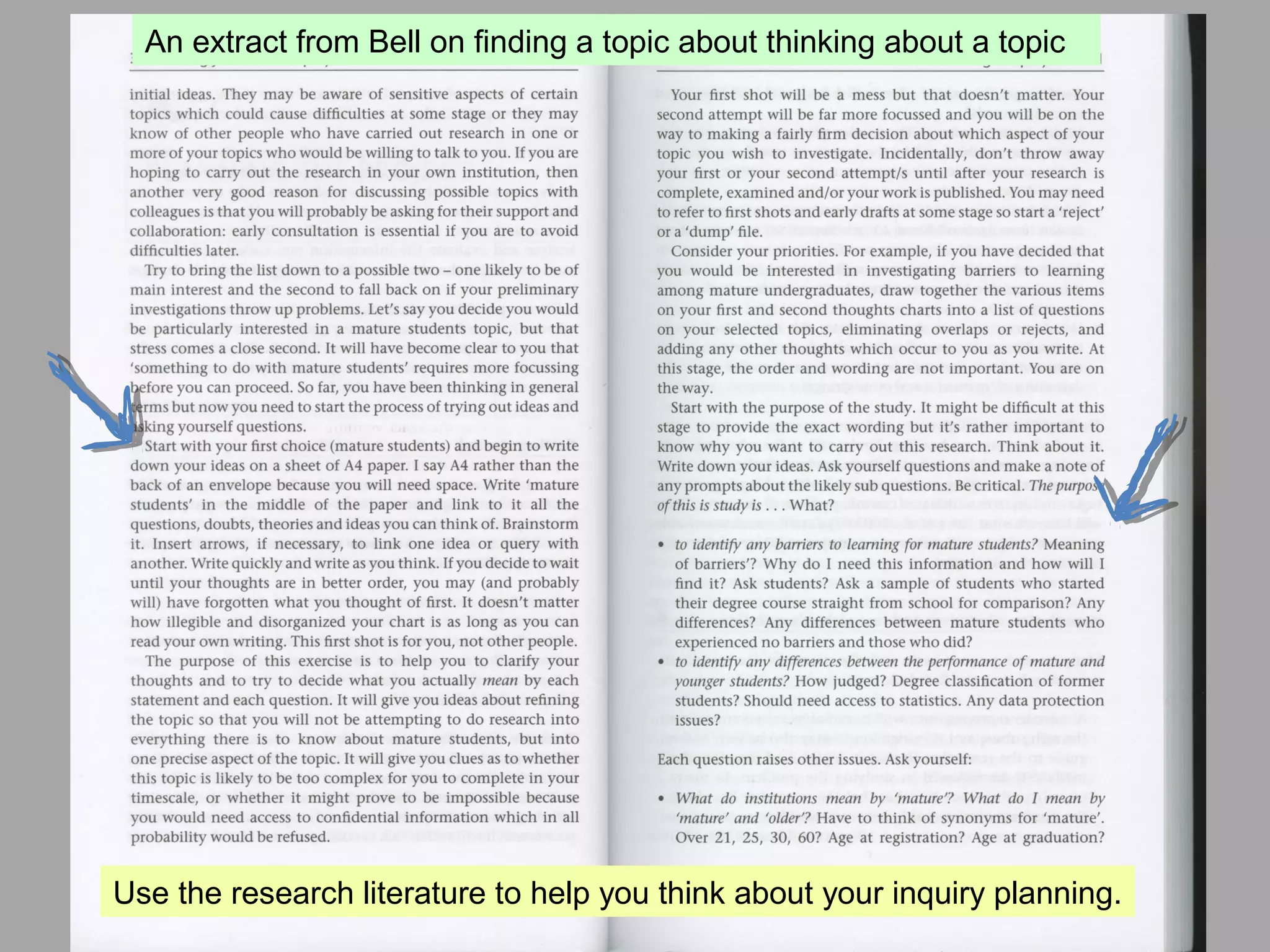
An extract from Bell on finding a topic about thinking about a topic
Use the research literature to help you think about your inquiry planning.
Networking
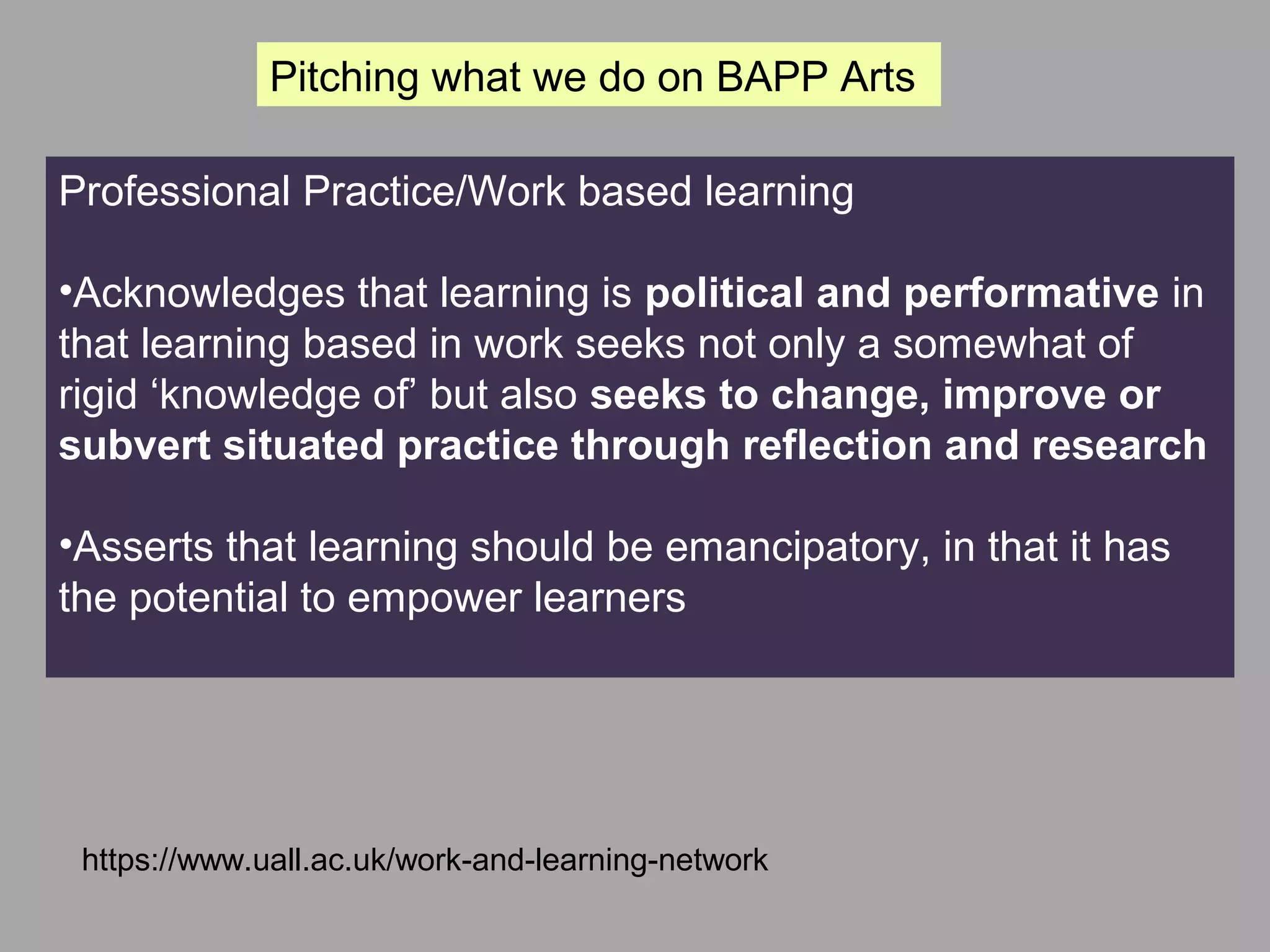
Professional Practice/Work based learning
•Acknowledges that learning is political and performative in
that learning based in work seeks not only a somewhat of
rigid ‘knowledge of’ but also seeks to change, improve or
subvert situated practice through reflection and research
•Asserts that learning should be emancipatory, in that it has
the potential to empower learners
https://www.uall.ac.uk/work-and-learning-network
Pitching what we do on BAPP Arts
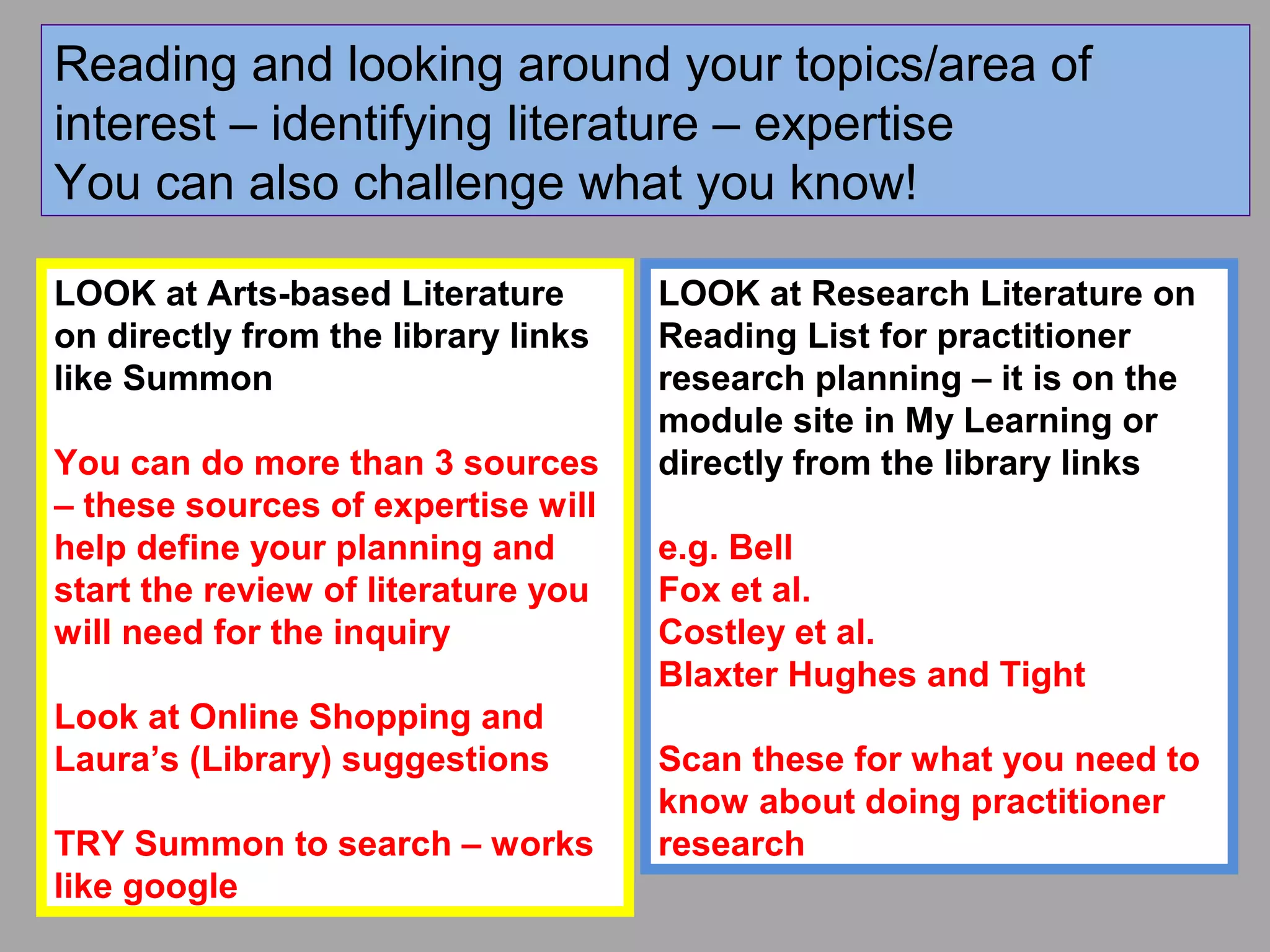
LOOK at Research Literature on
Reading List for practitioner
research planning – it is on the
module site in My Learning or
directly from the library links
e.g. Bell
Fox et al.
Costley et al.
Blaxter Hughes and Tight
Scan these for what you need to
know about doing practitioner
research
LOOK at Arts-based Literature
on directly from the library links
like Summon
You can do more than 3 sources
– these sources of expertise will
help define your planning and
start the review of literature you
will need for the inquiry
Look at Online Shopping and
Laura’s (Library) suggestions
TRY Summon to search – works
like google
Reading and looking around your topics/area of
interest – identifying literature – expertise
You can also challenge what you know!
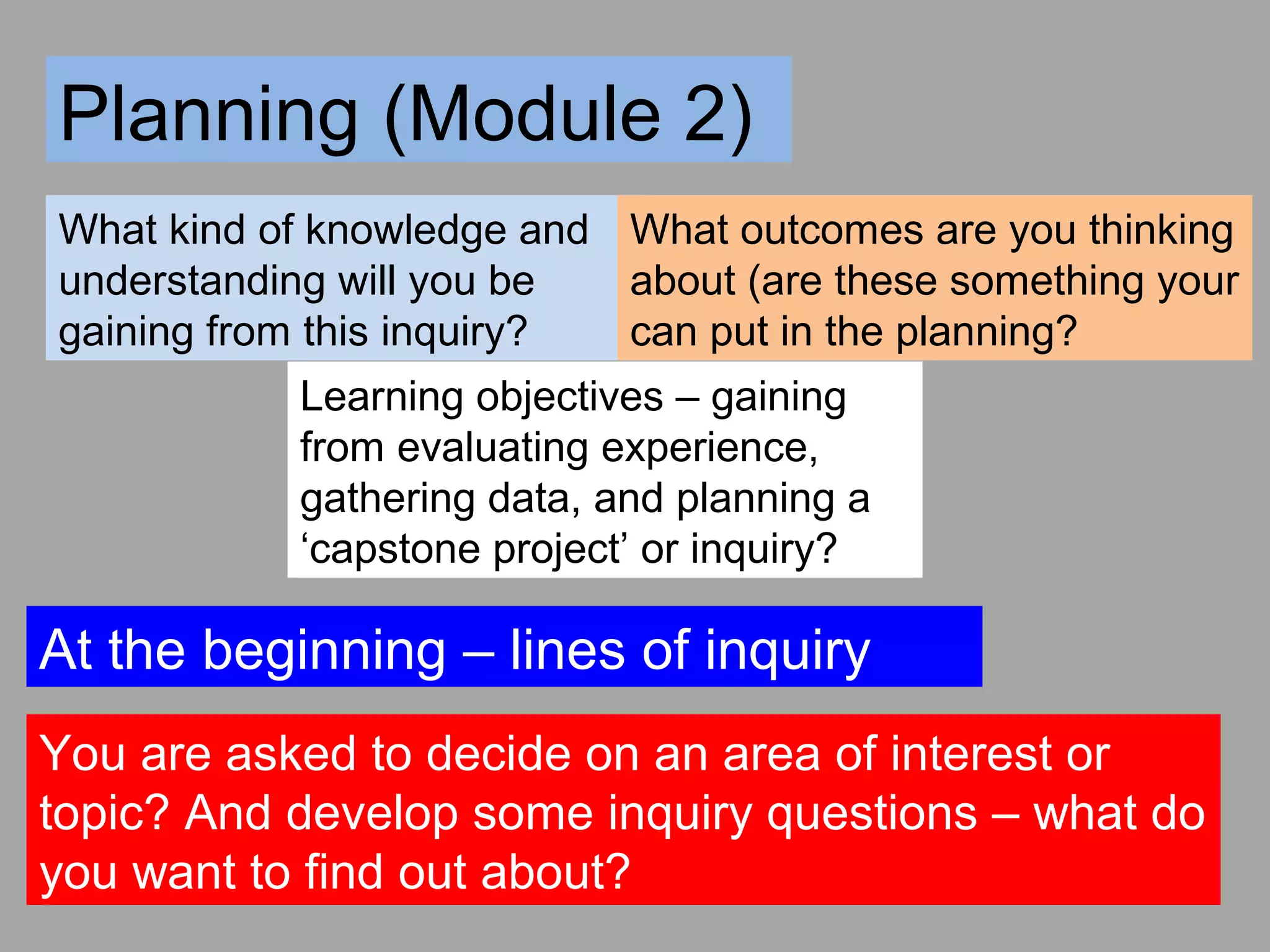
Planning (Module 2)
What kind of knowledge and
understanding will you be
gaining from this inquiry?
Learning objectives – gaining
from evaluating experience,
gathering data, and planning a
‘capstone project’ or inquiry?
What outcomes are you thinking
about (are these something your
can put in the planning?
At the beginning – lines of inquiry
You are asked to decide on an area of interest or
topic? And develop some inquiry questions – what do
you want to find out about?
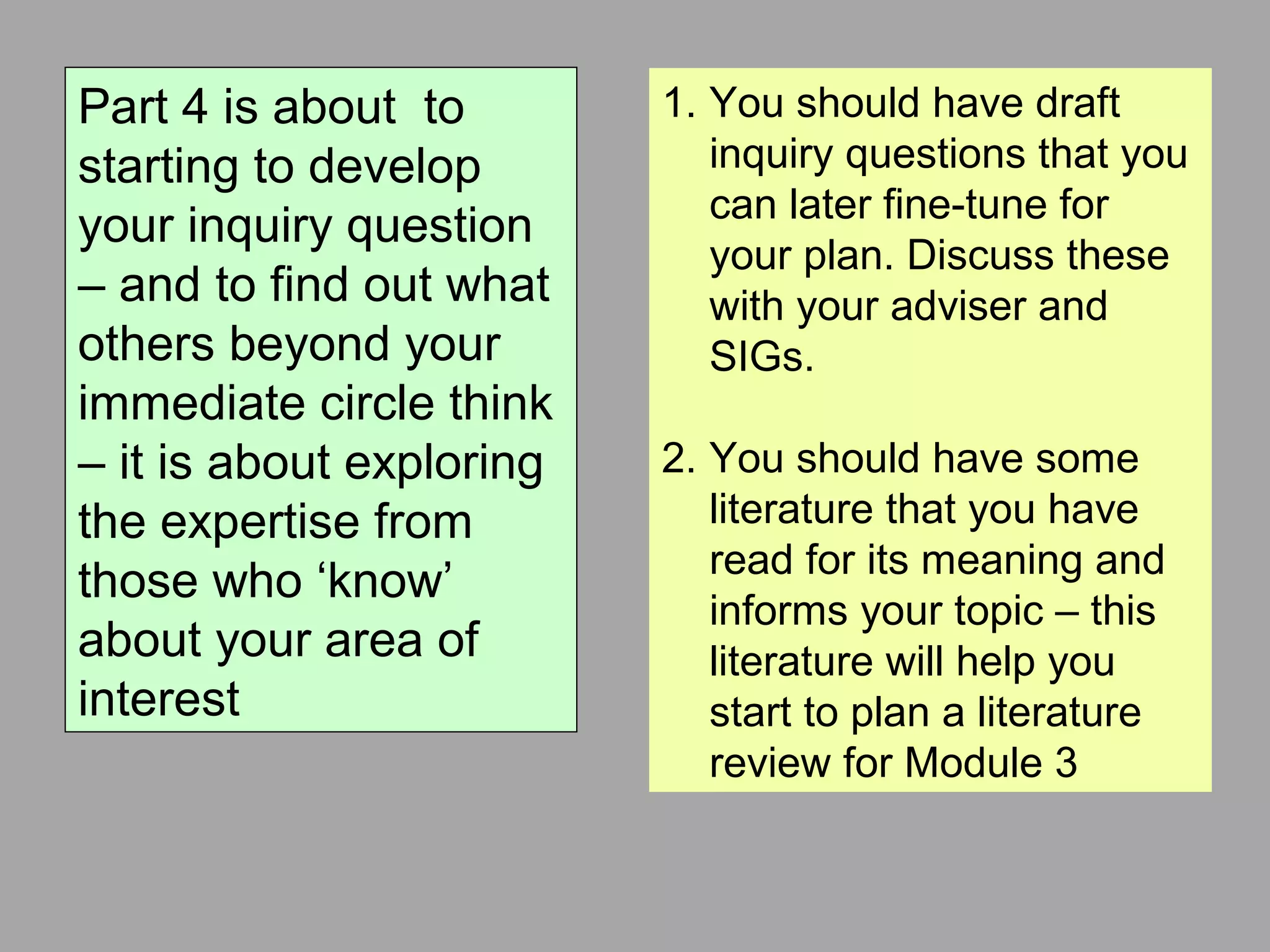
Part 4 is about to
starting to develop
your inquiry question
– and to find out what
others beyond your
immediate circle think
– it is about exploring
the expertise from
those who ‘know’
about your area of
interest
1. You should have draft
inquiry questions that you
can later fine-tune for
your plan. Discuss these
with your adviser and
SIGs.
2. You should have some
literature that you have
read for its meaning and
informs your topic – this
literature will help you
start to plan a literature
review for Module 3
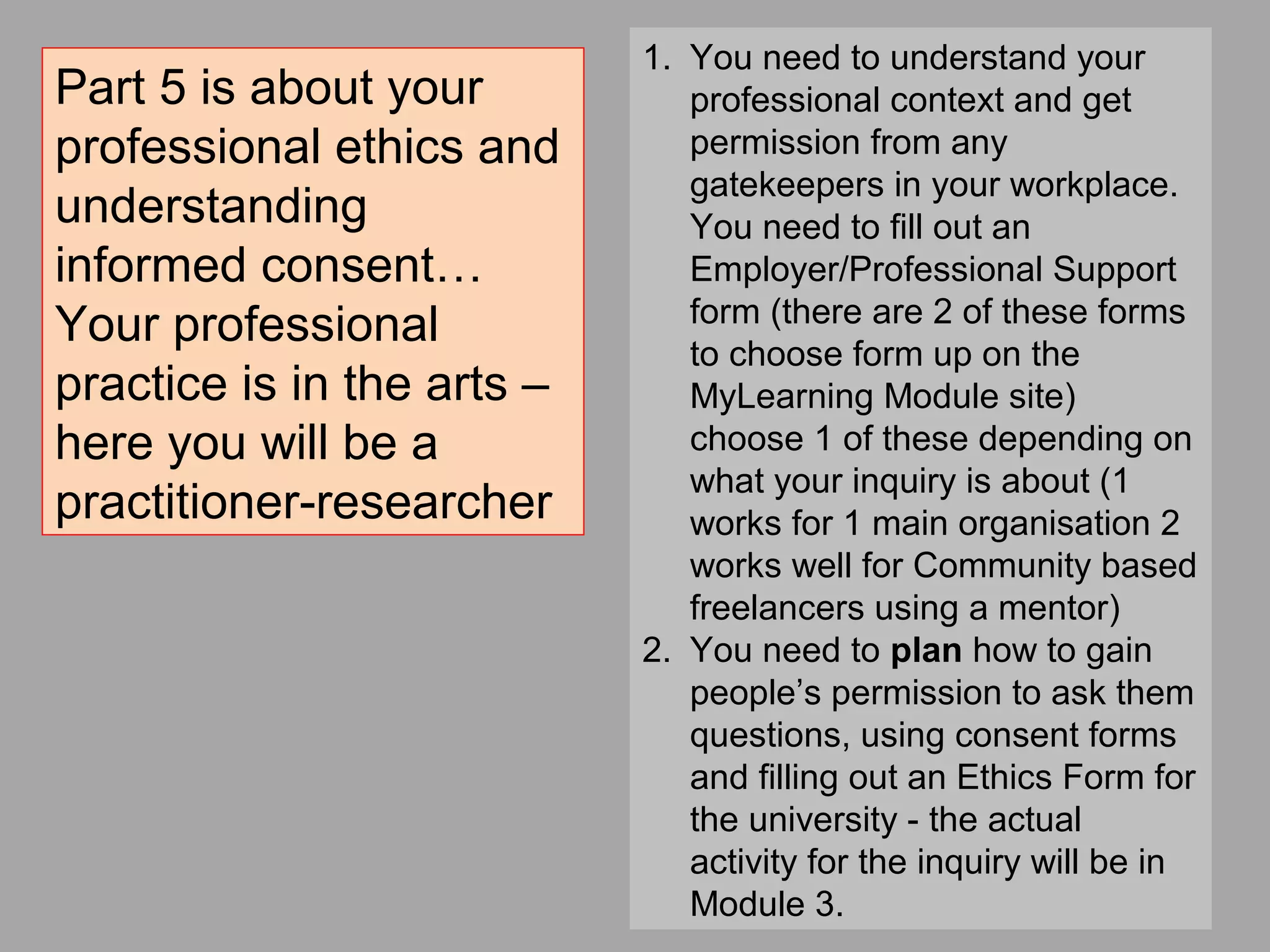
1. You need to understand your
professional context and get
permission from any
gatekeepers in your workplace.
You need to fill out an
Employer/Professional Support
form (there are 2 of these forms
to choose form up on the
MyLearning Module site)
choose 1 of these depending on
what your inquiry is about (1
works for 1 main organisation 2
works well for Community based
freelancers using a mentor)
2. You need to plan how to gain
people’s permission to ask them
questions, using consent forms
and filling out an Ethics Form for
the university - the actual
activity for the inquiry will be in
Module 3.
Part 5 is about your
professional ethics and
understanding
informed consent…
Your professional
practice is in the arts –
here you will be a
practitioner-researcher
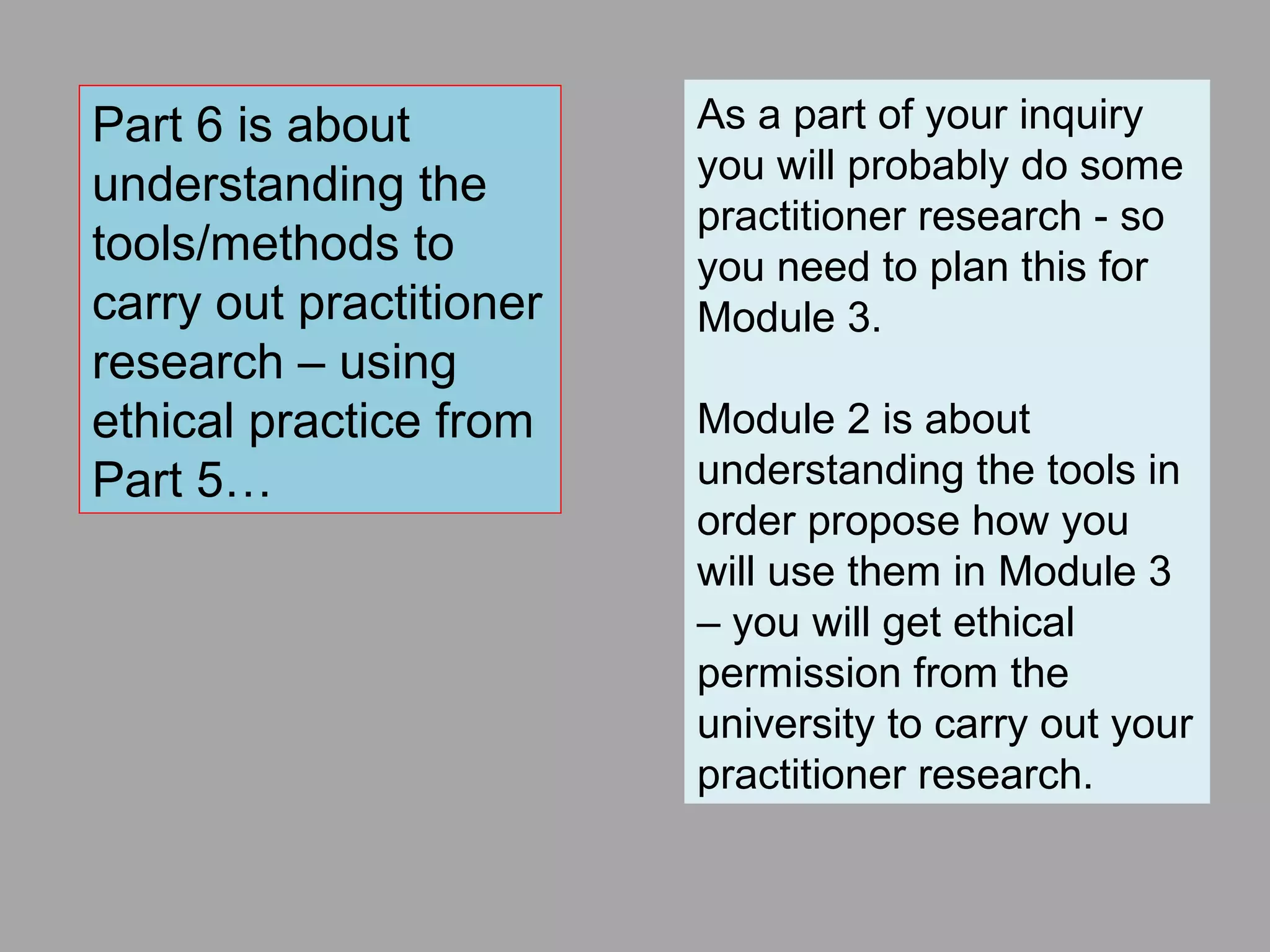
Part 6 is about
understanding the
tools/methods to
carry out practitioner
research – using
ethical practice from
Part 5…
As a part of your inquiry
you will probably do some
practitioner research - so
you need to plan this for
Module 3.
Module 2 is about
understanding the tools in
order propose how you
will use them in Module 3
– you will get ethical
permission from the
university to carry out your
practitioner research.
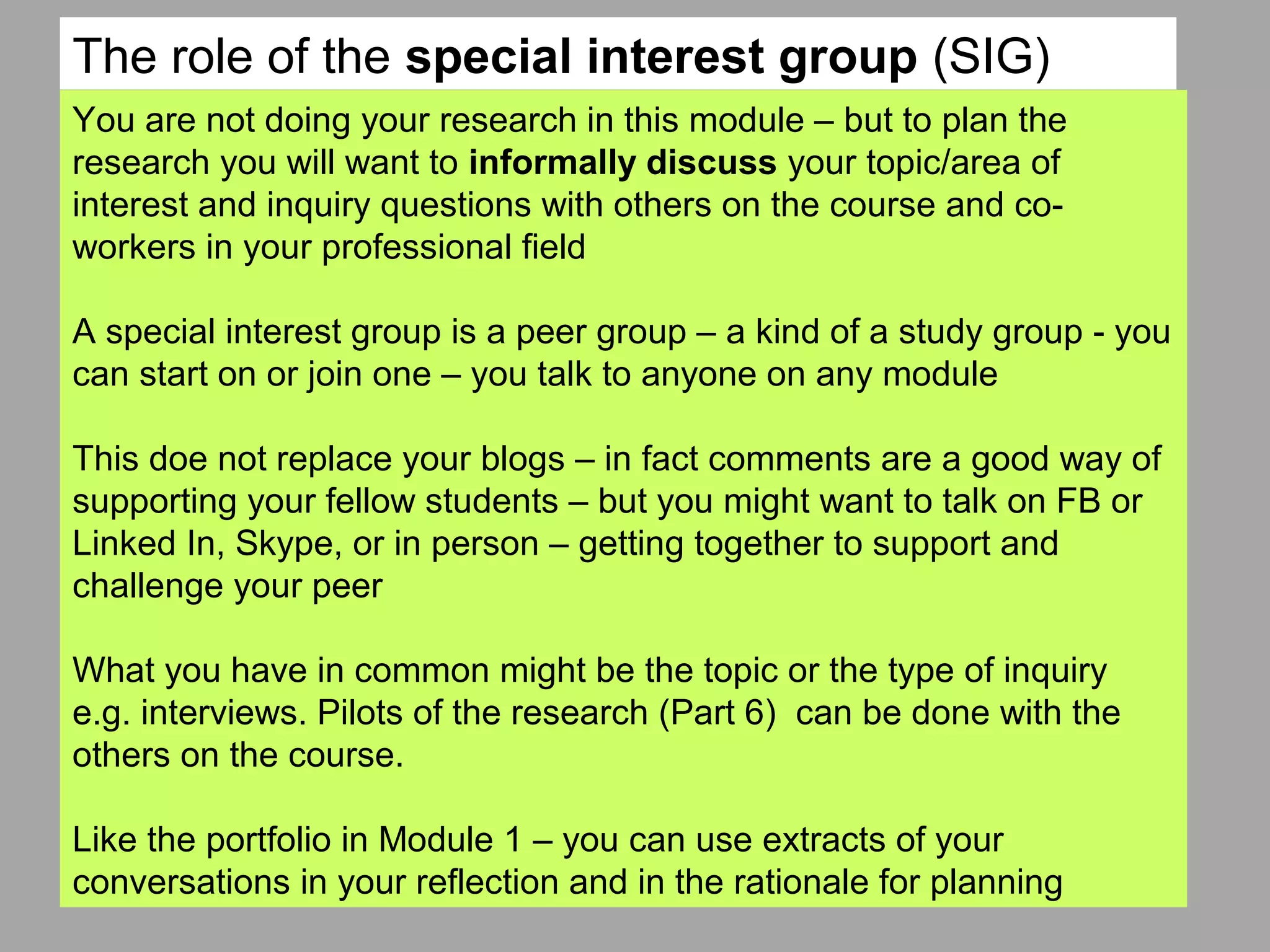
You are not doing your research in this module – but to plan the
research you will want to informally discuss your topic/area of
interest and inquiry questions with others on the course and co-
workers in your professional field
A special interest group is a peer group – a kind of a study group - you
can start on or join one – you talk to anyone on any module
This doe not replace your blogs – in fact comments are a good way of
supporting your fellow students – but you might want to talk on FB or
Linked In, Skype, or in person – getting together to support and
challenge your peer
What you have in common might be the topic or the type of inquiry
e.g. interviews. Pilots of the research (Part 6) can be done with the
others on the course.
Like the portfolio in Module 1 – you can use extracts of your
conversations in your reflection and in the rationale for planning
The role of the special interest group (SIG)
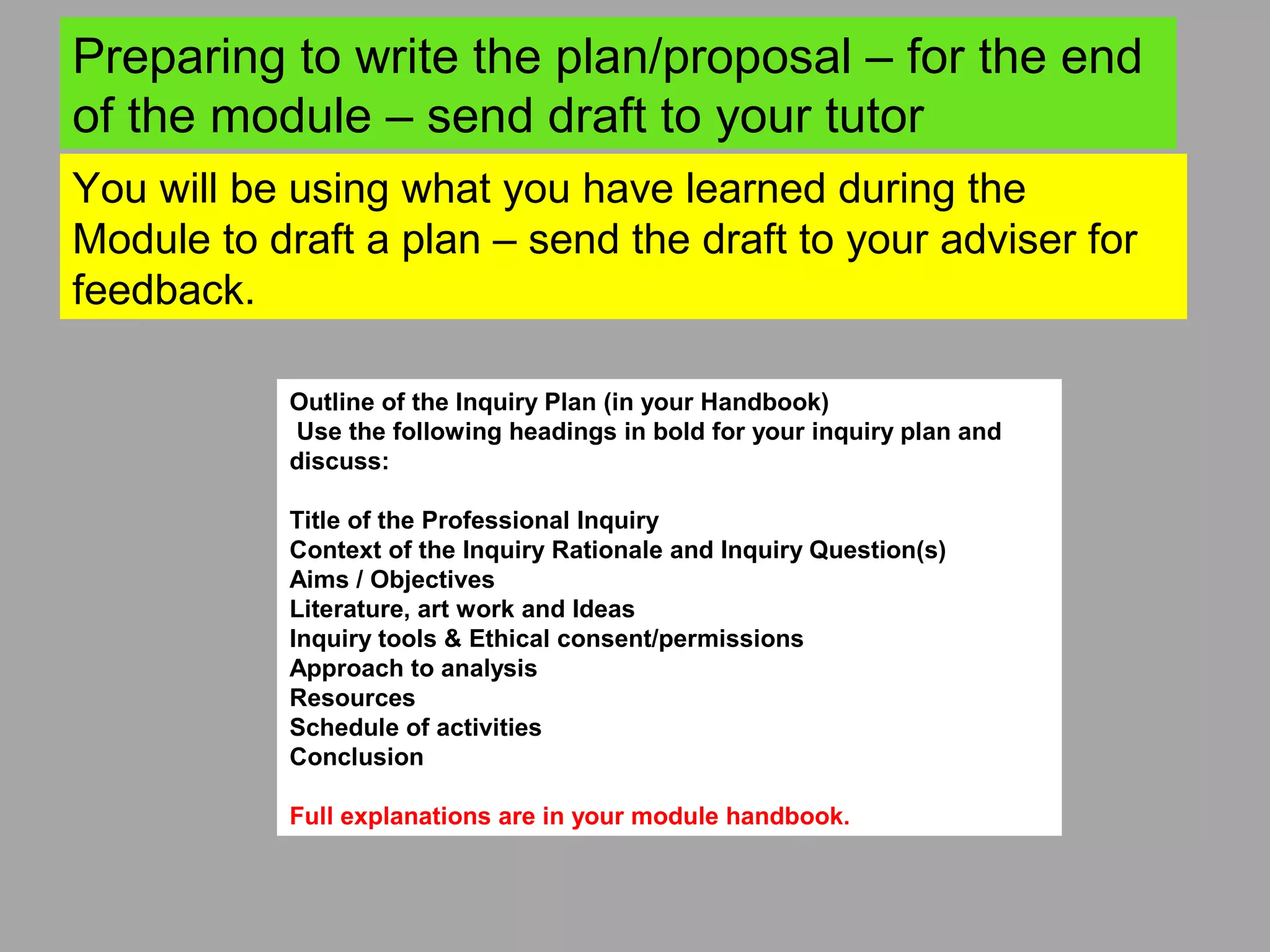
You will be using what you have learned during the
Module to draft a plan – send the draft to your adviser for
feedback.
Preparing to write the plan/proposal – for the end
of the module – send draft to your tutor
Outline of the Inquiry Plan (in your Handbook)
Use the following headings in bold for your inquiry plan and
discuss:
Title of the Professional Inquiry
Context of the Inquiry Rationale and Inquiry Question(s)
Aims / Objectives
Literature, art work and Ideas
Inquiry tools & Ethical consent/permissions
Approach to analysis
Resources
Schedule of activities
Conclusion
Full explanations are in your module handbook.
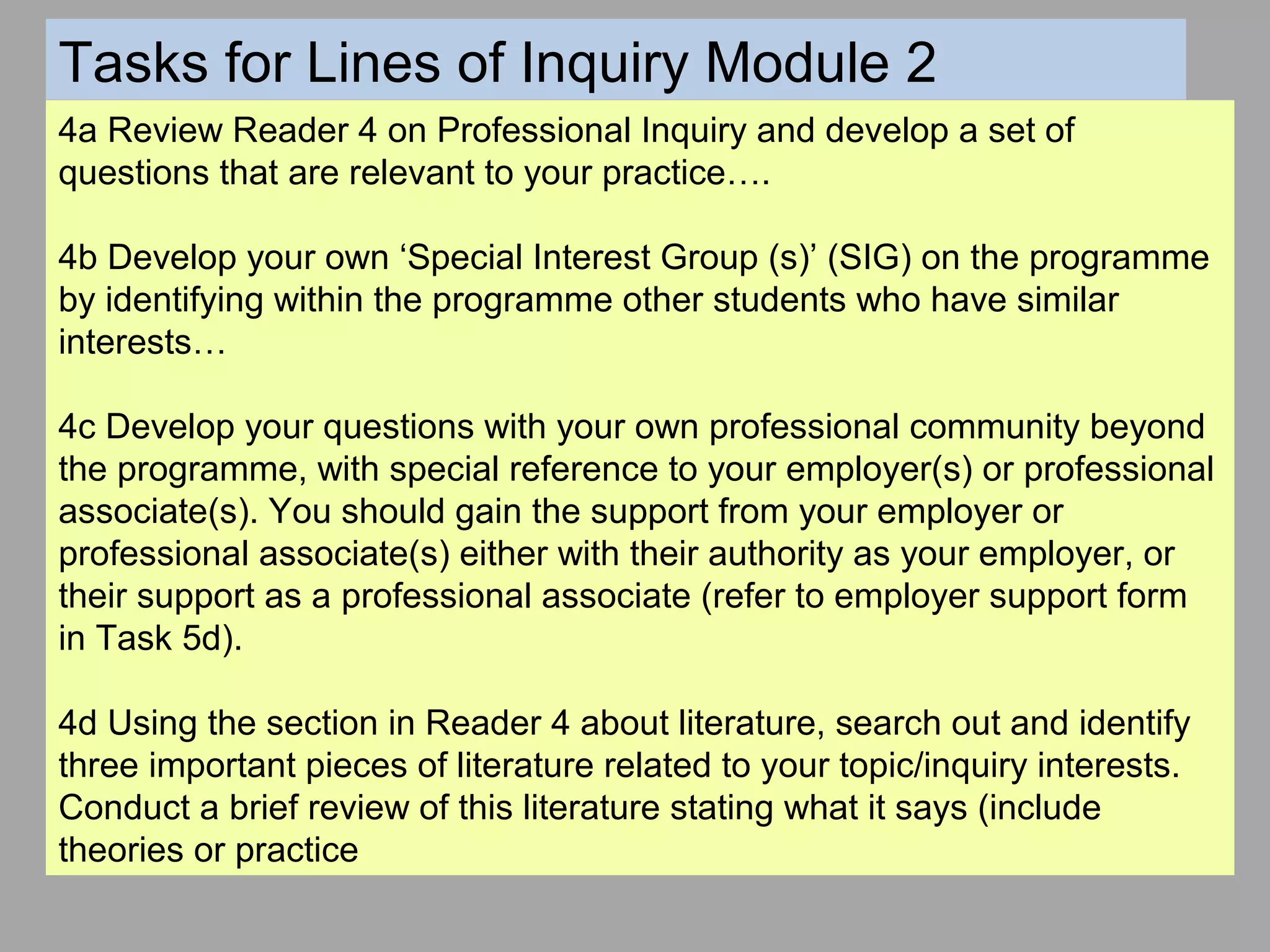
4a Review Reader 4 on Professional Inquiry and develop a set of
questions that are relevant to your practice….
4b Develop your own ‘Special Interest Group (s)’ (SIG) on the programme
by identifying within the programme other students who have similar
interests…
4c Develop your questions with your own professional community beyond
the programme, with special reference to your employer(s) or professional
associate(s). You should gain the support from your employer or
professional associate(s) either with their authority as your employer, or
their support as a professional associate (refer to employer support form
in Task 5d).
4d Using the section in Reader 4 about literature, search out and identify
three important pieces of literature related to your topic/inquiry interests.
Conduct a brief review of this literature stating what it says (include
theories or practice
Tasks for Lines of Inquiry Module 2
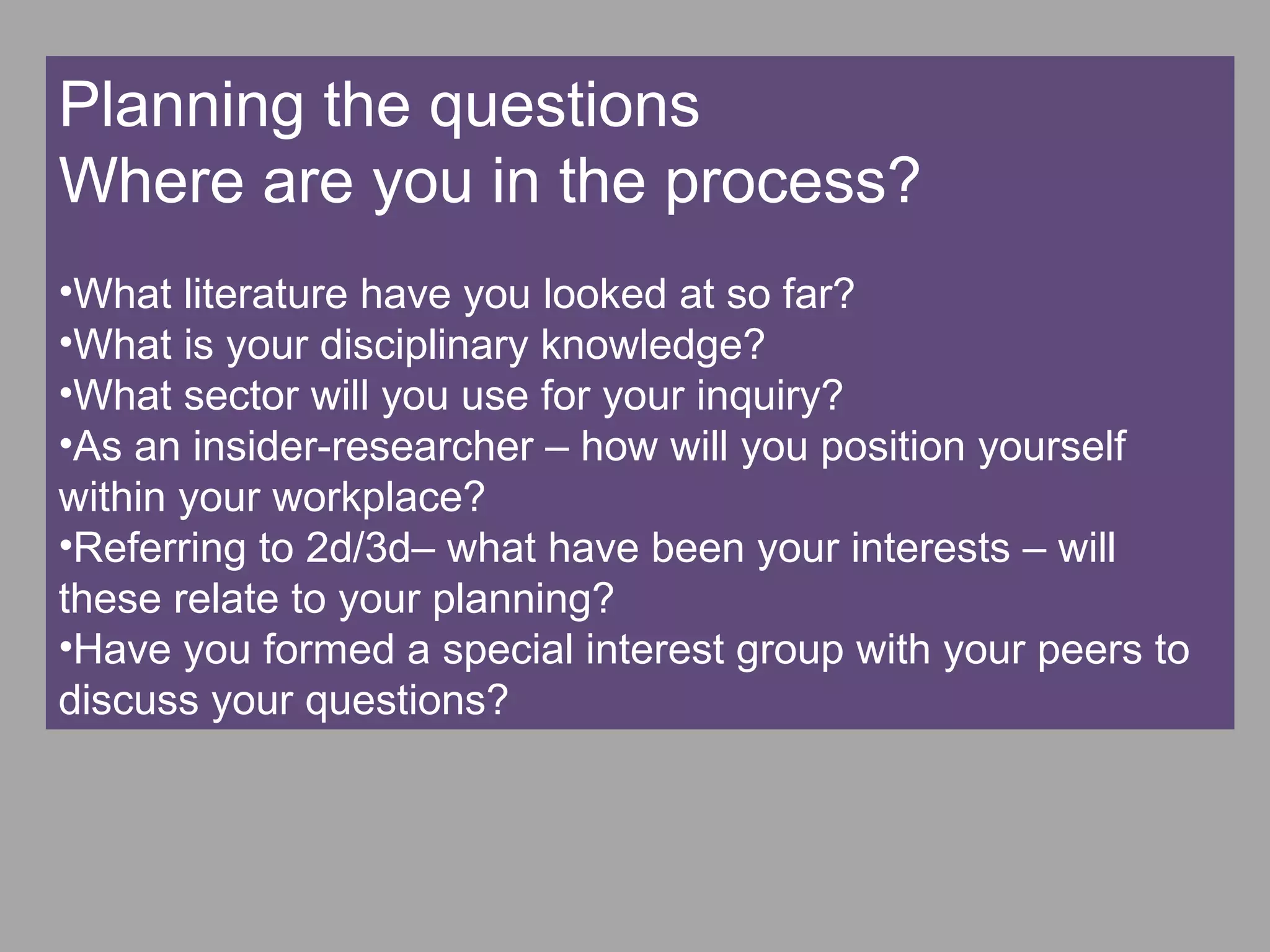
Planning the questions
Where are you in the process?
•What literature have you looked at so far?
•What is your disciplinary knowledge?
•What sector will you use for your inquiry?
•As an insider-researcher – how will you position yourself
within your workplace?
•Referring to 2d/3d– what have been your interests – will
these relate to your planning?
•Have you formed a special interest group with your peers to
discuss your questions?
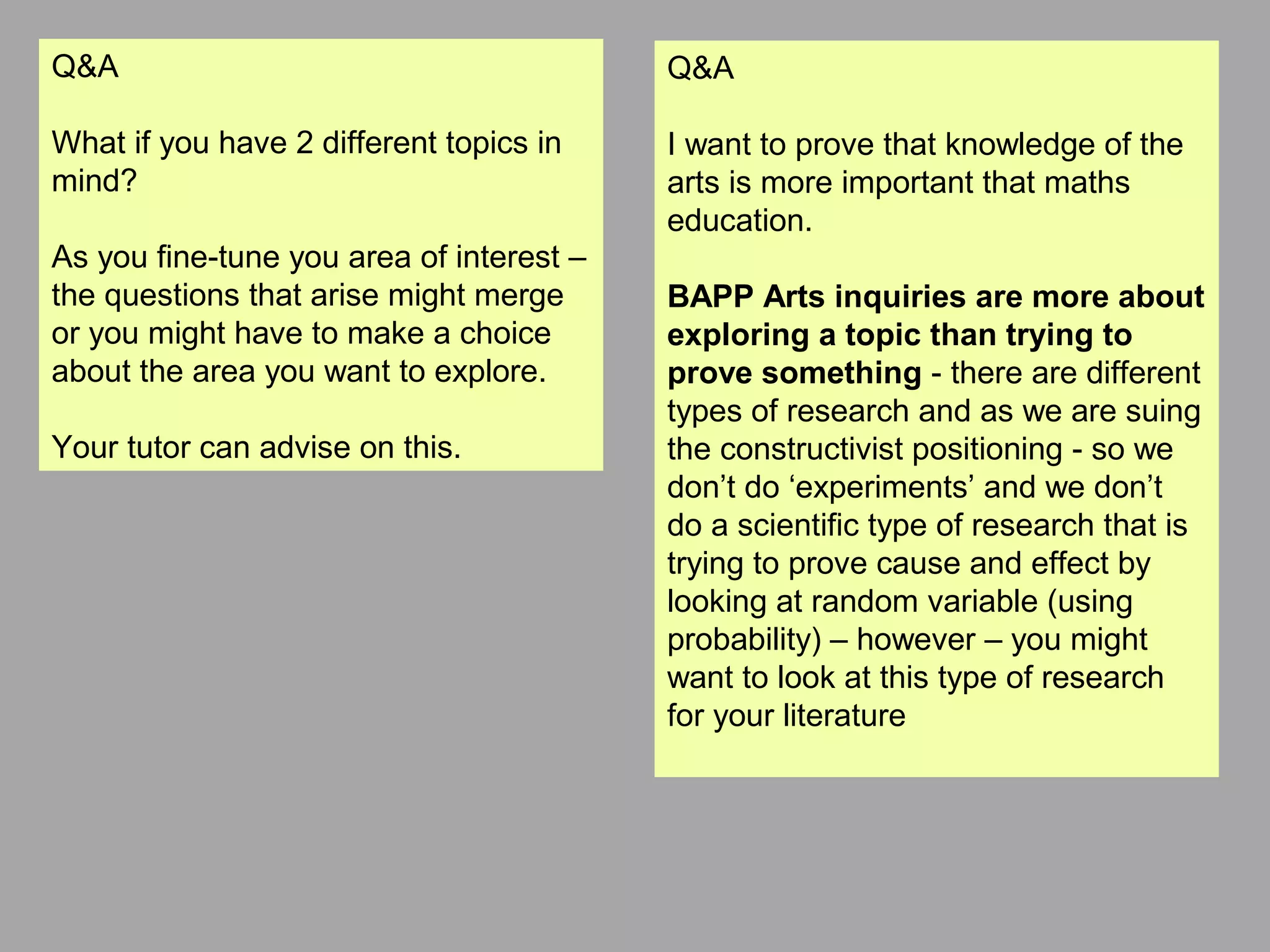
Q&A
What if you have 2 different topics in
mind?
As you fine-tune you area of interest –
the questions that arise might merge
or you might have to make a choice
about the area you want to explore.
Your tutor can advise on this.
Q&A
I want to prove that knowledge of the
arts is more important that maths
education.
BAPP Arts inquiries are more about
exploring a topic than trying to
prove something - there are different
types of research and as we are suing
the constructivist positioning - so we
don’t do ‘experiments’ and we don’t
do a scientific type of research that is
trying to prove cause and effect by
looking at random variable (using
probability) – however – you might
want to look at this type of research
for your literature
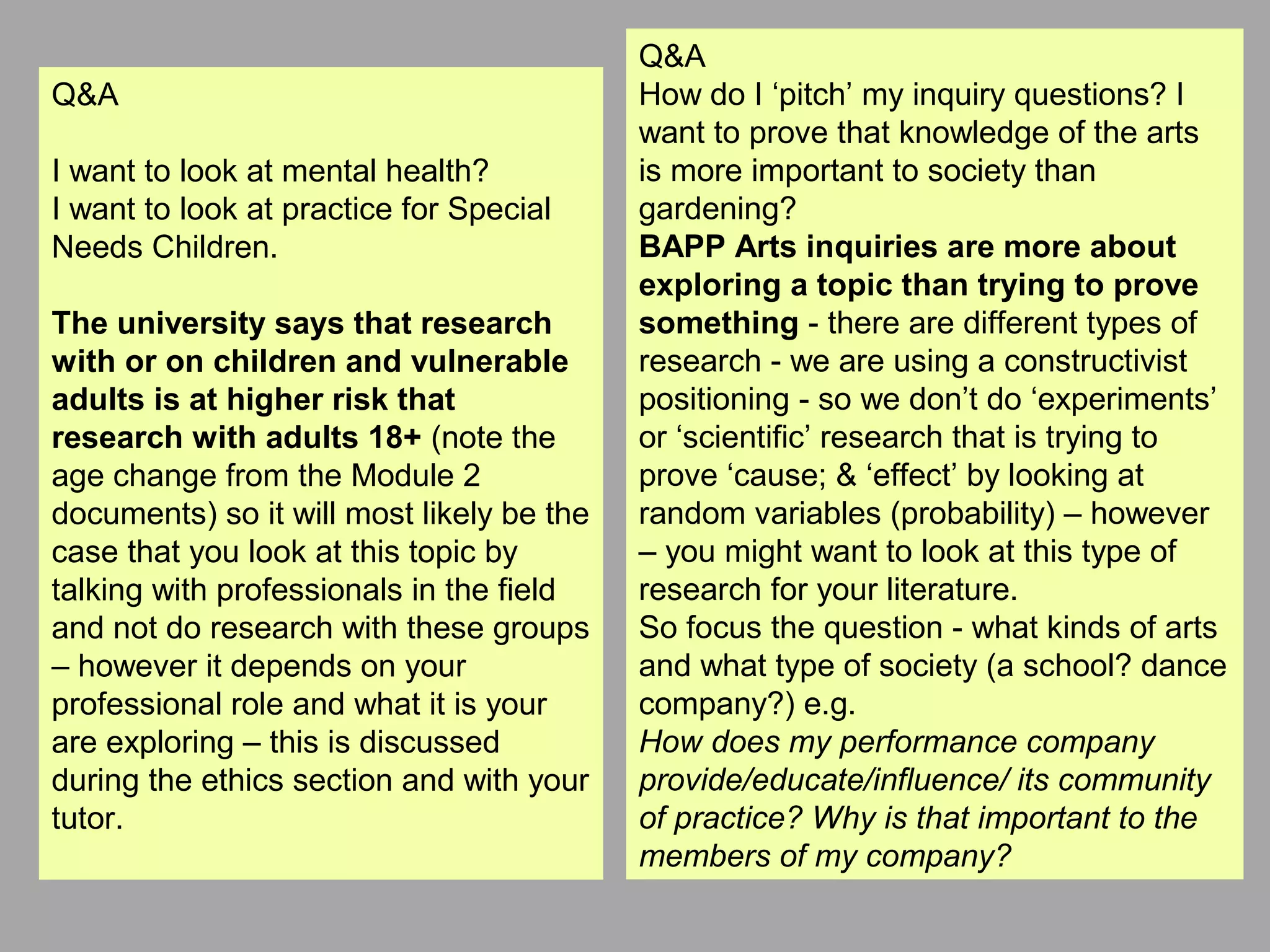
Q&A
How do I ‘pitch’ my inquiry questions? I
want to prove that knowledge of the arts
is more important to society than
gardening?
BAPP Arts inquiries are more about
exploring a topic than trying to prove
something - there are different types of
research - we are using a constructivist
positioning - so we don’t do ‘experiments’
or ‘scientific’ research that is trying to
prove ‘cause; & ‘effect’ by looking at
random variables (probability) – however
– you might want to look at this type of
research for your literature.
So focus the question - what kinds of arts
and what type of society (a school? dance
company?) e.g.
How does my performance company
provide/educate/influence/ its community
of practice? Why is that important to the
members of my company?
Q&A
I want to look at mental health?
I want to look at practice for Special
Needs Children.
The university says that research
with or on children and vulnerable
adults is at higher risk that
research with adults 18+ (note the
age change from the Module 2
documents) so it will most likely be the
case that you look at this topic by
talking with professionals in the field
and not do research with these groups
– however it depends on your
professional role and what it is your
are exploring – this is discussed
during the ethics section and with your
tutor.
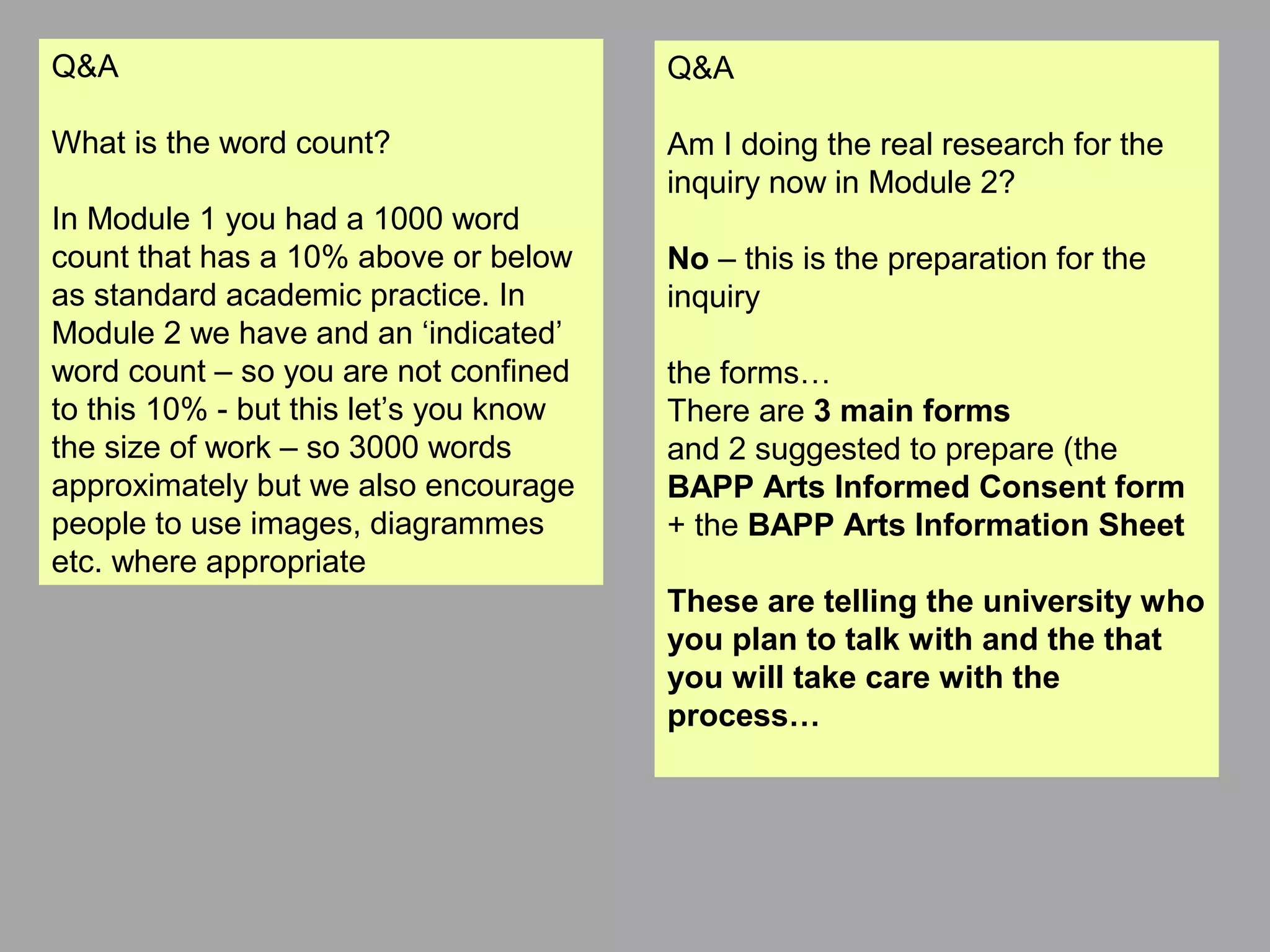
Q&A
What is the word count?
In Module 1 you had a 1000 word
count that has a 10% above or below
as standard academic practice. In
Module 2 we have and an ‘indicated’
word count – so you are not confined
to this 10% - but this let’s you know
the size of work – so 3000 words
approximately but we also encourage
people to use images, diagrammes
etc. where appropriate
Q&A
Am I doing the real research for the
inquiry now in Module 2?
No – this is the preparation for the
inquiry
the forms…
There are 3 main forms
and 2 suggested to prepare (the
BAPP Arts Informed Consent form
+ the BAPP Arts Information Sheet
These are telling the university who
you plan to talk with and the that
you will take care with the
process…
Look at example from others of Module 2
e.g. blogs to help with Module 2
http://mrahmet.blogspot.co.uk/2012_12_01_archive.html
http://adesolaa.blogspot.co.uk/2016/02/module-two-past-and-
present.html
http://adesolaa.blogspot.co.uk/2016/10/module-three-october-2016-
session.html considering assumptions
https://paulanottingham.blogspot.co.uk/2014/02/campus-session-1-
continued-what-we-did.html - looking for love - search and review of
literature

Final module 2 lines of inquiry 22.2.17

  • 1.
    Paula Nottingham 22/2/17http://blog.kingarthurflour.com/2016/02/15/cherry-pie/ WBS3630 (WBA) Module 2: Lines of Inquiry Thinking of a focus for your inquiry – a piece of the pie.
  • 2.
    M1 ideas communication, reflection, networking Arts knowledge with newideas M2 Planning Rehearsal planning for change within and after inquiry M3 Doing the inquiry Staging your work experience knowledge performance applause (?) BAPP Arts – planning inquiry
  • 3.
  • 4.
    http://twistedsifter.com/2013/11/terrifyingly-beautiful-photos-of-storm-clouds/ http://www.dailymail.co.uk/health/article-2567022/Seeing-rainbows-Its-time-eyes-checked.html Are there anyimages that relate to how you feel about where you are now in your studies – leading to some inquiry questions? Try spidergrams or mindmapping to visualise your work Try spidergrams or mindmapping to visualise your work Try mood boards to understand ideas Try mood boards to understand ideas Try images from work Try images from work I use a picture of seahorses to think bout research - they come – ponder – and move on gracefully. http://www.lovethesepics.com/2013/04/60-spectacular-seahorses-and- seadragons-pics/ Thanks for the suggestions everyone – great to see people using visual thinking.
  • 5.
    http://www.getbucks.co.uk/whats-on/theatre/lesley-joseph-coming-bucks-next-11020401 Think about thisinquiry proposal as the staging of a production. This image is related to Megan’s production of Annie. Relate the inquiry to you practice and what you know about your practice… Annie
  • 6.
    How can youposition yourself in the inquiry process? Looking at sources will help you ‘place’ yourself… Talking to other in you special interest groups Constructivism tells us that we learn by fitting new understanding and knowledge into and with, extending and supplanting, old understanding and knowledge. … Mezirow (1991) says learning is to bring about change or transformation
  • 7.
    Compare your listwith others and come up with some common themes about what you know…. these might change and may not be value-free. Try to relate your ‘assumptions’ and the power relationships in your particular context. What are your assumptions about your practice? Examples? I think everyone knows that teenagers are always hungry.... I think people who do not march in protest rallies just don’t care.... Remember you will need to think ‘ethically’ about your area of interest. Others might also have assumptions about what you do…
  • 8.
    What do youwant to know? The inquiry process… Finding K Explaining and reporting Using K to inform practice Knowledge and understanding that is informed by your context
  • 9.
    What is knowledge? Knowledgein the arts and humanities – not just skills and competences but a structured series of engagement with a body of knowledge or (in the case of the practical arts) a body of practice… the ideas change with time “[knowledge in] the arts and humanities change continuously by virtue of their being elements of a culture always in a condition of transformation. Thus they transform through internal dispute, contestation, revision of tastes and methods, discovery of recuperative research, politics and philosophies. These subjects are continuously in debate and discussion….” Fry et al. A Handbook for Teaching and Learning in Higher Education ( 2003)
  • 10.
    The changing natureof knowledge…. Lyotard(1984) knowledge is narrative and performative – only true of the time being – (value free?) Foucault (1972) treated knowledge as discourse – ideological – that which is accepted as true usually discourse of the powerful Jarvis (2001) The Age f Learning education and the Knowledge Society
  • 11.
    Research literature for the practitioner inquirytools Research literature for the practitioner inquiry tools Arts (performance, dance, acting, visual) Creative industries cultural Trans-disciplinarity Workplace Professional practice e.g. career transition What areas of knowledge do we use for BAPP Arts? Society Gender Business communication Society Gender Business communication
  • 12.
    Nancy Osbaldeston –photo courtesy of Arnaud Stephenson. A body of knowledge … what do you know?
  • 13.
    What do youknow and what do you want to know about? What I know 1 2 3 What I want to know 1 2 3 Compare your list with others and come up with some common themes about what you know…. these might change and may not be value-free. Try to relate your ‘assumptions’ and the power relationships in your particular context.
  • 14.
    Inquiry questions 1 2 3 What Iwant to know 1 2 3 Put into the form of questions to guide your inquiry The inquiry questions can sometimes be quite broad at first – then you can fine tune them. Sometimes you can merge 2 different directions – sometimes you will need to make a choice.
  • 15.
    An extract fromBell on finding a topic about thinking about a topic Use the research literature to help you think about your inquiry planning.
  • 16.
    Networking Professional Practice/Work basedlearning •Acknowledges that learning is political and performative in that learning based in work seeks not only a somewhat of rigid ‘knowledge of’ but also seeks to change, improve or subvert situated practice through reflection and research •Asserts that learning should be emancipatory, in that it has the potential to empower learners https://www.uall.ac.uk/work-and-learning-network Pitching what we do on BAPP Arts
  • 17.
    LOOK at ResearchLiterature on Reading List for practitioner research planning – it is on the module site in My Learning or directly from the library links e.g. Bell Fox et al. Costley et al. Blaxter Hughes and Tight Scan these for what you need to know about doing practitioner research LOOK at Arts-based Literature on directly from the library links like Summon You can do more than 3 sources – these sources of expertise will help define your planning and start the review of literature you will need for the inquiry Look at Online Shopping and Laura’s (Library) suggestions TRY Summon to search – works like google Reading and looking around your topics/area of interest – identifying literature – expertise You can also challenge what you know!
  • 18.
    Planning (Module 2) Whatkind of knowledge and understanding will you be gaining from this inquiry? Learning objectives – gaining from evaluating experience, gathering data, and planning a ‘capstone project’ or inquiry? What outcomes are you thinking about (are these something your can put in the planning? At the beginning – lines of inquiry You are asked to decide on an area of interest or topic? And develop some inquiry questions – what do you want to find out about?
  • 19.
    Part 4 isabout to starting to develop your inquiry question – and to find out what others beyond your immediate circle think – it is about exploring the expertise from those who ‘know’ about your area of interest 1. You should have draft inquiry questions that you can later fine-tune for your plan. Discuss these with your adviser and SIGs. 2. You should have some literature that you have read for its meaning and informs your topic – this literature will help you start to plan a literature review for Module 3
  • 20.
    1. You needto understand your professional context and get permission from any gatekeepers in your workplace. You need to fill out an Employer/Professional Support form (there are 2 of these forms to choose form up on the MyLearning Module site) choose 1 of these depending on what your inquiry is about (1 works for 1 main organisation 2 works well for Community based freelancers using a mentor) 2. You need to plan how to gain people’s permission to ask them questions, using consent forms and filling out an Ethics Form for the university - the actual activity for the inquiry will be in Module 3. Part 5 is about your professional ethics and understanding informed consent… Your professional practice is in the arts – here you will be a practitioner-researcher
  • 21.
    Part 6 isabout understanding the tools/methods to carry out practitioner research – using ethical practice from Part 5… As a part of your inquiry you will probably do some practitioner research - so you need to plan this for Module 3. Module 2 is about understanding the tools in order propose how you will use them in Module 3 – you will get ethical permission from the university to carry out your practitioner research.
  • 22.
    You are notdoing your research in this module – but to plan the research you will want to informally discuss your topic/area of interest and inquiry questions with others on the course and co- workers in your professional field A special interest group is a peer group – a kind of a study group - you can start on or join one – you talk to anyone on any module This doe not replace your blogs – in fact comments are a good way of supporting your fellow students – but you might want to talk on FB or Linked In, Skype, or in person – getting together to support and challenge your peer What you have in common might be the topic or the type of inquiry e.g. interviews. Pilots of the research (Part 6) can be done with the others on the course. Like the portfolio in Module 1 – you can use extracts of your conversations in your reflection and in the rationale for planning The role of the special interest group (SIG)
  • 23.
    You will beusing what you have learned during the Module to draft a plan – send the draft to your adviser for feedback. Preparing to write the plan/proposal – for the end of the module – send draft to your tutor Outline of the Inquiry Plan (in your Handbook) Use the following headings in bold for your inquiry plan and discuss: Title of the Professional Inquiry Context of the Inquiry Rationale and Inquiry Question(s) Aims / Objectives Literature, art work and Ideas Inquiry tools & Ethical consent/permissions Approach to analysis Resources Schedule of activities Conclusion Full explanations are in your module handbook.
  • 24.
    4a Review Reader4 on Professional Inquiry and develop a set of questions that are relevant to your practice…. 4b Develop your own ‘Special Interest Group (s)’ (SIG) on the programme by identifying within the programme other students who have similar interests… 4c Develop your questions with your own professional community beyond the programme, with special reference to your employer(s) or professional associate(s). You should gain the support from your employer or professional associate(s) either with their authority as your employer, or their support as a professional associate (refer to employer support form in Task 5d). 4d Using the section in Reader 4 about literature, search out and identify three important pieces of literature related to your topic/inquiry interests. Conduct a brief review of this literature stating what it says (include theories or practice Tasks for Lines of Inquiry Module 2
  • 25.
    Planning the questions Whereare you in the process? •What literature have you looked at so far? •What is your disciplinary knowledge? •What sector will you use for your inquiry? •As an insider-researcher – how will you position yourself within your workplace? •Referring to 2d/3d– what have been your interests – will these relate to your planning? •Have you formed a special interest group with your peers to discuss your questions?
  • 26.
    Q&A What if youhave 2 different topics in mind? As you fine-tune you area of interest – the questions that arise might merge or you might have to make a choice about the area you want to explore. Your tutor can advise on this. Q&A I want to prove that knowledge of the arts is more important that maths education. BAPP Arts inquiries are more about exploring a topic than trying to prove something - there are different types of research and as we are suing the constructivist positioning - so we don’t do ‘experiments’ and we don’t do a scientific type of research that is trying to prove cause and effect by looking at random variable (using probability) – however – you might want to look at this type of research for your literature
  • 27.
    Q&A How do I‘pitch’ my inquiry questions? I want to prove that knowledge of the arts is more important to society than gardening? BAPP Arts inquiries are more about exploring a topic than trying to prove something - there are different types of research - we are using a constructivist positioning - so we don’t do ‘experiments’ or ‘scientific’ research that is trying to prove ‘cause; & ‘effect’ by looking at random variables (probability) – however – you might want to look at this type of research for your literature. So focus the question - what kinds of arts and what type of society (a school? dance company?) e.g. How does my performance company provide/educate/influence/ its community of practice? Why is that important to the members of my company? Q&A I want to look at mental health? I want to look at practice for Special Needs Children. The university says that research with or on children and vulnerable adults is at higher risk that research with adults 18+ (note the age change from the Module 2 documents) so it will most likely be the case that you look at this topic by talking with professionals in the field and not do research with these groups – however it depends on your professional role and what it is your are exploring – this is discussed during the ethics section and with your tutor.
  • 28.
    Q&A What is theword count? In Module 1 you had a 1000 word count that has a 10% above or below as standard academic practice. In Module 2 we have and an ‘indicated’ word count – so you are not confined to this 10% - but this let’s you know the size of work – so 3000 words approximately but we also encourage people to use images, diagrammes etc. where appropriate Q&A Am I doing the real research for the inquiry now in Module 2? No – this is the preparation for the inquiry the forms… There are 3 main forms and 2 suggested to prepare (the BAPP Arts Informed Consent form + the BAPP Arts Information Sheet These are telling the university who you plan to talk with and the that you will take care with the process…
  • 29.
    Look at examplefrom others of Module 2 e.g. blogs to help with Module 2 http://mrahmet.blogspot.co.uk/2012_12_01_archive.html http://adesolaa.blogspot.co.uk/2016/02/module-two-past-and- present.html http://adesolaa.blogspot.co.uk/2016/10/module-three-october-2016- session.html considering assumptions https://paulanottingham.blogspot.co.uk/2014/02/campus-session-1- continued-what-we-did.html - looking for love - search and review of literature