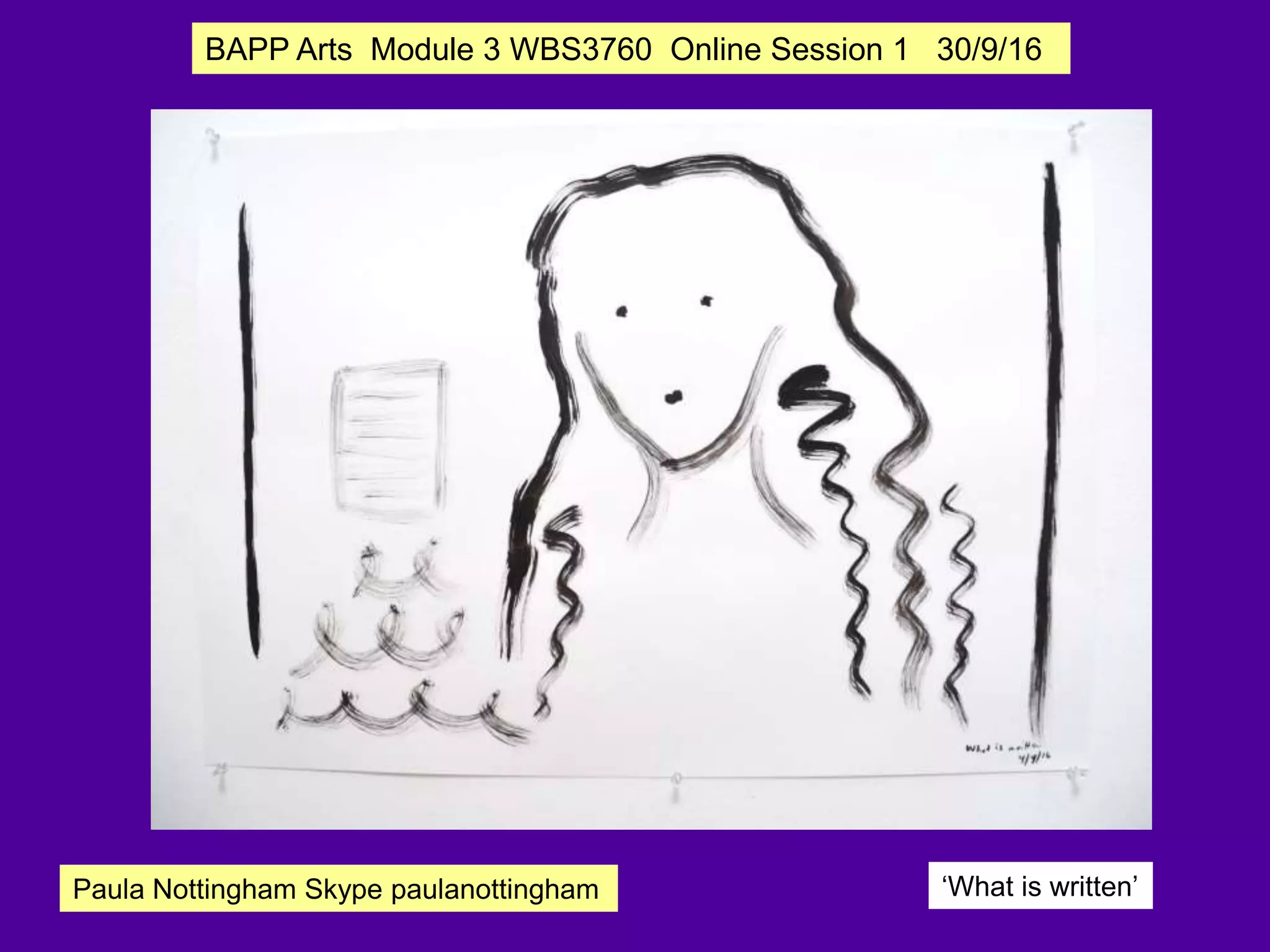
BAPP Arts Module 3 WBS3760 Online Session 1 30/9/16
Paula Nottingham Skype paulanottingham ‘What is written’
Ideas for the session…
Questions or points that you
need covered in the session?
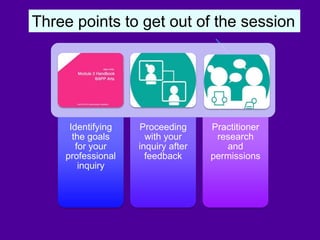
Three points to get out of the session
Identifying
the goals
for your
professional
inquiry
Proceeding
with your
inquiry after
feedback
Practitioner
research
and
permissions
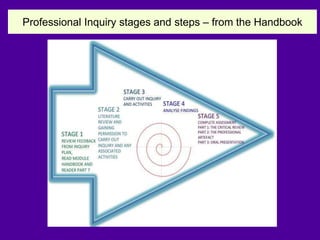
Professional Inquiry stages and steps – from the Handbook
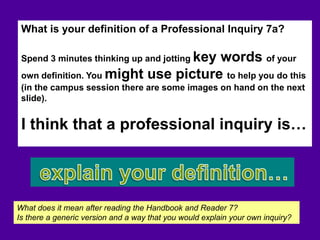
What is your definition of a Professional Inquiry 7a?
Spend 3 minutes thinking up and jotting key words of your
own definition. You might use picture to help you do this
(in the campus session there are some images on hand on the next
slide).
I think that a professional inquiry is…
What does it mean after reading the Handbook and Reader 7?
Is there a generic version and a way that you would explain your own inquiry?
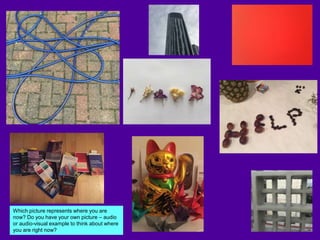
Which picture represents where you are
now? Do you have your own picture – audio
or audio-visual example to think about where
you are right now?
Paula’s attempt at a definition in words…
The professional inquiry is a learning approach that develops knowledge
and understanding about an arts-related area of practice that is
contextualised by your experience.
The inquiry uses steps and stages to allow inquiry questions to evolve
responses or solutions & develop valuable expertise in particular subject
areas. It informs your thinking using your experience, appropriate
literature and data from practitioner research; the process allows you to
think about the meaning of what you do.
The critical review explains what you have done in more formal terms.
The professional artefact demonstrates that you can communicate your
new knowledge within your professional setting.
The inquiry involves professional and personal dimensions that are
reflexive. There is a progression in the ability to think through issues and
problems using analysis and interpretation, academic argument
(convincing someone of your point of view using evidence) and critical
reflection.
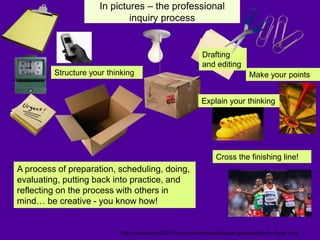
In pictures – the professional
inquiry process
A process of preparation, scheduling, doing,
evaluating, putting back into practice, and
reflecting on the process with others in
mind… be creative - you know how!
http://www.london2012.com/news/articles/double-gold-delight-for-farah.html
Drafting
and editing
Structure your thinking
Cross the finishing line!
Make your points
Explain your thinking
To review your plan for your professional inquiry -
look at feedback from your Module 2 plan and
discuss with your tutor and peers
Formative Feedback
Week 1: Task for 7a
After looking at your adviser feedback from Module 2 -
students send a 1 page summary to your tutor/adviser
with your inquiry title, your research/inquiry questions
and ideas, ethical issues, literature review up to this
point, changes to your plan, ideas for your artefact, and
any questions or issues that might have arisen for the
module after reading the Module 3 Handbook.
Exercise 1- talk to someone to develop
your thinking
Reviewing your plan… talk with someone over Skype or
phone to pinpoint what you need to do… tell this to your
partner and they write it down for you…
Where are you now?
Discuss with the others in your group:
1) Your topic area & inquiry questions
2) Ethical issues that are involved in the inquiry
3) What you have done so far in terms of researching
literature
4) What you have done so far in terms of gathering data
5) Have your partner write this down for you and give/send
it to you – it is a great way to get started and to clarify
what your are doing.
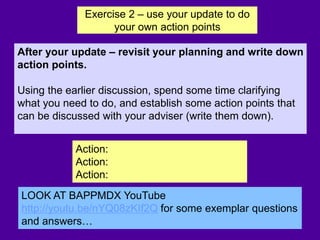
Action:
Action:
Action:
After your update – revisit your planning and write down
action points.
Using the earlier discussion, spend some time clarifying
what you need to do, and establish some action points that
can be discussed with your adviser (write them down).
LOOK AT BAPPMDX YouTube
http://youtu.be/nYQ08zKIf2Q for some exemplar questions
and answers…
Exercise 2 – use your update to do
your own action points
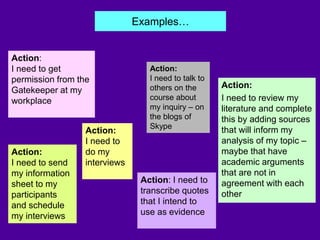
Examples…
Action:
I need to review my
literature and complete
this by adding sources
that will inform my
analysis of my topic –
maybe that have
academic arguments
that are not in
agreement with each
other
Action:
I need to send
my information
sheet to my
participants
and schedule
my interviews
Action:
I need to
do my
interviews
Action:
I need to get
permission from the
Gatekeeper at my
workplace
Action: I need to
transcribe quotes
that I intend to
use as evidence
Action:
I need to talk to
others on the
course about
my inquiry – on
the blogs of
Skype
Follow the process form your Ethics Release Form agreed with
your tutor – and any additional conditions sent by the university.
Your tutor will work closely with your to monitor your ethics. Keep in
touch with them.
Use the BAPP Arts informed consent form provided.
You can check your invitation to participant and information
sheet (sometimes sent as an email or posted online) used to invite
and inform participants before the practitioner research with your
tutor before you send these out (if you have any questions).
Put your informed consent forms and any additional
Employer/Professional forms in your appendices when you
submit…
Ethical Consideration
Literature and Research Literature
It is now time to be looking for more literature about your topic to
find expertise and ideas to inform your thinking.
Within the library on MyUnihub you can use Summon, the Library
Guides, go directly to ebooks and journals. Remember that
Sconol http://www.sconul.ac.uk
You have a Reading list on the My Learning WBS3760 site and
the library for what we call research literature – so books etc. that
talk about how to do the practitioner research e.g Bell, Costley et al.
Blaxter Huges and Tight, Fox et al., Gray etc.
Remember you can use Cite Them Right
http://www.citethemrightonline.com
for Harvard referencing – we also have guides. Take care to cite
your sources.
Reviewing the
Ideas/Literature
The review of ‘literature’ for the inquiry is more comprehensive than
Module 2 - which showed you how to find and review individual pieces
of literature – look at Reader 7.
Continue to accumulate sources that will inform your thinking
throughout the inquiry – discuss with your tutor and peers.
• Use the Middlesex library Summon tab (under the MyUniHub) to
help you find academic sources as well as Google and Google
Scholar (books, audiovisual, audio sources).
• Contact Laura or Michelle – our Librarians YOU HAVE THEIR
EMAILS
• Look at the Dinner Party on Paula’s
blog…http://paulanottingham.blogspot.co.uk/2016/03/the-
dinner-party-literature-for-your.html
How do you review literature?
There is information about reviewing literature in Reader 7 – it will become
summarised in your Critical Review but you can also do a fuller review and put
into your appendices.
ADD TO THIS ADVICE TODAY
Things to consider:
1. Relevance
2. Time and place written (currency)
3. Level and expertise (from earlier discussion with Jo and Ahmet)
Remember resources are available under the Reading List
Your literature should come from the areas that you are finding out about
for your research and work-based activities and should show the
expertise in the various fields (disciplinary) or workplace
(transdisciplinary) where you are focusing your inquiry.
Continue to blog as a way of
communication with the BAPP Arts
network/SIGs your peer groups
Communicate with your tutor in a meaningful
way and use the formative feedback
throughout the study period
Begin carry out your action plan and write about the main
ideas that will inform your work by verbally explaining your
inquiry and using the tutor update to start the writing process
Advice for the next few weeks
We can plan a group session with Alexandra Pitt (Alex)
about writing – Paula will put a blog to sign up for this
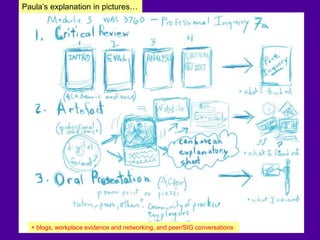
The 3 main parts of the final assessment for
Module 3 WBS3760
Submission has Part 1: The Critical Review
primarily written but can contain visual or audio visual elements showing the
process of investigating a topic (practitioner research) with analysis that has
implications for your practice
4 main sections as headings… look at Handbook
Part 2: The Professional Artefact
a product or a work in progress that is created - it can be a document, an event, or
an activity - it can be something that informs others in your community of practice or
workplace - the artefact should emerge from the inquiry
Part 3: The Oral Presentation (submitted later)
an in person/ audio-visual demonstration that shows that you have progressed in
your ability to show knowledge and understanding that is based on your ‘inquiry’
LAST BUT NOT LEAST - your blogs, workplace evidence and networking, and
peer/SIG conversations
Paula’s explanation in pictures…
+ blogs, workplace evidence and networking, and peer/SIG conversations
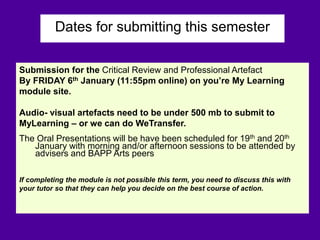
Dates for submitting this semester
Submission for the Critical Review and Professional Artefact
By FRIDAY 6th January (11:55pm online) on you’re My Learning
module site.
Audio- visual artefacts need to be under 500 mb to submit to
MyLearning – or we can do WeTransfer.
The Oral Presentations will be have been scheduled for 19th and 20th
January with morning and/or afternoon sessions to be attended by
advisers and BAPP Arts peers
If completing the module is not possible this term, you need to discuss this with
your tutor so that they can help you decide on the best course of action.
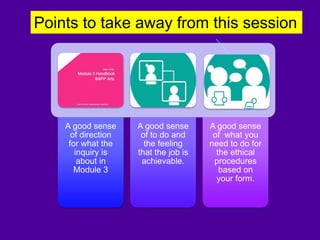
A good sense
of direction
for what the
inquiry is
about in
Module 3
A good sense
of to do and
the feeling
that the job is
achievable.
A good sense
of what you
need to do for
the ethical
procedures
based on
your form.
Points to take away from this session
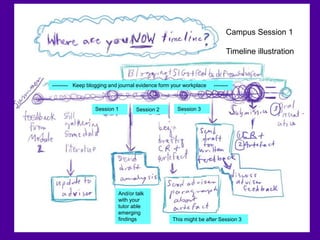
Campus Session 1
Timeline illustration
Session 1 Session 2 Session 3Session 1
And/or talk
with your
tutor able
emerging
findings This might be after Session 3
--------- Keep blogging and journal evidence form your workplace --------
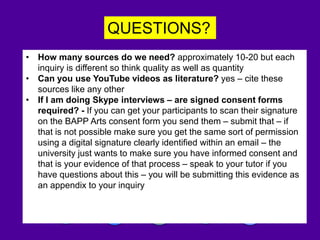
QUESTIONS?
Please write a blog abut this session!
• How many sources do we need? approximately 10-20 but each
inquiry is different so think quality as well as quantity
• Can you use YouTube videos as literature? yes – cite these
sources like any other
• If I am doing Skype interviews – are signed consent forms
required? - If you can get your participants to scan their signature
on the BAPP Arts consent form you send them – submit that – if
that is not possible make sure you get the same sort of permission
using a digital signature clearly identified within an email – the
university just wants to make sure you have informed consent and
that is your evidence of that process – speak to your tutor if you
have questions about this – you will be submitting this evidence as
an appendix to your inquiry

Module 3 online Session 1 WBS 3760 30.9.16

  • 1.
    BAPP Arts Module3 WBS3760 Online Session 1 30/9/16 Paula Nottingham Skype paulanottingham ‘What is written’
  • 2.
    Ideas for thesession… Questions or points that you need covered in the session?
  • 3.
    Three points toget out of the session Identifying the goals for your professional inquiry Proceeding with your inquiry after feedback Practitioner research and permissions
  • 4.
    Professional Inquiry stagesand steps – from the Handbook
  • 5.
    What is yourdefinition of a Professional Inquiry 7a? Spend 3 minutes thinking up and jotting key words of your own definition. You might use picture to help you do this (in the campus session there are some images on hand on the next slide). I think that a professional inquiry is… What does it mean after reading the Handbook and Reader 7? Is there a generic version and a way that you would explain your own inquiry?
  • 6.
    Which picture representswhere you are now? Do you have your own picture – audio or audio-visual example to think about where you are right now?
  • 7.
    Paula’s attempt ata definition in words… The professional inquiry is a learning approach that develops knowledge and understanding about an arts-related area of practice that is contextualised by your experience. The inquiry uses steps and stages to allow inquiry questions to evolve responses or solutions & develop valuable expertise in particular subject areas. It informs your thinking using your experience, appropriate literature and data from practitioner research; the process allows you to think about the meaning of what you do. The critical review explains what you have done in more formal terms. The professional artefact demonstrates that you can communicate your new knowledge within your professional setting. The inquiry involves professional and personal dimensions that are reflexive. There is a progression in the ability to think through issues and problems using analysis and interpretation, academic argument (convincing someone of your point of view using evidence) and critical reflection.
  • 8.
    In pictures –the professional inquiry process A process of preparation, scheduling, doing, evaluating, putting back into practice, and reflecting on the process with others in mind… be creative - you know how! http://www.london2012.com/news/articles/double-gold-delight-for-farah.html Drafting and editing Structure your thinking Cross the finishing line! Make your points Explain your thinking
  • 9.
    To review yourplan for your professional inquiry - look at feedback from your Module 2 plan and discuss with your tutor and peers
  • 10.
    Formative Feedback Week 1:Task for 7a After looking at your adviser feedback from Module 2 - students send a 1 page summary to your tutor/adviser with your inquiry title, your research/inquiry questions and ideas, ethical issues, literature review up to this point, changes to your plan, ideas for your artefact, and any questions or issues that might have arisen for the module after reading the Module 3 Handbook.
  • 11.
    Exercise 1- talkto someone to develop your thinking Reviewing your plan… talk with someone over Skype or phone to pinpoint what you need to do… tell this to your partner and they write it down for you… Where are you now? Discuss with the others in your group: 1) Your topic area & inquiry questions 2) Ethical issues that are involved in the inquiry 3) What you have done so far in terms of researching literature 4) What you have done so far in terms of gathering data 5) Have your partner write this down for you and give/send it to you – it is a great way to get started and to clarify what your are doing.
  • 12.
    Action: Action: Action: After your update– revisit your planning and write down action points. Using the earlier discussion, spend some time clarifying what you need to do, and establish some action points that can be discussed with your adviser (write them down). LOOK AT BAPPMDX YouTube http://youtu.be/nYQ08zKIf2Q for some exemplar questions and answers… Exercise 2 – use your update to do your own action points
  • 13.
    Examples… Action: I need toreview my literature and complete this by adding sources that will inform my analysis of my topic – maybe that have academic arguments that are not in agreement with each other Action: I need to send my information sheet to my participants and schedule my interviews Action: I need to do my interviews Action: I need to get permission from the Gatekeeper at my workplace Action: I need to transcribe quotes that I intend to use as evidence Action: I need to talk to others on the course about my inquiry – on the blogs of Skype
  • 14.
    Follow the processform your Ethics Release Form agreed with your tutor – and any additional conditions sent by the university. Your tutor will work closely with your to monitor your ethics. Keep in touch with them. Use the BAPP Arts informed consent form provided. You can check your invitation to participant and information sheet (sometimes sent as an email or posted online) used to invite and inform participants before the practitioner research with your tutor before you send these out (if you have any questions). Put your informed consent forms and any additional Employer/Professional forms in your appendices when you submit… Ethical Consideration
  • 15.
    Literature and ResearchLiterature It is now time to be looking for more literature about your topic to find expertise and ideas to inform your thinking. Within the library on MyUnihub you can use Summon, the Library Guides, go directly to ebooks and journals. Remember that Sconol http://www.sconul.ac.uk You have a Reading list on the My Learning WBS3760 site and the library for what we call research literature – so books etc. that talk about how to do the practitioner research e.g Bell, Costley et al. Blaxter Huges and Tight, Fox et al., Gray etc. Remember you can use Cite Them Right http://www.citethemrightonline.com for Harvard referencing – we also have guides. Take care to cite your sources.
  • 16.
    Reviewing the Ideas/Literature The reviewof ‘literature’ for the inquiry is more comprehensive than Module 2 - which showed you how to find and review individual pieces of literature – look at Reader 7. Continue to accumulate sources that will inform your thinking throughout the inquiry – discuss with your tutor and peers. • Use the Middlesex library Summon tab (under the MyUniHub) to help you find academic sources as well as Google and Google Scholar (books, audiovisual, audio sources). • Contact Laura or Michelle – our Librarians YOU HAVE THEIR EMAILS • Look at the Dinner Party on Paula’s blog…http://paulanottingham.blogspot.co.uk/2016/03/the- dinner-party-literature-for-your.html
  • 17.
    How do youreview literature? There is information about reviewing literature in Reader 7 – it will become summarised in your Critical Review but you can also do a fuller review and put into your appendices. ADD TO THIS ADVICE TODAY Things to consider: 1. Relevance 2. Time and place written (currency) 3. Level and expertise (from earlier discussion with Jo and Ahmet) Remember resources are available under the Reading List Your literature should come from the areas that you are finding out about for your research and work-based activities and should show the expertise in the various fields (disciplinary) or workplace (transdisciplinary) where you are focusing your inquiry.
  • 18.
    Continue to blogas a way of communication with the BAPP Arts network/SIGs your peer groups Communicate with your tutor in a meaningful way and use the formative feedback throughout the study period Begin carry out your action plan and write about the main ideas that will inform your work by verbally explaining your inquiry and using the tutor update to start the writing process Advice for the next few weeks We can plan a group session with Alexandra Pitt (Alex) about writing – Paula will put a blog to sign up for this
  • 19.
    The 3 mainparts of the final assessment for Module 3 WBS3760 Submission has Part 1: The Critical Review primarily written but can contain visual or audio visual elements showing the process of investigating a topic (practitioner research) with analysis that has implications for your practice 4 main sections as headings… look at Handbook Part 2: The Professional Artefact a product or a work in progress that is created - it can be a document, an event, or an activity - it can be something that informs others in your community of practice or workplace - the artefact should emerge from the inquiry Part 3: The Oral Presentation (submitted later) an in person/ audio-visual demonstration that shows that you have progressed in your ability to show knowledge and understanding that is based on your ‘inquiry’ LAST BUT NOT LEAST - your blogs, workplace evidence and networking, and peer/SIG conversations
  • 20.
    Paula’s explanation inpictures… + blogs, workplace evidence and networking, and peer/SIG conversations
  • 21.
    Dates for submittingthis semester Submission for the Critical Review and Professional Artefact By FRIDAY 6th January (11:55pm online) on you’re My Learning module site. Audio- visual artefacts need to be under 500 mb to submit to MyLearning – or we can do WeTransfer. The Oral Presentations will be have been scheduled for 19th and 20th January with morning and/or afternoon sessions to be attended by advisers and BAPP Arts peers If completing the module is not possible this term, you need to discuss this with your tutor so that they can help you decide on the best course of action.
  • 22.
    A good sense ofdirection for what the inquiry is about in Module 3 A good sense of to do and the feeling that the job is achievable. A good sense of what you need to do for the ethical procedures based on your form. Points to take away from this session
  • 23.
    Campus Session 1 Timelineillustration Session 1 Session 2 Session 3Session 1 And/or talk with your tutor able emerging findings This might be after Session 3 --------- Keep blogging and journal evidence form your workplace --------
  • 24.
    QUESTIONS? Please write ablog abut this session! • How many sources do we need? approximately 10-20 but each inquiry is different so think quality as well as quantity • Can you use YouTube videos as literature? yes – cite these sources like any other • If I am doing Skype interviews – are signed consent forms required? - If you can get your participants to scan their signature on the BAPP Arts consent form you send them – submit that – if that is not possible make sure you get the same sort of permission using a digital signature clearly identified within an email – the university just wants to make sure you have informed consent and that is your evidence of that process – speak to your tutor if you have questions about this – you will be submitting this evidence as an appendix to your inquiry