Thematic
Analysis
Qualitative Method
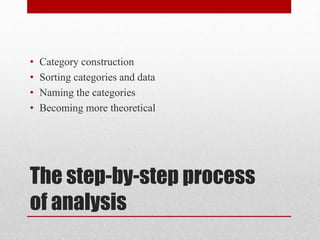
The step-by-step process
of analysis
• Category construction
• Sorting categories and data
• Naming the categories
• Becoming more theoretical
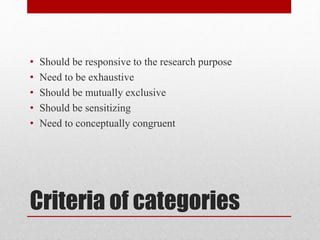
Criteria of categories
• Should be responsive to the research purpose
• Need to be exhaustive
• Should be mutually exclusive
• Should be sensitizing
• Need to conceptually congruent
How many?
• It depends
• According to Cresswell (2007), preferably FIVE to SIX
themes
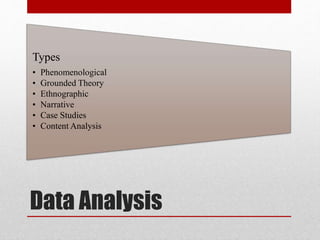
Data Analysis
Types
• Phenomenological
• Grounded Theory
• Ethnographic
• Narrative
• Case Studies
• Content Analysis
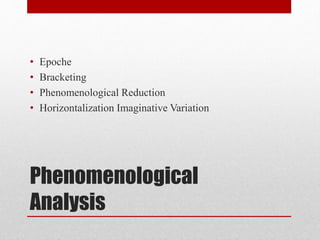
Phenomenological
Analysis
• Epoche
• Bracketing
• Phenomenological Reduction
• Horizontalization Imaginative Variation
Grounded Theory
• Categories
• Properties (Dimensions of category)
• A core category (Central category)
• Hypothesis (The suggested link between categories and
properties)
Ethnographic Analysis
• Collecting Data
• Searching for categories
• Reaffirms the categories
• Charting the collections of affirmed categories
Narrative Analysis
• Variety of techniques
Case Studies
• Merging all the collected data
• Sometimes involved more than one case
• Selecting categories
• Identifying themes
• Normally it has cross-case analysis (multiple cases)
Content Analysis
• Coding of raw data
• Construction of categories
• Revisiting the literature review
Using Software
• Always back to basic
• What is your research question?
• Don’t lose yourself in the software
• Focus on the real meaning behind the data
• Be consistent
References
• Merriam, S.B. (2009). Qualitative research. San
Francisco: Jossey-Bass.
• Berger, A.A. (2013). Media and communication research
methods: An introduction to qualitative and quantitative
approaches. California: SAGE Publication
• Creswell, J. W. (2009). Research design: qualitative,
quantitative and mixed methods approaches (3rd ed.).
California: SAGE Publication.

Thematic analysis (qa) testing