Facilitators
Rita Kizito:rita.kizito@wits.ac.za
Lynn Hewlett: lynn.hewlett@wits.ac.za
Laura Dison:Laura.dison@wits.ac.za
PAGE 1
Dealing with Data
NEW DIRECTIONS
This session
WHY WHAT HOW
• Why are you
doing this
research ( this
piece of
inquiry)?
• What is the
purpose?
• What does “
dealing with
data” entail?
• What kind of
data will you be
collecting?
• What process
will you use to
handle your
data?
PAGE 3
Main Texts ( Qualitative Data)
Creswell, J. W., & Creswell, J. D. (2017). Research
design: Qualitative, quantitative, and mixed
methods approaches. Sage publications.
Braun, V., & Clarke, V. (2006). Using thematic
analysis in psychology. Qualitative research in
psychology, 3(2), 77-101.
Clarke, V., Braun, V., & Hayfield, N. (2015). Thematic
analysis. Qualitative psychology: A practical guide
to research methods, 222-248.
PAGE 4
Why are you doing this research ?WHY
Purpose of your
research
 Are you exploring,
describing , trying to
understand a
, interpreting etc.?
 Are you measuring,
counting, experimenting,
comparing etc.?
What type of data are you planning to
collect ?
Qualitative data
 Interviews
 Observations
 Documents
 Audio-visual
materials
Quantitative data
 Instruments
 Checklists
 Records
PAGE 5
Discussions
PAGE 6
What does “ dealing with data” entail?
• Philosophical assumptions of inquiry
• Research question (s)
• Consulting the literature
• Data identification
• Data collection
• Data analysis
• Data interpretation
• Data reporting
GENERAL RESEARCH
PROCESS
involves a research approach
which has
 Variables,
hypotheses,
questions
 Instruments,
closed-ended
questions,
reliability, validity
 Statistical analysis
 Generalizability,
replicability,
control, and lack
of bias
 Central phenomenon
 Broad, general
questions
 Views of participants
 Reciprocity and respect
 Description and themes
 Interpretation
 Personal reflexivity
 Flexible structure
 Meaning or advocate
for groups/individuals
QUALITATIVE QUANTITATIVE
(MIXED)
WHAT
PAGE 7
WHAT What kind of analysis is involved ?
What type of data are you planning to
collect ?
Qualitative data
 Interviews
 Observations
 Documents
 Audio-visual
materials
Quantitative data
 Instruments
 Checklists
 Records
What kind of analysis is involved ?
Qualitative analysis
 Use text and images,
 For coding
 For theme
development
 For relating themes
Quantitative analysis
 Use statistical analysis,
 For description
 For comparing
 For relating variables
PAGE 8
WHAT Be mindful of the criteria of soundness …
PAGE 9
WHAT Be cognisant of your worldview or paradigm
 How do you see reality (ontology)?
 What are your views of how we come to know what we know (epistemology)?
 What are your views on the role of values (axiology)?
 How do you intend to conduct this particular research ( procedures)( methodology)?
PAGE 10
Discussions
PAGE 11
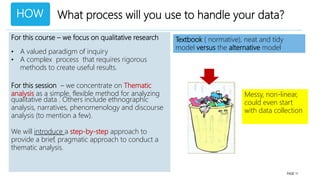
For this course – we focus on qualitative research
• A valued paradigm of inquiry
• A complex process that requires rigorous
methods to create useful results.
For this session – we concentrate on Thematic
analysis as a simple, flexible method for analyzing
qualitative data . Others include ethnographic
analysis, narratives, phenomenology and discourse
analysis (to mention a few).
We will introduce a step-by-step approach to
provide a brief, pragmatic approach to conduct a
thematic analysis.
HOW What process will you use to handle your data?
Textbook ( normative), neat and tidy
model versus the alternative model
Messy, non-linear,
could even start
with data collection
PAGE 12
HOW What process will you use to handle your data?
Qualitative data can be
defined as categorical.
Common data collection
methods include:
• One-to-One Interviews
• Focus groups
• Record keeping
• Process of observation
• Video and audio recordings
Inductive Approach
Open-ended exploration of data with minimal pre-
conceived ideas. Labour - intensive
Deductive Approach
Commonly starts with a pre-determined coding
framework, often informed by an existing theory or
model.
Main Approaches to Qualitative Data Analysis
PAGE 13
HOW What process will you use to handle your data?
Access to data
• Do you have access
to data ?
• Can you negotiate
this access ?
• Who is supporting
you
• Credibility
Permission can take
long • Doable within a
certain period
• Insider/outsider
• Relationships
(keep people on
board)
• Trade down
Ethical clearance
• Your language,
(inquiry,
conversation,
writing an account)
• Share accessible
reports
Consent Forms etc.
Practicality
PAGE 14
Discussions
PAGE 15
HOW About Thematic analysis
• Accessible an unsophisticated
• Flexible ( fits with different paradigms), can be used to analyze different texts
• Supports qualitative paradigms( philosophies) and analytic methods
Different interpretations appear in the literature
Coding reliability
Small q
Positivistic
Reflexive organic
Big Q
Both philosophy and techniques
are qualitative
Not structured
Depth of engagement
Technique and philosophy is
organic, iterative, not fixed , Role
researcher – reflexive,
interpretative, engaged , story
teller, culture memberships , social
justice principles…
Codebook ( formalized
operationalization of the codes )
Big Q
HOW Thematic Analysis
SIX PHASE PROCESS
o Phase 1: Familiarize yourself
with your data
o Phase 2: Generate Initial
Codes
o Phase 3: Search for Themes
o Phase 4: Review Themes
o Phase 5: Define and name
themes
o Phase 6: Produce the report
Condensed into four ( Raduzwan Rashid)
https://www.youtube.com/watch?v=ISpQa93lMPw&t=593s
Research sharing by Rashid
Braun, V., & Clarke, V. (2006).
Using thematic analysis in
psychology. Qualitative
research in psychology, 3(2),
77-101.
code
Short comments summing
up segments of your data
theme
Represents patterned response or meaning in
your data set ( Braun & Clarke, 2006, p.82)
PAGE 17
• Once the themes are well - established, you can begin writing the final
analysis and report.
• Provide a concise, coherent, logical, non -repetitive, and interesting
account of the data within and across themes (Braun & Clarke, 2006).
• Clearly communicate the logical processes by which findings were
developed
• Keep methodological notes, trustworthiness notes, and audit trail
notes to ease the reporting process.
HOW Producing the report
PAGE 18
Email:
rita.kizito@wits.ac.za
kizitorita@gmail.com

Dealing with data 10092020

  • 1.
    Facilitators Rita Kizito:rita.kizito@wits.ac.za Lynn Hewlett:lynn.hewlett@wits.ac.za Laura Dison:Laura.dison@wits.ac.za PAGE 1 Dealing with Data NEW DIRECTIONS
  • 2.
    This session WHY WHATHOW • Why are you doing this research ( this piece of inquiry)? • What is the purpose? • What does “ dealing with data” entail? • What kind of data will you be collecting? • What process will you use to handle your data?
  • 3.
    PAGE 3 Main Texts( Qualitative Data) Creswell, J. W., & Creswell, J. D. (2017). Research design: Qualitative, quantitative, and mixed methods approaches. Sage publications. Braun, V., & Clarke, V. (2006). Using thematic analysis in psychology. Qualitative research in psychology, 3(2), 77-101. Clarke, V., Braun, V., & Hayfield, N. (2015). Thematic analysis. Qualitative psychology: A practical guide to research methods, 222-248.
  • 4.
    PAGE 4 Why areyou doing this research ?WHY Purpose of your research  Are you exploring, describing , trying to understand a , interpreting etc.?  Are you measuring, counting, experimenting, comparing etc.? What type of data are you planning to collect ? Qualitative data  Interviews  Observations  Documents  Audio-visual materials Quantitative data  Instruments  Checklists  Records
  • 5.
  • 6.
    PAGE 6 What does“ dealing with data” entail? • Philosophical assumptions of inquiry • Research question (s) • Consulting the literature • Data identification • Data collection • Data analysis • Data interpretation • Data reporting GENERAL RESEARCH PROCESS involves a research approach which has  Variables, hypotheses, questions  Instruments, closed-ended questions, reliability, validity  Statistical analysis  Generalizability, replicability, control, and lack of bias  Central phenomenon  Broad, general questions  Views of participants  Reciprocity and respect  Description and themes  Interpretation  Personal reflexivity  Flexible structure  Meaning or advocate for groups/individuals QUALITATIVE QUANTITATIVE (MIXED) WHAT
  • 7.
    PAGE 7 WHAT Whatkind of analysis is involved ? What type of data are you planning to collect ? Qualitative data  Interviews  Observations  Documents  Audio-visual materials Quantitative data  Instruments  Checklists  Records What kind of analysis is involved ? Qualitative analysis  Use text and images,  For coding  For theme development  For relating themes Quantitative analysis  Use statistical analysis,  For description  For comparing  For relating variables
  • 8.
    PAGE 8 WHAT Bemindful of the criteria of soundness …
  • 9.
    PAGE 9 WHAT Becognisant of your worldview or paradigm  How do you see reality (ontology)?  What are your views of how we come to know what we know (epistemology)?  What are your views on the role of values (axiology)?  How do you intend to conduct this particular research ( procedures)( methodology)?
  • 10.
  • 11.
    PAGE 11 For thiscourse – we focus on qualitative research • A valued paradigm of inquiry • A complex process that requires rigorous methods to create useful results. For this session – we concentrate on Thematic analysis as a simple, flexible method for analyzing qualitative data . Others include ethnographic analysis, narratives, phenomenology and discourse analysis (to mention a few). We will introduce a step-by-step approach to provide a brief, pragmatic approach to conduct a thematic analysis. HOW What process will you use to handle your data? Textbook ( normative), neat and tidy model versus the alternative model Messy, non-linear, could even start with data collection
  • 12.
    PAGE 12 HOW Whatprocess will you use to handle your data? Qualitative data can be defined as categorical. Common data collection methods include: • One-to-One Interviews • Focus groups • Record keeping • Process of observation • Video and audio recordings Inductive Approach Open-ended exploration of data with minimal pre- conceived ideas. Labour - intensive Deductive Approach Commonly starts with a pre-determined coding framework, often informed by an existing theory or model. Main Approaches to Qualitative Data Analysis
  • 13.
    PAGE 13 HOW Whatprocess will you use to handle your data? Access to data • Do you have access to data ? • Can you negotiate this access ? • Who is supporting you • Credibility Permission can take long • Doable within a certain period • Insider/outsider • Relationships (keep people on board) • Trade down Ethical clearance • Your language, (inquiry, conversation, writing an account) • Share accessible reports Consent Forms etc. Practicality
  • 14.
  • 15.
    PAGE 15 HOW AboutThematic analysis • Accessible an unsophisticated • Flexible ( fits with different paradigms), can be used to analyze different texts • Supports qualitative paradigms( philosophies) and analytic methods Different interpretations appear in the literature Coding reliability Small q Positivistic Reflexive organic Big Q Both philosophy and techniques are qualitative Not structured Depth of engagement Technique and philosophy is organic, iterative, not fixed , Role researcher – reflexive, interpretative, engaged , story teller, culture memberships , social justice principles… Codebook ( formalized operationalization of the codes ) Big Q
  • 16.
    HOW Thematic Analysis SIXPHASE PROCESS o Phase 1: Familiarize yourself with your data o Phase 2: Generate Initial Codes o Phase 3: Search for Themes o Phase 4: Review Themes o Phase 5: Define and name themes o Phase 6: Produce the report Condensed into four ( Raduzwan Rashid) https://www.youtube.com/watch?v=ISpQa93lMPw&t=593s Research sharing by Rashid Braun, V., & Clarke, V. (2006). Using thematic analysis in psychology. Qualitative research in psychology, 3(2), 77-101. code Short comments summing up segments of your data theme Represents patterned response or meaning in your data set ( Braun & Clarke, 2006, p.82)
  • 17.
    PAGE 17 • Oncethe themes are well - established, you can begin writing the final analysis and report. • Provide a concise, coherent, logical, non -repetitive, and interesting account of the data within and across themes (Braun & Clarke, 2006). • Clearly communicate the logical processes by which findings were developed • Keep methodological notes, trustworthiness notes, and audit trail notes to ease the reporting process. HOW Producing the report
  • 18.

Editor's Notes

  • #5 Critical, reflexive and professional orientated activity
  • #7 Critical, reflexive and professional orientated activity
  • #8 Critical, reflexive and professional orientated activity
  • #9 Critical, reflexive and professional orientated activity
  • #10 Critical, reflexive and professional orientated activity
  • #12 Ethnographic analysis involves identifying categories related to cultural aspects Narratives tale on different forms\ Phenomenological analysis embeds an epochal approach, where one paints a picture e of own and different layers pf persepectives about a phenomenon
  • #13 Critical, reflexive and professional orientated activity
  • #14 Critical, reflexive and professional orientated activity
  • #17 Critical, reflexive and professional orientated activity