MOHAMMAD NOUR AL SAEED
GROUP : 3
6th year
Hemorrhage Classification
Open Wounds
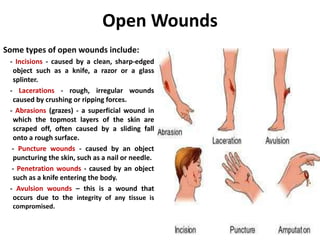
Some types of open wounds include:
- Incisions - caused by a clean, sharp-edged
object such as a knife, a razor or a glass
splinter.
- Lacerations - rough, irregular wounds
caused by crushing or ripping forces.
- Abrasions (grazes) - a superficial wound in
which the topmost layers of the skin are
scraped off, often caused by a sliding fall
onto a rough surface.
- Puncture wounds - caused by an object
puncturing the skin, such as a nail or needle.
- Penetration wounds - caused by an object
such as a knife entering the body.
- Avulsion wounds – this is a wound that
occurs due to the integrity of any tissue is
compromised.
Dressing and Bandaging
1) Dressing-any material used to cover a wound, help control bleeding, and
help prevent additional contamination.
2) Bandage-any material used to hold a dressing in place.
Types of dressings
1) Sterile and aseptic : free from germs, dirt, and foreign debris. If
commercially processed and individually packaged, dressings are usually
sterile and aseptic; if not available, be sure dressings are clean.
2) Bulky ( large ) dressings and multi-trauma dressings : thick dressings large
enough to completely cover large wounds, control serious bleeding, and
stabilize impaled objects.
3) Occlusive dressings : used for sealing open abdominal and chest wounds.
Often made of plastic wrap, they help prevent air from entering wound and
fluids from escaping.
4) Improvised dressings : any clean material that can be used to control
bleeding, such as handkerchiefs, towels, sheets, other similar materials.
Bleeding
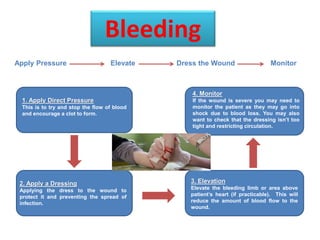
Apply Pressure Elevate Dress the Wound Monitor
4. Monitor
If the wound is severe you may need to
monitor the patient as they may go into
shock due to blood loss. You may also
want to check that the dressing isn’t too
tight and restricting circulation.
2. Apply a Dressing
Applying the dress to the wound to
protect it and preventing the spread of
infection.
3. Elevation
Elevate the bleeding limb or area above
patient’s heart (if practicable). This will
reduce the amount of blood flow to the
wound.
1. Apply Direct Pressure
This is to try and stop the flow of blood
and encourage a clot to form.
Controlling External Bleeding
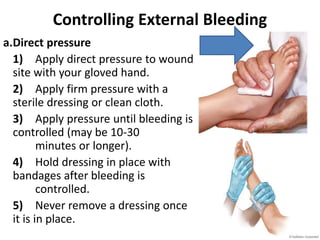
a.Direct pressure
1) Apply direct pressure to wound
site with your gloved hand.
2) Apply firm pressure with a
sterile dressing or clean cloth.
3) Apply pressure until bleeding is
controlled (may be 10-30
minutes or longer).
4) Hold dressing in place with
bandages after bleeding is
controlled.
5) Never remove a dressing once
it is in place.
Controlling External Bleeding
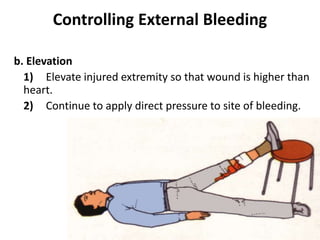
b. Elevation
1) Elevate injured extremity so that wound is higher than
heart.
2) Continue to apply direct pressure to site of bleeding.
Controlling External Bleeding
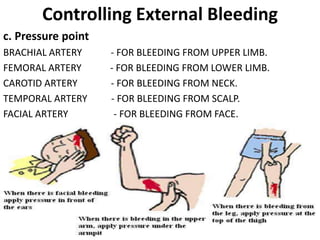
c. Pressure point
BRACHIAL ARTERY - FOR BLEEDING FROM UPPER LIMB.
FEMORAL ARTERY - FOR BLEEDING FROM LOWER LIMB.
CAROTID ARTERY - FOR BLEEDING FROM NECK.
TEMPORAL ARTERY - FOR BLEEDING FROM SCALP.
FACIAL ARTERY - FOR BLEEDING FROM FACE.
SUB CLAVIAN ARTERY - FOR BLEEDING FROM CHEST WALL & ARMPIT
Controlling External Bleeding
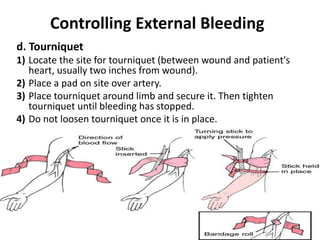
d. Tourniquet
1) Locate the site for tourniquet (between wound and patient's
heart, usually two inches from wound).
2) Place a pad on site over artery.
3) Place tourniquet around limb and secure it. Then tighten
tourniquet until bleeding has stopped.
4) Do not loosen tourniquet once it is in place.
Thanks For Your
Attention

Controlling External Bleeding

  • 1.
    MOHAMMAD NOUR ALSAEED GROUP : 3 6th year
  • 2.
  • 3.
    Open Wounds Some typesof open wounds include: - Incisions - caused by a clean, sharp-edged object such as a knife, a razor or a glass splinter. - Lacerations - rough, irregular wounds caused by crushing or ripping forces. - Abrasions (grazes) - a superficial wound in which the topmost layers of the skin are scraped off, often caused by a sliding fall onto a rough surface. - Puncture wounds - caused by an object puncturing the skin, such as a nail or needle. - Penetration wounds - caused by an object such as a knife entering the body. - Avulsion wounds – this is a wound that occurs due to the integrity of any tissue is compromised.
  • 4.
    Dressing and Bandaging 1)Dressing-any material used to cover a wound, help control bleeding, and help prevent additional contamination. 2) Bandage-any material used to hold a dressing in place. Types of dressings 1) Sterile and aseptic : free from germs, dirt, and foreign debris. If commercially processed and individually packaged, dressings are usually sterile and aseptic; if not available, be sure dressings are clean. 2) Bulky ( large ) dressings and multi-trauma dressings : thick dressings large enough to completely cover large wounds, control serious bleeding, and stabilize impaled objects. 3) Occlusive dressings : used for sealing open abdominal and chest wounds. Often made of plastic wrap, they help prevent air from entering wound and fluids from escaping. 4) Improvised dressings : any clean material that can be used to control bleeding, such as handkerchiefs, towels, sheets, other similar materials.
  • 5.
    Bleeding Apply Pressure ElevateDress the Wound Monitor 4. Monitor If the wound is severe you may need to monitor the patient as they may go into shock due to blood loss. You may also want to check that the dressing isn’t too tight and restricting circulation. 2. Apply a Dressing Applying the dress to the wound to protect it and preventing the spread of infection. 3. Elevation Elevate the bleeding limb or area above patient’s heart (if practicable). This will reduce the amount of blood flow to the wound. 1. Apply Direct Pressure This is to try and stop the flow of blood and encourage a clot to form.
  • 6.
    Controlling External Bleeding a.Directpressure 1) Apply direct pressure to wound site with your gloved hand. 2) Apply firm pressure with a sterile dressing or clean cloth. 3) Apply pressure until bleeding is controlled (may be 10-30 minutes or longer). 4) Hold dressing in place with bandages after bleeding is controlled. 5) Never remove a dressing once it is in place.
  • 7.
    Controlling External Bleeding b.Elevation 1) Elevate injured extremity so that wound is higher than heart. 2) Continue to apply direct pressure to site of bleeding.
  • 8.
    Controlling External Bleeding c.Pressure point BRACHIAL ARTERY - FOR BLEEDING FROM UPPER LIMB. FEMORAL ARTERY - FOR BLEEDING FROM LOWER LIMB. CAROTID ARTERY - FOR BLEEDING FROM NECK. TEMPORAL ARTERY - FOR BLEEDING FROM SCALP. FACIAL ARTERY - FOR BLEEDING FROM FACE. SUB CLAVIAN ARTERY - FOR BLEEDING FROM CHEST WALL & ARMPIT
  • 9.
    Controlling External Bleeding d.Tourniquet 1) Locate the site for tourniquet (between wound and patient's heart, usually two inches from wound). 2) Place a pad on site over artery. 3) Place tourniquet around limb and secure it. Then tighten tourniquet until bleeding has stopped. 4) Do not loosen tourniquet once it is in place.
  • 10.