04/04/2025 1
CHAPTER THREE
Wound, dressing and bandage
04/04/2025 2
objectives
At the end of this chapter, the students will be
able to
• Define the terms wound and bleeding
• Identify causes of wounds
• Describe different types of wound
• Describe the different first aid methods for
victims with wound and bleeding
• Define dressing and bandage
04/04/2025 3
Con…
• Describe types of bandage and its advantage
• Discuss the general principle of bandage
application
• Identify different types of first aid kits
• Demonstrate different type of bandage application
04/04/2025 4
Definition of wound
Wound:- is a break in to the continuity of the
tissue of the body either internally or externally.
which allows the blood to escape, entrance of
germs cause infections.
04/04/2025 5
Aim of dealing with wounds:
• To control bleeding
• Minimizing Scarring
• Relieving Pain
• To treat shock
• To maintain function of the body
• To prevent complication and infection secondary
to wound and bleeding
04/04/2025 6
Common causes of wound
 Based on cause
wounds can be divided in to two broad categories. Such as
1. surgical wounds- wound secondary to planned therapy such as
surgical incisions, needle introduction
2. Accidental wound- it is unintentional injury, Such as wounds
usually result from external physical forces.
• The most common accidents resulting open wounds are
 Direct blowing
 Animal or human bite
 Mishandling of sharp instruments
 Machinery
 Fall
 Motor vehicle accidents
04/04/2025 7
Classifications of wounds
A. Based on skin integrity
1. Open wounds- is a break in to skin and mucus
membrane
2.Closed wounds- is involves injury to underlying
tissue without a break in the skin or mucus
membranes but soft tissue damage present
 may have internal injury and bleeding
04/04/2025 8
Types of open wounds
• Open wounds can be classified according to the
object that causes the wound.
1. Abrasions wound
2. Incision wound
3. Puncture wound
4. Avulsion wound
5. Laceration wound
6. Contusion wound
7. Gunshot wound
04/04/2025 9
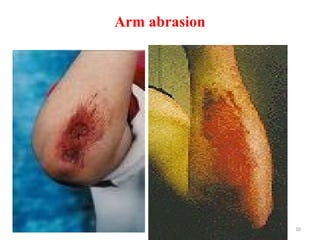
1.Abrasions wound
• An abrasion is a superficial and minor wound in
which the surface of the skin or mucus membrane
is worn away by rubbing or scraping
• Characteristics of abrasion wound
• The outer layer of protective skin is damaged
• Bleeding is limited
• Danger of contamination and risk of infection
exist
04/04/2025 10
Arm abrasion
04/04/2025 11
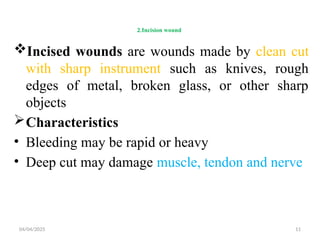
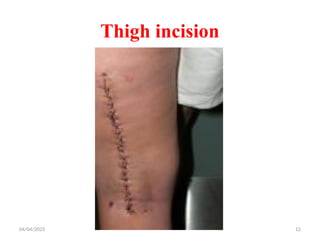
2.Incision wound
Incised wounds are wounds made by clean cut
with sharp instrument such as knives, rough
edges of metal, broken glass, or other sharp
objects
Characteristics
• Bleeding may be rapid or heavy
• Deep cut may damage muscle, tendon and nerve
04/04/2025 12
Thigh incision
04/04/2025 13
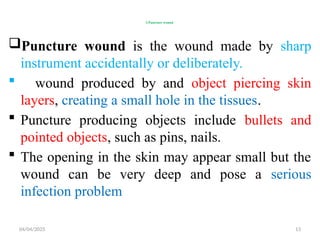
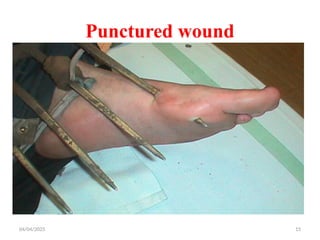
3.Puncture wound
Puncture wound is the wound made by sharp
instrument accidentally or deliberately.
 wound produced by and object piercing skin
layers, creating a small hole in the tissues.
 Puncture producing objects include bullets and
pointed objects, such as pins, nails.
 The opening in the skin may appear small but the
wound can be very deep and pose a serious
infection problem
04/04/2025 14
Characteristics
• Limited external bleeding
• Damage to internal organ, causes internal
bleeding
• Increased risk of infection due to lack of flushing
action of bleeding
• Tetanus may develop
04/04/2025 15
Punctured wound
04/04/2025 16
4.Avulsion wound
An avulsion involves the tearing or forcible
separation of part of body structure
Characteristics
• It may occur an incised and lacerated wound
• There will be heavy and rapid bleeding
• May be reattached by a surgeon
• Occurs in accidents such as motor vehicle,
gunshots, animal bites and other body-crushing
injuries
04/04/2025 17
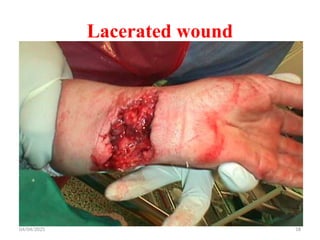
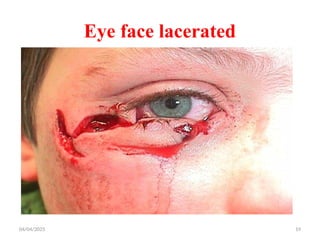
5.Laceration wound
Laceration wound displays jagged, irregular, or
blunt tearing or breaking of the soft tissues, and
usually caused when great force exerted against
the body
Characteristics
• Rapid and extensive bleeding
• Destruction of tissue is greater than that of wound
in a cut
• Deep contamination of the wound increases the
chance for later infection
04/04/2025 18
Lacerated wound
04/04/2025 19
Eye face lacerated
04/04/2025 20
 The difference between laceration and avulsion
laceration is a cut, commonly from a sharp object.
It can also occur when blunt force splits the skin
avulsion occurs when a portion of the skin, and
sometimes the underlying tissue, is partially or
completely torn away
04/04/2025 21
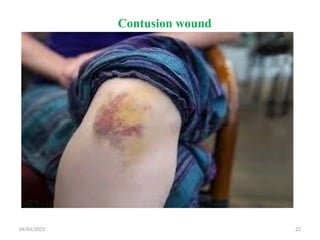
6.Contusion wound
. Contusion (bruise): any blunt blow, can rupture
capillaries beneath the skin.
• Blood leaks into the tissues causing bruising.
• The skin may be split, but is often unbroken
Sever contusion may indicate deeper, hidden
damage, such as a fracture or internal injury.
04/04/2025 22
Contusion wound
04/04/2025 23
7.Gunshot wound
. Gunshot wound
• A bullet or other missile may be driven into or
through the body, causing serious internal injury
and sucking in contaminants
• the wound at the point of entry may be small and
neat but the exit wound may be large.
04/04/2025 24
First aid for open wounds
• Stop/control the bleeding immediately
• Lay the victim quiet
• Cover the wound with sterile gauze and apply
pressure
• Elevate the limb if not contraindicated
• Dress the wound to prevent further
contamination and infection
• Treat shock
• Rest and clean
• Obtain medical attention
04/04/2025 25
Bleeding control
• Bleeding:- is escape of blood from vascular
structure or the loss of blood from the circulatory
system either externally or internally
Bleeding may vary from mild to severe or fatal,
type by depleting the function blood.
depleting
• Transporting oxygen, nutrients and wastes
• Protection against disease
• Maintenance of constant body temperature
04/04/2025 26
Natural body mechanism to stop bleeding
1. Clotting
2. Contraction of cut ends
3. Decrease blood pressure
Type of bleeding
• Bleeding may be from an artery, vein and/or
capillary,
04/04/2025 27
TYPE OF BLEEDING
• Haemorrhage /bleeding can be classified based
on blood vessels
1. Arterial bleeding
2. Venous bleeding
3. Capillary bleeding
04/04/2025 28
Arterial bleeding
Characteristics
• Rapid, profuse bleeding
• Usually severe, difficult and hard to control
• Bright red in color
• Arterial bleeding requires immediate attention
04/04/2025 29
Venous Bleeding
Characteristics
• Flows at steady (slow) rate
• Dark red in color
• Venus bleeding is easier to control than Arterial
bleeding
Capillary bleeding:- bleeding is usually slow,
oozing in nature
• this type of bleeding usually has a higher risk of
infection than other types of bleeding
04/04/2025 30
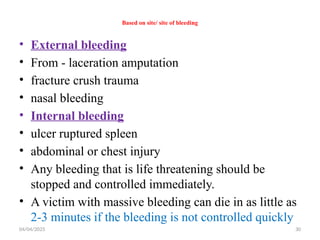
Based on site/ site of bleeding
• External bleeding
• From - laceration amputation
• fracture crush trauma
• nasal bleeding
• Internal bleeding
• ulcer ruptured spleen
• abdominal or chest injury
• Any bleeding that is life threatening should be
stopped and controlled immediately.
• A victim with massive bleeding can die in as little as
2-3 minutes if the bleeding is not controlled quickly
04/04/2025 31
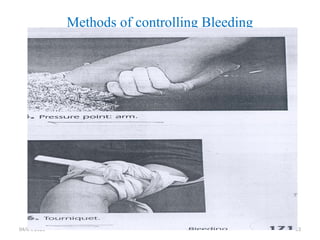
Methods of controlling bleeding externally
1. Apply direct pressure
• place sterile dressing or clean cloth over wound
5-15 minutes
2. Elevate the body part
• Raise wound above level of chest(heart) it possible
3. Apply a pressure bandage
• Using roller bandage cover dressing
completely,Secure the bandage
04/04/2025 32
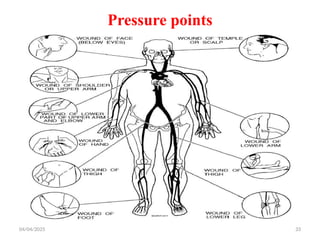
4. Use pressure point
Locate arterial site
• Scalp wound –temporal artery
• Cheek wound- facial artery
• head and neck bleeding –carotid artery
• chest and armpit bleeding –sub- clavian artery
• leg wound- femoral artery
5. Tourniquet application
04/04/2025 33
Pressure points
04/04/2025 34
First aids for control bleeding
For slight bleeding
• Apply slight pressure to bleeding point
• Elevate the bleeding part unless contra indicted
• Protect the wound from contamination and
infection by wash and apply dressing
• Dry the area with swab
• Refer as necessary
04/04/2025 35
For severe bleeding
Need for immediate action
because shock and loss of consciousness in victim
may occur from rapid loss of blood.
Because it is possible for a victim to bleed to
death in a very short period of time.
• a first-aider should stop any large, rapid loss of
blood immediately and treat for shock
04/04/2025 36
1. Tourniquet application for massive bleeding
• Rapid tourniquet application is fastest way to
stop extremity bleeding and is safe for the
casualty
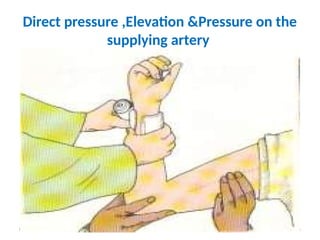
2. Direct pressure
• Direct pressure by hand over a dressing is the
preferred methods to control of sever bleeding,
since it prevents loss of blood from body with out
interfere with normal circulation
04/04/2025 37
• You can use your palm to apply direct pressure
by placing the palm of the hand on a dressing
directly over the entire area of an open wound.
• In most instances this technique will stop the
bleeding
• A thick pad of the cloth held between the hand
and the wound helps to control the bleeding by
absorbing the blood and allowing it to clot
04/04/2025 38
• It can be combined with pressure on artery.
• Once pressure is applied, keep it in place.
• If dressings become soaked with blood, apply
new dressings over the old dressings and continue
the direct hand pressure even more firmly.
• The less a bleeding wound is disturbed; the easier
it will be to stop the bleeding
04/04/2025 39
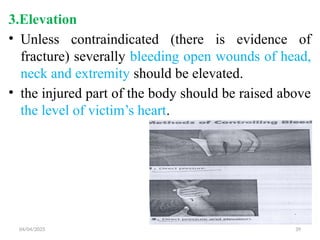
3.Elevation
• Unless contraindicated (there is evidence of
fracture) severally bleeding open wounds of head,
neck and extremity should be elevated.
• the injured part of the body should be raised above
the level of victim’s heart.
04/04/2025 40
• Elevation works by force of gravity to help
reduce blood pressure in the injured area and
thus aids in slowing down the pass of blood
through the wound
• It should be aided by direct pressure
04/04/2025 41
5.Pressure on supplying artery
• If severe bleeding from an open wound of arm or
leg does not stop after the application of direct
pressure plus elevation, the pressure point
technique may required
• Use of the pressure point technique temporarily
compresses the main artery against the underlying
bone and nearby tissues.
• The technique also stops circulation within the
limb.
04/04/2025 42
• Do not substitute its use for direct pressure and
elevation, but use the pressure point technique in
addition to those techniques.
• Use the Brachial artery for the control of sever
bleeding from upper extremity
• Apply pressure over the brachial artery, forcing
it against the arm bone.
• The pressure point is located midway between
the armpit and the elbow
04/04/2025 43
• Press your fingers toward your thumb to create
an inward force from opposite sides of the arm
• Use the Femoral artery for the control of sever
bleeding from lower extremity
• Apply pressure on the femoral artery by
forcing the artery against the pelvic bone.
04/04/2025 44
• To apply pressure on the femoral artery, position
the victim flat on his back, if possible and place
the heel of your hand directly over the pressure
point.
• Then lean forward over your straightened arm to
apply the amount of pressure needed to close the
artery.
• Keep your arm straight to prevent arm tension and
muscular strain while you apply this technique.
04/04/2025 45
Direct pressure ,Elevation &Pressure on the
supplying artery
04/04/2025 46
Tourniquet
It is a device used to press up an artery to prevent
loss of blood
• It can be rope or bandage
• The use of a tourniquet is dangerous and used
only for a sever, life threatening hemorrhage that
cannot be controlled by other means
• The decision to apply tourniquet in reality is the
decision to risk sacrifice of a limb in order to
save life.
04/04/2025 47
Procedures of tourniquet application
• The ability to apply a tourniquet to yourself or another
person will have the single biggest impact on reducing,
preventable death in service
• The Tourniquet should be applied directly to the skin
approximately 5cm (2-3inches) above the open wound
• In circumstances where the First-Aider has no time to
expose and search for wounds.
 the tourniquet may be applied directly over clothing in the
‘high and tight’ position
• as high on the limb and close to the torso as possible,
provided there are no solid objects inside the clothing.
04/04/2025 48
• Place tourniquet just above the wound; do not
allow it to touch the wound edges.
• If the wound is in a joint area or just below,
place the tourniquet immediately above the
joint.
• Wrap the tourniquet band tightly around the
limb twice and tie a half knot
• Place a short, strong stick or similar object that
will not break over the knot and tie two
additional overhand knots on top of stick.
• Twist the stick to tighten the tourniquet until
bleeding stops
04/04/2025 49
• Secure the stick in place with loose ends of
tourniquet or other improvised material
• Once the serious decision has been made to apply
the tourniquet should not be loosened except on
advice of a physician
• Treat the victim for shock, and give necessary
first aid for other injuries
• Do not cover tourniquet
04/04/2025 50
• If the application of a tourniquet does not control
bleeding, a second tourniquet should be applied
directly next too, and preferably above, the first
tourniquet.
• Additional bleeding control measures may also be
considered including wound packing, direct
pressure and/or indirect firm pressure applied to
the appropriate inguinal crease or clavicular notch.
04/04/2025 51
• Finally, the time of Tourniquet application should
be recorded either on the Tourniquet or on the
forehead of the casualty prefixed
• Make written note about time and site of
application and attach the note to the victim’s
clothing
(eg. “T=28/06/2017 at 4:30am”).
04/04/2025 52
• The correct application of a tourniquet is not
without risk. While it may save the life of the
casualty
• by preventing blood from reaching the limb and
injury, it also prevents the removal of waste
products from within the body.
• Over time, the accumulation of these waste
products can have a critical impact on the health
of the casualty when the tourniquet is removed.
• For this reason, it is highly recommended that
tourniquets are only removed by medical
professionals.
04/04/2025 53
Methods of controlling Bleeding
04/04/2025 54
Prevention of wound contamination
and infection
• Open wounds are subjected to infection &
contamination.
• The danger of infection can be prevented or
lessened by taking the appropriate first aid
measures, depending upon the severity of
bleeding
04/04/2025 55
Safe guard measures for wounds with sever bleeding
• Do not remove or disturb the dressing initially
applied on the wound
• Do not attempt to clean the wound since the
victims needs medical care
• Immobile the injured part
• Elevate the affected limb if possible
04/04/2025 56
Measures for wounds without severe bleeding
• To cleanse a wound, Wash your hands with
thoroughly soap and water
• Wash around and in the wound to remove bacteria
and other foreign bodies
• Rinse the wound thoroughly by flushing with
clean water, preferably running tab water
• Apply dry bandage and secure it firmly in place
• Inform the victim to visit health institution if
there is any problem (evidence of infection
appears).
04/04/2025 57
Removal of Foreign objects
• In small open wounds, wood splinters and glass
fragments often remain in the skin tissues or in
tissues just beneath the surface.
• Such Foreign object on the wound or underlying
structure may irritate the wound and cause
infection.
04/04/2025 58
Procedure for removal of foreign objects
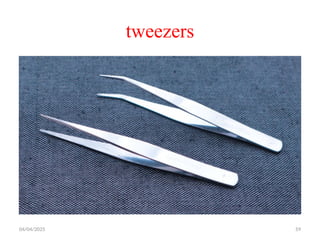
• Use tweezers to pull out any foreign object from
the surface of tissue.
• Sterilize it over a flame or in boiling water
• Objects imbedded just beneath the skin can be
lifted out with the tip of a needle that has been
sterilized
• Deeply embedded object regardless of site should
be left to be removed in hospital
04/04/2025 59
tweezers
04/04/2025 60
Identification and management of infection
• The period of healing after an injury may be
greatly lengthened by infection, which is the
result of invasion and growth of bacteria in with
the tissues of the body.
• If the bacteria get inside the tissues of the body
through break in the skin or mucous membranes,
serious infection may develop within hours or
days following an injury
04/04/2025 61
Signs and symptoms of infection
• Swelling
• Redness
• hotness, pain, fever
• pus formation and regional lymph node swelling
First aid
• Rest the affected part
• Elevate the affected part
• dressing
• Refer
04/04/2025 62
Closed wound
Wound without breakage to skin and mucus membrane
and visible bleeding
Characteristics of closed wound
• A closed wound may occur anywhere with the body
there is no break in the skin
Blood is not lost through the skin, but may flow
through outer openings of body cavities.
Closed wounds are less likely to become infected than
open wounds, since they are subject to less
contamination
Many closed wounds are relatively small injuries
involving soft tissue
04/04/2025 63
Causes Closed wound
• Most close wounds are caused by external forces
such as fall or other accidents (motor vehicle
accident).
• Sometimes closed wounds are caused if the
victim of closed fracture is mishandled or is
moved before splints are properly applied to
immobilize his/her injuries
04/04/2025 64
Sign and symptoms of closed wounds
• Cold, clammy skin-pale skin
• Very rapid but weak pulse
• Tachypnea
• Haematemesis
• Dizziness Melina
• Pain and tenderness Hematuria
• Restless Swelling
• Thirsty Dislocation
• Haemoptysis Deformity
04/04/2025 65
First Aid for closed wounds
• If a closed fracture is suspected, immobile the
affected part
• If an internal injury is suspected, get medical help
for the victim as soon as possible
• If the victim must be moved, carefully transport
him in lying position; give special attention to
prevent shock
• Do not give fluids by mouth to victim suspected of
having sever internal injury, no matter how much
he complains of thirst
• Refer
04/04/2025 66
DRESSING AND BANDAGE
04/04/2025 67
INTRODUCTION
• The technique of applying bandage and dressing vary
according to:
• the extent and location of the injures
• the material at hand and
• the ability of first aider to adapt to emergency
situation.
 Supplies can be obtained commercially for home use,
or substitutes can be prepared from household linen.
04/04/2025 68
Dressing
• Definition:
 Dressing/Compress is the immediate protective
cover placed over the wound.
• Sterile dressings are prior to use and are
preferable to unsterile dressings.
• If sterile dressings are not obtainable, a freshly
ironed or laundered cloth, such as handkerchief,
towel, sheet,or pillow-case may be used.
04/04/2025 69
Purpose
• To assist control of bleeding
• To absorb wound secretion and bleeding
• To prevent additional contamination
• To relieve pain
Principle of clean dressing
• To hold dressings in place
• To hold splint in place
• To immobilize and support the injured part
• To reduce or prevent edema
04/04/2025 70
Kinds of bandages
A bandage must be clean but need not be sterile
Most commercially available bandages are
• Gauze bandage = 1cm long by 3.5 or 8 cm width
• Elastic bandage of different size
• Triangular bandage
• Many tailed bandage /bandage of Muslin-to be
applied on the abdomen or chest when there is
injury in this area
• T-bandage- applied when there is perineal injury
• Others emergency bandages like-Lenin. belts,
socks, hand kerchiefs used in emergency situation
04/04/2025 71
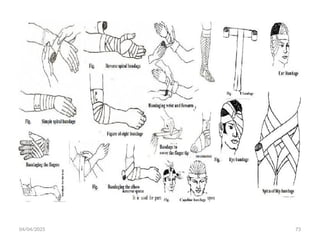
Types of bandage turn
• Circular turn-circular turns simply encircle the part with
each layer of bandages super imposed on the previous
one.
• It is the simplest of all bandage turns. However, its use
is limited to covering parts of uniform width, such as the
toes, fingers and head
• Spiral-Bandage ascending body part with each turn
overlying previous one by one half or 2/3
• Cover cylindrical body parts e.g Wrist, upper arm.
• Spiral reversal-Turn requiring twist/reversal of bandage
through each turn
04/04/2025 72
• Cover the cone shaped body parts
• Figure of eight-cover joints
• Recurrent-bandage secured by two circular turn
around the proximal ends of the body cover the
body part as stump or head.
• Application of bandage
General principles
• Bandage should be snug (it is useless if too loose)
but not too tight to interfere with circulation,
either at the time of application or later if swelling
occurs
04/04/2025 73
04/04/2025 74
• Leave the persons finger tips exposed when a
splint or bandage is applied to the arm and
• leave the toes exposed when a splint or bandage
is applied to the leg
• Watch for swelling, color changes of fingers and
coldness of the tips of fingers or toes, indicating
interference with circulation
• Loosen bandage immediately if the victim
complains numbness or tingling sensation
• Never apply tight circular bandage for the neck; it
may cause strangulation.
04/04/2025 75
Application of specific bandages
1. Elastic bandage
• Although they are the easiest of all bandages to apply.
• they are especially useful since they conform more
readily to the injured part than gauze or muslin.
• they are the most hazardous bandage because of the
tendency of the first aider to stretch them so that
circulation or nerve function may be impaired.
• They are expensive, but can be laundered and reused
for a number of purposes
• In using elastic bandages, the first-aider must take
great care not to stretch the material too tightly.
04/04/2025 76
2.Gauze bandage
• Skill is necessary in applying a gauze bandage to
prevent slippage and stretching, because gauze is very
loosely woven.
• Never apply wet gauze bandage, it will shrink as it dries
and become too tight
• Gauze can be used as a bandage in almost all parts of
the body
• Commonly used as
Circular bandages
Spiral bandages
Figure of eight (for joint areas)
Recurrent bandage (fingertip bandages)
04/04/2025 77
3.Triangle bandage (Triangular bandage)
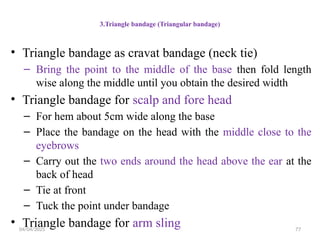
• Triangle bandage as cravat bandage (neck tie)
– Bring the point to the middle of the base then fold length
wise along the middle until you obtain the desired width
• Triangle bandage for scalp and fore head
– For hem about 5cm wide along the base
– Place the bandage on the head with the middle close to the
eyebrows
– Carry out the two ends around the head above the ear at the
back of head
– Tie at front
– Tuck the point under bandage
• Triangle bandage for arm sling
04/04/2025 78
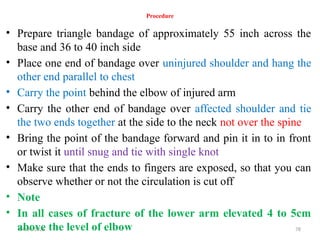
Procedure
• Prepare triangle bandage of approximately 55 inch across the
base and 36 to 40 inch side
• Place one end of bandage over uninjured shoulder and hang the
other end parallel to chest
• Carry the point behind the elbow of injured arm
• Carry the other end of bandage over affected shoulder and tie
the two ends together at the side to the neck not over the spine
• Bring the point of the bandage forward and pin it in to in front
or twist it until snug and tie with single knot
• Make sure that the ends to fingers are exposed, so that you can
observe whether or not the circulation is cut off
• Note
• In all cases of fracture of the lower arm elevated 4 to 5cm
above the level of elbow
04/04/2025 79
First aid kits and supplies
• It is important to have sterile dressings, prepared
splints, bandages and other first aid equipments
ready for use before the accident occur.
Type First aid kit
There are two general types of first aid kits, such
as
• Unit type
• Cabinet type
04/04/2025 80
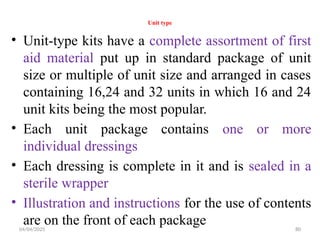
Unit type
• Unit-type kits have a complete assortment of first
aid material put up in standard package of unit
size or multiple of unit size and arranged in cases
containing 16,24 and 32 units in which 16 and 24
unit kits being the most popular.
• Each unit package contains one or more
individual dressings
• Each dressing is complete in it and is sealed in a
sterile wrapper
• Illustration and instructions for the use of contents
are on the front of each package
04/04/2025 81
Contents
• Adhesive compress
• Bandage compress
• Gauze pad
• Rolled bandage
• Tourniquet
• Scissors
• tweezers
04/04/2025 82
Cabinet type
• Cabinet kits are made for a wide variety of uses and range
in size from pocket version to large industrial kits.
• They are made to accept packages in different shapes and
sizes.
• The extra space in most cabinet kits also allows additional
items to be inserted according to user’s needs.
• Cabinet kits contain a large enough supply of most first
aid items to be used for more than a single treatment
• Cabinet kits carry familiar first aid items that are easily
recognized in an emergency
04/04/2025 83
Summary
1. Types of Wounds
- Open Wounds: Break in skin/mucous membrane
(e.g., abrasions, incisions, punctures, avulsions,
lacerations, gunshot wounds).
- Closed Wounds: No skin breakage but internal
tissue damage (e.g., contusions, internal bleeding).
- Key Characteristics:
- Abrasions: Superficial, limited bleeding.
- Punctures: Small entry, high infection risk.
-Avulsions: Tissue tearing; requires surgical
reattachment.
04/04/2025 84
2. Controlling Severe Bleeding
• Steps:
1. Direct Pressure: Use sterile dressing; reapply if
soaked.
2. Elevation: Raise limb above heart (if no fracture).
3. Pressure Points: Brachial (arm) or femoral (leg)
artery compression.
4. Tourniquet (last resort):
- Apply 5cm above wound.
- Record time; never loosen once applied.
- Risks: Limb compromise; use only for life-
threatening hemorrhage.
04/04/2025 85
3. Dressing & Bandage Essentials
• Dressing Purpose: Control bleeding, absorb
secretions, prevent infection.
Bandage Types:
- Gauze: Versatile for circular/spiral/figure-8 turns.
- Triangular: Scalp, sling, or cravat applications.
- Elastic: Conforms to body but risks over-tightening.
 Principles:
- Leave fingers/toes exposed to monitor circulation.
- Avoid wet gauze (shrinks) and neck circular
bandages.
04/04/2025 86
4. Infection Prevention & Signs
• Prevention:
- Cleanse minor wounds with water; avoid probing
deep objects.
- Use sterile/clean dressings.
• Infection Signs:
- Redness, swelling, heat, pus, fever.
• First Aid for Infection: Rest, elevate, dress, refer
to healthcare.
04/04/2025 87
5. First Aid Kits & Critical Supplies
Types:
1. Unit-Type: Pre-packaged, sterile, single-use (e.g.,
adhesive compresses, gauze).
2.Cabinet-Type: Larger, customizable (e.g., scissors,
tweezers, tourniquets).
Essentials:
- Sterile dressings, bandages, gloves, antiseptic
wipes.
 Tools: Scissors, tweezers, splints.
 Rule: Regularly check and replenish supplies.
04/04/2025 88
TRUE OR FALSE
1.Elastic bandages are safe to stretch tightly
around limbs.
2. Avulsion wounds involve tearing or forcible
separation of body tissue.
3. Fever redness, swelling, and pus formation
are signs of wound infection.
04/04/2025 89

CHAPTER 3dressing about compating fild.pptx

  • 1.
  • 2.
    04/04/2025 2 objectives At theend of this chapter, the students will be able to • Define the terms wound and bleeding • Identify causes of wounds • Describe different types of wound • Describe the different first aid methods for victims with wound and bleeding • Define dressing and bandage
  • 3.
    04/04/2025 3 Con… • Describetypes of bandage and its advantage • Discuss the general principle of bandage application • Identify different types of first aid kits • Demonstrate different type of bandage application
  • 4.
    04/04/2025 4 Definition ofwound Wound:- is a break in to the continuity of the tissue of the body either internally or externally. which allows the blood to escape, entrance of germs cause infections.
  • 5.
    04/04/2025 5 Aim ofdealing with wounds: • To control bleeding • Minimizing Scarring • Relieving Pain • To treat shock • To maintain function of the body • To prevent complication and infection secondary to wound and bleeding
  • 6.
    04/04/2025 6 Common causesof wound  Based on cause wounds can be divided in to two broad categories. Such as 1. surgical wounds- wound secondary to planned therapy such as surgical incisions, needle introduction 2. Accidental wound- it is unintentional injury, Such as wounds usually result from external physical forces. • The most common accidents resulting open wounds are  Direct blowing  Animal or human bite  Mishandling of sharp instruments  Machinery  Fall  Motor vehicle accidents
  • 7.
    04/04/2025 7 Classifications ofwounds A. Based on skin integrity 1. Open wounds- is a break in to skin and mucus membrane 2.Closed wounds- is involves injury to underlying tissue without a break in the skin or mucus membranes but soft tissue damage present  may have internal injury and bleeding
  • 8.
    04/04/2025 8 Types ofopen wounds • Open wounds can be classified according to the object that causes the wound. 1. Abrasions wound 2. Incision wound 3. Puncture wound 4. Avulsion wound 5. Laceration wound 6. Contusion wound 7. Gunshot wound
  • 9.
    04/04/2025 9 1.Abrasions wound •An abrasion is a superficial and minor wound in which the surface of the skin or mucus membrane is worn away by rubbing or scraping • Characteristics of abrasion wound • The outer layer of protective skin is damaged • Bleeding is limited • Danger of contamination and risk of infection exist
  • 10.
  • 11.
    04/04/2025 11 2.Incision wound Incisedwounds are wounds made by clean cut with sharp instrument such as knives, rough edges of metal, broken glass, or other sharp objects Characteristics • Bleeding may be rapid or heavy • Deep cut may damage muscle, tendon and nerve
  • 12.
  • 13.
    04/04/2025 13 3.Puncture wound Puncturewound is the wound made by sharp instrument accidentally or deliberately.  wound produced by and object piercing skin layers, creating a small hole in the tissues.  Puncture producing objects include bullets and pointed objects, such as pins, nails.  The opening in the skin may appear small but the wound can be very deep and pose a serious infection problem
  • 14.
    04/04/2025 14 Characteristics • Limitedexternal bleeding • Damage to internal organ, causes internal bleeding • Increased risk of infection due to lack of flushing action of bleeding • Tetanus may develop
  • 15.
  • 16.
    04/04/2025 16 4.Avulsion wound Anavulsion involves the tearing or forcible separation of part of body structure Characteristics • It may occur an incised and lacerated wound • There will be heavy and rapid bleeding • May be reattached by a surgeon • Occurs in accidents such as motor vehicle, gunshots, animal bites and other body-crushing injuries
  • 17.
    04/04/2025 17 5.Laceration wound Lacerationwound displays jagged, irregular, or blunt tearing or breaking of the soft tissues, and usually caused when great force exerted against the body Characteristics • Rapid and extensive bleeding • Destruction of tissue is greater than that of wound in a cut • Deep contamination of the wound increases the chance for later infection
  • 18.
  • 19.
  • 20.
    04/04/2025 20  Thedifference between laceration and avulsion laceration is a cut, commonly from a sharp object. It can also occur when blunt force splits the skin avulsion occurs when a portion of the skin, and sometimes the underlying tissue, is partially or completely torn away
  • 21.
    04/04/2025 21 6.Contusion wound .Contusion (bruise): any blunt blow, can rupture capillaries beneath the skin. • Blood leaks into the tissues causing bruising. • The skin may be split, but is often unbroken Sever contusion may indicate deeper, hidden damage, such as a fracture or internal injury.
  • 22.
  • 23.
    04/04/2025 23 7.Gunshot wound .Gunshot wound • A bullet or other missile may be driven into or through the body, causing serious internal injury and sucking in contaminants • the wound at the point of entry may be small and neat but the exit wound may be large.
  • 24.
    04/04/2025 24 First aidfor open wounds • Stop/control the bleeding immediately • Lay the victim quiet • Cover the wound with sterile gauze and apply pressure • Elevate the limb if not contraindicated • Dress the wound to prevent further contamination and infection • Treat shock • Rest and clean • Obtain medical attention
  • 25.
    04/04/2025 25 Bleeding control •Bleeding:- is escape of blood from vascular structure or the loss of blood from the circulatory system either externally or internally Bleeding may vary from mild to severe or fatal, type by depleting the function blood. depleting • Transporting oxygen, nutrients and wastes • Protection against disease • Maintenance of constant body temperature
  • 26.
    04/04/2025 26 Natural bodymechanism to stop bleeding 1. Clotting 2. Contraction of cut ends 3. Decrease blood pressure Type of bleeding • Bleeding may be from an artery, vein and/or capillary,
  • 27.
    04/04/2025 27 TYPE OFBLEEDING • Haemorrhage /bleeding can be classified based on blood vessels 1. Arterial bleeding 2. Venous bleeding 3. Capillary bleeding
  • 28.
    04/04/2025 28 Arterial bleeding Characteristics •Rapid, profuse bleeding • Usually severe, difficult and hard to control • Bright red in color • Arterial bleeding requires immediate attention
  • 29.
    04/04/2025 29 Venous Bleeding Characteristics •Flows at steady (slow) rate • Dark red in color • Venus bleeding is easier to control than Arterial bleeding Capillary bleeding:- bleeding is usually slow, oozing in nature • this type of bleeding usually has a higher risk of infection than other types of bleeding
  • 30.
    04/04/2025 30 Based onsite/ site of bleeding • External bleeding • From - laceration amputation • fracture crush trauma • nasal bleeding • Internal bleeding • ulcer ruptured spleen • abdominal or chest injury • Any bleeding that is life threatening should be stopped and controlled immediately. • A victim with massive bleeding can die in as little as 2-3 minutes if the bleeding is not controlled quickly
  • 31.
    04/04/2025 31 Methods ofcontrolling bleeding externally 1. Apply direct pressure • place sterile dressing or clean cloth over wound 5-15 minutes 2. Elevate the body part • Raise wound above level of chest(heart) it possible 3. Apply a pressure bandage • Using roller bandage cover dressing completely,Secure the bandage
  • 32.
    04/04/2025 32 4. Usepressure point Locate arterial site • Scalp wound –temporal artery • Cheek wound- facial artery • head and neck bleeding –carotid artery • chest and armpit bleeding –sub- clavian artery • leg wound- femoral artery 5. Tourniquet application
  • 33.
  • 34.
    04/04/2025 34 First aidsfor control bleeding For slight bleeding • Apply slight pressure to bleeding point • Elevate the bleeding part unless contra indicted • Protect the wound from contamination and infection by wash and apply dressing • Dry the area with swab • Refer as necessary
  • 35.
    04/04/2025 35 For severebleeding Need for immediate action because shock and loss of consciousness in victim may occur from rapid loss of blood. Because it is possible for a victim to bleed to death in a very short period of time. • a first-aider should stop any large, rapid loss of blood immediately and treat for shock
  • 36.
    04/04/2025 36 1. Tourniquetapplication for massive bleeding • Rapid tourniquet application is fastest way to stop extremity bleeding and is safe for the casualty 2. Direct pressure • Direct pressure by hand over a dressing is the preferred methods to control of sever bleeding, since it prevents loss of blood from body with out interfere with normal circulation
  • 37.
    04/04/2025 37 • Youcan use your palm to apply direct pressure by placing the palm of the hand on a dressing directly over the entire area of an open wound. • In most instances this technique will stop the bleeding • A thick pad of the cloth held between the hand and the wound helps to control the bleeding by absorbing the blood and allowing it to clot
  • 38.
    04/04/2025 38 • Itcan be combined with pressure on artery. • Once pressure is applied, keep it in place. • If dressings become soaked with blood, apply new dressings over the old dressings and continue the direct hand pressure even more firmly. • The less a bleeding wound is disturbed; the easier it will be to stop the bleeding
  • 39.
    04/04/2025 39 3.Elevation • Unlesscontraindicated (there is evidence of fracture) severally bleeding open wounds of head, neck and extremity should be elevated. • the injured part of the body should be raised above the level of victim’s heart.
  • 40.
    04/04/2025 40 • Elevationworks by force of gravity to help reduce blood pressure in the injured area and thus aids in slowing down the pass of blood through the wound • It should be aided by direct pressure
  • 41.
    04/04/2025 41 5.Pressure onsupplying artery • If severe bleeding from an open wound of arm or leg does not stop after the application of direct pressure plus elevation, the pressure point technique may required • Use of the pressure point technique temporarily compresses the main artery against the underlying bone and nearby tissues. • The technique also stops circulation within the limb.
  • 42.
    04/04/2025 42 • Donot substitute its use for direct pressure and elevation, but use the pressure point technique in addition to those techniques. • Use the Brachial artery for the control of sever bleeding from upper extremity • Apply pressure over the brachial artery, forcing it against the arm bone. • The pressure point is located midway between the armpit and the elbow
  • 43.
    04/04/2025 43 • Pressyour fingers toward your thumb to create an inward force from opposite sides of the arm • Use the Femoral artery for the control of sever bleeding from lower extremity • Apply pressure on the femoral artery by forcing the artery against the pelvic bone.
  • 44.
    04/04/2025 44 • Toapply pressure on the femoral artery, position the victim flat on his back, if possible and place the heel of your hand directly over the pressure point. • Then lean forward over your straightened arm to apply the amount of pressure needed to close the artery. • Keep your arm straight to prevent arm tension and muscular strain while you apply this technique.
  • 45.
    04/04/2025 45 Direct pressure,Elevation &Pressure on the supplying artery
  • 46.
    04/04/2025 46 Tourniquet It isa device used to press up an artery to prevent loss of blood • It can be rope or bandage • The use of a tourniquet is dangerous and used only for a sever, life threatening hemorrhage that cannot be controlled by other means • The decision to apply tourniquet in reality is the decision to risk sacrifice of a limb in order to save life.
  • 47.
    04/04/2025 47 Procedures oftourniquet application • The ability to apply a tourniquet to yourself or another person will have the single biggest impact on reducing, preventable death in service • The Tourniquet should be applied directly to the skin approximately 5cm (2-3inches) above the open wound • In circumstances where the First-Aider has no time to expose and search for wounds.  the tourniquet may be applied directly over clothing in the ‘high and tight’ position • as high on the limb and close to the torso as possible, provided there are no solid objects inside the clothing.
  • 48.
    04/04/2025 48 • Placetourniquet just above the wound; do not allow it to touch the wound edges. • If the wound is in a joint area or just below, place the tourniquet immediately above the joint. • Wrap the tourniquet band tightly around the limb twice and tie a half knot • Place a short, strong stick or similar object that will not break over the knot and tie two additional overhand knots on top of stick. • Twist the stick to tighten the tourniquet until bleeding stops
  • 49.
    04/04/2025 49 • Securethe stick in place with loose ends of tourniquet or other improvised material • Once the serious decision has been made to apply the tourniquet should not be loosened except on advice of a physician • Treat the victim for shock, and give necessary first aid for other injuries • Do not cover tourniquet
  • 50.
    04/04/2025 50 • Ifthe application of a tourniquet does not control bleeding, a second tourniquet should be applied directly next too, and preferably above, the first tourniquet. • Additional bleeding control measures may also be considered including wound packing, direct pressure and/or indirect firm pressure applied to the appropriate inguinal crease or clavicular notch.
  • 51.
    04/04/2025 51 • Finally,the time of Tourniquet application should be recorded either on the Tourniquet or on the forehead of the casualty prefixed • Make written note about time and site of application and attach the note to the victim’s clothing (eg. “T=28/06/2017 at 4:30am”).
  • 52.
    04/04/2025 52 • Thecorrect application of a tourniquet is not without risk. While it may save the life of the casualty • by preventing blood from reaching the limb and injury, it also prevents the removal of waste products from within the body. • Over time, the accumulation of these waste products can have a critical impact on the health of the casualty when the tourniquet is removed. • For this reason, it is highly recommended that tourniquets are only removed by medical professionals.
  • 53.
    04/04/2025 53 Methods ofcontrolling Bleeding
  • 54.
    04/04/2025 54 Prevention ofwound contamination and infection • Open wounds are subjected to infection & contamination. • The danger of infection can be prevented or lessened by taking the appropriate first aid measures, depending upon the severity of bleeding
  • 55.
    04/04/2025 55 Safe guardmeasures for wounds with sever bleeding • Do not remove or disturb the dressing initially applied on the wound • Do not attempt to clean the wound since the victims needs medical care • Immobile the injured part • Elevate the affected limb if possible
  • 56.
    04/04/2025 56 Measures forwounds without severe bleeding • To cleanse a wound, Wash your hands with thoroughly soap and water • Wash around and in the wound to remove bacteria and other foreign bodies • Rinse the wound thoroughly by flushing with clean water, preferably running tab water • Apply dry bandage and secure it firmly in place • Inform the victim to visit health institution if there is any problem (evidence of infection appears).
  • 57.
    04/04/2025 57 Removal ofForeign objects • In small open wounds, wood splinters and glass fragments often remain in the skin tissues or in tissues just beneath the surface. • Such Foreign object on the wound or underlying structure may irritate the wound and cause infection.
  • 58.
    04/04/2025 58 Procedure forremoval of foreign objects • Use tweezers to pull out any foreign object from the surface of tissue. • Sterilize it over a flame or in boiling water • Objects imbedded just beneath the skin can be lifted out with the tip of a needle that has been sterilized • Deeply embedded object regardless of site should be left to be removed in hospital
  • 59.
  • 60.
    04/04/2025 60 Identification andmanagement of infection • The period of healing after an injury may be greatly lengthened by infection, which is the result of invasion and growth of bacteria in with the tissues of the body. • If the bacteria get inside the tissues of the body through break in the skin or mucous membranes, serious infection may develop within hours or days following an injury
  • 61.
    04/04/2025 61 Signs andsymptoms of infection • Swelling • Redness • hotness, pain, fever • pus formation and regional lymph node swelling First aid • Rest the affected part • Elevate the affected part • dressing • Refer
  • 62.
    04/04/2025 62 Closed wound Woundwithout breakage to skin and mucus membrane and visible bleeding Characteristics of closed wound • A closed wound may occur anywhere with the body there is no break in the skin Blood is not lost through the skin, but may flow through outer openings of body cavities. Closed wounds are less likely to become infected than open wounds, since they are subject to less contamination Many closed wounds are relatively small injuries involving soft tissue
  • 63.
    04/04/2025 63 Causes Closedwound • Most close wounds are caused by external forces such as fall or other accidents (motor vehicle accident). • Sometimes closed wounds are caused if the victim of closed fracture is mishandled or is moved before splints are properly applied to immobilize his/her injuries
  • 64.
    04/04/2025 64 Sign andsymptoms of closed wounds • Cold, clammy skin-pale skin • Very rapid but weak pulse • Tachypnea • Haematemesis • Dizziness Melina • Pain and tenderness Hematuria • Restless Swelling • Thirsty Dislocation • Haemoptysis Deformity
  • 65.
    04/04/2025 65 First Aidfor closed wounds • If a closed fracture is suspected, immobile the affected part • If an internal injury is suspected, get medical help for the victim as soon as possible • If the victim must be moved, carefully transport him in lying position; give special attention to prevent shock • Do not give fluids by mouth to victim suspected of having sever internal injury, no matter how much he complains of thirst • Refer
  • 66.
  • 67.
    04/04/2025 67 INTRODUCTION • Thetechnique of applying bandage and dressing vary according to: • the extent and location of the injures • the material at hand and • the ability of first aider to adapt to emergency situation.  Supplies can be obtained commercially for home use, or substitutes can be prepared from household linen.
  • 68.
    04/04/2025 68 Dressing • Definition: Dressing/Compress is the immediate protective cover placed over the wound. • Sterile dressings are prior to use and are preferable to unsterile dressings. • If sterile dressings are not obtainable, a freshly ironed or laundered cloth, such as handkerchief, towel, sheet,or pillow-case may be used.
  • 69.
    04/04/2025 69 Purpose • Toassist control of bleeding • To absorb wound secretion and bleeding • To prevent additional contamination • To relieve pain Principle of clean dressing • To hold dressings in place • To hold splint in place • To immobilize and support the injured part • To reduce or prevent edema
  • 70.
    04/04/2025 70 Kinds ofbandages A bandage must be clean but need not be sterile Most commercially available bandages are • Gauze bandage = 1cm long by 3.5 or 8 cm width • Elastic bandage of different size • Triangular bandage • Many tailed bandage /bandage of Muslin-to be applied on the abdomen or chest when there is injury in this area • T-bandage- applied when there is perineal injury • Others emergency bandages like-Lenin. belts, socks, hand kerchiefs used in emergency situation
  • 71.
    04/04/2025 71 Types ofbandage turn • Circular turn-circular turns simply encircle the part with each layer of bandages super imposed on the previous one. • It is the simplest of all bandage turns. However, its use is limited to covering parts of uniform width, such as the toes, fingers and head • Spiral-Bandage ascending body part with each turn overlying previous one by one half or 2/3 • Cover cylindrical body parts e.g Wrist, upper arm. • Spiral reversal-Turn requiring twist/reversal of bandage through each turn
  • 72.
    04/04/2025 72 • Coverthe cone shaped body parts • Figure of eight-cover joints • Recurrent-bandage secured by two circular turn around the proximal ends of the body cover the body part as stump or head. • Application of bandage General principles • Bandage should be snug (it is useless if too loose) but not too tight to interfere with circulation, either at the time of application or later if swelling occurs
  • 73.
  • 74.
    04/04/2025 74 • Leavethe persons finger tips exposed when a splint or bandage is applied to the arm and • leave the toes exposed when a splint or bandage is applied to the leg • Watch for swelling, color changes of fingers and coldness of the tips of fingers or toes, indicating interference with circulation • Loosen bandage immediately if the victim complains numbness or tingling sensation • Never apply tight circular bandage for the neck; it may cause strangulation.
  • 75.
    04/04/2025 75 Application ofspecific bandages 1. Elastic bandage • Although they are the easiest of all bandages to apply. • they are especially useful since they conform more readily to the injured part than gauze or muslin. • they are the most hazardous bandage because of the tendency of the first aider to stretch them so that circulation or nerve function may be impaired. • They are expensive, but can be laundered and reused for a number of purposes • In using elastic bandages, the first-aider must take great care not to stretch the material too tightly.
  • 76.
    04/04/2025 76 2.Gauze bandage •Skill is necessary in applying a gauze bandage to prevent slippage and stretching, because gauze is very loosely woven. • Never apply wet gauze bandage, it will shrink as it dries and become too tight • Gauze can be used as a bandage in almost all parts of the body • Commonly used as Circular bandages Spiral bandages Figure of eight (for joint areas) Recurrent bandage (fingertip bandages)
  • 77.
    04/04/2025 77 3.Triangle bandage(Triangular bandage) • Triangle bandage as cravat bandage (neck tie) – Bring the point to the middle of the base then fold length wise along the middle until you obtain the desired width • Triangle bandage for scalp and fore head – For hem about 5cm wide along the base – Place the bandage on the head with the middle close to the eyebrows – Carry out the two ends around the head above the ear at the back of head – Tie at front – Tuck the point under bandage • Triangle bandage for arm sling
  • 78.
    04/04/2025 78 Procedure • Preparetriangle bandage of approximately 55 inch across the base and 36 to 40 inch side • Place one end of bandage over uninjured shoulder and hang the other end parallel to chest • Carry the point behind the elbow of injured arm • Carry the other end of bandage over affected shoulder and tie the two ends together at the side to the neck not over the spine • Bring the point of the bandage forward and pin it in to in front or twist it until snug and tie with single knot • Make sure that the ends to fingers are exposed, so that you can observe whether or not the circulation is cut off • Note • In all cases of fracture of the lower arm elevated 4 to 5cm above the level of elbow
  • 79.
    04/04/2025 79 First aidkits and supplies • It is important to have sterile dressings, prepared splints, bandages and other first aid equipments ready for use before the accident occur. Type First aid kit There are two general types of first aid kits, such as • Unit type • Cabinet type
  • 80.
    04/04/2025 80 Unit type •Unit-type kits have a complete assortment of first aid material put up in standard package of unit size or multiple of unit size and arranged in cases containing 16,24 and 32 units in which 16 and 24 unit kits being the most popular. • Each unit package contains one or more individual dressings • Each dressing is complete in it and is sealed in a sterile wrapper • Illustration and instructions for the use of contents are on the front of each package
  • 81.
    04/04/2025 81 Contents • Adhesivecompress • Bandage compress • Gauze pad • Rolled bandage • Tourniquet • Scissors • tweezers
  • 82.
    04/04/2025 82 Cabinet type •Cabinet kits are made for a wide variety of uses and range in size from pocket version to large industrial kits. • They are made to accept packages in different shapes and sizes. • The extra space in most cabinet kits also allows additional items to be inserted according to user’s needs. • Cabinet kits contain a large enough supply of most first aid items to be used for more than a single treatment • Cabinet kits carry familiar first aid items that are easily recognized in an emergency
  • 83.
    04/04/2025 83 Summary 1. Typesof Wounds - Open Wounds: Break in skin/mucous membrane (e.g., abrasions, incisions, punctures, avulsions, lacerations, gunshot wounds). - Closed Wounds: No skin breakage but internal tissue damage (e.g., contusions, internal bleeding). - Key Characteristics: - Abrasions: Superficial, limited bleeding. - Punctures: Small entry, high infection risk. -Avulsions: Tissue tearing; requires surgical reattachment.
  • 84.
    04/04/2025 84 2. ControllingSevere Bleeding • Steps: 1. Direct Pressure: Use sterile dressing; reapply if soaked. 2. Elevation: Raise limb above heart (if no fracture). 3. Pressure Points: Brachial (arm) or femoral (leg) artery compression. 4. Tourniquet (last resort): - Apply 5cm above wound. - Record time; never loosen once applied. - Risks: Limb compromise; use only for life- threatening hemorrhage.
  • 85.
    04/04/2025 85 3. Dressing& Bandage Essentials • Dressing Purpose: Control bleeding, absorb secretions, prevent infection. Bandage Types: - Gauze: Versatile for circular/spiral/figure-8 turns. - Triangular: Scalp, sling, or cravat applications. - Elastic: Conforms to body but risks over-tightening.  Principles: - Leave fingers/toes exposed to monitor circulation. - Avoid wet gauze (shrinks) and neck circular bandages.
  • 86.
    04/04/2025 86 4. InfectionPrevention & Signs • Prevention: - Cleanse minor wounds with water; avoid probing deep objects. - Use sterile/clean dressings. • Infection Signs: - Redness, swelling, heat, pus, fever. • First Aid for Infection: Rest, elevate, dress, refer to healthcare.
  • 87.
    04/04/2025 87 5. FirstAid Kits & Critical Supplies Types: 1. Unit-Type: Pre-packaged, sterile, single-use (e.g., adhesive compresses, gauze). 2.Cabinet-Type: Larger, customizable (e.g., scissors, tweezers, tourniquets). Essentials: - Sterile dressings, bandages, gloves, antiseptic wipes.  Tools: Scissors, tweezers, splints.  Rule: Regularly check and replenish supplies.
  • 88.
    04/04/2025 88 TRUE ORFALSE 1.Elastic bandages are safe to stretch tightly around limbs. 2. Avulsion wounds involve tearing or forcible separation of body tissue. 3. Fever redness, swelling, and pus formation are signs of wound infection.
  • 89.

Editor's Notes

  • #4 dealing with a wound," it typically refers to the process of managing, treating, and caring for an injury to the body.
  • #5 aim of dealing with wounds" refers to the primary goals or objectives involved in the management and treatment of injuries to the skin or underlying tissues
  • #14 The lack of flushing action of bleeding generally suggests an inadequate removal or cleansing of blood, which can lead to complications such as infection
  • #25 Depleting(reducing the quality)
  • #29 Capillary bleeding poses a higher risk of infection compared to bleeding from arteries or veins due to several anatomical, physiological, and environmental factors
  • #80 The terms 16-unit, 24-unit, and 34-unit kits typically refer to sets of tools, components, or products that come in specific quantities.