Binita Bhattarai
1
3/24/2019
FIRST AID
MANAGEMENT
OF WOUND
Prepared by-
Binita Bhattarai
Bsc. Nursing 4th yr
6th batch
Binita Bhattarai
2
3/24/2019
3/24/2019Binita Bhattarai
3
WOUND
 A wound is any damage or break in the surface of skin
which disturbs the continuity of skin.
 It also refers to the abnormal break in the skin from
where blood escapes.
Binita Bhattarai
4
3/24/2019
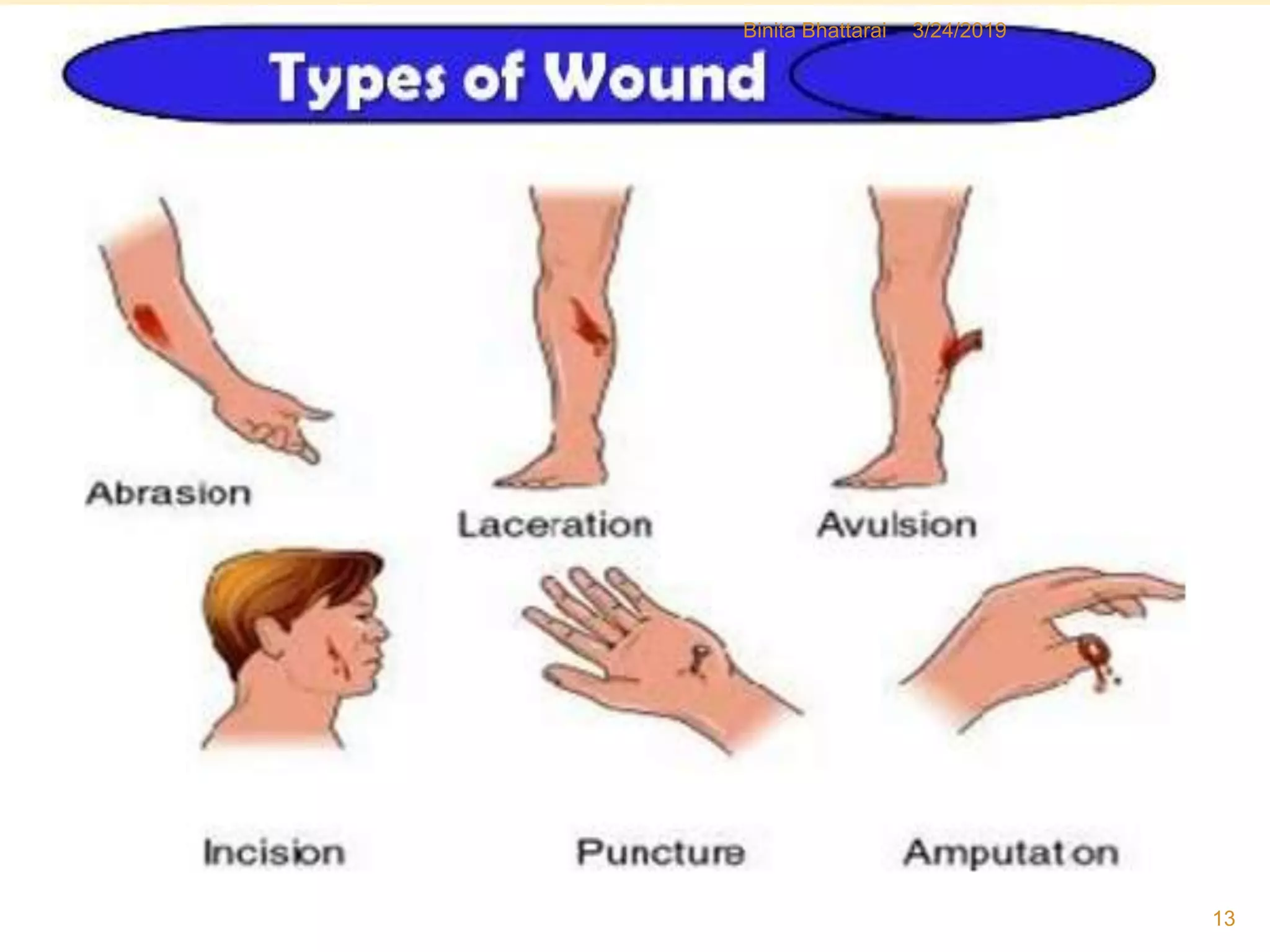
TYPES OF WOUND
 Open wound: An open wound is one in which there is a cut
or break in the continuity of the skin or mucus membranes. In
opened wound ,skin is broken which allows blood to escape
from the body. There are different types of wound:
 Incisions :caused by a clean ,sharp-edged object such as a
knife, a razor.
 Lacerations: irregular tear-like wounds by some blunt
trauma.
Binita Bhattarai
5
3/24/2019
3/24/2019Binita Bhattarai
6
CONTD..
 Abrasions (grazes):superficial wounds in which the topmost
layer of the skin is scraped off.
 Puncture: produced by sharp pointed object piercing the deep
tissues,leaving a very small opening on the surface.
 Penetration:caused by an object such as a knife entering and
coming out from skin.
 Gunshot :caused by a bullet or similar projectile driving into or
through the body.
Binita Bhattarai
7
3/24/2019
3/24/2019Binita Bhattarai
8
3/24/2019Binita Bhattarai
9
CONTD..
 Closed wound: closed wound allow blood to escape
from the circulatory system but not from the body
where skin is not broken.
 Contusions:more commonly known as bruises,caused
by a blunt force trauma that damage tissue under the
skin.
 Hematoma: collection of blood under the skin.
Binita Bhattarai
10
3/24/2019
3/24/2019Binita Bhattarai
11
CONTD.
 Crush injury: caused by extreme force applied
over a long period of time.
 Acute wound: disturbs the tissue.
 Chronic wound: slow process that lead to tissue
damage
Binita Bhattarai
12
3/24/2019
TYPES OF WOUND
Binita Bhattarai
13
3/24/2019
PRINCIPLES OF WOUND CARE
 Control of bleeding
 When there is an injury presents, blood usually follows.
 Bleeding is the body’s way of trying to clean out the
germs from the wound.
 But the continuous bleeding can leads to shock. So it is
necessary to control the bleeding immediately.
Binita Bhattarai
14
3/24/2019
CONTD…..
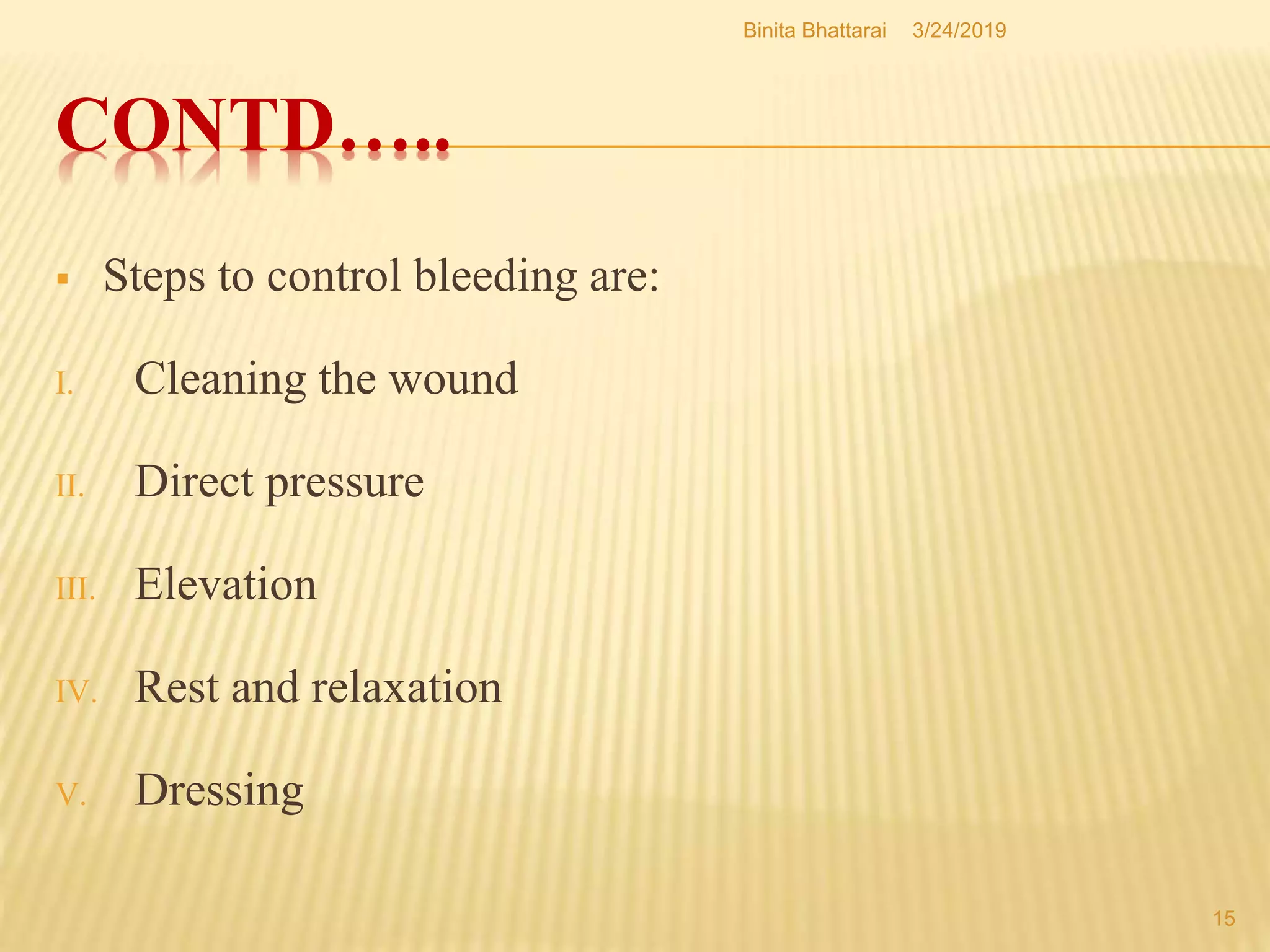
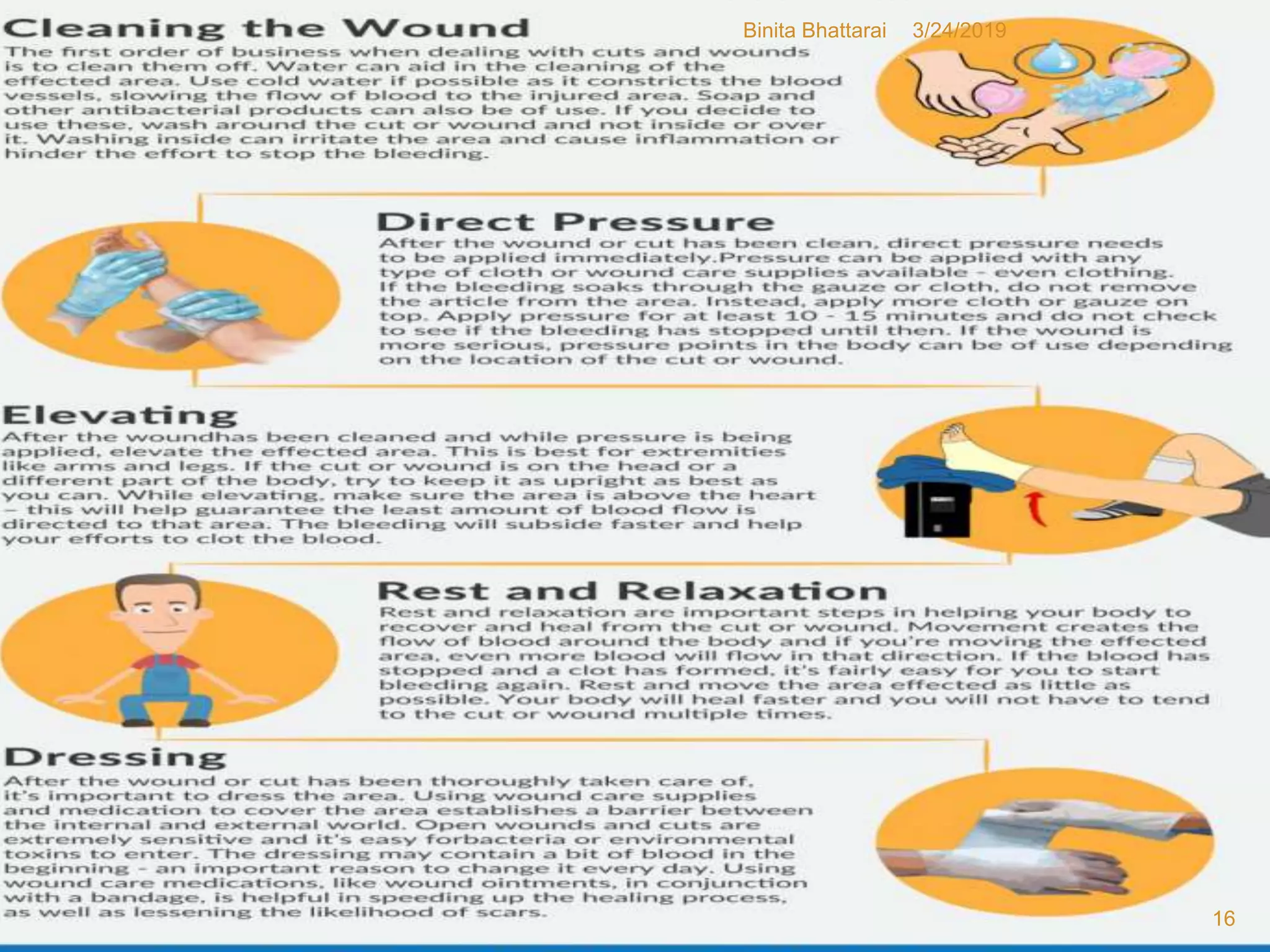
 Steps to control bleeding are:
I. Cleaning the wound
II. Direct pressure
III. Elevation
IV. Rest and relaxation
V. Dressing
Binita Bhattarai
15
3/24/2019
PRINCIPLES OF WOUND CARE
 Control of bleeding
Binita Bhattarai
16
3/24/2019
CONTD…..
 Prevention from wound infection
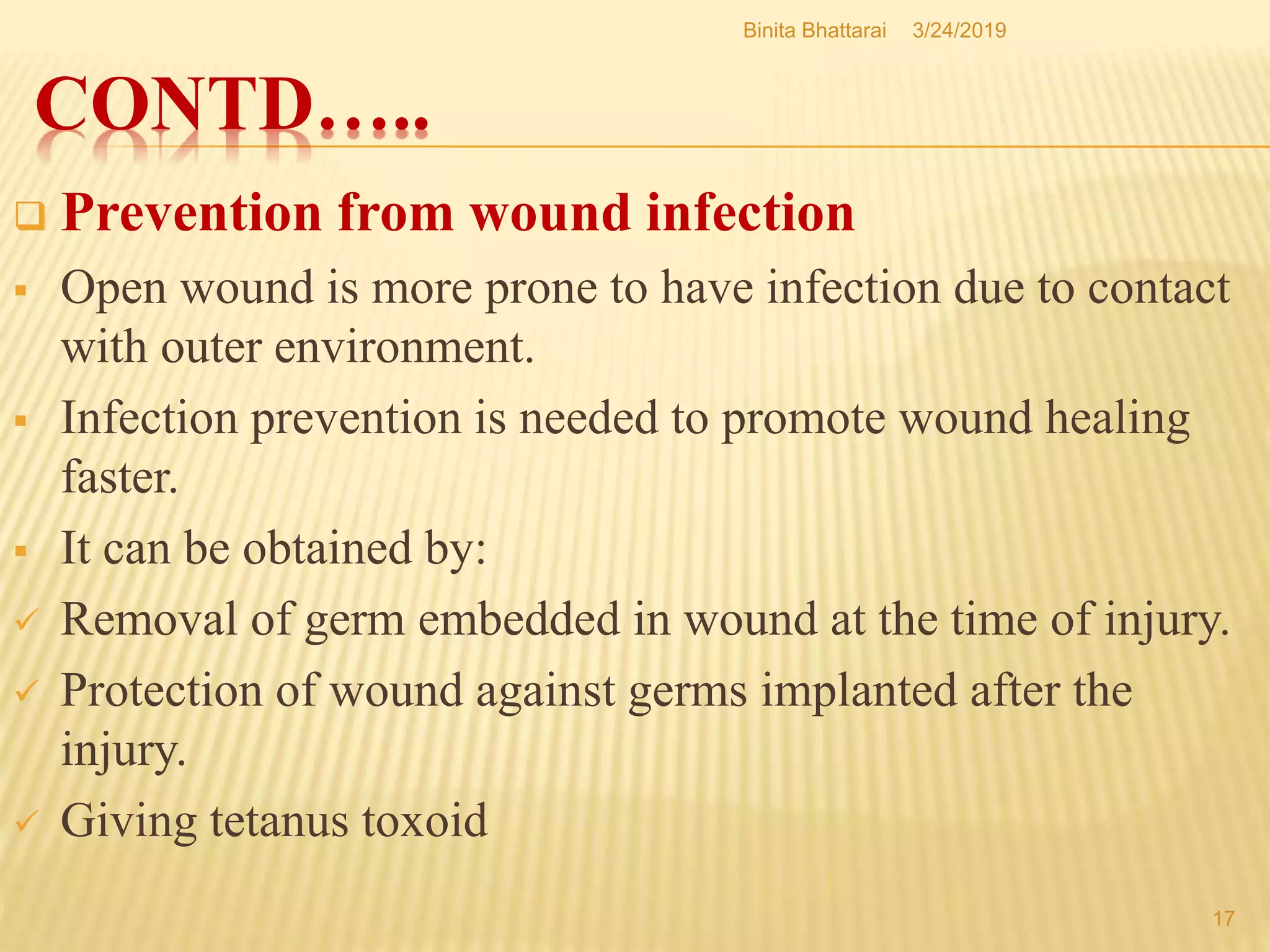
 Open wound is more prone to have infection due to contact
with outer environment.
 Infection prevention is needed to promote wound healing
faster.
 It can be obtained by:
 Removal of germ embedded in wound at the time of injury.
 Protection of wound against germs implanted after the
injury.
 Giving tetanus toxoid
Binita Bhattarai
17
3/24/2019
FIRST AID MANAGEMENT
 For minor wounds
 Wash your hands thoroughly with soap and clean
water,
 Avoid touching the wound with your fingers(use
disposable gloves).
 Don’t talk,cough,sneeze over the wound or
dressing.
 If the wound is dirty ,clean it by rinsing lightly
under running water from tap.
Binita Bhattarai
18
3/24/2019
CONTD..
 Pat gently dry with a sterile swab.
 Temporarily cover the wound with sterile gauze.
 Clean the skin around it with soap and water.
 Use new swab for each stroke.
 Pat dry,then cover the wound with an adhesive dressing.
Binita Bhattarai
19
3/24/2019
FIRST AID MANAGEMENT
 For major wounds
 Call for medical help.
 Apply continuous firm, direct pressure to wound,
using clean cloth or bandage until bleeding stops.
 If bleeding soaks through bandage, don't remove
the original bandage. Apply more bandages and
pressure.
 Get medical help to cleanse and close the wound
 Monitor and treat for shock if present.
Binita Bhattarai
20
3/24/2019
FIRST AID MANAGEMENT
 For externally bleeding wounds
 Don’t apply a tourniquet unless trained to do so.
 Don’t push anything back into the skin.
 Don’t apply antibiotic cream unless wound is
minor and cleaned first.
 Don’t remove blood soaked bandages.
 Don’t put pressure on an object sticking out of a
wound.
 Don’t use pressure points nor elevation.
Binita Bhattarai
21
3/24/2019
Binita Bhattarai
22
3/24/2019
Binita Bhattarai
23
3/24/2019
Binita Bhattarai
24
3/24/2019

First aid management of Wound

  • 1.
  • 2.
    FIRST AID MANAGEMENT OF WOUND Preparedby- Binita Bhattarai Bsc. Nursing 4th yr 6th batch Binita Bhattarai 2 3/24/2019
  • 3.
  • 4.
    WOUND  A woundis any damage or break in the surface of skin which disturbs the continuity of skin.  It also refers to the abnormal break in the skin from where blood escapes. Binita Bhattarai 4 3/24/2019
  • 5.
    TYPES OF WOUND Open wound: An open wound is one in which there is a cut or break in the continuity of the skin or mucus membranes. In opened wound ,skin is broken which allows blood to escape from the body. There are different types of wound:  Incisions :caused by a clean ,sharp-edged object such as a knife, a razor.  Lacerations: irregular tear-like wounds by some blunt trauma. Binita Bhattarai 5 3/24/2019
  • 6.
  • 7.
    CONTD..  Abrasions (grazes):superficialwounds in which the topmost layer of the skin is scraped off.  Puncture: produced by sharp pointed object piercing the deep tissues,leaving a very small opening on the surface.  Penetration:caused by an object such as a knife entering and coming out from skin.  Gunshot :caused by a bullet or similar projectile driving into or through the body. Binita Bhattarai 7 3/24/2019
  • 8.
  • 9.
  • 10.
    CONTD..  Closed wound:closed wound allow blood to escape from the circulatory system but not from the body where skin is not broken.  Contusions:more commonly known as bruises,caused by a blunt force trauma that damage tissue under the skin.  Hematoma: collection of blood under the skin. Binita Bhattarai 10 3/24/2019
  • 11.
  • 12.
    CONTD.  Crush injury:caused by extreme force applied over a long period of time.  Acute wound: disturbs the tissue.  Chronic wound: slow process that lead to tissue damage Binita Bhattarai 12 3/24/2019
  • 13.
    TYPES OF WOUND BinitaBhattarai 13 3/24/2019
  • 14.
    PRINCIPLES OF WOUNDCARE  Control of bleeding  When there is an injury presents, blood usually follows.  Bleeding is the body’s way of trying to clean out the germs from the wound.  But the continuous bleeding can leads to shock. So it is necessary to control the bleeding immediately. Binita Bhattarai 14 3/24/2019
  • 15.
    CONTD…..  Steps tocontrol bleeding are: I. Cleaning the wound II. Direct pressure III. Elevation IV. Rest and relaxation V. Dressing Binita Bhattarai 15 3/24/2019
  • 16.
    PRINCIPLES OF WOUNDCARE  Control of bleeding Binita Bhattarai 16 3/24/2019
  • 17.
    CONTD…..  Prevention fromwound infection  Open wound is more prone to have infection due to contact with outer environment.  Infection prevention is needed to promote wound healing faster.  It can be obtained by:  Removal of germ embedded in wound at the time of injury.  Protection of wound against germs implanted after the injury.  Giving tetanus toxoid Binita Bhattarai 17 3/24/2019
  • 18.
    FIRST AID MANAGEMENT For minor wounds  Wash your hands thoroughly with soap and clean water,  Avoid touching the wound with your fingers(use disposable gloves).  Don’t talk,cough,sneeze over the wound or dressing.  If the wound is dirty ,clean it by rinsing lightly under running water from tap. Binita Bhattarai 18 3/24/2019
  • 19.
    CONTD..  Pat gentlydry with a sterile swab.  Temporarily cover the wound with sterile gauze.  Clean the skin around it with soap and water.  Use new swab for each stroke.  Pat dry,then cover the wound with an adhesive dressing. Binita Bhattarai 19 3/24/2019
  • 20.
    FIRST AID MANAGEMENT For major wounds  Call for medical help.  Apply continuous firm, direct pressure to wound, using clean cloth or bandage until bleeding stops.  If bleeding soaks through bandage, don't remove the original bandage. Apply more bandages and pressure.  Get medical help to cleanse and close the wound  Monitor and treat for shock if present. Binita Bhattarai 20 3/24/2019
  • 21.
    FIRST AID MANAGEMENT For externally bleeding wounds  Don’t apply a tourniquet unless trained to do so.  Don’t push anything back into the skin.  Don’t apply antibiotic cream unless wound is minor and cleaned first.  Don’t remove blood soaked bandages.  Don’t put pressure on an object sticking out of a wound.  Don’t use pressure points nor elevation. Binita Bhattarai 21 3/24/2019
  • 22.
  • 23.
  • 24.