“If you were having
a birthday party,
which of your three
classmates would
you invite?”
Sociograms
SOCIOGRAMS
“graphic representation of social
links that a person has”
It is used to analyze the choices or
preferences each student makes
within a group
A sociogram is a teacher-made
device that determines how a
student is viewed by his/her
peers as he/she interacts with
classmates.
SOCIOGRAMS
It is constructed after
each student responds to
a question that tries to
probe the social affiliation
with other students (or
classmates)
SOCIOGRAMS
The result of the
sociometric test are
tabulated to determine how
many times each student is
selected and by whom
SOCIOGRAMS
Categories of students in a class
Star
A student who is
chosen by the most
number of his
classmates
Isolate
A student who is not
chosen by any of his
classmates
Categories of students in a class
Mutual Choice
Students who choose
each other
Categories of students in a class
One-way Choice
Students who choose
someone but the
choice is not
reciprocated
Categories of students in a class
Clique
Group of three or more
students within a class
who all choose each
other
Categories of students in a class
How to Devise a Sociogram
1. Devise a question that is simple and
easy-to-understand
e.g. “If you were having a birthday
party, which of your three classmates
would you invite?”
How to Devise a Sociogram
2. Ask students to write their answers
to the question.
(clearly state any limitations on choices
to be made)
e.g. number of choices, classmates only
How to Devise a Sociogram
3. Tally the number of times each
student is chosen.
How to Devise a Sociogram
4. Make a diagram consisting of several
circles.
(Each circle contains a student’s name.
indicate by an arrow the student who
chose another classmate.)
How to Devise a Sociogram
5. Assess the diagram to determine who
among the students is the most popular
and the most unpopular.
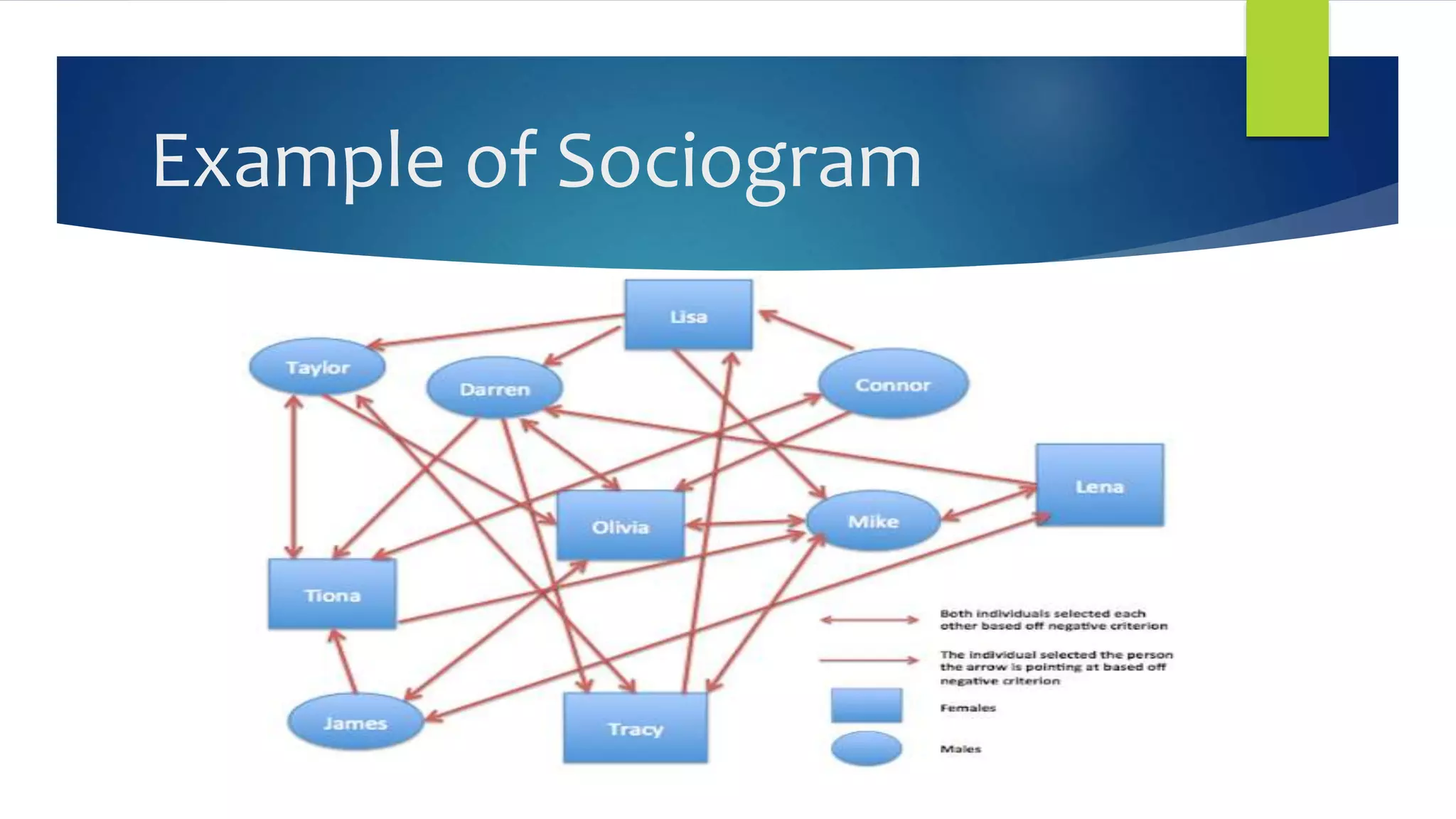
Example of Sociogram
Uses of Sociograms
1. allowing a student to work with
a chosen classmate or friends
2. placing an isolate in a situation
wherein he could be a charade
leader or a team captain
Uses of Sociograms
3. providing training in social skills
to the isolates or one-way choice
students
Uses of Sociograms
4. identifying pathways for social
acceptance for students who
often misbehave
Uses of Sociograms
In a sense, the sociogram can
determine those who are friends
and those who are not.
Limitations of
Sociograms
1. Sociograms only indicate
choices, not the reasons for such
choices
2. Sociograms do not necessarily
reflect true social acceptance or
integration in case of mutual
choices and cliques
Limitations of
Sociograms
3. Sociograms do not actually
reflect isolates as rejected by his
classmates. Isolates may be pupils
who are new or shy in class
Limitations of
Sociograms
4. Sociograms may indicate
popularity or isolation based on
the kind of questions asked. If the
situations were to be changed, the
choices may be quite different.
Limitations of
Sociograms
To make the sociograms more valid and
reliable, they should be used at the start
and end of the academic year or perhaps
administer a sociometric test at the middle
of the school year with different set of
questions asked under different situations.
Measuring Values
Values are defined as an
individual’s belief about ideal
conduct in the pursuit of truth,
wisdom, and beauty.
Values are usually learned and are
upheld important by groups of people.
Marriage is upheld by society as a
sacred ceremony and anyone who
refuses to accept it as such is
considered a social deviant.
Values must first be chosen willingly
from a set of alternatives. Then, they
should be cherished by a person. Lastly,
they must be acted upon repeatedly by
the individual.
The clarification process involves the
following steps:
C- choose willingly from alternatives
P- prize a value
A- act on that value repeatedly
Value Clusters
Self – discipline
Cleanliness, orderliness, fitness,
health, ecological harmony, orderly
conduct and self-control
Value Clusters
Integrity
Being true to oneself, truthfulness,
trustworthiness, sincerity, and
honesty
Value Clusters
Courage
Assertiveness, positive attitude,
spiritual strength
Value Clusters
Respect
Care, concern, tolerance,
consideration
Value Clusters
Responsibility
Commitment, accountability,
reliability
Value Clusters
Nationalism / Cultural
Loyalty, patriotism, appreciation of
heritage, pride in one’s country
Value Clusters
Peace / Prudence
Justice, fairness, harmony, serenity
Value Clusters
Self- reliance
Trustworthiness, independence,
industry, resourcefulness, creativity
Value Clusters
Love / Selflessness
Service, kindness, friendliness,
brotherhood
Value Clusters
Excellence
Productivity, quality, perseverance
Value Clusters
Spirituality
Humility, realization, of oneness with
other people and beings, purity,
sensitiveness to religious values
Value Clusters
Harmony
Beauty and simplicity
In measuring a particular value that is
internalized in a student, the specific
indicators should be spelled out and the
options may be listed as follows:
Always, Often, Sometimes, Seldom, and
Never
Example of a rating scale measuring
patriotism
Indicator Always
5
Often
4
Sometimes
3
Seldom
2
Never
1
I buy Filipino-made products
I sing “Lupang Hinirang”.
I tell others to visit the beautiful
places in the country.
I tell others to admire stories
about our national heroes.
I read books about our national
heroes.
Activity

Sociograms