










EDUCATIONAL RESEARCH I ESCUELA: CIENCIAS DE LA EDUCACION  MENCION: INGLES NOMBRES: Lcda. Alexandra Zúñiga Ojeda PERIODO: Abril - Agosto 2009
Welcome Second Bimester
General Objectives To analyze various tools of research To construct different types of instruments To understand and analyze the different steps of the research  proposal
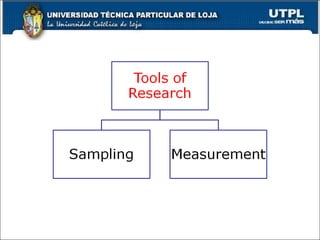
TOOLS OF RESEARCH CHAPTER 3
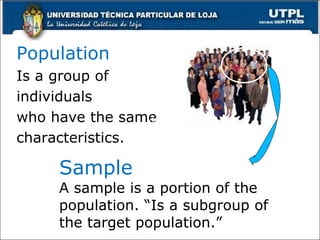
Sample A sample is a portion of the population.  “ Is a subgroup of the target population.” Population Is a group of individuals who have the same  characteristics. Identify
Steps in Sampling Recognize the population Identify the portion of the population to which one can have access. From the accessible population, one selects a sample.
Characteristics of the Sample Importance : E nables the researcher to study a portion of the population rather than the entire population. Representative which means the selection of individuals are from the population under study. Allows to generalize with confidence from the sample to the population.
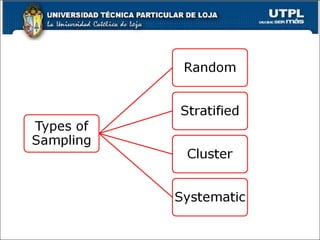
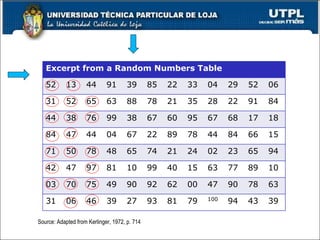
1. Random Sampling All members of the population have an equal and independent chance of being included. Procedure: Assign a number to  each  individual of the population. Use a random table  (statistics books) Example in the annex Nº 4 of your guide
Source: Adapted from Kerlinger, 1972, p. 714 Excerpt from a Random Numbers Table 52 13 44 91 39 85 22 33 04 29 52 06 31 52 65 63 88 78 21 35 28 22 91 84 44 38 76 99 38 67 60 95 67 68 17 18 84 47 44 04 67 22 89 78 44 84 66 15 71 50 78 48 65 74 21 24 02 23 65 94 42 47 97 81 10 99 40 15 63 77 89 10 03 70 75 49 90 92 62 00 47 90 78 63 31 06 46 39 27 93 81 79 100 94 43 39
2. Stratified Sampling Researchers divide the population on some specific characteristic. e.g.  gender, age, occupation, etc. Procedure: Divide the population by the stratum. Sample within each group in the stratum.
The individuals selected are proportional to their representation Population N= 9,0000 Boys N= 6,000 Girls N= 3,000 Random Sampling .66 of population .33 of population 200 100 Sample  =300 By: Creswell J. W. (2008)
“ We can see that of the 9,000 Native American children in the state, 3,000 are girls and  6,000 are boys. A researcher decided to choose a sample of 300 from this population of 9,000 children. A simple random sample results in the selection of mostly boys because there are more boys than girls in the population.
To make sure that the researcher selects boys in proportion to their representation in the population, she divides the list of 9,000 children into boys and girls. Then one third of the sample (3,000/9,000) of the sample is chosen to be girls, and two thirds (6,000/9,000), boys. The stratification procedure consist of stratifying by the population into boys and girls and selecting individuals  in proportion to their representation in the total population, resulting in 200 boys and 100 girls
3. Cluster Sampling It is used when the researcher cannot easily identify the population or the population is extremely large . The researcher would choose a number of schools randomly from a list of schools and then include all the students in those schools in the sample The unit chosen is not an individual but a group of individuals who are naturally together.
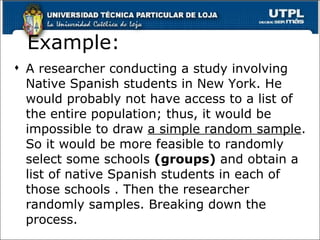
New York Some schools Native Spanish students Cluster Sampling
Example: A researcher conducting a study involving Native Spanish students in New York. He would probably not have access to a list of the entire population; thus, it would be impossible to draw  a simple random sample . So it would be more feasible to randomly select some schools  (groups)  and obtain a list of native Spanish students in each of those schools . Then the researcher randomly samples. Breaking down the process.
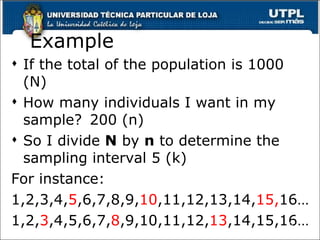
4. Systematic Sampling This procedure involves drawing a sample by taking every  kth  case from a list of the population. It is a slight variation of the simple random sampling. It is more convenient because individuals do not have to be numbered and it does not require a random number table.
Example If the total of the population is 1000 (N) How many individuals I want in my sample? 200 (n) So I divide  N  by  n  to determine the sampling interval 5 (k) For instance : 1,2,3,4, 5 ,6,7,8,9, 10 ,11,12,13,14, 15, 16… 1,2, 3 ,4,5,6,7, 8 ,9,10,11,12, 13 ,14,15,16…
Size of Sample Select as large a sample as possible from the population. (It will be more representative.) The larger the sample, the less the potential error.(Data will be more accurate and precise.) Representativeness
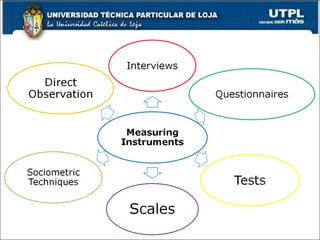
Measuring Instruments It is important to select reliable measuring instruments for the purpose of quantifying the behaviors and attributes he has chosen to study. One has to select or develop scales and instruments that can measure characteristics such as intelligence, personality, motivation, and attitudes.
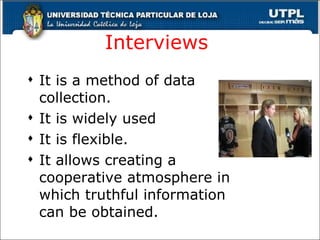
Interviews   It is a method of data collection. It is widely used It is flexible. It allows creating a cooperative atmosphere in which truthful information can be obtained .
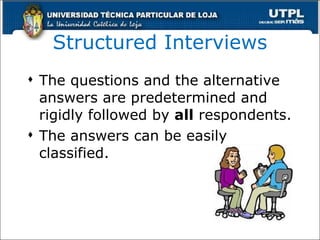
Structured  Interviews The questions and the alternative answers are predetermined and rigidly followed by  all  respondents. The answers can be easily classified.
Unstructured  Interviews These are more informal Free questioning of the subjects is possible regarding their views, attitudes, beliefs and other info. These are more flexible. The interviewees are given freedom to go beyond simple responses.
The question may deviate from the original plans and center in points that seem to be important. The interviews need expert, skillful, and alert interviewers. Help to generate and clarify the dimension present in the topic.
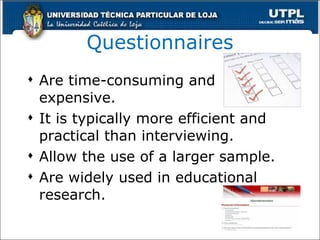
Questionnaires Are time-consuming and expensive. It is typically more efficient and practical than interviewing. Allow the use of a larger sample. Are widely used in educational research.
Structured Questionnaires Contains the questions and the alternative answers to them. The answers provided should include all possible responses. They force subjects to choose one of a number of preselected answers.
Unstructured Questionnaires Do not include suggested answers. Give the respondents freedom to reveal their opinions and attitudes. The information that respondents generate is not easy to process and analyze. Respondents may omit important information or emphasize thing that are of no interest to the researcher.
Validation of Questionnaires One way to validate a questionnaire is by interviewing a random sample of the respondents  and obtain their views  on the same topics covered in it. Some studies use direct observation of behavior as a criterion  of the validity of questionnaire responses.
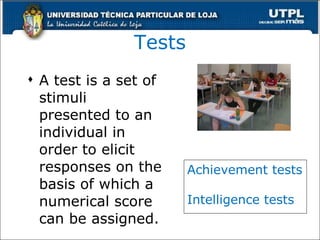
Tests A test is a set of stimuli presented to an individual in order to elicit responses on the basis of which a numerical score can be assigned . Achievement tests Intelligence tests
Achievement Tests Measure the mastery and proficiency of individuals in different areas of knowledge. Types: Standardized Teacher or research made
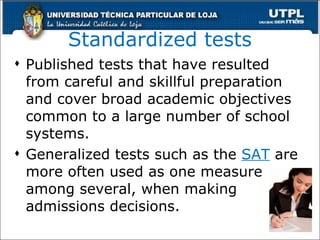
Standardized tests Published tests that have resulted from careful and skillful preparation and cover broad academic objectives common to a large number of school systems. Generalized tests such as the  SAT  are more often used as one measure among several, when making admissions decisions.
The use of norms gives an educator the basis for comparing his group with an estimate of the mean for all children at that grade level. Wikipedia “the results can be empirically documented, therefore the test scores can be shown to have a relative degree of  validity  and  reliability , as well as results which are generalizable … “
Teacher or research made These tests are used when the standardized tests are not appropriate to the specific objectives of a research study. The teacher or researcher should take grate care in preparing the test in relation to validity and reliability.
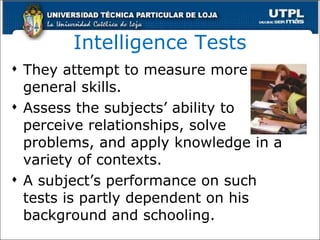
Intelligence Tests They attempt to measure more general skills. Assess the subjects’ ability to perceive relationships, solve problems, and apply knowledge in a variety of contexts. A subject’s performance on such tests is partly dependent on his background and schooling.
Scales A scale is a set of numerical values assigned to subjects, objects, or behaviors for the purpose of quantifying and measuring qualities. In contrast to tests, scales do not indicate success or failure  or strength and weakness.
Sociometric Techniques Methods for quantitatively assessing and measuring interpersonal and group relationships. The basic procedure involves requesting the members of a particular group to indicate their first, second, and subsequent  choices.
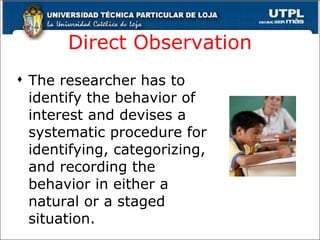
Direct Observation The researcher has to identify the behavior of interest and devises a systematic procedure for identifying, categorizing, and recording the behavior in either a natural or a staged situation.
Validity Means that the individual’s scores from an instrument make sense, are meaningful, and enable you, as the researcher, to draw good conclusions from the sample you are studying to the population.
Factors that affect validity A poor designed study Participant fatigue, stress, and misunderstanding of questions on the instrument Inability to make useful predictions from scores .
Content Validity Is the extent to which the questions on the instrument and the scores from these questions are representative of all the possible questions that a researcher could ask about the content of skills.
Content Validity Researchers examine the plan and the procedures used in construction the instrument. They examine the information about the objectives of the instrument, the content areas, and the level of difficulty of the questions.
Face Validity Is a  subjective evaluation  by expert judges as to what a measuring instrument appears to measure. Example: When one makes a judgment as to whether a test is valid for certain purposes by reading over the items but  without any objective evaluation .
Sampling Validity It is based upon expert judgment. If the content validity of an instrument is based upon an  adequate sampling  of the potential questions from a defined universe of items.
The experts’ task involves: Defining carefully the behavior, qualities, or content area  to be measured. Systematically subdividing  the total area into categories that represent different aspects of that content area followed by making judgments as to whether or not there are enough items in each category.
Reliability Means that scores from an instrument are stable and consistent. That is, scores should be nearly the same when researchers administer the instrument multiple times at different times.
Factors that affect reliability Questions of instruments are ambiguous and unclear. Procedures of test administration vary and are not standardize. Participants are fatigued, are nervous, misinterpret questions or guess on tests.
RESEARCH PROPOSAL CHAPTER 4
Stage 1: Plan the research PROPOSAL Identification of the problem Do we have to include culture in the English programs? Why do students in our public schools fail to learn English? How do adults learn a language?
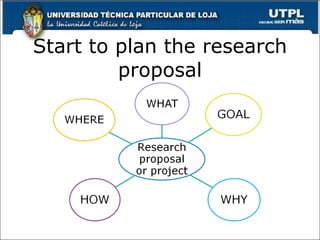
Start to plan the research proposal
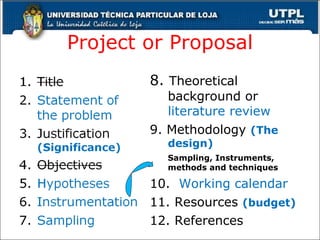
Project or Proposal 8.  Theoretical background or  literature review 9. Methodology  (The design) Sampling, Instruments, methods and techniques 10.  Working calendar 11. Resources  (budget) 12. References
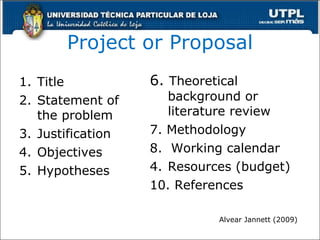
Project or Proposal Title Statement of the problem  Justification Objectives Hypotheses 6.  Theoretical background or literature review 7. Methodology 8.  Working calendar Resources (budget) 10. References Alvear Jannett (2009) )
The title/topic The name of the specific research problem or issue  Function:  - To differentiate the proposal/ project from other ones. - To announce the content of the proposal or project
Statement of the Problem ACCESSING  THE PROBLEM Description of the problem  Description of the background of the problem.
Justification Creswell (2008) “it presents the reasons for the importance of studying the issue or concern.” Reasons The relevance Who will benefit from the project? Expectations in the society,    institution, community … Feasibility and possibility Time and resources
Objectives Aims or objectives the researcher attempts to achieve To identify Teaching Techniques used by English teachers. To determine the importance of the use of teaching techniques in English classrooms.
Theoretical Background or Literature Review John Creswell (2008) “a written  summary  of journals articles, books  and other documents that describes the past  and current state of information; organizes the literature into  topics; and  documents  a need for a proposal study”. Document how your study adds to the existing information.
Hypothesis A hypothesis is a tentative theory or supposition provisionally stated by the researcher to explain certain facts, and to guide the investigation. If the project is a survey the problem will be stated in question form. If the project is designed to test a theory, the problem will be stated in hypothesis form.
Question form Hypothesis form
Methodological design HOW THE RESEARCH WILL BE CONDUCTED? Decide the Population or sample Determine the  methods, techniques, and instruments.
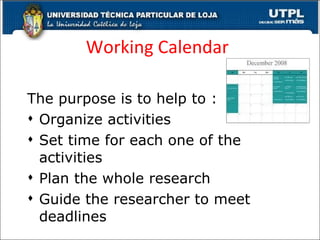
Working Calendar The purpose is to help to : Organize activities Set time for each one of the activities Plan the whole research  Guide the researcher to meet deadlines
Resources and Budget List  of human resources List of material resources Budget (financial sources)
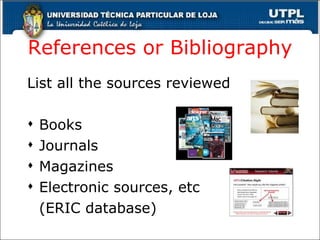
References or Bibliography List all the sources reviewed Books Journals Magazines Electronic sources, etc (ERIC  database )
Assignment second bimester OBJECTIVE PART Activity 1 True and false statements. ESSAY PART Activity 2 Construct a questionnaire using different structured-response modes to find out about the tests used by English teachers in their classrooms.
Activity 3 Given the following topic “Teaching Techniques used by English teachers” elaborate the following stages of a research proposal Statement of the problem Significance of the study Objectives Instrumentation
Questions???
Educational Resarch I,  II Bimestre

Educational Resarch I, II Bimestre

  • 1.
    EDUCATIONAL RESEARCH IESCUELA: CIENCIAS DE LA EDUCACION MENCION: INGLES NOMBRES: Lcda. Alexandra Zúñiga Ojeda PERIODO: Abril - Agosto 2009
  • 2.
  • 3.
    General Objectives Toanalyze various tools of research To construct different types of instruments To understand and analyze the different steps of the research proposal
  • 4.
  • 6.
    Sample A sampleis a portion of the population. “ Is a subgroup of the target population.” Population Is a group of individuals who have the same characteristics. Identify
  • 7.
    Steps in SamplingRecognize the population Identify the portion of the population to which one can have access. From the accessible population, one selects a sample.
  • 8.
    Characteristics of theSample Importance : E nables the researcher to study a portion of the population rather than the entire population. Representative which means the selection of individuals are from the population under study. Allows to generalize with confidence from the sample to the population.
  • 10.
    1. Random SamplingAll members of the population have an equal and independent chance of being included. Procedure: Assign a number to each individual of the population. Use a random table (statistics books) Example in the annex Nº 4 of your guide
  • 11.
    Source: Adapted fromKerlinger, 1972, p. 714 Excerpt from a Random Numbers Table 52 13 44 91 39 85 22 33 04 29 52 06 31 52 65 63 88 78 21 35 28 22 91 84 44 38 76 99 38 67 60 95 67 68 17 18 84 47 44 04 67 22 89 78 44 84 66 15 71 50 78 48 65 74 21 24 02 23 65 94 42 47 97 81 10 99 40 15 63 77 89 10 03 70 75 49 90 92 62 00 47 90 78 63 31 06 46 39 27 93 81 79 100 94 43 39
  • 12.
    2. Stratified SamplingResearchers divide the population on some specific characteristic. e.g. gender, age, occupation, etc. Procedure: Divide the population by the stratum. Sample within each group in the stratum.
  • 13.
    The individuals selectedare proportional to their representation Population N= 9,0000 Boys N= 6,000 Girls N= 3,000 Random Sampling .66 of population .33 of population 200 100 Sample =300 By: Creswell J. W. (2008)
  • 14.
    “ We cansee that of the 9,000 Native American children in the state, 3,000 are girls and 6,000 are boys. A researcher decided to choose a sample of 300 from this population of 9,000 children. A simple random sample results in the selection of mostly boys because there are more boys than girls in the population.
  • 15.
    To make surethat the researcher selects boys in proportion to their representation in the population, she divides the list of 9,000 children into boys and girls. Then one third of the sample (3,000/9,000) of the sample is chosen to be girls, and two thirds (6,000/9,000), boys. The stratification procedure consist of stratifying by the population into boys and girls and selecting individuals in proportion to their representation in the total population, resulting in 200 boys and 100 girls
  • 16.
    3. Cluster SamplingIt is used when the researcher cannot easily identify the population or the population is extremely large . The researcher would choose a number of schools randomly from a list of schools and then include all the students in those schools in the sample The unit chosen is not an individual but a group of individuals who are naturally together.
  • 17.
    New York Someschools Native Spanish students Cluster Sampling
  • 18.
    Example: A researcherconducting a study involving Native Spanish students in New York. He would probably not have access to a list of the entire population; thus, it would be impossible to draw a simple random sample . So it would be more feasible to randomly select some schools (groups) and obtain a list of native Spanish students in each of those schools . Then the researcher randomly samples. Breaking down the process.
  • 19.
    4. Systematic SamplingThis procedure involves drawing a sample by taking every kth case from a list of the population. It is a slight variation of the simple random sampling. It is more convenient because individuals do not have to be numbered and it does not require a random number table.
  • 20.
    Example If thetotal of the population is 1000 (N) How many individuals I want in my sample? 200 (n) So I divide N by n to determine the sampling interval 5 (k) For instance : 1,2,3,4, 5 ,6,7,8,9, 10 ,11,12,13,14, 15, 16… 1,2, 3 ,4,5,6,7, 8 ,9,10,11,12, 13 ,14,15,16…
  • 21.
    Size of SampleSelect as large a sample as possible from the population. (It will be more representative.) The larger the sample, the less the potential error.(Data will be more accurate and precise.) Representativeness
  • 22.
    Measuring Instruments Itis important to select reliable measuring instruments for the purpose of quantifying the behaviors and attributes he has chosen to study. One has to select or develop scales and instruments that can measure characteristics such as intelligence, personality, motivation, and attitudes.
  • 24.
    Interviews It is a method of data collection. It is widely used It is flexible. It allows creating a cooperative atmosphere in which truthful information can be obtained .
  • 25.
    Structured InterviewsThe questions and the alternative answers are predetermined and rigidly followed by all respondents. The answers can be easily classified.
  • 26.
    Unstructured InterviewsThese are more informal Free questioning of the subjects is possible regarding their views, attitudes, beliefs and other info. These are more flexible. The interviewees are given freedom to go beyond simple responses.
  • 27.
    The question maydeviate from the original plans and center in points that seem to be important. The interviews need expert, skillful, and alert interviewers. Help to generate and clarify the dimension present in the topic.
  • 28.
    Questionnaires Are time-consumingand expensive. It is typically more efficient and practical than interviewing. Allow the use of a larger sample. Are widely used in educational research.
  • 29.
    Structured Questionnaires Containsthe questions and the alternative answers to them. The answers provided should include all possible responses. They force subjects to choose one of a number of preselected answers.
  • 30.
    Unstructured Questionnaires Donot include suggested answers. Give the respondents freedom to reveal their opinions and attitudes. The information that respondents generate is not easy to process and analyze. Respondents may omit important information or emphasize thing that are of no interest to the researcher.
  • 31.
    Validation of QuestionnairesOne way to validate a questionnaire is by interviewing a random sample of the respondents and obtain their views on the same topics covered in it. Some studies use direct observation of behavior as a criterion of the validity of questionnaire responses.
  • 32.
    Tests A testis a set of stimuli presented to an individual in order to elicit responses on the basis of which a numerical score can be assigned . Achievement tests Intelligence tests
  • 33.
    Achievement Tests Measurethe mastery and proficiency of individuals in different areas of knowledge. Types: Standardized Teacher or research made
  • 34.
    Standardized tests Publishedtests that have resulted from careful and skillful preparation and cover broad academic objectives common to a large number of school systems. Generalized tests such as the SAT are more often used as one measure among several, when making admissions decisions.
  • 35.
    The use ofnorms gives an educator the basis for comparing his group with an estimate of the mean for all children at that grade level. Wikipedia “the results can be empirically documented, therefore the test scores can be shown to have a relative degree of validity and reliability , as well as results which are generalizable … “
  • 36.
    Teacher or researchmade These tests are used when the standardized tests are not appropriate to the specific objectives of a research study. The teacher or researcher should take grate care in preparing the test in relation to validity and reliability.
  • 37.
    Intelligence Tests Theyattempt to measure more general skills. Assess the subjects’ ability to perceive relationships, solve problems, and apply knowledge in a variety of contexts. A subject’s performance on such tests is partly dependent on his background and schooling.
  • 38.
    Scales A scaleis a set of numerical values assigned to subjects, objects, or behaviors for the purpose of quantifying and measuring qualities. In contrast to tests, scales do not indicate success or failure or strength and weakness.
  • 39.
    Sociometric Techniques Methodsfor quantitatively assessing and measuring interpersonal and group relationships. The basic procedure involves requesting the members of a particular group to indicate their first, second, and subsequent choices.
  • 40.
    Direct Observation Theresearcher has to identify the behavior of interest and devises a systematic procedure for identifying, categorizing, and recording the behavior in either a natural or a staged situation.
  • 41.
    Validity Means thatthe individual’s scores from an instrument make sense, are meaningful, and enable you, as the researcher, to draw good conclusions from the sample you are studying to the population.
  • 42.
    Factors that affectvalidity A poor designed study Participant fatigue, stress, and misunderstanding of questions on the instrument Inability to make useful predictions from scores .
  • 43.
    Content Validity Isthe extent to which the questions on the instrument and the scores from these questions are representative of all the possible questions that a researcher could ask about the content of skills.
  • 44.
    Content Validity Researchersexamine the plan and the procedures used in construction the instrument. They examine the information about the objectives of the instrument, the content areas, and the level of difficulty of the questions.
  • 45.
    Face Validity Isa subjective evaluation by expert judges as to what a measuring instrument appears to measure. Example: When one makes a judgment as to whether a test is valid for certain purposes by reading over the items but without any objective evaluation .
  • 46.
    Sampling Validity Itis based upon expert judgment. If the content validity of an instrument is based upon an adequate sampling of the potential questions from a defined universe of items.
  • 47.
    The experts’ taskinvolves: Defining carefully the behavior, qualities, or content area to be measured. Systematically subdividing the total area into categories that represent different aspects of that content area followed by making judgments as to whether or not there are enough items in each category.
  • 48.
    Reliability Means thatscores from an instrument are stable and consistent. That is, scores should be nearly the same when researchers administer the instrument multiple times at different times.
  • 49.
    Factors that affectreliability Questions of instruments are ambiguous and unclear. Procedures of test administration vary and are not standardize. Participants are fatigued, are nervous, misinterpret questions or guess on tests.
  • 50.
  • 52.
    Stage 1: Planthe research PROPOSAL Identification of the problem Do we have to include culture in the English programs? Why do students in our public schools fail to learn English? How do adults learn a language?
  • 53.
    Start to planthe research proposal
  • 54.
    Project or Proposal8. Theoretical background or literature review 9. Methodology (The design) Sampling, Instruments, methods and techniques 10. Working calendar 11. Resources (budget) 12. References
  • 55.
    Project or ProposalTitle Statement of the problem Justification Objectives Hypotheses 6. Theoretical background or literature review 7. Methodology 8. Working calendar Resources (budget) 10. References Alvear Jannett (2009) )
  • 56.
    The title/topic Thename of the specific research problem or issue Function: - To differentiate the proposal/ project from other ones. - To announce the content of the proposal or project
  • 57.
    Statement of theProblem ACCESSING THE PROBLEM Description of the problem Description of the background of the problem.
  • 58.
    Justification Creswell (2008)“it presents the reasons for the importance of studying the issue or concern.” Reasons The relevance Who will benefit from the project? Expectations in the society, institution, community … Feasibility and possibility Time and resources
  • 59.
    Objectives Aims orobjectives the researcher attempts to achieve To identify Teaching Techniques used by English teachers. To determine the importance of the use of teaching techniques in English classrooms.
  • 60.
    Theoretical Background orLiterature Review John Creswell (2008) “a written summary of journals articles, books and other documents that describes the past and current state of information; organizes the literature into topics; and documents a need for a proposal study”. Document how your study adds to the existing information.
  • 61.
    Hypothesis A hypothesisis a tentative theory or supposition provisionally stated by the researcher to explain certain facts, and to guide the investigation. If the project is a survey the problem will be stated in question form. If the project is designed to test a theory, the problem will be stated in hypothesis form.
  • 62.
  • 63.
    Methodological design HOWTHE RESEARCH WILL BE CONDUCTED? Decide the Population or sample Determine the methods, techniques, and instruments.
  • 64.
    Working Calendar Thepurpose is to help to : Organize activities Set time for each one of the activities Plan the whole research Guide the researcher to meet deadlines
  • 65.
    Resources and BudgetList of human resources List of material resources Budget (financial sources)
  • 66.
    References or BibliographyList all the sources reviewed Books Journals Magazines Electronic sources, etc (ERIC database )
  • 67.
    Assignment second bimesterOBJECTIVE PART Activity 1 True and false statements. ESSAY PART Activity 2 Construct a questionnaire using different structured-response modes to find out about the tests used by English teachers in their classrooms.
  • 68.
    Activity 3 Giventhe following topic “Teaching Techniques used by English teachers” elaborate the following stages of a research proposal Statement of the problem Significance of the study Objectives Instrumentation
  • 69.

Editor's Notes

  • #2 utpl
  • #3 Good evening dear students, I would like to welcome you to this videoconference of Educational Research I. My name is Alexandra Zuniga and I will be the tutor of this subject. This is Lic. Alba Vargas who is the tutor of Educational Research II; we both work as a team to organize the contents of these two subjects and provide you with knowledge which is presented from simple to complex. This knowledge will help you first to accomplish you thesis at the end of your program and in the future identify problems as teachers in your field. The contents of Educational Research I gives you an overall view of the process of research. First of all, basic concepts and definitions are presented; then, these concepts are related to the characteristics research. utpl
  • #4 As you have checked the organization of your guide. This guide functions, at the same time, as a text. For this reason, this material is the main source to study, learn, and understand research. However, remember that you will find useful information through the EVA and If you want to broaden your knowledge, you are allow to search information in different sources like books in libraries, articles, and the internet. (Espanol) utpl
  • #14 Pagina 154 y 155 libro de Creswell utpl
  • #71 utpl
  • #72 utpl