Prownty
M
INTRODUCTION
INTRODUCTION
• The word Sociometry comes from Latin word "Socius,"-
Partner/Friend/Companion and "Metrum,"- meaning
Measure.
• As these roots imply ,sociometry is a way of
measuring the degree of relatedness among
people.
• Term-coined by J.L.Moreno
DEFINITION
• Sociometry is "a method for, describing, discovering and
evaluating social status, structure, and development
through measuring the extent of acceptance or rejection
between individuals in groups
According to Jaspreet Kaur Sodhi.
• Purpose of Sociometry
• Measurement of relatedness
• interaction and the structure of a
group
•Assessment of behavior within groups
• To measure group characteristics- such as
morale, bonding etc
• Improving communication
Type of Sociometry
• Two main branches
1. Research sociometry
2. Applied sociometry
Research sociometry
• is action research with groups exploring
the socioemotional networks of
relationships using specified criteria.
• Example : - Who in this group do you want
to sit beside you at work?
Applied sociometrists
• Applied sociometrists utilize a range of
methods to assist people and groups
review, expand and develop their existing
psycho-social networks of relationships.
USES
OF
SOCIOMETRY ho
LIMITATION
OF
SOCIOMETRY
LIMITATION OF SOCIOMETRY
• A . Not necessarily stable relationship.
• B . Some members of the group may not reveal their real
relationships on account of some fear or other
considerations.
PROCESS OF SOCIOMETRY cp
A sociogram is an important tools for teachers
The sociogram is the chart used to actually apply
sociometry in the classroom .
• It charts the interrelationship within a group .
• It purpose is to discover group structures and
the relation of any one person to the group as a
whole.
• This shows the positive nature of sociometry and the use
of it is important for understanding the relationships
within classrooms .
Once this relationship is understood by the teacher , group
work can be better facilitated for greater learning to
Occur .
• The data for the sociogram may also be displayed as a
table or matrix of each person's choices . Such a table is
called a sociomatrix .
• Sociometric Techniques
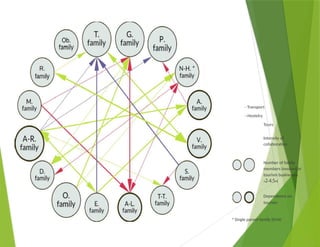
SOCIOGRAM
• A sociogram is a graphic
representation of social links
that a person has. It is a graph
drawing that plots the structure
of interpersonal relations in a
group situation.
Sociometric Techniques fc
• 1. Sociogram
• 2. Sociometric
• 3. Guess-Who Technique
• 4. Social Distance Scale
- Transport
--Hostelry
Tours
Intensity of
collaboration
Number of family
members involved in
tourism businesses
<2-4,5+)
Dependence on
tourism
H
Single parent family [N-HJ
SOCIOMETRIC TECHNIQUES
• Sociometric techniques are methods
that qualitatively measure aspects of
social relationships, such as social
acceptance (i.e., how much an
individual is liked by peers) and social
status (i.e., child's social standing in
comparison to peers
GUESS-WHO TECHNIQUE
• The guess-who technique was developed by
Hartshorne and May (1929). Guess who
technique' is used to study Interpersonal
Relations.
• a type of personality rating device used chiefly
in schools. Students are given short word
pictures describe a variety of personality types
and are directed to identify the classmates
whose personalities seem to correspond most
closely to those descriptions.
Social Distance Scale
• social distance scale is defined as a scale
that measures varying degrees of
closeness in people towards other
members of diverse social, ethnic or
racial groups. It measures the degrees of
warmth, hostility , indifference or intimacy
between these groups.
sociometery202201120163608-3ffe3a29.pptx

sociometery202201120163608-3ffe3a29.pptx

  • 1.
  • 3.
  • 4.
    INTRODUCTION • The wordSociometry comes from Latin word "Socius,"- Partner/Friend/Companion and "Metrum,"- meaning Measure. • As these roots imply ,sociometry is a way of measuring the degree of relatedness among people. • Term-coined by J.L.Moreno
  • 5.
    DEFINITION • Sociometry is"a method for, describing, discovering and evaluating social status, structure, and development through measuring the extent of acceptance or rejection between individuals in groups According to Jaspreet Kaur Sodhi.
  • 6.
    • Purpose ofSociometry • Measurement of relatedness • interaction and the structure of a group •Assessment of behavior within groups • To measure group characteristics- such as morale, bonding etc • Improving communication
  • 7.
    Type of Sociometry •Two main branches 1. Research sociometry 2. Applied sociometry
  • 8.
    Research sociometry • isaction research with groups exploring the socioemotional networks of relationships using specified criteria. • Example : - Who in this group do you want to sit beside you at work?
  • 9.
    Applied sociometrists • Appliedsociometrists utilize a range of methods to assist people and groups review, expand and develop their existing psycho-social networks of relationships.
  • 10.
  • 11.
  • 12.
    LIMITATION OF SOCIOMETRY •A . Not necessarily stable relationship. • B . Some members of the group may not reveal their real relationships on account of some fear or other considerations.
  • 13.
  • 14.
    A sociogram isan important tools for teachers The sociogram is the chart used to actually apply sociometry in the classroom . • It charts the interrelationship within a group . • It purpose is to discover group structures and the relation of any one person to the group as a whole.
  • 15.
    • This showsthe positive nature of sociometry and the use of it is important for understanding the relationships within classrooms . Once this relationship is understood by the teacher , group work can be better facilitated for greater learning to Occur . • The data for the sociogram may also be displayed as a table or matrix of each person's choices . Such a table is called a sociomatrix .
  • 16.
  • 17.
    SOCIOGRAM • A sociogramis a graphic representation of social links that a person has. It is a graph drawing that plots the structure of interpersonal relations in a group situation.
  • 18.
    Sociometric Techniques fc •1. Sociogram • 2. Sociometric • 3. Guess-Who Technique • 4. Social Distance Scale
  • 19.
    - Transport --Hostelry Tours Intensity of collaboration Numberof family members involved in tourism businesses <2-4,5+) Dependence on tourism H Single parent family [N-HJ
  • 20.
    SOCIOMETRIC TECHNIQUES • Sociometrictechniques are methods that qualitatively measure aspects of social relationships, such as social acceptance (i.e., how much an individual is liked by peers) and social status (i.e., child's social standing in comparison to peers
  • 21.
    GUESS-WHO TECHNIQUE • Theguess-who technique was developed by Hartshorne and May (1929). Guess who technique' is used to study Interpersonal Relations. • a type of personality rating device used chiefly in schools. Students are given short word pictures describe a variety of personality types and are directed to identify the classmates whose personalities seem to correspond most closely to those descriptions.
  • 22.
    Social Distance Scale •social distance scale is defined as a scale that measures varying degrees of closeness in people towards other members of diverse social, ethnic or racial groups. It measures the degrees of warmth, hostility , indifference or intimacy between these groups.