WELCOME
SEMINAR TOPIC-
SOCIOMETRY
SUBMITTED BY-
LAXMIPRIYA UPADHYAYA
MSC 1ST YEAR
ADMISSION NO-20643
CREDIT SEMINAR
• Relates to Latin etymology socius
means companion and metrum means
measure
• Sociometry is a quantitative method for
measuring social relationships
•a method for, describing, discovering
and evaluating social status, structure, and
development through measuring the extent
of acceptance or rejection between
individuals in groups
•Study and measurement of social choices
•Means of studying the attraction and
repulsion of members of groups
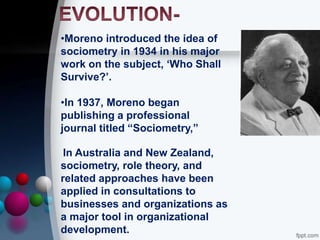
•Moreno introduced the idea of
sociometry in 1934 in his major
work on the subject, ‘Who Shall
Survive?’.
•In 1937, Moreno began
publishing a professional
journal titled “Sociometry,”
In Australia and New Zealand,
sociometry, role theory, and
related approaches have been
applied in consultations to
businesses and organizations as
a major tool in organizational
development.
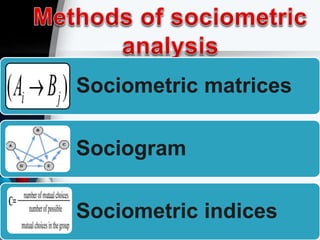
Sociometric matrices
Sociogram
Sociometric indices
Matrix is a rectangular array of numbers
or symbols. In sociometric analysis we
generally follow square or n*n matrix.
Steps followed are-
Collection of data by asking questions like
with whom you want to form your group,
to whom you generally go for advice etc
and saying them to choose any two of
members among group.
Same way for rejection we can take -1
The scores obtained summed up
column wise
The member selected will be given
score 1 and others scored as 0.
Choices-
One way choices where ‘a’ chooses ‘b’
but ‘b’ does not choose ‘a’
Mutual choices where ‘a’ chooses ‘b’ and
‘b’ chooses ‘a’
No choice
Star-the person getting maximum
number of choice
Isolate-person getting zero individual
choices
Clique-a group of 3 or morethan 3
mutually choosing each other
Sociogram or directed graphs
•A sociogram is a graphic representation
of social links that a person has.
• It is a graphical representation that plots
the structure of interpersonal relations in a
group situation
• A sociogram can be drawn on the basis
of many different criteria: Social relations,
channels of influence, lines of
communication etc.
classic
Used by
Moreno
Uses triangle,
circles,arrows
target
Used by
Northway
Uses bull eye
target circles or
concentric
circles
Sociometric indices
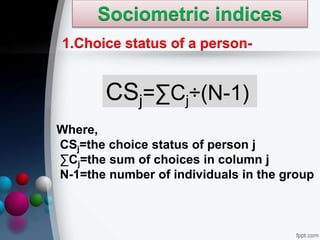
1.Choice status of a person-
CSj=∑Cj÷(N-1)
Where,
CSj=the choice status of person j
∑Cj=the sum of choices in column j
N-1=the number of individuals in the group
Co=∑(i j)÷n(n-1)/2
Where,
Co=group cohesiveness
∑(i j)=sum of mutual choices made
in that particular group
n(n-1)/2=total number of possible
pairs in a group of ‘n’people
In case of limited choice
denominator will b dn/2 where d is the
number of choices available
10*10 anjali sneha usha shara
d
soni
ta
urvi priti anki
ta
khu
sbu
ritik
a
anjali 0 0 0 0 1 1 0 0 0 0
sneha 0 0 1 0 0 0 1 0 0 0
usha 0 1 0 1 0 0 0 0 0 0
sharad 0 0 1 0 0 0 1 0 0 0
sonita 0 0 0 0 0 0 1 1 0 0
urvi 1 0 0 0 0 0 1 0 0 0
priti 0 0 0 0 1 0 0 1 0 0
ankita 0 0 0 0 1 0 1 0 0 0
khoosbu 0 0 0 0 0 0 1 1 0 0
ritika 0 0 0 0 1 0 0 0 1 0
TOTAL 1 1 2 1 4 1 6 3 1 0
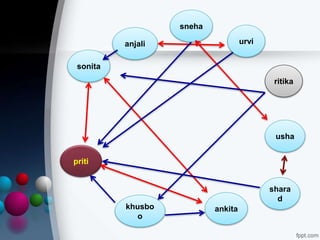
priti
sonita
sneha
usha
ankita
ritika
urvianjali
shara
d
khusbo
o
Number of mutual choices 5
Clique formed 1
Star or leader –pritee
Isolate-ritika
Choice status of individual for example
ankita= 3/9= .33
Group cohesiveness=5/20= .25
Social network analysis software
generally uses network and graph theory to
investigate social structures both
analytically and visually.
The main constructs are nodes (the
entities we are interested in – typically
people)
the ties or edges that connect them
For example Gephi, Pajek, Keyhubs or
InFlow
1.A study of communication networks in
sequential adoption and key
communicators-Y.P.SINGH
L-J SOCIOGRAM(Long et al)
5 bands
Third band is shaded as expected base and minimum
weighted score for it is six
Weighted score is calculated as 1st preference scores 3
2nd preference score 2
3rd prefernce scores 1
•Score 6-13 is kept in 4th band and
score above 13 kept in 5th band
•People lie in 4th and 5th band will be
selected as leaders
No limit of sample size is advocated
With a sample size of 100 it is easier to
get a score of 13 or above but incase of
sample size of 20 it is nearly impossible
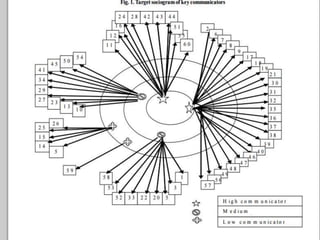
NORTHWAY TARGET DIAGRAM
Persons with larger communication act or
higher preference were placed in the
center and those with less
communication activity were placed
towards circumference.
Isolates lie outside the circle.
2.A study of leadership patterns and
roles in the adoption of improved
farm practices-by M.S.K REDDY
•He used northway target sociogram
•Wieghted scores are calculated
•He used indices like-
Group integration=1/no of isolates
Group coherence=rq/up
where r=no of mutual choices
d=no of choices allowed
p=d/n-1
n=total no of member
q=1-p
3.A study of communication patterns and key
communicators among rural women with
reference to the adoption of family planning
practices-Dr.RABIA MATHAI
Moreno’s Sociogram is used to know the key
communicators and opinion leaders
Difference in communication network ang group
cohesion is studied in highly adopting and low
adopting villages
In high adoption villages prevalent type of network is
wheel type
cliques and subgrou ps are linked among themselves
In low adoption viillages isolated spokes are found in
higher number
1. Sociometric questions are easy to
administer.
2. Sociometric questions are adaptable
to different types of settings and
issues
3. This method has highest validity
among all the methods to measure
diffusion network and opinion
leadership.
1. Analysis of sociometric data can
be complex.
2. Requires a large no of
respondents to locate small no of
opinion leaders
3. Not applicable to sample designs
where only a portion of the social
system is interviewed.
Validity of Sociometry
here question is Does sociometry really measure
something useful?
According to Jane Mouton, Robert Blake and
Benjamin Fruchter reviewed the early applications
of sociometry and concluded that the number of
sociometric choices do tend to predict such
performance criteria as productivity, combat
effectiveness, training ability, and leadership. An
inverse relationship also holds: the number of
sociometric choices received is negatively
correlated with undesirable aspects of behavior
such as accident-proneness, and frequency of
disciplinary charges” . The more frequently you
are chosen, the less likely you are to exhibit the
undesirable behavior.
Selection of opinion leader and key
communicator
While going to form a farmer organisation or
SHG group we can use the sociometry
To know the extent of homophily and
heterophily in a social system before
disseminating any technology there
To select few people on a particular subject for
training from among all
Seminar on sociometry

Seminar on sociometry

  • 1.
  • 2.
    SEMINAR TOPIC- SOCIOMETRY SUBMITTED BY- LAXMIPRIYAUPADHYAYA MSC 1ST YEAR ADMISSION NO-20643 CREDIT SEMINAR
  • 3.
    • Relates toLatin etymology socius means companion and metrum means measure • Sociometry is a quantitative method for measuring social relationships
  • 4.
    •a method for,describing, discovering and evaluating social status, structure, and development through measuring the extent of acceptance or rejection between individuals in groups •Study and measurement of social choices •Means of studying the attraction and repulsion of members of groups
  • 5.
    •Moreno introduced theidea of sociometry in 1934 in his major work on the subject, ‘Who Shall Survive?’. •In 1937, Moreno began publishing a professional journal titled “Sociometry,” In Australia and New Zealand, sociometry, role theory, and related approaches have been applied in consultations to businesses and organizations as a major tool in organizational development.
  • 6.
  • 7.
    Matrix is arectangular array of numbers or symbols. In sociometric analysis we generally follow square or n*n matrix. Steps followed are- Collection of data by asking questions like with whom you want to form your group, to whom you generally go for advice etc and saying them to choose any two of members among group.
  • 8.
    Same way forrejection we can take -1 The scores obtained summed up column wise The member selected will be given score 1 and others scored as 0.
  • 9.
    Choices- One way choiceswhere ‘a’ chooses ‘b’ but ‘b’ does not choose ‘a’ Mutual choices where ‘a’ chooses ‘b’ and ‘b’ chooses ‘a’ No choice Star-the person getting maximum number of choice Isolate-person getting zero individual choices Clique-a group of 3 or morethan 3 mutually choosing each other
  • 10.
    Sociogram or directedgraphs •A sociogram is a graphic representation of social links that a person has. • It is a graphical representation that plots the structure of interpersonal relations in a group situation • A sociogram can be drawn on the basis of many different criteria: Social relations, channels of influence, lines of communication etc.
  • 11.
    classic Used by Moreno Uses triangle, circles,arrows target Usedby Northway Uses bull eye target circles or concentric circles
  • 15.
    Sociometric indices 1.Choice statusof a person- CSj=∑Cj÷(N-1) Where, CSj=the choice status of person j ∑Cj=the sum of choices in column j N-1=the number of individuals in the group
  • 16.
    Co=∑(i j)÷n(n-1)/2 Where, Co=group cohesiveness ∑(ij)=sum of mutual choices made in that particular group n(n-1)/2=total number of possible pairs in a group of ‘n’people In case of limited choice denominator will b dn/2 where d is the number of choices available
  • 18.
    10*10 anjali snehausha shara d soni ta urvi priti anki ta khu sbu ritik a anjali 0 0 0 0 1 1 0 0 0 0 sneha 0 0 1 0 0 0 1 0 0 0 usha 0 1 0 1 0 0 0 0 0 0 sharad 0 0 1 0 0 0 1 0 0 0 sonita 0 0 0 0 0 0 1 1 0 0 urvi 1 0 0 0 0 0 1 0 0 0 priti 0 0 0 0 1 0 0 1 0 0 ankita 0 0 0 0 1 0 1 0 0 0 khoosbu 0 0 0 0 0 0 1 1 0 0 ritika 0 0 0 0 1 0 0 0 1 0 TOTAL 1 1 2 1 4 1 6 3 1 0
  • 19.
  • 20.
    Number of mutualchoices 5 Clique formed 1 Star or leader –pritee Isolate-ritika Choice status of individual for example ankita= 3/9= .33 Group cohesiveness=5/20= .25
  • 21.
    Social network analysissoftware generally uses network and graph theory to investigate social structures both analytically and visually. The main constructs are nodes (the entities we are interested in – typically people) the ties or edges that connect them For example Gephi, Pajek, Keyhubs or InFlow
  • 25.
    1.A study ofcommunication networks in sequential adoption and key communicators-Y.P.SINGH L-J SOCIOGRAM(Long et al) 5 bands Third band is shaded as expected base and minimum weighted score for it is six Weighted score is calculated as 1st preference scores 3 2nd preference score 2 3rd prefernce scores 1
  • 26.
    •Score 6-13 iskept in 4th band and score above 13 kept in 5th band •People lie in 4th and 5th band will be selected as leaders No limit of sample size is advocated With a sample size of 100 it is easier to get a score of 13 or above but incase of sample size of 20 it is nearly impossible
  • 27.
    NORTHWAY TARGET DIAGRAM Personswith larger communication act or higher preference were placed in the center and those with less communication activity were placed towards circumference. Isolates lie outside the circle.
  • 28.
    2.A study ofleadership patterns and roles in the adoption of improved farm practices-by M.S.K REDDY •He used northway target sociogram •Wieghted scores are calculated •He used indices like- Group integration=1/no of isolates Group coherence=rq/up where r=no of mutual choices d=no of choices allowed p=d/n-1 n=total no of member q=1-p
  • 29.
    3.A study ofcommunication patterns and key communicators among rural women with reference to the adoption of family planning practices-Dr.RABIA MATHAI Moreno’s Sociogram is used to know the key communicators and opinion leaders Difference in communication network ang group cohesion is studied in highly adopting and low adopting villages In high adoption villages prevalent type of network is wheel type cliques and subgrou ps are linked among themselves In low adoption viillages isolated spokes are found in higher number
  • 30.
    1. Sociometric questionsare easy to administer. 2. Sociometric questions are adaptable to different types of settings and issues 3. This method has highest validity among all the methods to measure diffusion network and opinion leadership.
  • 31.
    1. Analysis ofsociometric data can be complex. 2. Requires a large no of respondents to locate small no of opinion leaders 3. Not applicable to sample designs where only a portion of the social system is interviewed.
  • 32.
    Validity of Sociometry herequestion is Does sociometry really measure something useful? According to Jane Mouton, Robert Blake and Benjamin Fruchter reviewed the early applications of sociometry and concluded that the number of sociometric choices do tend to predict such performance criteria as productivity, combat effectiveness, training ability, and leadership. An inverse relationship also holds: the number of sociometric choices received is negatively correlated with undesirable aspects of behavior such as accident-proneness, and frequency of disciplinary charges” . The more frequently you are chosen, the less likely you are to exhibit the undesirable behavior.
  • 33.
    Selection of opinionleader and key communicator While going to form a farmer organisation or SHG group we can use the sociometry To know the extent of homophily and heterophily in a social system before disseminating any technology there To select few people on a particular subject for training from among all