
Cryptography
OUTLINE
   Introduction
   Brief History
   General Model
   Security Issues in Cryptography
   Cryptographic techniques
   Advantages And Disadvantages
   Applications
   Conclusion
Introduction
   Cryptography -- from the Greek word
    for “secret writing” -- is the “scrambling”
    of data so that only someone with the
    necessary key can “unscramble” it.
   Provide secrecy.
   Authenticate that a message has not
    changed in transit.
   Implicitly authenticate the sender.
Brief History
    The first documented use of cryptography
    in writing dates back 1900 B.C.
   When an Egyptian scribe used non-
    standard code in an inscription.
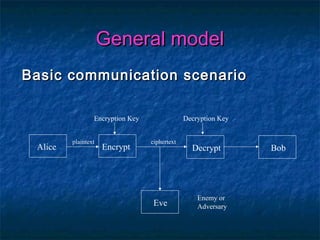
General model
Basic communication scenario

                 Encryption Key                Decryption Key


         plaintext                ciphertext
 Alice               Encrypt                     Decrypt        Bob


                                                   Enemy or
                                   Eve             Adversary
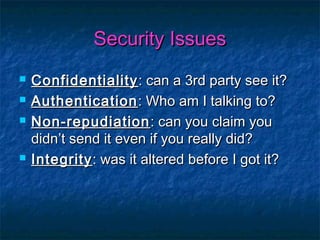
Security Issues
   Confidentiality : can a 3rd party see it?
   Authentication : Who am I talking to?
   Non-repudiation : can you claim you
    didn’t send it even if you really did?
   Integrity : was it altered before I got it?
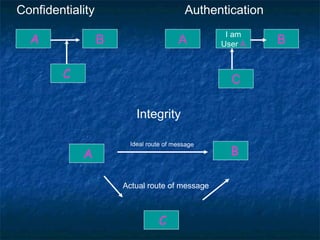
Confidentiality                          Authentication

  A
                                                 I am
                  B                    A        User A    B

        C                                         C

                         Integrity

                       Ideal route of message
            A                                     B

                      Actual route of message


                                C
Cryptographic techniques

   Encryption
   Decryption
   Symmetric key (Secret Key)
   Asymmetric key (Public Key)
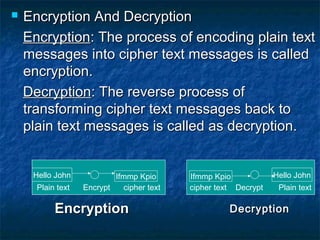
   Encryption And Decryption
    Encryption: The process of encoding plain text
    messages into cipher text messages is called
    encryption.
    Decryption: The reverse process of
    transforming cipher text messages back to
    plain text messages is called as decryption.


     Hello John            Ifmmp Kpio      Ifmmp Kpio            Hello John
      Plain text   Encrypt   cipher text   cipher text Decrypt    Plain text

           Encryption                                Decryption
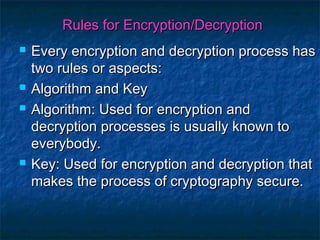
Rules for Encryption/Decryption
   Every encryption and decryption process has
    two rules or aspects:
   Algorithm and Key
   Algorithm: Used for encryption and
    decryption processes is usually known to
    everybody.
   Key: Used for encryption and decryption that
    makes the process of cryptography secure.
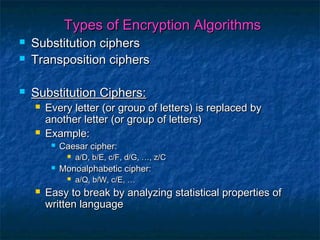
Types of Encryption Algorithms
   Substitution ciphers
   Transposition ciphers

   Substitution Ciphers:
       Every letter (or group of letters) is replaced by
        another letter (or group of letters)
       Example:
            Caesar cipher:
                 a/D, b/E, c/F, d/G, …, z/C
            Monoalphabetic cipher:
                 a/Q, b/W, c/E, …
       Easy to break by analyzing statistical properties of
        written language
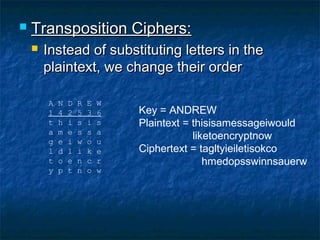
   Transposition Ciphers:
       Instead of substituting letters in the
        plaintext, we change their order

        A   N   D   R   E   W
        1   4   2   5   3   6   Key = ANDREW
        t   h   i   s   i   s   Plaintext = thisisamessageiwould
        a   m   e   s   s   a
        g   e   i   w   o   u
                                            liketoencryptnow
        l   d   l   i   k   e   Ciphertext = tagltyieiletisokco
        t   o   e   n   c   r                  hmedopsswinnsauerw
        y   p   t   n   o   w
Symmetric Cryptography (Secret Key)
Advantages of Classical
           Cryptography
   There are some very fast classical
    encryption (and decryption) algorithms
   Since the speed of a method varies with
    the length of the key, faster algorithms
    allow one to use longer key values.
   Larger key values make it harder to guess
    the key value -- and break the code -- by
    brute force.
Disadvantages of Classical
              Cryptography
   Requires secure transmission of
    key value
   Requires a separate key for each group of
    people that wishes to exchange encrypted
    messages (readable by any group
    member)
       For example, to have a separate key for each
        pair of people, 100 people would need 4950
        different keys.
Public-Key Cryptography:
      Asymmetric Cryptography
   Alice generates a key value (usually a
    number or pair of related numbers)
    which she makes public.
   Alice uses her public key (and some
    additional information) to determine a
    second key (her private key ).
   Alice keeps her private key (and the
    additional information she used to
    construct it) secret.
Public-Key Cryptography
              (continued)
   Bob (or Carol, or anyone else) can use
    Alice’s public key to encrypt a message for
    Alice.
   Alice can use her private key to decrypt
    this message.
   No-one without access to Alice’s private
    key (or the information used to construct
    it) can easily decrypt the message.
An Example: Internet
            Commerce
   Bob wants to use his credit card to buy
    some brownies from Alice over the
    Internet.
   Alice sends her public key to Bob.
   Bob uses this key to encrypt his credit-
    card number and sends the encrypted
    number to Alice.
   Alice uses her private key to decrypt
    this message (and get Bob’s credit-card
    number).
Hybrid Encryption Systems
   All known public key encryption algorithms
    are much slower than the fastest secret-
    key algorithms.
   In a hybrid system, Alice uses Bob’s
    public key to send him a secret shared
    session key .
   Alice and Bob use the session key to
    exchange information.
Internet Commerce
            (continued)
 Bob wants to order brownies from Alice

    and keep the entire transaction
    private.
   Bob sends Alice his public key.
   Alice generates a session key, encrypts
    it using Bob’s public key, and sends it to
    Bob.
   Bob uses the session key (and an
    agreed-upon symmetric encryption
    algorithm) to encrypt his order, and
Digital Signatures:
          Signing a Document
   Alice applies a (publicly known) hash
    function to a document that she
    wishes to “sign.” This function produces
    a digest of the document (usually a
    number).
   Alice then uses her private key to
    “encrypt” the digest.
   She can then send, or even broadcast,
    the document with the encrypted digest.
Digital Signature Verification
   Bob uses Alice’s public key to
    “decrypt” the digest that Alice
    “encrypted” with her private key.
   Bob applies the hash function to the
    document to obtain the digest directly.
   Bob compares these two values for the
    digest. If they match, it proves that
    Alice signed the document and that no
    one else has altered it.
Secure Transmission of Digitally
      Signed Documents

   Alice uses her private key to digitally
    sign a document. She then uses Bob’s
    public key to encrypt this digitally
    signed document.
   Bob uses his private key to decrypt the
    document. The result is Alice’s digitally
    signed document.
   Bob uses Alice’s public key to verify
    Alice’s digital signature.
Historical Background

   1976: W. Diffie and M.E. Hellman
    proposed the first public-key encryption
    algorithms -- actually an algorithm for
    public exchange of a secret key.
   1978: L.M Adleman, R.L. Rivest and A.
    Shamir propose the RSA encryption
    method
       Currently the most widely used
       Basis for the spreadsheet used in the lab
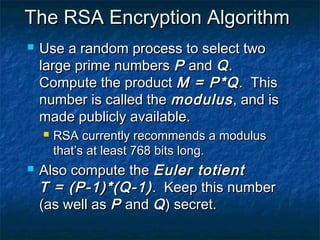
The RSA Encryption Algorithm
   Use a random process to select two
    large prime numbers P and Q .
    Compute the product M = P*Q . This
    number is called the modulus , and is
    made publicly available.
       RSA currently recommends a modulus
        that’s at least 768 bits long.
   Also compute the Euler totient
    T = (P-1)*(Q-1) . Keep this number
    (as well as P and Q ) secret.
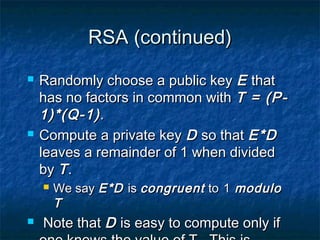
RSA (continued)
   Randomly choose a public key E that
    has no factors in common with T = (P-
    1)*(Q-1) .
   Compute a private key D so that E*D
    leaves a remainder of 1 when divided
    by T .
       We say E*D is congruent to 1 modulo
        T
   Note that D is easy to compute only if
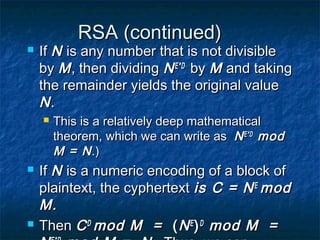
RSA (continued)
   If N is any number that is not divisible
    by M , then dividing N E*D by M and taking
    the remainder yields the original value
    N.
       This is a relatively deep mathematical
        theorem, which we can write as N E*D mod
        M = N .)
   If N is a numeric encoding of a block of
    plaintext, the cyphertext is C = N E mod
    M.
   Then C D mod M = ( N E ) D mod M =
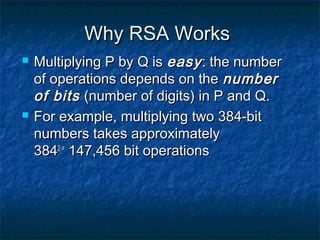
Why RSA Works
   Multiplying P by Q is easy : the number
    of operations depends on the number
    of bits (number of digits) in P and Q.
   For example, multiplying two 384-bit
    numbers takes approximately
    3842 = 147,456 bit operations
Why RSA Works (2)
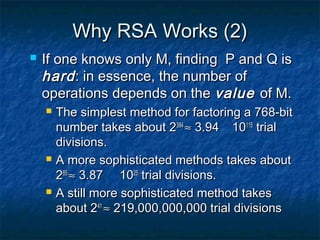
   If one knows only M, finding P and Q is
    hard : in essence, the number of
    operations depends on the value of M.
       The simplest method for factoring a 768-bit
        number takes about 2384 ≈ 3.94 10115 trial
        divisions.
       A more sophisticated methods takes about
        285 ≈ 3.87 1025 trial divisions.
       A still more sophisticated method takes
        about 241 ≈ 219,000,000,000 trial divisions
Why RSA Works (3)

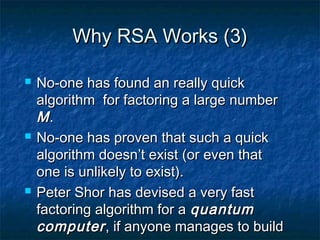
   No-one has found an really quick
    algorithm for factoring a large number
    M.
   No-one has proven that such a quick
    algorithm doesn’t exist (or even that
    one is unlikely to exist).
   Peter Shor has devised a very fast
    factoring algorithm for a quantum
    computer , if anyone manages to build

Crypt

  • 1.
  • 2.
    OUTLINE  Introduction  Brief History  General Model  Security Issues in Cryptography  Cryptographic techniques  Advantages And Disadvantages  Applications  Conclusion
  • 3.
    Introduction  Cryptography -- from the Greek word for “secret writing” -- is the “scrambling” of data so that only someone with the necessary key can “unscramble” it.  Provide secrecy.  Authenticate that a message has not changed in transit.  Implicitly authenticate the sender.
  • 4.
    Brief History  The first documented use of cryptography in writing dates back 1900 B.C.  When an Egyptian scribe used non- standard code in an inscription.
  • 5.
    General model Basic communicationscenario Encryption Key Decryption Key plaintext ciphertext Alice Encrypt Decrypt Bob Enemy or Eve Adversary
  • 6.
    Security Issues  Confidentiality : can a 3rd party see it?  Authentication : Who am I talking to?  Non-repudiation : can you claim you didn’t send it even if you really did?  Integrity : was it altered before I got it?
  • 7.
    Confidentiality Authentication A I am B A User A B C C Integrity Ideal route of message A B Actual route of message C
  • 8.
    Cryptographic techniques  Encryption  Decryption  Symmetric key (Secret Key)  Asymmetric key (Public Key)
  • 9.
    Encryption And Decryption Encryption: The process of encoding plain text messages into cipher text messages is called encryption. Decryption: The reverse process of transforming cipher text messages back to plain text messages is called as decryption. Hello John Ifmmp Kpio Ifmmp Kpio Hello John Plain text Encrypt cipher text cipher text Decrypt Plain text Encryption Decryption
  • 10.
    Rules for Encryption/Decryption  Every encryption and decryption process has two rules or aspects:  Algorithm and Key  Algorithm: Used for encryption and decryption processes is usually known to everybody.  Key: Used for encryption and decryption that makes the process of cryptography secure.
  • 11.
    Types of EncryptionAlgorithms  Substitution ciphers  Transposition ciphers  Substitution Ciphers:  Every letter (or group of letters) is replaced by another letter (or group of letters)  Example:  Caesar cipher:  a/D, b/E, c/F, d/G, …, z/C  Monoalphabetic cipher:  a/Q, b/W, c/E, …  Easy to break by analyzing statistical properties of written language
  • 12.
    Transposition Ciphers:  Instead of substituting letters in the plaintext, we change their order A N D R E W 1 4 2 5 3 6 Key = ANDREW t h i s i s Plaintext = thisisamessageiwould a m e s s a g e i w o u liketoencryptnow l d l i k e Ciphertext = tagltyieiletisokco t o e n c r hmedopsswinnsauerw y p t n o w
  • 13.
  • 14.
    Advantages of Classical Cryptography  There are some very fast classical encryption (and decryption) algorithms  Since the speed of a method varies with the length of the key, faster algorithms allow one to use longer key values.  Larger key values make it harder to guess the key value -- and break the code -- by brute force.
  • 15.
    Disadvantages of Classical Cryptography  Requires secure transmission of key value  Requires a separate key for each group of people that wishes to exchange encrypted messages (readable by any group member)  For example, to have a separate key for each pair of people, 100 people would need 4950 different keys.
  • 16.
    Public-Key Cryptography: Asymmetric Cryptography  Alice generates a key value (usually a number or pair of related numbers) which she makes public.  Alice uses her public key (and some additional information) to determine a second key (her private key ).  Alice keeps her private key (and the additional information she used to construct it) secret.
  • 17.
    Public-Key Cryptography (continued)  Bob (or Carol, or anyone else) can use Alice’s public key to encrypt a message for Alice.  Alice can use her private key to decrypt this message.  No-one without access to Alice’s private key (or the information used to construct it) can easily decrypt the message.
  • 18.
    An Example: Internet Commerce  Bob wants to use his credit card to buy some brownies from Alice over the Internet.  Alice sends her public key to Bob.  Bob uses this key to encrypt his credit- card number and sends the encrypted number to Alice.  Alice uses her private key to decrypt this message (and get Bob’s credit-card number).
  • 19.
    Hybrid Encryption Systems  All known public key encryption algorithms are much slower than the fastest secret- key algorithms.  In a hybrid system, Alice uses Bob’s public key to send him a secret shared session key .  Alice and Bob use the session key to exchange information.
  • 20.
    Internet Commerce (continued)  Bob wants to order brownies from Alice and keep the entire transaction private.  Bob sends Alice his public key.  Alice generates a session key, encrypts it using Bob’s public key, and sends it to Bob.  Bob uses the session key (and an agreed-upon symmetric encryption algorithm) to encrypt his order, and
  • 21.
    Digital Signatures: Signing a Document  Alice applies a (publicly known) hash function to a document that she wishes to “sign.” This function produces a digest of the document (usually a number).  Alice then uses her private key to “encrypt” the digest.  She can then send, or even broadcast, the document with the encrypted digest.
  • 22.
    Digital Signature Verification  Bob uses Alice’s public key to “decrypt” the digest that Alice “encrypted” with her private key.  Bob applies the hash function to the document to obtain the digest directly.  Bob compares these two values for the digest. If they match, it proves that Alice signed the document and that no one else has altered it.
  • 23.
    Secure Transmission ofDigitally Signed Documents  Alice uses her private key to digitally sign a document. She then uses Bob’s public key to encrypt this digitally signed document.  Bob uses his private key to decrypt the document. The result is Alice’s digitally signed document.  Bob uses Alice’s public key to verify Alice’s digital signature.
  • 24.
    Historical Background  1976: W. Diffie and M.E. Hellman proposed the first public-key encryption algorithms -- actually an algorithm for public exchange of a secret key.  1978: L.M Adleman, R.L. Rivest and A. Shamir propose the RSA encryption method  Currently the most widely used  Basis for the spreadsheet used in the lab
  • 25.
    The RSA EncryptionAlgorithm  Use a random process to select two large prime numbers P and Q . Compute the product M = P*Q . This number is called the modulus , and is made publicly available.  RSA currently recommends a modulus that’s at least 768 bits long.  Also compute the Euler totient T = (P-1)*(Q-1) . Keep this number (as well as P and Q ) secret.
  • 26.
    RSA (continued)  Randomly choose a public key E that has no factors in common with T = (P- 1)*(Q-1) .  Compute a private key D so that E*D leaves a remainder of 1 when divided by T .  We say E*D is congruent to 1 modulo T  Note that D is easy to compute only if
  • 27.
    RSA (continued)  If N is any number that is not divisible by M , then dividing N E*D by M and taking the remainder yields the original value N.  This is a relatively deep mathematical theorem, which we can write as N E*D mod M = N .)  If N is a numeric encoding of a block of plaintext, the cyphertext is C = N E mod M.  Then C D mod M = ( N E ) D mod M =
  • 28.
    Why RSA Works  Multiplying P by Q is easy : the number of operations depends on the number of bits (number of digits) in P and Q.  For example, multiplying two 384-bit numbers takes approximately 3842 = 147,456 bit operations
  • 29.
    Why RSA Works(2)  If one knows only M, finding P and Q is hard : in essence, the number of operations depends on the value of M.  The simplest method for factoring a 768-bit number takes about 2384 ≈ 3.94 10115 trial divisions.  A more sophisticated methods takes about 285 ≈ 3.87 1025 trial divisions.  A still more sophisticated method takes about 241 ≈ 219,000,000,000 trial divisions
  • 30.
    Why RSA Works(3)  No-one has found an really quick algorithm for factoring a large number M.  No-one has proven that such a quick algorithm doesn’t exist (or even that one is unlikely to exist).  Peter Shor has devised a very fast factoring algorithm for a quantum computer , if anyone manages to build

Editor's Notes

  • #2 Public-key Encryption 10/14/12 Montclair State University
  • #4 Public-key Encryption 10/14/12 Montclair State University Computers can very quickly search a document for a specified phrase (e.g., "Top secret" or "Social Security Number")
  • #14 Public-key Encryption 10/14/12 Montclair State University
  • #21 Public-key Encryption 10/14/12 Montclair State University Netscape has a hybrid system built in. It uses RSA for public-key encryption (with -- I believe -- a 512-bit key) and DES for secret-key encryption. PGP also uses a hybrid system with RSA for the public-key part, and IDEA for secret-key encryption.
  • #29 Public-key Encryption 10/14/12 Montclair State University
  • #30 Public-key Encryption 10/14/12 Montclair State University At one trial division per nanosecond (very fast!), the slow factoring algorithm takes approximately 10^106 seconds, or about 30 x 10^97 years! The faster algorithm takes approximately 3.87 x 10^16 seconds, about 100 million years. The fastest known algorithm would take about 4 minutes (assuming one trial division per nanosecond). Increasing the modulus to 1024 bits would increase the number of trial divisions to 2^46 or 7 x 10^13, taking 70,000,000 seconds, a little over 2 years!