Implicit Equations and Implicit Differentiation
            Implicit Equations
Implicit Equations and Implicit Differentiation
              Implicit Equations
The function y = 1/x may be written as xy = 1.
Implicit Equations and Implicit Differentiation
              Implicit Equations
The function y = 1/x may be written as xy = 1.
The y = 1/x is the explicit form because the output y is
given explicitly as a function of x. The equation
xy = 1 is said to be in the implicit form because the
relation between x and y are not given as a function.
Implicit Equations and Implicit Differentiation
              Implicit Equations
The function y = 1/x may be written as xy = 1.
The y = 1/x is the explicit form because the output y is
given explicitly as a function of x. The equation
xy = 1 is said to be in the implicit form because the
relation between x and y are not given as a function.
The implicit equation x2 + y2 = 1 has the unit circle as
its graph.
Implicit Equations and Implicit Differentiation
              Implicit Equations
The function y = 1/x may be written as xy = 1.
The y = 1/x is the explicit form because the output y is
given explicitly as a function of x. The equation
xy = 1 is said to be in the implicit form because the
relation between x and y are not given as a function.
The implicit equation x2 + y2 = 1 has the unit circle as
its graph. It’s not one function.           y = √1 – x2
However x2 + y2 = 1
may be represented by
two different functions.

y = √1 – x2    or    y = –√1 – x2
                                           y = – √1 – x2
Implicit Equations and Implicit Differentiation
The joint variables x and y in an implicit equation may
be inseparable by algebra.
Implicit Equations and Implicit Differentiation
The joint variables x and y in an implicit equation may
be inseparable by algebra.          sin(xy) = 0,
Implicit Equations and Implicit Differentiation
The joint variables x and y in an implicit equation may
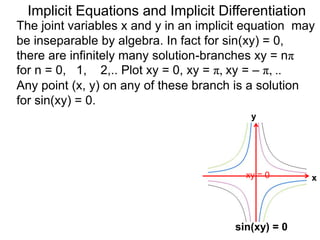
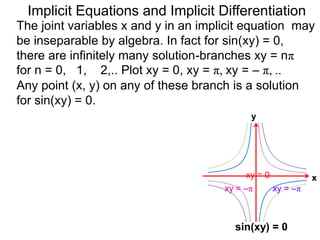
be inseparable by algebra. In fact for sin(xy) = 0,
there are infinitely many solution-branches xy = nπ
for n = 0, 1, 2,..
Implicit Equations and Implicit Differentiation
The joint variables x and y in an implicit equation may
be inseparable by algebra. In fact for sin(xy) = 0,
there are infinitely many solution-branches xy = nπ
for n = 0, 1, 2,.. Plot xy = 0, xy = π, xy = – π, ..
Implicit Equations and Implicit Differentiation
The joint variables x and y in an implicit equation may
be inseparable by algebra. In fact for sin(xy) = 0,
there are infinitely many solution-branches xy = nπ
for n = 0, 1, 2,.. Plot xy = 0, xy = π, xy = – π, ..


                                           y


                                                      x


                                        sin(xy) = 0
Implicit Equations and Implicit Differentiation
The joint variables x and y in an implicit equation may
be inseparable by algebra. In fact for sin(xy) = 0,
there are infinitely many solution-branches xy = nπ
for n = 0, 1, 2,.. Plot xy = 0, xy = π, xy = – π, ..
Any point (x, y) on any of these branch is a solution
for sin(xy) = 0.
                                           y


                                          xy = 0      x


                                        sin(xy) = 0
Implicit Equations and Implicit Differentiation
The joint variables x and y in an implicit equation may
be inseparable by algebra. In fact for sin(xy) = 0,
there are infinitely many solution-branches xy = nπ
for n = 0, 1, 2,.. Plot xy = 0, xy = π, xy = – π, ..
Any point (x, y) on any of these branch is a solution
for sin(xy) = 0.
                                           y


                                          xy = 0             x
                                                   xy = –π


                                        sin(xy) = 0
Implicit Equations and Implicit Differentiation
The joint variables x and y in an implicit equation may
be inseparable by algebra. In fact for sin(xy) = 0,
there are infinitely many solution-branches xy = nπ
for n = 0, 1, 2,.. Plot xy = 0, xy = π, xy = – π, ..
Any point (x, y) on any of these branch is a solution
for sin(xy) = 0.
                                            y


                                           xy = 0           x
                                      xy = –π     xy = –π


                                        sin(xy) = 0
Implicit Equations and Implicit Differentiation
The joint variables x and y in an implicit equation may
be inseparable by algebra. In fact for sin(xy) = 0,
there are infinitely many solution-branches xy = nπ
for n = 0, 1, 2,.. Plot xy = 0, xy = π, xy = – π, ..
Any point (x, y) on any of these branch is a solution
for sin(xy) = 0.
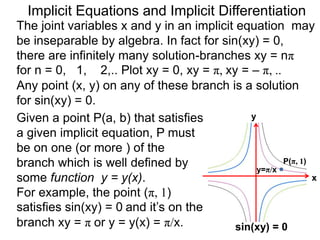
Given a point P(a, b) that satisfies         y
a given implicit equation, P must
be on one (or more ) of the
branch which is well defined by
some function y = y(x).                     xy = 0     x
                                      xy = –π   xy = –π


                                        sin(xy) = 0
Implicit Equations and Implicit Differentiation
The joint variables x and y in an implicit equation may
be inseparable by algebra. In fact for sin(xy) = 0,
there are infinitely many solution-branches xy = nπ
for n = 0, 1, 2,.. Plot xy = 0, xy = π, xy = – π, ..
Any point (x, y) on any of these branch is a solution
for sin(xy) = 0.
Given a point P(a, b) that satisfies          y
a given implicit equation, P must
be on one (or more ) of the
branch which is well defined by                 y=π/x
                                                      P(π, 1)

some function y = y(x).                                       x
For example, the point (π, 1)
satisfies sin(xy) = 0 and it’s on the
branch xy = π or y = y(x) = π/x.           sin(xy) = 0
Implicit Equations and Implicit Differentiation
We assume that the branch               y
function y = y(x) that contains P
is differentiable at the point P as
                                                    P(π, 1)
the case in the example here                y=π/x
that y = π/x is differentiable at                             x
P(π, 1).

                                      sin(xy) = 0
Implicit Equations and Implicit Differentiation
We assume that the branch               y
function y = y(x) that contains P
is differentiable at the point P as
                                                    P(π, 1)
the case in the example here                y=π/x
that y = π/x is differentiable at                             x
P(π, 1). The slope at P may be
found by taking the derivative of
the branch function y = π/x           sin(xy) = 0
which may be difficult to identify.
Implicit Equations and Implicit Differentiation
We assume that the branch                   y
function y = y(x) that contains P
is differentiable at the point P as
                                                    P(π, 1)
the case in the example here                  y=π/x
that y = π/x is differentiable at                           x
P(π, 1). The slope at P may be
found by taking the derivative of
the branch function y = π/x              sin(xy) = 0
which may be difficult to identify.
Instead we may compute a different form of the
derivative directly from the implicit equation sin(xy) = 0
and use it to compute the slope at the point P(π, 1).
Implicit Equations and Implicit Differentiation
We assume that the branch                   y
function y = y(x) that contains P
is differentiable at the point P as
                                                     P(π, 1)
the case in the example here                   y=π/x
that y = π/x is differentiable at                            x
P(π, 1). The slope at P may be
found by taking the derivative of
the branch function y = π/x               sin(xy) = 0
which may be difficult to identify.
Instead we may compute a different form of the
derivative directly from the implicit equation sin(xy) = 0
and use it to compute the slope at the point P(π, 1).
This procedure is called implicit differentiation and the
form of the derivative is called the implicit derivative.
Implicit Equations and Implicit Differentiation
To differentiate implicitly, we assume that y is y(x)
a function of x, and that we are to solve for y'(x).
Implicit Equations and Implicit Differentiation
To differentiate implicitly, we assume that y is y(x)
a function of x, and that we are to solve for y'(x).
Because y is y(x), all the the y’s in an implicit
equation are subjected to the Chain Rule.
Implicit Equations and Implicit Differentiation
To differentiate implicitly, we assume that y is y(x)
a function of x, and that we are to solve for y'(x).
Because y is y(x), all the the y’s in an implicit
equation are subjected to the Chain Rule.
Example A. Assume that y is y(x), expand the
following derivative in expressions of x, y and y'.
a. (x3 y)'


b. (x y3)'
Implicit Equations and Implicit Differentiation
To differentiate implicitly, we assume that y is y(x)
a function of x, and that we are to solve for y'(x).
Because y is y(x), all the the y’s in an implicit
equation are subjected to the Chain Rule.
Example A. Assume that y is y(x), expand the
following derivative in expressions of x, y and y'.
a. (x3 y)'
  By the Product Rule,
  (x3 y)' = (x3)' y + x3 (y)'
b. (x y3)'
Implicit Equations and Implicit Differentiation
To differentiate implicitly, we assume that y is y(x)
a function of x, and that we are to solve for y'(x).
Because y is y(x), all the the y’s in an implicit
equation are subjected to the Chain Rule.
Example A. Assume that y is y(x), expand the
following derivative in expressions of x, y and y'.
a. (x3 y)'
  By the Product Rule,
  (x3 y)' = (x3)' y + x3 (y)' = 3x2y + x3(y)'
b. (x y3)'
Implicit Equations and Implicit Differentiation
To differentiate implicitly, we assume that y is y(x)
a function of x, and that we are to solve for y'(x).
Because y is y(x), all the the y’s in an implicit
equation are subjected to the Chain Rule.
Example A. Assume that y is y(x), expand the
following derivative in expressions of x, y and y'.
a. (x3 y)'
  By the Product Rule,
  (x3 y)' = (x3)' y + x3 (y)' = 3x2y + x3(y)'
b. (x y3)'
  By the Product Rule,
  (x y3)' = (x)' y3 + x3 (y3)'
Implicit Equations and Implicit Differentiation
To differentiate implicitly, we assume that y is y(x)
a function of x, and that we are to solve for y'(x).
Because y is y(x), all the the y’s in an implicit
equation are subjected to the Chain Rule.
Example A. Assume that y is y(x), expand the
following derivative in expressions of x, y and y'.
a. (x3 y)'
  By the Product Rule,
  (x3 y)' = (x3)' y + x3 (y)' = 3x2y + x3(y)'
b. (x y3)'
                                 (3y2y')
  By the Product Rule,
  (x y3)' = (x)' y3 + x3 (y3)'
Implicit Equations and Implicit Differentiation
To differentiate implicitly, we assume that y is y(x)
a function of x, and that we are to solve for y'(x).
Because y is y(x), all the the y’s in an implicit
equation are subjected to the Chain Rule.
Example A. Assume that y is y(x), expand the
following derivative in expressions of x, y and y'.
a. (x3 y)'
  By the Product Rule,
  (x3 y)' = (x3)' y + x3 (y)' = 3x2y + x3(y)'
b. (x y3)'
                              (3y2y')
  By the Product Rule,
  (x y3)' = (x)' y3 + x3 (y3)' = y3 + 3x3y2y'
Implicit Equations and Implicit Differentiation
d. Expand (x3 y – x y3)' and collect the y' – term
Implicit Equations and Implicit Differentiation
d. Expand (x3 y – x y3)' and collect the y' – term
  (x3 y – x y3)'
  = [3x2y + x3 y'] – [y3 + 3x3y2 y']
Implicit Equations and Implicit Differentiation
d. Expand (x3 y – x y3)' and collect the y' – term
  (x3 y – x y3)'
  = [3x2y + x3 y'] – [y3 + 3x3y2 y']
  = 3x2y + x3 y' – y3 – 3x3y2 y'
Implicit Equations and Implicit Differentiation
d. Expand (x3 y – x y3)' and collect the y' – term
  (x3 y – x y3)'
  = [3x2y + x3 y'] – [y3 + 3x3y2 y']
  = 3x2y + x3 y' – y3 – 3x3y2 y'
  = 3x2y – y3 + (x3 – 3x3y2) y'
Implicit Equations and Implicit Differentiation
d. Expand (x3 y – x y3)' and collect the y' – term
  (x3 y – x y3)'
  = [3x2y + x3 y'] – [y3 + 3x3y2 y']
  = 3x2y + x3 y' – y3 – 3x3y2 y'
  = 3x2y – y3 + (x3 – 3x3y2) y'
Implicit Equations and Implicit Differentiation
d. Expand (x3 y – x y3)' and collect the y' – term
  (x3 y – x y3)'
  = [3x2y + x3 y'] – [y3 + 3x3y2 y']
  = 3x2y + x3 y' – y3 – 3x3y2 y'
  = 3x2y – y3 + (x3 – 3x3y2) y'
                                          y
Let us go back to the
equation sin(xy) = 0.

                                                      x


                                        sin(xy) = 0
Implicit Equations and Implicit Differentiation
d. Expand (x3 y – x y3)' and collect the y' – term
  (x3 y – x y3)'
  = [3x2y + x3 y'] – [y3 + 3x3y2 y']
  = 3x2y + x3 y' – y3 – 3x3y2 y'
  = 3x2y – y3 + (x3 – 3x3y2) y'
                                          y
Let us go back to the
equation sin(xy) = 0.
                                                      P(π, 1)
Example B. Use implicit
                                              y=π/x
differentiation to find y'                                      x
given that sin(xy) = 0 and find
the slope and the tangent line
at the point (π, 1) on the graph        sin(xy) = 0
of sin(xy) = 0.
Implicit Equations and Implicit Differentiation
Differentiate both sides of sin(xy) = 0 with respect to x,
[sin(xy) ] ' = (0)'


                                         y


                                                     P(π, 1)
                                             y=π/x
                                                               x


                                       sin(xy) = 0
Implicit Equations and Implicit Differentiation
Differentiate both sides of sin(xy) = 0 with respect to x,
[sin(xy) ] ' = (0)' by the Sine Chain Rule
[cos(xy)] (xy)' = 0
                                         y


                                                     P(π, 1)
                                             y=π/x
                                                               x


                                       sin(xy) = 0
Implicit Equations and Implicit Differentiation
Differentiate both sides of sin(xy) = 0 with respect to x,
[sin(xy) ] ' = (0)' by the Sine Chain Rule
[cos(xy)] (xy)' = 0 by the Product Rule
cos(xy) [(x)'y + x(y)'] = 0               y


                                                      P(π, 1)
                                              y=π/x
                                                                x


                                       sin(xy) = 0
Implicit Equations and Implicit Differentiation
Differentiate both sides of sin(xy) = 0 with respect to x,
[sin(xy) ] ' = (0)' by the Sine Chain Rule
[cos(xy)] (xy)' = 0 by the Product Rule
cos(xy) [(x)'y + x(y)'] = 0               y

cos(xy) [1*y + x(y)'] = 0
                                                      P(π, 1)
                                              y=π/x
                                                                x


                                       sin(xy) = 0
Implicit Equations and Implicit Differentiation
Differentiate both sides of sin(xy) = 0 with respect to x,
[sin(xy) ] ' = (0)' by the Sine Chain Rule
[cos(xy)] (xy)' = 0 by the Product Rule
cos(xy) [(x)'y + x(y)'] = 0               y

cos(xy) [1*y + x(y)'] = 0
                                                      P(π, 1)
Solve for (y)', set y + x(y)' = 0
                                              y=π/x
                                                                x


                                       sin(xy) = 0
Implicit Equations and Implicit Differentiation
Differentiate both sides of sin(xy) = 0 with respect to x,
[sin(xy) ] ' = (0)' by the Sine Chain Rule
[cos(xy)] (xy)' = 0 by the Product Rule
cos(xy) [(x)'y + x(y)'] = 0               y

cos(xy) [1*y + x(y)'] = 0
                                                      P(π, 1)
Solve for (y)', set y + x(y)' = 0
                                              y=π/x
                        –y                                      x
x(y)' = –y or that y' = x


                                       sin(xy) = 0
Implicit Equations and Implicit Differentiation
Differentiate both sides of sin(xy) = 0 with respect to x,
[sin(xy) ] ' = (0)' by the Sine Chain Rule
[cos(xy)] (xy)' = 0 by the Product Rule
cos(xy) [(x)'y + x(y)'] = 0               y

cos(xy) [1*y + x(y)'] = 0
                                                      P(π, 1)
Solve for (y)', set y + x(y)' = 0
                                              y=π/x
                         –y                                     x
x(y)' = –y or that y' = x
At P(π, 1), x = π, y = 1
y' = –1 = the slope at P.
      π                                sin(xy) = 0
Implicit Equations and Implicit Differentiation
Differentiate both sides of sin(xy) = 0 with respect to x,
[sin(xy) ] ' = (0)' by the Sine Chain Rule
[cos(xy)] (xy)' = 0 by the Product Rule
cos(xy) [(x)'y + x(y)'] = 0                y

cos(xy) [1*y + x(y)'] = 0
                                                 P(π, 1)
Solve for (y)', set y + x(y)' = 0
                                           y=π/x
                         –y                                x
x(y)' = –y or that y' = x
At P(π, 1), x = π, y = 1
y' = –1 = the slope at P.
      π                                sin(xy) = 0

Using the the Point–Slope Formula at P (π, 1), the
equation of the tangent line is y = –x + 2.
                                     π
Implicit Equations and Implicit Differentiation
Your turn: Expand [cos3 (x/y)] '
Implicit Equations and Implicit Differentiation
Your turn: Expand [cos3 (x/y)] '
By the Power Chain Rule,
[cos3 (x/y)] ' = 3cos2(x/y) [cos (x/y)] '
= 3cos2(x/y) [– sin(x/y)] (x/y) '
= 3cos2(x/y) [– sin(x/y)] ((y – xy')/y2)
Implicit Equations and Implicit Differentiation
Your turn: Expand [cos3 (x/y)] '
By the Power Chain Rule,
[cos3 (x/y)] ' = 3cos2(x/y) [cos (x/y)] '
= 3cos2(x/y) [– sin(x/y)] (x/y) '
= 3cos2(x/y) [– sin(x/y)] ((y – xy')/y2)

                       exy    x2+1
                             = y2 find y' implicitly.
Example C. Given
Implicit Equations and Implicit Differentiation
Your turn: Expand [cos3 (x/y)] '
By the Power Chain Rule,
[cos3 (x/y)] ' = 3cos2(x/y) [cos (x/y)] '
= 3cos2(x/y) [– sin(x/y)] (x/y) '
= 3cos2(x/y) [– sin(x/y)] ((y – xy')/y2)

                       exy    x2+1
                             = y2 find y' implicitly.
Example C. Given
We are to differentiate with respect to x on both sides
of the equation.
Implicit Equations and Implicit Differentiation
Your turn: Expand [cos3 (x/y)] '
By the Power Chain Rule,
[cos3 (x/y)] ' = 3cos2(x/y) [cos (x/y)] '
= 3cos2(x/y) [– sin(x/y)] (x/y) '
= 3cos2(x/y) [– sin(x/y)] ((y – xy')/y2)

                       exy    x2+1
                             = y2 find y' implicitly.
Example C. Given
We are to differentiate with respect to x on both sides
of the equation. However it’s easier if we clear the
denominators first.

y2 exy = x2+1
Implicit Equations and Implicit Differentiation
Your turn: Expand [cos3 (x/y)] '
By the Power Chain Rule,
[cos3 (x/y)] ' = 3cos2(x/y) [cos (x/y)] '
= 3cos2(x/y) [– sin(x/y)] (x/y) '
= 3cos2(x/y) [– sin(x/y)] ((y – xy')/y2)

                       exy    x2+1
                             = y2 find y' implicitly.
Example C. Given
We are to differentiate with respect to x on both sides
of the equation. However it’s easier if we clear the
denominators first.
Hence we differentiate both sides of
y2 exy = x2+1
Implicit Equations and Implicit Differentiation
[y2 exy ] ' = [x2+1] '
Implicit Equations and Implicit Differentiation
[y2 exy ] ' = [x2+1] '
        Product
        Rule


(y2)' exy + y2(exy)' =
Implicit Equations and Implicit Differentiation
[y2 exy ] ' = [x2+1] '
       Product
       Rule         Derivative of x2 with respect to x


(y2)' exy + y2(exy)' = 2x
Implicit Equations and Implicit Differentiation
[y2 exy ] ' = [x2+1] '
       Product
       Rule         Derivative of x2 with respect to x


(y2)' exy + y2(exy)' = 2x
       Chain Rule


2y(y)' exy
Implicit Equations and Implicit Differentiation
[y2 exy ] ' = [x2+1] '
       Product
       Rule         Derivative of x2 with respect to x


(y2)' exy + y2(exy)' = 2x
       Chain Rule


2y(y)' exy + y2 exy (xy)' = 2x
Implicit Equations and Implicit Differentiation
[y2 exy ] ' = [x2+1] '
       Product
       Rule           Derivative of x2 with respect to x


(y2)' exy + y2(exy)' = 2x
       Chain Rule


2y(y)' exy + y2 exy (xy)' = 2x
        Product Chain Rule

2y(y)' exy + y2 exy (y + xy') = 2x
Implicit Equations and Implicit Differentiation
[y2 exy ] ' = [x2+1] '
       Product
       Rule           Derivative of x2 with respect to x


(y2)' exy + y2(exy)' = 2x
       Chain Rule


2y(y)' exy + y2 exy (xy)' = 2x
        Product Chain Rule

2y(y)' exy + y2 exy (y + xy') = 2x
We are done with differentiating.
Next is to extract the y'.
Implicit Equations and Implicit Differentiation
[y2 exy ] ' = [x2+1] '
       Product
       Rule           Derivative of x2 with respect to x


(y2)' exy + y2(exy)' = 2x
       Chain Rule


2y(y)' exy + y2 exy (xy)' = 2x
        Product Chain Rule

2y(y)' exy + y2 exy (y + xy') = 2x
We are done with differentiating.
Next is to extract the y'.
Pull out the inherited exy factor on the left first.
exy [2y(y)' + y2 (y + xy')] = 2x
Implicit Equations and Implicit Differentiation
exy [2y(y)' + y2 (y + xy')] = 2x
Implicit Equations and Implicit Differentiation
exy [2y(y)' + y2 (y + xy')] = 2x
2y(y)' + y2 (y + xy') = 2x
                        exy
Implicit Equations and Implicit Differentiation
exy [2y(y)' + y2 (y + xy')] = 2x
2y(y)' + y2 (y + xy') = 2x
                        exy
2y y' + y3 + xy2 y' = 2xexy
Implicit Equations and Implicit Differentiation
exy [2y(y)' + y2 (y + xy')] = 2x
2y(y)' + y2 (y + xy') = 2x
                        exy
2y y' + y3 + xy2 y' = 2xexy
2yy' + xy2 y' = 2x – y3
                  exy
Implicit Equations and Implicit Differentiation
exy [2y(y)' + y2 (y + xy')] = 2x
2y(y)' + y2 (y + xy') = 2x
                        exy
2y y' + y3 + xy2 y' = 2xexy
2yy' + xy2 y' = 2x – y3
                  exy
y' (2y+ xy2 ) = 2x – y3
                exy
Implicit Equations and Implicit Differentiation
exy [2y(y)' + y2 (y + xy')] = 2x
2y(y)' + y2 (y + xy') = 2x
                        exy
2y y' + y3 + xy2 y' = 2xexy
2yy' + xy2 y' = 2x – y3
                  exy
y' (2y+ xy2 ) = 2x – y3
                exy
      2x
      exy  – y3
y' =
      (2y+ xy2 )
Implicit Equations and Implicit Differentiation
exy [2y(y)' + y2 (y + xy')] = 2x
2y(y)' + y2 (y + xy') = 2x
                        exy
2y y' + y3 + xy2 y' = 2xexy
2yy' + xy2 y' = 2x – y3
                  exy
y' (2y+ xy2 ) = 2x – y3
                exy
      2x
      exy  – y3
y' =               multiply exy up and down, we get
      (2y+ xy2 )

y' =    2x – y3exy
       (2y+ xy2 )exy
Log Differentiation
The technique of log–differentiation takes advantage
of the fact that a “messy” function or an equation may
be disassembled into simpler terms after logging.
Log Differentiation
The technique of log–differentiation takes advantage
of the fact that a “messy” function or an equation may
be disassembled into simpler terms after logging.
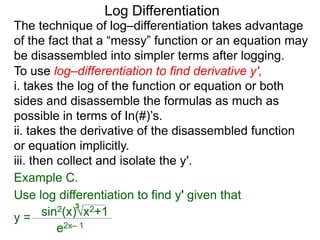
To use log–differentiation to find derivative y',
Log Differentiation
The technique of log–differentiation takes advantage
of the fact that a “messy” function or an equation may
be disassembled into simpler terms after logging.
To use log–differentiation to find derivative y',
i. takes the log of the function or equation or both
sides and disassemble the formulas as much as
possible in terms of In(#)’s.
Log Differentiation
The technique of log–differentiation takes advantage
of the fact that a “messy” function or an equation may
be disassembled into simpler terms after logging.
To use log–differentiation to find derivative y',
i. takes the log of the function or equation or both
sides and disassemble the formulas as much as
possible in terms of In(#)’s.
ii. takes the derivative of the disassembled function
or equation implicitly.
Log Differentiation
The technique of log–differentiation takes advantage
of the fact that a “messy” function or an equation may
be disassembled into simpler terms after logging.
To use log–differentiation to find derivative y',
i. takes the log of the function or equation or both
sides and disassemble the formulas as much as
possible in terms of In(#)’s.
ii. takes the derivative of the disassembled function
or equation implicitly.
iii. then collect and isolate the y'.
Log Differentiation
The technique of log–differentiation takes advantage
of the fact that a “messy” function or an equation may
be disassembled into simpler terms after logging.
To use log–differentiation to find derivative y',
i. takes the log of the function or equation or both
sides and disassemble the formulas as much as
possible in terms of In(#)’s.
ii. takes the derivative of the disassembled function
or equation implicitly.
iii. then collect and isolate the y'.
Example C.
Use log differentiation to find y' given that
              3
          2(x)√x2+1
y = sin
          e2x– 1
Log Differentiation
Takes the natural–log on both sides we have
                                  3
                             2(x) √x2+1
            ln(y) = ln   sin
                            e2x– 1
Log Differentiation
Takes the natural–log on both sides we have
                                    3
                               2(x) √x2+1
              ln(y) = ln   sin
                              e2x– 1
ln(y) = In(sin2(x)) + In( (x2+1)3/2) – In(e2x–1)
Log Differentiation
Takes the natural–log on both sides we have
                                    3
                               2(x) √x2+1
              ln(y) = ln   sin
                              e2x– 1
ln(y) = In(sin2(x)) + In( (x2+1)3/2) – In(e2x–1)
ln(y) = 2In(sin (x)) + 3 In(x2+1) – 2x + 1
                       2
Log Differentiation
Takes the natural–log on both sides we have
                                   3
                              2(x) √x2+1
             ln(y) = ln   sin
                              e2x– 1
ln(y) = In(sin2(x)) + In( (x2+1)3/2) – In(e2x–1)
ln(y) = 2In(sin (x)) + 3 In(x2+1) – 2x + 1 Differentiate
                       2
                                               both sides
Log Differentiation
Takes the natural–log on both sides we have
                                   3
                              2(x) √x2+1
             ln(y) = ln   sin
                              e2x– 1
ln(y) = In(sin2(x)) + In( (x2+1)3/2) – In(e2x–1)
ln(y) = 2In(sin (x)) + 3 In(x2+1) – 2x + 1 Differentiate
                       2
                                               both sides
        y'
         y =
Log Differentiation
Takes the natural–log on both sides we have
                                   3
                              2(x) √x2+1
             ln(y) = ln   sin
                              e2x– 1
ln(y) = In(sin2(x)) + In( (x2+1)3/2) – In(e2x–1)
ln(y) = 2In(sin (x)) + 3 In(x2+1) – 2x + 1 Differentiate
                       2
                                               both sides
        y' 2cos(x)
         y = sin(x)
Log Differentiation
Takes the natural–log on both sides we have
                                   3
                              2(x) √x2+1
             ln(y) = ln   sin
                              e2x– 1
ln(y) = In(sin2(x)) + In( (x2+1)3/2) – In(e2x–1)
ln(y) = 2In(sin (x)) + 3 In(x2+1) – 2x + 1 Differentiate
                       2
                                               both sides
        y' 2cos(x) 3 2x – 2
         y = sin(x) + 2 x2+1
Log Differentiation
Takes the natural–log on both sides we have
                                   3
                              2(x) √x2+1
             ln(y) = ln   sin
                              e2x– 1
ln(y) = In(sin2(x)) + In( (x2+1)3/2) – In(e2x–1)
ln(y) = 2In(sin (x)) + 3 In(x2+1) – 2x + 1 Differentiate
                        2
                                               both sides
        y' 2cos(x) 3 2x – 2
         y = sin(x) + 2 x2+1
Hence
y' = 2cos(x) + 3    2+1
                         –2 y
       sin(x)     x
Log Differentiation
Takes the natural–log on both sides we have
                                    3
                               2(x) √x2+1
              ln(y) = ln   sin
                               e2x– 1
 ln(y) = In(sin2(x)) + In( (x2+1)3/2) – In(e2x–1)
 ln(y) = 2In(sin (x)) + 3 In(x2+1) – 2x + 1 Differentiate
                         2
                                                both sides
         y' 2cos(x) 3 2x – 2
          y = sin(x) + 2 x2+1
Hence
y' = 2cos(x) + 3     2+1
                          –2 y
        sin(x)     x
                                         3
      2cos(x)                       2(x)√x2+1
y' =
      sin(x)    + x2+1 – 2 sin
                      3
                                    e2x– 1

3.2 implicit equations and implicit differentiation

  • 1.
    Implicit Equations andImplicit Differentiation
  • 2.
    Implicit Equations andImplicit Differentiation Implicit Equations
  • 3.
    Implicit Equations andImplicit Differentiation Implicit Equations The function y = 1/x may be written as xy = 1.
  • 4.
    Implicit Equations andImplicit Differentiation Implicit Equations The function y = 1/x may be written as xy = 1. The y = 1/x is the explicit form because the output y is given explicitly as a function of x. The equation xy = 1 is said to be in the implicit form because the relation between x and y are not given as a function.
  • 5.
    Implicit Equations andImplicit Differentiation Implicit Equations The function y = 1/x may be written as xy = 1. The y = 1/x is the explicit form because the output y is given explicitly as a function of x. The equation xy = 1 is said to be in the implicit form because the relation between x and y are not given as a function. The implicit equation x2 + y2 = 1 has the unit circle as its graph.
  • 6.
    Implicit Equations andImplicit Differentiation Implicit Equations The function y = 1/x may be written as xy = 1. The y = 1/x is the explicit form because the output y is given explicitly as a function of x. The equation xy = 1 is said to be in the implicit form because the relation between x and y are not given as a function. The implicit equation x2 + y2 = 1 has the unit circle as its graph. It’s not one function. y = √1 – x2 However x2 + y2 = 1 may be represented by two different functions. y = √1 – x2 or y = –√1 – x2 y = – √1 – x2
  • 7.
    Implicit Equations andImplicit Differentiation The joint variables x and y in an implicit equation may be inseparable by algebra.
  • 8.
    Implicit Equations andImplicit Differentiation The joint variables x and y in an implicit equation may be inseparable by algebra. sin(xy) = 0,
  • 9.
    Implicit Equations andImplicit Differentiation The joint variables x and y in an implicit equation may be inseparable by algebra. In fact for sin(xy) = 0, there are infinitely many solution-branches xy = nπ for n = 0, 1, 2,..
  • 10.
    Implicit Equations andImplicit Differentiation The joint variables x and y in an implicit equation may be inseparable by algebra. In fact for sin(xy) = 0, there are infinitely many solution-branches xy = nπ for n = 0, 1, 2,.. Plot xy = 0, xy = π, xy = – π, ..
  • 11.
    Implicit Equations andImplicit Differentiation The joint variables x and y in an implicit equation may be inseparable by algebra. In fact for sin(xy) = 0, there are infinitely many solution-branches xy = nπ for n = 0, 1, 2,.. Plot xy = 0, xy = π, xy = – π, .. y x sin(xy) = 0
  • 12.
    Implicit Equations andImplicit Differentiation The joint variables x and y in an implicit equation may be inseparable by algebra. In fact for sin(xy) = 0, there are infinitely many solution-branches xy = nπ for n = 0, 1, 2,.. Plot xy = 0, xy = π, xy = – π, .. Any point (x, y) on any of these branch is a solution for sin(xy) = 0. y xy = 0 x sin(xy) = 0
  • 13.
    Implicit Equations andImplicit Differentiation The joint variables x and y in an implicit equation may be inseparable by algebra. In fact for sin(xy) = 0, there are infinitely many solution-branches xy = nπ for n = 0, 1, 2,.. Plot xy = 0, xy = π, xy = – π, .. Any point (x, y) on any of these branch is a solution for sin(xy) = 0. y xy = 0 x xy = –π sin(xy) = 0
  • 14.
    Implicit Equations andImplicit Differentiation The joint variables x and y in an implicit equation may be inseparable by algebra. In fact for sin(xy) = 0, there are infinitely many solution-branches xy = nπ for n = 0, 1, 2,.. Plot xy = 0, xy = π, xy = – π, .. Any point (x, y) on any of these branch is a solution for sin(xy) = 0. y xy = 0 x xy = –π xy = –π sin(xy) = 0
  • 15.
    Implicit Equations andImplicit Differentiation The joint variables x and y in an implicit equation may be inseparable by algebra. In fact for sin(xy) = 0, there are infinitely many solution-branches xy = nπ for n = 0, 1, 2,.. Plot xy = 0, xy = π, xy = – π, .. Any point (x, y) on any of these branch is a solution for sin(xy) = 0. Given a point P(a, b) that satisfies y a given implicit equation, P must be on one (or more ) of the branch which is well defined by some function y = y(x). xy = 0 x xy = –π xy = –π sin(xy) = 0
  • 16.
    Implicit Equations andImplicit Differentiation The joint variables x and y in an implicit equation may be inseparable by algebra. In fact for sin(xy) = 0, there are infinitely many solution-branches xy = nπ for n = 0, 1, 2,.. Plot xy = 0, xy = π, xy = – π, .. Any point (x, y) on any of these branch is a solution for sin(xy) = 0. Given a point P(a, b) that satisfies y a given implicit equation, P must be on one (or more ) of the branch which is well defined by y=π/x P(π, 1) some function y = y(x). x For example, the point (π, 1) satisfies sin(xy) = 0 and it’s on the branch xy = π or y = y(x) = π/x. sin(xy) = 0
  • 17.
    Implicit Equations andImplicit Differentiation We assume that the branch y function y = y(x) that contains P is differentiable at the point P as P(π, 1) the case in the example here y=π/x that y = π/x is differentiable at x P(π, 1). sin(xy) = 0
  • 18.
    Implicit Equations andImplicit Differentiation We assume that the branch y function y = y(x) that contains P is differentiable at the point P as P(π, 1) the case in the example here y=π/x that y = π/x is differentiable at x P(π, 1). The slope at P may be found by taking the derivative of the branch function y = π/x sin(xy) = 0 which may be difficult to identify.
  • 19.
    Implicit Equations andImplicit Differentiation We assume that the branch y function y = y(x) that contains P is differentiable at the point P as P(π, 1) the case in the example here y=π/x that y = π/x is differentiable at x P(π, 1). The slope at P may be found by taking the derivative of the branch function y = π/x sin(xy) = 0 which may be difficult to identify. Instead we may compute a different form of the derivative directly from the implicit equation sin(xy) = 0 and use it to compute the slope at the point P(π, 1).
  • 20.
    Implicit Equations andImplicit Differentiation We assume that the branch y function y = y(x) that contains P is differentiable at the point P as P(π, 1) the case in the example here y=π/x that y = π/x is differentiable at x P(π, 1). The slope at P may be found by taking the derivative of the branch function y = π/x sin(xy) = 0 which may be difficult to identify. Instead we may compute a different form of the derivative directly from the implicit equation sin(xy) = 0 and use it to compute the slope at the point P(π, 1). This procedure is called implicit differentiation and the form of the derivative is called the implicit derivative.
  • 21.
    Implicit Equations andImplicit Differentiation To differentiate implicitly, we assume that y is y(x) a function of x, and that we are to solve for y'(x).
  • 22.
    Implicit Equations andImplicit Differentiation To differentiate implicitly, we assume that y is y(x) a function of x, and that we are to solve for y'(x). Because y is y(x), all the the y’s in an implicit equation are subjected to the Chain Rule.
  • 23.
    Implicit Equations andImplicit Differentiation To differentiate implicitly, we assume that y is y(x) a function of x, and that we are to solve for y'(x). Because y is y(x), all the the y’s in an implicit equation are subjected to the Chain Rule. Example A. Assume that y is y(x), expand the following derivative in expressions of x, y and y'. a. (x3 y)' b. (x y3)'
  • 24.
    Implicit Equations andImplicit Differentiation To differentiate implicitly, we assume that y is y(x) a function of x, and that we are to solve for y'(x). Because y is y(x), all the the y’s in an implicit equation are subjected to the Chain Rule. Example A. Assume that y is y(x), expand the following derivative in expressions of x, y and y'. a. (x3 y)' By the Product Rule, (x3 y)' = (x3)' y + x3 (y)' b. (x y3)'
  • 25.
    Implicit Equations andImplicit Differentiation To differentiate implicitly, we assume that y is y(x) a function of x, and that we are to solve for y'(x). Because y is y(x), all the the y’s in an implicit equation are subjected to the Chain Rule. Example A. Assume that y is y(x), expand the following derivative in expressions of x, y and y'. a. (x3 y)' By the Product Rule, (x3 y)' = (x3)' y + x3 (y)' = 3x2y + x3(y)' b. (x y3)'
  • 26.
    Implicit Equations andImplicit Differentiation To differentiate implicitly, we assume that y is y(x) a function of x, and that we are to solve for y'(x). Because y is y(x), all the the y’s in an implicit equation are subjected to the Chain Rule. Example A. Assume that y is y(x), expand the following derivative in expressions of x, y and y'. a. (x3 y)' By the Product Rule, (x3 y)' = (x3)' y + x3 (y)' = 3x2y + x3(y)' b. (x y3)' By the Product Rule, (x y3)' = (x)' y3 + x3 (y3)'
  • 27.
    Implicit Equations andImplicit Differentiation To differentiate implicitly, we assume that y is y(x) a function of x, and that we are to solve for y'(x). Because y is y(x), all the the y’s in an implicit equation are subjected to the Chain Rule. Example A. Assume that y is y(x), expand the following derivative in expressions of x, y and y'. a. (x3 y)' By the Product Rule, (x3 y)' = (x3)' y + x3 (y)' = 3x2y + x3(y)' b. (x y3)' (3y2y') By the Product Rule, (x y3)' = (x)' y3 + x3 (y3)'
  • 28.
    Implicit Equations andImplicit Differentiation To differentiate implicitly, we assume that y is y(x) a function of x, and that we are to solve for y'(x). Because y is y(x), all the the y’s in an implicit equation are subjected to the Chain Rule. Example A. Assume that y is y(x), expand the following derivative in expressions of x, y and y'. a. (x3 y)' By the Product Rule, (x3 y)' = (x3)' y + x3 (y)' = 3x2y + x3(y)' b. (x y3)' (3y2y') By the Product Rule, (x y3)' = (x)' y3 + x3 (y3)' = y3 + 3x3y2y'
  • 29.
    Implicit Equations andImplicit Differentiation d. Expand (x3 y – x y3)' and collect the y' – term
  • 30.
    Implicit Equations andImplicit Differentiation d. Expand (x3 y – x y3)' and collect the y' – term (x3 y – x y3)' = [3x2y + x3 y'] – [y3 + 3x3y2 y']
  • 31.
    Implicit Equations andImplicit Differentiation d. Expand (x3 y – x y3)' and collect the y' – term (x3 y – x y3)' = [3x2y + x3 y'] – [y3 + 3x3y2 y'] = 3x2y + x3 y' – y3 – 3x3y2 y'
  • 32.
    Implicit Equations andImplicit Differentiation d. Expand (x3 y – x y3)' and collect the y' – term (x3 y – x y3)' = [3x2y + x3 y'] – [y3 + 3x3y2 y'] = 3x2y + x3 y' – y3 – 3x3y2 y' = 3x2y – y3 + (x3 – 3x3y2) y'
  • 33.
    Implicit Equations andImplicit Differentiation d. Expand (x3 y – x y3)' and collect the y' – term (x3 y – x y3)' = [3x2y + x3 y'] – [y3 + 3x3y2 y'] = 3x2y + x3 y' – y3 – 3x3y2 y' = 3x2y – y3 + (x3 – 3x3y2) y'
  • 34.
    Implicit Equations andImplicit Differentiation d. Expand (x3 y – x y3)' and collect the y' – term (x3 y – x y3)' = [3x2y + x3 y'] – [y3 + 3x3y2 y'] = 3x2y + x3 y' – y3 – 3x3y2 y' = 3x2y – y3 + (x3 – 3x3y2) y' y Let us go back to the equation sin(xy) = 0. x sin(xy) = 0
  • 35.
    Implicit Equations andImplicit Differentiation d. Expand (x3 y – x y3)' and collect the y' – term (x3 y – x y3)' = [3x2y + x3 y'] – [y3 + 3x3y2 y'] = 3x2y + x3 y' – y3 – 3x3y2 y' = 3x2y – y3 + (x3 – 3x3y2) y' y Let us go back to the equation sin(xy) = 0. P(π, 1) Example B. Use implicit y=π/x differentiation to find y' x given that sin(xy) = 0 and find the slope and the tangent line at the point (π, 1) on the graph sin(xy) = 0 of sin(xy) = 0.
  • 36.
    Implicit Equations andImplicit Differentiation Differentiate both sides of sin(xy) = 0 with respect to x, [sin(xy) ] ' = (0)' y P(π, 1) y=π/x x sin(xy) = 0
  • 37.
    Implicit Equations andImplicit Differentiation Differentiate both sides of sin(xy) = 0 with respect to x, [sin(xy) ] ' = (0)' by the Sine Chain Rule [cos(xy)] (xy)' = 0 y P(π, 1) y=π/x x sin(xy) = 0
  • 38.
    Implicit Equations andImplicit Differentiation Differentiate both sides of sin(xy) = 0 with respect to x, [sin(xy) ] ' = (0)' by the Sine Chain Rule [cos(xy)] (xy)' = 0 by the Product Rule cos(xy) [(x)'y + x(y)'] = 0 y P(π, 1) y=π/x x sin(xy) = 0
  • 39.
    Implicit Equations andImplicit Differentiation Differentiate both sides of sin(xy) = 0 with respect to x, [sin(xy) ] ' = (0)' by the Sine Chain Rule [cos(xy)] (xy)' = 0 by the Product Rule cos(xy) [(x)'y + x(y)'] = 0 y cos(xy) [1*y + x(y)'] = 0 P(π, 1) y=π/x x sin(xy) = 0
  • 40.
    Implicit Equations andImplicit Differentiation Differentiate both sides of sin(xy) = 0 with respect to x, [sin(xy) ] ' = (0)' by the Sine Chain Rule [cos(xy)] (xy)' = 0 by the Product Rule cos(xy) [(x)'y + x(y)'] = 0 y cos(xy) [1*y + x(y)'] = 0 P(π, 1) Solve for (y)', set y + x(y)' = 0 y=π/x x sin(xy) = 0
  • 41.
    Implicit Equations andImplicit Differentiation Differentiate both sides of sin(xy) = 0 with respect to x, [sin(xy) ] ' = (0)' by the Sine Chain Rule [cos(xy)] (xy)' = 0 by the Product Rule cos(xy) [(x)'y + x(y)'] = 0 y cos(xy) [1*y + x(y)'] = 0 P(π, 1) Solve for (y)', set y + x(y)' = 0 y=π/x –y x x(y)' = –y or that y' = x sin(xy) = 0
  • 42.
    Implicit Equations andImplicit Differentiation Differentiate both sides of sin(xy) = 0 with respect to x, [sin(xy) ] ' = (0)' by the Sine Chain Rule [cos(xy)] (xy)' = 0 by the Product Rule cos(xy) [(x)'y + x(y)'] = 0 y cos(xy) [1*y + x(y)'] = 0 P(π, 1) Solve for (y)', set y + x(y)' = 0 y=π/x –y x x(y)' = –y or that y' = x At P(π, 1), x = π, y = 1 y' = –1 = the slope at P. π sin(xy) = 0
  • 43.
    Implicit Equations andImplicit Differentiation Differentiate both sides of sin(xy) = 0 with respect to x, [sin(xy) ] ' = (0)' by the Sine Chain Rule [cos(xy)] (xy)' = 0 by the Product Rule cos(xy) [(x)'y + x(y)'] = 0 y cos(xy) [1*y + x(y)'] = 0 P(π, 1) Solve for (y)', set y + x(y)' = 0 y=π/x –y x x(y)' = –y or that y' = x At P(π, 1), x = π, y = 1 y' = –1 = the slope at P. π sin(xy) = 0 Using the the Point–Slope Formula at P (π, 1), the equation of the tangent line is y = –x + 2. π
  • 44.
    Implicit Equations andImplicit Differentiation Your turn: Expand [cos3 (x/y)] '
  • 45.
    Implicit Equations andImplicit Differentiation Your turn: Expand [cos3 (x/y)] ' By the Power Chain Rule, [cos3 (x/y)] ' = 3cos2(x/y) [cos (x/y)] ' = 3cos2(x/y) [– sin(x/y)] (x/y) ' = 3cos2(x/y) [– sin(x/y)] ((y – xy')/y2)
  • 46.
    Implicit Equations andImplicit Differentiation Your turn: Expand [cos3 (x/y)] ' By the Power Chain Rule, [cos3 (x/y)] ' = 3cos2(x/y) [cos (x/y)] ' = 3cos2(x/y) [– sin(x/y)] (x/y) ' = 3cos2(x/y) [– sin(x/y)] ((y – xy')/y2) exy x2+1 = y2 find y' implicitly. Example C. Given
  • 47.
    Implicit Equations andImplicit Differentiation Your turn: Expand [cos3 (x/y)] ' By the Power Chain Rule, [cos3 (x/y)] ' = 3cos2(x/y) [cos (x/y)] ' = 3cos2(x/y) [– sin(x/y)] (x/y) ' = 3cos2(x/y) [– sin(x/y)] ((y – xy')/y2) exy x2+1 = y2 find y' implicitly. Example C. Given We are to differentiate with respect to x on both sides of the equation.
  • 48.
    Implicit Equations andImplicit Differentiation Your turn: Expand [cos3 (x/y)] ' By the Power Chain Rule, [cos3 (x/y)] ' = 3cos2(x/y) [cos (x/y)] ' = 3cos2(x/y) [– sin(x/y)] (x/y) ' = 3cos2(x/y) [– sin(x/y)] ((y – xy')/y2) exy x2+1 = y2 find y' implicitly. Example C. Given We are to differentiate with respect to x on both sides of the equation. However it’s easier if we clear the denominators first. y2 exy = x2+1
  • 49.
    Implicit Equations andImplicit Differentiation Your turn: Expand [cos3 (x/y)] ' By the Power Chain Rule, [cos3 (x/y)] ' = 3cos2(x/y) [cos (x/y)] ' = 3cos2(x/y) [– sin(x/y)] (x/y) ' = 3cos2(x/y) [– sin(x/y)] ((y – xy')/y2) exy x2+1 = y2 find y' implicitly. Example C. Given We are to differentiate with respect to x on both sides of the equation. However it’s easier if we clear the denominators first. Hence we differentiate both sides of y2 exy = x2+1
  • 50.
    Implicit Equations andImplicit Differentiation [y2 exy ] ' = [x2+1] '
  • 51.
    Implicit Equations andImplicit Differentiation [y2 exy ] ' = [x2+1] ' Product Rule (y2)' exy + y2(exy)' =
  • 52.
    Implicit Equations andImplicit Differentiation [y2 exy ] ' = [x2+1] ' Product Rule Derivative of x2 with respect to x (y2)' exy + y2(exy)' = 2x
  • 53.
    Implicit Equations andImplicit Differentiation [y2 exy ] ' = [x2+1] ' Product Rule Derivative of x2 with respect to x (y2)' exy + y2(exy)' = 2x Chain Rule 2y(y)' exy
  • 54.
    Implicit Equations andImplicit Differentiation [y2 exy ] ' = [x2+1] ' Product Rule Derivative of x2 with respect to x (y2)' exy + y2(exy)' = 2x Chain Rule 2y(y)' exy + y2 exy (xy)' = 2x
  • 55.
    Implicit Equations andImplicit Differentiation [y2 exy ] ' = [x2+1] ' Product Rule Derivative of x2 with respect to x (y2)' exy + y2(exy)' = 2x Chain Rule 2y(y)' exy + y2 exy (xy)' = 2x Product Chain Rule 2y(y)' exy + y2 exy (y + xy') = 2x
  • 56.
    Implicit Equations andImplicit Differentiation [y2 exy ] ' = [x2+1] ' Product Rule Derivative of x2 with respect to x (y2)' exy + y2(exy)' = 2x Chain Rule 2y(y)' exy + y2 exy (xy)' = 2x Product Chain Rule 2y(y)' exy + y2 exy (y + xy') = 2x We are done with differentiating. Next is to extract the y'.
  • 57.
    Implicit Equations andImplicit Differentiation [y2 exy ] ' = [x2+1] ' Product Rule Derivative of x2 with respect to x (y2)' exy + y2(exy)' = 2x Chain Rule 2y(y)' exy + y2 exy (xy)' = 2x Product Chain Rule 2y(y)' exy + y2 exy (y + xy') = 2x We are done with differentiating. Next is to extract the y'. Pull out the inherited exy factor on the left first. exy [2y(y)' + y2 (y + xy')] = 2x
  • 58.
    Implicit Equations andImplicit Differentiation exy [2y(y)' + y2 (y + xy')] = 2x
  • 59.
    Implicit Equations andImplicit Differentiation exy [2y(y)' + y2 (y + xy')] = 2x 2y(y)' + y2 (y + xy') = 2x exy
  • 60.
    Implicit Equations andImplicit Differentiation exy [2y(y)' + y2 (y + xy')] = 2x 2y(y)' + y2 (y + xy') = 2x exy 2y y' + y3 + xy2 y' = 2xexy
  • 61.
    Implicit Equations andImplicit Differentiation exy [2y(y)' + y2 (y + xy')] = 2x 2y(y)' + y2 (y + xy') = 2x exy 2y y' + y3 + xy2 y' = 2xexy 2yy' + xy2 y' = 2x – y3 exy
  • 62.
    Implicit Equations andImplicit Differentiation exy [2y(y)' + y2 (y + xy')] = 2x 2y(y)' + y2 (y + xy') = 2x exy 2y y' + y3 + xy2 y' = 2xexy 2yy' + xy2 y' = 2x – y3 exy y' (2y+ xy2 ) = 2x – y3 exy
  • 63.
    Implicit Equations andImplicit Differentiation exy [2y(y)' + y2 (y + xy')] = 2x 2y(y)' + y2 (y + xy') = 2x exy 2y y' + y3 + xy2 y' = 2xexy 2yy' + xy2 y' = 2x – y3 exy y' (2y+ xy2 ) = 2x – y3 exy 2x exy – y3 y' = (2y+ xy2 )
  • 64.
    Implicit Equations andImplicit Differentiation exy [2y(y)' + y2 (y + xy')] = 2x 2y(y)' + y2 (y + xy') = 2x exy 2y y' + y3 + xy2 y' = 2xexy 2yy' + xy2 y' = 2x – y3 exy y' (2y+ xy2 ) = 2x – y3 exy 2x exy – y3 y' = multiply exy up and down, we get (2y+ xy2 ) y' = 2x – y3exy (2y+ xy2 )exy
  • 65.
    Log Differentiation The techniqueof log–differentiation takes advantage of the fact that a “messy” function or an equation may be disassembled into simpler terms after logging.
  • 66.
    Log Differentiation The techniqueof log–differentiation takes advantage of the fact that a “messy” function or an equation may be disassembled into simpler terms after logging. To use log–differentiation to find derivative y',
  • 67.
    Log Differentiation The techniqueof log–differentiation takes advantage of the fact that a “messy” function or an equation may be disassembled into simpler terms after logging. To use log–differentiation to find derivative y', i. takes the log of the function or equation or both sides and disassemble the formulas as much as possible in terms of In(#)’s.
  • 68.
    Log Differentiation The techniqueof log–differentiation takes advantage of the fact that a “messy” function or an equation may be disassembled into simpler terms after logging. To use log–differentiation to find derivative y', i. takes the log of the function or equation or both sides and disassemble the formulas as much as possible in terms of In(#)’s. ii. takes the derivative of the disassembled function or equation implicitly.
  • 69.
    Log Differentiation The techniqueof log–differentiation takes advantage of the fact that a “messy” function or an equation may be disassembled into simpler terms after logging. To use log–differentiation to find derivative y', i. takes the log of the function or equation or both sides and disassemble the formulas as much as possible in terms of In(#)’s. ii. takes the derivative of the disassembled function or equation implicitly. iii. then collect and isolate the y'.
  • 70.
    Log Differentiation The techniqueof log–differentiation takes advantage of the fact that a “messy” function or an equation may be disassembled into simpler terms after logging. To use log–differentiation to find derivative y', i. takes the log of the function or equation or both sides and disassemble the formulas as much as possible in terms of In(#)’s. ii. takes the derivative of the disassembled function or equation implicitly. iii. then collect and isolate the y'. Example C. Use log differentiation to find y' given that 3 2(x)√x2+1 y = sin e2x– 1
  • 71.
    Log Differentiation Takes thenatural–log on both sides we have 3 2(x) √x2+1 ln(y) = ln sin e2x– 1
  • 72.
    Log Differentiation Takes thenatural–log on both sides we have 3 2(x) √x2+1 ln(y) = ln sin e2x– 1 ln(y) = In(sin2(x)) + In( (x2+1)3/2) – In(e2x–1)
  • 73.
    Log Differentiation Takes thenatural–log on both sides we have 3 2(x) √x2+1 ln(y) = ln sin e2x– 1 ln(y) = In(sin2(x)) + In( (x2+1)3/2) – In(e2x–1) ln(y) = 2In(sin (x)) + 3 In(x2+1) – 2x + 1 2
  • 74.
    Log Differentiation Takes thenatural–log on both sides we have 3 2(x) √x2+1 ln(y) = ln sin e2x– 1 ln(y) = In(sin2(x)) + In( (x2+1)3/2) – In(e2x–1) ln(y) = 2In(sin (x)) + 3 In(x2+1) – 2x + 1 Differentiate 2 both sides
  • 75.
    Log Differentiation Takes thenatural–log on both sides we have 3 2(x) √x2+1 ln(y) = ln sin e2x– 1 ln(y) = In(sin2(x)) + In( (x2+1)3/2) – In(e2x–1) ln(y) = 2In(sin (x)) + 3 In(x2+1) – 2x + 1 Differentiate 2 both sides y' y =
  • 76.
    Log Differentiation Takes thenatural–log on both sides we have 3 2(x) √x2+1 ln(y) = ln sin e2x– 1 ln(y) = In(sin2(x)) + In( (x2+1)3/2) – In(e2x–1) ln(y) = 2In(sin (x)) + 3 In(x2+1) – 2x + 1 Differentiate 2 both sides y' 2cos(x) y = sin(x)
  • 77.
    Log Differentiation Takes thenatural–log on both sides we have 3 2(x) √x2+1 ln(y) = ln sin e2x– 1 ln(y) = In(sin2(x)) + In( (x2+1)3/2) – In(e2x–1) ln(y) = 2In(sin (x)) + 3 In(x2+1) – 2x + 1 Differentiate 2 both sides y' 2cos(x) 3 2x – 2 y = sin(x) + 2 x2+1
  • 78.
    Log Differentiation Takes thenatural–log on both sides we have 3 2(x) √x2+1 ln(y) = ln sin e2x– 1 ln(y) = In(sin2(x)) + In( (x2+1)3/2) – In(e2x–1) ln(y) = 2In(sin (x)) + 3 In(x2+1) – 2x + 1 Differentiate 2 both sides y' 2cos(x) 3 2x – 2 y = sin(x) + 2 x2+1 Hence y' = 2cos(x) + 3 2+1 –2 y sin(x) x
  • 79.
    Log Differentiation Takes thenatural–log on both sides we have 3 2(x) √x2+1 ln(y) = ln sin e2x– 1 ln(y) = In(sin2(x)) + In( (x2+1)3/2) – In(e2x–1) ln(y) = 2In(sin (x)) + 3 In(x2+1) – 2x + 1 Differentiate 2 both sides y' 2cos(x) 3 2x – 2 y = sin(x) + 2 x2+1 Hence y' = 2cos(x) + 3 2+1 –2 y sin(x) x 3 2cos(x) 2(x)√x2+1 y' = sin(x) + x2+1 – 2 sin 3 e2x– 1