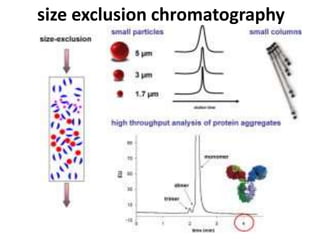
size exclusion chromatography
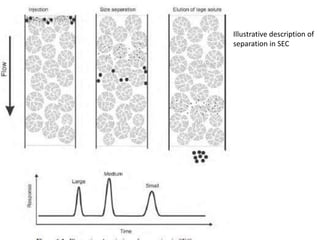
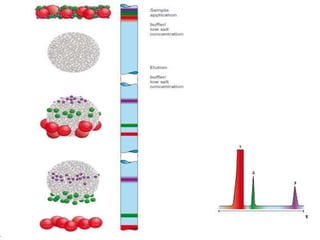
Illustrative description of 
separation in SEC
HONG, Paula; KOZA, Stephan; BOUVIER, Edouard SP. A REVIEW SIZE-EXCLUSION 
CHROMATOGRAPHY FOR THE ANALYSIS OF PROTEIN 
BIOTHERAPEUTICS AND THEIR AGGREGATES. Journal of liquid 
chromatography & related technologies, v. 35, n. 20, p. 2923-2950, 2012. 
FEKETE, Szabolcs et al. Theory and practice of Size Exclusion 
Chromatography for the analysis of protein aggregates. Journal of 
Pharmaceutical and Biomedical Analysis, 2014.
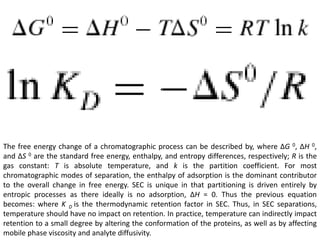
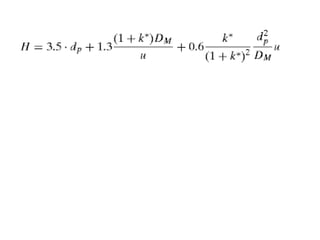
The free energy change of a chromatographic process can be described by, where ΔG 0, ΔH 0, 
and ΔS 0 are the standard free energy, enthalpy, and entropy differences, respectively; R is the 
gas constant: T is absolute temperature, and k is the partition coefficient. For most 
chromatographic modes of separation, the enthalpy of adsorption is the dominant contributor 
to the overall change in free energy. SEC is unique in that partitioning is driven entirely by 
entropic processes as there ideally is no adsorption, ΔH = 0. Thus the previous equation 
becomes: where K D is the thermodynamic retention factor in SEC. Thus, in SEC separations, 
temperature should have no impact on retention. In practice, temperature can indirectly impact 
retention to a small degree by altering the conformation of the proteins, as well as by affecting 
mobile phase viscosity and analyte diffusivity.
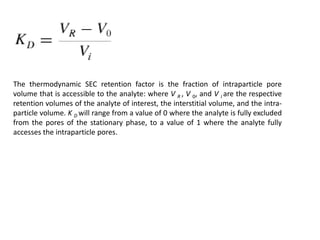
The thermodynamic SEC retention factor is the fraction of intraparticle pore 
volume that is accessible to the analyte: where V R , V 0, and V i are the respective 
retention volumes of the analyte of interest, the interstitial volume, and the intra-particle 
volume. K D will range from a value of 0 where the analyte is fully excluded 
from the pores of the stationary phase, to a value of 1 where the analyte fully 
accesses the intraparticle pores.
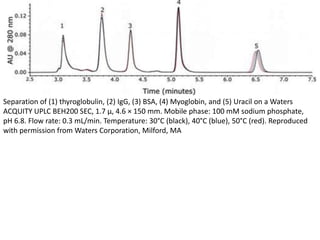
Separation of (1) thyroglobulin, (2) IgG, (3) BSA, (4) Myoglobin, and (5) Uracil on a Waters 
ACQUITY UPLC BEH200 SEC, 1.7 μ, 4.6 × 150 mm. Mobile phase: 100 mM sodium phosphate, 
pH 6.8. Flow rate: 0.3 mL/min. Temperature: 30°C (black), 40°C (blue), 50°C (red). Reproduced 
with permission from Waters Corporation, Milford, MA
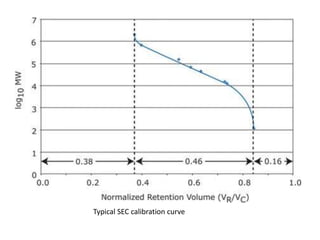
Typical SEC calibration curve
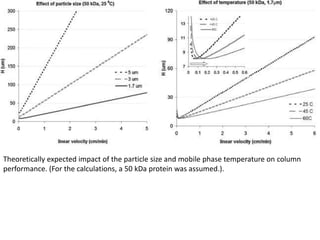
Theoretically expected impact of the particle size and mobile phase temperature on column 
performance. (For the calculations, a 50 kDa protein was assumed.).
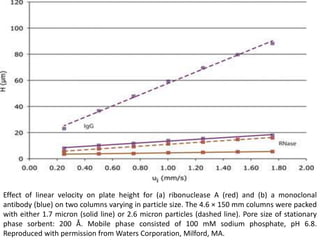
Effect of linear velocity on plate height for (a) ribonuclease A (red) and (b) a monoclonal 
antibody (blue) on two columns varying in particle size. The 4.6 × 150 mm columns were packed 
with either 1.7 micron (solid line) or 2.6 micron particles (dashed line). Pore size of stationary 
phase sorbent: 200 Å. Mobile phase consisted of 100 mM sodium phosphate, pH 6.8. 
Reproduced with permission from Waters Corporation, Milford, MA.
Comparison of Columns: Effect of Particle Size on Efficiency and Resolution for a Reduced 
Antibody 
Theoretical Plates 
[-17pt] 
Columns 
Dimension 
s (m i.d. × 
mm length) 
Particle 
size (μm) 
Pore sizes 
(Å) HC LC Resolution 
TSKgel 
G3000SW 
7.5 × 300 10 250 1980 3845 3 
TSKgel 
G3000SWxl 
7.8 × 300 5 250 5060 10674 4 
Shodex 
KW-804 
8.0 × 300 7 250 4952 8859 2 
Protein-Pak 
300SW 
7.5 × 300 10 250 2078 4271 3 
BioSuite 
250 
7.8 × 300 5 250 5149 9403 3
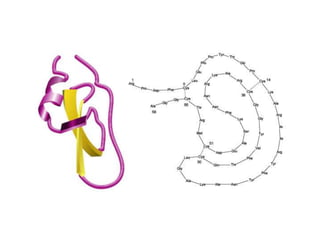
The drug aprotinin (Trasylol, previously Bayer and now Nordic Group 
pharmaceuticals), is the small protein bovine pancreatic trypsin inhibitor, 
or BPTI, which inhibits trypsin and related proteolytic enzymes. Under the 
trade name Trasylol, aprotinin was used as a medication administered 
by injection to reduce bleeding during complex surgery, such as heart and liver 
surgery. Its main effect is the slowing down of fibrinolysis, the process that 
leads to the breakdown of blood clots. The aim in its use was to decrease the 
need for blood transfusions during surgery, as well as end-organ damage due 
to hypotension (low blood pressure) as a result of marked blood loss. The drug 
was temporarily withdrawn worldwide in 2007 after studies suggested that its 
use increased the risk of complications or death
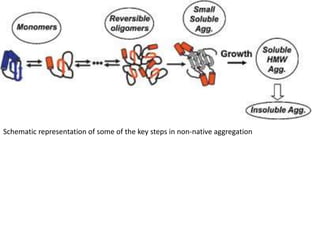
Schematic representation of some of the key steps in non-native aggregation
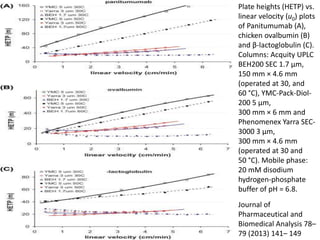
Plate heights (HETP) vs. 
linear velocity (u0) plots 
of Panitumumab (A), 
chicken ovalbumin (B) 
and β-lactoglobulin (C). 
Columns: Acquity UPLC 
BEH200 SEC 1.7 μm, 
150 mm × 4.6 mm 
(operated at 30, and 
60 °C), YMC-Pack-Diol- 
200 5 μm, 
300 mm × 6 mm and 
Phenomenex Yarra SEC- 
3000 3 μm, 
300 mm × 4.6 mm 
(operated at 30 and 
50 °C). Mobile phase: 
20 mM disodium 
hydrogen-phosphate 
buffer of pH = 6.8. 
Journal of 
Pharmaceutical and 
Biomedical Analysis 78– 
79 (2013) 141– 149
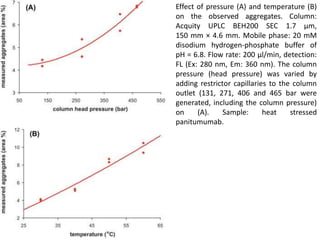
Effect of pressure (A) and temperature (B) 
on the observed aggregates. Column: 
Acquity UPLC BEH200 SEC 1.7 μm, 
150 mm × 4.6 mm. Mobile phase: 20 mM 
disodium hydrogen-phosphate buffer of 
pH = 6.8. Flow rate: 200 μl/min, detection: 
FL (Ex: 280 nm, Em: 360 nm). The column 
pressure (head pressure) was varied by 
adding restrictor capillaries to the column 
outlet (131, 271, 406 and 465 bar were 
generated, including the column pressure) 
on (A). Sample: heat stressed 
panitumumab.
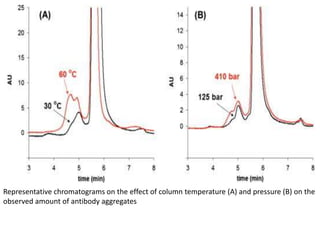
Representative chromatograms on the effect of column temperature (A) and pressure (B) on the 
observed amount of antibody aggregates
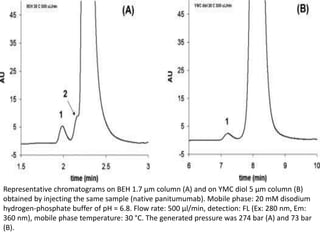
Representative chromatograms on BEH 1.7 μm column (A) and on YMC diol 5 μm column (B) 
obtained by injecting the same sample (native panitumumab). Mobile phase: 20 mM disodium 
hydrogen-phosphate buffer of pH = 6.8. Flow rate: 500 μl/min, detection: FL (Ex: 280 nm, Em: 
360 nm), mobile phase temperature: 30 °C. The generated pressure was 274 bar (A) and 73 bar 
(B).
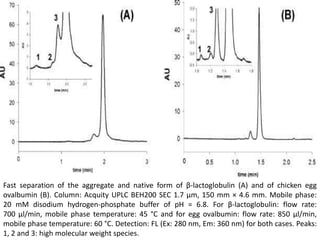
Fast separation of the aggregate and native form of β-lactoglobulin (A) and of chicken egg 
ovalbumin (B). Column: Acquity UPLC BEH200 SEC 1.7 μm, 150 mm × 4.6 mm. Mobile phase: 
20 mM disodium hydrogen-phosphate buffer of pH = 6.8. For β-lactoglobulin: flow rate: 
700 μl/min, mobile phase temperature: 45 °C and for egg ovalbumin: flow rate: 850 μl/min, 
mobile phase temperature: 60 °C. Detection: FL (Ex: 280 nm, Em: 360 nm) for both cases. Peaks: 
1, 2 and 3: high molecular weight species.
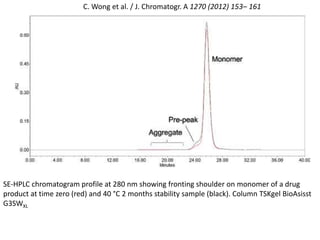
C. Wong et al. / J. Chromatogr. A 1270 (2012) 153– 161 
SE-HPLC chromatogram profile at 280 nm showing fronting shoulder on monomer of a drug 
product at time zero (red) and 40 °C 2 months stability sample (black). Column TSKgel BioAsisst 
G3SWXL
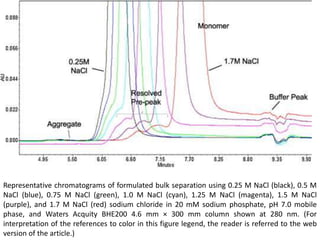
Representative chromatograms of formulated bulk separation using 0.25 M NaCl (black), 0.5 M 
NaCl (blue), 0.75 M NaCl (green), 1.0 M NaCl (cyan), 1.25 M NaCl (magenta), 1.5 M NaCl 
(purple), and 1.7 M NaCl (red) sodium chloride in 20 mM sodium phosphate, pH 7.0 mobile 
phase, and Waters Acquity BHE200 4.6 mm × 300 mm column shown at 280 nm. (For 
interpretation of the references to color in this figure legend, the reader is referred to the web 
version of the article.)
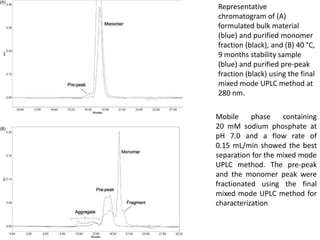
Representative 
chromatogram of (A) 
formulated bulk material 
(blue) and purified monomer 
fraction (black), and (B) 40 °C, 
9 months stability sample 
(blue) and purified pre-peak 
fraction (black) using the final 
mixed mode UPLC method at 
280 nm. 
Mobile phase containing 
20 mM sodium phosphate at 
pH 7.0 and a flow rate of 
0.15 mL/min showed the best 
separation for the mixed mode 
UPLC method. The pre-peak 
and the monomer peak were 
fractionated using the final 
mixed mode UPLC method for 
characterization
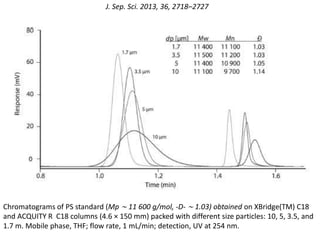
J. Sep. Sci. 2013, 36, 2718–2727 
Chromatograms of PS standard (Mp ∼ 11 600 g/mol, -D- ∼ 1.03) obtained on XBridge(TM) C18 
and ACQUITY R C18 columns (4.6 × 150 mm) packed with different size particles: 10, 5, 3.5, and 
1.7 m. Mobile phase, THF; flow rate, 1 mL/min; detection, UV at 254 nm.
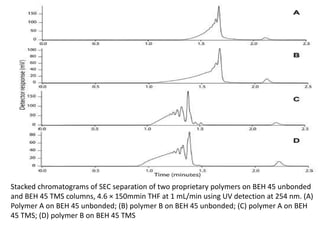
Stacked chromatograms of SEC separation of two proprietary polymers on BEH 45 unbonded 
and BEH 45 TMS columns, 4.6 × 150mmin THF at 1 mL/min using UV detection at 254 nm. (A) 
Polymer A on BEH 45 unbonded; (B) polymer B on BEH 45 unbonded; (C) polymer A on BEH 
45 TMS; (D) polymer B on BEH 45 TMS
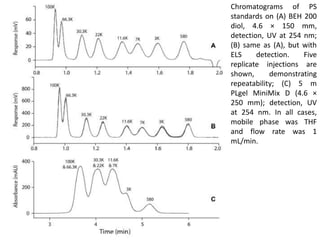
Chromatograms of PS 
standards on (A) BEH 200 
diol, 4.6 × 150 mm, 
detection, UV at 254 nm; 
(B) same as (A), but with 
ELS detection. Five 
replicate injections are 
shown, demonstrating 
repeatability; (C) 5 m 
PLgel MiniMix D (4.6 × 
250 mm); detection, UV 
at 254 nm. In all cases, 
mobile phase was THF 
and flow rate was 1 
mL/min.
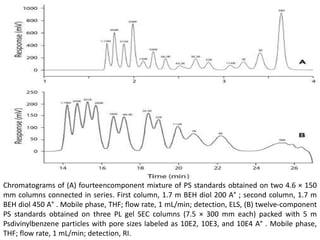
Chromatograms of (A) fourteencomponent mixture of PS standards obtained on two 4.6 × 150 
mm columns connected in series. First column, 1.7 m BEH diol 200 A° ; second column, 1.7 m 
BEH diol 450 A° . Mobile phase, THF; flow rate, 1 mL/min; detection, ELS, (B) twelve-component 
PS standards obtained on three PL gel SEC columns (7.5 × 300 mm each) packed with 5 m 
Psdivinylbenzene particles with pore sizes labeled as 10E2, 10E3, and 10E4 A° . Mobile phase, 
THF; flow rate, 1 mL/min; detection, RI.
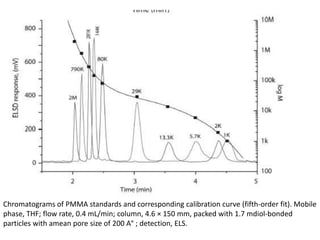
Chromatograms of PMMA standards and corresponding calibration curve (fifth-order fit). Mobile 
phase, THF; flow rate, 0.4 mL/min; column, 4.6 × 150 mm, packed with 1.7 mdiol-bonded 
particles with amean pore size of 200 A° ; detection, ELS.

Size exclusion chromatography

  • 1.
  • 2.
    Illustrative description of separation in SEC
  • 4.
    HONG, Paula; KOZA,Stephan; BOUVIER, Edouard SP. A REVIEW SIZE-EXCLUSION CHROMATOGRAPHY FOR THE ANALYSIS OF PROTEIN BIOTHERAPEUTICS AND THEIR AGGREGATES. Journal of liquid chromatography & related technologies, v. 35, n. 20, p. 2923-2950, 2012. FEKETE, Szabolcs et al. Theory and practice of Size Exclusion Chromatography for the analysis of protein aggregates. Journal of Pharmaceutical and Biomedical Analysis, 2014.
  • 6.
    The free energychange of a chromatographic process can be described by, where ΔG 0, ΔH 0, and ΔS 0 are the standard free energy, enthalpy, and entropy differences, respectively; R is the gas constant: T is absolute temperature, and k is the partition coefficient. For most chromatographic modes of separation, the enthalpy of adsorption is the dominant contributor to the overall change in free energy. SEC is unique in that partitioning is driven entirely by entropic processes as there ideally is no adsorption, ΔH = 0. Thus the previous equation becomes: where K D is the thermodynamic retention factor in SEC. Thus, in SEC separations, temperature should have no impact on retention. In practice, temperature can indirectly impact retention to a small degree by altering the conformation of the proteins, as well as by affecting mobile phase viscosity and analyte diffusivity.
  • 7.
    The thermodynamic SECretention factor is the fraction of intraparticle pore volume that is accessible to the analyte: where V R , V 0, and V i are the respective retention volumes of the analyte of interest, the interstitial volume, and the intra-particle volume. K D will range from a value of 0 where the analyte is fully excluded from the pores of the stationary phase, to a value of 1 where the analyte fully accesses the intraparticle pores.
  • 8.
    Separation of (1)thyroglobulin, (2) IgG, (3) BSA, (4) Myoglobin, and (5) Uracil on a Waters ACQUITY UPLC BEH200 SEC, 1.7 μ, 4.6 × 150 mm. Mobile phase: 100 mM sodium phosphate, pH 6.8. Flow rate: 0.3 mL/min. Temperature: 30°C (black), 40°C (blue), 50°C (red). Reproduced with permission from Waters Corporation, Milford, MA
  • 9.
  • 11.
    Theoretically expected impactof the particle size and mobile phase temperature on column performance. (For the calculations, a 50 kDa protein was assumed.).
  • 12.
    Effect of linearvelocity on plate height for (a) ribonuclease A (red) and (b) a monoclonal antibody (blue) on two columns varying in particle size. The 4.6 × 150 mm columns were packed with either 1.7 micron (solid line) or 2.6 micron particles (dashed line). Pore size of stationary phase sorbent: 200 Å. Mobile phase consisted of 100 mM sodium phosphate, pH 6.8. Reproduced with permission from Waters Corporation, Milford, MA.
  • 13.
    Comparison of Columns:Effect of Particle Size on Efficiency and Resolution for a Reduced Antibody Theoretical Plates [-17pt] Columns Dimension s (m i.d. × mm length) Particle size (μm) Pore sizes (Å) HC LC Resolution TSKgel G3000SW 7.5 × 300 10 250 1980 3845 3 TSKgel G3000SWxl 7.8 × 300 5 250 5060 10674 4 Shodex KW-804 8.0 × 300 7 250 4952 8859 2 Protein-Pak 300SW 7.5 × 300 10 250 2078 4271 3 BioSuite 250 7.8 × 300 5 250 5149 9403 3
  • 17.
    The drug aprotinin(Trasylol, previously Bayer and now Nordic Group pharmaceuticals), is the small protein bovine pancreatic trypsin inhibitor, or BPTI, which inhibits trypsin and related proteolytic enzymes. Under the trade name Trasylol, aprotinin was used as a medication administered by injection to reduce bleeding during complex surgery, such as heart and liver surgery. Its main effect is the slowing down of fibrinolysis, the process that leads to the breakdown of blood clots. The aim in its use was to decrease the need for blood transfusions during surgery, as well as end-organ damage due to hypotension (low blood pressure) as a result of marked blood loss. The drug was temporarily withdrawn worldwide in 2007 after studies suggested that its use increased the risk of complications or death
  • 27.
    Schematic representation ofsome of the key steps in non-native aggregation
  • 28.
    Plate heights (HETP)vs. linear velocity (u0) plots of Panitumumab (A), chicken ovalbumin (B) and β-lactoglobulin (C). Columns: Acquity UPLC BEH200 SEC 1.7 μm, 150 mm × 4.6 mm (operated at 30, and 60 °C), YMC-Pack-Diol- 200 5 μm, 300 mm × 6 mm and Phenomenex Yarra SEC- 3000 3 μm, 300 mm × 4.6 mm (operated at 30 and 50 °C). Mobile phase: 20 mM disodium hydrogen-phosphate buffer of pH = 6.8. Journal of Pharmaceutical and Biomedical Analysis 78– 79 (2013) 141– 149
  • 29.
    Effect of pressure(A) and temperature (B) on the observed aggregates. Column: Acquity UPLC BEH200 SEC 1.7 μm, 150 mm × 4.6 mm. Mobile phase: 20 mM disodium hydrogen-phosphate buffer of pH = 6.8. Flow rate: 200 μl/min, detection: FL (Ex: 280 nm, Em: 360 nm). The column pressure (head pressure) was varied by adding restrictor capillaries to the column outlet (131, 271, 406 and 465 bar were generated, including the column pressure) on (A). Sample: heat stressed panitumumab.
  • 30.
    Representative chromatograms onthe effect of column temperature (A) and pressure (B) on the observed amount of antibody aggregates
  • 31.
    Representative chromatograms onBEH 1.7 μm column (A) and on YMC diol 5 μm column (B) obtained by injecting the same sample (native panitumumab). Mobile phase: 20 mM disodium hydrogen-phosphate buffer of pH = 6.8. Flow rate: 500 μl/min, detection: FL (Ex: 280 nm, Em: 360 nm), mobile phase temperature: 30 °C. The generated pressure was 274 bar (A) and 73 bar (B).
  • 32.
    Fast separation ofthe aggregate and native form of β-lactoglobulin (A) and of chicken egg ovalbumin (B). Column: Acquity UPLC BEH200 SEC 1.7 μm, 150 mm × 4.6 mm. Mobile phase: 20 mM disodium hydrogen-phosphate buffer of pH = 6.8. For β-lactoglobulin: flow rate: 700 μl/min, mobile phase temperature: 45 °C and for egg ovalbumin: flow rate: 850 μl/min, mobile phase temperature: 60 °C. Detection: FL (Ex: 280 nm, Em: 360 nm) for both cases. Peaks: 1, 2 and 3: high molecular weight species.
  • 33.
    C. Wong etal. / J. Chromatogr. A 1270 (2012) 153– 161 SE-HPLC chromatogram profile at 280 nm showing fronting shoulder on monomer of a drug product at time zero (red) and 40 °C 2 months stability sample (black). Column TSKgel BioAsisst G3SWXL
  • 34.
    Representative chromatograms offormulated bulk separation using 0.25 M NaCl (black), 0.5 M NaCl (blue), 0.75 M NaCl (green), 1.0 M NaCl (cyan), 1.25 M NaCl (magenta), 1.5 M NaCl (purple), and 1.7 M NaCl (red) sodium chloride in 20 mM sodium phosphate, pH 7.0 mobile phase, and Waters Acquity BHE200 4.6 mm × 300 mm column shown at 280 nm. (For interpretation of the references to color in this figure legend, the reader is referred to the web version of the article.)
  • 35.
    Representative chromatogram of(A) formulated bulk material (blue) and purified monomer fraction (black), and (B) 40 °C, 9 months stability sample (blue) and purified pre-peak fraction (black) using the final mixed mode UPLC method at 280 nm. Mobile phase containing 20 mM sodium phosphate at pH 7.0 and a flow rate of 0.15 mL/min showed the best separation for the mixed mode UPLC method. The pre-peak and the monomer peak were fractionated using the final mixed mode UPLC method for characterization
  • 36.
    J. Sep. Sci.2013, 36, 2718–2727 Chromatograms of PS standard (Mp ∼ 11 600 g/mol, -D- ∼ 1.03) obtained on XBridge(TM) C18 and ACQUITY R C18 columns (4.6 × 150 mm) packed with different size particles: 10, 5, 3.5, and 1.7 m. Mobile phase, THF; flow rate, 1 mL/min; detection, UV at 254 nm.
  • 37.
    Stacked chromatograms ofSEC separation of two proprietary polymers on BEH 45 unbonded and BEH 45 TMS columns, 4.6 × 150mmin THF at 1 mL/min using UV detection at 254 nm. (A) Polymer A on BEH 45 unbonded; (B) polymer B on BEH 45 unbonded; (C) polymer A on BEH 45 TMS; (D) polymer B on BEH 45 TMS
  • 38.
    Chromatograms of PS standards on (A) BEH 200 diol, 4.6 × 150 mm, detection, UV at 254 nm; (B) same as (A), but with ELS detection. Five replicate injections are shown, demonstrating repeatability; (C) 5 m PLgel MiniMix D (4.6 × 250 mm); detection, UV at 254 nm. In all cases, mobile phase was THF and flow rate was 1 mL/min.
  • 39.
    Chromatograms of (A)fourteencomponent mixture of PS standards obtained on two 4.6 × 150 mm columns connected in series. First column, 1.7 m BEH diol 200 A° ; second column, 1.7 m BEH diol 450 A° . Mobile phase, THF; flow rate, 1 mL/min; detection, ELS, (B) twelve-component PS standards obtained on three PL gel SEC columns (7.5 × 300 mm each) packed with 5 m Psdivinylbenzene particles with pore sizes labeled as 10E2, 10E3, and 10E4 A° . Mobile phase, THF; flow rate, 1 mL/min; detection, RI.
  • 40.
    Chromatograms of PMMAstandards and corresponding calibration curve (fifth-order fit). Mobile phase, THF; flow rate, 0.4 mL/min; column, 4.6 × 150 mm, packed with 1.7 mdiol-bonded particles with amean pore size of 200 A° ; detection, ELS.