Shahjalal University of Science and
Technology,
Sylhet
Department of Chemistry
Course no. : CHE 370
Course title : Computational Chemistry
A presentation on gel chromatography
Submitted to,
Dr Muhammad Abul Hasnat
&
Dr Ahmed Jalal Farid Us Samad
Presented by,
Tanjila Islam
Reg No.: 2010131019
Semester : 3/2
Gel chromatography
Developed by,
Tanjila Islam
Reg no.: 2010131019
Semester : 3/2
Principle of gel chromatography :
• Gel chromatography, also known
as gel permeation
chromatography(GPC), is a
chromatographic technique that
separates dissolved molecules on
the basis of their size by pumping
them through specialized columns
containing a microporous packing
material(gel).
Gel chromatography
Points to accentuate on :
• Stationary phase is a porous polymer matrix whose
pores are completely filled with the solvent to be
used as the mobile phase.
• The pore size is highly critical, since the basis of the
separation is that molecules above a certain size are
totally excluded from the pores, and the interior of
the pores is accessible, partly or wholly, to smaller
molecules.
• The flow of mobile phase will cause larger molecules
to pass through the column unhindered, without
penetrating the gel matrix, whereas smaller
molecules will be retarded according to their
penetration of the gel.
Molecules coming
towards pores into gel
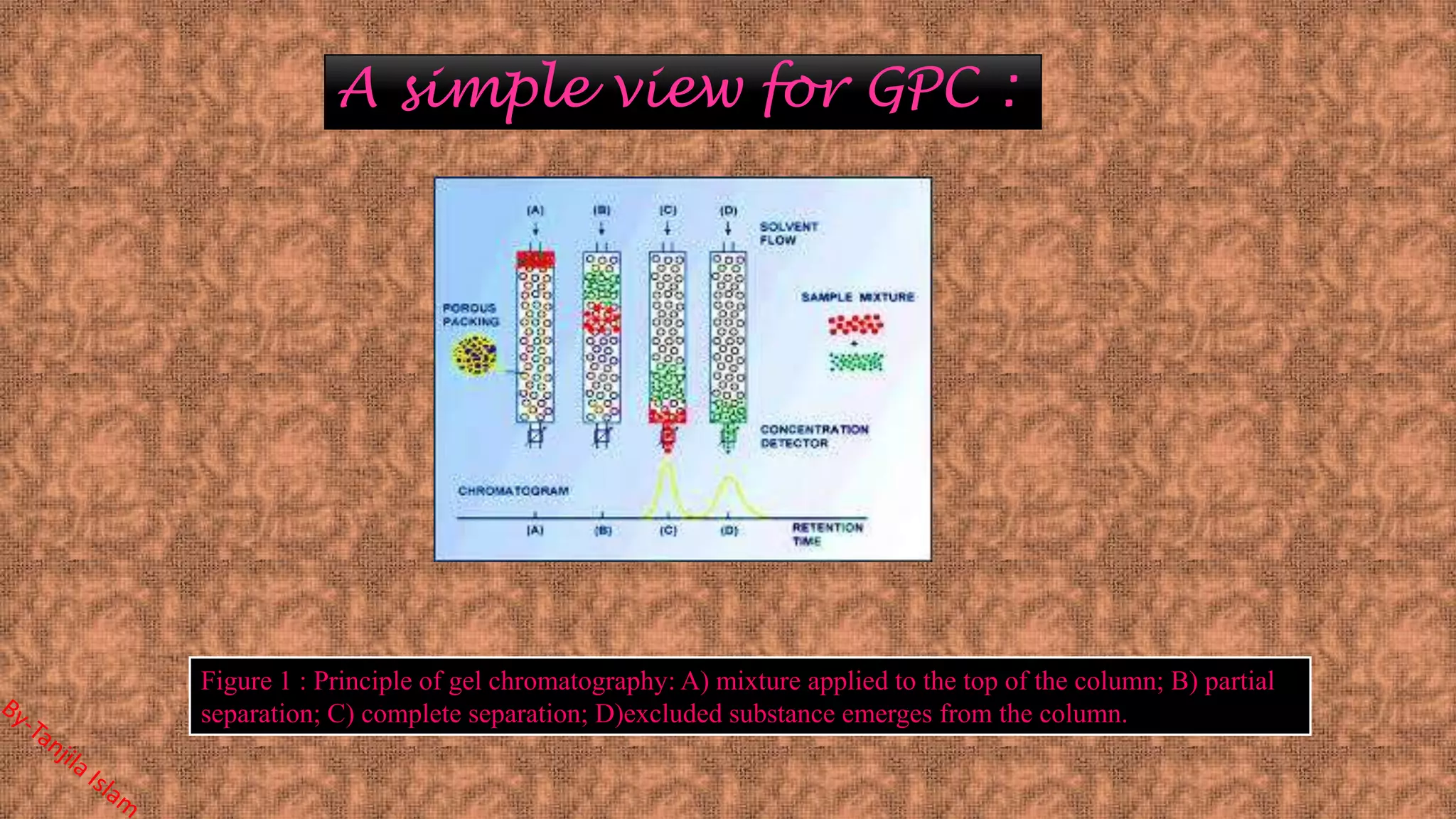
A simple view for GPC :
Figure 1 : Principle of gel chromatography: A) mixture applied to the top of the column; B) partial
separation; C) complete separation; D)excluded substance emerges from the column.
Column parameters and separation :
• A column is made up by pouring a slurry of swollen gel particles in
the solvent used to swell the gel into a suitable tubular container.
• An equation is given below:
Vt = V0 + Vi + Vm
where,
Vt = the total volume of the column (which can be measured),
V0 = the volume of liquid outside the gel matrix
(known also void or dead volume),
Vi = the volume of liquid inside the matrix,
Vm= the volume of the gel matrix,
By-TanjilaIslam
Fig : Separation parameter
for GPC column
Criteria of gel :
Fig: Choice of gel
* The gel must be chemically inert,
* It must be mechanically stable,
* It has to be a carefully formed and reproducible porous structure,
* It must contain a fairly uniform particle size.
Variety of gels :
Dextran gel:
• natural linear polysaccharide
containing α-1,6 link
• insoluble in aqueous media
• formed by cross-linking of -OH
groups of dextran and a dispersion
of epichlorohydrin in an organic
medium
• high chemical stability
Fig : structure of dextran gel
Agarose gel :
• large porous size gel
• formed from the neutral fraction of agar
and the agarose units cross-linked with
alternating 1,3 linked-β-D-galactose and
1,4-linked 3,6-anhydro-α-L-galactose units
• formed below 30˚C
• Useful for large molecule separation Fig : Polymer of agarose gel
Polyamide gel:
• low solubility
• used for separation of
phenols, organic acids etc
• ability to form strong H-
bonds between its amide
and the phenolic
-OH groups
Methodology:
Fig: Instrumentation of gel chromatography
• Column preparation
• Sample preparation
Application :
• Group separations and desalting
• Fractionation of mixtures
• Molecular weight determinations : log M = A – B(Ve/Vo)
• Protein ligand binding
Fig : Group separation of haemoglobin and sodium chloride
THANK YOU
By,
Tanjila Islam

Gel chromatography

  • 1.
    Shahjalal University ofScience and Technology, Sylhet Department of Chemistry Course no. : CHE 370 Course title : Computational Chemistry A presentation on gel chromatography Submitted to, Dr Muhammad Abul Hasnat & Dr Ahmed Jalal Farid Us Samad Presented by, Tanjila Islam Reg No.: 2010131019 Semester : 3/2
  • 2.
    Gel chromatography Developed by, TanjilaIslam Reg no.: 2010131019 Semester : 3/2
  • 3.
    Principle of gelchromatography : • Gel chromatography, also known as gel permeation chromatography(GPC), is a chromatographic technique that separates dissolved molecules on the basis of their size by pumping them through specialized columns containing a microporous packing material(gel). Gel chromatography
  • 4.
    Points to accentuateon : • Stationary phase is a porous polymer matrix whose pores are completely filled with the solvent to be used as the mobile phase. • The pore size is highly critical, since the basis of the separation is that molecules above a certain size are totally excluded from the pores, and the interior of the pores is accessible, partly or wholly, to smaller molecules. • The flow of mobile phase will cause larger molecules to pass through the column unhindered, without penetrating the gel matrix, whereas smaller molecules will be retarded according to their penetration of the gel. Molecules coming towards pores into gel
  • 5.
    A simple viewfor GPC : Figure 1 : Principle of gel chromatography: A) mixture applied to the top of the column; B) partial separation; C) complete separation; D)excluded substance emerges from the column.
  • 6.
    Column parameters andseparation : • A column is made up by pouring a slurry of swollen gel particles in the solvent used to swell the gel into a suitable tubular container. • An equation is given below: Vt = V0 + Vi + Vm where, Vt = the total volume of the column (which can be measured), V0 = the volume of liquid outside the gel matrix (known also void or dead volume), Vi = the volume of liquid inside the matrix, Vm= the volume of the gel matrix, By-TanjilaIslam Fig : Separation parameter for GPC column
  • 7.
    Criteria of gel: Fig: Choice of gel * The gel must be chemically inert, * It must be mechanically stable, * It has to be a carefully formed and reproducible porous structure, * It must contain a fairly uniform particle size.
  • 8.
    Variety of gels: Dextran gel: • natural linear polysaccharide containing α-1,6 link • insoluble in aqueous media • formed by cross-linking of -OH groups of dextran and a dispersion of epichlorohydrin in an organic medium • high chemical stability Fig : structure of dextran gel
  • 9.
    Agarose gel : •large porous size gel • formed from the neutral fraction of agar and the agarose units cross-linked with alternating 1,3 linked-β-D-galactose and 1,4-linked 3,6-anhydro-α-L-galactose units • formed below 30˚C • Useful for large molecule separation Fig : Polymer of agarose gel
  • 10.
    Polyamide gel: • lowsolubility • used for separation of phenols, organic acids etc • ability to form strong H- bonds between its amide and the phenolic -OH groups
  • 11.
    Methodology: Fig: Instrumentation ofgel chromatography • Column preparation • Sample preparation
  • 12.
    Application : • Groupseparations and desalting • Fractionation of mixtures • Molecular weight determinations : log M = A – B(Ve/Vo) • Protein ligand binding Fig : Group separation of haemoglobin and sodium chloride
  • 13.