Notes
V
J. Org. Chem., Vol.43, No. 14,1978 2923
(11) Potassium ferricyanide has previously been used to convert vic-l,2-di-
carboxylate groups to double bonds. See, for example, L. F. Fieser and
M. J. Haddadin, J. Am. Chem. SOC.,86, 2392 (1964). The oxidative dide-
carboxylation of 1,2dicarboxyiicacids is, of course, a well-known process.
See inter alia (a)C. A. Grob, M. Ohta, and A. Weiss, Helv. Chirn. Acta, 41,
1911 [1958);and (b)E. N. Cain, R. Vukov, and S. Masamune, J. Chern.SOC.
D, 98 (1969).
Rapid Chromatographic Technique for Preparative
Separations with Moderate Resolution
W. Clark Still,* Michael Kahn, and Abhijit M i t r a
Departm(7nt o/ Chemistry,Columbia Uniuersity,
1Veu York, Neu; York 10027
ReceiLied January 26, 1978
We wish to describe a simple absorption chromatography
technique for the routine purification of organic compounds.
Large scale preparative separations are traditionally carried
out by tedious long column chromatography. Although the
results are sometimes satisfactory, the technique is always
time consuming and frequently gives poor recovery due to
band tailing. These problems are especially acute when sam-
ples of greater than 1or 2 g must be separated.In recent years
several preparative systems have evolved which reduce sep-
aration times to 1-3 h and allowthe resolution of components
having Al?f 1 0.05 on analytical TLC. Of these, medium
pressure Chromatography' and short column chromatogra-
phy2have been the most successful in our laboratory. We have
recently developed a substantially faster technique for the
routine purification of reaction products which we call flash
chromatography. Although its resolution is only moderate
(LRfL 0.15), the system is extremely inexpensive to set up
and operate and allows separations of samples weighing
0.01-10.0 g3in 10-15 m ~ n . ~
Flash chromatography is basically an air pressure driven
hybrid of medium pressure and short column chromatography
which has been optimized for particularly rapid separations.
Optimization studies were carried out under a set of standard
conditions5 using samples of benzyl alcohol on a 20 mm X 5
in. column of silica gel 60 and monitoring the column output
with a Tracor 970 ultraviolet detector. Resolution is measured
in terms of the ratio of retention time (r)to peak width (w,w/2)
(Figure l),and the results are diagrammed in Figures 2-4 for
variations in silica gel particle size, eluant flow rate, and
sample size.
A number of interesting facts emerge from these data. First,
we find that one of the most popular grades of silica gel 60,
70-230 mesh (63-200 pm),gives the poorest resolution of any
gel studied under our standard conditions. Second, particle
sizes less than 40 pm offer no improvement in resolution with
our method of packing.' Column performance is quite sensi-
tive to the rate of elution m d is best with relatively high eluant
flow rates. The solvent head above the adsorbent bed should
drop 2.0 f 0.1in./min for optimum resolution with mixtures
of ethyl acetate/petroleum ether (30-60 "C).EFinally, the peak
width shows the expected increase with the sample size.
Sample recovery was 295%.
~ ~~
TIME
Figure 1. Typical chromatogram.
1 I I L
40 63 200
<40 26- 40- 63-
Figure 2. Silica gel particle size6 (pm):( 0 )r h : ( 0 )r/(w/2).
0 1.0 2 0 3.0 4.0
Figure 3. Eluant flow rate (in./min).
4 1
Psz24I
0 100 200 300 400
Figure 4. Sample size (mg).
A
rAir
Flow Controller
Figure 5.
The apparatus required for this technique consists of a set
of chromatography columns and a flow controller valve
(below).The column is a flattened bottom 18 in. glass tube
fitted with a Teflon stopcock and topped with a 24/40 glass
joint. Columns without fritted glass bed supports are generally
preferred since they have significantly less dead volume than
the standard fritted round-bottom variety. The flowcontroller
0022-3263/78/1943-2923$01.00/0 1978American Chemical Society
2924 J. Org. Chem., Vol.43, No. 14, 1978 Notes
e -
I," -am- *
TI
? . . . . . . . . . . . .RI I 2 a Y 5 c 7 1 q IO II 1 2
?CRUDE FRACTIONS
SAMPLE
Figure 6.
valve is a simple variable bleed device for precise regulation
of the elution rate and is constructed from a gladTeflon
needle valve (Ace Glass Co. No. 8193-04 or equivalent) and
a standard 24/40 joint.
A detailed procedure is presented in the experimental
section and is summarized as follows: (1)A solvent is chosen
which givesgood separation and movesthe desired component
to Rf = 0.35 on analytical TLC (E. Merck No. 5765).9(2) A
column of the appropriate diameter (see Table I) is selected
and filled with 5-6 in. of dry 40-63 pm silica gel (E.Merck No.
9385).1°(3) The column is filled with solvent and pressure is
used to rapidly push all the air from the silica gel. (4)The
sample is applied and the column is refilled with solvent and
eluted at a flow rate of 2 in./min.
The time required to elute the desired components from the
column is generally sofast (5-10 min) that we have abandoned
automatic fraction collectors in favor of a simple rack holding
forty 20 X 150 mm test tubes. Small fractions are typically
collected early in the elution with larger ones being collected
toward the end of the chromatography. Separated compo-
nents are conveniently detected by spotting -5 pL of each
fraction along the long side of 7 cm X 2.5 cm TLC plate and
then by developing the plate sideways. Heavier spotting may
be required for small samples or highly retentive components.
A typical separation is shown in Figure 6.
Over the past year we have run many hundreds of these
columns. In every case we have been able to effect clean sep-
aration of compounds having ARf 2 0.15in less than 15min
and in many cases separationsat ARf 0.10 were possible.
The amount of sample used on a given column is proportional
to its cross-sectional area and Table I can serve as a guide to
column selection.
The sample size may increase substantially if less resolution
is required; we have used a 50-mm column for the purification
of up to 10 g of compound having impurities at ARf 2 0.4.
Resolution is maintained even with large diameter columns.
For example the epimeric alcohols 1and 2 have an Rf of 0.34
Bu3Sn' QkOH Bu3s"+Q,,oHBu
I 2
and 0.25, respectively, in 5% ethyl acetate/petroleum ether.
A 1.0-gmixture of 1 and 2 (ARf= 0.09) easily separated with
only a 65-mg mixed fraction in 7 min on a 40-mm diameter
column (500mL of 5%EtOAc/petroleum ether).
If the components to be separated are closer on TLC than
ARf 0.15, increased resolution may be achieved by using a
longer (e.g., 10 in.) column of gel alternatively a less polar
solvent can be used. Such a solvent can be selected to move
the desired components on TLC to Rf = 0.25 without in-
creasing the elution times too drastically. In either case, the
column should be only lightly loaded with sample and a2rapid
flow rate of 2 in./min should be maintained. Sloweir flows
clearly give poorer resolution with ethyl acetate/petroleum
ether mixtures.
Table I
typical
fractioncolumn vol of sample:
diameter, eluant," typical loading(mg) size,
mm mL ARf 2 0.2 I R f 20.1 mL
10 100 100 40 5
20 200 400 160 10
30 400 900 360 20
40 600 1600 600 30
50 1000 2500 1000 50
0 Typical volume of eluant required for packing and elution.
In conclusion, flash chromatography provides a rapid and
inexpensive general method for the preparative separation
of mixtures requiring only moderate resolution. Even in cases
where high resolution is required, preliminary purification by
the flash technique allows simplified high-resolution sepa-
rations without contamination of expensive HPLC columns.
Finally, we would like to stress the facts that use of the 40-63
pm silica gel and a pressure- (and not vacuum-) driven flow
rate of 2.0 in./min are crucial for successfulseparations by this
method.
Experimental Section
Chromatography columns and the flow controller valve were as-
sembled as described in the text. The silica gel used was 40-63 pm
(400-230 mesh) silica gel 60 (E. Merck No. 9385).1° Solvents were
distilled prior to use. Thin layer chromatograms (TLC)were run on
glass supported silica gel 60 plates (0.25-mm layer, F-254) (E.Merck
No. 5765).
Flash Chromatography. General Procedure. First a low vis-
cosity solvent system (e.g., ethyl acetateh0-60 "C petroleum etherla
is found which separates the mixture and moves the desired compo-
nent on analytical TLC to an Rf of 0.35.9If several compounds are to
be separated which run very close on TLC, adjust the solvent to put
the midpoint between the components at Rf = 0.35. If the compounds
are widely separated, adjust the R, of the less mobile component to
0.35. Having chosen the solvent, a column of the appropriate diameter
(seetext, Table I) is selected and a small plug of glass wool is placed
in the tube connecting the stopcock to the column body (A in the di-
agram above). Two telescoping lengths of glass tubing (6and 8 mm
0.d.) make placement of the glass wool plug easy. Next a smooth '/a
in. layer of 50-100 mesh sand is added to cover the bottom of the
column and dry 40-63 pm silica gel is poured into the column in a
single portion to give a depth of 5.5-6 in. With the stopcock open, the
column is gently tapped vertically on the bench top to pack the gel.
Next a l/a in. layer of sand is carefully placed on the flat top of the dry
gel bed and the column is clamped for pressure packing and elution.
The solvent chosen above is then poured carefully over the sand to
fillthe column completely. The needle valve (B)of the flow controller
is opened all the way and the flow controller is fitted tightly to the top
of the column and secured with strong rubber bands. The main air
line valve leading to the flow controller is opened slightly and a finger
is placed fairly tightly over the bleed port (C).This will cause the
pressure above the adsorbent bed to climb rapidly and compress the
silica gel as solvent is rapidly forced through the column. It is im-
portant to maintain the pressure until all the air is expelled and the
lower part of the column is cool; otherwise, the column will fragment
and should be repacked unless the separation desired is a trivial one.
Particular care is necessary with large diameter columns. The pressure
is then released and excess eluant is forced out of the column above
the adsorbent bed by partially blocking the bleed port (C).The top
of the silica gel should not be allowed to run dry. Next the sample is
applied by pipette as a 20-250% solution in the eluant to the top of the
adsorbent bed and the flow controller is briefly placed on top of the
column to push all of the sample into the silica gel." The solvent used
to pack the column is ordinarily reused to elute the column. The walls
of the column are washed down with a few milliliters of fresh eluant,
the washings are pushed into the gel as before, and the column is
carefully filled with eluant so as not to disturb the adsorbent bed. The
flow controller is finally secured to the column and adjusted to cause
the surface of the solvent in the column to fall 2.0 in./min.This seems
to be an optimum value of the flow rate for most low viscosity solvents
for any column diameter with the 40-63 km silica gel. Fractions are
Notes J . Org. Chenz., Vol.43, No. 14, 1978 2925
collected until all the solventhas been used (seeTable I to estimate
the amount of solventand fractionsize).It is best not to let the column
run dry since further elution is occasionally necessary. Purified
components are identified as described in the text by TLC. If the
foregoinginstructionsare followedexactly, there is littleopportunity
for the separationto fail.
Although we generallypack fresh columns for each separation,the
expense of large-scaleseparations makes it advantageous to reuse
large diametercolumns.Column recyclingis effectedby firstflushing
(rate = 2 in./min)the column with approximately5 in. of the more
polar component in the eluant (generallyethyl acetate or acetone)
and then with 5 in. of the desired eluant. If the eluant is relatively
nonpolar (e.g., 110% EtOAc/petroleumether), it may be more ad-
visable to use a flushingsolvent (e.g., 2040%EtOAc/petroleumether)
which is somewhat less polar than the pure high polarity compo-
nent.
Registry No.-l,66417-28-5; 2,66417-27-4.
References and Notes
(1) Such units have been described and used extensively by J. M. McCali. R.
E. TenBrinkt, and C. H. Lin at the Upjohn Company and A. I. Meyers at
Colorado State University
(2) B. J. Hunt and W.Rigby, Chern. Ind. (London), 1868 (1967).
(3) This is not a limitation but is merely the scale range which we have
used.
(4) This is the total time requiredfor column packing, sample application, and
complete elution.
Standard conditions: 5 in. high bed of 40-63 pm silica gel 60 in a 20 mm
diameter column packed as described in text, 2.0 in. of solvent flow/min,
200 mg of benzyl alcohol. 25% ethyl acetate/petroleum ether eluant.
These gels are manufactured by E. Merck and are the following grades:
<40 p m (silica gel H,No. 7736), 25-40 pm (LiChroPrepSi60, No.9390),
40-63 pm (silica gel 60, No. 9385), 63-200 pm (silica gel 60, No.
10180.
(7) Slurry packing, incrementaldry packing, or single portion dry packinggave
identical results with the 40-63 pm gel. Since the last technique was the
simplest, it was employed in ail our studies.
(8) This is a particularly good general solvent system. For extremely polar
compounds, acetone/petroleum ether or acetone/methylene chloride
mixtures are often useful. Significantly higher viscosity solvents will require
slower optimum resolution flow rates.
(9) If this R, is given by a solvent having <2% of the polar component,a slightly
less polar eluant is desirable. Thus if 1% ethyl acetate/petroleum ether
gives a compound an R, of 0.35 on TLC, the column is runwith 0.5% ethyl
acetate.
(10) 40-63 pm gel is also used for medium pressure chromatography' and is
available from MCB in 1 kg ($45/kg) or 25 kg ($16/kg) lots.
(11) if the sample is only partiallysoluble in the eluant, just enough of the more
polar component is added to give complete dissolution. Large quantities
of very polar impurities are best removed prior to chromatography so that
excessive quantities of solvent or large increases in solvent polarity will
be unnecessaryfor sample application.
Homo-C-nucleosides. The Synthesis of Certain
6-Substituted 4-Pyrimidinonesl
John A. Secrist 111
Department oJ Chemistry, The Ohio State University,
Columbus, Ohio 43210
Receioed February I , 1978
The chemistry of C-nucleosideshas received considerable
attention recently due to the biological activities of naturally
occurring compounds such as showdomycin, formycin, and
oxazinomycin.2 Though synthetic methodology has evolved
for the preparation of a number of C-nucleosideanalogues,2
only one investigation has dealt with the synthesis of homo-
C- nucleoside^,^ compounds with a methylene unit between
a carbon of the nitrogen base and the standard D-ribose
moiety. This note describes the facile synthesis of a series of
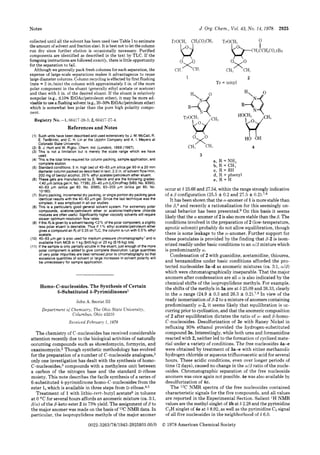
6-substituted 4-pyrimidinone homo-C-nucleosidesfrom the
ester 1,which is available in three steps from D - r i b o ~ e . ~ , ~
Treatment of 1 with lithio-tert-butyl acetate6 in toluene
at 0 OC for several hours affords an anomericmixture (ca. 3:1,
@la)of the p-keto ester 2 in 75%yield. The assignment of /3 to
the major anomer was made on the basis of l3C NMR data. In
particular, the isopropylidene methyls of the major anomer
0022-326317811943-2925$01.00/0
1 2
Tr = trityl
4
3
a, R = NH,
b, R = CH,
c, R = SH
d, R = phenyl
e , R = H
occur at 6 25.66 and 27.54, within the range strongly indicative
of a p configuration (25.5 f 0.2 and 27.5 f 0.2).7,s
It has been shown that the a-anomer of 1is more stablethan
the p,4and recently a rationalization for this seemingly un-
usual behavior has been pre~ented.~On this basis it seems
likely that the a anomer of 2 is alsomore stablethan the @.The
conditions involved in the preparation of 2 (low-temperature,
aprotic solvent) probably do not allow equilibration, though
there is some leakage to the a-anomer. Further support for
these postulates is provided by the finding that p-2 is isom-
erized readily under basic conditionsto an alp mixture which
is predominantly a.
Condensation of 2 with guanidine, acetamidine, thiourea,
and benzamidine under basic conditions afforded the pro-
tected nucleosides 3a-d as anomeric mixtures (ca. 3:1, alp)
which were chromatographically inseparable.That the major
anomers after condensation are all a is also indicated by the
chemical shifts of the isopropylidene methyls. For example,
the shifts of the methyls in 3a are at 6 25.09 and 26.33,clearly
in the a range (24.9 f 0.3 and 26.3 f 0.2).7,SIn view of the
ready isomerization of 8-2to a mixture of anomers containing
predominantly a-2,it seems likely that equilibration is oc-
curring prior to cyclization,and that the anomeric composition
of 2 after equilibration dictates the ratio of a- and @-homo-
C-nucleosides. Desulfurization of 3c with Raney Nickel in
refluxing 95% ethanol provided the hydrogen-substituted
compound 3e. Interestingly, while both urea and formamidine
reacted with 2, neither led to the formation of cyclized mate-
rial under a variety of conditions. The free nucleosides 4a-e
were obtained by treatment of 3a-e with either methanolic
hydrogen chloride or aqueous trifluoroacetic acid for several
hours. These acidic conditions, even over longer periods of
time (2 days),caused no change in the alp ratio of the nucle-
osides. Chromatographic separation of the free nucleoside
anomers was once again not possible. 4e was also available by
desulfurization of 4c.
The 13C NMR spectra of the free nucleosides contained
characteristic signals for the five compounds, and all values
are reported in the Experimental Section. Salient 1H NMR
values are the methyl singlet of 4b at 6 2.28and the pyrimidine
C2H singlet of 4e at 6 8.92, as well as the pyrimidine C5 signal
of all five nucleosides in the neighborhood of d 6.0.
01978American Chemical Society

Purification

  • 1.
    Notes V J. Org. Chem.,Vol.43, No. 14,1978 2923 (11) Potassium ferricyanide has previously been used to convert vic-l,2-di- carboxylate groups to double bonds. See, for example, L. F. Fieser and M. J. Haddadin, J. Am. Chem. SOC.,86, 2392 (1964). The oxidative dide- carboxylation of 1,2dicarboxyiicacids is, of course, a well-known process. See inter alia (a)C. A. Grob, M. Ohta, and A. Weiss, Helv. Chirn. Acta, 41, 1911 [1958);and (b)E. N. Cain, R. Vukov, and S. Masamune, J. Chern.SOC. D, 98 (1969). Rapid Chromatographic Technique for Preparative Separations with Moderate Resolution W. Clark Still,* Michael Kahn, and Abhijit M i t r a Departm(7nt o/ Chemistry,Columbia Uniuersity, 1Veu York, Neu; York 10027 ReceiLied January 26, 1978 We wish to describe a simple absorption chromatography technique for the routine purification of organic compounds. Large scale preparative separations are traditionally carried out by tedious long column chromatography. Although the results are sometimes satisfactory, the technique is always time consuming and frequently gives poor recovery due to band tailing. These problems are especially acute when sam- ples of greater than 1or 2 g must be separated.In recent years several preparative systems have evolved which reduce sep- aration times to 1-3 h and allowthe resolution of components having Al?f 1 0.05 on analytical TLC. Of these, medium pressure Chromatography' and short column chromatogra- phy2have been the most successful in our laboratory. We have recently developed a substantially faster technique for the routine purification of reaction products which we call flash chromatography. Although its resolution is only moderate (LRfL 0.15), the system is extremely inexpensive to set up and operate and allows separations of samples weighing 0.01-10.0 g3in 10-15 m ~ n . ~ Flash chromatography is basically an air pressure driven hybrid of medium pressure and short column chromatography which has been optimized for particularly rapid separations. Optimization studies were carried out under a set of standard conditions5 using samples of benzyl alcohol on a 20 mm X 5 in. column of silica gel 60 and monitoring the column output with a Tracor 970 ultraviolet detector. Resolution is measured in terms of the ratio of retention time (r)to peak width (w,w/2) (Figure l),and the results are diagrammed in Figures 2-4 for variations in silica gel particle size, eluant flow rate, and sample size. A number of interesting facts emerge from these data. First, we find that one of the most popular grades of silica gel 60, 70-230 mesh (63-200 pm),gives the poorest resolution of any gel studied under our standard conditions. Second, particle sizes less than 40 pm offer no improvement in resolution with our method of packing.' Column performance is quite sensi- tive to the rate of elution m d is best with relatively high eluant flow rates. The solvent head above the adsorbent bed should drop 2.0 f 0.1in./min for optimum resolution with mixtures of ethyl acetate/petroleum ether (30-60 "C).EFinally, the peak width shows the expected increase with the sample size. Sample recovery was 295%. ~ ~~ TIME Figure 1. Typical chromatogram. 1 I I L 40 63 200 <40 26- 40- 63- Figure 2. Silica gel particle size6 (pm):( 0 )r h : ( 0 )r/(w/2). 0 1.0 2 0 3.0 4.0 Figure 3. Eluant flow rate (in./min). 4 1 Psz24I 0 100 200 300 400 Figure 4. Sample size (mg). A rAir Flow Controller Figure 5. The apparatus required for this technique consists of a set of chromatography columns and a flow controller valve (below).The column is a flattened bottom 18 in. glass tube fitted with a Teflon stopcock and topped with a 24/40 glass joint. Columns without fritted glass bed supports are generally preferred since they have significantly less dead volume than the standard fritted round-bottom variety. The flowcontroller 0022-3263/78/1943-2923$01.00/0 1978American Chemical Society
  • 2.
    2924 J. Org.Chem., Vol.43, No. 14, 1978 Notes e - I," -am- * TI ? . . . . . . . . . . . .RI I 2 a Y 5 c 7 1 q IO II 1 2 ?CRUDE FRACTIONS SAMPLE Figure 6. valve is a simple variable bleed device for precise regulation of the elution rate and is constructed from a gladTeflon needle valve (Ace Glass Co. No. 8193-04 or equivalent) and a standard 24/40 joint. A detailed procedure is presented in the experimental section and is summarized as follows: (1)A solvent is chosen which givesgood separation and movesthe desired component to Rf = 0.35 on analytical TLC (E. Merck No. 5765).9(2) A column of the appropriate diameter (see Table I) is selected and filled with 5-6 in. of dry 40-63 pm silica gel (E.Merck No. 9385).1°(3) The column is filled with solvent and pressure is used to rapidly push all the air from the silica gel. (4)The sample is applied and the column is refilled with solvent and eluted at a flow rate of 2 in./min. The time required to elute the desired components from the column is generally sofast (5-10 min) that we have abandoned automatic fraction collectors in favor of a simple rack holding forty 20 X 150 mm test tubes. Small fractions are typically collected early in the elution with larger ones being collected toward the end of the chromatography. Separated compo- nents are conveniently detected by spotting -5 pL of each fraction along the long side of 7 cm X 2.5 cm TLC plate and then by developing the plate sideways. Heavier spotting may be required for small samples or highly retentive components. A typical separation is shown in Figure 6. Over the past year we have run many hundreds of these columns. In every case we have been able to effect clean sep- aration of compounds having ARf 2 0.15in less than 15min and in many cases separationsat ARf 0.10 were possible. The amount of sample used on a given column is proportional to its cross-sectional area and Table I can serve as a guide to column selection. The sample size may increase substantially if less resolution is required; we have used a 50-mm column for the purification of up to 10 g of compound having impurities at ARf 2 0.4. Resolution is maintained even with large diameter columns. For example the epimeric alcohols 1and 2 have an Rf of 0.34 Bu3Sn' QkOH Bu3s"+Q,,oHBu I 2 and 0.25, respectively, in 5% ethyl acetate/petroleum ether. A 1.0-gmixture of 1 and 2 (ARf= 0.09) easily separated with only a 65-mg mixed fraction in 7 min on a 40-mm diameter column (500mL of 5%EtOAc/petroleum ether). If the components to be separated are closer on TLC than ARf 0.15, increased resolution may be achieved by using a longer (e.g., 10 in.) column of gel alternatively a less polar solvent can be used. Such a solvent can be selected to move the desired components on TLC to Rf = 0.25 without in- creasing the elution times too drastically. In either case, the column should be only lightly loaded with sample and a2rapid flow rate of 2 in./min should be maintained. Sloweir flows clearly give poorer resolution with ethyl acetate/petroleum ether mixtures. Table I typical fractioncolumn vol of sample: diameter, eluant," typical loading(mg) size, mm mL ARf 2 0.2 I R f 20.1 mL 10 100 100 40 5 20 200 400 160 10 30 400 900 360 20 40 600 1600 600 30 50 1000 2500 1000 50 0 Typical volume of eluant required for packing and elution. In conclusion, flash chromatography provides a rapid and inexpensive general method for the preparative separation of mixtures requiring only moderate resolution. Even in cases where high resolution is required, preliminary purification by the flash technique allows simplified high-resolution sepa- rations without contamination of expensive HPLC columns. Finally, we would like to stress the facts that use of the 40-63 pm silica gel and a pressure- (and not vacuum-) driven flow rate of 2.0 in./min are crucial for successfulseparations by this method. Experimental Section Chromatography columns and the flow controller valve were as- sembled as described in the text. The silica gel used was 40-63 pm (400-230 mesh) silica gel 60 (E. Merck No. 9385).1° Solvents were distilled prior to use. Thin layer chromatograms (TLC)were run on glass supported silica gel 60 plates (0.25-mm layer, F-254) (E.Merck No. 5765). Flash Chromatography. General Procedure. First a low vis- cosity solvent system (e.g., ethyl acetateh0-60 "C petroleum etherla is found which separates the mixture and moves the desired compo- nent on analytical TLC to an Rf of 0.35.9If several compounds are to be separated which run very close on TLC, adjust the solvent to put the midpoint between the components at Rf = 0.35. If the compounds are widely separated, adjust the R, of the less mobile component to 0.35. Having chosen the solvent, a column of the appropriate diameter (seetext, Table I) is selected and a small plug of glass wool is placed in the tube connecting the stopcock to the column body (A in the di- agram above). Two telescoping lengths of glass tubing (6and 8 mm 0.d.) make placement of the glass wool plug easy. Next a smooth '/a in. layer of 50-100 mesh sand is added to cover the bottom of the column and dry 40-63 pm silica gel is poured into the column in a single portion to give a depth of 5.5-6 in. With the stopcock open, the column is gently tapped vertically on the bench top to pack the gel. Next a l/a in. layer of sand is carefully placed on the flat top of the dry gel bed and the column is clamped for pressure packing and elution. The solvent chosen above is then poured carefully over the sand to fillthe column completely. The needle valve (B)of the flow controller is opened all the way and the flow controller is fitted tightly to the top of the column and secured with strong rubber bands. The main air line valve leading to the flow controller is opened slightly and a finger is placed fairly tightly over the bleed port (C).This will cause the pressure above the adsorbent bed to climb rapidly and compress the silica gel as solvent is rapidly forced through the column. It is im- portant to maintain the pressure until all the air is expelled and the lower part of the column is cool; otherwise, the column will fragment and should be repacked unless the separation desired is a trivial one. Particular care is necessary with large diameter columns. The pressure is then released and excess eluant is forced out of the column above the adsorbent bed by partially blocking the bleed port (C).The top of the silica gel should not be allowed to run dry. Next the sample is applied by pipette as a 20-250% solution in the eluant to the top of the adsorbent bed and the flow controller is briefly placed on top of the column to push all of the sample into the silica gel." The solvent used to pack the column is ordinarily reused to elute the column. The walls of the column are washed down with a few milliliters of fresh eluant, the washings are pushed into the gel as before, and the column is carefully filled with eluant so as not to disturb the adsorbent bed. The flow controller is finally secured to the column and adjusted to cause the surface of the solvent in the column to fall 2.0 in./min.This seems to be an optimum value of the flow rate for most low viscosity solvents for any column diameter with the 40-63 km silica gel. Fractions are
  • 3.
    Notes J .Org. Chenz., Vol.43, No. 14, 1978 2925 collected until all the solventhas been used (seeTable I to estimate the amount of solventand fractionsize).It is best not to let the column run dry since further elution is occasionally necessary. Purified components are identified as described in the text by TLC. If the foregoinginstructionsare followedexactly, there is littleopportunity for the separationto fail. Although we generallypack fresh columns for each separation,the expense of large-scaleseparations makes it advantageous to reuse large diametercolumns.Column recyclingis effectedby firstflushing (rate = 2 in./min)the column with approximately5 in. of the more polar component in the eluant (generallyethyl acetate or acetone) and then with 5 in. of the desired eluant. If the eluant is relatively nonpolar (e.g., 110% EtOAc/petroleumether), it may be more ad- visable to use a flushingsolvent (e.g., 2040%EtOAc/petroleumether) which is somewhat less polar than the pure high polarity compo- nent. Registry No.-l,66417-28-5; 2,66417-27-4. References and Notes (1) Such units have been described and used extensively by J. M. McCali. R. E. TenBrinkt, and C. H. Lin at the Upjohn Company and A. I. Meyers at Colorado State University (2) B. J. Hunt and W.Rigby, Chern. Ind. (London), 1868 (1967). (3) This is not a limitation but is merely the scale range which we have used. (4) This is the total time requiredfor column packing, sample application, and complete elution. Standard conditions: 5 in. high bed of 40-63 pm silica gel 60 in a 20 mm diameter column packed as described in text, 2.0 in. of solvent flow/min, 200 mg of benzyl alcohol. 25% ethyl acetate/petroleum ether eluant. These gels are manufactured by E. Merck and are the following grades: <40 p m (silica gel H,No. 7736), 25-40 pm (LiChroPrepSi60, No.9390), 40-63 pm (silica gel 60, No. 9385), 63-200 pm (silica gel 60, No. 10180. (7) Slurry packing, incrementaldry packing, or single portion dry packinggave identical results with the 40-63 pm gel. Since the last technique was the simplest, it was employed in ail our studies. (8) This is a particularly good general solvent system. For extremely polar compounds, acetone/petroleum ether or acetone/methylene chloride mixtures are often useful. Significantly higher viscosity solvents will require slower optimum resolution flow rates. (9) If this R, is given by a solvent having <2% of the polar component,a slightly less polar eluant is desirable. Thus if 1% ethyl acetate/petroleum ether gives a compound an R, of 0.35 on TLC, the column is runwith 0.5% ethyl acetate. (10) 40-63 pm gel is also used for medium pressure chromatography' and is available from MCB in 1 kg ($45/kg) or 25 kg ($16/kg) lots. (11) if the sample is only partiallysoluble in the eluant, just enough of the more polar component is added to give complete dissolution. Large quantities of very polar impurities are best removed prior to chromatography so that excessive quantities of solvent or large increases in solvent polarity will be unnecessaryfor sample application. Homo-C-nucleosides. The Synthesis of Certain 6-Substituted 4-Pyrimidinonesl John A. Secrist 111 Department oJ Chemistry, The Ohio State University, Columbus, Ohio 43210 Receioed February I , 1978 The chemistry of C-nucleosideshas received considerable attention recently due to the biological activities of naturally occurring compounds such as showdomycin, formycin, and oxazinomycin.2 Though synthetic methodology has evolved for the preparation of a number of C-nucleosideanalogues,2 only one investigation has dealt with the synthesis of homo- C- nucleoside^,^ compounds with a methylene unit between a carbon of the nitrogen base and the standard D-ribose moiety. This note describes the facile synthesis of a series of 6-substituted 4-pyrimidinone homo-C-nucleosidesfrom the ester 1,which is available in three steps from D - r i b o ~ e . ~ , ~ Treatment of 1 with lithio-tert-butyl acetate6 in toluene at 0 OC for several hours affords an anomericmixture (ca. 3:1, @la)of the p-keto ester 2 in 75%yield. The assignment of /3 to the major anomer was made on the basis of l3C NMR data. In particular, the isopropylidene methyls of the major anomer 0022-326317811943-2925$01.00/0 1 2 Tr = trityl 4 3 a, R = NH, b, R = CH, c, R = SH d, R = phenyl e , R = H occur at 6 25.66 and 27.54, within the range strongly indicative of a p configuration (25.5 f 0.2 and 27.5 f 0.2).7,s It has been shown that the a-anomer of 1is more stablethan the p,4and recently a rationalization for this seemingly un- usual behavior has been pre~ented.~On this basis it seems likely that the a anomer of 2 is alsomore stablethan the @.The conditions involved in the preparation of 2 (low-temperature, aprotic solvent) probably do not allow equilibration, though there is some leakage to the a-anomer. Further support for these postulates is provided by the finding that p-2 is isom- erized readily under basic conditionsto an alp mixture which is predominantly a. Condensation of 2 with guanidine, acetamidine, thiourea, and benzamidine under basic conditions afforded the pro- tected nucleosides 3a-d as anomeric mixtures (ca. 3:1, alp) which were chromatographically inseparable.That the major anomers after condensation are all a is also indicated by the chemical shifts of the isopropylidene methyls. For example, the shifts of the methyls in 3a are at 6 25.09 and 26.33,clearly in the a range (24.9 f 0.3 and 26.3 f 0.2).7,SIn view of the ready isomerization of 8-2to a mixture of anomers containing predominantly a-2,it seems likely that equilibration is oc- curring prior to cyclization,and that the anomeric composition of 2 after equilibration dictates the ratio of a- and @-homo- C-nucleosides. Desulfurization of 3c with Raney Nickel in refluxing 95% ethanol provided the hydrogen-substituted compound 3e. Interestingly, while both urea and formamidine reacted with 2, neither led to the formation of cyclized mate- rial under a variety of conditions. The free nucleosides 4a-e were obtained by treatment of 3a-e with either methanolic hydrogen chloride or aqueous trifluoroacetic acid for several hours. These acidic conditions, even over longer periods of time (2 days),caused no change in the alp ratio of the nucle- osides. Chromatographic separation of the free nucleoside anomers was once again not possible. 4e was also available by desulfurization of 4c. The 13C NMR spectra of the free nucleosides contained characteristic signals for the five compounds, and all values are reported in the Experimental Section. Salient 1H NMR values are the methyl singlet of 4b at 6 2.28and the pyrimidine C2H singlet of 4e at 6 8.92, as well as the pyrimidine C5 signal of all five nucleosides in the neighborhood of d 6.0. 01978American Chemical Society