Structural Analysis
Prepared By
Manu Melwin Joy
Research Scholar
School of Management Studies
CUSAT, Kerala, India.
Phone – 9744551114
Mail – manu_melwinjoy@yahoo.com
Kindly restrict the use of slides for personal purpose.
Please seek permission to reproduce the same in public
forms and presentations.
Contents
• Ego states – Definition.
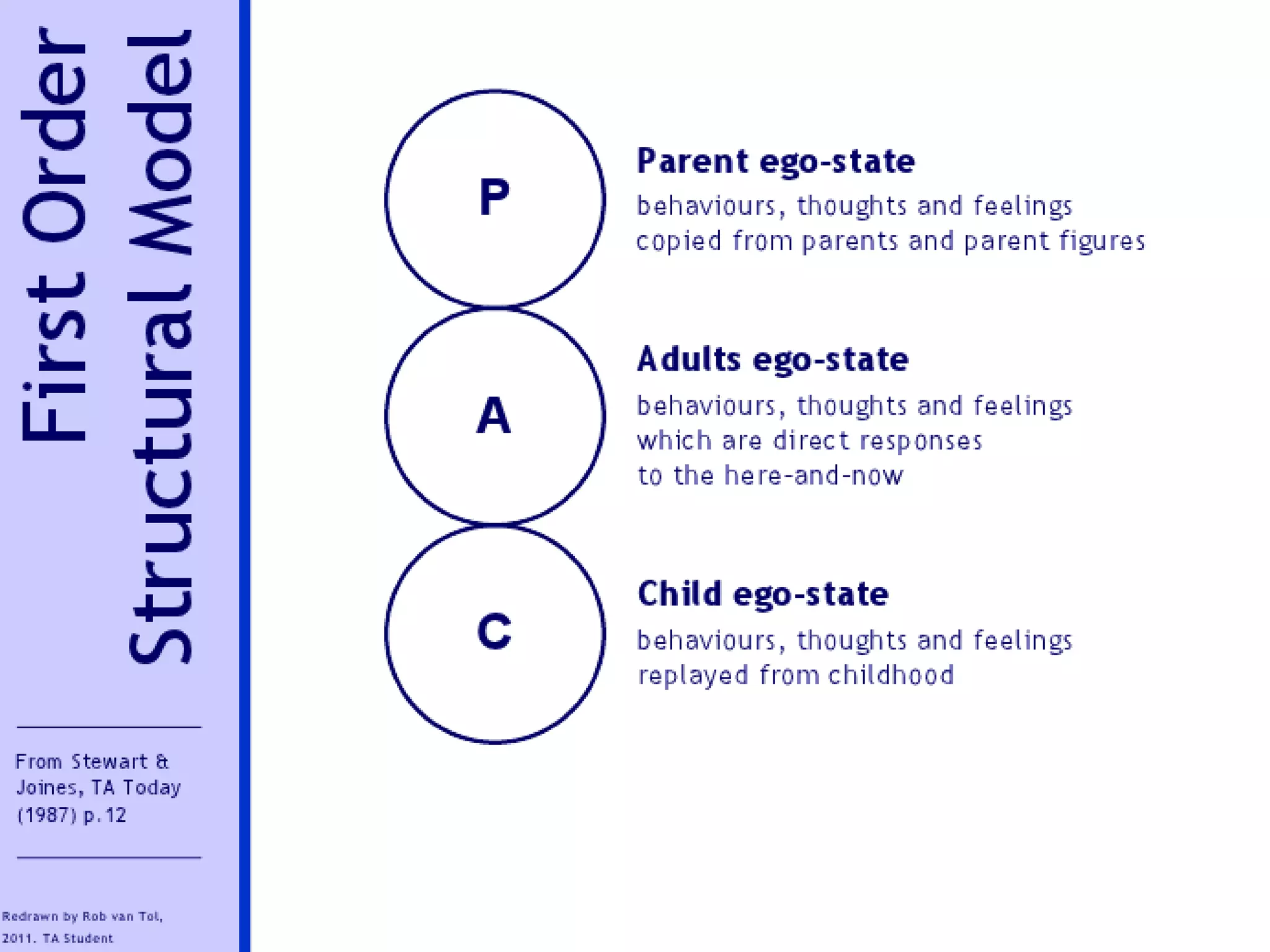
• First Order Structural Model.
• Functional Model.
• Ego Gram.
• Second Order Structural Model.
• Structural Pathology
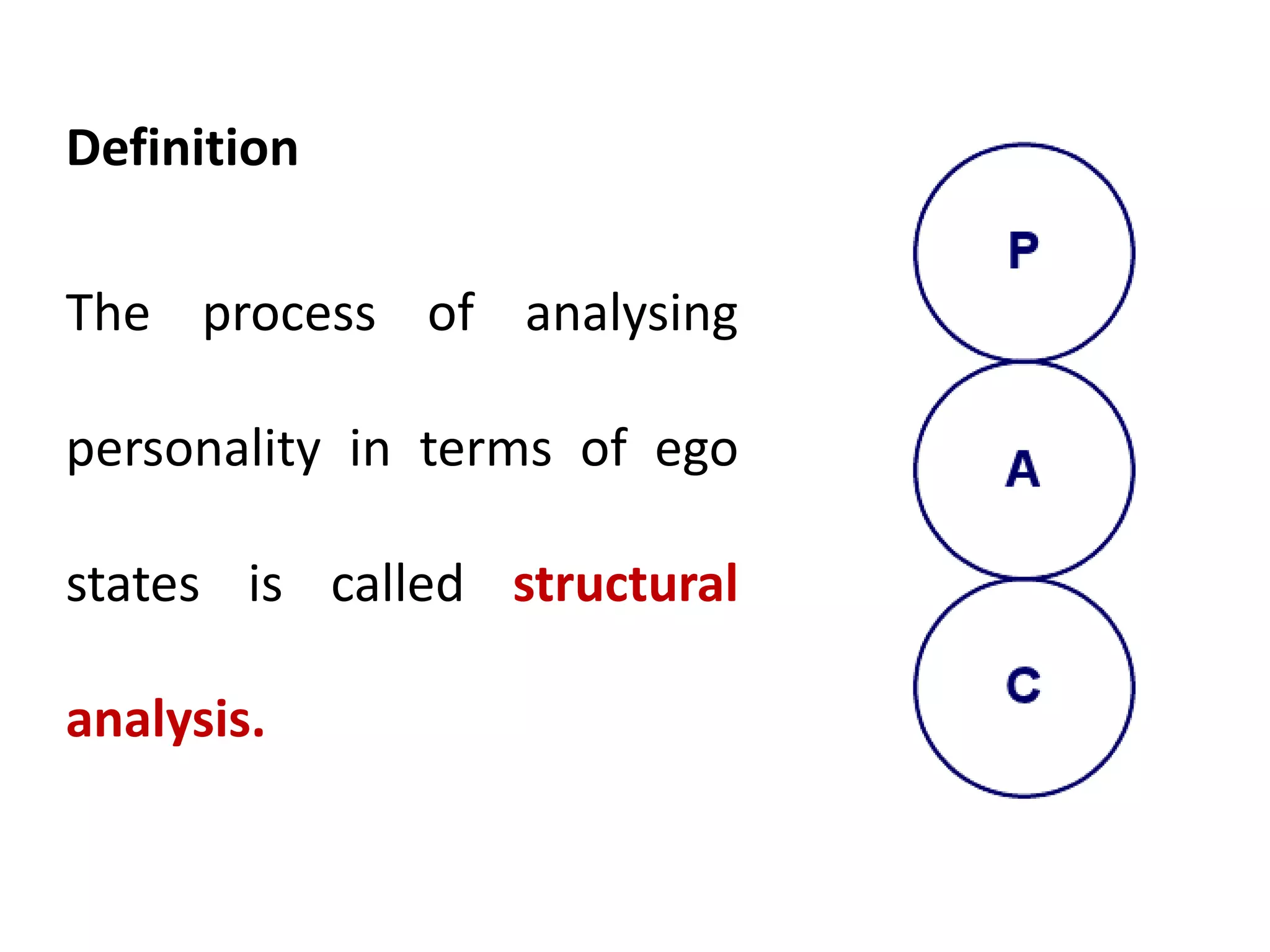
The process of analysing
personality in terms of ego
states is called structural
analysis.
Definition
Think back over the past 24 hours of your life.
• Were there moments during that time when you
acted, thought and felt just as you did when you
were a child?
• Were there other times when you found yourself
behaving, thinking and feeling in ways you copied
long ago from you parents or from other people
who were parent figures for you?
• And were there still other occasions when your
behavior, thoughts and feelings wee simply a
direct here and now response to what was
happening around you at that moment?
• Take time to write down one example of each of
these three situations.
Activity
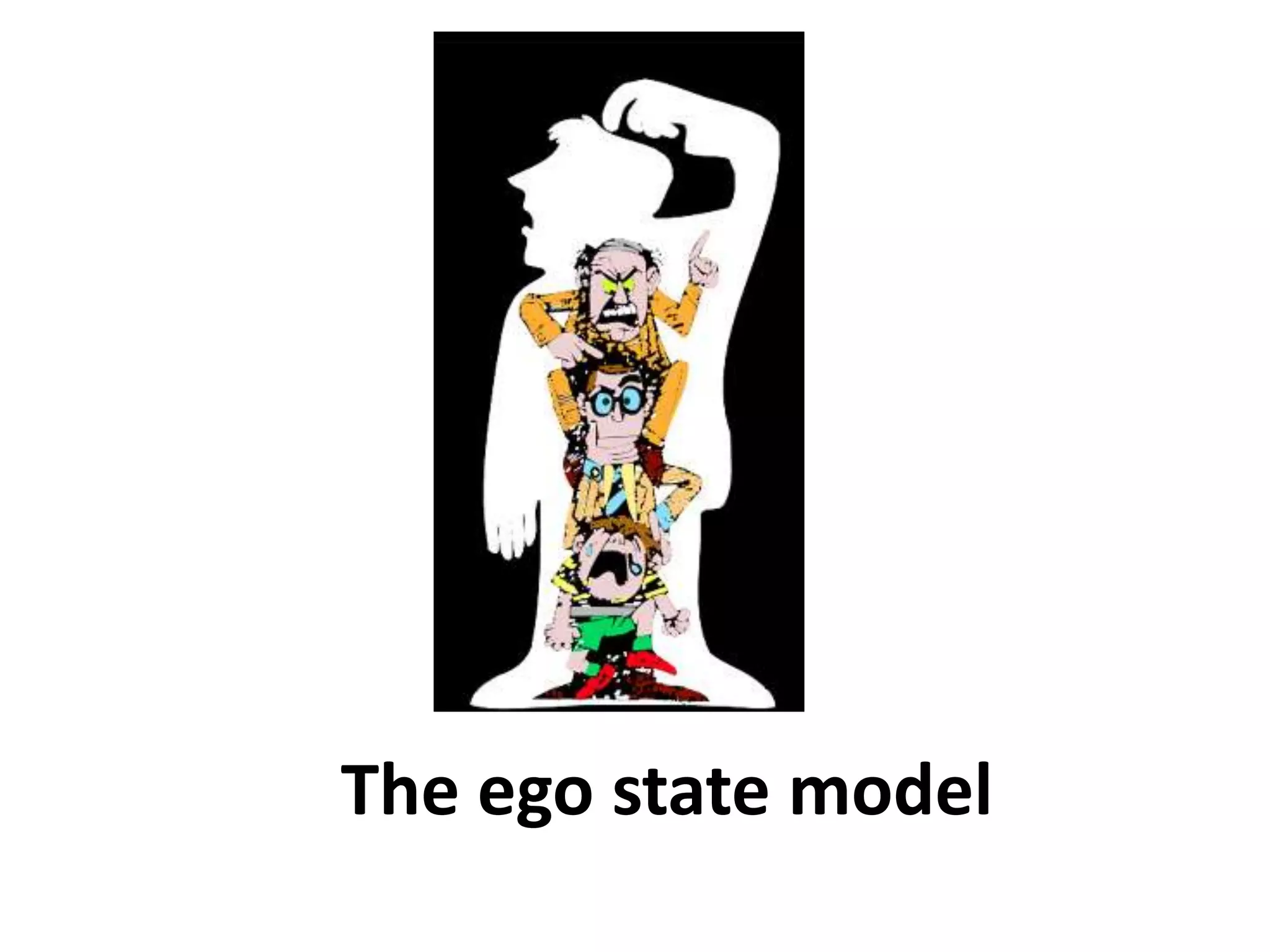
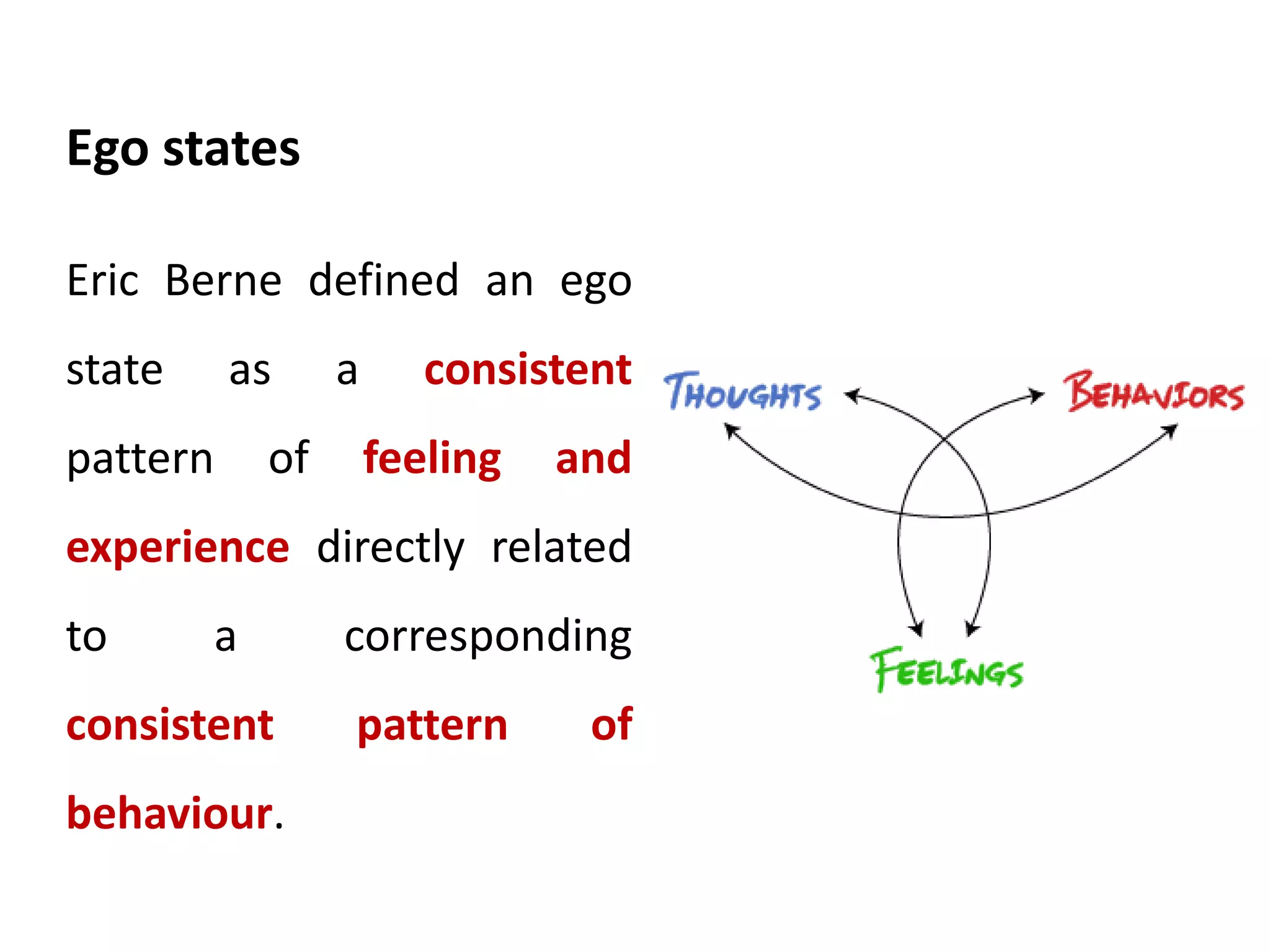
Eric Berne defined an ego
state as a consistent
pattern of feeling and
experience directly related
to a corresponding
consistent pattern of
behaviour.
Ego states
Berne was exact in his choice of words. It is worth while taking some time now
to clear what he was conveying in this definition.
• Berne is saying that each ego state is defined by a combination of
feeling and experience which consistently occur together.
• Berne is suggesting that the behaviour typical of each ego state is
consistently shown together.
• Berne is saying that when I am in touch with the feeling and experience
defining a particular ego state, I will also be showing the behaviours
which define that same ego state.
The whole point of the ego state model is that it allows us to make reliable
connections of this kind between behaviour, experience and feelings.
Definition in detail
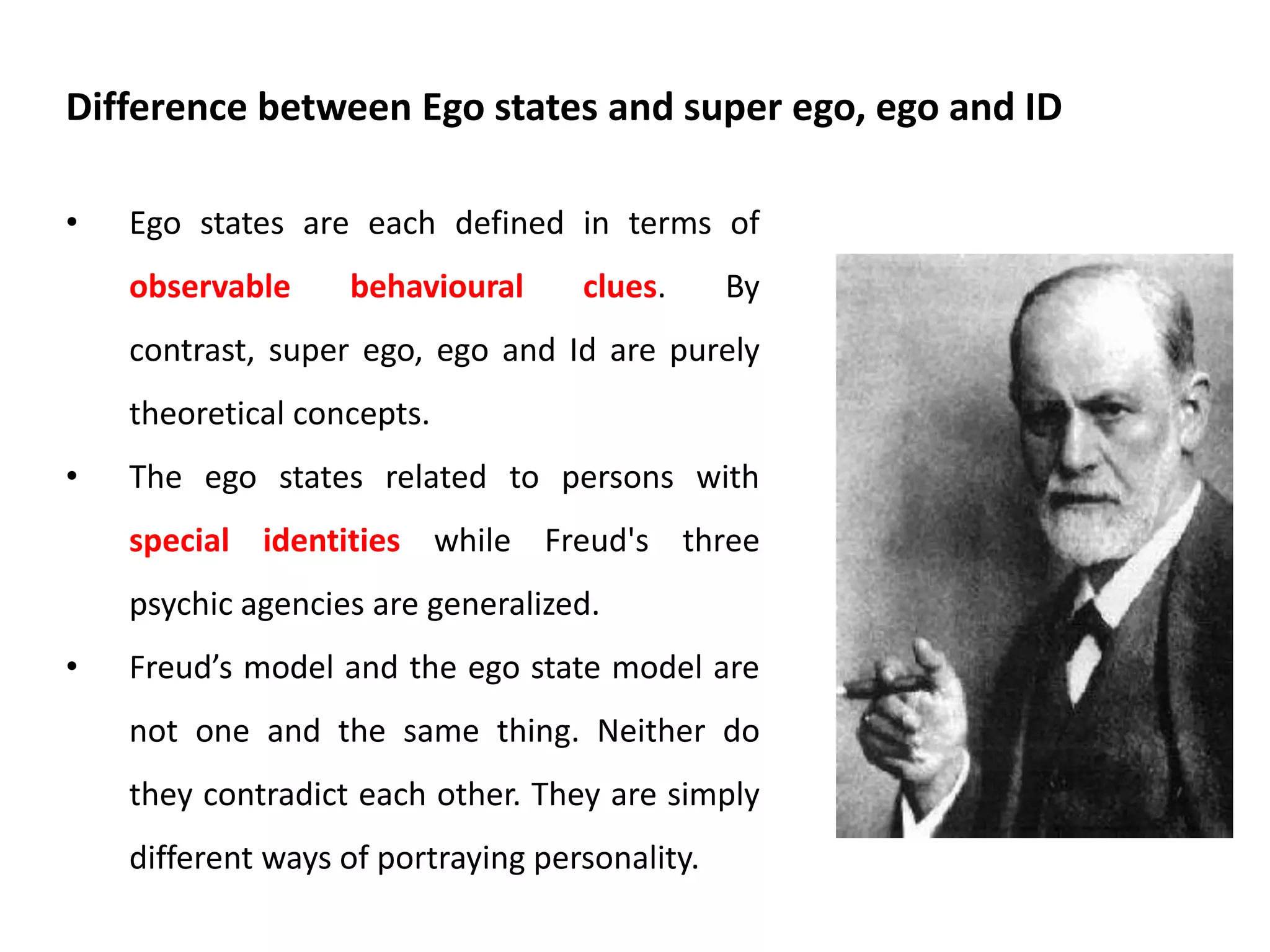
• Ego states are each defined in terms of
observable behavioural clues. By
contrast, super ego, ego and Id are purely
theoretical concepts.
• The ego states related to persons with
special identities while Freud's three
psychic agencies are generalized.
• Freud’s model and the ego state model are
not one and the same thing. Neither do
they contradict each other. They are simply
different ways of portraying personality.
Difference between Ego states and super ego, ego and ID
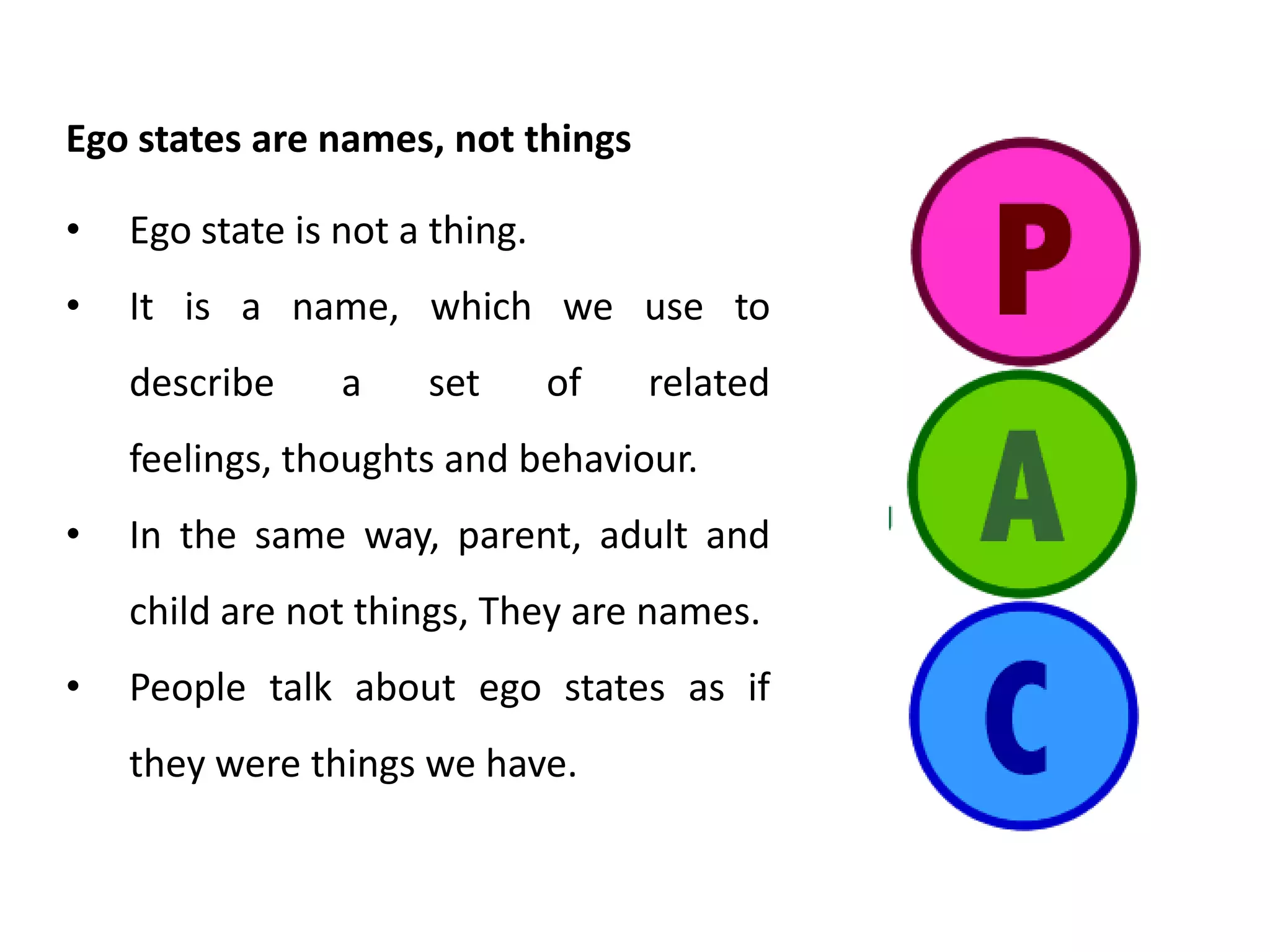
• Ego state is not a thing.
• It is a name, which we use to
describe a set of related feelings,
thoughts and behaviour.
• In the same way, parent, adult and
child are not things, They are names.
• People talk about ego states as if
they were things we have.
Ego states are names, not things
• Oversimplified model states that when I am thinking, I am in
adult. When I am feeling, I am in child. When I am making value
judgements, I am in parent.
• The oversimplified model completely omits to mention that I can
think and feel and make value judgements from any of my ego
states.
• An even more serious fault of the over simplified model is that it
says nothing about the time dimension of ego states. Berne
emphasised that parent and child are echoes of past. Only when I
am in my adult am I responding to situations with all my present
resources as a grown up.
The over simplified model
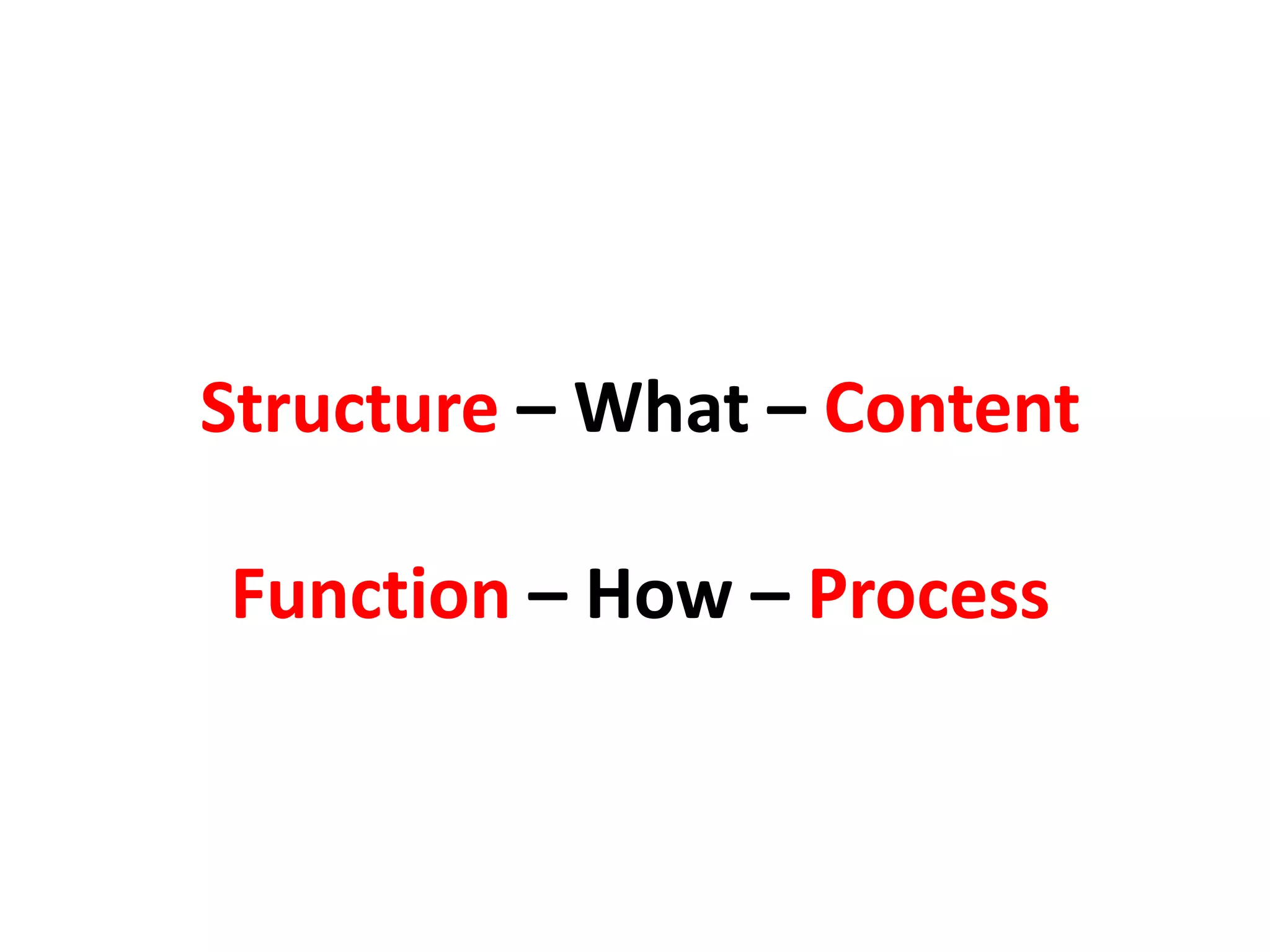
Structure – What – Content
Function – How – Process
• Think back through the past 24 hours.
• Make a note of an instance when you were in
controlling parent.
• Make a note of an instance when you were in
nurturing parent.
• Make a note of an instance when you were in
adult.
• Make a note of an instance when you were in
adapted child.
• Make a note of an instance when you were in
free child.
Activity
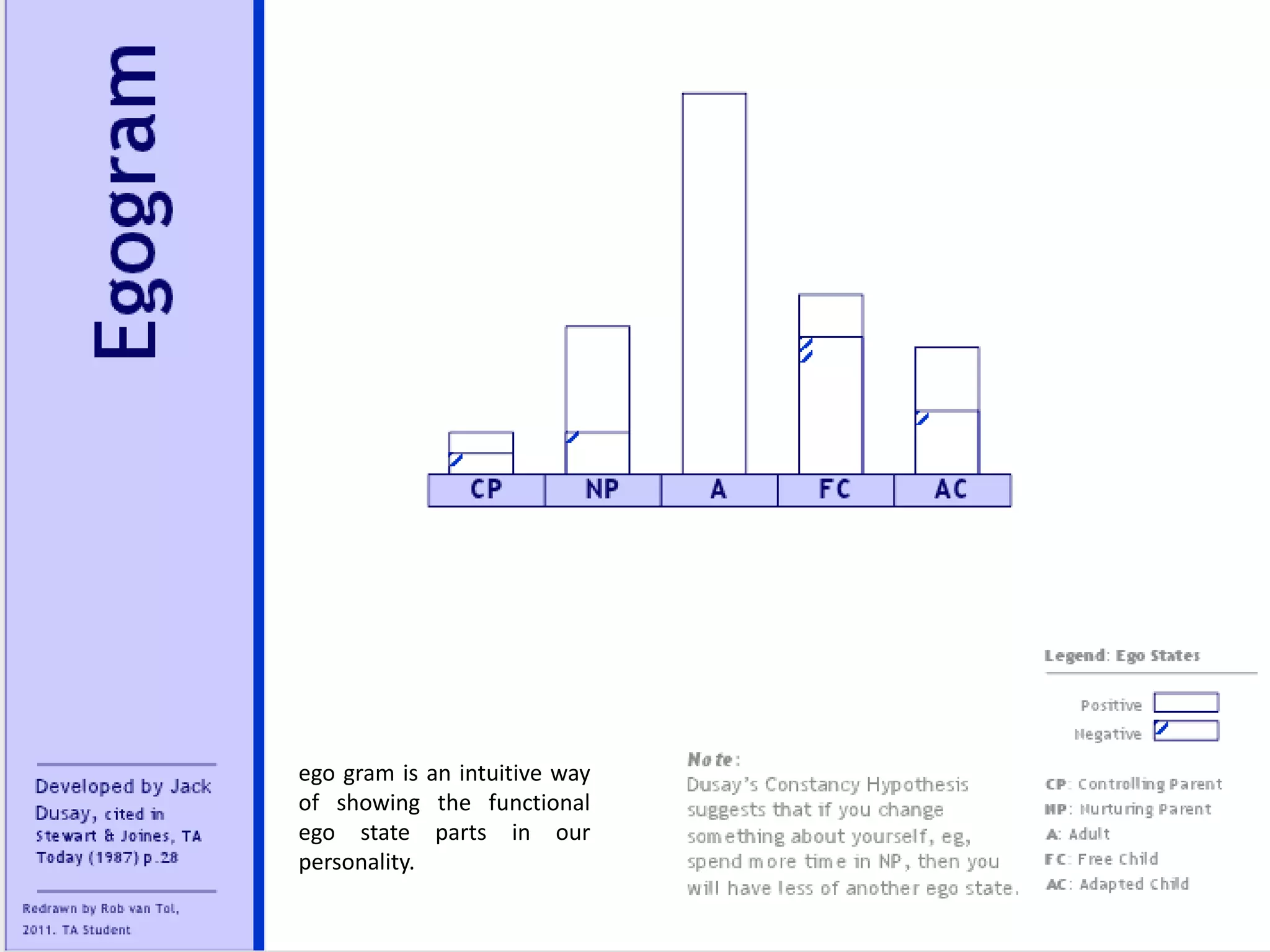
ego gram is an intuitive way
of showing the functional
ego state parts in our
personality.
• Draw you ego gram.
• Is there anything you want to change
about your ego gram.
• If there is , decide which bar you need
to raise to achieve this change.
• List at least five new behaviour which
you can practice to increase this ego
state.
• Draw you ideal ego gram.
Activity
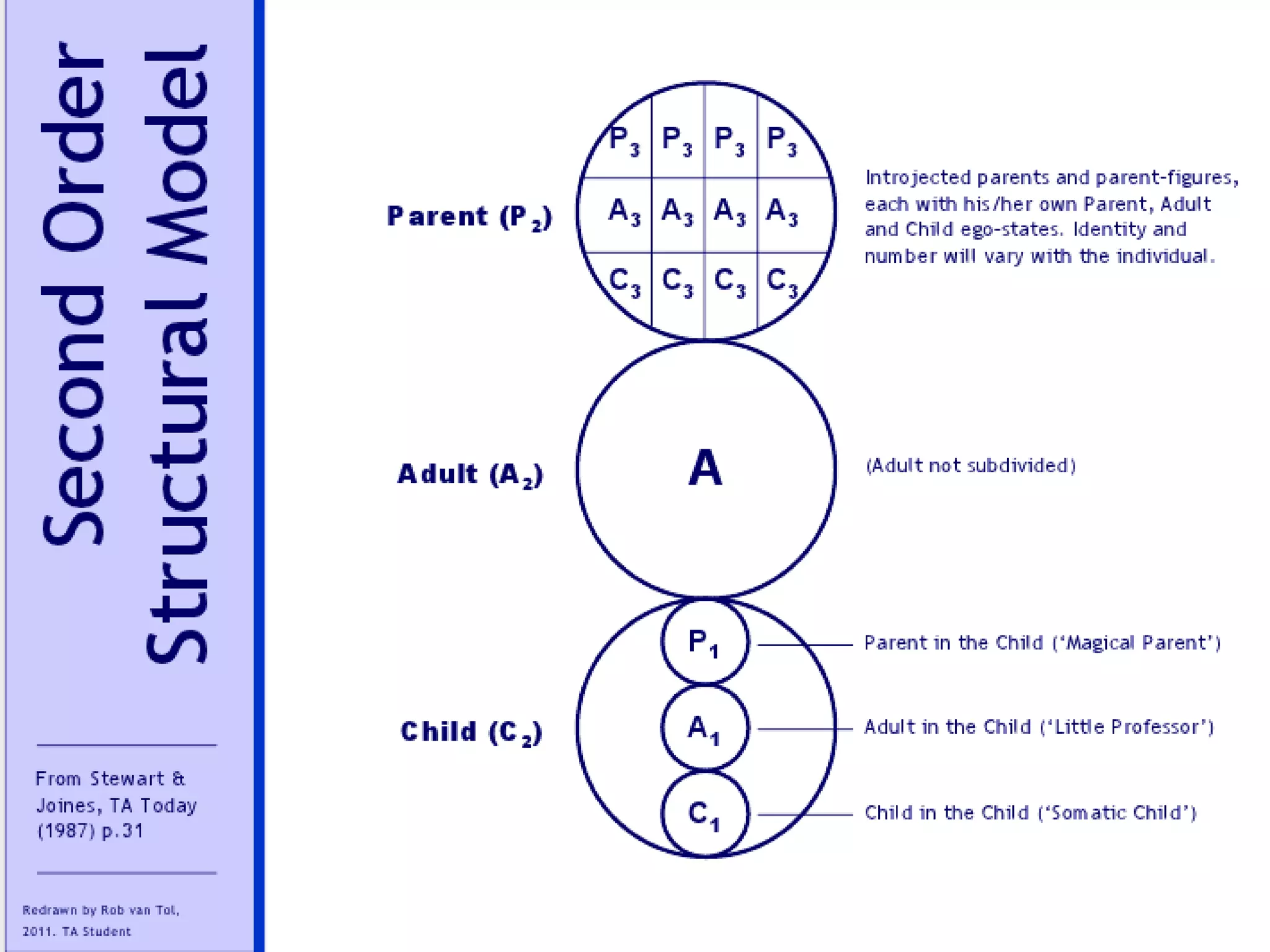
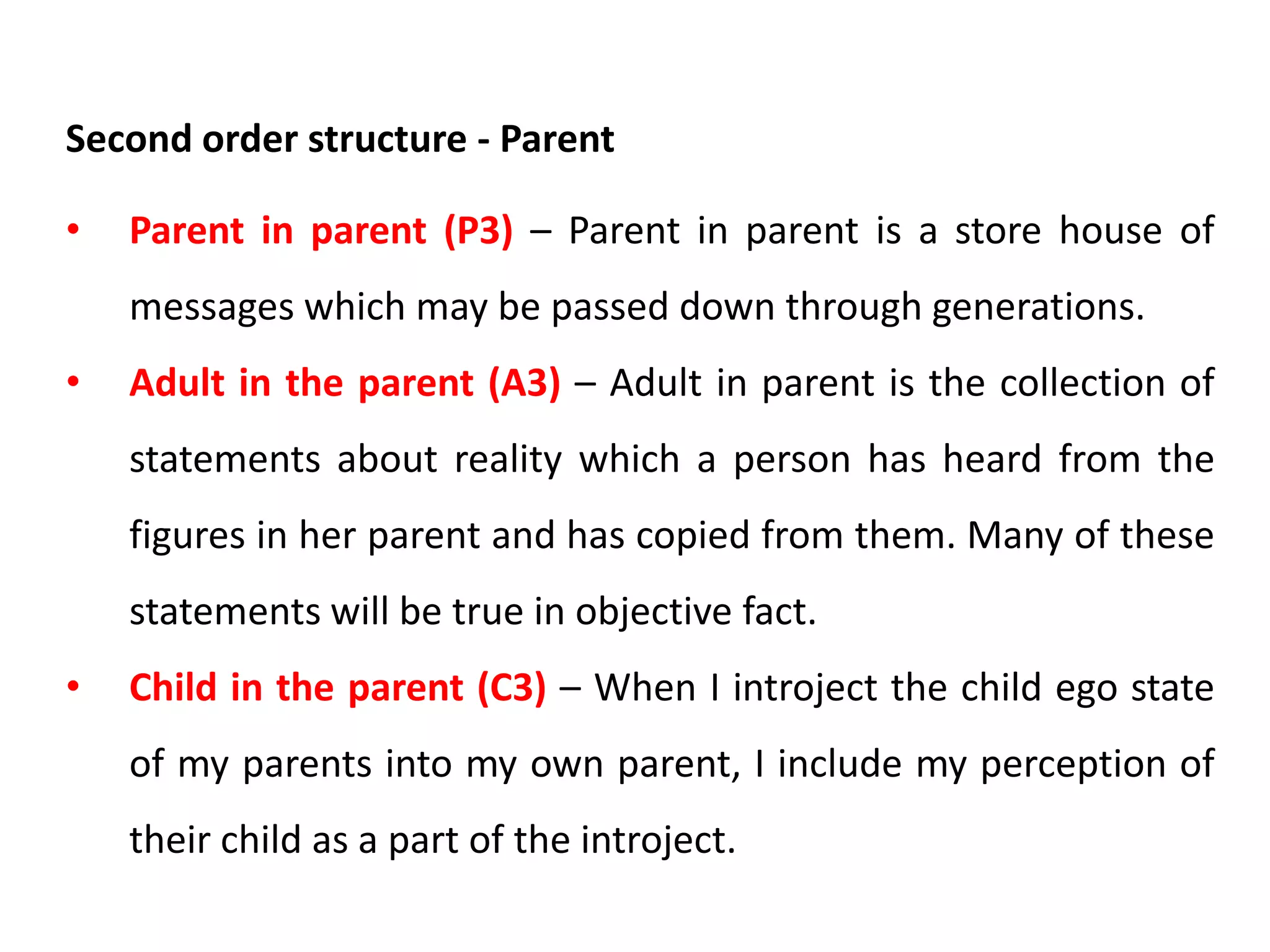
• Parent in parent (P3) – Parent in parent is a store house of
messages which may be passed down through generations.
• Adult in the parent (A3) – Adult in parent is the collection of
statements about reality which a person has heard from the
figures in her parent and has copied from them. Many of these
statements will be true in objective fact.
• Child in the parent (C3) – When I introject the child ego state
of my parents into my own parent, I include my perception of
their child as a part of the introject.
Second order structure - Parent
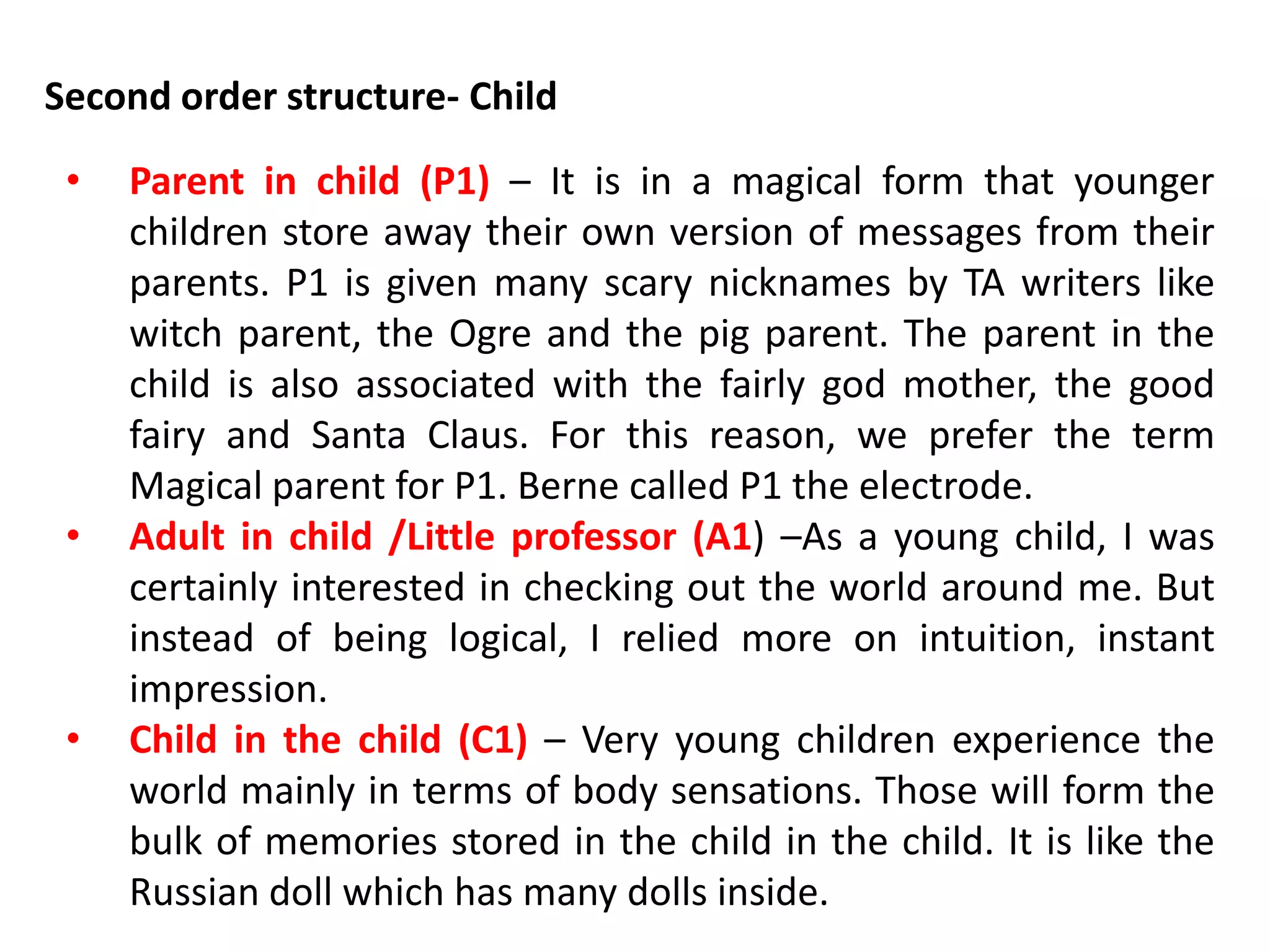
• Parent in child (P1) – It is in a magical form that younger
children store away their own version of messages from their
parents. P1 is given many scary nicknames by TA writers like
witch parent, the Ogre and the pig parent. The parent in the
child is also associated with the fairly god mother, the good
fairy and Santa Claus. For this reason, we prefer the term
Magical parent for P1. Berne called P1 the electrode.
• Adult in child /Little professor (A1) –As a young child, I was
certainly interested in checking out the world around me. But
instead of being logical, I relied more on intuition, instant
impression.
• Child in the child (C1) – Very young children experience the
world mainly in terms of body sensations. Those will form the
bulk of memories stored in the child in the child. It is like the
Russian doll which has many dolls inside.
Second order structure- Child
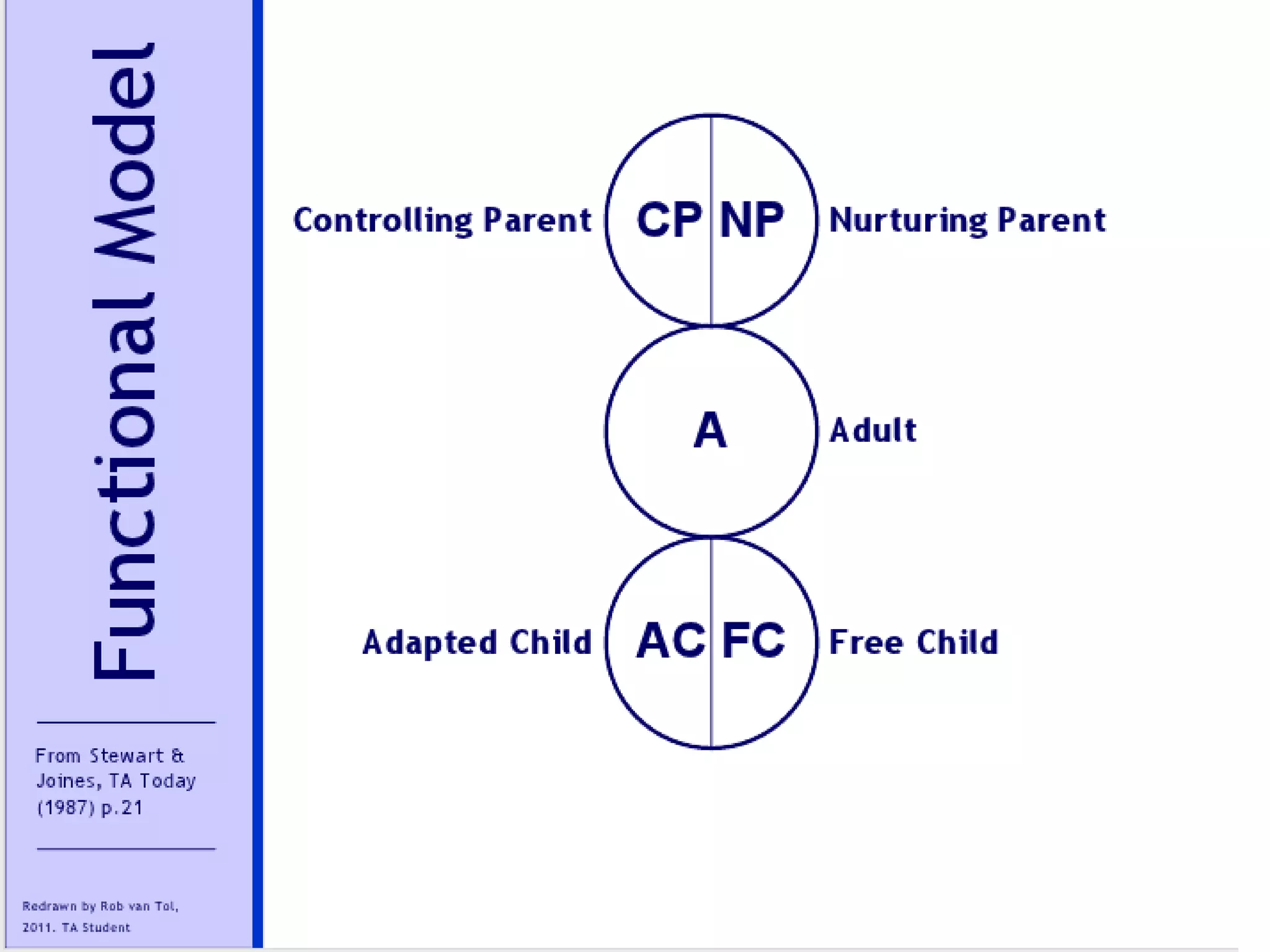
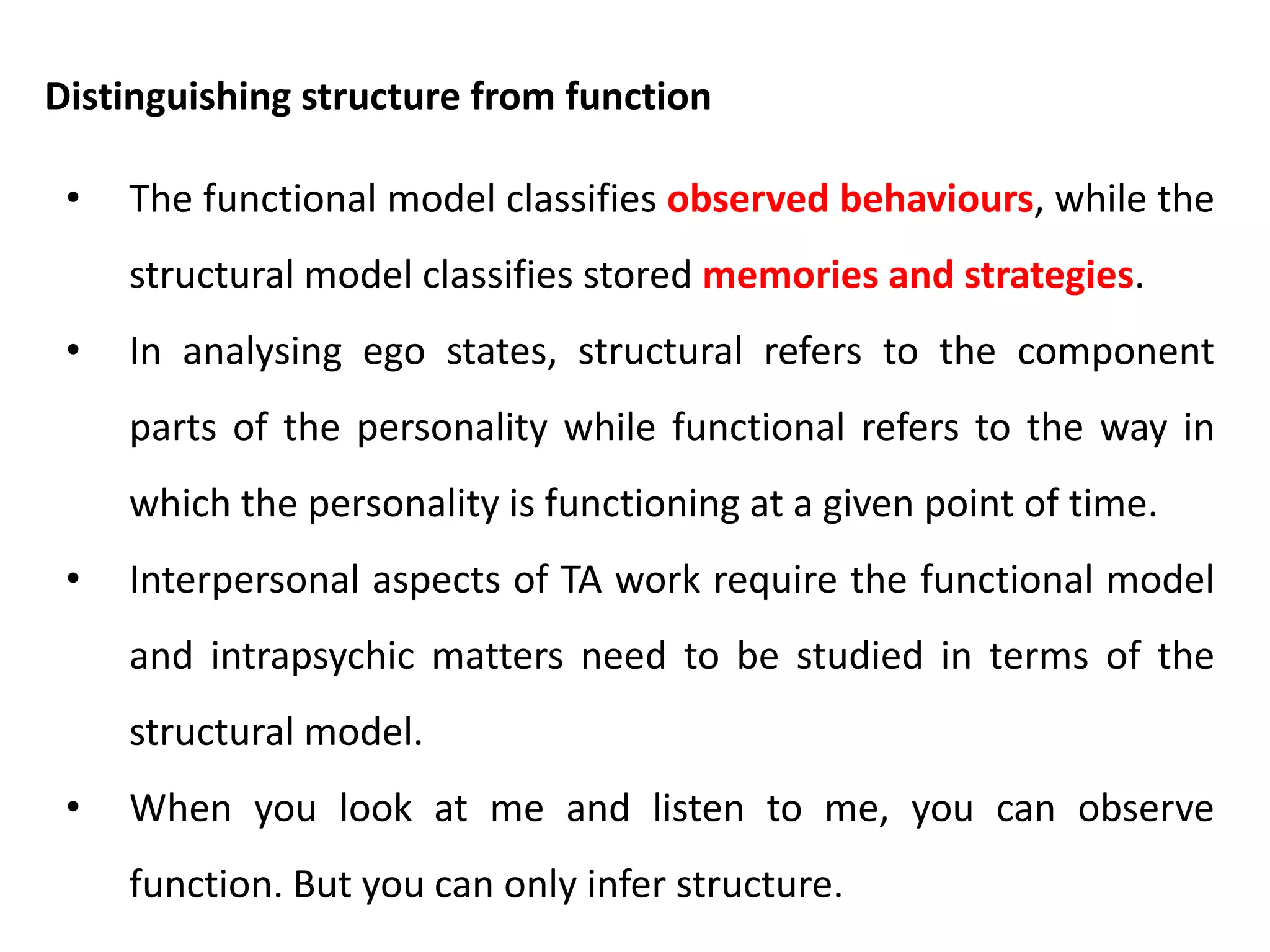
• The functional model classifies observed behaviours, while the
structural model classifies stored memories and strategies.
• In analysing ego states, structural refers to the component
parts of the personality while functional refers to the way in
which the personality is functioning at a given point of time.
• Interpersonal aspects of TA work require the functional model
and intrapsychic matters need to be studied in terms of the
structural model.
• When you look at me and listen to me, you can observe
function. But you can only infer structure.
Distinguishing structure from function
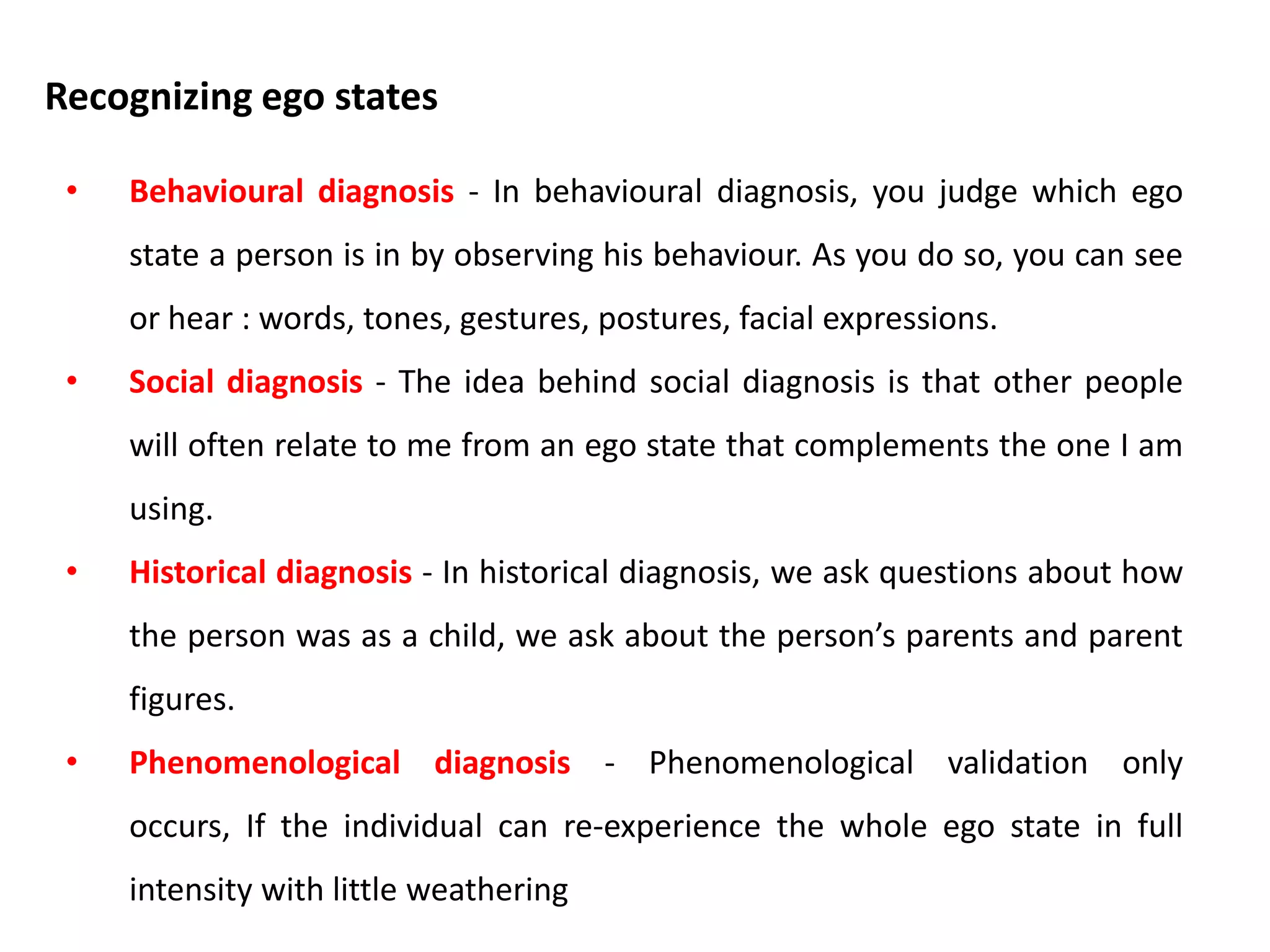
• Behavioural diagnosis - In behavioural diagnosis, you judge which ego
state a person is in by observing his behaviour. As you do so, you can see
or hear : words, tones, gestures, postures, facial expressions.
• Social diagnosis - The idea behind social diagnosis is that other people
will often relate to me from an ego state that complements the one I am
using.
• Historical diagnosis - In historical diagnosis, we ask questions about how
the person was as a child, we ask about the person’s parents and parent
figures.
• Phenomenological diagnosis - Phenomenological validation only occurs,
If the individual can re-experience the whole ego state in full intensity
with little weathering
Recognizing ego states
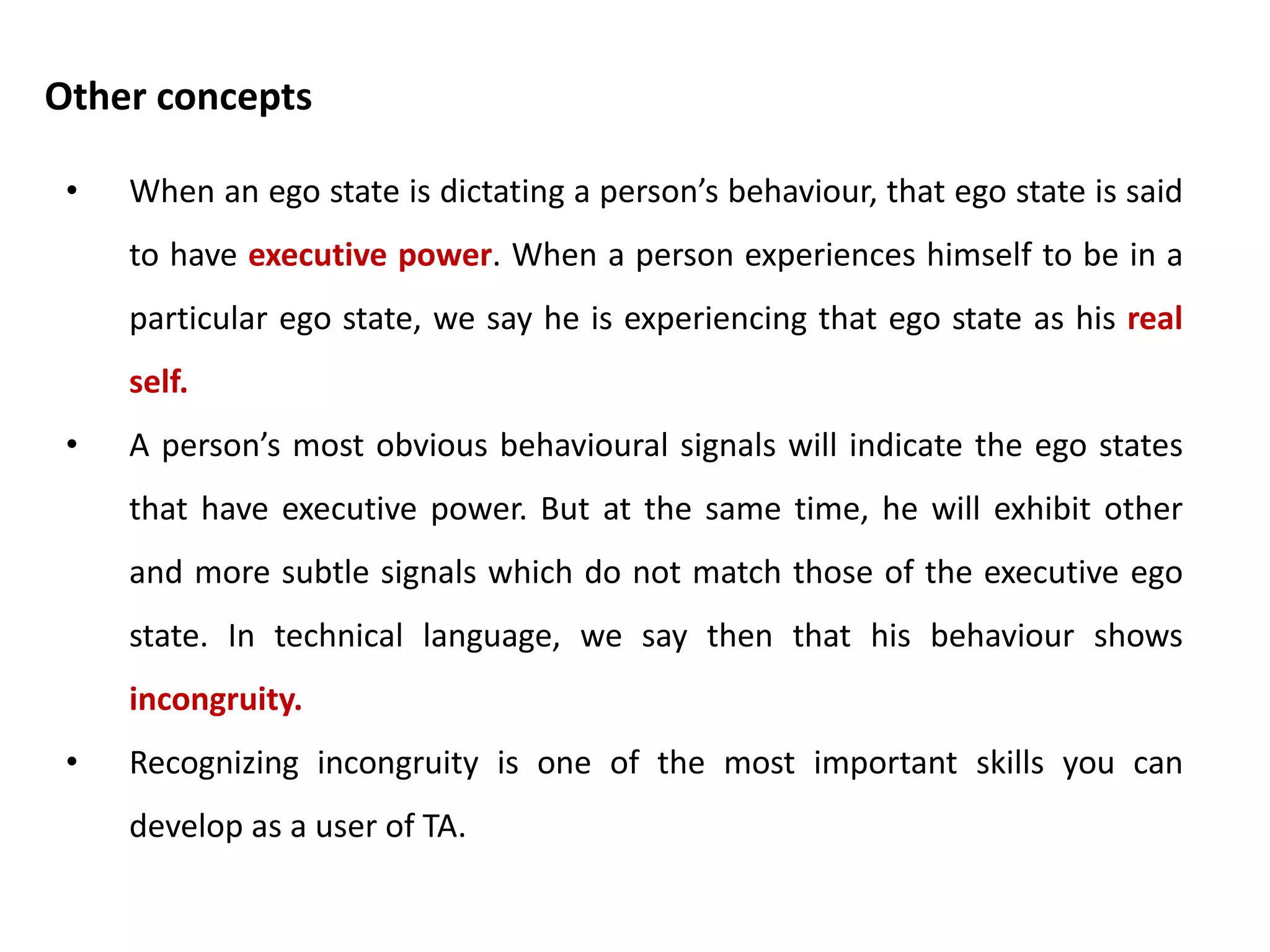
• When an ego state is dictating a person’s behaviour, that ego state is said
to have executive power. When a person experiences himself to be in a
particular ego state, we say he is experiencing that ego state as his real
self.
• A person’s most obvious behavioural signals will indicate the ego states
that have executive power. But at the same time, he will exhibit other
and more subtle signals which do not match those of the executive ego
state. In technical language, we say then that his behaviour shows
incongruity.
• Recognizing incongruity is one of the most important skills you can
develop as a user of TA.
Other concepts
• Eric Berne developed a theoretical explanation of what happens when
we shift executive power and our sense of real self between one ego
state and another.
• He suggested that energy exists in three forms : Bound, unbound and
free. Cathexis is psychic energy.
• When the monkey is sitting on a high branch, it posses potential energy
which is analogous to bound cathexis.
• If the monkey then does fall off the branch, the potential energy is
released as kinetic energy which Illustrates the unbound cathexis.
• Rather than falling off the branch, the monkey can exercise the choice to
jump to the ground. Berne suggests that this voluntary uses of energy is
analogous to free cathexis.
Berne’s energy theory
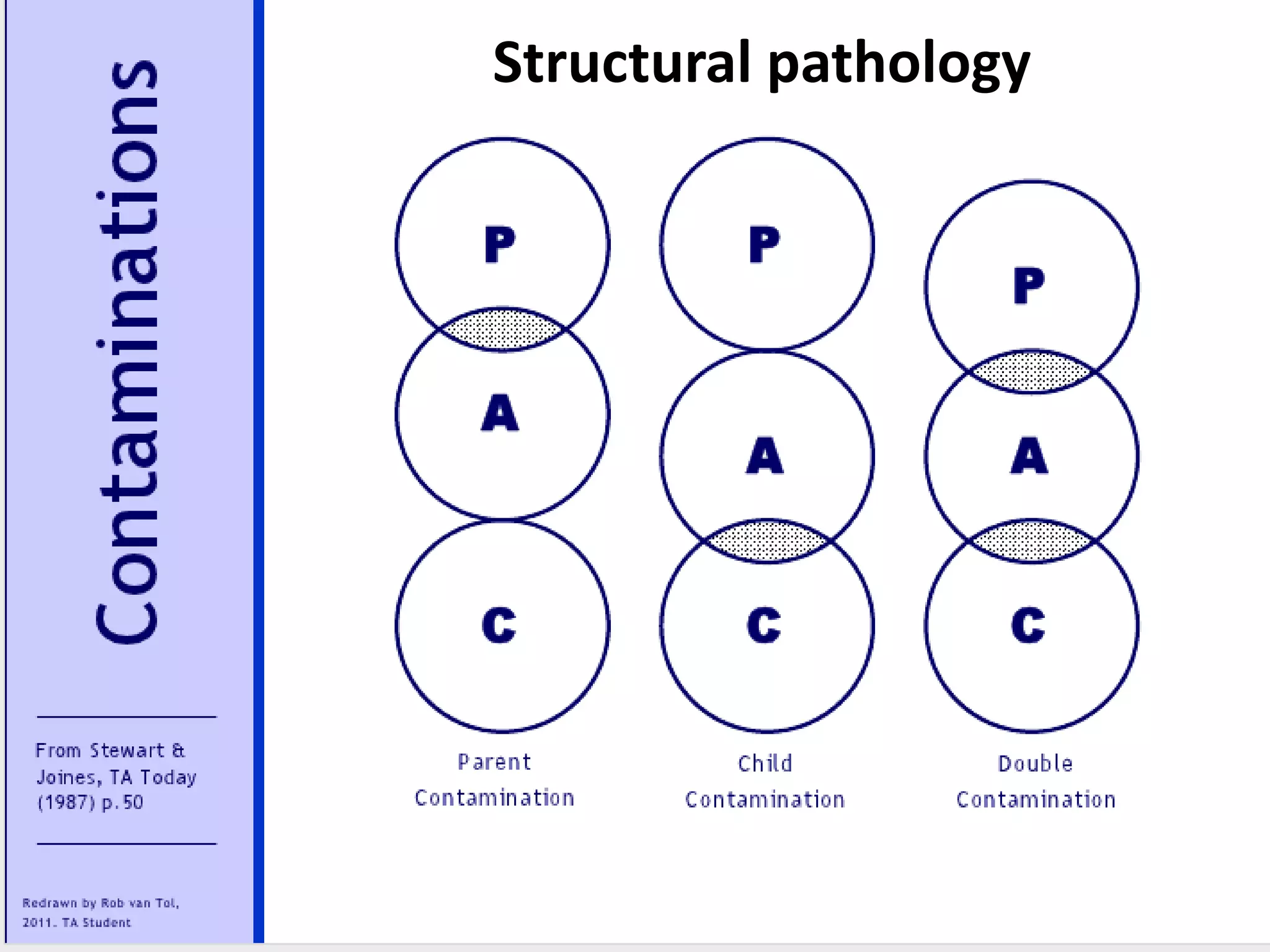
Structural pathology
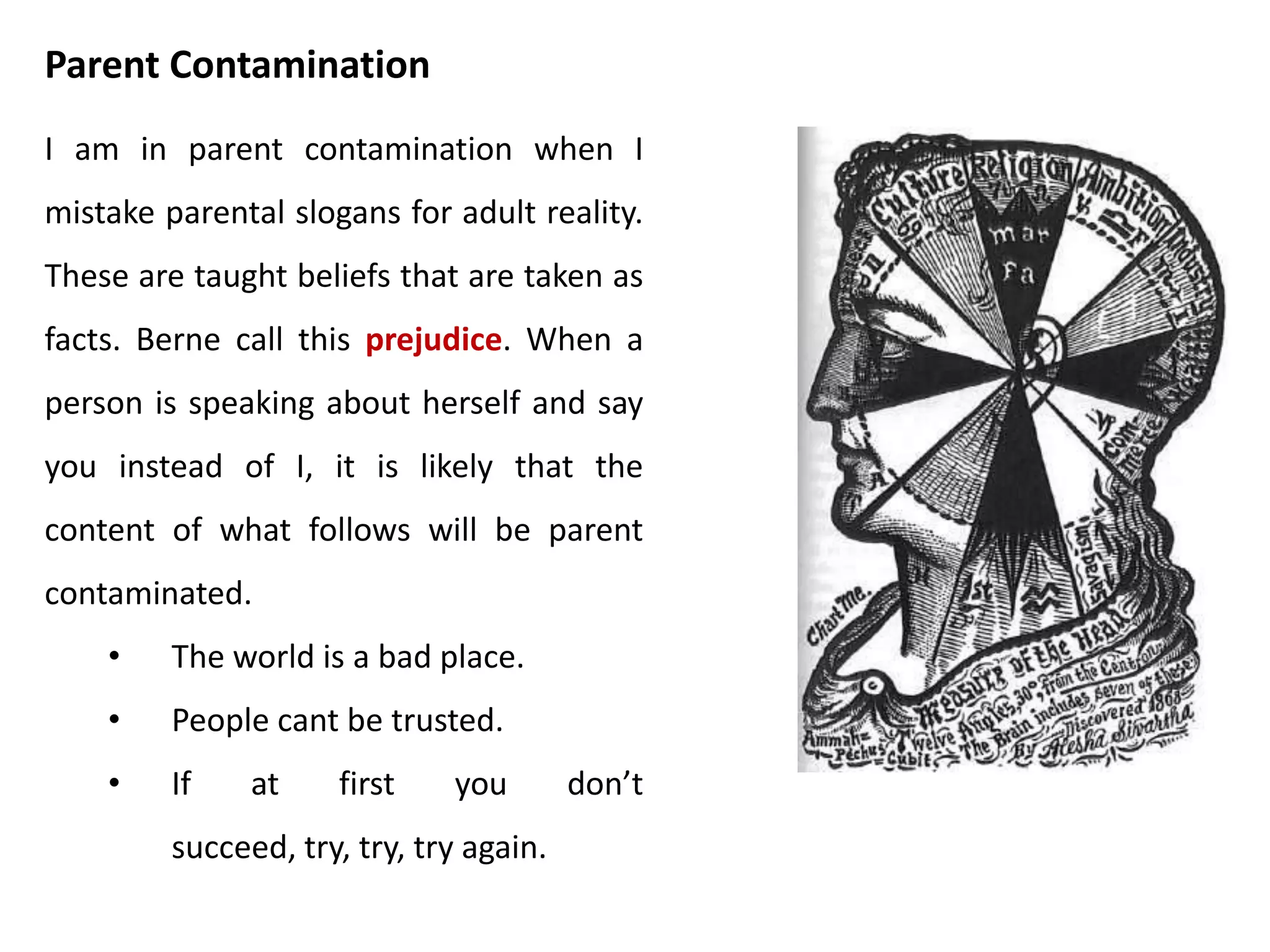
I am in parent contamination when I
mistake parental slogans for adult reality.
These are taught beliefs that are taken as
facts. Berne call this prejudice. When a
person is speaking about herself and say
you instead of I, it is likely that the
content of what follows will be parent
contaminated.
• The world is a bad place.
• People cant be trusted.
• If at first you don’t
succeed, try, try, try again.
Parent Contamination
• Take two minutes to write down all the
slogans and beliefs you remember hearing
from your parents and parental figures.
• Look through you list of parental slogans
and beliefs. Check whether each one is a
statement of reality or a parent
contamination.
• If you decide there are any you want to
update to fit with grown up reality, strike
them out and substitute your new version.
Activity
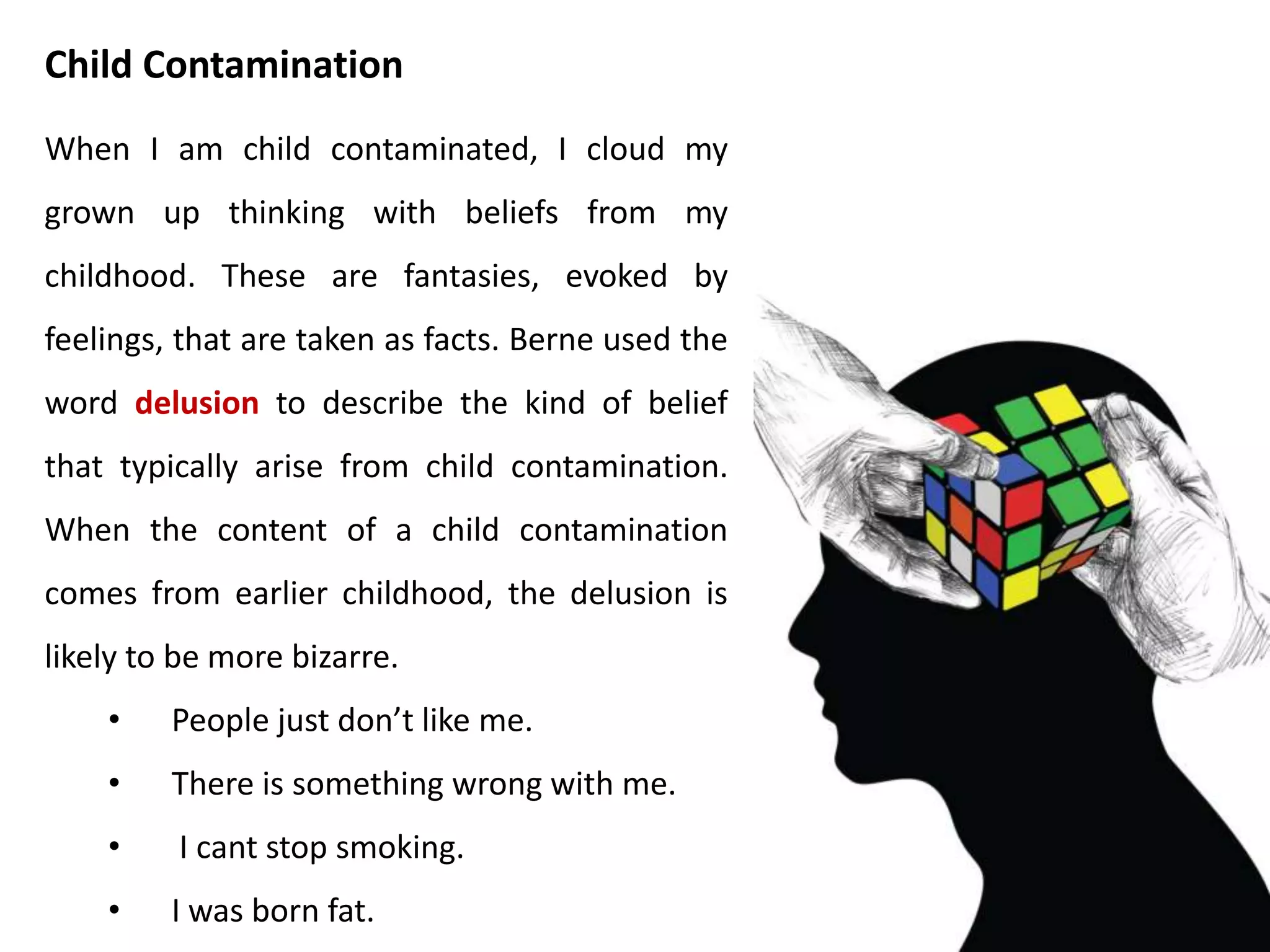
When I am child contaminated, I cloud my
grown up thinking with beliefs from my
childhood. These are fantasies, evoked by
feelings, that are taken as facts. Berne used the
word delusion to describe the kind of belief
that typically arise from child contamination.
When the content of a child contamination
comes from earlier childhood, the delusion is
likely to be more bizarre.
• People just don’t like me.
• There is something wrong with me.
• I cant stop smoking.
• I was born fat.
Child Contamination
• Take a piece of paper and head it : “ I am the
sort of person who….”
• Take two minutes to write down all the ways
you think of to finish the sentence.
• At the end of two minutes, relax, breathe and
look around the room for a while.
• For each of the ways you finished the
sentence, check whether it is a statement
about reality or a child contamination.
• If you decide any of the statement about
yourself do come from child
contamination, think what the reality of the
matter is. Strike out the child contamination
words and put in the adult updates.
Activity
It occurs when the person replays a
parental slogan, agrees to it with a child
belief, and mistakes both of these for
reality.
• People cant be trusted paired
with
• I can never trust anyone.
• Children should be seen and
not heart paired with
• To get by in the world, I have to
keep quit.
Double Contamination
Exclusion
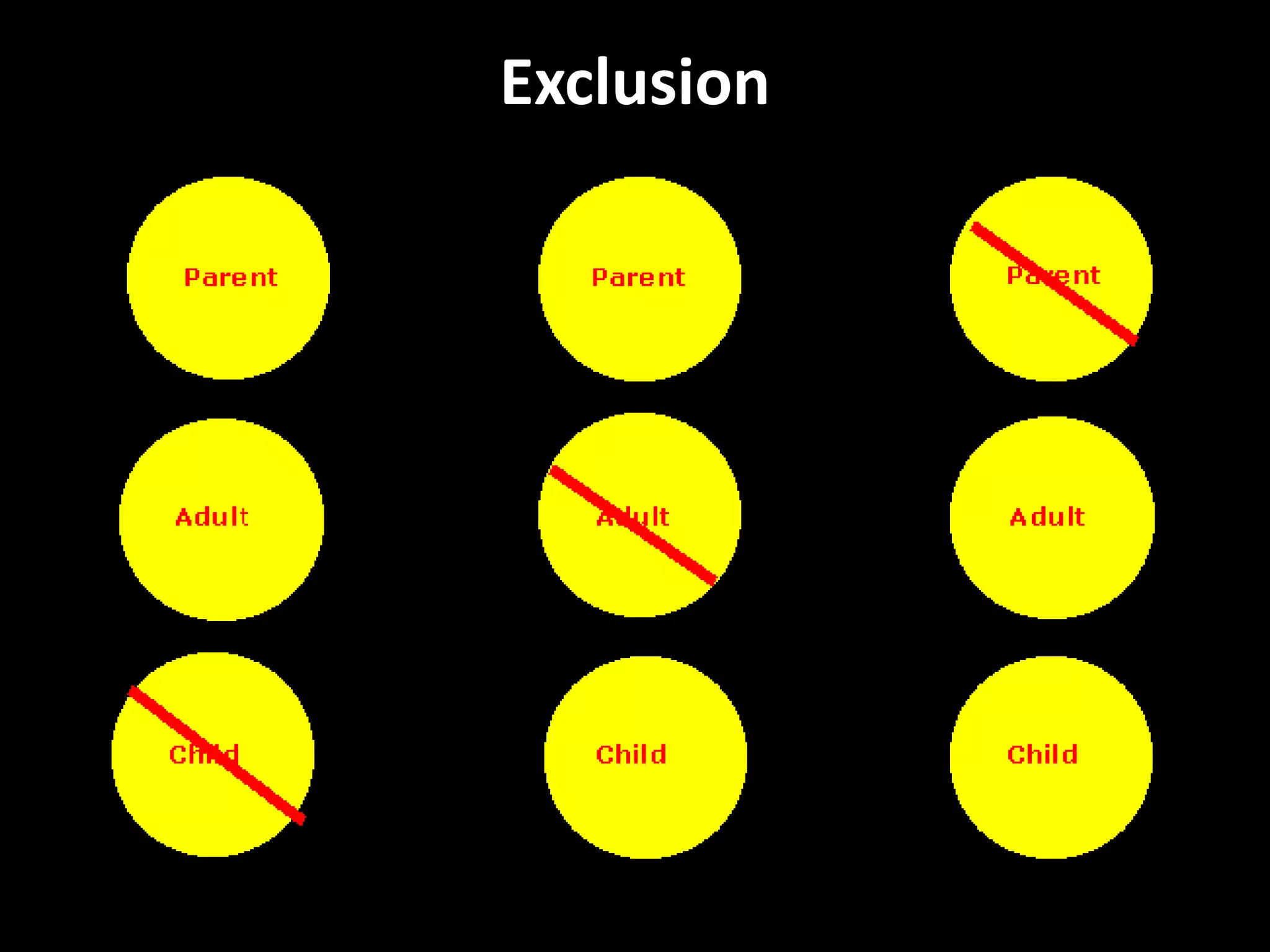
• Sometimes, Berne suggested, a person will shut out one or more of her
ego states. He called this exclusion.
• Excluded parent – People who have excluded parents will operate with
no ready made rules about the world. Instead, they made their own rules
afresh in every situation.( Politicians, mafia bosses)
• Excluded adult – If I exclude adult, I switch of my grown up power of
reality testing. Instead, I hear only an internal parent child dialogue.
(Diagnosed psychotic)
• Excluded child – Someone who excludes child will shut out the stored
memories of his own childhood. When we express feelings as
grownups, we are often in our child ego state. Therefore the person with
excluded child will often be regarded as cold fish or all head.
Exclusion
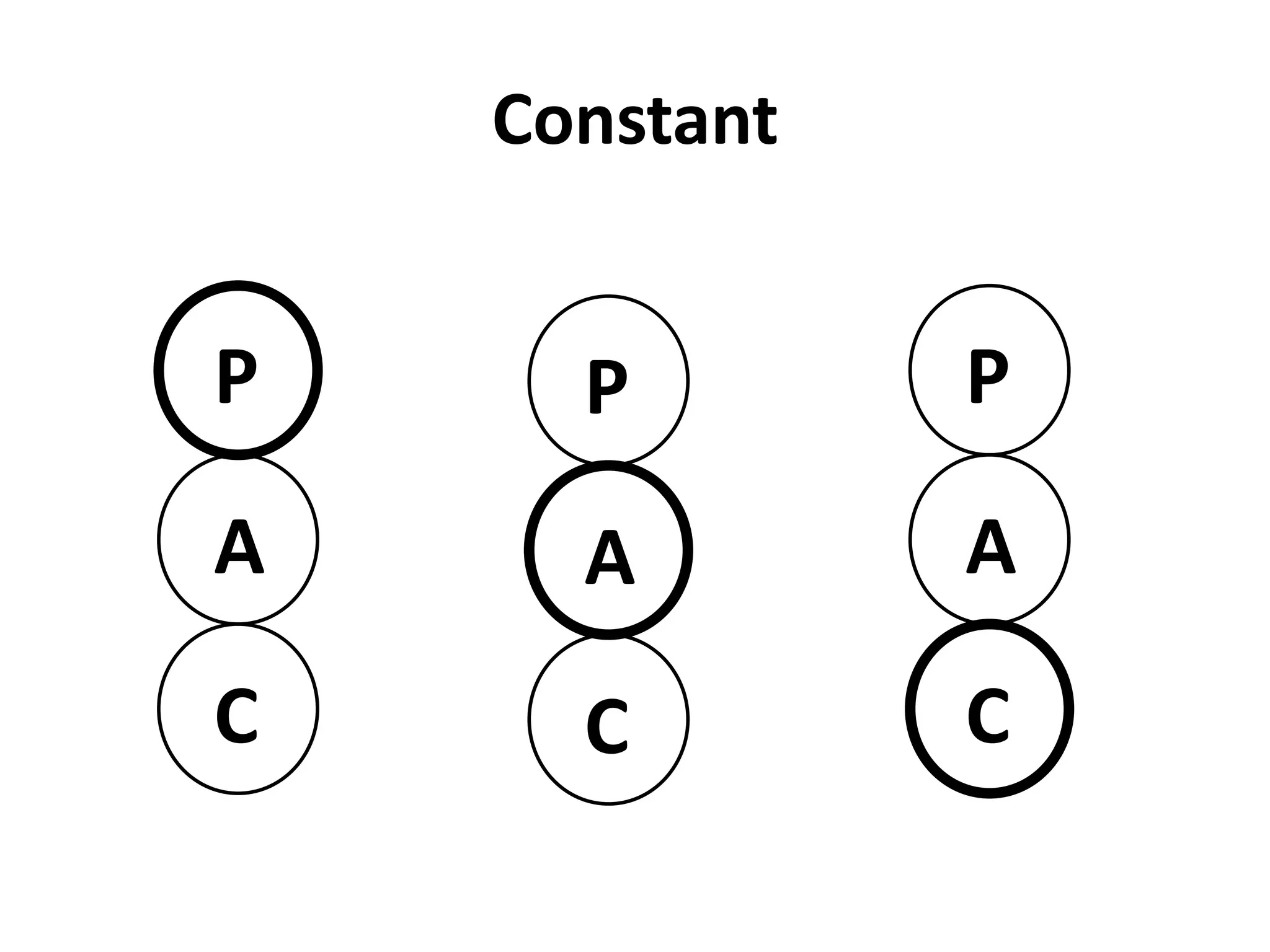
Constant
P
A
C
P
A
C
P
A
C
• If two out of the three ego states are excluded, the one operational ego
state is labelled constant or excluding.
• Constant parent – A person with constant parent will deal with the world
solely by accessing set of parental rules.
• Constant Adult – He is unable to join in the fun. Instead the functions
almost solely as a planner, information collector and data processor.
• Constant child – He will at all time behave, think and feel as though they
were still in childhood. Meeting a problem, this person’s strategy will be
to escalate feelings.
• Exclusion is never total. Instead, it is specific to particular situation.
Constant
Thank You
Other TA topics available on slideshare
1. Strokes - http://www.slideshare.net/manumjoy/strokes-24081607.
2. Games People Play - http://www.slideshare.net/manumjoy/psychological-
games-people-play.
3. Structural Analysis - http://www.slideshare.net/manumjoy/the-ego-state-model.
4. What is TA? - http://www.slideshare.net/manumjoy/what-ta-is
5. Cycles of Development - http://www.slideshare.net/manumjoy/cycles-of-
developement-pamela-levin-transactional-analysis.
6. Stages of Cure - http://www.slideshare.net/manumjoy/stages-of-cure.
7. Transactions - http://www.slideshare.net/manumjoy/transactions-33677298.
8. Time Structuring - http://www.slideshare.net/manumjoy/time-structuring.
9. Life Position - http://www.slideshare.net/manumjoy/life-position.
10. Autonomy - http://www.slideshare.net/manumjoy/autonomy-33690557.
11. Structural Pathology - http://www.slideshare.net/manumjoy/structural-pathology.
12. Game Analysis - http://www.slideshare.net/manumjoy/game-analysis-33725636.
13. Integrated Adult - http://www.slideshare.net/manumjoy/integrated-adult.
14. Stroke Economy - http://www.slideshare.net/manumjoy/stroke-economy-
33826702.

Structural Analysis - Transactional Analysis

  • 1.
  • 2.
    Prepared By Manu MelwinJoy Research Scholar School of Management Studies CUSAT, Kerala, India. Phone – 9744551114 Mail – manu_melwinjoy@yahoo.com Kindly restrict the use of slides for personal purpose. Please seek permission to reproduce the same in public forms and presentations.
  • 3.
    Contents • Ego states– Definition. • First Order Structural Model. • Functional Model. • Ego Gram. • Second Order Structural Model. • Structural Pathology
  • 4.
    The process ofanalysing personality in terms of ego states is called structural analysis. Definition
  • 5.
    Think back overthe past 24 hours of your life. • Were there moments during that time when you acted, thought and felt just as you did when you were a child? • Were there other times when you found yourself behaving, thinking and feeling in ways you copied long ago from you parents or from other people who were parent figures for you? • And were there still other occasions when your behavior, thoughts and feelings wee simply a direct here and now response to what was happening around you at that moment? • Take time to write down one example of each of these three situations. Activity
  • 6.
    Eric Berne definedan ego state as a consistent pattern of feeling and experience directly related to a corresponding consistent pattern of behaviour. Ego states
  • 7.
    Berne was exactin his choice of words. It is worth while taking some time now to clear what he was conveying in this definition. • Berne is saying that each ego state is defined by a combination of feeling and experience which consistently occur together. • Berne is suggesting that the behaviour typical of each ego state is consistently shown together. • Berne is saying that when I am in touch with the feeling and experience defining a particular ego state, I will also be showing the behaviours which define that same ego state. The whole point of the ego state model is that it allows us to make reliable connections of this kind between behaviour, experience and feelings. Definition in detail
  • 9.
    • Ego statesare each defined in terms of observable behavioural clues. By contrast, super ego, ego and Id are purely theoretical concepts. • The ego states related to persons with special identities while Freud's three psychic agencies are generalized. • Freud’s model and the ego state model are not one and the same thing. Neither do they contradict each other. They are simply different ways of portraying personality. Difference between Ego states and super ego, ego and ID
  • 10.
    • Ego stateis not a thing. • It is a name, which we use to describe a set of related feelings, thoughts and behaviour. • In the same way, parent, adult and child are not things, They are names. • People talk about ego states as if they were things we have. Ego states are names, not things
  • 11.
    • Oversimplified modelstates that when I am thinking, I am in adult. When I am feeling, I am in child. When I am making value judgements, I am in parent. • The oversimplified model completely omits to mention that I can think and feel and make value judgements from any of my ego states. • An even more serious fault of the over simplified model is that it says nothing about the time dimension of ego states. Berne emphasised that parent and child are echoes of past. Only when I am in my adult am I responding to situations with all my present resources as a grown up. The over simplified model
  • 12.
    Structure – What– Content Function – How – Process
  • 14.
    • Think backthrough the past 24 hours. • Make a note of an instance when you were in controlling parent. • Make a note of an instance when you were in nurturing parent. • Make a note of an instance when you were in adult. • Make a note of an instance when you were in adapted child. • Make a note of an instance when you were in free child. Activity
  • 15.
    ego gram isan intuitive way of showing the functional ego state parts in our personality.
  • 16.
    • Draw youego gram. • Is there anything you want to change about your ego gram. • If there is , decide which bar you need to raise to achieve this change. • List at least five new behaviour which you can practice to increase this ego state. • Draw you ideal ego gram. Activity
  • 18.
    • Parent inparent (P3) – Parent in parent is a store house of messages which may be passed down through generations. • Adult in the parent (A3) – Adult in parent is the collection of statements about reality which a person has heard from the figures in her parent and has copied from them. Many of these statements will be true in objective fact. • Child in the parent (C3) – When I introject the child ego state of my parents into my own parent, I include my perception of their child as a part of the introject. Second order structure - Parent
  • 19.
    • Parent inchild (P1) – It is in a magical form that younger children store away their own version of messages from their parents. P1 is given many scary nicknames by TA writers like witch parent, the Ogre and the pig parent. The parent in the child is also associated with the fairly god mother, the good fairy and Santa Claus. For this reason, we prefer the term Magical parent for P1. Berne called P1 the electrode. • Adult in child /Little professor (A1) –As a young child, I was certainly interested in checking out the world around me. But instead of being logical, I relied more on intuition, instant impression. • Child in the child (C1) – Very young children experience the world mainly in terms of body sensations. Those will form the bulk of memories stored in the child in the child. It is like the Russian doll which has many dolls inside. Second order structure- Child
  • 20.
    • The functionalmodel classifies observed behaviours, while the structural model classifies stored memories and strategies. • In analysing ego states, structural refers to the component parts of the personality while functional refers to the way in which the personality is functioning at a given point of time. • Interpersonal aspects of TA work require the functional model and intrapsychic matters need to be studied in terms of the structural model. • When you look at me and listen to me, you can observe function. But you can only infer structure. Distinguishing structure from function
  • 21.
    • Behavioural diagnosis- In behavioural diagnosis, you judge which ego state a person is in by observing his behaviour. As you do so, you can see or hear : words, tones, gestures, postures, facial expressions. • Social diagnosis - The idea behind social diagnosis is that other people will often relate to me from an ego state that complements the one I am using. • Historical diagnosis - In historical diagnosis, we ask questions about how the person was as a child, we ask about the person’s parents and parent figures. • Phenomenological diagnosis - Phenomenological validation only occurs, If the individual can re-experience the whole ego state in full intensity with little weathering Recognizing ego states
  • 22.
    • When anego state is dictating a person’s behaviour, that ego state is said to have executive power. When a person experiences himself to be in a particular ego state, we say he is experiencing that ego state as his real self. • A person’s most obvious behavioural signals will indicate the ego states that have executive power. But at the same time, he will exhibit other and more subtle signals which do not match those of the executive ego state. In technical language, we say then that his behaviour shows incongruity. • Recognizing incongruity is one of the most important skills you can develop as a user of TA. Other concepts
  • 23.
    • Eric Bernedeveloped a theoretical explanation of what happens when we shift executive power and our sense of real self between one ego state and another. • He suggested that energy exists in three forms : Bound, unbound and free. Cathexis is psychic energy. • When the monkey is sitting on a high branch, it posses potential energy which is analogous to bound cathexis. • If the monkey then does fall off the branch, the potential energy is released as kinetic energy which Illustrates the unbound cathexis. • Rather than falling off the branch, the monkey can exercise the choice to jump to the ground. Berne suggests that this voluntary uses of energy is analogous to free cathexis. Berne’s energy theory
  • 24.
  • 25.
    I am inparent contamination when I mistake parental slogans for adult reality. These are taught beliefs that are taken as facts. Berne call this prejudice. When a person is speaking about herself and say you instead of I, it is likely that the content of what follows will be parent contaminated. • The world is a bad place. • People cant be trusted. • If at first you don’t succeed, try, try, try again. Parent Contamination
  • 26.
    • Take twominutes to write down all the slogans and beliefs you remember hearing from your parents and parental figures. • Look through you list of parental slogans and beliefs. Check whether each one is a statement of reality or a parent contamination. • If you decide there are any you want to update to fit with grown up reality, strike them out and substitute your new version. Activity
  • 27.
    When I amchild contaminated, I cloud my grown up thinking with beliefs from my childhood. These are fantasies, evoked by feelings, that are taken as facts. Berne used the word delusion to describe the kind of belief that typically arise from child contamination. When the content of a child contamination comes from earlier childhood, the delusion is likely to be more bizarre. • People just don’t like me. • There is something wrong with me. • I cant stop smoking. • I was born fat. Child Contamination
  • 28.
    • Take apiece of paper and head it : “ I am the sort of person who….” • Take two minutes to write down all the ways you think of to finish the sentence. • At the end of two minutes, relax, breathe and look around the room for a while. • For each of the ways you finished the sentence, check whether it is a statement about reality or a child contamination. • If you decide any of the statement about yourself do come from child contamination, think what the reality of the matter is. Strike out the child contamination words and put in the adult updates. Activity
  • 29.
    It occurs whenthe person replays a parental slogan, agrees to it with a child belief, and mistakes both of these for reality. • People cant be trusted paired with • I can never trust anyone. • Children should be seen and not heart paired with • To get by in the world, I have to keep quit. Double Contamination
  • 30.
  • 31.
    • Sometimes, Bernesuggested, a person will shut out one or more of her ego states. He called this exclusion. • Excluded parent – People who have excluded parents will operate with no ready made rules about the world. Instead, they made their own rules afresh in every situation.( Politicians, mafia bosses) • Excluded adult – If I exclude adult, I switch of my grown up power of reality testing. Instead, I hear only an internal parent child dialogue. (Diagnosed psychotic) • Excluded child – Someone who excludes child will shut out the stored memories of his own childhood. When we express feelings as grownups, we are often in our child ego state. Therefore the person with excluded child will often be regarded as cold fish or all head. Exclusion
  • 32.
  • 33.
    • If twoout of the three ego states are excluded, the one operational ego state is labelled constant or excluding. • Constant parent – A person with constant parent will deal with the world solely by accessing set of parental rules. • Constant Adult – He is unable to join in the fun. Instead the functions almost solely as a planner, information collector and data processor. • Constant child – He will at all time behave, think and feel as though they were still in childhood. Meeting a problem, this person’s strategy will be to escalate feelings. • Exclusion is never total. Instead, it is specific to particular situation. Constant
  • 34.
  • 35.
    Other TA topicsavailable on slideshare 1. Strokes - http://www.slideshare.net/manumjoy/strokes-24081607. 2. Games People Play - http://www.slideshare.net/manumjoy/psychological- games-people-play. 3. Structural Analysis - http://www.slideshare.net/manumjoy/the-ego-state-model. 4. What is TA? - http://www.slideshare.net/manumjoy/what-ta-is 5. Cycles of Development - http://www.slideshare.net/manumjoy/cycles-of- developement-pamela-levin-transactional-analysis. 6. Stages of Cure - http://www.slideshare.net/manumjoy/stages-of-cure. 7. Transactions - http://www.slideshare.net/manumjoy/transactions-33677298. 8. Time Structuring - http://www.slideshare.net/manumjoy/time-structuring. 9. Life Position - http://www.slideshare.net/manumjoy/life-position. 10. Autonomy - http://www.slideshare.net/manumjoy/autonomy-33690557. 11. Structural Pathology - http://www.slideshare.net/manumjoy/structural-pathology. 12. Game Analysis - http://www.slideshare.net/manumjoy/game-analysis-33725636. 13. Integrated Adult - http://www.slideshare.net/manumjoy/integrated-adult. 14. Stroke Economy - http://www.slideshare.net/manumjoy/stroke-economy- 33826702.