METHODS OF TRAINING
6 Methods of Training…
  Can you name them?
1.   Interval
2.   Continuous
3.   Fartlek
4.   Circuit
5.   Weight
6.   Cross
Interval Training – Speed                   and CV

• Periods of hard work followed by periods of rest.
• Improves mainly speed, will also improve CV.
• High intensity and fast pace.

 1 Rep = Sprint for 60m, rest for 30seconds
1 Set (of repetitions) = 4xruns and rest.

• ‘Rest’ might mean milder exercise
   e.g. 30m sprint 30m
slow jogging.

• The ‘Rest’ periods give us time to recover.

Who uses it?
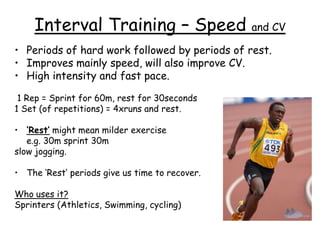
Sprinters (Athletics, Swimming, cycling)
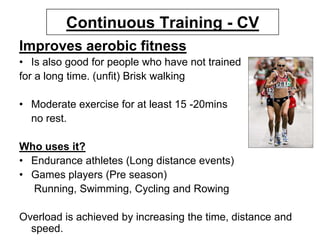
Continuous Training - CV
Improves aerobic fitness
• Is also good for people who have not trained
for a long time. (unfit) Brisk walking

• Moderate exercise for at least 15 -20mins
  no rest.

Who uses it?
• Endurance athletes (Long distance events)
• Games players (Pre season)
  Running, Swimming, Cycling and Rowing

Overload is achieved by increasing the time, distance and
  speed.
Continuous Training
Advantages?
• Improves aerobic fitness

• Cheap

• Can be done individual and in a group

• Improves health and fitness

• Can be done anywhere

• Adapted to suit individual needs

• Range of activities can be used (Running, Swimming, Cycling,
  Rowing, Cross trainer)

• Can easily apply the FITT principle
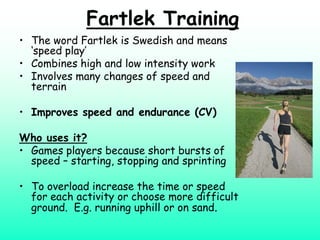
Fartlek Training
• The word Fartlek is Swedish and means
  ‘speed play’
• Combines high and low intensity work
• Involves many changes of speed and
  terrain

• Improves speed and endurance (CV)

Who uses it?
• Games players because short bursts of
  speed – starting, stopping and sprinting

• To overload increase the time or speed
  for each activity or choose more difficult
  ground. E.g. running uphill or on sand.
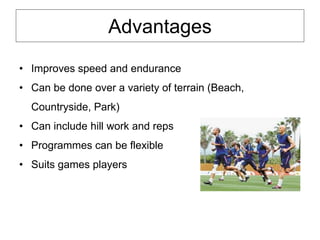
Advantages
• Improves speed and endurance
• Can be done over a variety of terrain (Beach,
  Countryside, Park)
• Can include hill work and reps
• Programmes can be flexible
• Suits games players
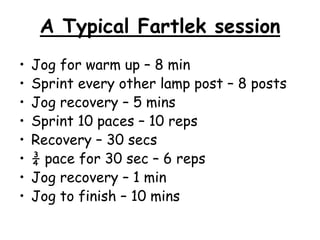
A Typical Fartlek session
•   Jog for warm up – 8 min
•   Sprint every other lamp post – 8 posts
•   Jog recovery – 5 mins
•   Sprint 10 paces – 10 reps
•   Recovery – 30 secs
•   ¾ pace for 30 sec – 6 reps
•   Jog recovery – 1 min
•   Jog to finish – 10 mins
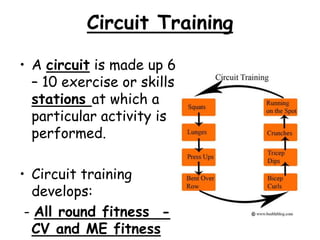
Circuit Training

• A circuit is made up 6
  – 10 exercise or skills
  stations at which a
  particular activity is
  performed.

• Circuit training
  develops:
 - All round fitness -
  CV and ME fitness
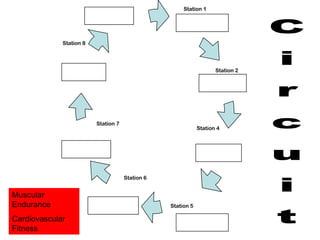
Station 1
                            Station 1


             Station 8


                                                                    Station 2


                         Station 7
                                                             Station 4


                                     Station 6


Muscular
Endurance                                        Station 5

Cardiovascular
Fitness
1. How can we determine which type of fitness is
    improved?
TYPE of activity
TIME spent at each activity
NUMBER of stations and circuits completed.

How do we increase the difficulty in a circuit?

If we want to improve leg power and cardio
    vascular fitness – What type of exercises
    would we include in a circuit?
Circuit Training
Who uses it?
Games players, swimmers

Advantages?
Not much equipment needed
Not expensive
Can be done at home or at the gym
Uses music – motivational
Fitness and skills
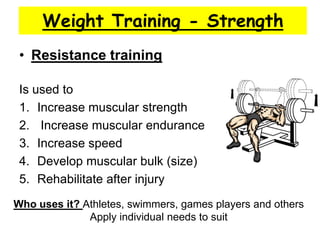
Weight Training - Strength
 • Resistance training

 Is used to
 1. Increase muscular strength
 2. Increase muscular endurance
 3. Increase speed
 4. Develop muscular bulk (size)
 5. Rehabilitate after injury
Who uses it? Athletes, swimmers, games players and others
              Apply individual needs to suit
Weight Training Advantages
Can develop muscular strength, muscular endurance
  and power...
• Max strength =
  3 sets of 6 reps at near max weight.

• Muscular endurance =
  3 sets of 20-30 reps.

• Muscular power
  3 sets of 10-15 reps.
Can use a variety of exercises to work on specific
  muscle groups

Is easy to monitor progress and overload.
Cross Training
• A mixture of training methods
• Who? Used for most sports
• E.g. Circuit training and interval training for Football CV
  and ME fitness.

Advantages?
• Allows for a variety of training
• Makes training more interesting
• Training can be adapted to weather
• Can rest different muscle groups from day to day.
BRAIN TEASER
1. Name the 6 types of training.
2. Name 3 exercises you could include in a
   circuit designed to improve muscular
   endurance.
3. What type of training improves
   cardiovascular fitness – explain.
4. What is interval training?
5. What is fartlek training and why is it
   good for games players.

Methods of training

  • 1.
  • 2.
    6 Methods ofTraining… Can you name them? 1. Interval 2. Continuous 3. Fartlek 4. Circuit 5. Weight 6. Cross
  • 3.
    Interval Training –Speed and CV • Periods of hard work followed by periods of rest. • Improves mainly speed, will also improve CV. • High intensity and fast pace. 1 Rep = Sprint for 60m, rest for 30seconds 1 Set (of repetitions) = 4xruns and rest. • ‘Rest’ might mean milder exercise e.g. 30m sprint 30m slow jogging. • The ‘Rest’ periods give us time to recover. Who uses it? Sprinters (Athletics, Swimming, cycling)
  • 4.
    Continuous Training -CV Improves aerobic fitness • Is also good for people who have not trained for a long time. (unfit) Brisk walking • Moderate exercise for at least 15 -20mins no rest. Who uses it? • Endurance athletes (Long distance events) • Games players (Pre season) Running, Swimming, Cycling and Rowing Overload is achieved by increasing the time, distance and speed.
  • 5.
    Continuous Training Advantages? • Improvesaerobic fitness • Cheap • Can be done individual and in a group • Improves health and fitness • Can be done anywhere • Adapted to suit individual needs • Range of activities can be used (Running, Swimming, Cycling, Rowing, Cross trainer) • Can easily apply the FITT principle
  • 6.
    Fartlek Training • Theword Fartlek is Swedish and means ‘speed play’ • Combines high and low intensity work • Involves many changes of speed and terrain • Improves speed and endurance (CV) Who uses it? • Games players because short bursts of speed – starting, stopping and sprinting • To overload increase the time or speed for each activity or choose more difficult ground. E.g. running uphill or on sand.
  • 7.
    Advantages • Improves speedand endurance • Can be done over a variety of terrain (Beach, Countryside, Park) • Can include hill work and reps • Programmes can be flexible • Suits games players
  • 8.
    A Typical Fartleksession • Jog for warm up – 8 min • Sprint every other lamp post – 8 posts • Jog recovery – 5 mins • Sprint 10 paces – 10 reps • Recovery – 30 secs • ¾ pace for 30 sec – 6 reps • Jog recovery – 1 min • Jog to finish – 10 mins
  • 9.
    Circuit Training • Acircuit is made up 6 – 10 exercise or skills stations at which a particular activity is performed. • Circuit training develops: - All round fitness - CV and ME fitness
  • 10.
    Station 1 Station 1 Station 8 Station 2 Station 7 Station 4 Station 6 Muscular Endurance Station 5 Cardiovascular Fitness
  • 11.
    1. How canwe determine which type of fitness is improved? TYPE of activity TIME spent at each activity NUMBER of stations and circuits completed. How do we increase the difficulty in a circuit? If we want to improve leg power and cardio vascular fitness – What type of exercises would we include in a circuit?
  • 12.
    Circuit Training Who usesit? Games players, swimmers Advantages? Not much equipment needed Not expensive Can be done at home or at the gym Uses music – motivational Fitness and skills
  • 13.
    Weight Training -Strength • Resistance training Is used to 1. Increase muscular strength 2. Increase muscular endurance 3. Increase speed 4. Develop muscular bulk (size) 5. Rehabilitate after injury Who uses it? Athletes, swimmers, games players and others Apply individual needs to suit
  • 14.
    Weight Training Advantages Candevelop muscular strength, muscular endurance and power... • Max strength = 3 sets of 6 reps at near max weight. • Muscular endurance = 3 sets of 20-30 reps. • Muscular power 3 sets of 10-15 reps. Can use a variety of exercises to work on specific muscle groups Is easy to monitor progress and overload.
  • 15.
    Cross Training • Amixture of training methods • Who? Used for most sports • E.g. Circuit training and interval training for Football CV and ME fitness. Advantages? • Allows for a variety of training • Makes training more interesting • Training can be adapted to weather • Can rest different muscle groups from day to day.
  • 16.
    BRAIN TEASER 1. Namethe 6 types of training. 2. Name 3 exercises you could include in a circuit designed to improve muscular endurance. 3. What type of training improves cardiovascular fitness – explain. 4. What is interval training? 5. What is fartlek training and why is it good for games players.