ON THE JOB  AND  OFF THE JOB  TRAINING
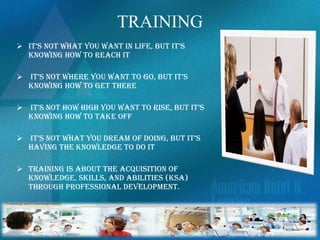
TRAINING It’s not what you want in life, but it’s knowing how to reach it It’s not where you want to go, but it’s knowing how to get there It’s not how high you want to rise, but it’s knowing how to take off It’s not what you dream of doing, but it’s having the knowledge to do it Training is about the acquisition of knowledge, skills, and abilities (KSA) through professional development.
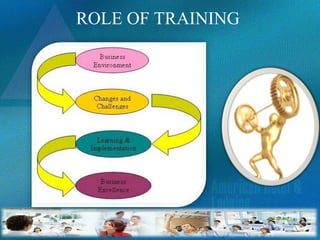
ROLE OF TRAINING
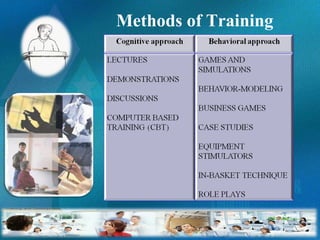
Methods of Training
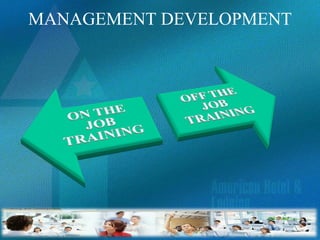
MANAGEMENT DEVELOPMENT
ON-THE-JOB TRAINING  (OJT) This method of training uses more knowledgeable, experienced and skilled employees, such as mangers, supervisors to give training to less knowledgeable, skilled, and experienced employees. This type of training often takes place at the work place in informal manner.  Characterized It is done on ad-hoc manner with no formal procedure, or content At the start of training, or during the training, no specific goals or objectives are developed Trainers usually have no formal qualification or training experience for training
Procedure of on-the-job training program The participant observes a more experienced, knowledgeable, and skilled trainer (employee)  The method, process, and techniques are well discussed before, during and after trainer has explained about performing the tasks When the trainee is prepared, the trainee starts performing on the work place The trainer provides continuing direction of work and feedback The trainee is given more and more work so that he accomplishes the job flawlessly
 
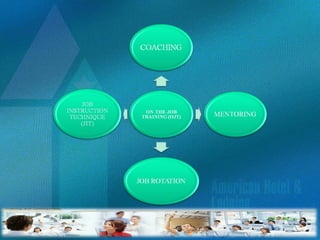
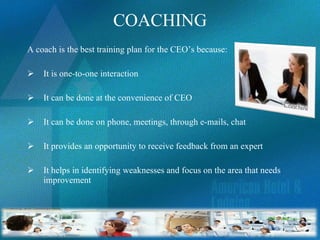
COACHING A coach is the best training plan for the CEO’s because: It is one-to-one interaction It can be done at the convenience of CEO It can be done on phone, meetings, through e-mails, chat It provides an opportunity to receive feedback from an expert It helps in identifying weaknesses and focus on the area that needs improvement
PROCEDURE OF THE COACHING Understand the participant’s job, the knowledge, skills, and attitudes, and resources required to meet the desired expectation Meet the participant and mutually agree on the objective that has to be achieved Mutually arrive at a plan and schedule At the job, show the participant how to achieve the objectives, observe the performance and then provide feedback Repeat step 4 until performance improves
MENTORING Mentoring focus on attitude development Conducted for management-level employees Mentoring is done by someone inside the company It is one-to-one interaction It helps in identifying weaknesses and focus on the area that needs improvement
JOB ROTATION It is the process of preparing employees at a lower level to replace someone at the next higher level.  Benefits of Job Rotation  It provides the employees with opportunities to broaden the horizon of knowledge, skills, and abilities by working in different departments, business units, functions, and countries Identification of Knowledge, skills, and attitudes (KSAs) required It determines the areas where improvement is required Assessment of the employees who have the potential and caliber for filling the position
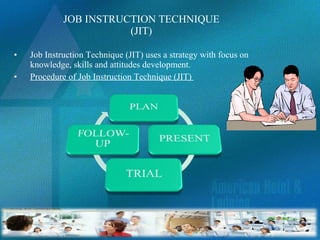
JOB INSTRUCTION TECHNIQUE (JIT) Job Instruction Technique (JIT) uses a strategy with focus on knowledge, skills and attitudes development. Procedure of Job Instruction Technique (JIT)
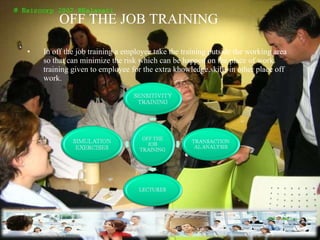
OFF THE JOB TRAINING In off the job training a employee take the training outside the working area so that can minimize the risk which can be happen on the place of work. training given to employee for the extra khowledge,skills in other place off work. 
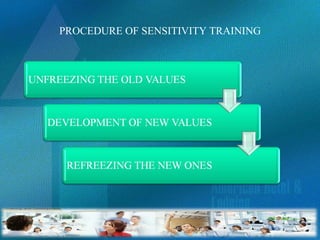
SENSITIVITY TRAINING Sensitivity training is about making people understand about themselves and others reasonably, which is done by developing in them social sensitivity and behavioral flexibility.  Social sensitivity in one word is empathy. It is ability of an individual to sense what others feel and think from their own point of view. Behavioral flexibility is ability to behave suitably in light of understanding .
PROCEDURE OF SENSITIVITY TRAINING
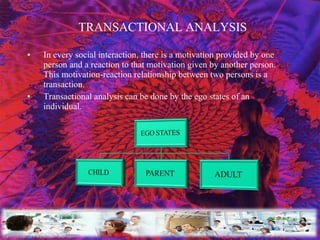
TRANSACTIONAL ANALYSIS In every social interaction, there is a motivation provided by one person and a reaction to that motivation given by another person. This motivation-reaction relationship between two persons is a transaction. Transactional analysis can be done by the ego states of an individual.
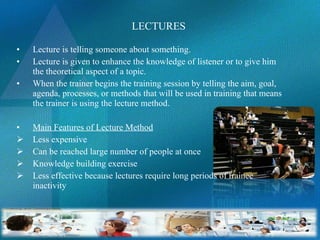
  LECTURES Lecture is telling someone about something. Lecture is given to enhance the knowledge of listener or to give him the theoretical aspect of a topic. When the trainer begins the training session by telling the aim, goal, agenda, processes, or methods that will be used in training that means the trainer is using the lecture method. Main Features of Lecture Method Less expensive Can be reached large number of people at once Knowledge building exercise Less effective because lectures require long periods of trainee inactivity
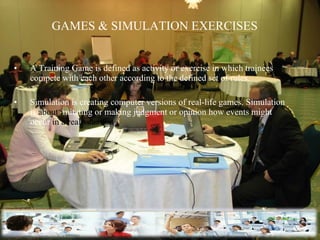
GAMES & SIMULATION EXERCISES A Training Game is defined as activity or exercise in which trainees compete with each other according to the defined set of rules. Simulation is creating computer versions of real-life games. Simulation is  about i mitating or making judgment or opinion how events might occur  in a real situation .
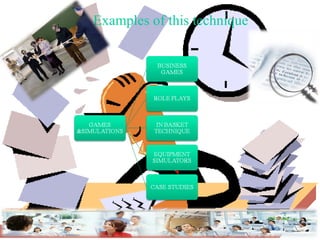
Examples of this technique
 

18188520 job-training-method

  • 1.
    ON THE JOB AND OFF THE JOB TRAINING
  • 2.
    TRAINING It’s notwhat you want in life, but it’s knowing how to reach it It’s not where you want to go, but it’s knowing how to get there It’s not how high you want to rise, but it’s knowing how to take off It’s not what you dream of doing, but it’s having the knowledge to do it Training is about the acquisition of knowledge, skills, and abilities (KSA) through professional development.
  • 3.
  • 4.
  • 5.
  • 6.
    ON-THE-JOB TRAINING (OJT) This method of training uses more knowledgeable, experienced and skilled employees, such as mangers, supervisors to give training to less knowledgeable, skilled, and experienced employees. This type of training often takes place at the work place in informal manner. Characterized It is done on ad-hoc manner with no formal procedure, or content At the start of training, or during the training, no specific goals or objectives are developed Trainers usually have no formal qualification or training experience for training
  • 7.
    Procedure of on-the-jobtraining program The participant observes a more experienced, knowledgeable, and skilled trainer (employee) The method, process, and techniques are well discussed before, during and after trainer has explained about performing the tasks When the trainee is prepared, the trainee starts performing on the work place The trainer provides continuing direction of work and feedback The trainee is given more and more work so that he accomplishes the job flawlessly
  • 8.
  • 9.
    COACHING A coachis the best training plan for the CEO’s because: It is one-to-one interaction It can be done at the convenience of CEO It can be done on phone, meetings, through e-mails, chat It provides an opportunity to receive feedback from an expert It helps in identifying weaknesses and focus on the area that needs improvement
  • 10.
    PROCEDURE OF THECOACHING Understand the participant’s job, the knowledge, skills, and attitudes, and resources required to meet the desired expectation Meet the participant and mutually agree on the objective that has to be achieved Mutually arrive at a plan and schedule At the job, show the participant how to achieve the objectives, observe the performance and then provide feedback Repeat step 4 until performance improves
  • 11.
    MENTORING Mentoring focuson attitude development Conducted for management-level employees Mentoring is done by someone inside the company It is one-to-one interaction It helps in identifying weaknesses and focus on the area that needs improvement
  • 12.
    JOB ROTATION Itis the process of preparing employees at a lower level to replace someone at the next higher level. Benefits of Job Rotation It provides the employees with opportunities to broaden the horizon of knowledge, skills, and abilities by working in different departments, business units, functions, and countries Identification of Knowledge, skills, and attitudes (KSAs) required It determines the areas where improvement is required Assessment of the employees who have the potential and caliber for filling the position
  • 13.
    JOB INSTRUCTION TECHNIQUE(JIT) Job Instruction Technique (JIT) uses a strategy with focus on knowledge, skills and attitudes development. Procedure of Job Instruction Technique (JIT)
  • 14.
    OFF THE JOBTRAINING In off the job training a employee take the training outside the working area so that can minimize the risk which can be happen on the place of work. training given to employee for the extra khowledge,skills in other place off work. 
  • 15.
    SENSITIVITY TRAINING Sensitivitytraining is about making people understand about themselves and others reasonably, which is done by developing in them social sensitivity and behavioral flexibility. Social sensitivity in one word is empathy. It is ability of an individual to sense what others feel and think from their own point of view. Behavioral flexibility is ability to behave suitably in light of understanding .
  • 16.
  • 17.
    TRANSACTIONAL ANALYSIS Inevery social interaction, there is a motivation provided by one person and a reaction to that motivation given by another person. This motivation-reaction relationship between two persons is a transaction. Transactional analysis can be done by the ego states of an individual.
  • 18.
    LECTURESLecture is telling someone about something. Lecture is given to enhance the knowledge of listener or to give him the theoretical aspect of a topic. When the trainer begins the training session by telling the aim, goal, agenda, processes, or methods that will be used in training that means the trainer is using the lecture method. Main Features of Lecture Method Less expensive Can be reached large number of people at once Knowledge building exercise Less effective because lectures require long periods of trainee inactivity
  • 19.
    GAMES & SIMULATIONEXERCISES A Training Game is defined as activity or exercise in which trainees compete with each other according to the defined set of rules. Simulation is creating computer versions of real-life games. Simulation is about i mitating or making judgment or opinion how events might occur in a real situation .
  • 20.
  • 21.