Observational Research 697 Qualitative Research February 20, 2008 By: Eddie Gose, Mark Hines, Lisa Waters
 
What is observational research? Observation of people in action Act of recording that which is being observed Roots in ethnographic research Goal is to help the researcher learn perspectives held by participants (Mack, et al., 2005) Used in conjunction with other methods (e.g. interviews, focus groups, content analysis)
Theory behind the method Need details
How do we go about it? Participative Covertly Overtly
Pros & Cons Pros Flexible Directly measures behavior Gives researcher “insider” view Allows for morphing of study Open-ended Cons Time consuming Difficult to record everything Subjective Participants may not act in true nature Hard to be an “insider”  Invasive & intrusive Not generalizable Can’t measure cognitive or affective
Forms of data collection Field notes Video Audio Transcripts Need more
Phases of observational research Phase 1: develop positive relationships with participants, gatekeeper, etc.  Phase 2: improve design, refocus, redefine questions after initial observations (may be ongoing) Phase 3: select additional participants as necessary Phase 4: follow up and probe deeper
Ethical Considerations How much do you disclose? Depends on type of research you are doing! Covert? Overt? Participative? Make your intentions clear to participants Get informed consent Develop a “code of practice” Maintain confidentiality
How to be an effective observer Know what you’re researching! Check in with your lens, biases, experiences and expectations -- have a blank mind  ( Goldbart, J. & Hustler, D., 2004, p. 18) Know the culture Rehearse how you’ll explain your purpose Document what you observe without expectations!  Summarize and expand on field notes as soon as possible Decide how you’ll observe  Be open to “research problem reformulation” (Goldbart, J. & Hustler, D., 2004, p. 18)
Tips for conduction observational research Find an “informant”  Field notes should include accounts of event, behaviors, reactions, conversations, physical gestures, etc.  Go where people are engaged in their daily lives (Mack, et al., 2005)
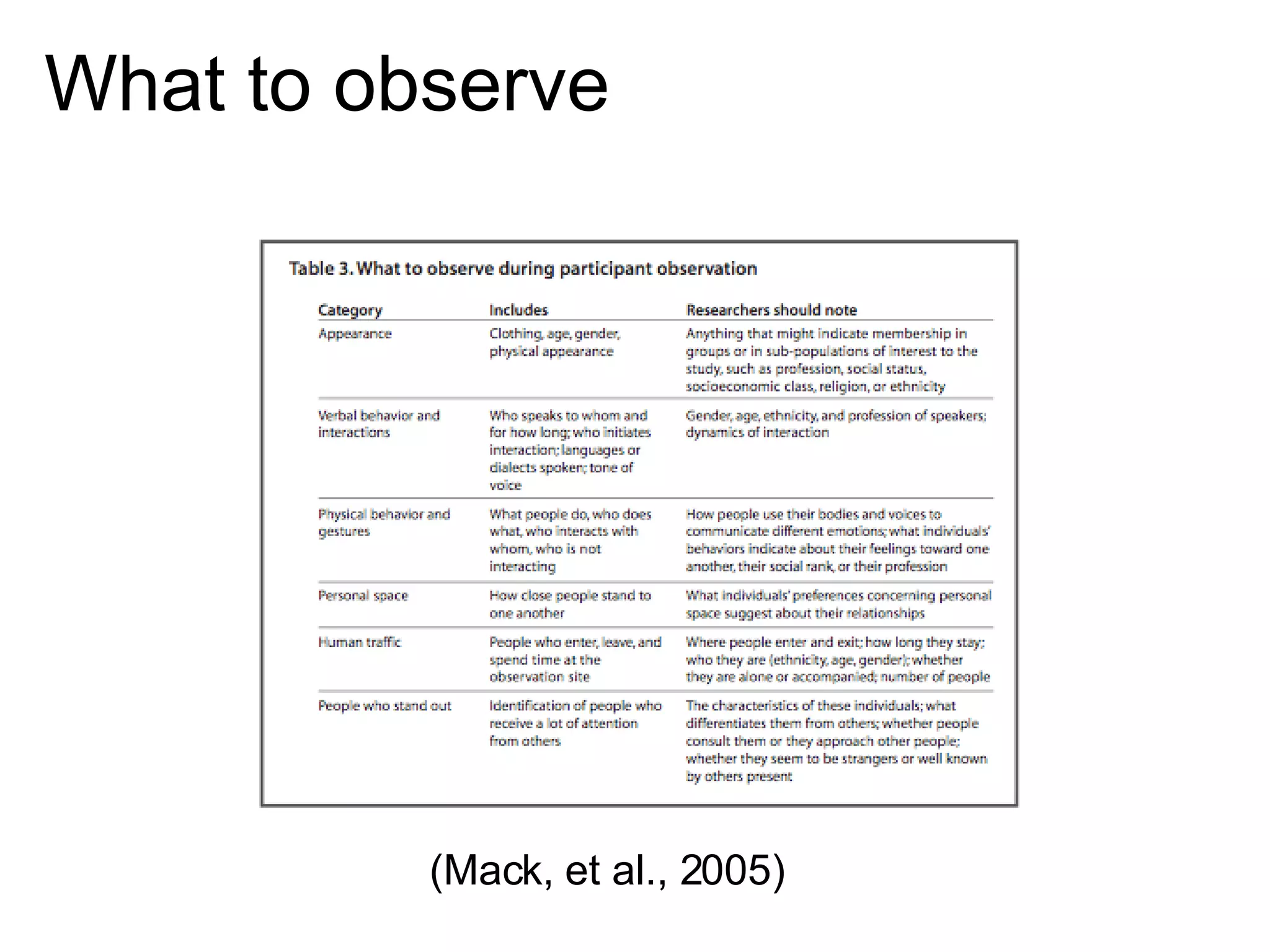
What to observe (Mack, et al., 2005)
On your mark, get set, observe! Add the other two videos here -- give them the same instructions as we did at beginning of the PPT -- only this time, they need to employ what they have learned.
 
Add the other video
What did you learn?
Rap up
References and Bibliography Mack, N., Woodsong, C., MacQueen, K.M., Guest, G., & Namey, E. (2005). Qualitative research methods:  A data collector’s field guide. Research Triangle Park, NC: Family Health International.

Observational Research (version 1)

  • 1.
    Observational Research 697Qualitative Research February 20, 2008 By: Eddie Gose, Mark Hines, Lisa Waters
  • 2.
  • 3.
    What is observationalresearch? Observation of people in action Act of recording that which is being observed Roots in ethnographic research Goal is to help the researcher learn perspectives held by participants (Mack, et al., 2005) Used in conjunction with other methods (e.g. interviews, focus groups, content analysis)
  • 4.
    Theory behind themethod Need details
  • 5.
    How do wego about it? Participative Covertly Overtly
  • 6.
    Pros & ConsPros Flexible Directly measures behavior Gives researcher “insider” view Allows for morphing of study Open-ended Cons Time consuming Difficult to record everything Subjective Participants may not act in true nature Hard to be an “insider” Invasive & intrusive Not generalizable Can’t measure cognitive or affective
  • 7.
    Forms of datacollection Field notes Video Audio Transcripts Need more
  • 8.
    Phases of observationalresearch Phase 1: develop positive relationships with participants, gatekeeper, etc. Phase 2: improve design, refocus, redefine questions after initial observations (may be ongoing) Phase 3: select additional participants as necessary Phase 4: follow up and probe deeper
  • 9.
    Ethical Considerations Howmuch do you disclose? Depends on type of research you are doing! Covert? Overt? Participative? Make your intentions clear to participants Get informed consent Develop a “code of practice” Maintain confidentiality
  • 10.
    How to bean effective observer Know what you’re researching! Check in with your lens, biases, experiences and expectations -- have a blank mind ( Goldbart, J. & Hustler, D., 2004, p. 18) Know the culture Rehearse how you’ll explain your purpose Document what you observe without expectations! Summarize and expand on field notes as soon as possible Decide how you’ll observe Be open to “research problem reformulation” (Goldbart, J. & Hustler, D., 2004, p. 18)
  • 11.
    Tips for conductionobservational research Find an “informant” Field notes should include accounts of event, behaviors, reactions, conversations, physical gestures, etc. Go where people are engaged in their daily lives (Mack, et al., 2005)
  • 12.
    What to observe(Mack, et al., 2005)
  • 13.
    On your mark,get set, observe! Add the other two videos here -- give them the same instructions as we did at beginning of the PPT -- only this time, they need to employ what they have learned.
  • 14.
  • 15.
  • 16.
  • 17.
  • 18.
    References and BibliographyMack, N., Woodsong, C., MacQueen, K.M., Guest, G., & Namey, E. (2005). Qualitative research methods: A data collector’s field guide. Research Triangle Park, NC: Family Health International.