The Planting of English America
1500 - 1733
Chapter 2
Protestant Reformation
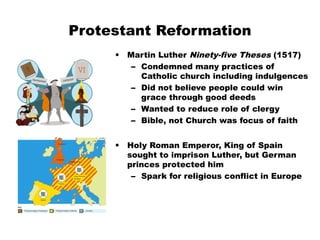
• Martin Luther Ninety-five Theses (1517)
– Condemned many practices of
Catholic church including indulgences
– Did not believe people could win
grace through good deeds
– Wanted to reduce role of clergy
– Bible, not Church was focus of faith
• Holy Roman Emperor, King of Spain
sought to imprison Luther, but German
princes protected him
– Spark for religious conflict in Europe
England’s Imperial Stirrings
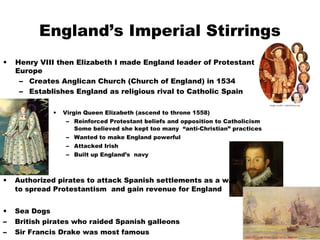
• Henry VIII then Elizabeth I made England leader of Protestant
Europe
– Creates Anglican Church (Church of England) in 1534
– Establishes England as religious rival to Catholic Spain
• Virgin Queen Elizabeth (ascend to throne 1558)
– Reinforced Protestant beliefs and opposition to Catholicism
Some believed she kept too many “anti-Christian” practices
– Wanted to make England powerful
– Attacked Irish
– Built up England’s navy
• Authorized pirates to attack Spanish settlements as a way
to spread Protestantism and gain revenue for England
• Sea Dogs
– British pirates who raided Spanish galleons
– Sir Francis Drake was most famous
First British Attempts at Colonization
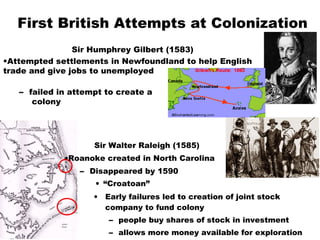
Sir Humphrey Gilbert (1583)
•Attempted settlements in Newfoundland to help English
trade and give jobs to unemployed
– failed in attempt to create a
colony
Sir Walter Raleigh (1585)
•Roanoke created in North Carolina
– Disappeared by 1590
• “Croatoan”
• Early failures led to creation of joint stock
company to fund colony
– people buy shares of stock in investment
– allows more money available for exploration
England Eclipses Spain
• Spanish Armada (1588)
– Philip II of Spain wanted to restore Catholicism to England
– Navies fought in English Channel
• “Protestant Wind” blows and scatters Spanish Navy
– British defeat Spanish Armada
– Led to decline of Spain and rise of Britain
• England becomes dominant North American power
• Dutch Independence (1566-1581)
– Britain supported revolt of Dutch against Spain
• Treaty of London (1604)
– Peace established between England and Spain
– Creates sense of optimism and confidence in England
• Spread Protestant Christianity, especially
Puritanism
• Price Revolution
• Inflation spurred by American gold and silver
• Support British navy and merchant marine
• Economic depression in late 1500s led to
homeless and unemployed to move
Reasons for Colonies
• Booming population
• Land enclosure movement
• Raw materials for British
industry
• Government supported industry
• Markets for British goods
• Little Ice Age (1350-1850)
– Coldest time 1620-1660 led to
crop failures, famine, social
unrest
mpshire, England
Richard Hakluyt (1584 -1600)
•Wrote books encouraging
exploration
•Argued for “planting”
settlements in New World
•Lobbied for approval of charter
for Virginia Company
Virginia Company of London
• Also known as London
Company
– King James I gave charter
in 1606 to create a colony
– Given land between modern
NJ and SC
– Settlers told to find gold or
lose funding
– Guaranteed same rights as
Englishmen
• Sent 3 ships to Virginia
– Susan Constant, Godspeed,
Discovery
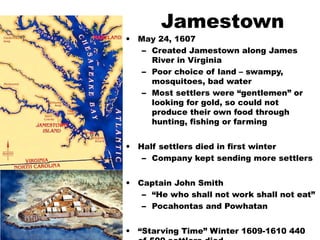
Jamestown
• May 24, 1607
– Created Jamestown along James
River in Virginia
– Poor choice of land – swampy,
mosquitoes, bad water
– Most settlers were “gentlemen” or
looking for gold, so could not
produce their own food through
hunting, fishing or farming
• Half settlers died in first winter
– Company kept sending more settlers
• Captain John Smith
– “He who shall not work shall not eat”
– Pocahontas and Powhatan
• “Starving Time” Winter 1609-1610 440
Conflict with Powhatan
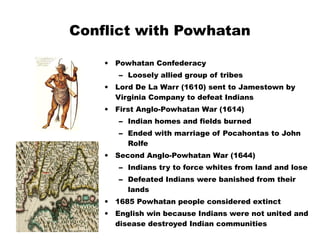
• Powhatan Confederacy
– Loosely allied group of tribes
• Lord De La Warr (1610) sent to Jamestown by
Virginia Company to defeat Indians
• First Anglo-Powhatan War (1614)
– Indian homes and fields burned
– Ended with marriage of Pocahontas to John
Rolfe
• Second Anglo-Powhatan War (1644)
– Indians try to force whites from land and lose
– Defeated Indians were banished from their
lands
• 1685 Powhatan people considered extinct
• English win because Indians were not united and
disease destroyed Indian communities
Indians New World
• Ways of life changed
– Horses created Indian migration and
offered new hunting opportunities
• Disease
– Destroyed entire cultures, sometimes
in advance of white settlement
– Eliminated elders and social stability
• Trade
– Barter system moved to commercial
trade
– Increased competition between tribes
for European goods, especially guns
• Algonquians
– United with other tribes to increase
power vis a vis Europeans
Tobacco
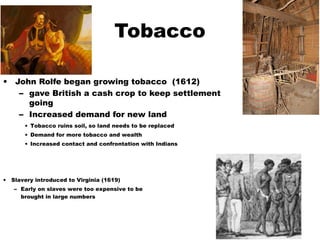
• John Rolfe began growing tobacco (1612)
– gave British a cash crop to keep settlement
going
– Increased demand for new land
• Tobacco ruins soil, so land needs to be replaced
• Demand for more tobacco and wealth
• Increased contact and confrontation with Indians
• Slavery introduced to Virginia (1619)
– Early on slaves were too expensive to be
brought in large numbers
House of Burgesses
• Colony established
– Company allowed more
relaxed rules to attract
settlers
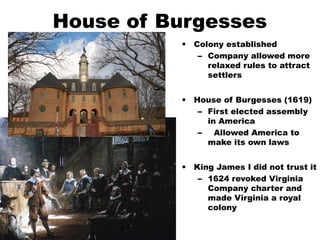
• House of Burgesses (1619)
– First elected assembly
in America
– Allowed America to
make its own laws
• King James I did not trust it
– 1624 revoked Virginia
Company charter and
made Virginia a royal
colony
Proprietorships
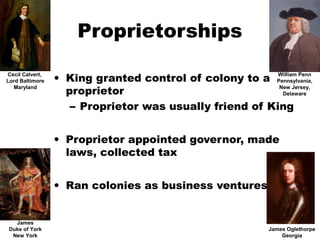
• King granted control of colony to a
proprietor
– Proprietor was usually friend of King
• Proprietor appointed governor, made
laws, collected tax
• Ran colonies as business ventures
Cecil Calvert,
Lord Baltimore
Maryland
James
Duke of York
New York
William Penn
Pennsylvania,
New Jersey,
Delaware
James Oglethorpe
Georgia
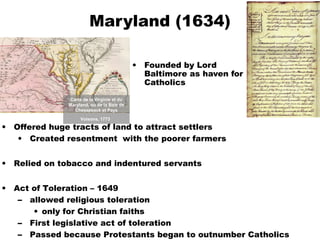
Maryland (1634)
• Founded by Lord
Baltimore as haven for
Catholics
Carte de la Virginie et du
Maryland, ou de la Baie de
Chesapeack et Pays
Voisons, 1773
• Offered huge tracts of land to attract settlers
• Created resentment with the poorer farmers
• Relied on tobacco and indentured servants
• Act of Toleration – 1649
– allowed religious toleration
• only for Christian faiths
– First legislative act of toleration
– Passed because Protestants began to outnumber Catholics
West Indies
• By mid 1700s Britain takes many
Caribbean islands from Dutch
• Sugar plantations required huge
estates, mills and investment of
capital
– Required large numbers of
slaves
– Blacks outnumber whites 4 to 1
– Britain create slave codes to
control population (1661
Barbados)
• Poor and small farmers from West Indies migrate to America for
opportunity (e.g. Alexander Hamilton)
– Bring slavery and slave codes
English Civil War 1642-1651
• Conflict between King and
Parliament in 1640s
• 1649 King Charles I beheaded,
Oliver Cromwell, Puritan, put in
charge of Parliament
– Reduces flow of Puritans leaving
England for New England
– Parliament did not focus on
what was happening in colonies
• 1660 Charles II asked to be King
• 1685 James II becomes King, but
angers people
Carolina
• Charles granted land to supporters in
1670
• Made wealth from trading food with
sugar plantations of Caribbean
– Also traded Indian slaves to West
Indies and New England
• Rice becomes major export
– Slaves from West Africa had the
expertise to allow growth of rice
• Charleston becomes busiest seaport
in South
– North was mostly discontented
Virginians, seen as independent
and rebellious
Georgia
• Founded by James Oglethorpe in
1733
– Savannah was principle port
• Created as place to send
criminals, drunk and idle poor
• Served as barrier to Spanish and
French settlements
• Allowed religious toleration for
Christians except Catholics
this map was published in 1733 in Benjamin Martyn's
"Reasons for Establishing the Colony of Georgia..."
• Mismanagement in Georgia
– Prohibited alcohol, ownership of land,
slavery
– Only allowed mulberry trees for silk –
didn’t work
– Did not allow self government
• Never succeeded.
Plantation Colonies
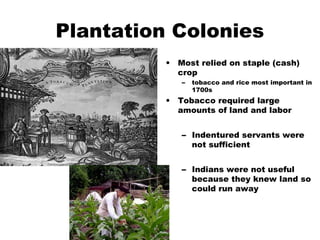
• Most relied on staple (cash)
crop
– tobacco and rice most important in
1700s
• Tobacco required large
amounts of land and labor
– Indentured servants were
not sufficient
– Indians were not useful
because they knew land so
could run away
Plantation Colonies
• Deep Rivers and peninsulas encouraged
water transport
– Reduced need for cities because trade
happened directly from plantation to
England
– South Carolina lacked deep rivers, and
Charleston develops
– Limited influence and development of
schools and churches
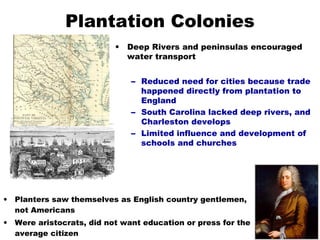
• Planters saw themselves as English country gentlemen,
not Americans
• Were aristocrats, did not want education or press for the
average citizen
Ocean Tied Some to England
• Planters saw themselves as
English country gentlemen, not
Americans
• South Carolina lacked
deep rivers
– Led to development
of Charleston as
large trading points

Chapter 2

  • 1.
    The Planting ofEnglish America 1500 - 1733 Chapter 2
  • 2.
    Protestant Reformation • MartinLuther Ninety-five Theses (1517) – Condemned many practices of Catholic church including indulgences – Did not believe people could win grace through good deeds – Wanted to reduce role of clergy – Bible, not Church was focus of faith • Holy Roman Emperor, King of Spain sought to imprison Luther, but German princes protected him – Spark for religious conflict in Europe
  • 3.
    England’s Imperial Stirrings •Henry VIII then Elizabeth I made England leader of Protestant Europe – Creates Anglican Church (Church of England) in 1534 – Establishes England as religious rival to Catholic Spain • Virgin Queen Elizabeth (ascend to throne 1558) – Reinforced Protestant beliefs and opposition to Catholicism Some believed she kept too many “anti-Christian” practices – Wanted to make England powerful – Attacked Irish – Built up England’s navy • Authorized pirates to attack Spanish settlements as a way to spread Protestantism and gain revenue for England • Sea Dogs – British pirates who raided Spanish galleons – Sir Francis Drake was most famous
  • 4.
    First British Attemptsat Colonization Sir Humphrey Gilbert (1583) •Attempted settlements in Newfoundland to help English trade and give jobs to unemployed – failed in attempt to create a colony Sir Walter Raleigh (1585) •Roanoke created in North Carolina – Disappeared by 1590 • “Croatoan” • Early failures led to creation of joint stock company to fund colony – people buy shares of stock in investment – allows more money available for exploration
  • 5.
    England Eclipses Spain •Spanish Armada (1588) – Philip II of Spain wanted to restore Catholicism to England – Navies fought in English Channel • “Protestant Wind” blows and scatters Spanish Navy – British defeat Spanish Armada – Led to decline of Spain and rise of Britain • England becomes dominant North American power • Dutch Independence (1566-1581) – Britain supported revolt of Dutch against Spain • Treaty of London (1604) – Peace established between England and Spain – Creates sense of optimism and confidence in England
  • 6.
    • Spread ProtestantChristianity, especially Puritanism • Price Revolution • Inflation spurred by American gold and silver • Support British navy and merchant marine • Economic depression in late 1500s led to homeless and unemployed to move Reasons for Colonies • Booming population • Land enclosure movement • Raw materials for British industry • Government supported industry • Markets for British goods • Little Ice Age (1350-1850) – Coldest time 1620-1660 led to crop failures, famine, social unrest mpshire, England Richard Hakluyt (1584 -1600) •Wrote books encouraging exploration •Argued for “planting” settlements in New World •Lobbied for approval of charter for Virginia Company
  • 7.
    Virginia Company ofLondon • Also known as London Company – King James I gave charter in 1606 to create a colony – Given land between modern NJ and SC – Settlers told to find gold or lose funding – Guaranteed same rights as Englishmen • Sent 3 ships to Virginia – Susan Constant, Godspeed, Discovery
  • 8.
    Jamestown • May 24,1607 – Created Jamestown along James River in Virginia – Poor choice of land – swampy, mosquitoes, bad water – Most settlers were “gentlemen” or looking for gold, so could not produce their own food through hunting, fishing or farming • Half settlers died in first winter – Company kept sending more settlers • Captain John Smith – “He who shall not work shall not eat” – Pocahontas and Powhatan • “Starving Time” Winter 1609-1610 440
  • 9.
    Conflict with Powhatan •Powhatan Confederacy – Loosely allied group of tribes • Lord De La Warr (1610) sent to Jamestown by Virginia Company to defeat Indians • First Anglo-Powhatan War (1614) – Indian homes and fields burned – Ended with marriage of Pocahontas to John Rolfe • Second Anglo-Powhatan War (1644) – Indians try to force whites from land and lose – Defeated Indians were banished from their lands • 1685 Powhatan people considered extinct • English win because Indians were not united and disease destroyed Indian communities
  • 10.
    Indians New World •Ways of life changed – Horses created Indian migration and offered new hunting opportunities • Disease – Destroyed entire cultures, sometimes in advance of white settlement – Eliminated elders and social stability • Trade – Barter system moved to commercial trade – Increased competition between tribes for European goods, especially guns • Algonquians – United with other tribes to increase power vis a vis Europeans
  • 11.
    Tobacco • John Rolfebegan growing tobacco (1612) – gave British a cash crop to keep settlement going – Increased demand for new land • Tobacco ruins soil, so land needs to be replaced • Demand for more tobacco and wealth • Increased contact and confrontation with Indians • Slavery introduced to Virginia (1619) – Early on slaves were too expensive to be brought in large numbers
  • 12.
    House of Burgesses •Colony established – Company allowed more relaxed rules to attract settlers • House of Burgesses (1619) – First elected assembly in America – Allowed America to make its own laws • King James I did not trust it – 1624 revoked Virginia Company charter and made Virginia a royal colony
  • 13.
    Proprietorships • King grantedcontrol of colony to a proprietor – Proprietor was usually friend of King • Proprietor appointed governor, made laws, collected tax • Ran colonies as business ventures Cecil Calvert, Lord Baltimore Maryland James Duke of York New York William Penn Pennsylvania, New Jersey, Delaware James Oglethorpe Georgia
  • 14.
    Maryland (1634) • Foundedby Lord Baltimore as haven for Catholics Carte de la Virginie et du Maryland, ou de la Baie de Chesapeack et Pays Voisons, 1773 • Offered huge tracts of land to attract settlers • Created resentment with the poorer farmers • Relied on tobacco and indentured servants • Act of Toleration – 1649 – allowed religious toleration • only for Christian faiths – First legislative act of toleration – Passed because Protestants began to outnumber Catholics
  • 15.
    West Indies • Bymid 1700s Britain takes many Caribbean islands from Dutch • Sugar plantations required huge estates, mills and investment of capital – Required large numbers of slaves – Blacks outnumber whites 4 to 1 – Britain create slave codes to control population (1661 Barbados) • Poor and small farmers from West Indies migrate to America for opportunity (e.g. Alexander Hamilton) – Bring slavery and slave codes
  • 16.
    English Civil War1642-1651 • Conflict between King and Parliament in 1640s • 1649 King Charles I beheaded, Oliver Cromwell, Puritan, put in charge of Parliament – Reduces flow of Puritans leaving England for New England – Parliament did not focus on what was happening in colonies • 1660 Charles II asked to be King • 1685 James II becomes King, but angers people
  • 17.
    Carolina • Charles grantedland to supporters in 1670 • Made wealth from trading food with sugar plantations of Caribbean – Also traded Indian slaves to West Indies and New England • Rice becomes major export – Slaves from West Africa had the expertise to allow growth of rice • Charleston becomes busiest seaport in South – North was mostly discontented Virginians, seen as independent and rebellious
  • 18.
    Georgia • Founded byJames Oglethorpe in 1733 – Savannah was principle port • Created as place to send criminals, drunk and idle poor • Served as barrier to Spanish and French settlements • Allowed religious toleration for Christians except Catholics this map was published in 1733 in Benjamin Martyn's "Reasons for Establishing the Colony of Georgia..." • Mismanagement in Georgia – Prohibited alcohol, ownership of land, slavery – Only allowed mulberry trees for silk – didn’t work – Did not allow self government • Never succeeded.
  • 19.
    Plantation Colonies • Mostrelied on staple (cash) crop – tobacco and rice most important in 1700s • Tobacco required large amounts of land and labor – Indentured servants were not sufficient – Indians were not useful because they knew land so could run away
  • 20.
    Plantation Colonies • DeepRivers and peninsulas encouraged water transport – Reduced need for cities because trade happened directly from plantation to England – South Carolina lacked deep rivers, and Charleston develops – Limited influence and development of schools and churches • Planters saw themselves as English country gentlemen, not Americans • Were aristocrats, did not want education or press for the average citizen
  • 21.
    Ocean Tied Someto England • Planters saw themselves as English country gentlemen, not Americans • South Carolina lacked deep rivers – Led to development of Charleston as large trading points

Editor's Notes

  • #7 British population was 3 million in 1500 and increased to 5 million by 1630 Price revolution also undermines traditional landed gentry of England because wealth was no longer determined by control of land. Price of rents were static because they were long term basis, but prices increased rapidly
  • #16 http://www.antiquemaps-fair.com/showimg.php?Img=images/large/i_109/11906.jpg&Title=17th%20century%20sea-chart%20of%20the%20West%20Indies