Chapter 5:
Europe Discovers the New World
Georgia History
Trinity Christian School
Mrs. Holland
The Age of Discovery
• European nations begin looking for their
own direct route to the Indies.
– The Indies was the source of silk, spices,
gems and tea
– Eliminate the “Middle Man” = increase profit
• Europe at first believed only Europe,
Africa, and Asia existed and set out to sail
west in order to reach the Far East.
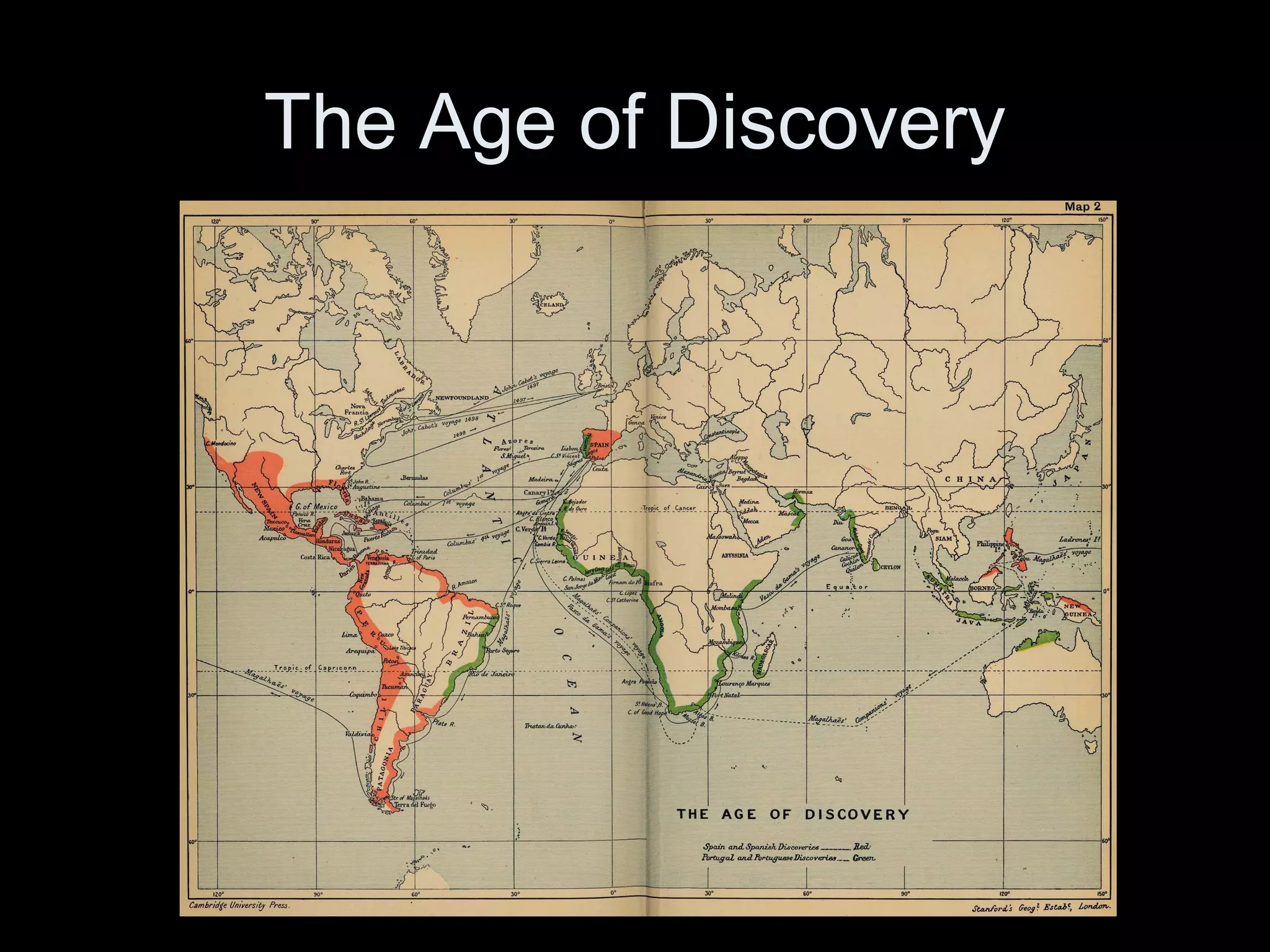
The Age of Discovery
1492:
Colombus Discovers the New World
• Niña, Pinta & Santa María
• Columbus was sure that he had found the
Indies
– No silk, spices or riches
– He named the native “Indians”
• Accompanied by Italian businessman
Amerigo Vespucci
– Named “America” in 1507 by a Swiss
mapmaker
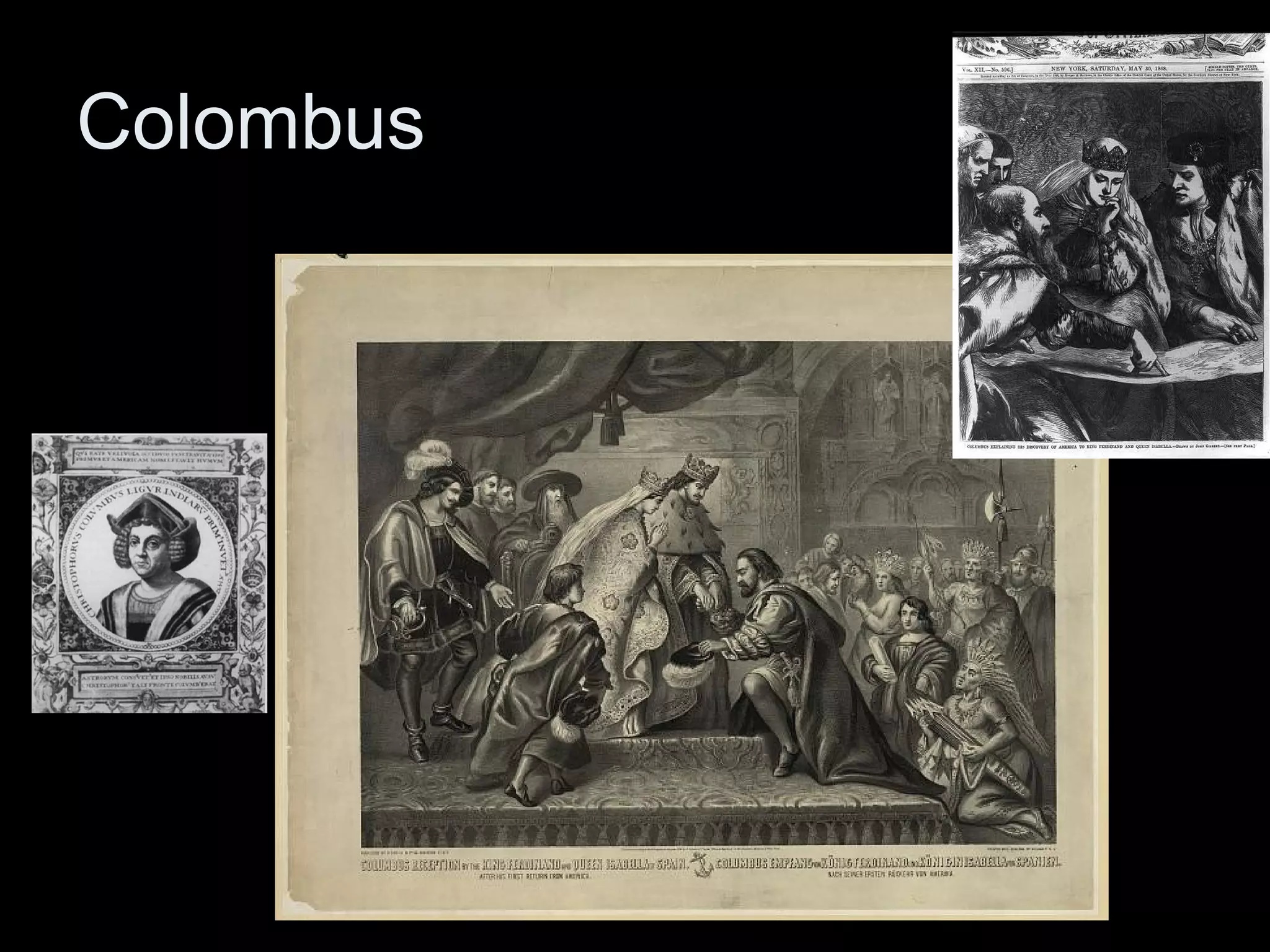
Colombus
Spain Claims the New World
• Spain vs. Portugal
– Portugal wanted an eastern route to the Far East
• Portugal also had shipping routes around Africa
– Spain (through Colombus) appeared to have found
an eastern route
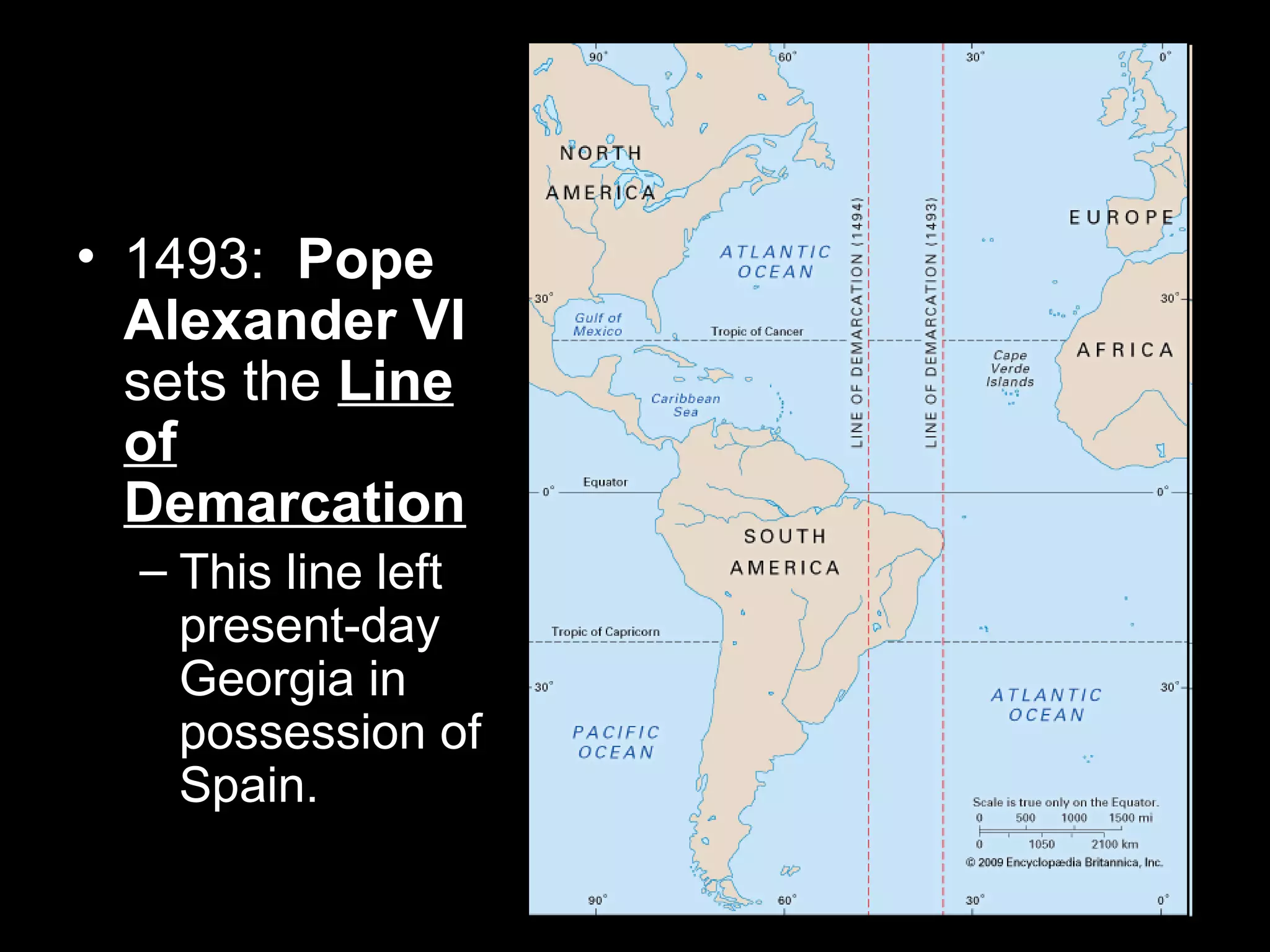
• 1493: Pope
Alexander VI
sets the Line
of
Demarcation
– This line left
present-day
Georgia in
possession of
Spain.
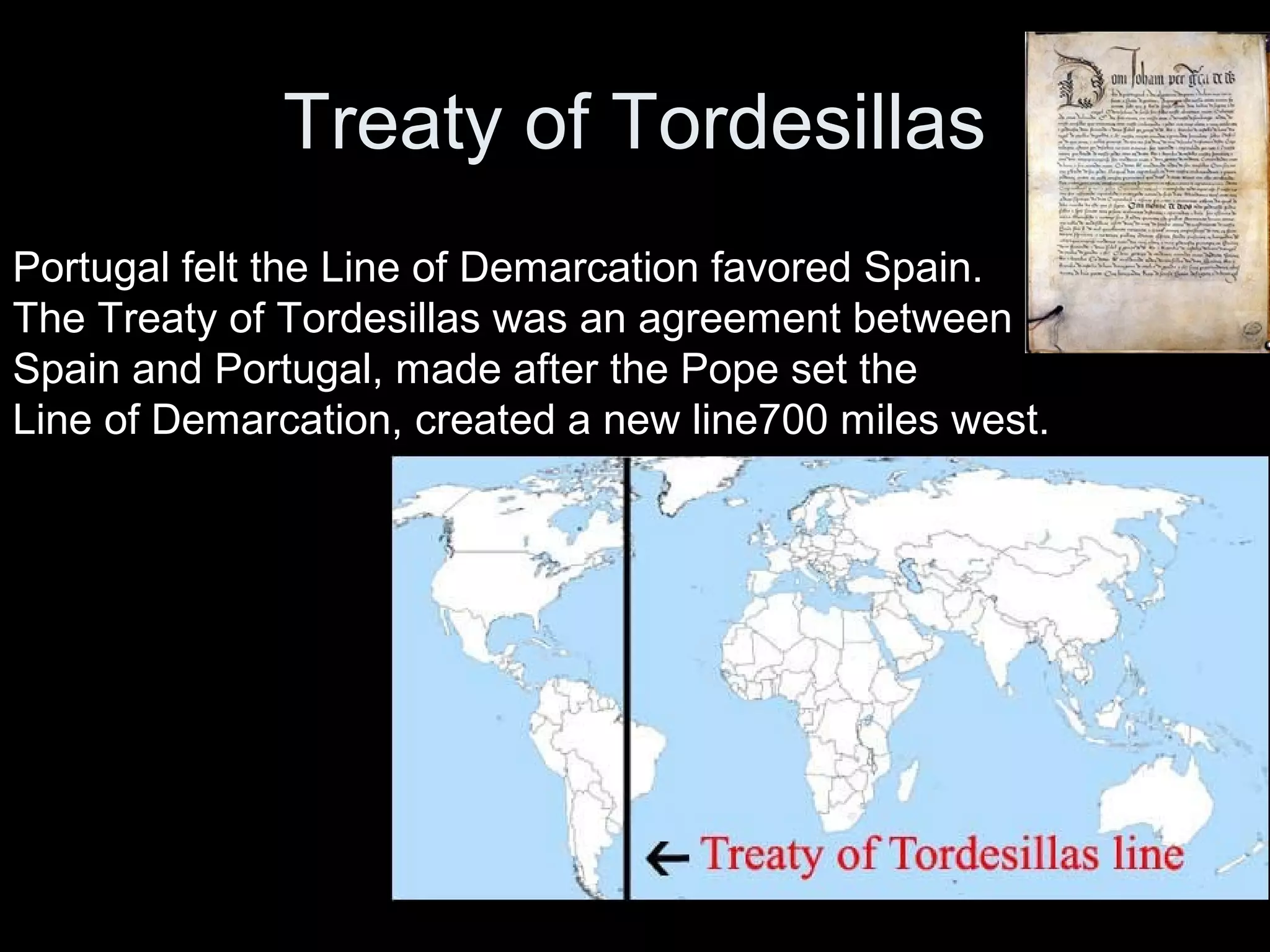
Treaty of Tordesillas
Portugal felt the Line of Demarcation favored Spain.
The Treaty of Tordesillas was an agreement between
Spain and Portugal, made after the Pope set the
Line of Demarcation, created a new line700 miles west.
English Claims in the New World
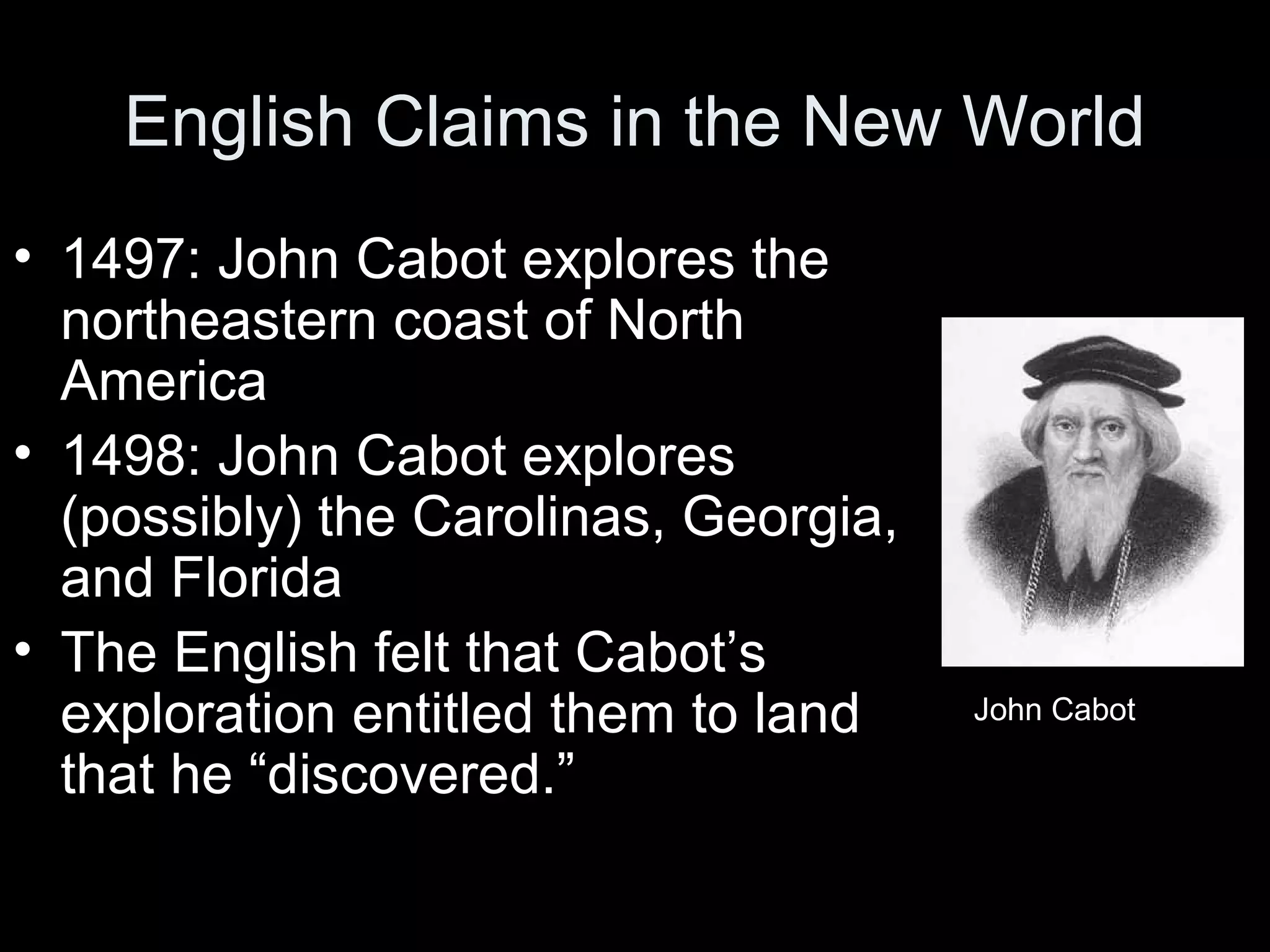
• 1497: John Cabot explores the
northeastern coast of North
America
• 1498: John Cabot explores
(possibly) the Carolinas, Georgia,
and Florida
• The English felt that Cabot’s
exploration entitled them to land
that he “discovered.”
John Cabot
England vs. Spain
• England ignored Pope Alexander VI’s Line
of Demarcation & the Treaty of Tordesillas
– Spain replies with the Rights of First
Discovery: A country could claim lands that its
explorers found first
– England claimed first discovery claims had to
be followed by occupation
• All powers agree that New World claims
did NOT require the permission of natives!
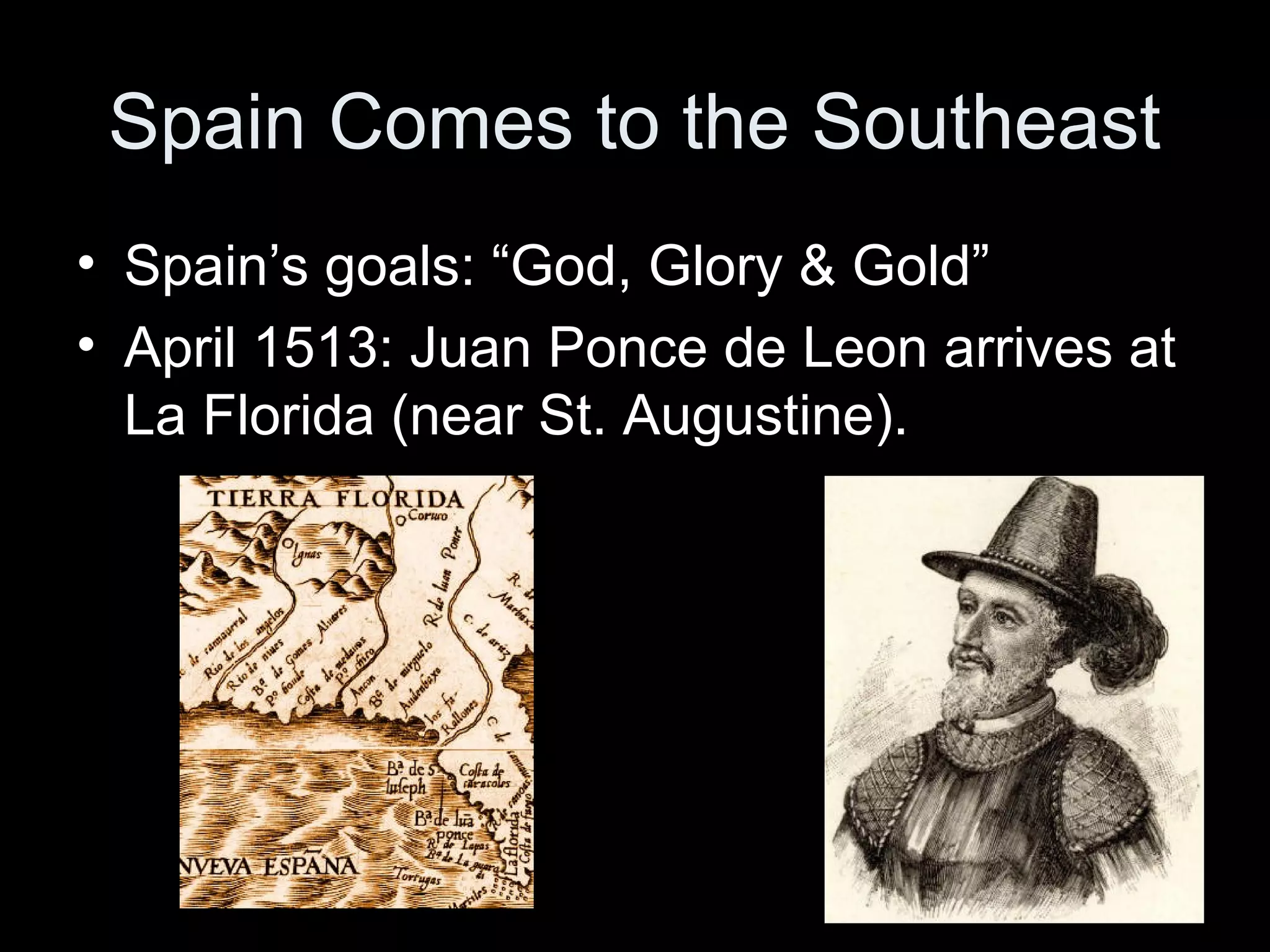
Spain Comes to the Southeast
• Spain’s goals: “God, Glory & Gold”
• April 1513: Juan Ponce de Leon arrives at
La Florida (near St. Augustine).
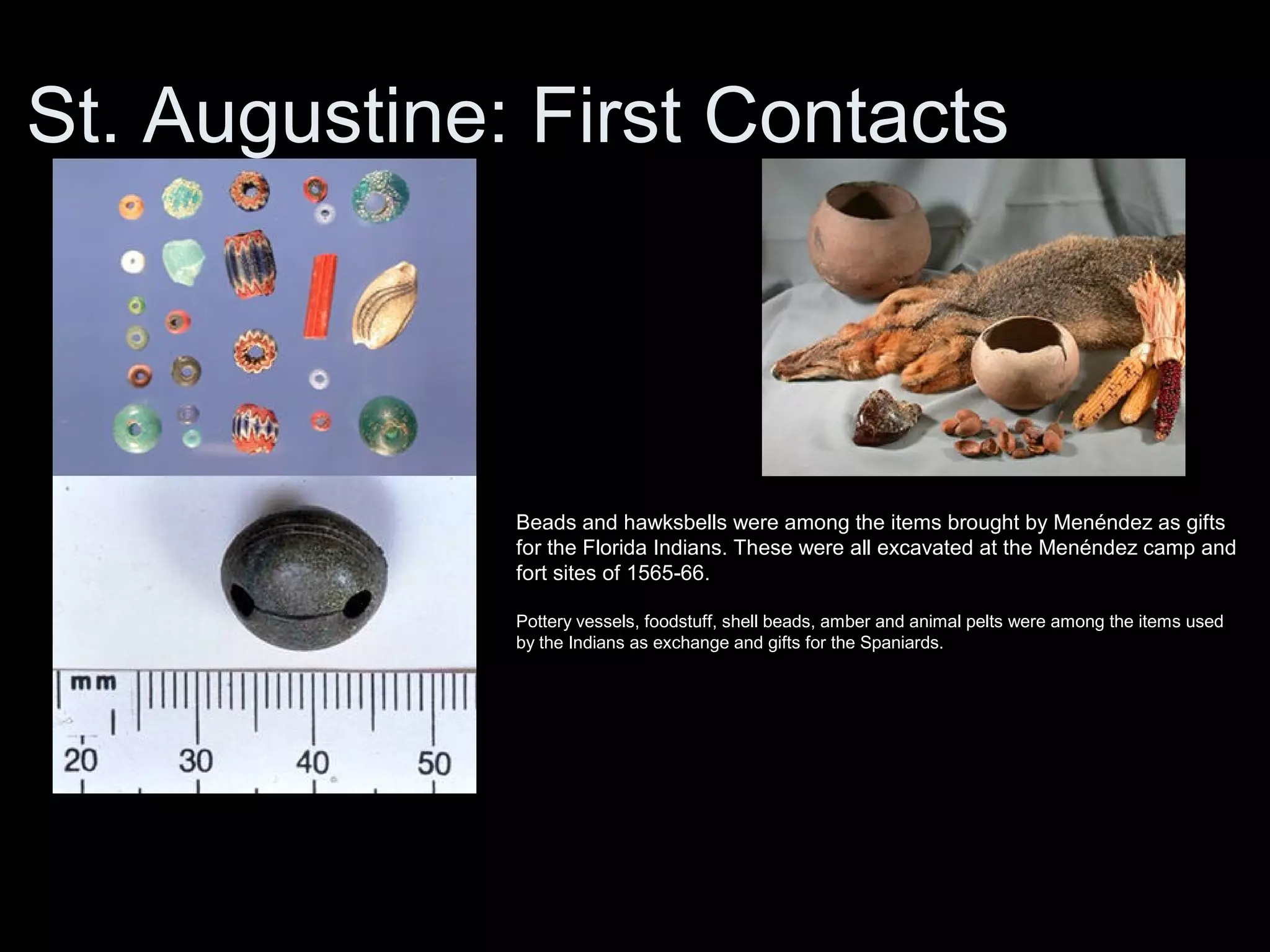
St. Augustine: First Contacts
Beads and hawksbells were among the items brought by Menéndez as gifts
for the Florida Indians. These were all excavated at the Menéndez camp and
fort sites of 1565-66.
Pottery vessels, foodstuff, shell beads, amber and animal pelts were among the items used
by the Indians as exchange and gifts for the Spaniards.
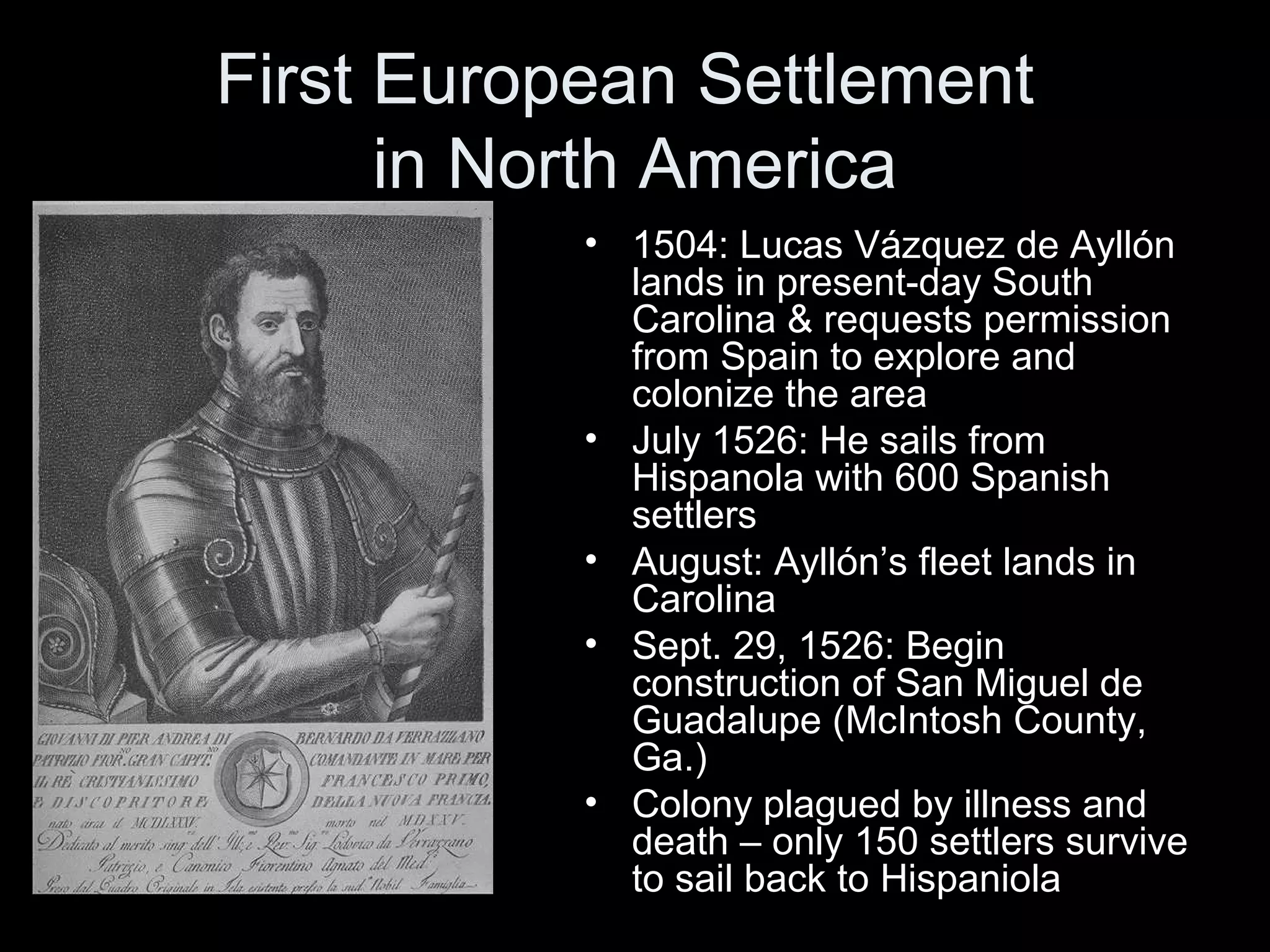
First European Settlement
in North America
• 1504: Lucas Vázquez de Ayllón
lands in present-day South
Carolina & requests permission
from Spain to explore and
colonize the area
• July 1526: He sails from
Hispanola with 600 Spanish
settlers
• August: Ayllón’s fleet lands in
Carolina
• Sept. 29, 1526: Begin
construction of San Miguel de
Guadalupe (McIntosh County,
Ga.)
• Colony plagued by illness and
death – only 150 settlers survive
to sail back to Hispaniola
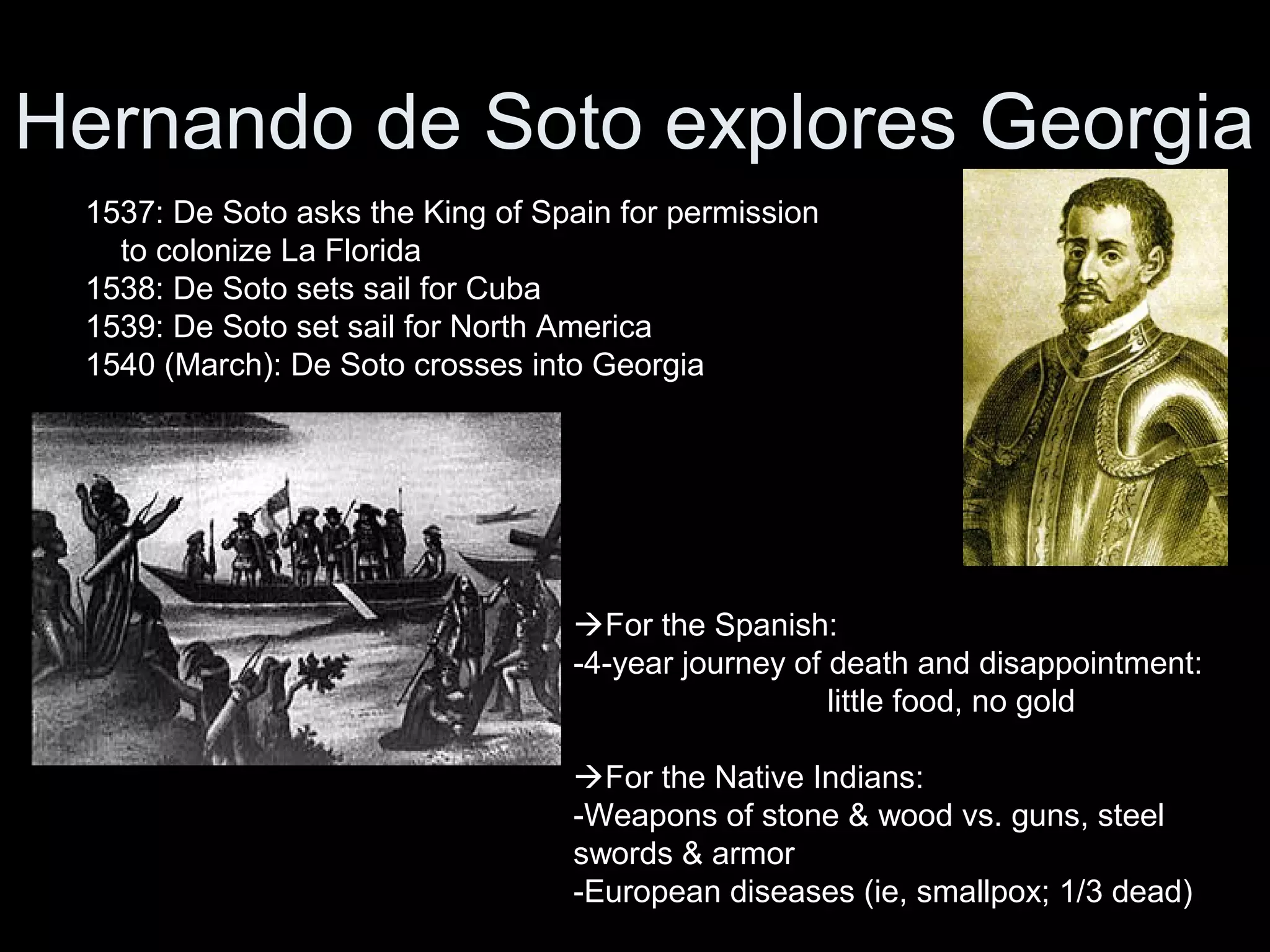
Hernando de Soto explores Georgia
1537: De Soto asks the King of Spain for permission
to colonize La Florida
1538: De Soto sets sail for Cuba
1539: De Soto set sail for North America
1540 (March): De Soto crosses into Georgia
For the Spanish:
-4-year journey of death and disappointment:
little food, no gold
For the Native Indians:
-Weapons of stone & wood vs. guns, steel
swords & armor
-European diseases (ie, smallpox; 1/3 dead)
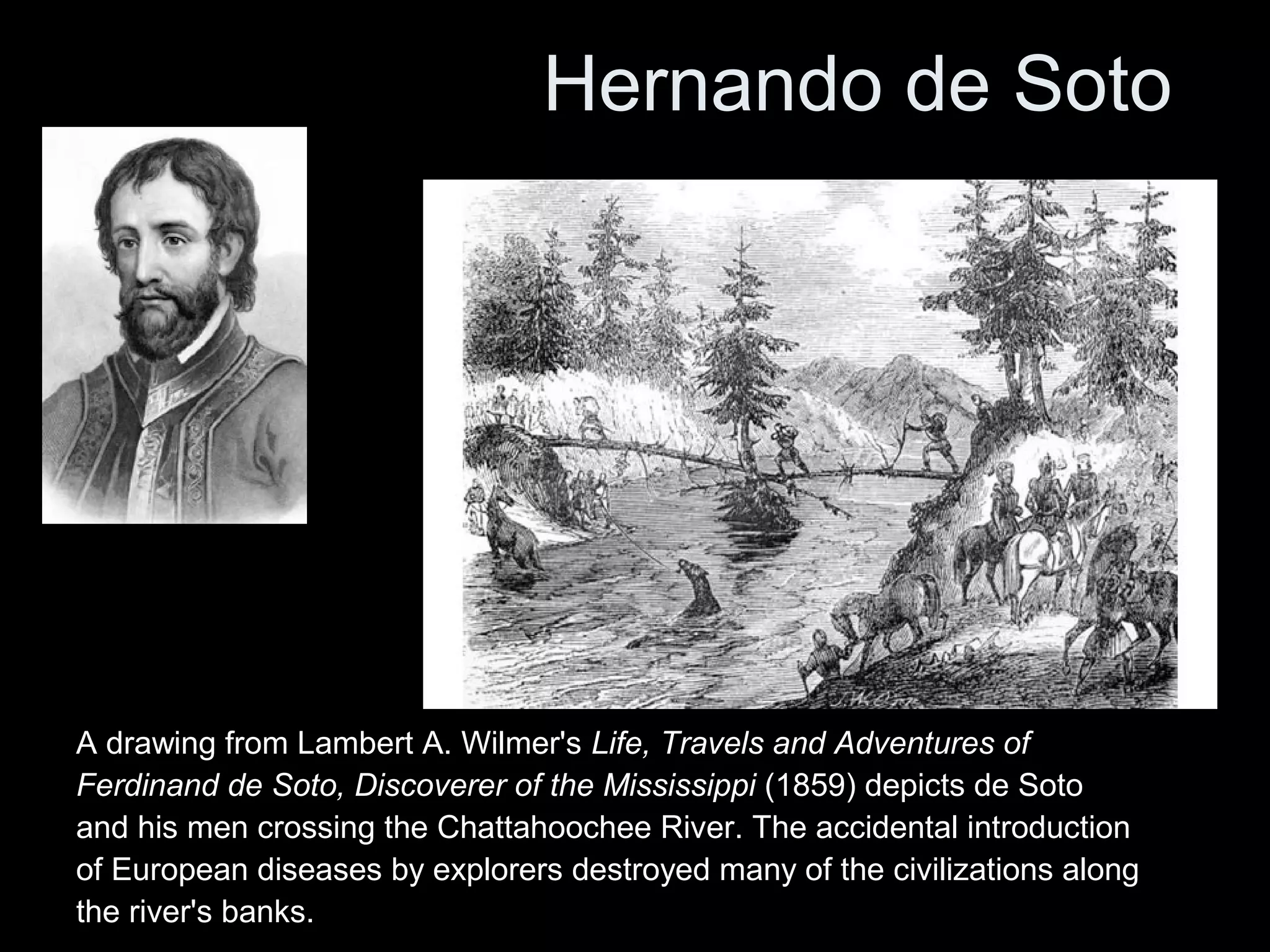
Hernando de Soto
A drawing from Lambert A. Wilmer's Life, Travels and Adventures of
Ferdinand de Soto, Discoverer of the Mississippi (1859) depicts de Soto
and his men crossing the Chattahoochee River. The accidental introduction
of European diseases by explorers destroyed many of the civilizations along
the river's banks.
French Claims in the Southeast
• 1524: Giovanni de Verrazano sailed
from France
– Basis for French claims to North America
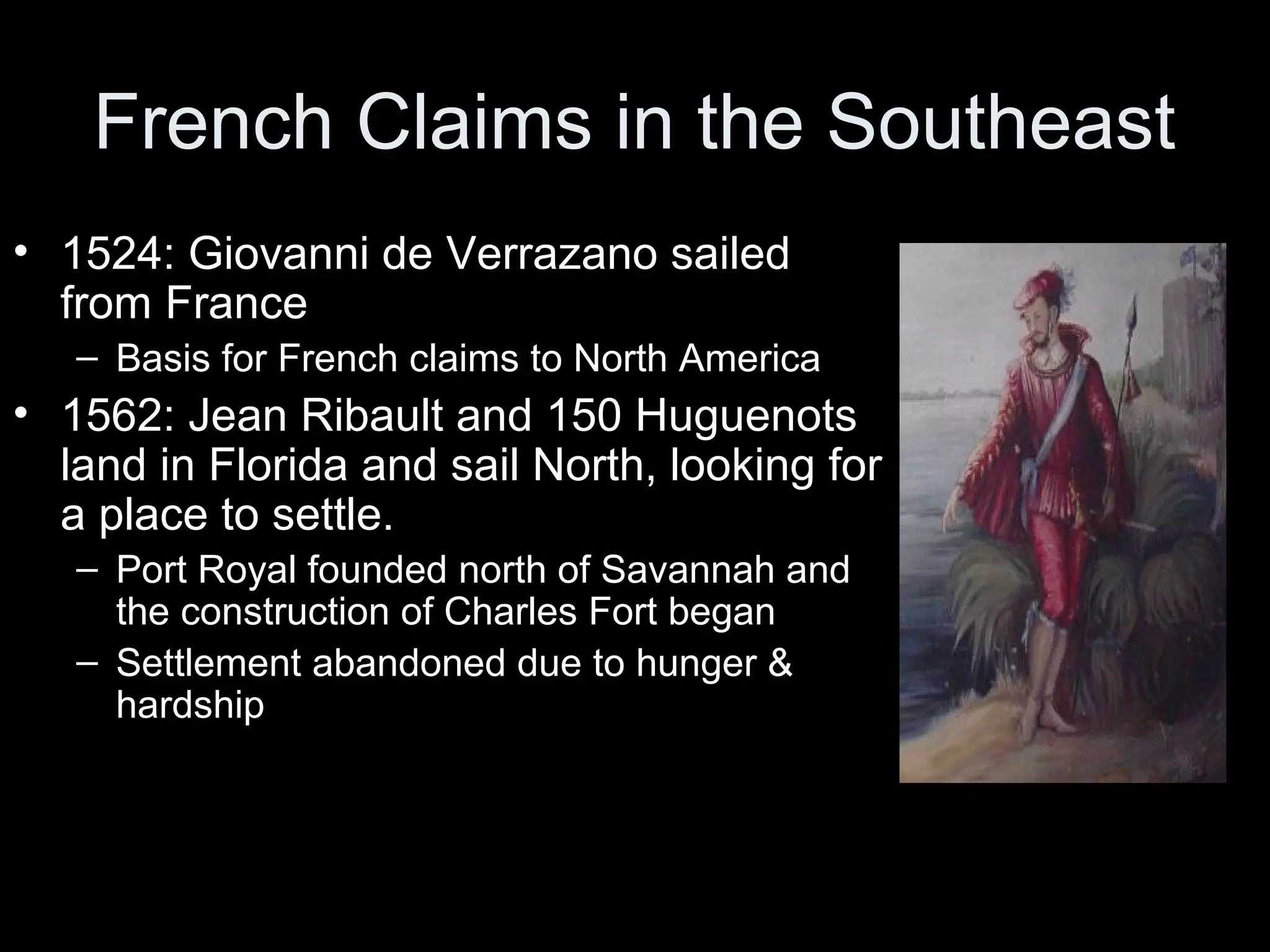
• 1562: Jean Ribault and 150 Huguenots
land in Florida and sail North, looking for
a place to settle.
– Port Royal founded north of Savannah and
the construction of Charles Fort began
– Settlement abandoned due to hunger &
hardship
French Claims, cont’d
• 1564: A 2nd
group of Huguenots arrive
in La Florida and build Fort Caroline
– Building on Spanish soil/ raiding Spanish
ships
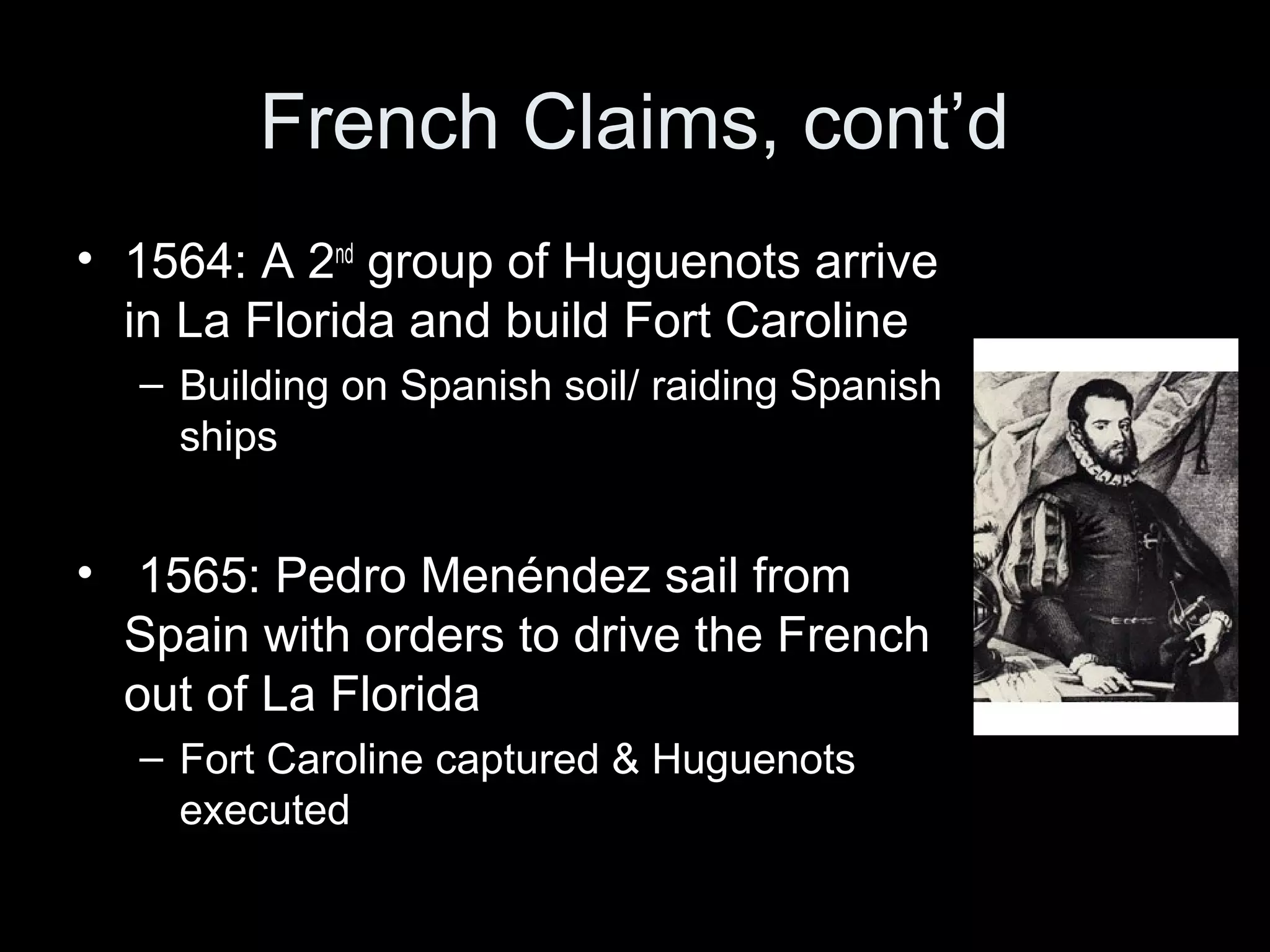
• 1565: Pedro Menéndez sail from
Spain with orders to drive the French
out of La Florida
– Fort Caroline captured & Huguenots
executed
Spanish Settlements in La Florida
• Menendez founded St. Augustine
– The Gulf Stream aided Spanish ships back to
the mother country (avoid pirates)
Spanish Missions in La Florida
• To convert the Indians to Christianity
(Catholicism) the Spanish built missions
(church outposts) with friars (missionaries)
– Usually built at the village of an important
local chief
– Social & Religious instruction
– Instruction in reading/writing, agriculture
– A place for trading
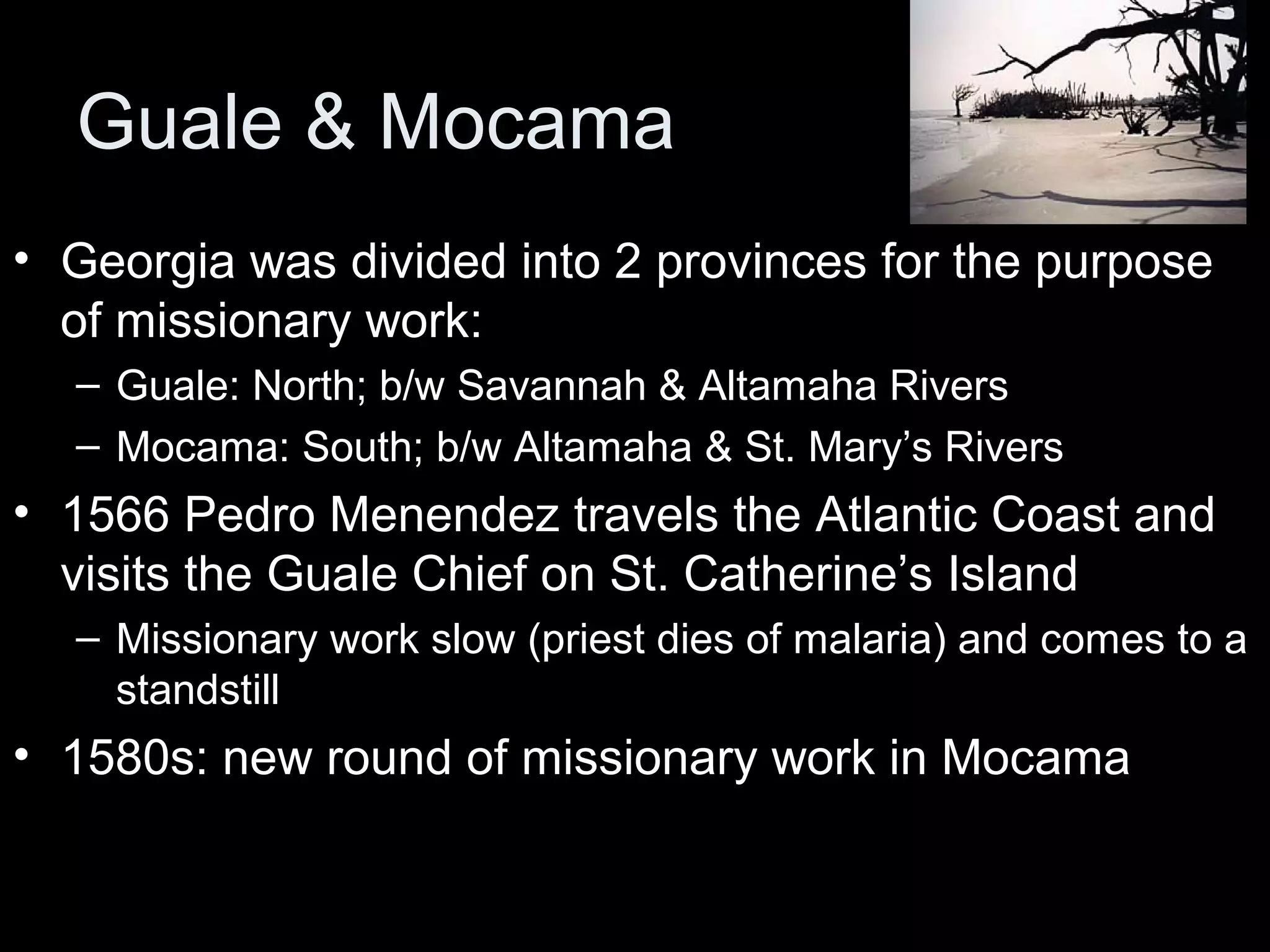
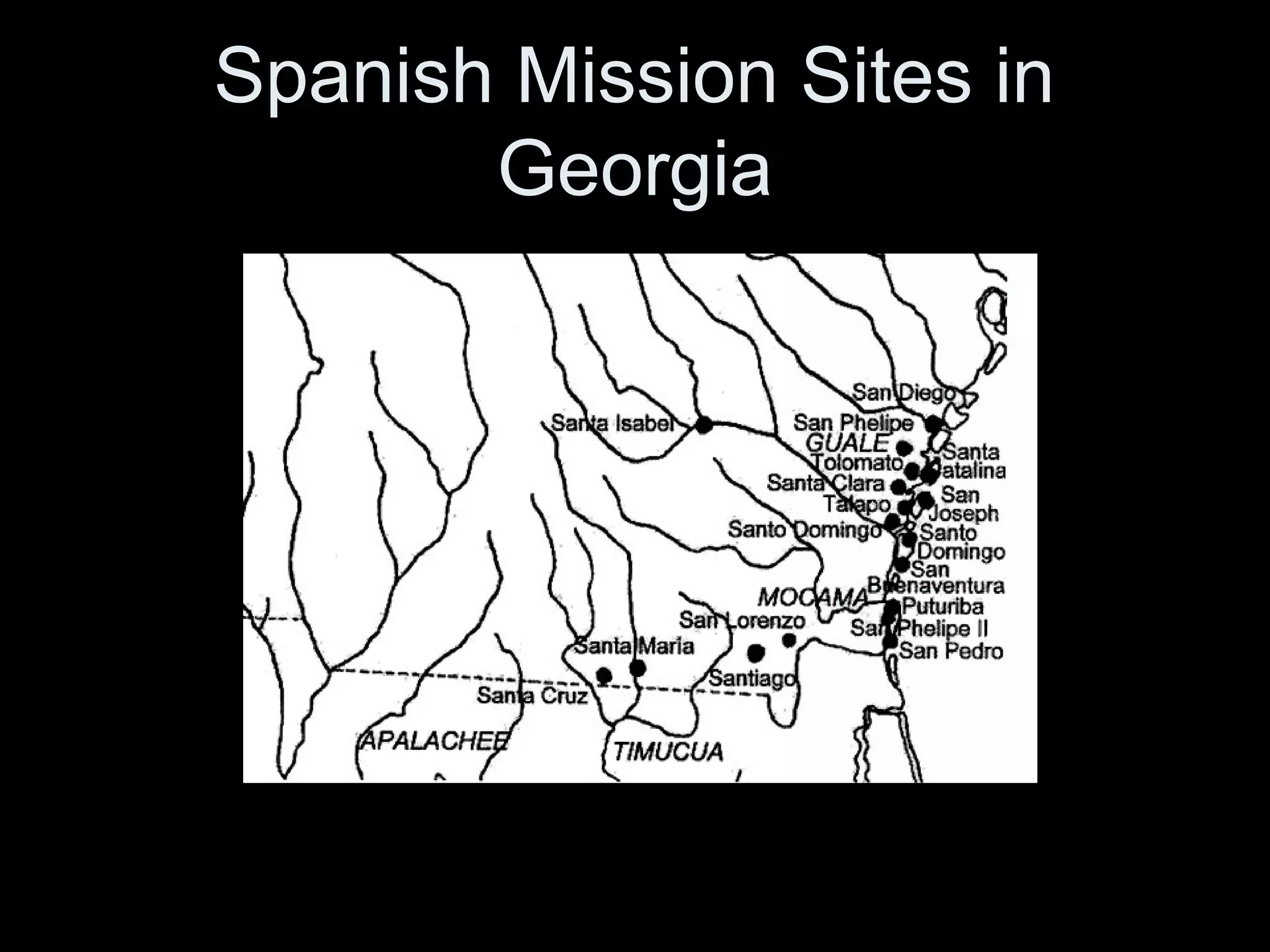
Guale & Mocama
• Georgia was divided into 2 provinces for the purpose
of missionary work:
– Guale: North; b/w Savannah & Altamaha Rivers
– Mocama: South; b/w Altamaha & St. Mary’s Rivers
• 1566 Pedro Menendez travels the Atlantic Coast and
visits the Guale Chief on St. Catherine’s Island
– Missionary work slow (priest dies of malaria) and comes to a
standstill
• 1580s: new round of missionary work in Mocama
Juanillo Rebellion
• 1597: Friars declare Don Juanillo unfit to
assume the Chiefdom of the Guale Indians.
– Juanillo calls for a revolt and missions begin to
fall
– The uprising was overturned by Mocama Indians
(who supported the Spanish) at Cumberland
Island.
– 5 missionaries were executed
Spanish Mission Sites in
Georgia
England Comes to North America
• 16th
Century: Spain is THE world superpower
– Spain refuses to share; England takes by force
• 1586: Sir Francis Drake burns St. Augustine
• 1604: Spain and England sign a peace treaty
• King James I develops the idea of chartered colonies,
and in 1606 issues a charter to the Virginia Company
• 1607: The Virginia Company sails from England with
Virginia’s first settlers and soon settle James Town.
Why did England want to colonize
North America?
• Power & glory
• Economic gain: mercantilism
• Belief that England was overpopulated
with poor, homeless, unemployed people
• A refuge for religious groups
– 1617: Separatists request permission to
immigrate to America
– 1619: Puritans set sail aboard the Mayflower
for America
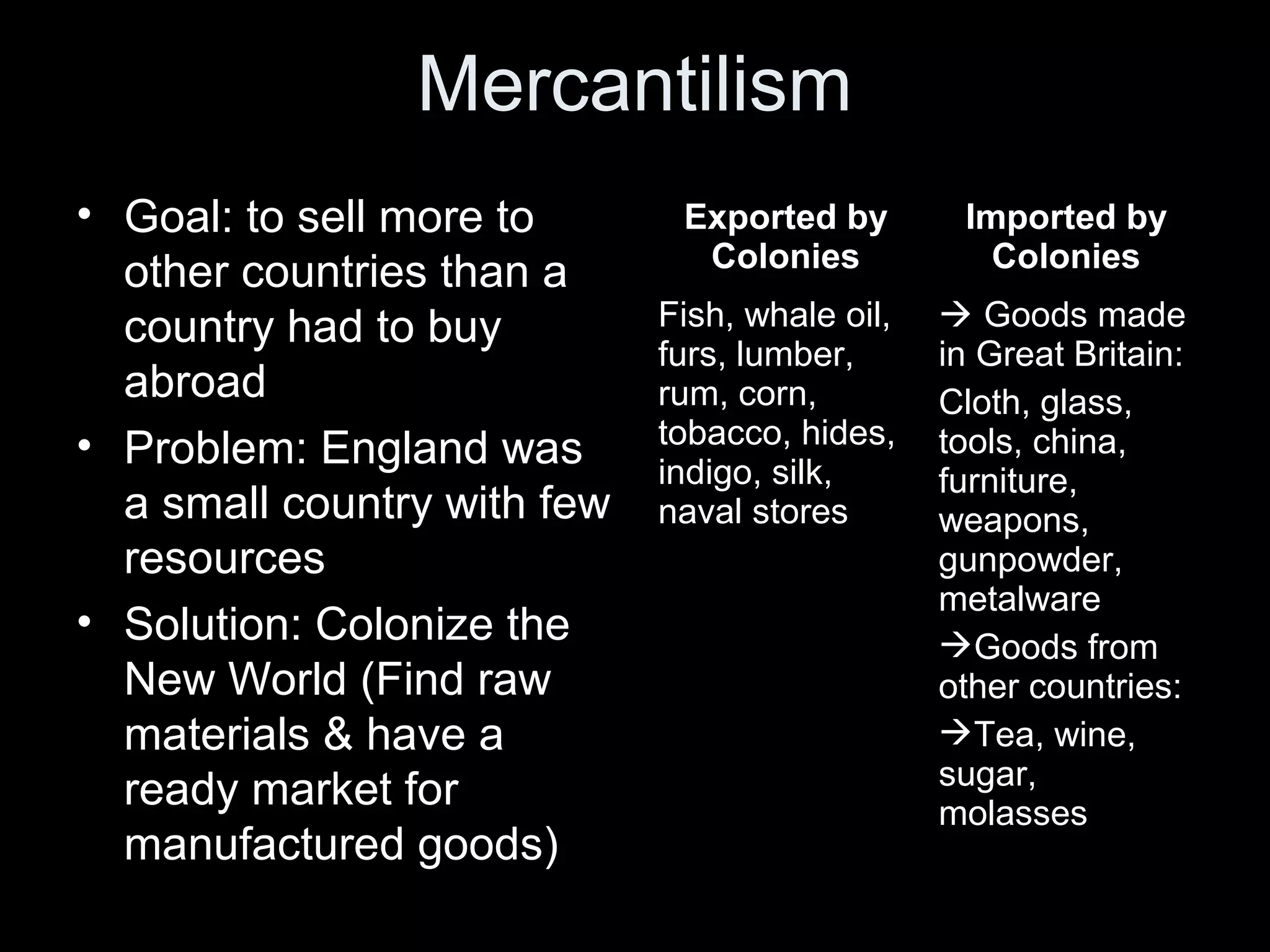
Mercantilism
• Goal: to sell more to
other countries than a
country had to buy
abroad
• Problem: England was
a small country with few
resources
• Solution: Colonize the
New World (Find raw
materials & have a
ready market for
manufactured goods)
Exported by
Colonies
Imported by
Colonies
Fish, whale oil,
furs, lumber,
rum, corn,
tobacco, hides,
indigo, silk,
naval stores
 Goods made
in Great Britain:
Cloth, glass,
tools, china,
furniture,
weapons,
gunpowder,
metalware
Goods from
other countries:
Tea, wine,
sugar,
molasses
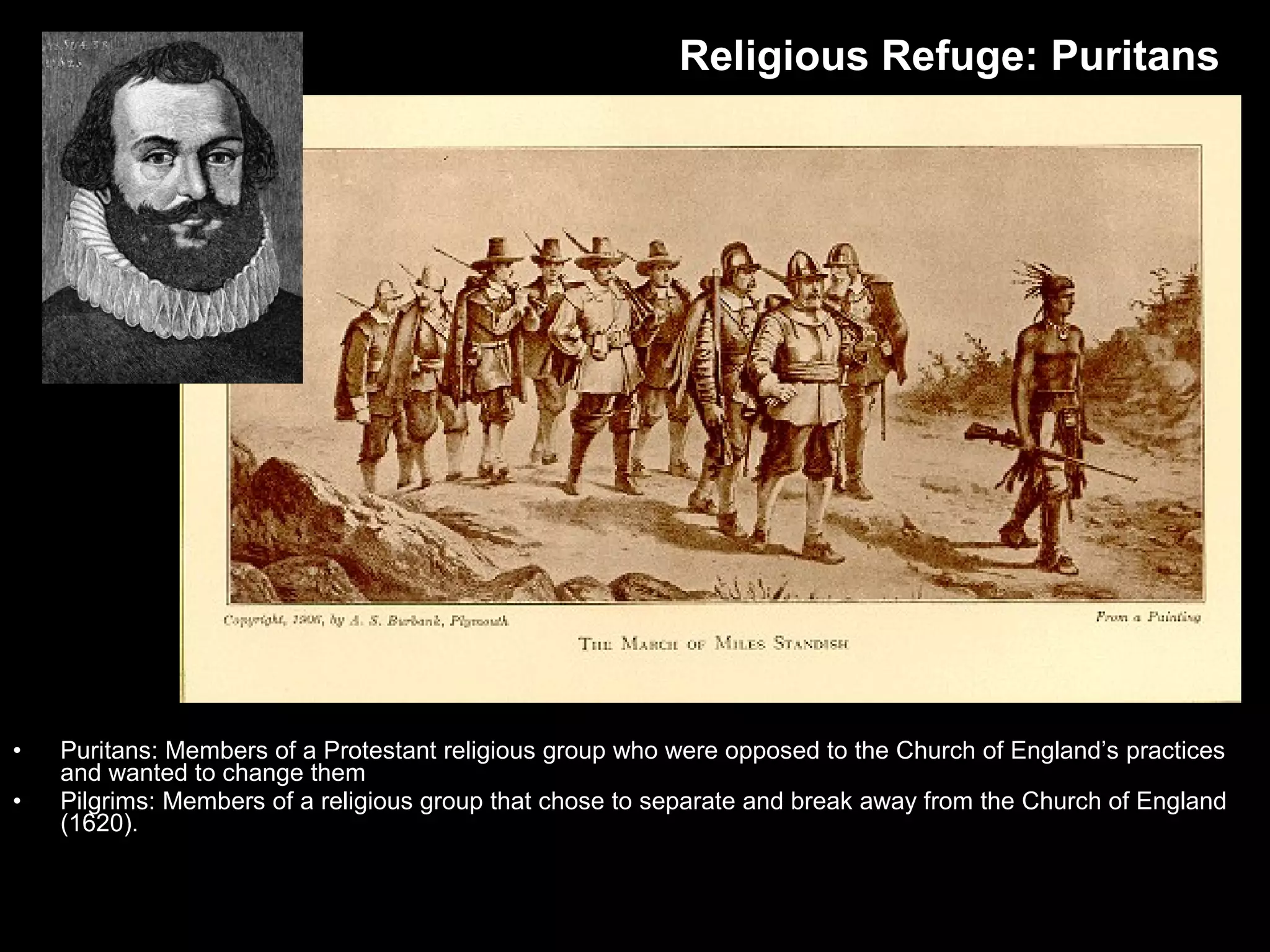
• Puritans: Members of a Protestant religious group who were opposed to the Church of England’s practices
and wanted to change them
• Pilgrims: Members of a religious group that chose to separate and break away from the Church of England
(1620).
Religious Refuge: Puritans
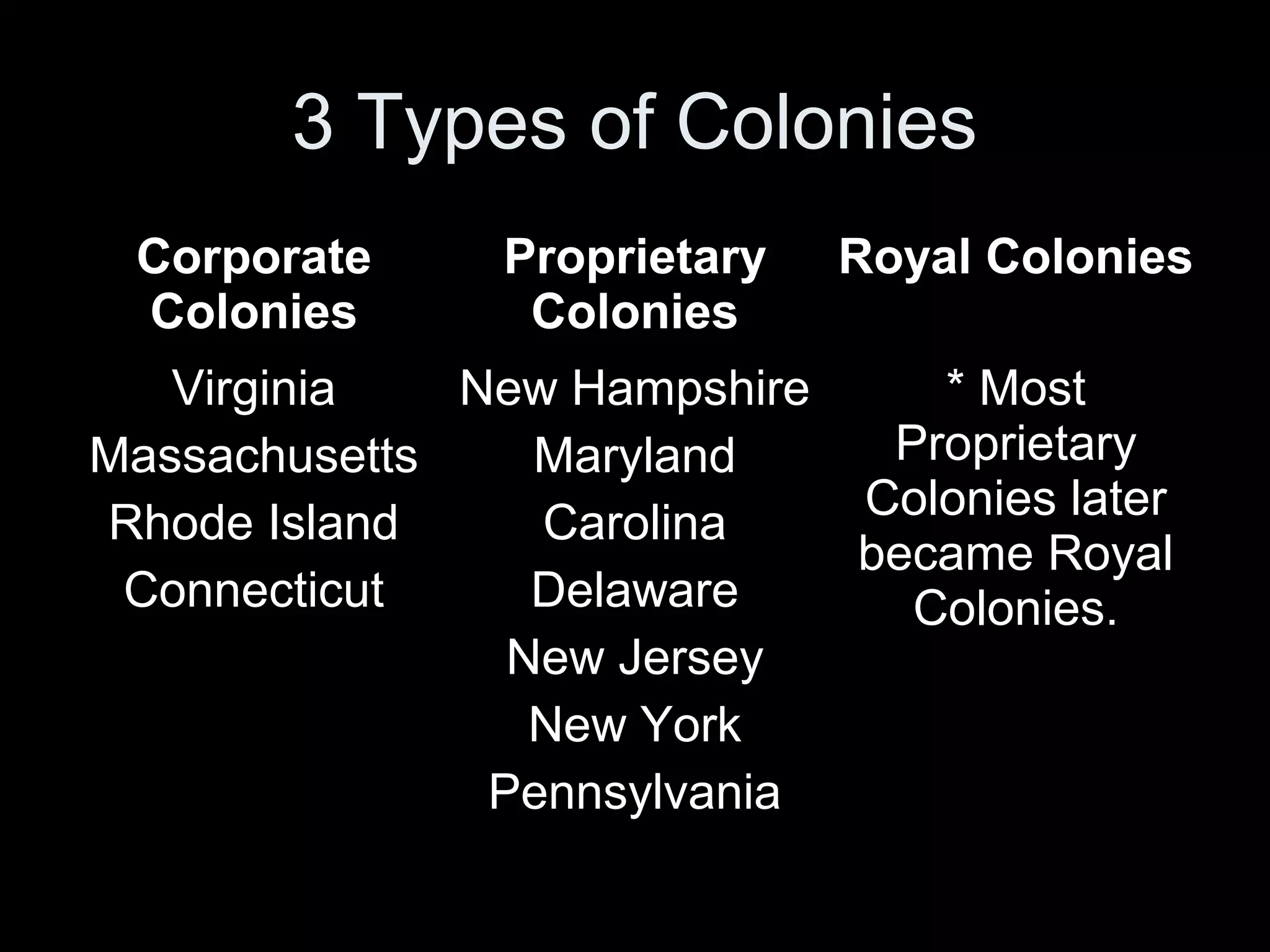
3 Types of Colonies
Corporate
Colonies
Proprietary
Colonies
Royal Colonies
Virginia
Massachusetts
Rhode Island
Connecticut
New Hampshire
Maryland
Carolina
Delaware
New Jersey
New York
Pennsylvania
* Most
Proprietary
Colonies later
became Royal
Colonies.
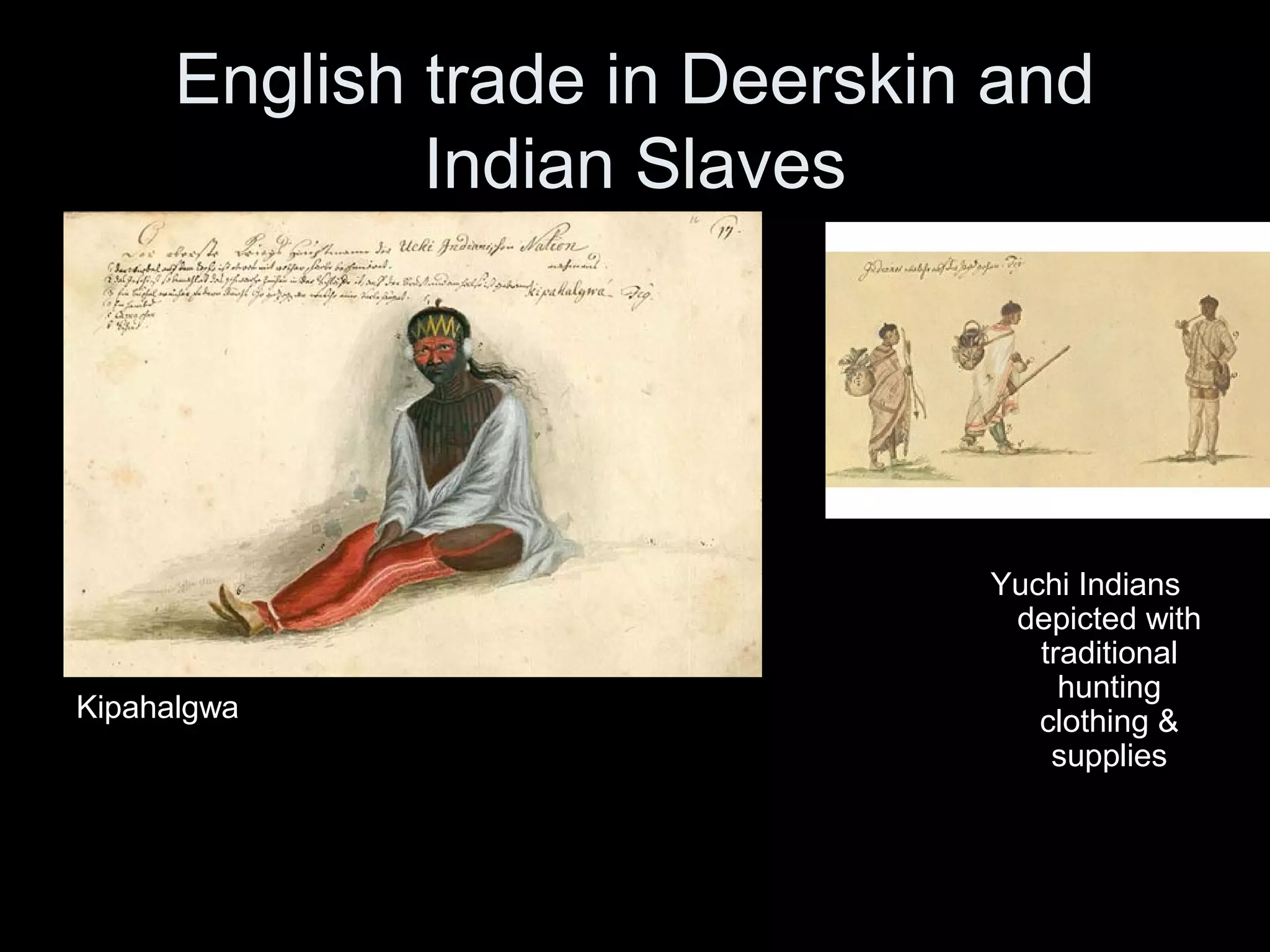
English trade in Deerskin and
Indian Slaves
Kipahalgwa
Yuchi Indians
depicted with
traditional
hunting
clothing &
supplies
England Creates Carolina
• 1663: King Charles II issues a charter for
Carolina
– English (firearms, tools, clothing) develop active
traders with Indians (deerskins, furs)
• 1670: Settlement of Charles Town angers
Spanish officials
• 1680: English officers lead a raid on the Spanish
mission Santa Catalina de Guale
– Spanish retreat; Entirely gone from Georgia by 1685.
Late 17th
Century Claims =
“The Debatable Land”
• Spain: Guale & Mocama
• France: St. Lawrence River to Great
Lakes and down the Mississippi River to
the Gulf of Mexico
• England: Carolina
– 1712: divided into a southern & northern
province
– 1715: Yamasee Indian Revolt
A New Colony South of the
Savannah River
• 1717: Sir Robert Montgomery proposes Azilia
– Goal: silk/wine production; buffer colony
– Unable to raise money or enlist colonists
• 1720: John Barnwell calls upon the British to build a
series of small forts S and W of Carolina
– 1721: construction begins on Fort King George
• 1724: Jean Pierre Purry (Swiss) proposes a colony, to
be named “Georgine” or “Georgia”
– Proposal fails, idea survives
• 1732: Oglethorpe convinces King George II to approve
the colony of Georgia!
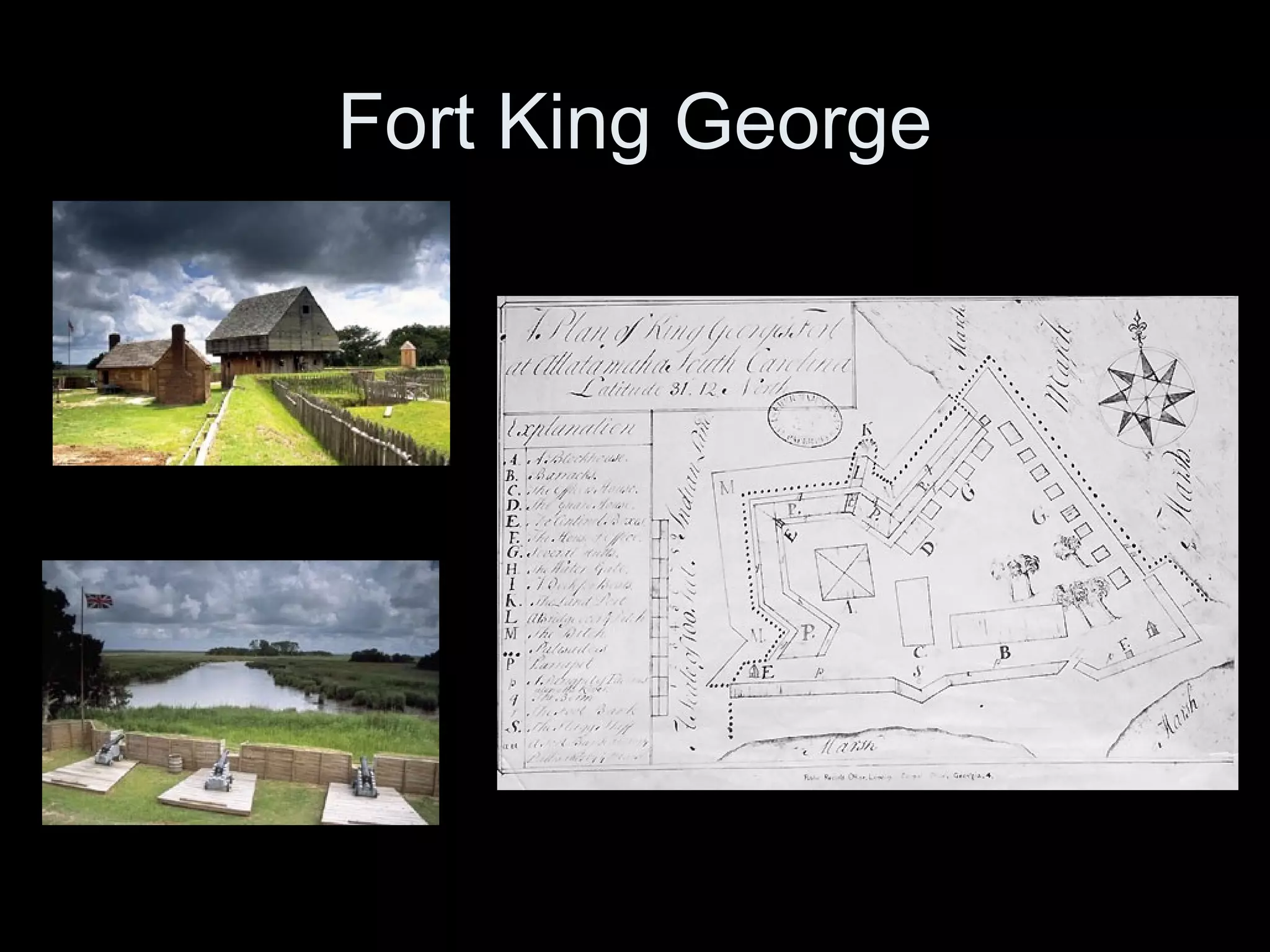
Fort King George

Chapter 5

  • 1.
    Chapter 5: Europe Discoversthe New World Georgia History Trinity Christian School Mrs. Holland
  • 2.
    The Age ofDiscovery • European nations begin looking for their own direct route to the Indies. – The Indies was the source of silk, spices, gems and tea – Eliminate the “Middle Man” = increase profit • Europe at first believed only Europe, Africa, and Asia existed and set out to sail west in order to reach the Far East.
  • 3.
    The Age ofDiscovery
  • 4.
    1492: Colombus Discovers theNew World • Niña, Pinta & Santa María • Columbus was sure that he had found the Indies – No silk, spices or riches – He named the native “Indians” • Accompanied by Italian businessman Amerigo Vespucci – Named “America” in 1507 by a Swiss mapmaker
  • 5.
  • 6.
    Spain Claims theNew World • Spain vs. Portugal – Portugal wanted an eastern route to the Far East • Portugal also had shipping routes around Africa – Spain (through Colombus) appeared to have found an eastern route
  • 7.
    • 1493: Pope AlexanderVI sets the Line of Demarcation – This line left present-day Georgia in possession of Spain.
  • 8.
    Treaty of Tordesillas Portugalfelt the Line of Demarcation favored Spain. The Treaty of Tordesillas was an agreement between Spain and Portugal, made after the Pope set the Line of Demarcation, created a new line700 miles west.
  • 9.
    English Claims inthe New World • 1497: John Cabot explores the northeastern coast of North America • 1498: John Cabot explores (possibly) the Carolinas, Georgia, and Florida • The English felt that Cabot’s exploration entitled them to land that he “discovered.” John Cabot
  • 10.
    England vs. Spain •England ignored Pope Alexander VI’s Line of Demarcation & the Treaty of Tordesillas – Spain replies with the Rights of First Discovery: A country could claim lands that its explorers found first – England claimed first discovery claims had to be followed by occupation • All powers agree that New World claims did NOT require the permission of natives!
  • 11.
    Spain Comes tothe Southeast • Spain’s goals: “God, Glory & Gold” • April 1513: Juan Ponce de Leon arrives at La Florida (near St. Augustine).
  • 12.
    St. Augustine: FirstContacts Beads and hawksbells were among the items brought by Menéndez as gifts for the Florida Indians. These were all excavated at the Menéndez camp and fort sites of 1565-66. Pottery vessels, foodstuff, shell beads, amber and animal pelts were among the items used by the Indians as exchange and gifts for the Spaniards.
  • 13.
    First European Settlement inNorth America • 1504: Lucas Vázquez de Ayllón lands in present-day South Carolina & requests permission from Spain to explore and colonize the area • July 1526: He sails from Hispanola with 600 Spanish settlers • August: Ayllón’s fleet lands in Carolina • Sept. 29, 1526: Begin construction of San Miguel de Guadalupe (McIntosh County, Ga.) • Colony plagued by illness and death – only 150 settlers survive to sail back to Hispaniola
  • 14.
    Hernando de Sotoexplores Georgia 1537: De Soto asks the King of Spain for permission to colonize La Florida 1538: De Soto sets sail for Cuba 1539: De Soto set sail for North America 1540 (March): De Soto crosses into Georgia For the Spanish: -4-year journey of death and disappointment: little food, no gold For the Native Indians: -Weapons of stone & wood vs. guns, steel swords & armor -European diseases (ie, smallpox; 1/3 dead)
  • 15.
    Hernando de Soto Adrawing from Lambert A. Wilmer's Life, Travels and Adventures of Ferdinand de Soto, Discoverer of the Mississippi (1859) depicts de Soto and his men crossing the Chattahoochee River. The accidental introduction of European diseases by explorers destroyed many of the civilizations along the river's banks.
  • 16.
    French Claims inthe Southeast • 1524: Giovanni de Verrazano sailed from France – Basis for French claims to North America • 1562: Jean Ribault and 150 Huguenots land in Florida and sail North, looking for a place to settle. – Port Royal founded north of Savannah and the construction of Charles Fort began – Settlement abandoned due to hunger & hardship
  • 17.
    French Claims, cont’d •1564: A 2nd group of Huguenots arrive in La Florida and build Fort Caroline – Building on Spanish soil/ raiding Spanish ships • 1565: Pedro Menéndez sail from Spain with orders to drive the French out of La Florida – Fort Caroline captured & Huguenots executed
  • 18.
    Spanish Settlements inLa Florida • Menendez founded St. Augustine – The Gulf Stream aided Spanish ships back to the mother country (avoid pirates)
  • 19.
    Spanish Missions inLa Florida • To convert the Indians to Christianity (Catholicism) the Spanish built missions (church outposts) with friars (missionaries) – Usually built at the village of an important local chief – Social & Religious instruction – Instruction in reading/writing, agriculture – A place for trading
  • 20.
    Guale & Mocama •Georgia was divided into 2 provinces for the purpose of missionary work: – Guale: North; b/w Savannah & Altamaha Rivers – Mocama: South; b/w Altamaha & St. Mary’s Rivers • 1566 Pedro Menendez travels the Atlantic Coast and visits the Guale Chief on St. Catherine’s Island – Missionary work slow (priest dies of malaria) and comes to a standstill • 1580s: new round of missionary work in Mocama
  • 21.
    Juanillo Rebellion • 1597:Friars declare Don Juanillo unfit to assume the Chiefdom of the Guale Indians. – Juanillo calls for a revolt and missions begin to fall – The uprising was overturned by Mocama Indians (who supported the Spanish) at Cumberland Island. – 5 missionaries were executed
  • 22.
  • 23.
    England Comes toNorth America • 16th Century: Spain is THE world superpower – Spain refuses to share; England takes by force • 1586: Sir Francis Drake burns St. Augustine • 1604: Spain and England sign a peace treaty • King James I develops the idea of chartered colonies, and in 1606 issues a charter to the Virginia Company • 1607: The Virginia Company sails from England with Virginia’s first settlers and soon settle James Town.
  • 24.
    Why did Englandwant to colonize North America? • Power & glory • Economic gain: mercantilism • Belief that England was overpopulated with poor, homeless, unemployed people • A refuge for religious groups – 1617: Separatists request permission to immigrate to America – 1619: Puritans set sail aboard the Mayflower for America
  • 25.
    Mercantilism • Goal: tosell more to other countries than a country had to buy abroad • Problem: England was a small country with few resources • Solution: Colonize the New World (Find raw materials & have a ready market for manufactured goods) Exported by Colonies Imported by Colonies Fish, whale oil, furs, lumber, rum, corn, tobacco, hides, indigo, silk, naval stores  Goods made in Great Britain: Cloth, glass, tools, china, furniture, weapons, gunpowder, metalware Goods from other countries: Tea, wine, sugar, molasses
  • 26.
    • Puritans: Membersof a Protestant religious group who were opposed to the Church of England’s practices and wanted to change them • Pilgrims: Members of a religious group that chose to separate and break away from the Church of England (1620). Religious Refuge: Puritans
  • 27.
    3 Types ofColonies Corporate Colonies Proprietary Colonies Royal Colonies Virginia Massachusetts Rhode Island Connecticut New Hampshire Maryland Carolina Delaware New Jersey New York Pennsylvania * Most Proprietary Colonies later became Royal Colonies.
  • 28.
    English trade inDeerskin and Indian Slaves Kipahalgwa Yuchi Indians depicted with traditional hunting clothing & supplies
  • 29.
    England Creates Carolina •1663: King Charles II issues a charter for Carolina – English (firearms, tools, clothing) develop active traders with Indians (deerskins, furs) • 1670: Settlement of Charles Town angers Spanish officials • 1680: English officers lead a raid on the Spanish mission Santa Catalina de Guale – Spanish retreat; Entirely gone from Georgia by 1685.
  • 30.
    Late 17th Century Claims= “The Debatable Land” • Spain: Guale & Mocama • France: St. Lawrence River to Great Lakes and down the Mississippi River to the Gulf of Mexico • England: Carolina – 1712: divided into a southern & northern province – 1715: Yamasee Indian Revolt
  • 31.
    A New ColonySouth of the Savannah River • 1717: Sir Robert Montgomery proposes Azilia – Goal: silk/wine production; buffer colony – Unable to raise money or enlist colonists • 1720: John Barnwell calls upon the British to build a series of small forts S and W of Carolina – 1721: construction begins on Fort King George • 1724: Jean Pierre Purry (Swiss) proposes a colony, to be named “Georgine” or “Georgia” – Proposal fails, idea survives • 1732: Oglethorpe convinces King George II to approve the colony of Georgia!
  • 32.