Colonial America Review Politics, Economics, and Society
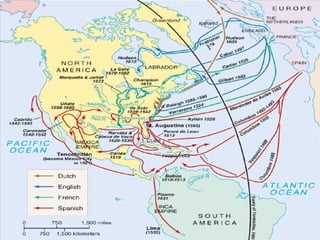
C/E of English Exploration Causes: Economic necessity- mercantilism Military power- must counter growing empire of Spain, France and Portugal Effects: British gain a foothold in New World at Jamestown, eventually along Atlantic seaboard
 
Big Picture of English Exploration Early exploration was sanctioned by the King in hopes of gaining an empire to match England’s growing power on the seas, as well as gaining wealth similar to the Spanish expeditions of the South Soon becomes a haven for religious dissenters, poor, landless men (enclosure), wealthy merchants looking for more wealth and debtors!
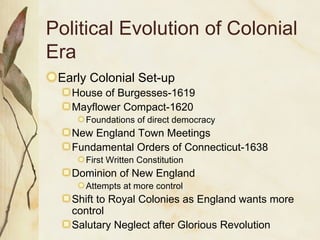
Political Evolution of Colonial Era Early Colonial Set-up House of Burgesses-1619 Mayflower Compact-1620 Foundations of direct democracy New England Town Meetings Fundamental Orders of Connecticut-1638 First Written Constitution Dominion of New England Attempts at more control Shift to Royal Colonies as England wants more control Salutary Neglect after Glorious Revolution
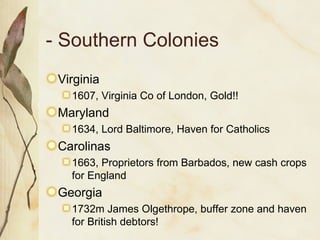
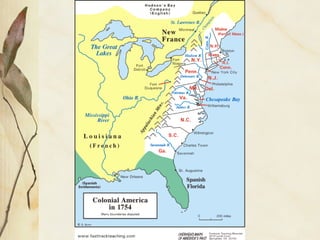
- Southern Colonies Virginia 1607, Virginia Co of London, Gold!! Maryland 1634, Lord Baltimore, Haven for Catholics Carolinas 1663, Proprietors from Barbados, new cash crops for England Georgia 1732m James Olgethrope, buffer zone and haven for British debtors!
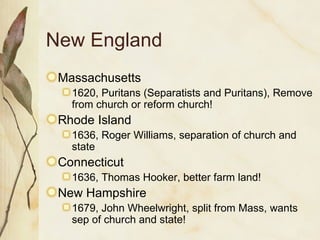
New England Massachusetts 1620, Puritans (Separatists and Puritans), Remove from church or reform church! Rhode Island 1636, Roger Williams, separation of church and state Connecticut 1636, Thomas Hooker, better farm land! New Hampshire 1679, John Wheelwright, split from Mass, wants sep of church and state!
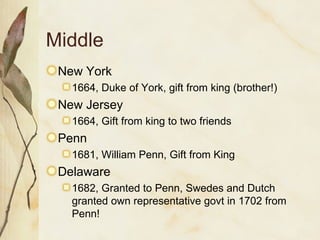
Middle  New York 1664, Duke of York, gift from king (brother!) New Jersey 1664, Gift from king to two friends Penn 1681, William Penn, Gift from King Delaware 1682, Granted to Penn, Swedes and Dutch granted own representative govt in 1702 from Penn!
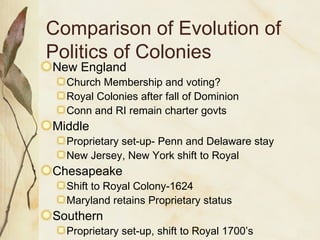
Comparison of Evolution of Politics of Colonies New England Church Membership and voting? Royal Colonies after fall of Dominion Conn and RI remain charter govts Middle Proprietary set-up- Penn and Delaware stay New Jersey, New York shift to Royal Chesapeake Shift to Royal Colony-1624 Maryland retains Proprietary status Southern Proprietary set-up, shift to Royal 1700’s
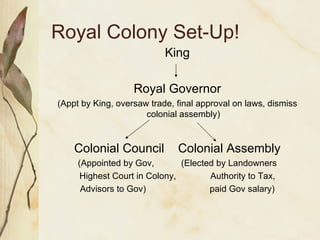
Royal Colony Set-Up! King Royal Governor (Appt by King, oversaw trade, final approval on laws, dismiss colonial assembly) Colonial Council  Colonial Assembly (Appointed by Gov,  (Elected by Landowners Highest Court in Colony,  Authority to Tax, Advisors to Gov)  paid Gov salary)
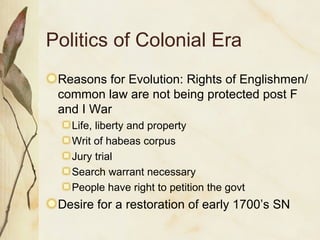
Politics of Colonial Era Reasons for Evolution: Rights of Englishmen/common law are not being protected post F and I War Life, liberty and property Writ of habeas corpus Jury trial Search warrant necessary People have right to petition the govt Desire for a restoration of early 1700’s SN
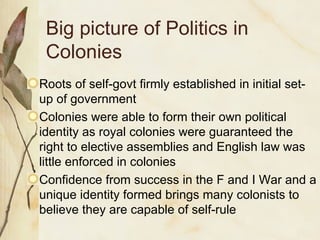
Big picture of Politics in Colonies Roots of self-govt firmly established in initial set-up of government Colonies were able to form their own political identity as royal colonies were guaranteed the right to elective assemblies and English law was little enforced in colonies Confidence from success in the F and I War and a unique identity formed brings many colonists to believe they are capable of self-rule
Comparison of Economic Systems in Colonies New England: lumbering, fishing, ship-building, subsistence farming Middle: Trade centers (NYC, Phili), breadbasket (wheat farming) Chesapeake: Tobacco plantations Southern: Rice, Indigo plantations
Evolution of Economic Systems Economic control grows with Navigation Acts of 1660’s Not evenly enforced (if not royal colony, could not force compliance) Enforcement of oceanic trade laws Non-enforcement of internal laws/ regulations post-1700 Own taxation laws by colonial assemblies
Mercantilism Colonies are there to support the Mother Country (favorable balance of trade) Navigation Acts Products finished in England, enumerated goods must be sold only to England Chesapeake saw greatest restrictions!! Triangular Trade Does not allow colonial manufacturing to develop in full Lack of skilled workmen, capital, inland transportation Does produce furniture, beaver hats
Evolution of Economic Systems of Colonies Indentured Servitude/Slavery-young single men come to New World for economic opportunity  Slavery moved to in Chesapeake with slowing of European IS’s, Bacon’s Rebellion, defacto to dejure Tobacco is labor intensive! Slavery present in Southern colonies from the beginning- Carolinas Always not enough labor for the amount of land to work! Effect: slave system is embedded in culture of the Chesapeake and Southern colonies
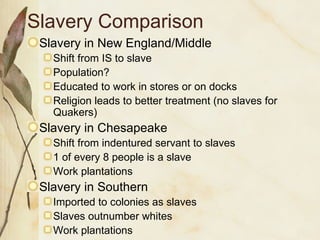
Slavery Comparison Slavery in New England/Middle Shift from IS to slave Population? Educated to work in stores or on docks Religion leads to better treatment (no slaves for Quakers) Slavery in Chesapeake Shift from indentured servant to slaves 1 of every 8 people is a slave Work plantations Slavery in Southern Imported to colonies as slaves Slaves outnumber whites Work plantations
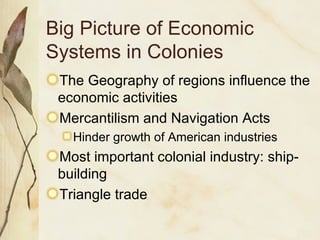
Big Picture of Economic Systems in Colonies The Geography of regions influence the economic activities Mercantilism and Navigation Acts Hinder growth of American industries Most important colonial industry: ship-building Triangle trade
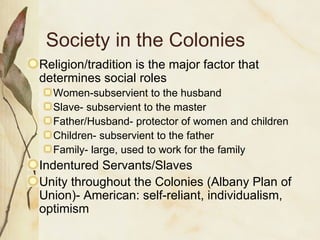
Society in the Colonies Religion/tradition is the major factor that determines social roles Women-subservient to the husband Slave- subservient to the master Father/Husband- protector of women and children Children- subservient to the father Family- large, used to work for the family Indentured Servants/Slaves Unity throughout the Colonies (Albany Plan of Union)- American: self-reliant, individualism, optimism
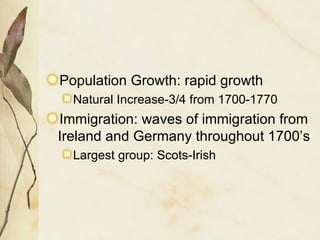
Population Growth: rapid growth Natural Increase-3/4 from 1700-1770 Immigration: waves of immigration from Ireland and Germany throughout 1700’s Largest group: Scots-Irish
Education Must be educated in New England to read the Bible for salvation! Better educated than most of Europe Varies from colony to colony High literacy rates Harvard- est. 1636
Big Picture of Society in Colonies Religion dictates social structure Education is very important, especially in the New England colonies Population growth is rapid due to immigration and natural increase Unity grows in a sense of being “American”, but does not extend to politics
Evolution of Religion in Colonies NE: founded by Puritans-great summary in review books! Covenant of Works/Predestination effects set up of life Effects- extremely devout had lasting implications on society, politics and economy Least democratic region, voting rights only as a church member Caused conformity Gender Roles in society harshly defined
Conformity of Religion Roger Williams: separation of church and state, King has no right to give away land that belonged to natives, freedom of religion Banished 1635, founded RI with principles of freedom of religion Anne Hutchinson: Believed in Covenant of Grace, not Covenant of Works toted by most Puritan ministers, preached in home that on could communicate directly with God, makes church as an institution less important Tainted Puritan believes and gender roles!
Evolution of Religion Halfway Covenant Shift in importance with forced Religious toleration and voting changes post 1690 Glorious Revolution! Salem Witch Trials, Great Awakening in response to loss of purpose and devoutness
Religion in Chesapeake Maryland- Act of Toleration-1649 Settlement is motivated by wealth Headright System Settlement by singles, little inducement for devoutness
Quakers Persecution in New England William Penn in 1681 Follow Quaker laws, but you do not have to be Quaker Fair Treatment of Native Americans No slaves!!
Big Picture of Culture in Colonies Most colonies had a state supported church Tolerance grew over the 1600’s as more religious groups find the New World a haven for religious freedom Salem Witch Trials- showing the decline in Puritan ideals Great Awakening is attempt to regain Puritan ideals from founding Freedom of Press established with Zenger Trial in 1735
 
Questions for Discussion Although New England and the Chesapeake region were both settled by largely people of English origin, by 1700 the regions had evolved into two distinct societies. Why did this difference in development occur?
To what extent had the colonists developed a sense of their own identity and unity as Americans by the eve of the Revolution?
Analyze the extent to which religious freedom existed in the British North American Colonies prior to 1700. How did the economic, geographic, and social factors encourage the growth of slavery as an important part of the colonies between 1607-1750.

APUSH Colonies review

  • 1.
    Colonial America ReviewPolitics, Economics, and Society
  • 2.
    C/E of EnglishExploration Causes: Economic necessity- mercantilism Military power- must counter growing empire of Spain, France and Portugal Effects: British gain a foothold in New World at Jamestown, eventually along Atlantic seaboard
  • 3.
  • 4.
    Big Picture ofEnglish Exploration Early exploration was sanctioned by the King in hopes of gaining an empire to match England’s growing power on the seas, as well as gaining wealth similar to the Spanish expeditions of the South Soon becomes a haven for religious dissenters, poor, landless men (enclosure), wealthy merchants looking for more wealth and debtors!
  • 5.
    Political Evolution ofColonial Era Early Colonial Set-up House of Burgesses-1619 Mayflower Compact-1620 Foundations of direct democracy New England Town Meetings Fundamental Orders of Connecticut-1638 First Written Constitution Dominion of New England Attempts at more control Shift to Royal Colonies as England wants more control Salutary Neglect after Glorious Revolution
  • 6.
    - Southern ColoniesVirginia 1607, Virginia Co of London, Gold!! Maryland 1634, Lord Baltimore, Haven for Catholics Carolinas 1663, Proprietors from Barbados, new cash crops for England Georgia 1732m James Olgethrope, buffer zone and haven for British debtors!
  • 7.
    New England Massachusetts1620, Puritans (Separatists and Puritans), Remove from church or reform church! Rhode Island 1636, Roger Williams, separation of church and state Connecticut 1636, Thomas Hooker, better farm land! New Hampshire 1679, John Wheelwright, split from Mass, wants sep of church and state!
  • 8.
    Middle NewYork 1664, Duke of York, gift from king (brother!) New Jersey 1664, Gift from king to two friends Penn 1681, William Penn, Gift from King Delaware 1682, Granted to Penn, Swedes and Dutch granted own representative govt in 1702 from Penn!
  • 9.
    Comparison of Evolutionof Politics of Colonies New England Church Membership and voting? Royal Colonies after fall of Dominion Conn and RI remain charter govts Middle Proprietary set-up- Penn and Delaware stay New Jersey, New York shift to Royal Chesapeake Shift to Royal Colony-1624 Maryland retains Proprietary status Southern Proprietary set-up, shift to Royal 1700’s
  • 10.
    Royal Colony Set-Up!King Royal Governor (Appt by King, oversaw trade, final approval on laws, dismiss colonial assembly) Colonial Council Colonial Assembly (Appointed by Gov, (Elected by Landowners Highest Court in Colony, Authority to Tax, Advisors to Gov) paid Gov salary)
  • 11.
    Politics of ColonialEra Reasons for Evolution: Rights of Englishmen/common law are not being protected post F and I War Life, liberty and property Writ of habeas corpus Jury trial Search warrant necessary People have right to petition the govt Desire for a restoration of early 1700’s SN
  • 12.
    Big picture ofPolitics in Colonies Roots of self-govt firmly established in initial set-up of government Colonies were able to form their own political identity as royal colonies were guaranteed the right to elective assemblies and English law was little enforced in colonies Confidence from success in the F and I War and a unique identity formed brings many colonists to believe they are capable of self-rule
  • 13.
    Comparison of EconomicSystems in Colonies New England: lumbering, fishing, ship-building, subsistence farming Middle: Trade centers (NYC, Phili), breadbasket (wheat farming) Chesapeake: Tobacco plantations Southern: Rice, Indigo plantations
  • 14.
    Evolution of EconomicSystems Economic control grows with Navigation Acts of 1660’s Not evenly enforced (if not royal colony, could not force compliance) Enforcement of oceanic trade laws Non-enforcement of internal laws/ regulations post-1700 Own taxation laws by colonial assemblies
  • 15.
    Mercantilism Colonies arethere to support the Mother Country (favorable balance of trade) Navigation Acts Products finished in England, enumerated goods must be sold only to England Chesapeake saw greatest restrictions!! Triangular Trade Does not allow colonial manufacturing to develop in full Lack of skilled workmen, capital, inland transportation Does produce furniture, beaver hats
  • 16.
    Evolution of EconomicSystems of Colonies Indentured Servitude/Slavery-young single men come to New World for economic opportunity Slavery moved to in Chesapeake with slowing of European IS’s, Bacon’s Rebellion, defacto to dejure Tobacco is labor intensive! Slavery present in Southern colonies from the beginning- Carolinas Always not enough labor for the amount of land to work! Effect: slave system is embedded in culture of the Chesapeake and Southern colonies
  • 17.
    Slavery Comparison Slaveryin New England/Middle Shift from IS to slave Population? Educated to work in stores or on docks Religion leads to better treatment (no slaves for Quakers) Slavery in Chesapeake Shift from indentured servant to slaves 1 of every 8 people is a slave Work plantations Slavery in Southern Imported to colonies as slaves Slaves outnumber whites Work plantations
  • 18.
    Big Picture ofEconomic Systems in Colonies The Geography of regions influence the economic activities Mercantilism and Navigation Acts Hinder growth of American industries Most important colonial industry: ship-building Triangle trade
  • 19.
    Society in theColonies Religion/tradition is the major factor that determines social roles Women-subservient to the husband Slave- subservient to the master Father/Husband- protector of women and children Children- subservient to the father Family- large, used to work for the family Indentured Servants/Slaves Unity throughout the Colonies (Albany Plan of Union)- American: self-reliant, individualism, optimism
  • 20.
    Population Growth: rapidgrowth Natural Increase-3/4 from 1700-1770 Immigration: waves of immigration from Ireland and Germany throughout 1700’s Largest group: Scots-Irish
  • 21.
    Education Must beeducated in New England to read the Bible for salvation! Better educated than most of Europe Varies from colony to colony High literacy rates Harvard- est. 1636
  • 22.
    Big Picture ofSociety in Colonies Religion dictates social structure Education is very important, especially in the New England colonies Population growth is rapid due to immigration and natural increase Unity grows in a sense of being “American”, but does not extend to politics
  • 23.
    Evolution of Religionin Colonies NE: founded by Puritans-great summary in review books! Covenant of Works/Predestination effects set up of life Effects- extremely devout had lasting implications on society, politics and economy Least democratic region, voting rights only as a church member Caused conformity Gender Roles in society harshly defined
  • 24.
    Conformity of ReligionRoger Williams: separation of church and state, King has no right to give away land that belonged to natives, freedom of religion Banished 1635, founded RI with principles of freedom of religion Anne Hutchinson: Believed in Covenant of Grace, not Covenant of Works toted by most Puritan ministers, preached in home that on could communicate directly with God, makes church as an institution less important Tainted Puritan believes and gender roles!
  • 25.
    Evolution of ReligionHalfway Covenant Shift in importance with forced Religious toleration and voting changes post 1690 Glorious Revolution! Salem Witch Trials, Great Awakening in response to loss of purpose and devoutness
  • 26.
    Religion in ChesapeakeMaryland- Act of Toleration-1649 Settlement is motivated by wealth Headright System Settlement by singles, little inducement for devoutness
  • 27.
    Quakers Persecution inNew England William Penn in 1681 Follow Quaker laws, but you do not have to be Quaker Fair Treatment of Native Americans No slaves!!
  • 28.
    Big Picture ofCulture in Colonies Most colonies had a state supported church Tolerance grew over the 1600’s as more religious groups find the New World a haven for religious freedom Salem Witch Trials- showing the decline in Puritan ideals Great Awakening is attempt to regain Puritan ideals from founding Freedom of Press established with Zenger Trial in 1735
  • 29.
  • 30.
    Questions for DiscussionAlthough New England and the Chesapeake region were both settled by largely people of English origin, by 1700 the regions had evolved into two distinct societies. Why did this difference in development occur?
  • 31.
    To what extenthad the colonists developed a sense of their own identity and unity as Americans by the eve of the Revolution?
  • 32.
    Analyze the extentto which religious freedom existed in the British North American Colonies prior to 1700. How did the economic, geographic, and social factors encourage the growth of slavery as an important part of the colonies between 1607-1750.

Editor's Notes

  • #5 Tell me which Colonies are for Religious Dissenters: Mass Bay Colony, Plymouth, Conn, RI, Penn, Maryland Poor, Landless (Specifically): Jamestown (Virginia) Wealthy: New York, Delaware, New Jersey, Carolinas Debtors: Georgia
  • #6 Review Dominion of New England and discuss why Salutary Neglect was used in relation to the colonies!- Lack of enforcement EXCEPT for oceanic trade