WELCOME
EDU- 08 ASSESSMENT IN EDUCATION
SEMESTER II
OBJECTIVE TYPE
SHORT – ANSWER TYPE
ESSAY TYPE
Presentation By
Class room test and assessments
play a central role in the evaluation
of student learning.
The main goal of classroom
testing and assessment is to obtain
valid, reliable and useful information
concerning student achievement.
There are different test items to
check the learning outcomes.
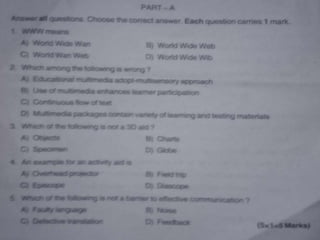
Objective type questions are questions, that
require a specific answer. An objective
question usually has only one potential
correct answer and they leave no room
for opinion.
An Objective test is so named because the
system of scoring is objective rather than
subjective.
The problem may be stated as a direct question or as
an incomplete statement and is called the stem. The
list of suggested solutions may include words,
symbols, etc, are called alternatives.
USES
* to measure variety of knowledge out
comes ( Specific facts, terminology,
principles, methods and procedures etc.
TYPES
Force response items
Fixed response items
 Multiple choice
 Alternative response type (true/ false)
 Matching block
 Completion type
 It covers all the aspects of the content.
 Rapid scoring is possible.
 Evaluation time will be less.
 Students can answer quick.
 Objective evaluation.
 Blind guessing is possible.
 Content validity cannot be tested.
 The specific abilities like expression and
organization are not tested.
 It takes more time in construction.
MULTIPLE CHOICE
The item,
should be clear, accurate and
unambiguous.
should give either a direct or an incomplete
statement,
should have only one correct answer.
should keep the blank only at the end of
the statement. should avoid negatively
stated items
should avoid grammatical clues, repetition
of item responses of words or phrases that
have been used in the item stem.
TRUE- FALSE ITEMS
The statement,
should not be used with out qualification.
should not be very long.
should not use statements with words like
always, never, no , only(*false) ,
sometimes & often(* true).
should avoid negative statements.
MATCHING BLOCK ITEM
The statement,
should give clear directions.
should contain small premises and
responses.
should contain homogenous premises and
responses.
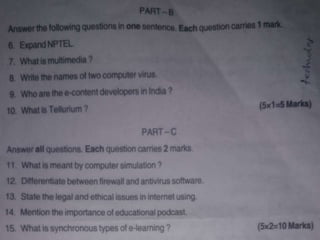
SHORT ANSWER TYPE
 Short answer type questions are the
type, that can be answered by a
word or a few sentences.
 It uses a direct question
 Comes between objective and essay type.
 Can be answered in few sentences.
 Is highly thought provoking.
 Can cover a wide range of content.
 It contains objectives individually like
knowledge, understanding, synthesis,
application, analysis and evaluation.
CHARACTERESTICS
USE
It is suitable for measuring a wide variety
of relatively simple learning outcomes.
Eg:-
 What is meant by EDUSAT?
EDUSAT is the first satellite built
exclusively for serving the
educational sector.
ADVANTAGES
Large portion of content can be covered.
Easy to construct, because it measures
simple learning outcomes.
It provides little opportunity for guessing.
It is useful in interpreting diagrams,
charts etc.
LIMITATIONS
 It leads to rote learning
 Personal bias of teacher and students are
involved.
 It can not test the expression ability of
students.
 Writing skill can not be measure properly.
Suggestions while constructing
 Avoid the irrelevant clues.
 Ensure that tests measure more than the
memorization of factual knowledge.
Essay test is a test that
requires the student to
structure a rather long
written response up to
several paragraphs
 It demands long answers.
 Allows freedom of response to a problem.
 Contains fewer questions than objectives
and short answer questions.
 It is easy to prepare
 Less time needed for preparation.
 Student get much freedom to express his
ideas.
Characteristics
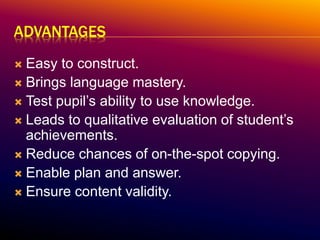
ADVANTAGES
 Easy to construct.
 Brings language mastery.
 Test pupil’s ability to use knowledge.
 Leads to qualitative evaluation of student’s
achievements.
 Reduce chances of on-the-spot copying.
 Enable plan and answer.
 Ensure content validity.
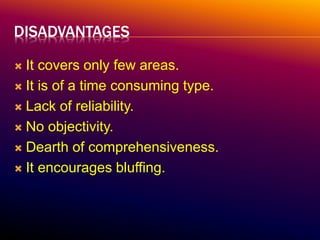
DISADVANTAGES
 It covers only few areas.
 It is of a time consuming type.
 Lack of reliability.
 No objectivity.
 Dearth of comprehensiveness.
 It encourages bluffing.
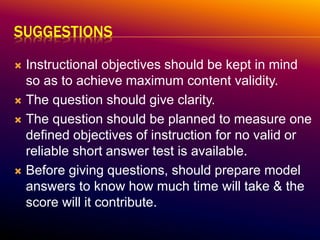
SUGGESTIONS
 Instructional objectives should be kept in mind
so as to achieve maximum content validity.
 The question should give clarity.
 The question should be planned to measure one
defined objectives of instruction for no valid or
reliable short answer test is available.
 Before giving questions, should prepare model
answers to know how much time will take & the
score will it contribute.
types of test items

types of test items

  • 1.
    WELCOME EDU- 08 ASSESSMENTIN EDUCATION SEMESTER II
  • 2.
    OBJECTIVE TYPE SHORT –ANSWER TYPE ESSAY TYPE Presentation By
  • 3.
    Class room testand assessments play a central role in the evaluation of student learning. The main goal of classroom testing and assessment is to obtain valid, reliable and useful information concerning student achievement. There are different test items to check the learning outcomes.
  • 4.
    Objective type questionsare questions, that require a specific answer. An objective question usually has only one potential correct answer and they leave no room for opinion. An Objective test is so named because the system of scoring is objective rather than subjective.
  • 5.
    The problem maybe stated as a direct question or as an incomplete statement and is called the stem. The list of suggested solutions may include words, symbols, etc, are called alternatives. USES * to measure variety of knowledge out comes ( Specific facts, terminology, principles, methods and procedures etc.
  • 7.
    TYPES Force response items Fixedresponse items  Multiple choice  Alternative response type (true/ false)  Matching block  Completion type
  • 8.
     It coversall the aspects of the content.  Rapid scoring is possible.  Evaluation time will be less.  Students can answer quick.  Objective evaluation.
  • 9.
     Blind guessingis possible.  Content validity cannot be tested.  The specific abilities like expression and organization are not tested.  It takes more time in construction.
  • 10.
    MULTIPLE CHOICE The item, shouldbe clear, accurate and unambiguous. should give either a direct or an incomplete statement, should have only one correct answer. should keep the blank only at the end of the statement. should avoid negatively stated items
  • 11.
    should avoid grammaticalclues, repetition of item responses of words or phrases that have been used in the item stem. TRUE- FALSE ITEMS The statement, should not be used with out qualification. should not be very long. should not use statements with words like always, never, no , only(*false) , sometimes & often(* true). should avoid negative statements.
  • 12.
    MATCHING BLOCK ITEM Thestatement, should give clear directions. should contain small premises and responses. should contain homogenous premises and responses.
  • 13.
    SHORT ANSWER TYPE Short answer type questions are the type, that can be answered by a word or a few sentences.  It uses a direct question
  • 14.
     Comes betweenobjective and essay type.  Can be answered in few sentences.  Is highly thought provoking.  Can cover a wide range of content.  It contains objectives individually like knowledge, understanding, synthesis, application, analysis and evaluation. CHARACTERESTICS
  • 15.
    USE It is suitablefor measuring a wide variety of relatively simple learning outcomes. Eg:-  What is meant by EDUSAT? EDUSAT is the first satellite built exclusively for serving the educational sector.
  • 17.
    ADVANTAGES Large portion ofcontent can be covered. Easy to construct, because it measures simple learning outcomes. It provides little opportunity for guessing. It is useful in interpreting diagrams, charts etc.
  • 18.
    LIMITATIONS  It leadsto rote learning  Personal bias of teacher and students are involved.  It can not test the expression ability of students.  Writing skill can not be measure properly.
  • 19.
    Suggestions while constructing Avoid the irrelevant clues.  Ensure that tests measure more than the memorization of factual knowledge.
  • 20.
    Essay test isa test that requires the student to structure a rather long written response up to several paragraphs
  • 21.
     It demandslong answers.  Allows freedom of response to a problem.  Contains fewer questions than objectives and short answer questions.  It is easy to prepare  Less time needed for preparation.  Student get much freedom to express his ideas. Characteristics
  • 23.
    ADVANTAGES  Easy toconstruct.  Brings language mastery.  Test pupil’s ability to use knowledge.  Leads to qualitative evaluation of student’s achievements.  Reduce chances of on-the-spot copying.  Enable plan and answer.  Ensure content validity.
  • 24.
    DISADVANTAGES  It coversonly few areas.  It is of a time consuming type.  Lack of reliability.  No objectivity.  Dearth of comprehensiveness.  It encourages bluffing.
  • 25.
    SUGGESTIONS  Instructional objectivesshould be kept in mind so as to achieve maximum content validity.  The question should give clarity.  The question should be planned to measure one defined objectives of instruction for no valid or reliable short answer test is available.  Before giving questions, should prepare model answers to know how much time will take & the score will it contribute.