Evaluating Students
in Social Science
Prepared by: Suzeth V. Asanza
INTRODUCTION
● It is a process of determining the extent to which the
objectives of social studies have been achieved by the
students.
● Evaluation is generally used for certification and
placement purposes, but it has greater potential to be
used for instructional purposes. For this, evaluation has
to be a continuous and comprehensive process
EVALUATION FOR CERTIFICATION
The performance of students is also evaluated by
the social studies teachers periodically as well as
annually to judge the level of performance of each
student and grade her/him accordingly so that
certificates could be provided.
Essay Test
01
Essay items
• It is appropriate when assessing students’ ability to
organize and present their original ideas.
• It consists of a few questions wherein the examinee is
expected to demonstrate to recall factual knowledge;
organize his knowledge; and present his knowledge in
logical and integrated answers.
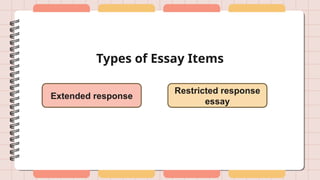
Types of Essay Items
Extended response
Restricted response
essay
Extended response
• An essay test that allows the students to determine
the length and complexity of the response is called an
extended essay item.
• It is very useful in assessing the synthesis and
evaluation skills of the students.
• When the objective is to determine whether the
students can organize ideas, integrate and express
ideas, evaluate information in the knowledge, it is
best to use extended response essay tests.
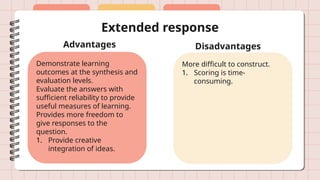
Extended response
Advantages Disadvantages
Demonstrate learning
outcomes at the synthesis and
evaluation levels.
Evaluate the answers with
sufficient reliability to provide
useful measures of learning.
Provides more freedom to
give responses to the
question.
1. Provide creative
integration of ideas.
More difficult to construct.
1. Scoring is time-
consuming.
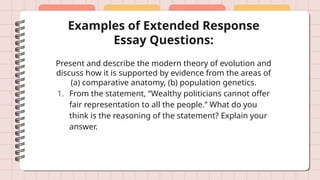
Examples of Extended Response
Essay Questions:
Present and describe the modern theory of evolution and
discuss how it is supported by evidence from the areas of
(a) comparative anatomy, (b) population genetics.
1. From the statement, “Wealthy politicians cannot offer
fair representation to all the people.” What do you
think is the reasoning of the statement? Explain your
answer.
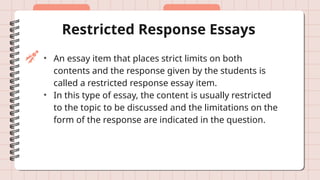
Restricted Response Essays
• An essay item that places strict limits on both
contents and the response given by the students is
called a restricted response essay item.
• In this type of essay, the content is usually restricted
to the topic to be discussed and the limitations on the
form of the response are indicated in the question.
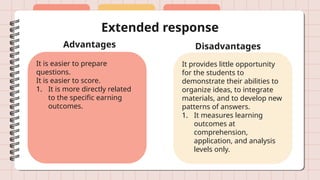
Extended response
Advantages Disadvantages
It is easier to prepare
questions.
It is easier to score.
1. It is more directly related
to the specific earning
outcomes.
It provides little opportunity
for the students to
demonstrate their abilities to
organize ideas, to integrate
materials, and to develop new
patterns of answers.
1. It measures learning
outcomes at
comprehension,
application, and analysis
levels only.
Examples of Restricted Response
Essay Questions:
1. List the major facts and opinions in the First State of the
Nation Address (SONA) of Pres. Ferdinand R. Marcos Jr. .
Limit your answer to one page only. The score will depend
on the content, organization, and accuracy of your answer.
1. Point out the strengths and weaknesses of a multiple-
choice type of test. Limit your answer to five strengths
and five weaknesses. Explain each answer in not more
than two sentences.
Guidelines in Constructing Essay Test Items
Construct essay questions used to measure complex learning outcomes only.
Essay questions should relate directly to the learning outcomes to be
measured.
Formulate essay questions that present a clear task to be performed.
An item should be stated precisely and it must focus on the desired answer.
All students should be required to answer the same question.
The number of points and time spent in answering the questions must be
indicated in each item.
Specify the number of words, paragraphs, or the number of sentences for
the answer.
1. The scoring system must be discussed or presented to the students.
Advantages of Essay Test
It is easier to prepare and less time consuming compared to other
paper and pencil tests.
It measures higher-order thinking skills (analysis, synthesis, and
evaluation).
It allows students’ freedom to express individuality in answering the
given questions.
The students have a chance to express their idea to plan their
answers.
It reduces guessing answer compared to any of the objective type of
test.
It permits more realistic tasks to the students.
1. It emphasizes the integration and application of ideas.
Disadvantages of Essay Test
It cannot provide an objective measure of the achievement of the
students.
It needs so much time to grade and prepare scoring criteria.
The scores are usually not reliable most especially without scoring
criteria.
It measures a limited amount of content and objectives.
Low variation of scores.
1. It usually encourages bluffing.
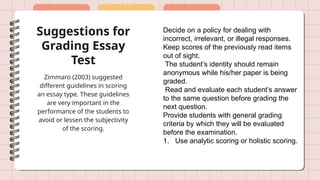
Suggestions for
Grading Essay
Test
Zimmaro (2003) suggested
different guidelines in scoring
an essay type. These guidelines
are very important in the
performance of the students to
avoid or lessen the subjectivity
of the scoring.
Decide on a policy for dealing with
incorrect, irrelevant, or illegal responses.
Keep scores of the previously read items
out of sight.
The student’s identity should remain
anonymous while his/her paper is being
graded.
Read and evaluate each student’s answer
to the same question before grading the
next question.
Provide students with general grading
criteria by which they will be evaluated
before the examination.
1. Use analytic scoring or holistic scoring.
Completion
Test
02
Completion Test
● This test consists of a series of items which
requires the testee to fill a word or phrase
on the blanks.
● An item may contain one or more blanks.
● This is also called the filling the blanks
type of test.
Rules and Suggestions for the
Construction of Completion Test
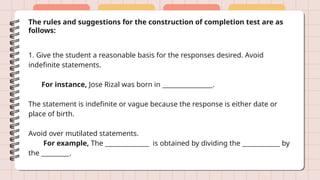
The rules and suggestions for the construction of completion test are as
follows:
1. Give the student a reasonable basis for the responses desired. Avoid
indefinite statements.
For instance, Jose Rizal was born in ________________.
The statement is indefinite or vague because the response is either date or
place of birth.
Avoid over mutilated statements.
For example, The ______________ is obtained by dividing the ____________ by
the _________.
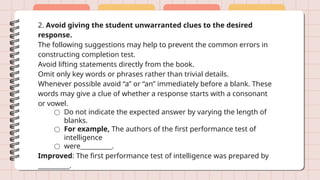
2. Avoid giving the student unwarranted clues to the desired
response.
The following suggestions may help to prevent the common errors in
constructing completion test.
Avoid lifting statements directly from the book.
Omit only key words or phrases rather than trivial details.
Whenever possible avoid “a” or “an” immediately before a blank. These
words may give a clue of whether a response starts with a consonant
or vowel.
○ Do not indicate the expected answer by varying the length of
blanks.
○ For example, The authors of the first performance test of
intelligence
○ were__________.
Improved: The first performance test of intelligence was prepared by
__________.
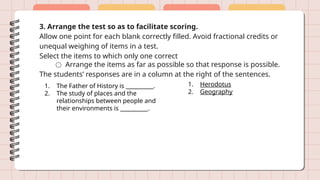
3. Arrange the test so as to facilitate scoring.
Allow one point for each blank correctly filled. Avoid fractional credits or
unequal weighing of items in a test.
Select the items to which only one correct
○ Arrange the items as far as possible so that response is possible.
The students’ responses are in a column at the right of the sentences.
1. The Father of History is __________.
2. The study of places and the
relationships between people and
their environments is __________.
1. Herodotus
2. Geography
Defining term
or concept
03
DEFINING TERM OR CONCEPT
● A concept testing survey helps students evaluate ideas
development, an ad campaign, or even a message or claim, by
getting feedback from students or a teachers.
● Whether you want to test a single concept, or compare different
concepts with an A/B test, taking the time to test before you
execute can help you avoid mistakes.
● Using a concept testing survey makes it easy to get accurate
feedback from students.
ANSWER A QUESTION
● It is a situation in which a student or a group of students asks a
questions and another person’s or group of students answers
them.
● Answer a question is a short method of teaching.
● This instruction aims to prevent students from fearing they
cannot articulate their values or their beliefs will not withstand
scrutiny.
● This method of teaching effectively involves teachers balancing
facts and opinions to understand students’ ideas.
● This method of questioning aims to uncover beliefs and support
the thoughts and statements of the participants in the inquiry.
Simple Recall
• This type of test is the easiest to construct among the
objective type of tests.
• The response requires the examinee to recall
previously learned lessons and the answers are usually
short consisting of either a word or phrase.
Rules and Suggestions for the
Construction of Simple-recall Type
The test items must be so worded that the response is brief as
possible, preferably a single word, number, symbol, or a brief
phrase. This objectifies and facilitates.
The direct question is preferable than the statement form. It is
easier to phrase and scoring. More natural to the examinees.
1. The arrangement of examinees’ responses in a column,
preferably at the right column, is more convenient for them
as it eliminates the need to turn their neck to write their
answer before the item.
4. The question must be so worded that there is only one correct
response, whenever this is impossible, all acceptable answers
must be included in the scoring key.
5. Make a minimum use of textbook language in wording the
question. Unfamiliar phrasing reduces the possibility of correct
responses that represent more meaningless verbal associations
ADVANTAGES
This type of test is particularly valuable in mathematics and the physical sciences, where
the stimulus appears in the form of a problem requiring computation.
As it needs very brief answer, does not result in bringing boredom and fatigue.
It is easy to construct.
It almost completely eliminates guessing as a factor in unreliability and thus minimizes
one of the most common criticisms of objective tests.
Thus items are sufficiently reliable and highly valid.
The familiarity of facts and naturalness is measured.
It can serve the diagnostic purpose.
Quite comprehensive in covering the syllabus and testing of the realization of the
stipulated objectives.
1. The scoring and interpretation of the responses of the students do not pose any
LIMITATIONS
Such questions test only the factual things and memory. The powers of
understanding, reasoning, application, interpretation etc. cannot be
tested through these questions.
Preparation of such items demands great skill and experience on the part
of the paper setter.
It is costly in terms of time and labor for its preparation.
Administration of such tests may also create so many disciplinary and
administrative problems. The mode of responses of questions may also
drift the students towards picking up unfair means.
1. If not properly constructed, scoring can be subjective.
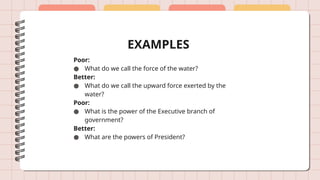
EXAMPLES
Poor:
● What do we call the force of the water?
Better:
● What do we call the upward force exerted by the
water?
Poor:
● What is the power of the Executive branch of
government?
Better:
● What are the powers of President?
ENUMERATION
● Enumeration type of test or exam is done by enumerating
particular answers to a particular question.
● This type of exam is actually a gimme (very easy). But this type of
exam is very tricky also because you have to memorize all the
items that are included in a particular category or list.
For example:
List down the countries of ASEAN member
1. Enumerate the international organization in the world.
Selection-Type
Test
04
TRUE AND FALSE TEST
● In this type of test, the examinees determine whether the statement
presented is true or false.
● The true or false test item Is an example of a “forced- choice test” because
there two possible choices in these types of tests.
● The students are required to choose the answer true or false in
recognition of a correct statement or incorrect statement.
● True or false type of test is appropriate in assessing the behavioral
objectives such as “identify,” “select,” or “recognize.”
● It is also suited to assess the knowledge and comprehension level in the
cognitive domain.
● This type of test is appropriate when there are only two plausible
alternatives or distracters.
Guidelines in
Constructing True or
False Test
Avoid writing a very long statement. Eliminate unnecessary word(s) in the
statement (be concise).
Avoid trivial questions.
It should contain only one idea in each item except for a statement
showing the relationship between cause and effect.
It can be used for establishing cause and effect relationships.
1. Avoid using opinion-based statements, if it cannot be avoided the
statement should be attributed to somebody.
2. Avoid using negative or double negatives. Construct the statement
positively. If this cannot be avoided, bold negative words or
underlined it to call the attention of the examinees.
7. Avoid specific determiner such as “never,” “always,” “all,” “none” for they
tend to appear in the statements that are false.
8. Avoid specific determiner such as “some,” “sometimes,” and “may” they
tend to appear in the statements that are true.
9. The number of true items must be the same as the number of false items.
10. Avoid grammatical clues that lead to a correct answer such as the
article (a, an, the).
11. Avoid statements directly taken from the textbook.
12. Avoid arranging the statements in a logical order such as (TTTTT-FFFFF,
TTFFTTFF).
13. Directions should indicate where or how the students should mark their
answers.
Advantages and
Disadvantages of True
or False Test
Advantages
It covers a lot of content in a short period.
It is easier to prepare compared to the multiple-choice and
matching type of test.
It is easier to score because it can be scored objectively
compared to a test that depends on the judgment of the
rater(s).
1. IT is useful when there are two alternatives only.
2. The score is more reliable than the essay test.
Disadvantages
Limited only to the low level of thinking skills such as
knowledge and comprehension, or recognition or recall
information.
1. High probability of guessing the correct answer (50%)
compared to multiple- choice consist of four options (25%)
MATCHING TYPE
The matching type item consists of two columns.
Column A contains the descriptions and must be
placed on the left side while Column B contains the
options and is placed on the right side. The examinees
are asked to match the options that are associated with
the description(s).
Guidelines in
Constructing Matching
Type Test
The descriptions and options must be short and homogeneous.
The descriptions must be written on the left side and marked it with
Column A and the options must be written at the right side and marked it
with Column B to save time for the examinees.
1. There should be more options than descriptors or indicate in the
directions that each option may be used more than once to
decrease the chance of guessing.
2. Matching directions should specify the basis for matching. Failure to
indicate how matches should be marked can greatly increase the
time consumed by the teacher in scoring.
3. Avoid too many correct answers.
6. When using names, always include the complete name (first name
and Surname) to avoid ambiguities.
7. Use numbers for the descriptions and capital letters for the options
to avoid confusion to the students that have a reading problem.
8. Arrange the options into chronological order or alphabetical order.
9. The descriptions and options must be written on the same page.
10. A minimum of three items and a maximum of seven items for
elementary level and a maximum of seventeen items for secondary and
tertiary levels.
Advantages and
Disadvantages of
Matching Type Test
Advantages
It is simpler to construct than a multiple-choice type of test.
It reduces the effect of guessing compared to the multiple-
choice and true or false type of tests.
It is appropriate to assess the association between facts.
Provides easy, accurate, efficient, objective, and reliable test
scores.
1. More content can be covered in the given set of tests.
Disadvantages
It measures only simple recall or memorization of information.
It is difficult to construct due to problems in selecting the
descriptions and options.
1. It assesses the only low level of the cognitive domain such
as knowledge and comprehension.
MULTIPLE CHOICE
• A multiple-choice test is used to measure knowledge
outcomes and other types of learning outcomes
such as comprehension and applications.
• It is the most commonly used format in measuring
student achievements at different levels of learning.
• Multiple-choice item consists of three parts: the
stem, the keyed option, and the incorrect options or
alternatives.
Guidelines in
Constructing Multiple-
choice Test
Make a test item that is practical or with the real-world about
applications to the students.
1. Use diagrams or drawings when asking questions about the
application, analysis, or evaluation.
2. When asked to interpret or evaluate quotations, present actual
quotations from secondary sources like published books or
newspapers.
3. Use tables, figures, or charts when asking questions to interpret.
4. Use pictures if possible when students are required to apply
concepts and principles.
5. List the choices/options vertically not horizontally.
7. Avoid trivial questions.
8. Use only one correct answer or best answer format.
9. Use three to five options to discourage guessing.
10. Be sure that distracters are plausible and effective.
11. Increase the similarity of the options to increase the difficulty of the
item.
12. Do not use “none of the above” options when answer. Asking for the
best
13. Avoid using “all of the above” options. It is usually the correct
answer and makes the item too easy for the examinee with partial
knowledge.
Advantages of Multiple-
choice Test
ADVANTAGES
Measures learning outcomes from the knowledge to evaluation level.
Scoring is highly objective, easy, and reliable.
Scores are more reliable than subjective types of tests.
Measures broad samples of content within a short time.
Distracters can provide diagnostic information.
1. Item analysis can reveal the difficulty of an item and can
discriminate against the good and poor performing students.
DISADVANTAGES
Time-consuming to construct a good item.
Difficult to find effective and plausible distracters.
Scores can be influenced by the reading ability of the examinees.
In some cases, there is more than one justifiable correct answer.
1. Ineffective in assessing the problem-solving skills of the
students.
2. Not applicable when assessing the students’ ability to organize
and express ideas.
Guidelines in
Constructing the
Distracters
The distracters should be plausible.
The distracters should be equally popular to all examinees.
Avoid using ineffective distracters. Replace distracter(s) that are
not effective to the examinees.
Each distracter should be chosen by at least 5% of the examinees
but not more than the key answer.
1. Revise distracter (s) that are over attractive to the teachers.
They might be ambiguous to the examinees.
THANK YOU!
Do you have any questions?
CREDITS: This presentation template was created
by Slidesgo, and includes icons by Flaticon, and
infographics & images by Freepik
Thanks!
Do you have any questions?

EVALUATING STUDENTS IN SOCIAL SCIENCE.pptx

  • 1.
    Evaluating Students in SocialScience Prepared by: Suzeth V. Asanza
  • 2.
    INTRODUCTION ● It isa process of determining the extent to which the objectives of social studies have been achieved by the students. ● Evaluation is generally used for certification and placement purposes, but it has greater potential to be used for instructional purposes. For this, evaluation has to be a continuous and comprehensive process
  • 3.
    EVALUATION FOR CERTIFICATION Theperformance of students is also evaluated by the social studies teachers periodically as well as annually to judge the level of performance of each student and grade her/him accordingly so that certificates could be provided.
  • 4.
  • 5.
    Essay items • Itis appropriate when assessing students’ ability to organize and present their original ideas. • It consists of a few questions wherein the examinee is expected to demonstrate to recall factual knowledge; organize his knowledge; and present his knowledge in logical and integrated answers.
  • 6.
    Types of EssayItems Extended response Restricted response essay
  • 7.
    Extended response • Anessay test that allows the students to determine the length and complexity of the response is called an extended essay item. • It is very useful in assessing the synthesis and evaluation skills of the students. • When the objective is to determine whether the students can organize ideas, integrate and express ideas, evaluate information in the knowledge, it is best to use extended response essay tests.
  • 8.
    Extended response Advantages Disadvantages Demonstratelearning outcomes at the synthesis and evaluation levels. Evaluate the answers with sufficient reliability to provide useful measures of learning. Provides more freedom to give responses to the question. 1. Provide creative integration of ideas. More difficult to construct. 1. Scoring is time- consuming.
  • 9.
    Examples of ExtendedResponse Essay Questions: Present and describe the modern theory of evolution and discuss how it is supported by evidence from the areas of (a) comparative anatomy, (b) population genetics. 1. From the statement, “Wealthy politicians cannot offer fair representation to all the people.” What do you think is the reasoning of the statement? Explain your answer.
  • 10.
    Restricted Response Essays •An essay item that places strict limits on both contents and the response given by the students is called a restricted response essay item. • In this type of essay, the content is usually restricted to the topic to be discussed and the limitations on the form of the response are indicated in the question.
  • 11.
    Extended response Advantages Disadvantages Itis easier to prepare questions. It is easier to score. 1. It is more directly related to the specific earning outcomes. It provides little opportunity for the students to demonstrate their abilities to organize ideas, to integrate materials, and to develop new patterns of answers. 1. It measures learning outcomes at comprehension, application, and analysis levels only.
  • 12.
    Examples of RestrictedResponse Essay Questions: 1. List the major facts and opinions in the First State of the Nation Address (SONA) of Pres. Ferdinand R. Marcos Jr. . Limit your answer to one page only. The score will depend on the content, organization, and accuracy of your answer. 1. Point out the strengths and weaknesses of a multiple- choice type of test. Limit your answer to five strengths and five weaknesses. Explain each answer in not more than two sentences.
  • 13.
    Guidelines in ConstructingEssay Test Items Construct essay questions used to measure complex learning outcomes only. Essay questions should relate directly to the learning outcomes to be measured. Formulate essay questions that present a clear task to be performed. An item should be stated precisely and it must focus on the desired answer. All students should be required to answer the same question. The number of points and time spent in answering the questions must be indicated in each item. Specify the number of words, paragraphs, or the number of sentences for the answer. 1. The scoring system must be discussed or presented to the students.
  • 14.
    Advantages of EssayTest It is easier to prepare and less time consuming compared to other paper and pencil tests. It measures higher-order thinking skills (analysis, synthesis, and evaluation). It allows students’ freedom to express individuality in answering the given questions. The students have a chance to express their idea to plan their answers. It reduces guessing answer compared to any of the objective type of test. It permits more realistic tasks to the students. 1. It emphasizes the integration and application of ideas.
  • 15.
    Disadvantages of EssayTest It cannot provide an objective measure of the achievement of the students. It needs so much time to grade and prepare scoring criteria. The scores are usually not reliable most especially without scoring criteria. It measures a limited amount of content and objectives. Low variation of scores. 1. It usually encourages bluffing.
  • 16.
    Suggestions for Grading Essay Test Zimmaro(2003) suggested different guidelines in scoring an essay type. These guidelines are very important in the performance of the students to avoid or lessen the subjectivity of the scoring. Decide on a policy for dealing with incorrect, irrelevant, or illegal responses. Keep scores of the previously read items out of sight. The student’s identity should remain anonymous while his/her paper is being graded. Read and evaluate each student’s answer to the same question before grading the next question. Provide students with general grading criteria by which they will be evaluated before the examination. 1. Use analytic scoring or holistic scoring.
  • 17.
  • 18.
    Completion Test ● Thistest consists of a series of items which requires the testee to fill a word or phrase on the blanks. ● An item may contain one or more blanks. ● This is also called the filling the blanks type of test.
  • 19.
    Rules and Suggestionsfor the Construction of Completion Test
  • 20.
    The rules andsuggestions for the construction of completion test are as follows: 1. Give the student a reasonable basis for the responses desired. Avoid indefinite statements. For instance, Jose Rizal was born in ________________. The statement is indefinite or vague because the response is either date or place of birth. Avoid over mutilated statements. For example, The ______________ is obtained by dividing the ____________ by the _________.
  • 21.
    2. Avoid givingthe student unwarranted clues to the desired response. The following suggestions may help to prevent the common errors in constructing completion test. Avoid lifting statements directly from the book. Omit only key words or phrases rather than trivial details. Whenever possible avoid “a” or “an” immediately before a blank. These words may give a clue of whether a response starts with a consonant or vowel. ○ Do not indicate the expected answer by varying the length of blanks. ○ For example, The authors of the first performance test of intelligence ○ were__________. Improved: The first performance test of intelligence was prepared by __________.
  • 22.
    3. Arrange thetest so as to facilitate scoring. Allow one point for each blank correctly filled. Avoid fractional credits or unequal weighing of items in a test. Select the items to which only one correct ○ Arrange the items as far as possible so that response is possible. The students’ responses are in a column at the right of the sentences. 1. The Father of History is __________. 2. The study of places and the relationships between people and their environments is __________. 1. Herodotus 2. Geography
  • 23.
  • 24.
    DEFINING TERM ORCONCEPT ● A concept testing survey helps students evaluate ideas development, an ad campaign, or even a message or claim, by getting feedback from students or a teachers. ● Whether you want to test a single concept, or compare different concepts with an A/B test, taking the time to test before you execute can help you avoid mistakes. ● Using a concept testing survey makes it easy to get accurate feedback from students.
  • 25.
    ANSWER A QUESTION ●It is a situation in which a student or a group of students asks a questions and another person’s or group of students answers them. ● Answer a question is a short method of teaching. ● This instruction aims to prevent students from fearing they cannot articulate their values or their beliefs will not withstand scrutiny. ● This method of teaching effectively involves teachers balancing facts and opinions to understand students’ ideas. ● This method of questioning aims to uncover beliefs and support the thoughts and statements of the participants in the inquiry.
  • 26.
    Simple Recall • Thistype of test is the easiest to construct among the objective type of tests. • The response requires the examinee to recall previously learned lessons and the answers are usually short consisting of either a word or phrase.
  • 27.
    Rules and Suggestionsfor the Construction of Simple-recall Type
  • 28.
    The test itemsmust be so worded that the response is brief as possible, preferably a single word, number, symbol, or a brief phrase. This objectifies and facilitates. The direct question is preferable than the statement form. It is easier to phrase and scoring. More natural to the examinees. 1. The arrangement of examinees’ responses in a column, preferably at the right column, is more convenient for them as it eliminates the need to turn their neck to write their answer before the item.
  • 29.
    4. The questionmust be so worded that there is only one correct response, whenever this is impossible, all acceptable answers must be included in the scoring key. 5. Make a minimum use of textbook language in wording the question. Unfamiliar phrasing reduces the possibility of correct responses that represent more meaningless verbal associations
  • 30.
    ADVANTAGES This type oftest is particularly valuable in mathematics and the physical sciences, where the stimulus appears in the form of a problem requiring computation. As it needs very brief answer, does not result in bringing boredom and fatigue. It is easy to construct. It almost completely eliminates guessing as a factor in unreliability and thus minimizes one of the most common criticisms of objective tests. Thus items are sufficiently reliable and highly valid. The familiarity of facts and naturalness is measured. It can serve the diagnostic purpose. Quite comprehensive in covering the syllabus and testing of the realization of the stipulated objectives. 1. The scoring and interpretation of the responses of the students do not pose any
  • 31.
    LIMITATIONS Such questions testonly the factual things and memory. The powers of understanding, reasoning, application, interpretation etc. cannot be tested through these questions. Preparation of such items demands great skill and experience on the part of the paper setter. It is costly in terms of time and labor for its preparation. Administration of such tests may also create so many disciplinary and administrative problems. The mode of responses of questions may also drift the students towards picking up unfair means. 1. If not properly constructed, scoring can be subjective.
  • 32.
    EXAMPLES Poor: ● What dowe call the force of the water? Better: ● What do we call the upward force exerted by the water? Poor: ● What is the power of the Executive branch of government? Better: ● What are the powers of President?
  • 33.
    ENUMERATION ● Enumeration typeof test or exam is done by enumerating particular answers to a particular question. ● This type of exam is actually a gimme (very easy). But this type of exam is very tricky also because you have to memorize all the items that are included in a particular category or list. For example: List down the countries of ASEAN member 1. Enumerate the international organization in the world.
  • 34.
  • 35.
    TRUE AND FALSETEST ● In this type of test, the examinees determine whether the statement presented is true or false. ● The true or false test item Is an example of a “forced- choice test” because there two possible choices in these types of tests. ● The students are required to choose the answer true or false in recognition of a correct statement or incorrect statement. ● True or false type of test is appropriate in assessing the behavioral objectives such as “identify,” “select,” or “recognize.” ● It is also suited to assess the knowledge and comprehension level in the cognitive domain. ● This type of test is appropriate when there are only two plausible alternatives or distracters.
  • 36.
  • 37.
    Avoid writing avery long statement. Eliminate unnecessary word(s) in the statement (be concise). Avoid trivial questions. It should contain only one idea in each item except for a statement showing the relationship between cause and effect. It can be used for establishing cause and effect relationships. 1. Avoid using opinion-based statements, if it cannot be avoided the statement should be attributed to somebody. 2. Avoid using negative or double negatives. Construct the statement positively. If this cannot be avoided, bold negative words or underlined it to call the attention of the examinees.
  • 38.
    7. Avoid specificdeterminer such as “never,” “always,” “all,” “none” for they tend to appear in the statements that are false. 8. Avoid specific determiner such as “some,” “sometimes,” and “may” they tend to appear in the statements that are true. 9. The number of true items must be the same as the number of false items. 10. Avoid grammatical clues that lead to a correct answer such as the article (a, an, the). 11. Avoid statements directly taken from the textbook. 12. Avoid arranging the statements in a logical order such as (TTTTT-FFFFF, TTFFTTFF). 13. Directions should indicate where or how the students should mark their answers.
  • 39.
  • 40.
    Advantages It covers alot of content in a short period. It is easier to prepare compared to the multiple-choice and matching type of test. It is easier to score because it can be scored objectively compared to a test that depends on the judgment of the rater(s). 1. IT is useful when there are two alternatives only. 2. The score is more reliable than the essay test.
  • 41.
    Disadvantages Limited only tothe low level of thinking skills such as knowledge and comprehension, or recognition or recall information. 1. High probability of guessing the correct answer (50%) compared to multiple- choice consist of four options (25%)
  • 42.
    MATCHING TYPE The matchingtype item consists of two columns. Column A contains the descriptions and must be placed on the left side while Column B contains the options and is placed on the right side. The examinees are asked to match the options that are associated with the description(s).
  • 43.
  • 44.
    The descriptions andoptions must be short and homogeneous. The descriptions must be written on the left side and marked it with Column A and the options must be written at the right side and marked it with Column B to save time for the examinees. 1. There should be more options than descriptors or indicate in the directions that each option may be used more than once to decrease the chance of guessing. 2. Matching directions should specify the basis for matching. Failure to indicate how matches should be marked can greatly increase the time consumed by the teacher in scoring. 3. Avoid too many correct answers.
  • 45.
    6. When usingnames, always include the complete name (first name and Surname) to avoid ambiguities. 7. Use numbers for the descriptions and capital letters for the options to avoid confusion to the students that have a reading problem. 8. Arrange the options into chronological order or alphabetical order. 9. The descriptions and options must be written on the same page. 10. A minimum of three items and a maximum of seven items for elementary level and a maximum of seventeen items for secondary and tertiary levels.
  • 46.
  • 47.
    Advantages It is simplerto construct than a multiple-choice type of test. It reduces the effect of guessing compared to the multiple- choice and true or false type of tests. It is appropriate to assess the association between facts. Provides easy, accurate, efficient, objective, and reliable test scores. 1. More content can be covered in the given set of tests.
  • 48.
    Disadvantages It measures onlysimple recall or memorization of information. It is difficult to construct due to problems in selecting the descriptions and options. 1. It assesses the only low level of the cognitive domain such as knowledge and comprehension.
  • 49.
    MULTIPLE CHOICE • Amultiple-choice test is used to measure knowledge outcomes and other types of learning outcomes such as comprehension and applications. • It is the most commonly used format in measuring student achievements at different levels of learning. • Multiple-choice item consists of three parts: the stem, the keyed option, and the incorrect options or alternatives.
  • 50.
  • 51.
    Make a testitem that is practical or with the real-world about applications to the students. 1. Use diagrams or drawings when asking questions about the application, analysis, or evaluation. 2. When asked to interpret or evaluate quotations, present actual quotations from secondary sources like published books or newspapers. 3. Use tables, figures, or charts when asking questions to interpret. 4. Use pictures if possible when students are required to apply concepts and principles. 5. List the choices/options vertically not horizontally.
  • 52.
    7. Avoid trivialquestions. 8. Use only one correct answer or best answer format. 9. Use three to five options to discourage guessing. 10. Be sure that distracters are plausible and effective. 11. Increase the similarity of the options to increase the difficulty of the item. 12. Do not use “none of the above” options when answer. Asking for the best 13. Avoid using “all of the above” options. It is usually the correct answer and makes the item too easy for the examinee with partial knowledge.
  • 53.
  • 54.
    ADVANTAGES Measures learning outcomesfrom the knowledge to evaluation level. Scoring is highly objective, easy, and reliable. Scores are more reliable than subjective types of tests. Measures broad samples of content within a short time. Distracters can provide diagnostic information. 1. Item analysis can reveal the difficulty of an item and can discriminate against the good and poor performing students.
  • 55.
    DISADVANTAGES Time-consuming to constructa good item. Difficult to find effective and plausible distracters. Scores can be influenced by the reading ability of the examinees. In some cases, there is more than one justifiable correct answer. 1. Ineffective in assessing the problem-solving skills of the students. 2. Not applicable when assessing the students’ ability to organize and express ideas.
  • 56.
  • 57.
    The distracters shouldbe plausible. The distracters should be equally popular to all examinees. Avoid using ineffective distracters. Replace distracter(s) that are not effective to the examinees. Each distracter should be chosen by at least 5% of the examinees but not more than the key answer. 1. Revise distracter (s) that are over attractive to the teachers. They might be ambiguous to the examinees.
  • 58.
    THANK YOU! Do youhave any questions?
  • 59.
    CREDITS: This presentationtemplate was created by Slidesgo, and includes icons by Flaticon, and infographics & images by Freepik Thanks! Do you have any questions?

Editor's Notes

  • #21 There are several ways in which clues are often carelessly given
  • #22 There are several ways in which clues are often carelessly given
  • #25 This type of instruction aims not to strike fear in the hearts of students that they either cannot articulate clearly the values that guide their lives, or that their values and beliefs do not withstand scrutiny. This is effective method of teaching when a teachers wants to know the idea of the students is he/she know between the facts and opinion of an idea. This method of questioning aims to uncover beliefs and support the thoughts and statements of the participants in the inquiry. This students ask question as well, both of the teacher and each other.
  • #26 Because the item appears as a direct question, a sentence, word, or phrase or even a specific direction.
  • #30 Reduces Guessing: Since students need to supply the correct answer instead of choosing from options, the chance of guessing the right answer is almost eliminated. This makes the test more accurate. Reliable and Valid: The questions provide dependable results and effectively measure what they are supposed to assess. Tests Familiarity and Understanding: Simple recall questions evaluate how well students know and understand the material naturally, rather than just recognizing the correct answer. Helps Diagnose Problems: These tests can identify areas where students struggle, helping teachers understand their needs better. Covers the Syllabus Thoroughly: The format allows for a wide range of questions, ensuring all important topics and objectives are tested. Easy Scoring: Evaluating and interpreting student answers is straightforward, making the process quick and efficient
  • #31  1. Limited testing ability: These questions only check if students can remember facts. They don’t test deeper skills like understanding, reasoning, or applying knowledge. 2. Challenging to create: Designing good questions requires skill and experience, which can be difficult for some test creators. 3. Time-consuming to prepare: Creating effective recall questions takes a lot of time and effort. 4. Potential for cheating: Administering these tests can lead to discipline issues, as students may resort to cheating, especially if the format encourages it. 5. Risk of biased scoring: If the questions aren’t clear or well-made, grading may depend on personal interpretation, leading to unfair results.
  • #49 The stem represents the problem or question usually expressed in the completion form or question form. The key option is the correct answer. The incorrect options or alternatives are also called distracters of foil.