DECONSTRUCTION
WHAT IS
DECONSTRUCTION?
• Jacques Derrida
• Explained as a strategy “Rules for
reading, interpretation and writing.”
HISTORY OF
DECONSTRUCTION
• Rene Descartes (1596-1650) and
Fredrick Nietzsche (1844-1900) were
pioneers in deconstruction.
• They began to question the objective
truth of language.
• This is also known as Poststructuralist,
this criticism came after structuralism.
STRUCTURALISM
• This is the prelude to Deconstruction.
• It is a science that seeks to
understand how a system works, In
this case, Language.
• The structure of language comes from
the human mind.
FERDINAND DE SAUSSURE
• Looked at
language
Diachronically.
• He traced words
over time looking
for the changes in
sounds and
meanings.
RULES OF LANGUAGE
• These rules of language were developed by
Ferdinand de Saussure.
• Langue - Language is made of a set of rules, known
as this.
• Parole - General rules of language applied by
members of a specific community.
• Signs – He depicted language as a set of signs, that
came in two parts the Signifier and the Signified
SIGNIFIED AND SIGNIFIER IN
DECONSTRUCTION
• Signifier – The written and sound
construction that makes up a word
• Signified – The meaning of the word.
• Deconstruction looks at the ambiguities
in signifiers, and states that there can
be many different signified meanings
for a single signifier
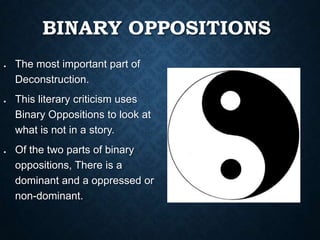
BINARY OPPOSITIONS
The most important part of
Deconstruction.
This literary criticism uses
Binary Oppositions to look at
what is not in a story.
Of the two parts of binary
oppositions, There is a
dominant and a oppressed or
non-dominant.
OTHERS INVOLVED
Roland Barthes(1915-1980) – French Theorist whom worked on the
development of structuralism and Deconstruction.
Vladamir Propp(1895-1970) – Russian scholar that worked on folk
tales.
Jonathan Culler(1944-Today) – Worked at Cornell University; Worked
on Structuralism.
IMPACT OF
DECONSTRUCTION
Takes away from the text
because you are looking for
what's not there.
Makes literature seem like
―Word Play‖
Humanists view it as a ―wedge
between life and literature‖
Looks for the Ideologies that
are in our language.
DECONSTRUCTION IN
PRACTICE
In deconstruction the signified and the
signifier are unstable, and can take on
multiple meanings.
We live in a logo centric world – We want
to believe that everything is grounded.
In Deconstruction, this is the opposite of
the logo centric view.
DECONSTRUCTIVE
ANALYSIS
In a Deconstructive analysis you are looking to
reverse the dominant and non-dominant binary
oppositions.
Giving the privileged status to the oppressed of
the two Binary opposites.
Tries to find blind spots in the literature.
Derrida derived this method because ―By
deconstructing constraints, he tried to open new
ways of thinking and knowing‖(Dobie)
• Look at Symbolism of snow to
extract the opposite:
• White
• Cold
• Winter
• Usually symbolizing death so
the opposite could be life.
• This poem then could be
talking about the Rebirth of
humans in religion.
Snow
By Frederick Seidel
Snow is what it does.
It falls and it stays and it goes.
It melts and it is here
somewhere.
We all will get there.
Source: Poetry (September 2012).
SIX LINES FOR LOUISE BOGAN
• This poem almost deconstructs
itself.
• Notice that there are 2 parts to
each sentence, making 4 in each
line.
• This poem tells of each opposite
in itself.
• Tamed
• Love
• Wildness
• Beloved
Six Lines for Louise Bogan
By Michael Collier
All that has tamed me I have learned
to love
and lost that wildness that was
once beloved.
All that was loved I’ve learned to tame
and lost the beloved that once
was wild.
All that is wild is tamed by love—
and the beloved (wildness) that
once was loved.
Source: Poetry (April 2012).
CREDITS AND CITATIONS
Dobie, Ann B. Theory into Practice. Wadsworth, Cengage Learning,
2012. Paperback.
Slide 2: http://xkcd.com/451/
Slide 4:
http://2.bp.blogspot.com/_BA__Bih8snc/S7RYxRBiiiI/AAAAAAAACT4/1KUXSjC1SL8/s1600/p1.jpg
Slide 5:
http://www.cepolina.com/photo/art/architecture/tensile_structure/5/tensile_structure_cone_column.jpg
Slide 6:
http://upload.wikimedia.org/wikipedia/commons/thumb/d/de/Ferdinand_de_Saussure_by_Jullien.png/406
px-Ferdinand_de_Saussure_by_Jullien.png
Slide 9: http://alexakeeler.files.wordpress.com/2011/04/yin-yang1.jpg
Slide 11: http://nukeitfromorbit.com/xnuke.jpg.pagespeed.ic.XD9-0bi6PQ.jpg
Slide 12: http://www.englishbiz.co.uk/images/rightwrongtshirt.gif

Deconstruction

  • 1.
  • 2.
    WHAT IS DECONSTRUCTION? • JacquesDerrida • Explained as a strategy “Rules for reading, interpretation and writing.”
  • 3.
    HISTORY OF DECONSTRUCTION • ReneDescartes (1596-1650) and Fredrick Nietzsche (1844-1900) were pioneers in deconstruction. • They began to question the objective truth of language. • This is also known as Poststructuralist, this criticism came after structuralism.
  • 4.
    STRUCTURALISM • This isthe prelude to Deconstruction. • It is a science that seeks to understand how a system works, In this case, Language. • The structure of language comes from the human mind.
  • 5.
    FERDINAND DE SAUSSURE •Looked at language Diachronically. • He traced words over time looking for the changes in sounds and meanings.
  • 6.
    RULES OF LANGUAGE •These rules of language were developed by Ferdinand de Saussure. • Langue - Language is made of a set of rules, known as this. • Parole - General rules of language applied by members of a specific community. • Signs – He depicted language as a set of signs, that came in two parts the Signifier and the Signified
  • 7.
    SIGNIFIED AND SIGNIFIERIN DECONSTRUCTION • Signifier – The written and sound construction that makes up a word • Signified – The meaning of the word. • Deconstruction looks at the ambiguities in signifiers, and states that there can be many different signified meanings for a single signifier
  • 8.
    BINARY OPPOSITIONS The mostimportant part of Deconstruction. This literary criticism uses Binary Oppositions to look at what is not in a story. Of the two parts of binary oppositions, There is a dominant and a oppressed or non-dominant.
  • 9.
    OTHERS INVOLVED Roland Barthes(1915-1980)– French Theorist whom worked on the development of structuralism and Deconstruction. Vladamir Propp(1895-1970) – Russian scholar that worked on folk tales. Jonathan Culler(1944-Today) – Worked at Cornell University; Worked on Structuralism.
  • 10.
    IMPACT OF DECONSTRUCTION Takes awayfrom the text because you are looking for what's not there. Makes literature seem like ―Word Play‖ Humanists view it as a ―wedge between life and literature‖ Looks for the Ideologies that are in our language.
  • 11.
    DECONSTRUCTION IN PRACTICE In deconstructionthe signified and the signifier are unstable, and can take on multiple meanings. We live in a logo centric world – We want to believe that everything is grounded. In Deconstruction, this is the opposite of the logo centric view.
  • 12.
    DECONSTRUCTIVE ANALYSIS In a Deconstructiveanalysis you are looking to reverse the dominant and non-dominant binary oppositions. Giving the privileged status to the oppressed of the two Binary opposites. Tries to find blind spots in the literature. Derrida derived this method because ―By deconstructing constraints, he tried to open new ways of thinking and knowing‖(Dobie)
  • 13.
    • Look atSymbolism of snow to extract the opposite: • White • Cold • Winter • Usually symbolizing death so the opposite could be life. • This poem then could be talking about the Rebirth of humans in religion. Snow By Frederick Seidel Snow is what it does. It falls and it stays and it goes. It melts and it is here somewhere. We all will get there. Source: Poetry (September 2012).
  • 14.
    SIX LINES FORLOUISE BOGAN • This poem almost deconstructs itself. • Notice that there are 2 parts to each sentence, making 4 in each line. • This poem tells of each opposite in itself. • Tamed • Love • Wildness • Beloved Six Lines for Louise Bogan By Michael Collier All that has tamed me I have learned to love and lost that wildness that was once beloved. All that was loved I’ve learned to tame and lost the beloved that once was wild. All that is wild is tamed by love— and the beloved (wildness) that once was loved. Source: Poetry (April 2012).
  • 15.
    CREDITS AND CITATIONS Dobie,Ann B. Theory into Practice. Wadsworth, Cengage Learning, 2012. Paperback. Slide 2: http://xkcd.com/451/ Slide 4: http://2.bp.blogspot.com/_BA__Bih8snc/S7RYxRBiiiI/AAAAAAAACT4/1KUXSjC1SL8/s1600/p1.jpg Slide 5: http://www.cepolina.com/photo/art/architecture/tensile_structure/5/tensile_structure_cone_column.jpg Slide 6: http://upload.wikimedia.org/wikipedia/commons/thumb/d/de/Ferdinand_de_Saussure_by_Jullien.png/406 px-Ferdinand_de_Saussure_by_Jullien.png Slide 9: http://alexakeeler.files.wordpress.com/2011/04/yin-yang1.jpg Slide 11: http://nukeitfromorbit.com/xnuke.jpg.pagespeed.ic.XD9-0bi6PQ.jpg Slide 12: http://www.englishbiz.co.uk/images/rightwrongtshirt.gif