Figures of
Speech
What is the difference
between
LITERAL and FIGURATIVE
Language?
LITERAL FIGURATIVE
 The actual,
dictionary
meaning of a
word; language
that means what
it appears to
mean.
 Language that
goes beyond
the normal
meaning of the
words used.
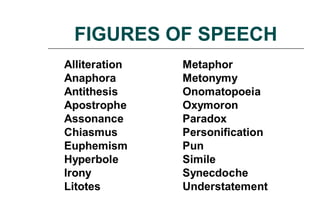
FIGURES OF SPEECH
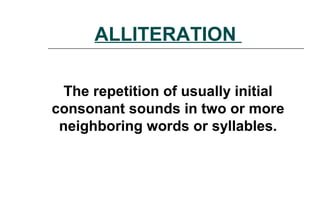
ALLITERATION
The repetition of usually initial
consonant sounds in two or more
neighboring words or syllables.
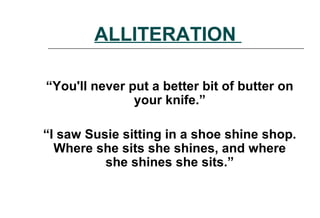
ALLITERATION
“You'll never put a better bit of butter on
your knife.”
“I saw Susie sitting in a shoe shine shop.
Where she sits she shines, and where
she shines she sits.”
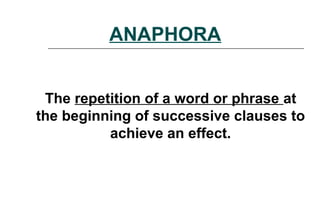
ANAPHORA
The repetition of a word or phrase at
the beginning of successive clauses to
achieve an effect.
ANAPHORA
“We shall go on to the end, we shall fight in
France, we shall fight on the seas and
oceans, we shall fight with growing
confidence and growing strength in the air,
we shall defend our Island, whatever the cost
may be, we shall fight on the beaches, we
shall fight on the landing grounds, we shall
fight in the fields and in the streets, we shall
fight in the hills; we shall never surrender.”
ANTITHESIS
An opposition or contrast of ideas.
Two opposite ideas are put together
to achieve an contrasting effect.
ANTITHESIS
“Speech is silver, but silence is gold.”
“Love is an ideal thing, marriage a real
thing.”
“Many are called, but few are chosen.”
APOSTROPHE
When you speak up into an object, an
idea, or someone who doesn’t exist as
if it is a living person.
APOSTROPHE
“Hello darkness, my old friend
I've come to talk with you again..”
“Twinkle, twinkle, little star, how I
wonder what you are..”
“Oh, pillow, thank you for being my
shoulder when I’m alone.”
ASSONANCE
Identity or similarity in sound
between internal vowels in
neighboring words.
ASSONANCE
"It beats as it sweeps as it cleans.“
"Old age should burn and rave at close
of day; Rage, rage, against the dying
of the light.”
“Johnny went here and there and
everywhere.”
CHIASMUS
A verbal pattern in which the second
half of an expression is balanced
against the first but with the parts
reversed.
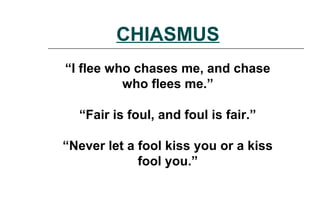
CHIASMUS
“I flee who chases me, and chase
who flees me.”
“Fair is foul, and foul is fair.”
“Never let a fool kiss you or a kiss
fool you.”
EUPHENISM
A mild or indirect word or expression
substituted for one considered to be too
harsh or unpleasant.
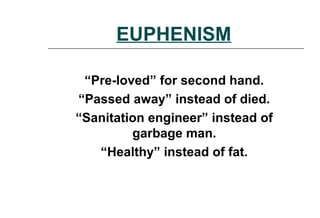
EUPHENISM
“Pre-loved” for second hand.
“Passed away” instead of died.
“Sanitation engineer” instead of
garbage man.
“Healthy” instead of fat.
HYPERBOLE
An extravagant statement; the use of
exaggerated terms for the purpose of
emphasis or heightened effect.
HYPERBOLE
“I am so hungry I could eat a horse.”
“I have a million things to do.”
“If I can’t buy that new game, I will die.”
“I'll love you, dear, I'll love you till China
and Africa meet.”
IRONY
The use of words to convey the opposite
of their literal meaning.
A statement or situation where the
meaning is contradicted by the appearance
or presentation of the idea.
IRONY
Situational Irony – where actions or events have
opposite result from what is expected.
Verbal Irony – where someone says the
opposite of what they really mean or intend.
Dramatic Irony – occurs when the audience or
reader of a text knows something that the
characters do not.
IRONY
A pilot with a fear of heights.
Saying “oh great” after failing the
exam.
In horror movies, the audience aware
that there is a killer in the house, but
the character does not.
LITOTES
A figure of speech consisting of an
understatement in which an affirmative
is expressed by negating its opposite.
LITOTES
If a person is very intelligent, someone
might say, “he’s not dumb.” or “he’s not
unintelligent.”
After someone hires you, you might say,
“thank you ma’am, you won’t regret it.”
METAPHOR
Involves a comparison between two
relatively unlike things without the
use of “like” or “as”.
METAPHOR
Time is a thief.
He has a heart of stone.
His head was spinning with ideas.
John is a real pig when he eats.
You are my sunshine.
METONYMY
Which a word or phrase is substituted
for another with which it is closely
associated; also, the rhetorical strategy
of describing something indirectly by
referring to things around it.
METONYMY
“Pen is mightier than the sword.”
Let me give you a hand.
“Friends, Romans, countrymen, lend
me your ears.”
ONOMATOPEIA
The formation or use of words that
imitate the sounds associated with the
objects or actions they refer to.
ONOMATOPEIA
"Plop, plop, fizz, fizz, oh what a relief it
is.”
The firecracker made a loud ka-boom!
Both bees and buzzers buzz.
The bird’s chirp filled the empty night
air.
OXYMORON
A figure of speech in which
incongruous or contradictory
terms appear side by side.
OXYMORON
“A yawn may be defined as a silent yell.”
“O miserable abundance, O beggarly
riches!”
“That building is a little bit big and pretty
ugly.”
“Cruel kindness”
“Living death”
PARADOX
Contrary to expectations, existing belief
or perceived opinion. It is a statement
that appears to be self-contradictory.
PARADOX
"War is peace."
"Freedom is slavery."
"Ignorance is strength.“
You can save money by
spending it.
A rich man is no richer than a
poor man.
PERSONIFICATION
A figure of speech in which an
inanimate object or abstraction is
endowed with human qualities or
abilities.
PERSONIFICATION
The stars danced playfully in the
moonlit sky.
The run down house appeared
depressed.
The first rays of morning tiptoed
through the meadow.
She did not realize that opportunity
was knocking at her door.
PUN
A play on words, sometimes on different
senses of the same word and
sometimes on the similar sense or
sound of different words.
PUN
“When it rains, it pours.”
A horse is a very stable animal.
Time flies like an arrow. Fruit flies like a
banana.
The two pianists had a good marriage.
They were always in a chord.
SIMILE
A stated comparison (usually formed with
"like" or "as") between two fundamentally
dissimilar things that have certain
qualities in common.
SIMILE
My love is like a red, red rose.
You were as brave as a lion.
They fought like cats and dogs.
He is as funny as a barrel of monkeys.
He is skinny like a toothpick.
SYNECDOCHE
A figure of speech is which a part is
used to represent the whole, the whole
for a part, the specific for the general,
the general for the specific, or the
material for the thing made from it.
SYNECHDOCHE
His parents bought him a new set
of wheels.
“Hey men, good threads.”
“Take your face out.”
UNDERSTATEMENT
A figure of speech in which a writer or a
speaker deliberately makes a situation
seem less important or serious than it
is.
UNDERSTATEMENT
“I have to have this operation… It
isn't very serious. I have this tiny
little tumor on the brain.”
“I know a little about running a
company.” –comment by a
businessman.
LOVE IS A DREAM
Love is a dream
Its gone as we wake up
Leaving some moments
To be cherished
Love is like a wind
It embraces us with passion
leaving the scent of fresh flowers
tingling our mind
Love is like a water bubble
Beautiful to see from far
Even rainbows are visible
But a tender touch will break it
Leaving a refreshing sprinkle
Love resembles a shadow
We try to escape but it follow
At times it makes us hollow
It disappears with the sun
And leave us in the Nights
To Haunt all over again
LOVE IS A DREAM

Figures of Speech

  • 1.
  • 2.
    What is thedifference between LITERAL and FIGURATIVE Language?
  • 3.
    LITERAL FIGURATIVE  Theactual, dictionary meaning of a word; language that means what it appears to mean.  Language that goes beyond the normal meaning of the words used.
  • 4.
  • 5.
    ALLITERATION The repetition ofusually initial consonant sounds in two or more neighboring words or syllables.
  • 6.
    ALLITERATION “You'll never puta better bit of butter on your knife.” “I saw Susie sitting in a shoe shine shop. Where she sits she shines, and where she shines she sits.”
  • 7.
    ANAPHORA The repetition ofa word or phrase at the beginning of successive clauses to achieve an effect.
  • 8.
    ANAPHORA “We shall goon to the end, we shall fight in France, we shall fight on the seas and oceans, we shall fight with growing confidence and growing strength in the air, we shall defend our Island, whatever the cost may be, we shall fight on the beaches, we shall fight on the landing grounds, we shall fight in the fields and in the streets, we shall fight in the hills; we shall never surrender.”
  • 9.
    ANTITHESIS An opposition orcontrast of ideas. Two opposite ideas are put together to achieve an contrasting effect.
  • 10.
    ANTITHESIS “Speech is silver,but silence is gold.” “Love is an ideal thing, marriage a real thing.” “Many are called, but few are chosen.”
  • 11.
    APOSTROPHE When you speakup into an object, an idea, or someone who doesn’t exist as if it is a living person.
  • 12.
    APOSTROPHE “Hello darkness, myold friend I've come to talk with you again..” “Twinkle, twinkle, little star, how I wonder what you are..” “Oh, pillow, thank you for being my shoulder when I’m alone.”
  • 13.
    ASSONANCE Identity or similarityin sound between internal vowels in neighboring words.
  • 14.
    ASSONANCE "It beats asit sweeps as it cleans.“ "Old age should burn and rave at close of day; Rage, rage, against the dying of the light.” “Johnny went here and there and everywhere.”
  • 15.
    CHIASMUS A verbal patternin which the second half of an expression is balanced against the first but with the parts reversed.
  • 16.
    CHIASMUS “I flee whochases me, and chase who flees me.” “Fair is foul, and foul is fair.” “Never let a fool kiss you or a kiss fool you.”
  • 17.
    EUPHENISM A mild orindirect word or expression substituted for one considered to be too harsh or unpleasant.
  • 18.
    EUPHENISM “Pre-loved” for secondhand. “Passed away” instead of died. “Sanitation engineer” instead of garbage man. “Healthy” instead of fat.
  • 19.
    HYPERBOLE An extravagant statement;the use of exaggerated terms for the purpose of emphasis or heightened effect.
  • 20.
    HYPERBOLE “I am sohungry I could eat a horse.” “I have a million things to do.” “If I can’t buy that new game, I will die.” “I'll love you, dear, I'll love you till China and Africa meet.”
  • 21.
    IRONY The use ofwords to convey the opposite of their literal meaning. A statement or situation where the meaning is contradicted by the appearance or presentation of the idea.
  • 22.
    IRONY Situational Irony –where actions or events have opposite result from what is expected. Verbal Irony – where someone says the opposite of what they really mean or intend. Dramatic Irony – occurs when the audience or reader of a text knows something that the characters do not.
  • 23.
    IRONY A pilot witha fear of heights. Saying “oh great” after failing the exam. In horror movies, the audience aware that there is a killer in the house, but the character does not.
  • 24.
    LITOTES A figure ofspeech consisting of an understatement in which an affirmative is expressed by negating its opposite.
  • 25.
    LITOTES If a personis very intelligent, someone might say, “he’s not dumb.” or “he’s not unintelligent.” After someone hires you, you might say, “thank you ma’am, you won’t regret it.”
  • 26.
    METAPHOR Involves a comparisonbetween two relatively unlike things without the use of “like” or “as”.
  • 27.
    METAPHOR Time is athief. He has a heart of stone. His head was spinning with ideas. John is a real pig when he eats. You are my sunshine.
  • 28.
    METONYMY Which a wordor phrase is substituted for another with which it is closely associated; also, the rhetorical strategy of describing something indirectly by referring to things around it.
  • 29.
    METONYMY “Pen is mightierthan the sword.” Let me give you a hand. “Friends, Romans, countrymen, lend me your ears.”
  • 30.
    ONOMATOPEIA The formation oruse of words that imitate the sounds associated with the objects or actions they refer to.
  • 31.
    ONOMATOPEIA "Plop, plop, fizz,fizz, oh what a relief it is.” The firecracker made a loud ka-boom! Both bees and buzzers buzz. The bird’s chirp filled the empty night air.
  • 32.
    OXYMORON A figure ofspeech in which incongruous or contradictory terms appear side by side.
  • 33.
    OXYMORON “A yawn maybe defined as a silent yell.” “O miserable abundance, O beggarly riches!” “That building is a little bit big and pretty ugly.” “Cruel kindness” “Living death”
  • 34.
    PARADOX Contrary to expectations,existing belief or perceived opinion. It is a statement that appears to be self-contradictory.
  • 35.
    PARADOX "War is peace." "Freedomis slavery." "Ignorance is strength.“ You can save money by spending it. A rich man is no richer than a poor man.
  • 36.
    PERSONIFICATION A figure ofspeech in which an inanimate object or abstraction is endowed with human qualities or abilities.
  • 37.
    PERSONIFICATION The stars dancedplayfully in the moonlit sky. The run down house appeared depressed. The first rays of morning tiptoed through the meadow. She did not realize that opportunity was knocking at her door.
  • 38.
    PUN A play onwords, sometimes on different senses of the same word and sometimes on the similar sense or sound of different words.
  • 39.
    PUN “When it rains,it pours.” A horse is a very stable animal. Time flies like an arrow. Fruit flies like a banana. The two pianists had a good marriage. They were always in a chord.
  • 40.
    SIMILE A stated comparison(usually formed with "like" or "as") between two fundamentally dissimilar things that have certain qualities in common.
  • 41.
    SIMILE My love islike a red, red rose. You were as brave as a lion. They fought like cats and dogs. He is as funny as a barrel of monkeys. He is skinny like a toothpick.
  • 42.
    SYNECDOCHE A figure ofspeech is which a part is used to represent the whole, the whole for a part, the specific for the general, the general for the specific, or the material for the thing made from it.
  • 43.
    SYNECHDOCHE His parents boughthim a new set of wheels. “Hey men, good threads.” “Take your face out.”
  • 44.
    UNDERSTATEMENT A figure ofspeech in which a writer or a speaker deliberately makes a situation seem less important or serious than it is.
  • 45.
    UNDERSTATEMENT “I have tohave this operation… It isn't very serious. I have this tiny little tumor on the brain.” “I know a little about running a company.” –comment by a businessman.
  • 46.
    LOVE IS ADREAM Love is a dream Its gone as we wake up Leaving some moments To be cherished Love is like a wind It embraces us with passion leaving the scent of fresh flowers tingling our mind Love is like a water bubble Beautiful to see from far
  • 47.
    Even rainbows arevisible But a tender touch will break it Leaving a refreshing sprinkle Love resembles a shadow We try to escape but it follow At times it makes us hollow It disappears with the sun And leave us in the Nights To Haunt all over again LOVE IS A DREAM