Tunneling Safety
johnanewquist@gmail.com
Draft 9 28 14 2015
Structural Issues
• Rock Fall - Fall of rock blocks of major
dimensions. The different
mechanisms involved are wedge or
planar failure..
• Collapse Heading collapse - failure of
the heading / lining failure .
• Daylight Collapse Heading collapse -
lining failure of the heading that
reaches the surface creating a crater.
• Excessive Deformation - Excessive
deformations inside the tunnel or at
the surface. This can occur for
example due to deficient design,
construction defects and/or due to
particular type of terrains such as
swelling and squeezing ground,
which had not been predicted.
• Flooding - Comprises cases where the
tunnel was invaded by large
quantities of underground water.
• Rock Burst - Spalling Overstressing of
massive or intact brittle rock, i.e. the
stresses developed in the ground
exceed the local strength of the
material. It can cause spalling or in
the worst cases sudden and violent
failure of the rock mass
• Portal failure - Particular locations of
a tunnel, where there is a lower
• Shaft failure - resistance of ground
mass and/ or concentration of
stresses.
• Other - Other types of collapse that
include slope failures, etc
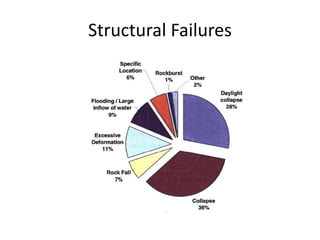
Structural Failures
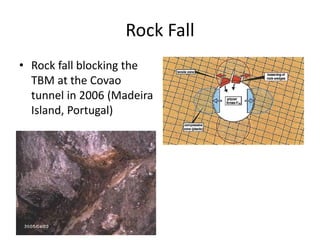
Rock Fall
• Rock fall blocking the
TBM at the Covao
tunnel in 2006 (Madeira
Island, Portugal)
Collapse
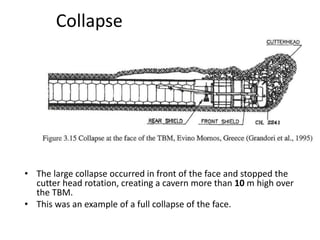
• The large collapse occurred in front of the face and stopped the
cutter head rotation, creating a cavern more than 10 m high over
the TBM.
• This was an example of a full collapse of the face.
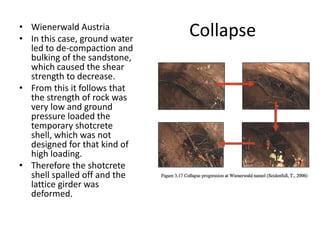
Collapse• Wienerwald Austria
• In this case, ground water
led to de-compaction and
bulking of the sandstone,
which caused the shear
strength to decrease.
• From this it follows that
the strength of rock was
very low and ground
pressure loaded the
temporary shotcrete
shell, which was not
designed for that kind of
high loading.
• Therefore the shotcrete
shell spalled off and the
lattice girder was
deformed.
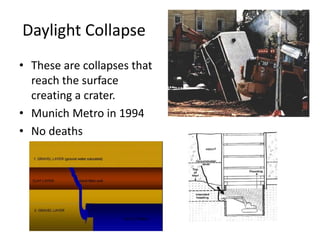
Daylight Collapse
• These are collapses that
reach the surface
creating a crater.
• Munich Metro in 1994
• No deaths
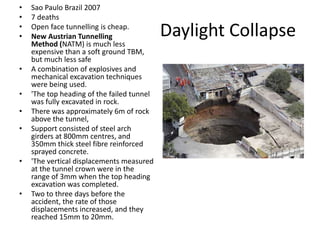
Daylight Collapse
• Sao Paulo Brazil 2007
• 7 deaths
• Open face tunnelling is cheap.
• New Austrian Tunnelling
Method (NATM) is much less
expensive than a soft ground TBM,
but much less safe
• A combination of explosives and
mechanical excavation techniques
were being used.
• 'The top heading of the failed tunnel
was fully excavated in rock.
• There was approximately 6m of rock
above the tunnel,
• Support consisted of steel arch
girders at 800mm centres, and
350mm thick steel fibre reinforced
sprayed concrete.
• 'The vertical displacements measured
at the tunnel crown were in the
range of 3mm when the top heading
excavation was completed.
• Two to three days before the
accident, the rate of those
displacements increased, and they
reached 15mm to 20mm.
Daylight Collapse
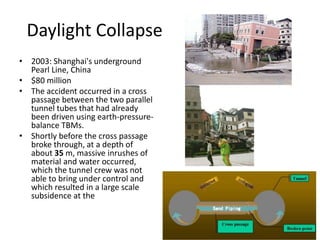
• 2003: Shanghai's underground
Pearl Line, China
• $80 million
• The accident occurred in a cross
passage between the two parallel
tunnel tubes that had already
been driven using earth-pressure-
balance TBMs.
• Shortly before the cross passage
broke through, at a depth of
about 35 m, massive inrushes of
material and water occurred,
which the tunnel crew was not
able to bring under control and
which resulted in a large scale
subsidence at the
Daylight Collapse
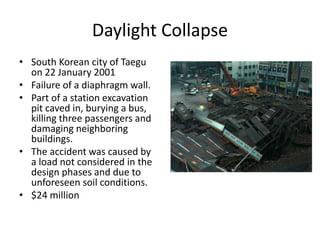
• South Korean city of Taegu
on 22 January 2001
• Failure of a diaphragm wall.
• Part of a station excavation
pit caved in, burying a bus,
killing three passengers and
damaging neighboring
buildings.
• The accident was caused by
a load not considered in the
design phases and due to
unforeseen soil conditions.
• $24 million
Flooding
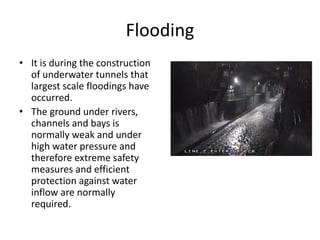
• It is during the construction
of underwater tunnels that
largest scale floodings have
occurred.
• The ground under rivers,
channels and bays is
normally weak and under
high water pressure and
therefore extreme safety
measures and efficient
protection against water
inflow are normally
required.
Flooding
• Seikan tunnel is a 53.85 km long
railway tunnel in Japan
• 1963-1976
• Four floods
• 23 deaths
• Leaks and soft rock
• TBM not practical due to the
various types of soils.
• Drill and pound.
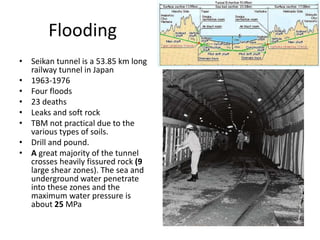
• A great majority of the tunnel
crosses heavily fissured rock (9
large shear zones). The sea and
underground water penetrate
into these zones and the
maximum water pressure is
about 25 MPa
Flooding
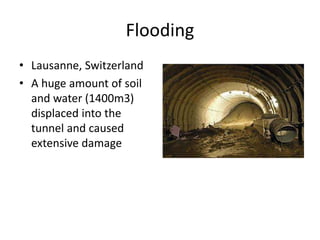
• Lausanne, Switzerland
• A huge amount of soil
and water (1400m3)
displaced into the
tunnel and caused
extensive damage
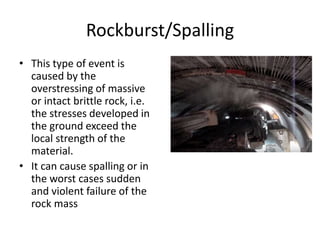
Rockburst/Spalling
• This type of event is
caused by the
overstressing of massive
or intact brittle rock, i.e.
the stresses developed in
the ground exceed the
local strength of the
material.
• It can cause spalling or in
the worst cases sudden
and violent failure of the
rock mass
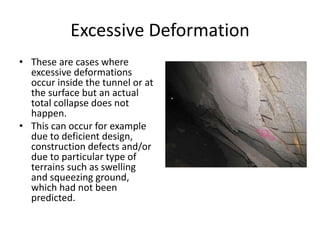
Excessive Deformation
• These are cases where
excessive deformations
occur inside the tunnel or at
the surface but an actual
total collapse does not
happen.
• This can occur for example
due to deficient design,
construction defects and/or
due to particular type of
terrains such as swelling
and squeezing ground,
which had not been
predicted.
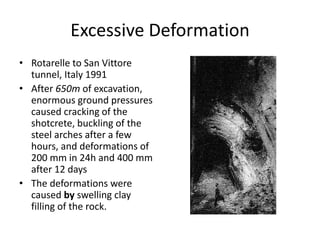
Excessive Deformation
• Rotarelle to San Vittore
tunnel, Italy 1991
• After 650m of excavation,
enormous ground pressures
caused cracking of the
shotcrete, buckling of the
steel arches after a few
hours, and deformations of
200 mm in 24h and 400 mm
after 12 days
• The deformations were
caused by swelling clay
filling of the rock.
Excessive Deformation
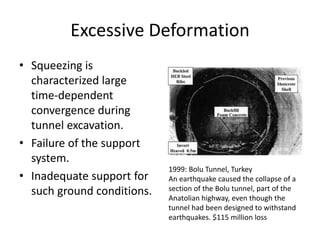
• Squeezing is
characterized large
time-dependent
convergence during
tunnel excavation.
• Failure of the support
system.
• Inadequate support for
such ground conditions.
1999: Bolu Tunnel, Turkey
An earthquake caused the collapse of a
section of the Bolu tunnel, part of the
Anatolian highway, even though the
tunnel had been designed to withstand
earthquakes. $115 million loss
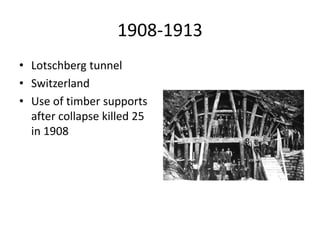
1908-1913
• Lotschberg tunnel
• Switzerland
• Use of timber supports
after collapse killed 25
in 1908
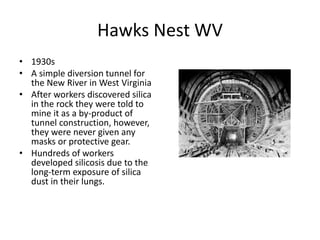
Hawks Nest WV
• 1930s
• A simple diversion tunnel for
the New River in West Virginia
• After workers discovered silica
in the rock they were told to
mine it as a by-product of
tunnel construction, however,
they were never given any
masks or protective gear.
• Hundreds of workers
developed silicosis due to the
long-term exposure of silica
dust in their lungs.
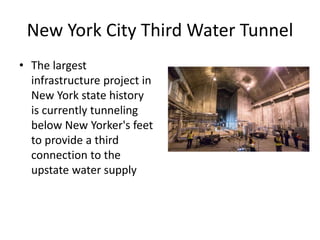
New York City Third Water Tunnel
• The largest
infrastructure project in
New York state history
is currently tunneling
below New Yorker's feet
to provide a third
connection to the
upstate water supply
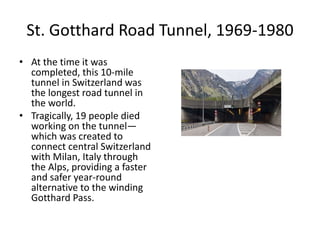
St. Gotthard Road Tunnel, 1969-1980
• At the time it was
completed, this 10-mile
tunnel in Switzerland was
the longest road tunnel in
the world.
• Tragically, 19 people died
working on the tunnel—
which was created to
connect central Switzerland
with Milan, Italy through
the Alps, providing a faster
and safer year-round
alternative to the winding
Gotthard Pass.
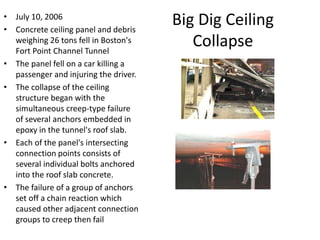
Big Dig Ceiling
Collapse
• July 10, 2006
• Concrete ceiling panel and debris
weighing 26 tons fell in Boston's
Fort Point Channel Tunnel
• The panel fell on a car killing a
passenger and injuring the driver.
• The collapse of the ceiling
structure began with the
simultaneous creep-type failure
of several anchors embedded in
epoxy in the tunnel's roof slab.
• Each of the panel's intersecting
connection points consists of
several individual bolts anchored
into the roof slab concrete.
• The failure of a group of anchors
set off a chain reaction which
caused other adjacent connection
groups to creep then fail
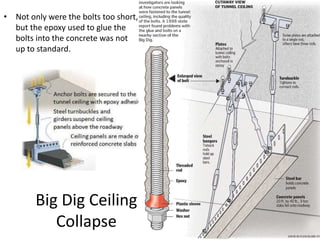
Big Dig Ceiling
Collapse
• Not only were the bolts too short,
but the epoxy used to glue the
bolts into the concrete was not
up to standard.
Big Dig Ceiling
Collapse
• Major cause of the collapse to
"epoxy creep“
• On August 8, 2007, a Suffolk
County Grand Jury indicted epoxy
company Powers Fasteners, Inc.,
on one charge of involuntary
manslaughter, with the maximum
penalty in Massachusetts being a
fine of one thousand dollars.[10]
• The epoxy used in the D Street
portal that failed cost $1287.60.
The cost to redesign, inspect, and
repair all of the tunnels after the
collapse was $54 million.[1
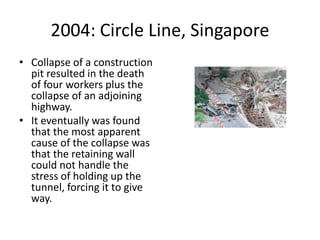
2004: Circle Line, Singapore
• Collapse of a construction
pit resulted in the death
of four workers plus the
collapse of an adjoining
highway.
• It eventually was found
that the most apparent
cause of the collapse was
that the retaining wall
could not handle the
stress of holding up the
tunnel, forcing it to give
way.
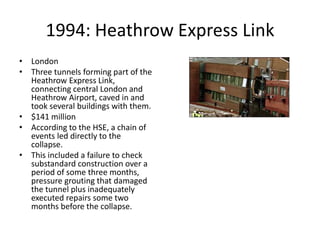
1994: Heathrow Express Link
• London
• Three tunnels forming part of the
Heathrow Express Link,
connecting central London and
Heathrow Airport, caved in and
took several buildings with them.
• $141 million
• According to the HSE, a chain of
events led directly to the
collapse.
• This included a failure to check
substandard construction over a
period of some three months,
pressure grouting that damaged
the tunnel plus inadequately
executed repairs some two
months before the collapse.
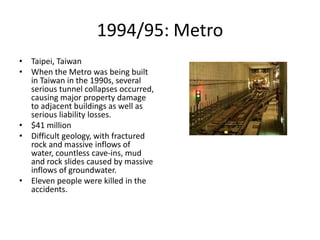
1994/95: Metro
• Taipei, Taiwan
• When the Metro was being built
in Taiwan in the 1990s, several
serious tunnel collapses occurred,
causing major property damage
to adjacent buildings as well as
serious liability losses.
• $41 million
• Difficult geology, with fractured
rock and massive inflows of
water, countless cave-ins, mud
and rock slides caused by massive
inflows of groundwater.
• Eleven people were killed in the
accidents.
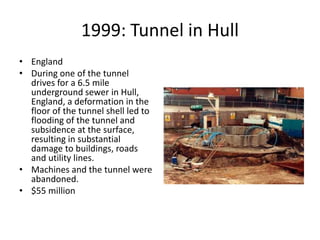
1999: Tunnel in Hull
• England
• During one of the tunnel
drives for a 6.5 mile
underground sewer in Hull,
England, a deformation in the
floor of the tunnel shell led to
flooding of the tunnel and
subsidence at the surface,
resulting in substantial
damage to buildings, roads
and utility lines.
• Machines and the tunnel were
abandoned.
• $55 million
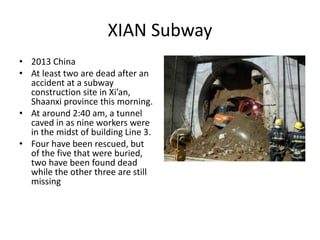
XIAN Subway
• 2013 China
• At least two are dead after an
accident at a subway
construction site in Xi’an,
Shaanxi province this morning.
• At around 2:40 am, a tunnel
caved in as nine workers were
in the midst of building Line 3.
• Four have been rescued, but
of the five that were buried,
two have been found dead
while the other three are still
missing
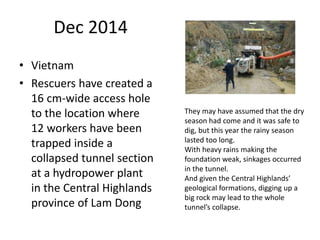
Dec 2014
• Vietnam
• Rescuers have created a
16 cm-wide access hole
to the location where
12 workers have been
trapped inside a
collapsed tunnel section
at a hydropower plant
in the Central Highlands
province of Lam Dong
They may have assumed that the dry
season had come and it was safe to
dig, but this year the rainy season
lasted too long.
With heavy rains making the
foundation weak, sinkages occurred
in the tunnel.
And given the Central Highlands’
geological formations, digging up a
big rock may lead to the whole
tunnel’s collapse.
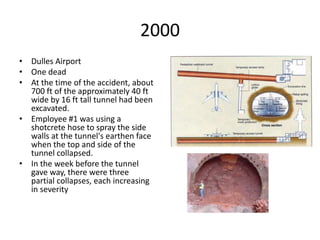
2000
• Dulles Airport
• One dead
• At the time of the accident, about
700 ft of the approximately 40 ft
wide by 16 ft tall tunnel had been
excavated.
• Employee #1 was using a
shotcrete hose to spray the side
walls at the tunnel's earthen face
when the top and side of the
tunnel collapsed.
• In the week before the tunnel
gave way, there were three
partial collapses, each increasing
in severity
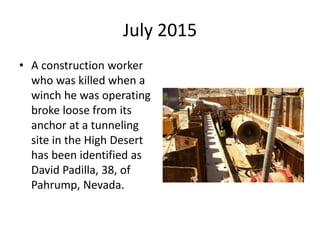
July 2015
• A construction worker
who was killed when a
winch he was operating
broke loose from its
anchor at a tunneling
site in the High Desert
has been identified as
David Padilla, 38, of
Pahrump, Nevada.
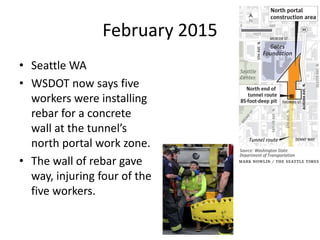
February 2015
• Seattle WA
• WSDOT now says five
workers were installing
rebar for a concrete
wall at the tunnel’s
north portal work zone.
• The wall of rebar gave
way, injuring four of the
five workers.
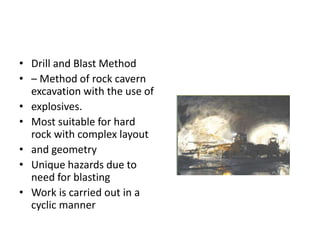
• Drill and Blast Method
• – Method of rock cavern
excavation with the use of
• explosives.
• Most suitable for hard
rock with complex layout
• and geometry
• Unique hazards due to
need for blasting
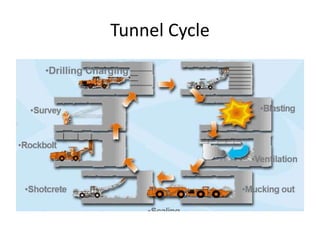
• Work is carried out in a
cyclic manner
Tunnel Cycle
• Uncertainty in the nature and
variability of ground conditions
(rock quality, ground water, gas,
etc) -
• need for adequate site
investigations prior to and
• vigilance during tunnelling
• Confined space of tunnel
environment (limited
• access, escape, air quality
control)
• Difficulty in communications
(sound and signal
• barriers)
• Work in compressed air (soft
ground)
Emergencies
• Ground collapse (need we
say more?)
• Support failure
• Flooding
• Gas explosion
• Oxygen deficiency
• Fire (encountering
inflammable gas)
• Accidents : moving plants
• Plant and power failure
• Stoppages
Blasting Issues
• Falling from heights or
falling on level
(tripping/slipping)
• Materials falling from height
or from stacks or vehicles
• Burial by fall of material
(rock collapse or stacking
collapse)
• Flooding or inrush of water
• Machinery related (cranes,
excavators, etc)
• Vehicles (excavators, dump
trucks)
• Electrical installations
• Fire and explosions (gas and
explosives)
• Air pollution (oxygen
deficiency, toxic fumes &
radon gas)
Blasting
• Blasting a “way of life”
in hard rock tunnelling
• Fly rock
• Airblast and ground
shock
• Toxic fumes
• Accidental explosions
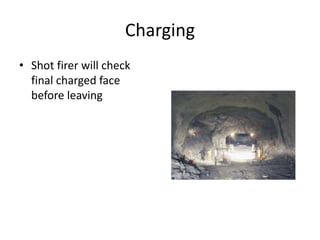
Charging
• Shot firer will check
final charged face
before leaving
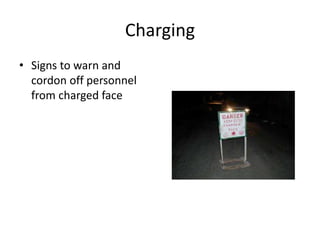
Charging
• Signs to warn and
cordon off personnel
from charged face
Pre Blasting
• Responsibilities of Shot-
firer
• – Connecting the
explosive charges
• – Final checking before
blasting
• – Work with Tunnel
Foremen & Safety
Supervisor to ensure
adequate safety measures
are taken.
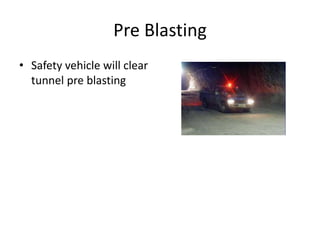
Pre Blasting
• Safety vehicle will clear
tunnel pre blasting
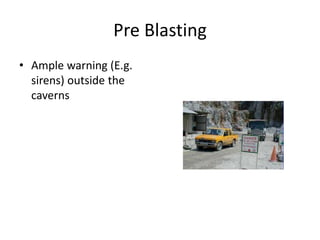
Pre Blasting
• Ample warning (E.g.
sirens) outside the
caverns
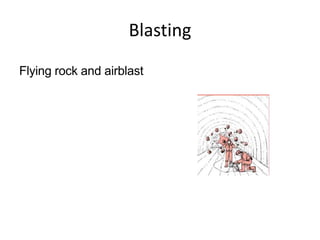
Blasting
Flying rock and airblast
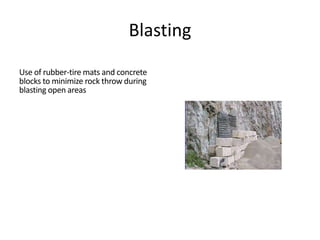
Blasting
Use of rubber-tire mats and concrete
blocks to minimize rock throw during
blasting open areas
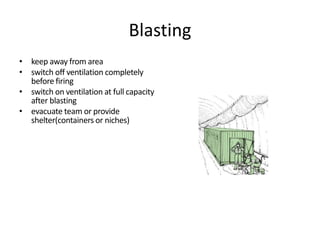
Blasting
• keep away from area
• switch off ventilation completely
before firing
• switch on ventilation at full capacity
after blasting
• evacuate team or provide
shelter(containers or niches)
Misfires
• Should there be no
initiation of explosives,
minimum
• re-entry time must not be
less than 30 mins.
• – After initiation,
minimum retry time must
not be less than 15mins
(after ventilation)
• – Blast inspection team
shall enter tunnel with
appropriate breathing
apparatus.
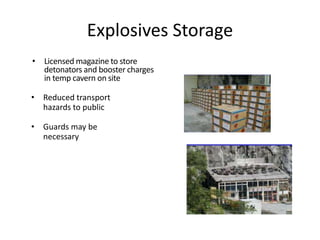
Explosives Storage
• Licensed magazine to store
detonators and booster charges
in temp cavern on site
• Reduced transport
hazards to public
• Guards may be
necessary
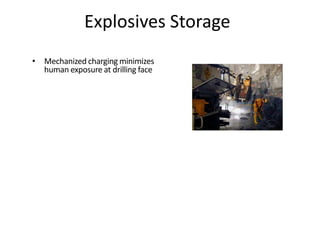
Explosives Storage
• Mechanized charging minimizes
human exposure at drilling face
After Blasting
• Ventilation
• Gas/dust monitoring
• Minimum entry time
after blasting (with
ventilation)
Radon
• Naturally occurring in
rock and soil
• Radon and radon
daughters are radioactive
and can cause adverse
health effects (lung
cancer)
• Is released by exposed
surface, blasted rock,
groundwater, from
outside air
• Conditions improve with
proper ventilation
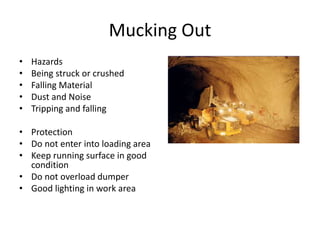
Mucking Out
• Hazards
• Being struck or crushed
• Falling Material
• Dust and Noise
• Tripping and falling
• Protection
• Do not enter into loading area
• Keep running surface in good
condition
• Do not overload dumper
• Good lighting in work area
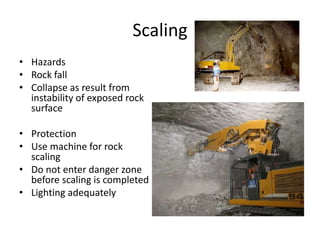
Scaling
• Hazards
• Rock fall
• Collapse as result from
instability of exposed rock
surface
• Protection
• Use machine for rock
scaling
• Do not enter danger zone
before scaling is completed
• Lighting adequately
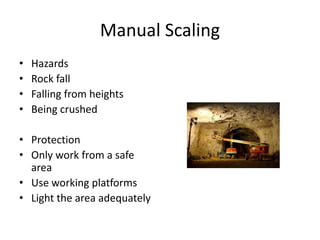
Manual Scaling
• Hazards
• Rock fall
• Falling from heights
• Being crushed
• Protection
• Only work from a safe
area
• Use working platforms
• Light the area adequately
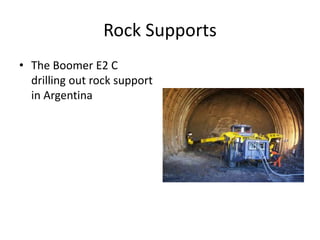
Rock Supports
• The Boomer E2 C
drilling out rock support
in Argentina
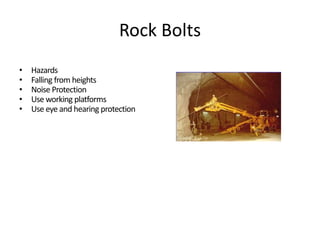
Rock Bolts
• Hazards
• Falling from heights
• Noise Protection
• Use working platforms
• Use eye and hearing protection
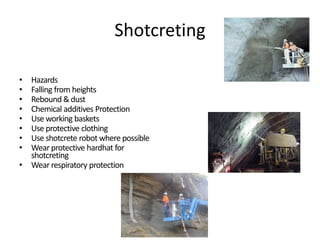
Shotcreting
• Hazards
• Falling from heights
• Rebound & dust
• Chemical additives Protection
• Use working baskets
• Use protective clothing
• Use shotcrete robot where possible
• Wear protective hardhat for
shotcreting
• Wear respiratory protection
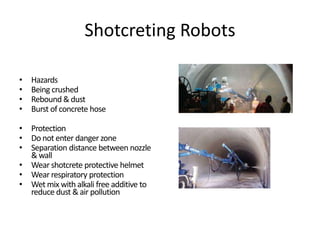
Shotcreting Robots
• Hazards
• Being crushed
• Rebound & dust
• Burst of concrete hose
• Protection
• Donot enter danger zone
• Separation distance between nozzle
& wall
• Wear shotcrete protective helmet
• Wear respiratory protection
• Wet mix with alkali free additive to
reduce dust & air pollution
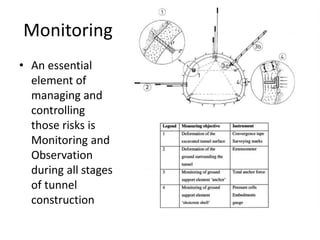
Monitoring
• An essential
element of
managing and
controlling
those risks is
Monitoring and
Observation
during all stages
of tunnel
construction
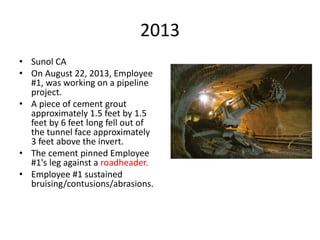
2013
• Sunol CA
• On August 22, 2013, Employee
#1, was working on a pipeline
project.
• A piece of cement grout
approximately 1.5 feet by 1.5
feet by 6 feet long fell out of
the tunnel face approximately
3 feet above the invert.
• The cement pinned Employee
#1's leg against a roadheader.
• Employee #1 sustained
bruising/contusions/abrasions.
2013
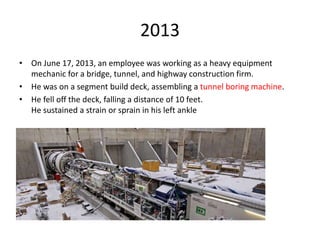
• On June 17, 2013, an employee was working as a heavy equipment
mechanic for a bridge, tunnel, and highway construction firm.
• He was on a segment build deck, assembling a tunnel boring machine.
• He fell off the deck, falling a distance of 10 feet.
He sustained a strain or sprain in his left ankle
2012
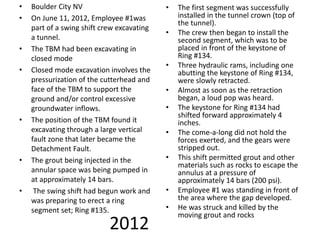
• Boulder City NV
• On June 11, 2012, Employee #1was
part of a swing shift crew excavating
a tunnel.
• The TBM had been excavating in
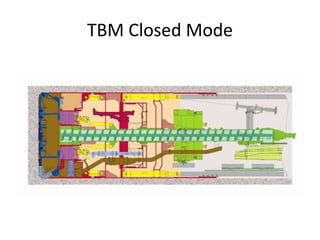
closed mode
• Closed mode excavation involves the
pressurization of the cutterhead and
face of the TBM to support the
ground and/or control excessive
groundwater inflows.
• The position of the TBM found it
excavating through a large vertical
fault zone that later became the
Detachment Fault.
• The grout being injected in the
annular space was being pumped in
at approximately 14 bars.
• The swing shift had begun work and
was preparing to erect a ring
segment set; Ring #135.
• The first segment was successfully
installed in the tunnel crown (top of
the tunnel).
• The crew then began to install the
second segment, which was to be
placed in front of the keystone of
Ring #134.
• Three hydraulic rams, including one
abutting the keystone of Ring #134,
were slowly retracted.
• Almost as soon as the retraction
began, a loud pop was heard.
• The keystone for Ring #134 had
shifted forward approximately 4
inches.
• The come-a-long did not hold the
forces exerted, and the gears were
stripped out.
• This shift permitted grout and other
materials such as rocks to escape the
annulus at a pressure of
approximately 14 bars (200 psi).
• Employee #1 was standing in front of
the area where the gap developed.
• He was struck and killed by the
moving grout and rocks
TBM Closed Mode
2011
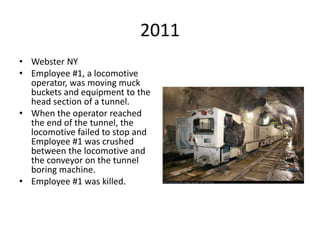
• Webster NY
• Employee #1, a locomotive
operator, was moving muck
buckets and equipment to the
head section of a tunnel.
• When the operator reached
the end of the tunnel, the
locomotive failed to stop and
Employee #1 was crushed
between the locomotive and
the conveyor on the tunnel
boring machine.
• Employee #1 was killed.
2011
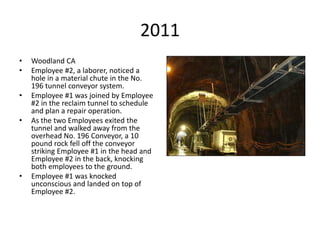
• Woodland CA
• Employee #2, a laborer, noticed a
hole in a material chute in the No.
196 tunnel conveyor system.
• Employee #1 was joined by Employee
#2 in the reclaim tunnel to schedule
and plan a repair operation.
• As the two Employees exited the
tunnel and walked away from the
overhead No. 196 Conveyor, a 10
pound rock fell off the conveyor
striking Employee #1 in the head and
Employee #2 in the back, knocking
both employees to the ground.
• Employee #1 was knocked
unconscious and landed on top of
Employee #2.
2009
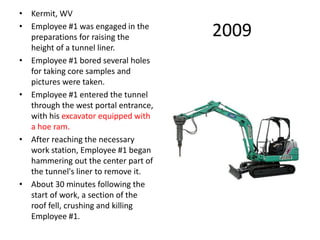
• Kermit, WV
• Employee #1 was engaged in the
preparations for raising the
height of a tunnel liner.
• Employee #1 bored several holes
for taking core samples and
pictures were taken.
• Employee #1 entered the tunnel
through the west portal entrance,
with his excavator equipped with
a hoe ram.
• After reaching the necessary
work station, Employee #1 began
hammering out the center part of
the tunnel's liner to remove it.
• About 30 minutes following the
start of work, a section of the
roof fell, crushing and killing
Employee #1.
2009
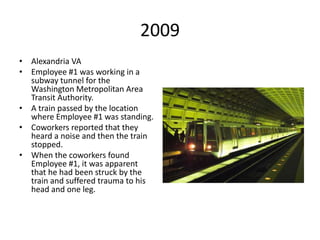
• Alexandria VA
• Employee #1 was working in a
subway tunnel for the
Washington Metropolitan Area
Transit Authority.
• A train passed by the location
where Employee #1 was standing.
• Coworkers reported that they
heard a noise and then the train
stopped.
• When the coworkers found
Employee #1, it was apparent
that he had been struck by the
train and suffered trauma to his
head and one leg.
2009
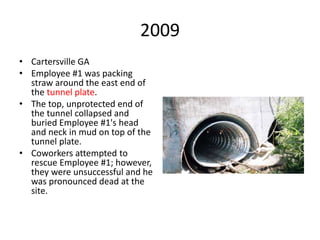
• Cartersville GA
• Employee #1 was packing
straw around the east end of
the tunnel plate.
• The top, unprotected end of
the tunnel collapsed and
buried Employee #1's head
and neck in mud on top of the
tunnel plate.
• Coworkers attempted to
rescue Employee #1; however,
they were unsuccessful and he
was pronounced dead at the
site.
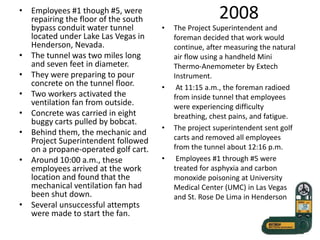
2008• Employees #1 though #5, were
repairing the floor of the south
bypass conduit water tunnel
located under Lake Las Vegas in
Henderson, Nevada.
• The tunnel was two miles long
and seven feet in diameter.
• They were preparing to pour
concrete on the tunnel floor.
• Two workers activated the
ventilation fan from outside.
• Concrete was carried in eight
buggy carts pulled by bobcat.
• Behind them, the mechanic and
Project Superintendent followed
on a propane-operated golf cart.
• Around 10:00 a.m., these
employees arrived at the work
location and found that the
mechanical ventilation fan had
been shut down.
• Several unsuccessful attempts
were made to start the fan.
• The Project Superintendent and
foreman decided that work would
continue, after measuring the natural
air flow using a handheld Mini
Thermo-Anemometer by Extech
Instrument.
• At 11:15 a.m., the foreman radioed
from inside tunnel that employees
were experiencing difficulty
breathing, chest pains, and fatigue.
• The project superintendent sent golf
carts and removed all employees
from the tunnel about 12:16 p.m.
• Employees #1 through #5 were
treated for asphyxia and carbon
monoxide poisoning at University
Medical Center (UMC) in Las Vegas
and St. Rose De Lima in Henderson
2007
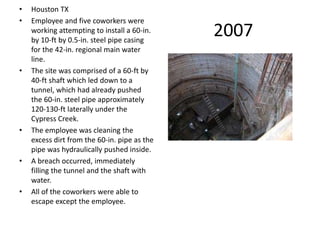
• Houston TX
• Employee and five coworkers were
working attempting to install a 60-in.
by 10-ft by 0.5-in. steel pipe casing
for the 42-in. regional main water
line.
• The site was comprised of a 60-ft by
40-ft shaft which led down to a
tunnel, which had already pushed
the 60-in. steel pipe approximately
120-130-ft laterally under the
Cypress Creek.
• The employee was cleaning the
excess dirt from the 60-in. pipe as the
pipe was hydraulically pushed inside.
• A breach occurred, immediately
filling the tunnel and the shaft with
water.
• All of the coworkers were able to
escape except the employee.
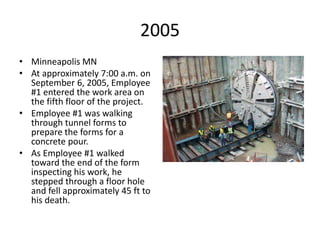
2005
• Minneapolis MN
• At approximately 7:00 a.m. on
September 6, 2005, Employee
#1 entered the work area on
the fifth floor of the project.
• Employee #1 was walking
through tunnel forms to
prepare the forms for a
concrete pour.
• As Employee #1 walked
toward the end of the form
inspecting his work, he
stepped through a floor hole
and fell approximately 45 ft to
his death.
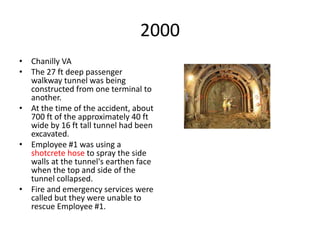
2000
• Chanilly VA
• The 27 ft deep passenger
walkway tunnel was being
constructed from one terminal to
another.
• At the time of the accident, about
700 ft of the approximately 40 ft
wide by 16 ft tall tunnel had been
excavated.
• Employee #1 was using a
shotcrete hose to spray the side
walls at the tunnel's earthen face
when the top and side of the
tunnel collapsed.
• Fire and emergency services were
called but they were unable to
rescue Employee #1.
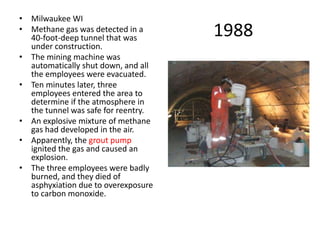
1988
• Milwaukee WI
• Methane gas was detected in a
40-foot-deep tunnel that was
under construction.
• The mining machine was
automatically shut down, and all
the employees were evacuated.
• Ten minutes later, three
employees entered the area to
determine if the atmosphere in
the tunnel was safe for reentry.
• An explosive mixture of methane
gas had developed in the air.
• Apparently, the grout pump
ignited the gas and caused an
explosion.
• The three employees were badly
burned, and they died of
asphyxiation due to overexposure
to carbon monoxide.
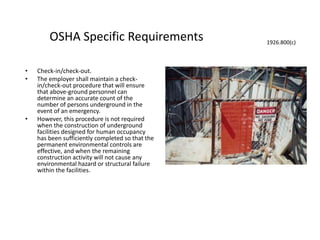
OSHA Specific Requirements
• Check-in/check-out.
• The employer shall maintain a check-
in/check-out procedure that will ensure
that above-ground personnel can
determine an accurate count of the
number of persons underground in the
event of an emergency.
• However, this procedure is not required
when the construction of underground
facilities designed for human occupancy
has been sufficiently completed so that the
permanent environmental controls are
effective, and when the remaining
construction activity will not cause any
environmental hazard or structural failure
within the facilities.
1926.800(c)
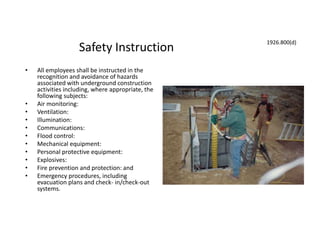
Safety Instruction
• All employees shall be instructed in the
recognition and avoidance of hazards
associated with underground construction
activities including, where appropriate, the
following subjects:
• Air monitoring:
• Ventilation:
• Illumination:
• Communications:
• Flood control:
• Mechanical equipment:
• Personal protective equipment:
• Explosives:
• Fire prevention and protection: and
• Emergency procedures, including
evacuation plans and check- in/check-out
systems.
1926.800(d)
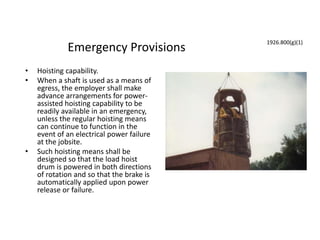
Emergency Provisions
• Hoisting capability.
• When a shaft is used as a means of
egress, the employer shall make
advance arrangements for power-
assisted hoisting capability to be
readily available in an emergency,
unless the regular hoisting means
can continue to function in the
event of an electrical power failure
at the jobsite.
• Such hoisting means shall be
designed so that the load hoist
drum is powered in both directions
of rotation and so that the brake is
automatically applied upon power
release or failure.
1926.800(g)(1)
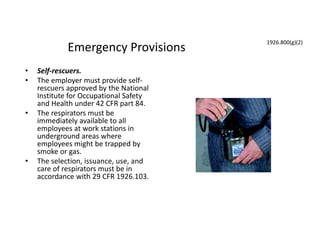
Emergency Provisions
• Self-rescuers.
• The employer must provide self-
rescuers approved by the National
Institute for Occupational Safety
and Health under 42 CFR part 84.
• The respirators must be
immediately available to all
employees at work stations in
underground areas where
employees might be trapped by
smoke or gas.
• The selection, issuance, use, and
care of respirators must be in
accordance with 29 CFR 1926.103.
1926.800(g)(2)
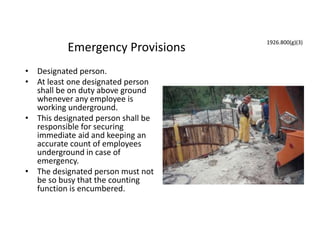
Emergency Provisions
• Designated person.
• At least one designated person
shall be on duty above ground
whenever any employee is
working underground.
• This designated person shall be
responsible for securing
immediate aid and keeping an
accurate count of employees
underground in case of
emergency.
• The designated person must not
be so busy that the counting
function is encumbered.
1926.800(g)(3)
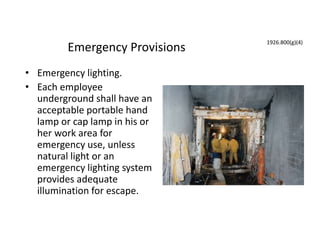
Emergency Provisions
• Emergency lighting.
• Each employee
underground shall have an
acceptable portable hand
lamp or cap lamp in his or
her work area for
emergency use, unless
natural light or an
emergency lighting system
provides adequate
illumination for escape.
1926.800(g)(4)
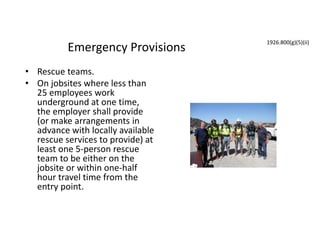
Emergency Provisions
• Rescue teams.
• On jobsites where less than
25 employees work
underground at one time,
the employer shall provide
(or make arrangements in
advance with locally available
rescue services to provide) at
least one 5-person rescue
team to be either on the
jobsite or within one-half
hour travel time from the
entry point.
1926.800(g)(5)(ii)
Hazardous Classifications
• Potentially gassy operations.
• Underground construction operations shall
be classified as potentially gassy if either:
• Air monitoring discloses 10 percent or
more of the lower explosive limit for
methane or other flammable gases
measured at 12 inches (304.8 mm) to + or -
0.25 inch (6.35 mm) from the roof, face,
floor or walls in any underground work
area for more than a 24-hour period: or
• The history of the geographical area or
geological formation indicates that 10
percent or more of the lower explosive
limit for methane or other flammable
gases is likely to be encountered in such
underground operations.
1926.800(h)(1)
Air Quality and Monitoring.
• Where this paragraph requires monitoring of
airborne contaminants "as often as
necessary," the competent person shall
make a reasonable determination as to
which substances to monitor and how
frequently monitor, considering at least the
following factors:
• Location of jobsite: Proximity to fuel tanks,
sewers, gas lines, old landfills, coal deposits,
and swamps;
• Geology:
• History: Presence of air contaminants in
nearby jobsites, changes in levels of
substances monitored on the prior shift; and
• Work practices and jobsite conditions: The
use of diesel engines, use of explosives, use
of fuel gas, volume and flow of ventilation,
visible atmospheric conditions,
decompression of the atmosphere, welding,
cutting and hot work, and employees'
physical reactions to working underground.
1926.800(j)(1)(i)(B)
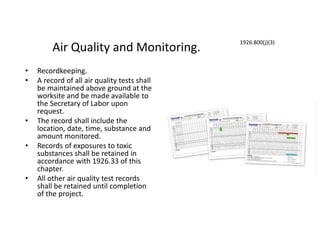
Air Quality and Monitoring.
• Recordkeeping.
• A record of all air quality tests shall
be maintained above ground at the
worksite and be made available to
the Secretary of Labor upon
request.
• The record shall include the
location, date, time, substance and
amount monitored.
• Records of exposures to toxic
substances shall be retained in
accordance with 1926.33 of this
chapter.
• All other air quality test records
shall be retained until completion
of the project.
1926.800(j)(3)
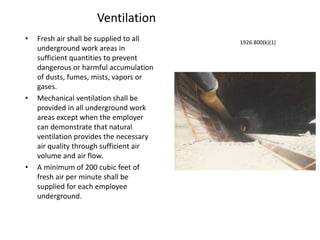
Ventilation
• Fresh air shall be supplied to all
underground work areas in
sufficient quantities to prevent
dangerous or harmful accumulation
of dusts, fumes, mists, vapors or
gases.
• Mechanical ventilation shall be
provided in all underground work
areas except when the employer
can demonstrate that natural
ventilation provides the necessary
air quality through sufficient air
volume and air flow.
• A minimum of 200 cubic feet of
fresh air per minute shall be
supplied for each employee
underground.
1926.800(k)(1)
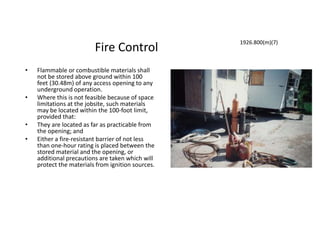
Fire Control
• Flammable or combustible materials shall
not be stored above ground within 100
feet (30.48m) of any access opening to any
underground operation.
• Where this is not feasible because of space
limitations at the jobsite, such materials
may be located within the 100-foot limit,
provided that:
• They are located as far as practicable from
the opening; and
• Either a fire-resistant barrier of not less
than one-hour rating is placed between the
stored material and the opening, or
additional precautions are taken which will
protect the materials from ignition sources.
1926.800(m)(7)
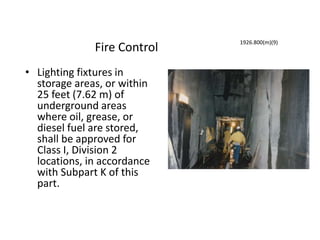
Fire Control
• Lighting fixtures in
storage areas, or within
25 feet (7.62 m) of
underground areas
where oil, grease, or
diesel fuel are stored,
shall be approved for
Class I, Division 2
locations, in accordance
with Subpart K of this
part.
1926.800(m)(9)
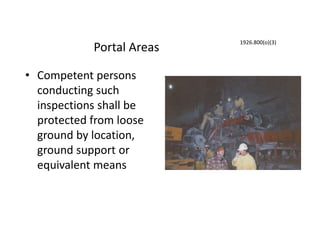
Portal Areas
• Competent persons
conducting such
inspections shall be
protected from loose
ground by location,
ground support or
equivalent means
1926.800(o)(3)
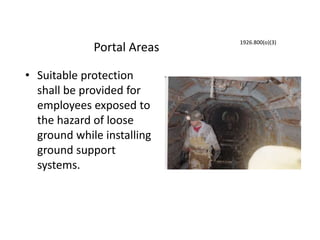
Portal Areas
• Suitable protection
shall be provided for
employees exposed to
the hazard of loose
ground while installing
ground support
systems.
1926.800(o)(3)
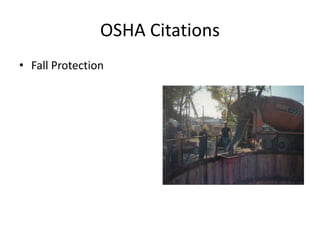
OSHA Citations
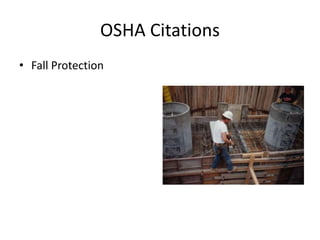
• Fall Protection
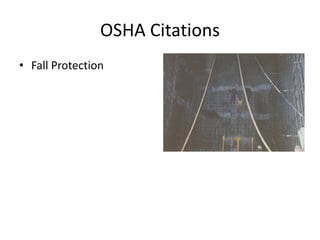
OSHA Citations
• Fall Protection
OSHA Citations
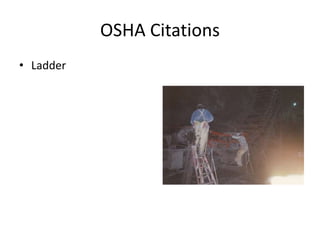
• Ladder
OSHA Citations
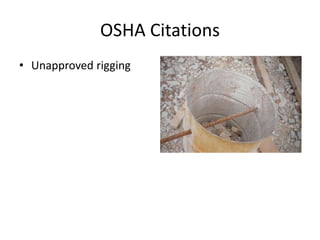
• Unapproved rigging
OSHA Citations
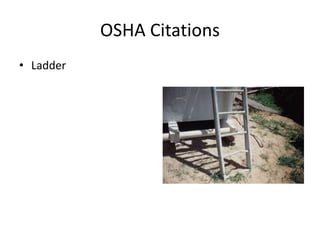
• Ladder
OSHA Citations
• Fall Protection
OSHA Citations
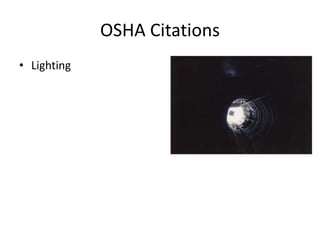
• Lighting
OSHA Citations
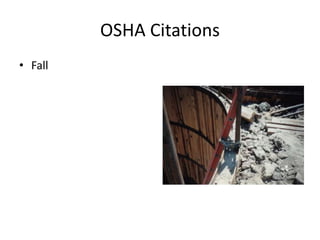
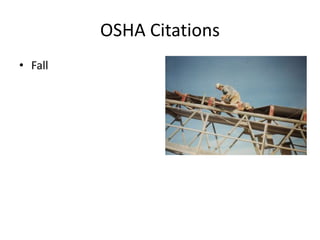
• Fall
OSHA Citations
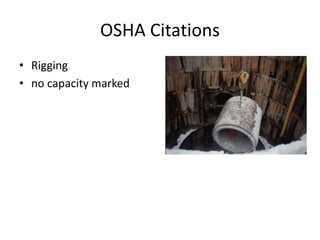
• Rigging
• no capacity marked
OSHA Citations
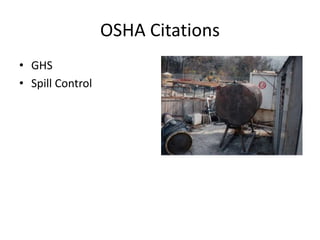
• GHS
• Spill Control
OSHA Citations
• Fall
OSHA Citations
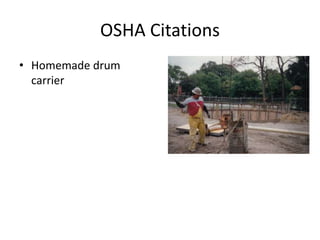
• Homemade drum
carrier

1926 tunneling safety 2015

  • 1.
  • 2.
    Structural Issues • RockFall - Fall of rock blocks of major dimensions. The different mechanisms involved are wedge or planar failure.. • Collapse Heading collapse - failure of the heading / lining failure . • Daylight Collapse Heading collapse - lining failure of the heading that reaches the surface creating a crater. • Excessive Deformation - Excessive deformations inside the tunnel or at the surface. This can occur for example due to deficient design, construction defects and/or due to particular type of terrains such as swelling and squeezing ground, which had not been predicted. • Flooding - Comprises cases where the tunnel was invaded by large quantities of underground water. • Rock Burst - Spalling Overstressing of massive or intact brittle rock, i.e. the stresses developed in the ground exceed the local strength of the material. It can cause spalling or in the worst cases sudden and violent failure of the rock mass • Portal failure - Particular locations of a tunnel, where there is a lower • Shaft failure - resistance of ground mass and/ or concentration of stresses. • Other - Other types of collapse that include slope failures, etc
  • 3.
  • 4.
    Rock Fall • Rockfall blocking the TBM at the Covao tunnel in 2006 (Madeira Island, Portugal)
  • 5.
    Collapse • The largecollapse occurred in front of the face and stopped the cutter head rotation, creating a cavern more than 10 m high over the TBM. • This was an example of a full collapse of the face.
  • 6.
    Collapse• Wienerwald Austria •In this case, ground water led to de-compaction and bulking of the sandstone, which caused the shear strength to decrease. • From this it follows that the strength of rock was very low and ground pressure loaded the temporary shotcrete shell, which was not designed for that kind of high loading. • Therefore the shotcrete shell spalled off and the lattice girder was deformed.
  • 7.
    Daylight Collapse • Theseare collapses that reach the surface creating a crater. • Munich Metro in 1994 • No deaths
  • 8.
    Daylight Collapse • SaoPaulo Brazil 2007 • 7 deaths • Open face tunnelling is cheap. • New Austrian Tunnelling Method (NATM) is much less expensive than a soft ground TBM, but much less safe • A combination of explosives and mechanical excavation techniques were being used. • 'The top heading of the failed tunnel was fully excavated in rock. • There was approximately 6m of rock above the tunnel, • Support consisted of steel arch girders at 800mm centres, and 350mm thick steel fibre reinforced sprayed concrete. • 'The vertical displacements measured at the tunnel crown were in the range of 3mm when the top heading excavation was completed. • Two to three days before the accident, the rate of those displacements increased, and they reached 15mm to 20mm.
  • 9.
    Daylight Collapse • 2003:Shanghai's underground Pearl Line, China • $80 million • The accident occurred in a cross passage between the two parallel tunnel tubes that had already been driven using earth-pressure- balance TBMs. • Shortly before the cross passage broke through, at a depth of about 35 m, massive inrushes of material and water occurred, which the tunnel crew was not able to bring under control and which resulted in a large scale subsidence at the
  • 10.
    Daylight Collapse • SouthKorean city of Taegu on 22 January 2001 • Failure of a diaphragm wall. • Part of a station excavation pit caved in, burying a bus, killing three passengers and damaging neighboring buildings. • The accident was caused by a load not considered in the design phases and due to unforeseen soil conditions. • $24 million
  • 11.
    Flooding • It isduring the construction of underwater tunnels that largest scale floodings have occurred. • The ground under rivers, channels and bays is normally weak and under high water pressure and therefore extreme safety measures and efficient protection against water inflow are normally required.
  • 12.
    Flooding • Seikan tunnelis a 53.85 km long railway tunnel in Japan • 1963-1976 • Four floods • 23 deaths • Leaks and soft rock • TBM not practical due to the various types of soils. • Drill and pound. • A great majority of the tunnel crosses heavily fissured rock (9 large shear zones). The sea and underground water penetrate into these zones and the maximum water pressure is about 25 MPa
  • 13.
    Flooding • Lausanne, Switzerland •A huge amount of soil and water (1400m3) displaced into the tunnel and caused extensive damage
  • 14.
    Rockburst/Spalling • This typeof event is caused by the overstressing of massive or intact brittle rock, i.e. the stresses developed in the ground exceed the local strength of the material. • It can cause spalling or in the worst cases sudden and violent failure of the rock mass
  • 15.
    Excessive Deformation • Theseare cases where excessive deformations occur inside the tunnel or at the surface but an actual total collapse does not happen. • This can occur for example due to deficient design, construction defects and/or due to particular type of terrains such as swelling and squeezing ground, which had not been predicted.
  • 16.
    Excessive Deformation • Rotarelleto San Vittore tunnel, Italy 1991 • After 650m of excavation, enormous ground pressures caused cracking of the shotcrete, buckling of the steel arches after a few hours, and deformations of 200 mm in 24h and 400 mm after 12 days • The deformations were caused by swelling clay filling of the rock.
  • 17.
    Excessive Deformation • Squeezingis characterized large time-dependent convergence during tunnel excavation. • Failure of the support system. • Inadequate support for such ground conditions. 1999: Bolu Tunnel, Turkey An earthquake caused the collapse of a section of the Bolu tunnel, part of the Anatolian highway, even though the tunnel had been designed to withstand earthquakes. $115 million loss
  • 18.
    1908-1913 • Lotschberg tunnel •Switzerland • Use of timber supports after collapse killed 25 in 1908
  • 19.
    Hawks Nest WV •1930s • A simple diversion tunnel for the New River in West Virginia • After workers discovered silica in the rock they were told to mine it as a by-product of tunnel construction, however, they were never given any masks or protective gear. • Hundreds of workers developed silicosis due to the long-term exposure of silica dust in their lungs.
  • 20.
    New York CityThird Water Tunnel • The largest infrastructure project in New York state history is currently tunneling below New Yorker's feet to provide a third connection to the upstate water supply
  • 21.
    St. Gotthard RoadTunnel, 1969-1980 • At the time it was completed, this 10-mile tunnel in Switzerland was the longest road tunnel in the world. • Tragically, 19 people died working on the tunnel— which was created to connect central Switzerland with Milan, Italy through the Alps, providing a faster and safer year-round alternative to the winding Gotthard Pass.
  • 22.
    Big Dig Ceiling Collapse •July 10, 2006 • Concrete ceiling panel and debris weighing 26 tons fell in Boston's Fort Point Channel Tunnel • The panel fell on a car killing a passenger and injuring the driver. • The collapse of the ceiling structure began with the simultaneous creep-type failure of several anchors embedded in epoxy in the tunnel's roof slab. • Each of the panel's intersecting connection points consists of several individual bolts anchored into the roof slab concrete. • The failure of a group of anchors set off a chain reaction which caused other adjacent connection groups to creep then fail
  • 23.
    Big Dig Ceiling Collapse •Not only were the bolts too short, but the epoxy used to glue the bolts into the concrete was not up to standard.
  • 24.
    Big Dig Ceiling Collapse •Major cause of the collapse to "epoxy creep“ • On August 8, 2007, a Suffolk County Grand Jury indicted epoxy company Powers Fasteners, Inc., on one charge of involuntary manslaughter, with the maximum penalty in Massachusetts being a fine of one thousand dollars.[10] • The epoxy used in the D Street portal that failed cost $1287.60. The cost to redesign, inspect, and repair all of the tunnels after the collapse was $54 million.[1
  • 25.
    2004: Circle Line,Singapore • Collapse of a construction pit resulted in the death of four workers plus the collapse of an adjoining highway. • It eventually was found that the most apparent cause of the collapse was that the retaining wall could not handle the stress of holding up the tunnel, forcing it to give way.
  • 26.
    1994: Heathrow ExpressLink • London • Three tunnels forming part of the Heathrow Express Link, connecting central London and Heathrow Airport, caved in and took several buildings with them. • $141 million • According to the HSE, a chain of events led directly to the collapse. • This included a failure to check substandard construction over a period of some three months, pressure grouting that damaged the tunnel plus inadequately executed repairs some two months before the collapse.
  • 27.
    1994/95: Metro • Taipei,Taiwan • When the Metro was being built in Taiwan in the 1990s, several serious tunnel collapses occurred, causing major property damage to adjacent buildings as well as serious liability losses. • $41 million • Difficult geology, with fractured rock and massive inflows of water, countless cave-ins, mud and rock slides caused by massive inflows of groundwater. • Eleven people were killed in the accidents.
  • 28.
    1999: Tunnel inHull • England • During one of the tunnel drives for a 6.5 mile underground sewer in Hull, England, a deformation in the floor of the tunnel shell led to flooding of the tunnel and subsidence at the surface, resulting in substantial damage to buildings, roads and utility lines. • Machines and the tunnel were abandoned. • $55 million
  • 29.
    XIAN Subway • 2013China • At least two are dead after an accident at a subway construction site in Xi’an, Shaanxi province this morning. • At around 2:40 am, a tunnel caved in as nine workers were in the midst of building Line 3. • Four have been rescued, but of the five that were buried, two have been found dead while the other three are still missing
  • 30.
    Dec 2014 • Vietnam •Rescuers have created a 16 cm-wide access hole to the location where 12 workers have been trapped inside a collapsed tunnel section at a hydropower plant in the Central Highlands province of Lam Dong They may have assumed that the dry season had come and it was safe to dig, but this year the rainy season lasted too long. With heavy rains making the foundation weak, sinkages occurred in the tunnel. And given the Central Highlands’ geological formations, digging up a big rock may lead to the whole tunnel’s collapse.
  • 31.
    2000 • Dulles Airport •One dead • At the time of the accident, about 700 ft of the approximately 40 ft wide by 16 ft tall tunnel had been excavated. • Employee #1 was using a shotcrete hose to spray the side walls at the tunnel's earthen face when the top and side of the tunnel collapsed. • In the week before the tunnel gave way, there were three partial collapses, each increasing in severity
  • 32.
    July 2015 • Aconstruction worker who was killed when a winch he was operating broke loose from its anchor at a tunneling site in the High Desert has been identified as David Padilla, 38, of Pahrump, Nevada.
  • 33.
    February 2015 • SeattleWA • WSDOT now says five workers were installing rebar for a concrete wall at the tunnel’s north portal work zone. • The wall of rebar gave way, injuring four of the five workers.
  • 34.
    • Drill andBlast Method • – Method of rock cavern excavation with the use of • explosives. • Most suitable for hard rock with complex layout • and geometry • Unique hazards due to need for blasting • Work is carried out in a cyclic manner
  • 35.
  • 36.
    • Uncertainty inthe nature and variability of ground conditions (rock quality, ground water, gas, etc) - • need for adequate site investigations prior to and • vigilance during tunnelling • Confined space of tunnel environment (limited • access, escape, air quality control) • Difficulty in communications (sound and signal • barriers) • Work in compressed air (soft ground)
  • 37.
    Emergencies • Ground collapse(need we say more?) • Support failure • Flooding • Gas explosion • Oxygen deficiency • Fire (encountering inflammable gas) • Accidents : moving plants • Plant and power failure • Stoppages
  • 38.
    Blasting Issues • Fallingfrom heights or falling on level (tripping/slipping) • Materials falling from height or from stacks or vehicles • Burial by fall of material (rock collapse or stacking collapse) • Flooding or inrush of water • Machinery related (cranes, excavators, etc) • Vehicles (excavators, dump trucks) • Electrical installations • Fire and explosions (gas and explosives) • Air pollution (oxygen deficiency, toxic fumes & radon gas)
  • 39.
    Blasting • Blasting a“way of life” in hard rock tunnelling • Fly rock • Airblast and ground shock • Toxic fumes • Accidental explosions
  • 40.
    Charging • Shot firerwill check final charged face before leaving
  • 41.
    Charging • Signs towarn and cordon off personnel from charged face
  • 42.
    Pre Blasting • Responsibilitiesof Shot- firer • – Connecting the explosive charges • – Final checking before blasting • – Work with Tunnel Foremen & Safety Supervisor to ensure adequate safety measures are taken.
  • 43.
    Pre Blasting • Safetyvehicle will clear tunnel pre blasting
  • 44.
    Pre Blasting • Amplewarning (E.g. sirens) outside the caverns
  • 45.
  • 46.
    Blasting Use of rubber-tiremats and concrete blocks to minimize rock throw during blasting open areas
  • 47.
    Blasting • keep awayfrom area • switch off ventilation completely before firing • switch on ventilation at full capacity after blasting • evacuate team or provide shelter(containers or niches)
  • 48.
    Misfires • Should therebe no initiation of explosives, minimum • re-entry time must not be less than 30 mins. • – After initiation, minimum retry time must not be less than 15mins (after ventilation) • – Blast inspection team shall enter tunnel with appropriate breathing apparatus.
  • 49.
    Explosives Storage • Licensedmagazine to store detonators and booster charges in temp cavern on site • Reduced transport hazards to public • Guards may be necessary
  • 50.
    Explosives Storage • Mechanizedcharging minimizes human exposure at drilling face
  • 51.
    After Blasting • Ventilation •Gas/dust monitoring • Minimum entry time after blasting (with ventilation)
  • 52.
    Radon • Naturally occurringin rock and soil • Radon and radon daughters are radioactive and can cause adverse health effects (lung cancer) • Is released by exposed surface, blasted rock, groundwater, from outside air • Conditions improve with proper ventilation
  • 53.
    Mucking Out • Hazards •Being struck or crushed • Falling Material • Dust and Noise • Tripping and falling • Protection • Do not enter into loading area • Keep running surface in good condition • Do not overload dumper • Good lighting in work area
  • 54.
    Scaling • Hazards • Rockfall • Collapse as result from instability of exposed rock surface • Protection • Use machine for rock scaling • Do not enter danger zone before scaling is completed • Lighting adequately
  • 55.
    Manual Scaling • Hazards •Rock fall • Falling from heights • Being crushed • Protection • Only work from a safe area • Use working platforms • Light the area adequately
  • 56.
    Rock Supports • TheBoomer E2 C drilling out rock support in Argentina
  • 57.
    Rock Bolts • Hazards •Falling from heights • Noise Protection • Use working platforms • Use eye and hearing protection
  • 58.
    Shotcreting • Hazards • Fallingfrom heights • Rebound & dust • Chemical additives Protection • Use working baskets • Use protective clothing • Use shotcrete robot where possible • Wear protective hardhat for shotcreting • Wear respiratory protection
  • 59.
    Shotcreting Robots • Hazards •Being crushed • Rebound & dust • Burst of concrete hose • Protection • Donot enter danger zone • Separation distance between nozzle & wall • Wear shotcrete protective helmet • Wear respiratory protection • Wet mix with alkali free additive to reduce dust & air pollution
  • 60.
    Monitoring • An essential elementof managing and controlling those risks is Monitoring and Observation during all stages of tunnel construction
  • 61.
    2013 • Sunol CA •On August 22, 2013, Employee #1, was working on a pipeline project. • A piece of cement grout approximately 1.5 feet by 1.5 feet by 6 feet long fell out of the tunnel face approximately 3 feet above the invert. • The cement pinned Employee #1's leg against a roadheader. • Employee #1 sustained bruising/contusions/abrasions.
  • 62.
    2013 • On June17, 2013, an employee was working as a heavy equipment mechanic for a bridge, tunnel, and highway construction firm. • He was on a segment build deck, assembling a tunnel boring machine. • He fell off the deck, falling a distance of 10 feet. He sustained a strain or sprain in his left ankle
  • 63.
    2012 • Boulder CityNV • On June 11, 2012, Employee #1was part of a swing shift crew excavating a tunnel. • The TBM had been excavating in closed mode • Closed mode excavation involves the pressurization of the cutterhead and face of the TBM to support the ground and/or control excessive groundwater inflows. • The position of the TBM found it excavating through a large vertical fault zone that later became the Detachment Fault. • The grout being injected in the annular space was being pumped in at approximately 14 bars. • The swing shift had begun work and was preparing to erect a ring segment set; Ring #135. • The first segment was successfully installed in the tunnel crown (top of the tunnel). • The crew then began to install the second segment, which was to be placed in front of the keystone of Ring #134. • Three hydraulic rams, including one abutting the keystone of Ring #134, were slowly retracted. • Almost as soon as the retraction began, a loud pop was heard. • The keystone for Ring #134 had shifted forward approximately 4 inches. • The come-a-long did not hold the forces exerted, and the gears were stripped out. • This shift permitted grout and other materials such as rocks to escape the annulus at a pressure of approximately 14 bars (200 psi). • Employee #1 was standing in front of the area where the gap developed. • He was struck and killed by the moving grout and rocks
  • 64.
  • 65.
    2011 • Webster NY •Employee #1, a locomotive operator, was moving muck buckets and equipment to the head section of a tunnel. • When the operator reached the end of the tunnel, the locomotive failed to stop and Employee #1 was crushed between the locomotive and the conveyor on the tunnel boring machine. • Employee #1 was killed.
  • 66.
    2011 • Woodland CA •Employee #2, a laborer, noticed a hole in a material chute in the No. 196 tunnel conveyor system. • Employee #1 was joined by Employee #2 in the reclaim tunnel to schedule and plan a repair operation. • As the two Employees exited the tunnel and walked away from the overhead No. 196 Conveyor, a 10 pound rock fell off the conveyor striking Employee #1 in the head and Employee #2 in the back, knocking both employees to the ground. • Employee #1 was knocked unconscious and landed on top of Employee #2.
  • 67.
    2009 • Kermit, WV •Employee #1 was engaged in the preparations for raising the height of a tunnel liner. • Employee #1 bored several holes for taking core samples and pictures were taken. • Employee #1 entered the tunnel through the west portal entrance, with his excavator equipped with a hoe ram. • After reaching the necessary work station, Employee #1 began hammering out the center part of the tunnel's liner to remove it. • About 30 minutes following the start of work, a section of the roof fell, crushing and killing Employee #1.
  • 68.
    2009 • Alexandria VA •Employee #1 was working in a subway tunnel for the Washington Metropolitan Area Transit Authority. • A train passed by the location where Employee #1 was standing. • Coworkers reported that they heard a noise and then the train stopped. • When the coworkers found Employee #1, it was apparent that he had been struck by the train and suffered trauma to his head and one leg.
  • 69.
    2009 • Cartersville GA •Employee #1 was packing straw around the east end of the tunnel plate. • The top, unprotected end of the tunnel collapsed and buried Employee #1's head and neck in mud on top of the tunnel plate. • Coworkers attempted to rescue Employee #1; however, they were unsuccessful and he was pronounced dead at the site.
  • 70.
    2008• Employees #1though #5, were repairing the floor of the south bypass conduit water tunnel located under Lake Las Vegas in Henderson, Nevada. • The tunnel was two miles long and seven feet in diameter. • They were preparing to pour concrete on the tunnel floor. • Two workers activated the ventilation fan from outside. • Concrete was carried in eight buggy carts pulled by bobcat. • Behind them, the mechanic and Project Superintendent followed on a propane-operated golf cart. • Around 10:00 a.m., these employees arrived at the work location and found that the mechanical ventilation fan had been shut down. • Several unsuccessful attempts were made to start the fan. • The Project Superintendent and foreman decided that work would continue, after measuring the natural air flow using a handheld Mini Thermo-Anemometer by Extech Instrument. • At 11:15 a.m., the foreman radioed from inside tunnel that employees were experiencing difficulty breathing, chest pains, and fatigue. • The project superintendent sent golf carts and removed all employees from the tunnel about 12:16 p.m. • Employees #1 through #5 were treated for asphyxia and carbon monoxide poisoning at University Medical Center (UMC) in Las Vegas and St. Rose De Lima in Henderson
  • 71.
    2007 • Houston TX •Employee and five coworkers were working attempting to install a 60-in. by 10-ft by 0.5-in. steel pipe casing for the 42-in. regional main water line. • The site was comprised of a 60-ft by 40-ft shaft which led down to a tunnel, which had already pushed the 60-in. steel pipe approximately 120-130-ft laterally under the Cypress Creek. • The employee was cleaning the excess dirt from the 60-in. pipe as the pipe was hydraulically pushed inside. • A breach occurred, immediately filling the tunnel and the shaft with water. • All of the coworkers were able to escape except the employee.
  • 72.
    2005 • Minneapolis MN •At approximately 7:00 a.m. on September 6, 2005, Employee #1 entered the work area on the fifth floor of the project. • Employee #1 was walking through tunnel forms to prepare the forms for a concrete pour. • As Employee #1 walked toward the end of the form inspecting his work, he stepped through a floor hole and fell approximately 45 ft to his death.
  • 73.
    2000 • Chanilly VA •The 27 ft deep passenger walkway tunnel was being constructed from one terminal to another. • At the time of the accident, about 700 ft of the approximately 40 ft wide by 16 ft tall tunnel had been excavated. • Employee #1 was using a shotcrete hose to spray the side walls at the tunnel's earthen face when the top and side of the tunnel collapsed. • Fire and emergency services were called but they were unable to rescue Employee #1.
  • 74.
    1988 • Milwaukee WI •Methane gas was detected in a 40-foot-deep tunnel that was under construction. • The mining machine was automatically shut down, and all the employees were evacuated. • Ten minutes later, three employees entered the area to determine if the atmosphere in the tunnel was safe for reentry. • An explosive mixture of methane gas had developed in the air. • Apparently, the grout pump ignited the gas and caused an explosion. • The three employees were badly burned, and they died of asphyxiation due to overexposure to carbon monoxide.
  • 75.
    OSHA Specific Requirements •Check-in/check-out. • The employer shall maintain a check- in/check-out procedure that will ensure that above-ground personnel can determine an accurate count of the number of persons underground in the event of an emergency. • However, this procedure is not required when the construction of underground facilities designed for human occupancy has been sufficiently completed so that the permanent environmental controls are effective, and when the remaining construction activity will not cause any environmental hazard or structural failure within the facilities. 1926.800(c)
  • 76.
    Safety Instruction • Allemployees shall be instructed in the recognition and avoidance of hazards associated with underground construction activities including, where appropriate, the following subjects: • Air monitoring: • Ventilation: • Illumination: • Communications: • Flood control: • Mechanical equipment: • Personal protective equipment: • Explosives: • Fire prevention and protection: and • Emergency procedures, including evacuation plans and check- in/check-out systems. 1926.800(d)
  • 77.
    Emergency Provisions • Hoistingcapability. • When a shaft is used as a means of egress, the employer shall make advance arrangements for power- assisted hoisting capability to be readily available in an emergency, unless the regular hoisting means can continue to function in the event of an electrical power failure at the jobsite. • Such hoisting means shall be designed so that the load hoist drum is powered in both directions of rotation and so that the brake is automatically applied upon power release or failure. 1926.800(g)(1)
  • 78.
    Emergency Provisions • Self-rescuers. •The employer must provide self- rescuers approved by the National Institute for Occupational Safety and Health under 42 CFR part 84. • The respirators must be immediately available to all employees at work stations in underground areas where employees might be trapped by smoke or gas. • The selection, issuance, use, and care of respirators must be in accordance with 29 CFR 1926.103. 1926.800(g)(2)
  • 79.
    Emergency Provisions • Designatedperson. • At least one designated person shall be on duty above ground whenever any employee is working underground. • This designated person shall be responsible for securing immediate aid and keeping an accurate count of employees underground in case of emergency. • The designated person must not be so busy that the counting function is encumbered. 1926.800(g)(3)
  • 80.
    Emergency Provisions • Emergencylighting. • Each employee underground shall have an acceptable portable hand lamp or cap lamp in his or her work area for emergency use, unless natural light or an emergency lighting system provides adequate illumination for escape. 1926.800(g)(4)
  • 81.
    Emergency Provisions • Rescueteams. • On jobsites where less than 25 employees work underground at one time, the employer shall provide (or make arrangements in advance with locally available rescue services to provide) at least one 5-person rescue team to be either on the jobsite or within one-half hour travel time from the entry point. 1926.800(g)(5)(ii)
  • 82.
    Hazardous Classifications • Potentiallygassy operations. • Underground construction operations shall be classified as potentially gassy if either: • Air monitoring discloses 10 percent or more of the lower explosive limit for methane or other flammable gases measured at 12 inches (304.8 mm) to + or - 0.25 inch (6.35 mm) from the roof, face, floor or walls in any underground work area for more than a 24-hour period: or • The history of the geographical area or geological formation indicates that 10 percent or more of the lower explosive limit for methane or other flammable gases is likely to be encountered in such underground operations. 1926.800(h)(1)
  • 83.
    Air Quality andMonitoring. • Where this paragraph requires monitoring of airborne contaminants "as often as necessary," the competent person shall make a reasonable determination as to which substances to monitor and how frequently monitor, considering at least the following factors: • Location of jobsite: Proximity to fuel tanks, sewers, gas lines, old landfills, coal deposits, and swamps; • Geology: • History: Presence of air contaminants in nearby jobsites, changes in levels of substances monitored on the prior shift; and • Work practices and jobsite conditions: The use of diesel engines, use of explosives, use of fuel gas, volume and flow of ventilation, visible atmospheric conditions, decompression of the atmosphere, welding, cutting and hot work, and employees' physical reactions to working underground. 1926.800(j)(1)(i)(B)
  • 84.
    Air Quality andMonitoring. • Recordkeeping. • A record of all air quality tests shall be maintained above ground at the worksite and be made available to the Secretary of Labor upon request. • The record shall include the location, date, time, substance and amount monitored. • Records of exposures to toxic substances shall be retained in accordance with 1926.33 of this chapter. • All other air quality test records shall be retained until completion of the project. 1926.800(j)(3)
  • 85.
    Ventilation • Fresh airshall be supplied to all underground work areas in sufficient quantities to prevent dangerous or harmful accumulation of dusts, fumes, mists, vapors or gases. • Mechanical ventilation shall be provided in all underground work areas except when the employer can demonstrate that natural ventilation provides the necessary air quality through sufficient air volume and air flow. • A minimum of 200 cubic feet of fresh air per minute shall be supplied for each employee underground. 1926.800(k)(1)
  • 86.
    Fire Control • Flammableor combustible materials shall not be stored above ground within 100 feet (30.48m) of any access opening to any underground operation. • Where this is not feasible because of space limitations at the jobsite, such materials may be located within the 100-foot limit, provided that: • They are located as far as practicable from the opening; and • Either a fire-resistant barrier of not less than one-hour rating is placed between the stored material and the opening, or additional precautions are taken which will protect the materials from ignition sources. 1926.800(m)(7)
  • 87.
    Fire Control • Lightingfixtures in storage areas, or within 25 feet (7.62 m) of underground areas where oil, grease, or diesel fuel are stored, shall be approved for Class I, Division 2 locations, in accordance with Subpart K of this part. 1926.800(m)(9)
  • 88.
    Portal Areas • Competentpersons conducting such inspections shall be protected from loose ground by location, ground support or equivalent means 1926.800(o)(3)
  • 89.
    Portal Areas • Suitableprotection shall be provided for employees exposed to the hazard of loose ground while installing ground support systems. 1926.800(o)(3)
  • 90.
  • 91.
  • 92.
  • 93.
  • 94.
  • 95.
  • 96.
  • 97.
  • 98.
  • 99.
  • 100.
  • 101.