






Authorized Outreach Trainer
Update
1
Draft Sep 3
2017
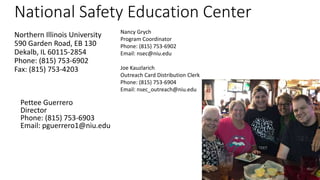
National Safety Education Center
Northern Illinois University
590 Garden Road, EB 130
Dekalb, IL 60115-2854
Phone: (815) 753-6902
Fax: (815) 753-4203
2
Nancy Grych
Program Coordinator
Phone: (815) 753-6902
Email: nsec@niu.edu
Joe Kauzlarich
Outreach Card Distribution Clerk
Phone: (815) 753-6904
Email: nsec_outreach@niu.edu
Pettee Guerrero
Director
Phone: (815) 753-6903
Email: pguerrero1@niu.edu
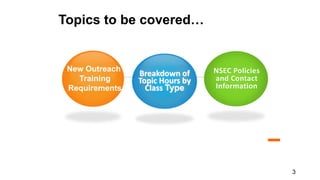
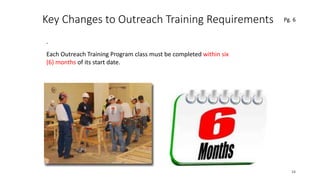
Topics to be covered…
Breakdown of
Topic Hours by
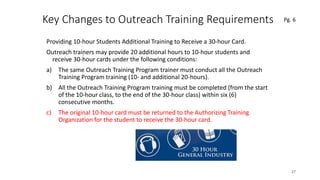
Class Type
NSEC Policies
and Contact
Information
New Outreach
Requirements
New Outreach
Training
Requirements
3
New Requirements January
2017
4
Key Changes to Outreach Training Requirements
5
For OSHA Authorized Outreach Trainers
OSHA Outreach Training Program training does not meet the
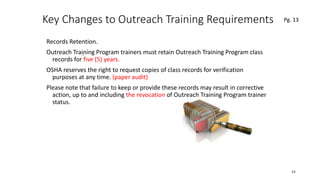
training requirements contained in any OSHA standard.
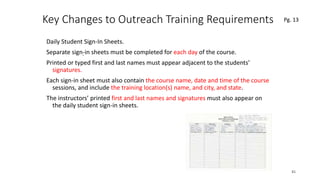
Some states and local jurisdictions have enacted laws mandating
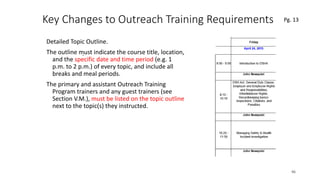
Outreach Training Program training, and some employers and
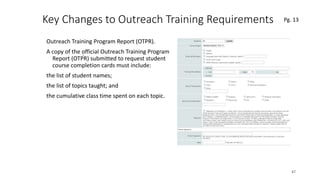
unions require workers to have this training to work on job sites
or to fulfill their own safety training goals.
Pg. 1
States Requiring 10/30 Hour Cards
• New York State – 10 public work projects of
$250,000 or more. 5 years recert.
• Massachusetts – 10 hour construction
• New Hampshire 10 - publicly projects of
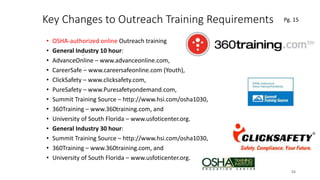
$100,000 or more
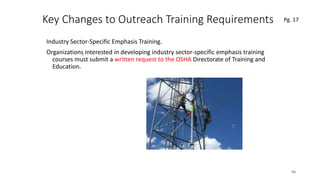
• Connecticut - 10 - public project over $100,000.
• Rhode Island - 10 - public project over $100,000
• Florida - All construction employees are
required to take OSHA-authorized training prior
to employment on any Miami-Dade County
public or private contract valued in excess of
$1,000,000.
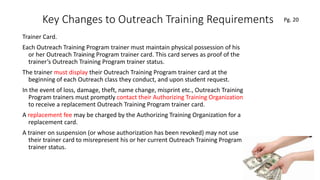
• West Virginia -Workers on any public
improvement project with a total cost in excess
of $500,000 are required to take OSHA-
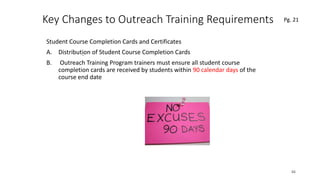
authorized training.
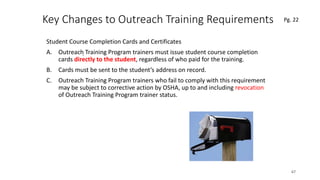
• Missouri – 10 - public bodies for construction
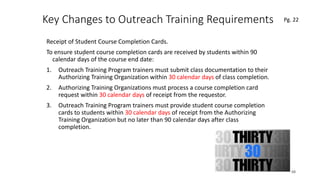
of public works
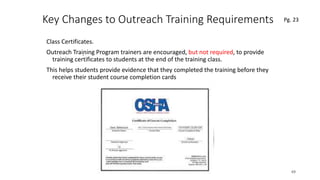
• Nevada - All construction workers in the state
to undergo a 10-hour. All Supervisors on a
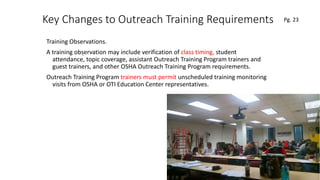
construction site to undergo a 30-hour safety
training course (OSHA-30) approved by OSHA
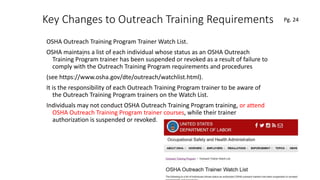
at least once every five years
• Pennsylvania - All employees (10-hour) and at
least one supervisory employee (30-hour) of
licensed contractors are required to take
OSHA-authorized training if they are
performing permitted construction or
demolition work within the city of
Philadelphia.
Key Changes to Outreach Training Requirements
7
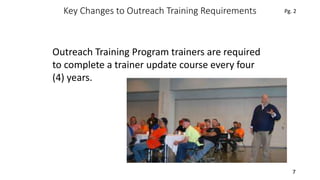
Outreach Training Program trainers are required
to complete a trainer update course every four
(4) years.
Pg. 2
Key Changes to Outreach Training Requirements
8
If a trainer’s authorization status has expired, the trainer has a 90
calendar day grace period after their expiration date to take the
trainer update course or the applicable industry trainer course.
During the grace period, the trainer will be unable to conduct
Outreach Training Program training and receive student course
completion cards.
After the grace period ends, a trainer’s authorization status may be
reinstated only by retaking the applicable industry trainer course
and meeting applicable course prerequisites
Pg. 2
Extensions to the grace period will not be granted.
(except military deployment).
Key Changes to Outreach Training Requirements
9
Trainers may be affiliated with only one Authorizing Training
Organization per industry (e.g., a trainer may be authorized
through one ATO for Construction, and authorized through another
ATO for General Industry.
Example.
NSEC – General Industry
Red Rocks – Construction
Pg. 2
Key Changes to Outreach Training Requirements
10
Statement of Compliance
•Authorized trainers must sign a Statement of Compliance with their authorizing
training organization verifying that the training they conduct will be in accordance
with Outreach Training Program requirements and procedures.
•The Statement of Compliance must be submitted to the organization where the
most recent trainer course or update course was completed.
•The Statement of Compliance is located in the New Program Requirements:
Appendix A
•The Statement of Compliance must be on file before a trainer can receive cards,
effective immediately.
Pg. 3
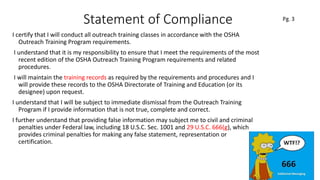
Statement of Compliance
I certify that I will conduct all outreach training classes in accordance with the OSHA
Outreach Training Program requirements.
I understand that it is my responsibility to ensure that I meet the requirements of the most
recent edition of the OSHA Outreach Training Program requirements and related
procedures.
I will maintain the training records as required by the requirements and procedures and I
will provide these records to the OSHA Directorate of Training and Education (or its
designee) upon request.
I understand that I will be subject to immediate dismissal from the Outreach Training
Program if I provide information that is not true, complete and correct.
I further understand that providing false information may subject me to civil and criminal
penalties under Federal law, including 18 U.S.C. Sec. 1001 and 29 U.S.C. 666(g), which
provides criminal penalties for making any false statement, representation or
certification.
11
Key Changes to Outreach Training Requirements
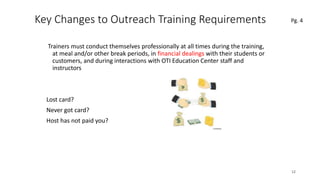
Trainers must conduct themselves professionally at all times during the training,
at meal and/or other break periods, in financial dealings with their students or
customers, and during interactions with OTI Education Center staff and
instructors
Lost card?
Never got card?
Host has not paid you?
12
Pg. 4
Key Changes to Outreach Training Requirements
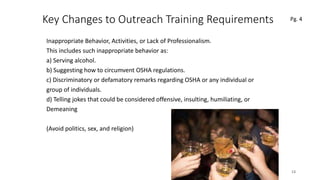
Inappropriate Behavior, Activities, or Lack of Professionalism.
This includes such inappropriate behavior as:
a) Serving alcohol.
b) Suggesting how to circumvent OSHA regulations.
c) Discriminatory or defamatory remarks regarding OSHA or any individual or
group of individuals.
d) Telling jokes that could be considered offensive, insulting, humiliating, or
Demeaning
(Avoid politics, sex, and religion)
13
Key Changes to Outreach Training Requirements
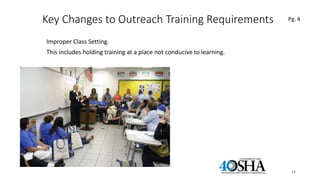
Improper Class Setting.
This includes holding training at a place not conducive to learning.
14
Key Changes to Outreach Training Requirements
Failure to Handle the Payment and Refund of Course Tuition and Fees in a
Professional Manner.
This includes failing to reimburse full course tuition and fees within five (5)
business days of cancelling a class, or, if the trainer reschedules the cancelled
class, failing to reimburse full course tuition and fees to each student that does
not affirmatively agree, within 10 business days of the class cancellation, to
attend the rescheduled class..
15
Key Changes to Outreach Training Requirements
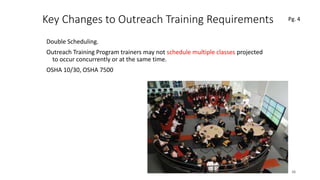
Double Scheduling.
Outreach Training Program trainers may not schedule multiple classes projected
to occur concurrently or at the same time.
OSHA 10/30, OSHA 7500
16
Key Changes to Outreach Training Requirements
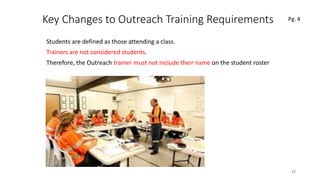
Students are defined as those attending a class.
Trainers are not considered students.
Therefore, the Outreach trainer must not include their name on the student roster
17
Key Changes to Outreach Training Requirements
Attendance.
To receive a course completion card, the student must attend the entire class and
complete all class requirements, including all requisite topics and the minimum
number of contact hours
No 90%
Common Audit finding in paper audits.
18
Key Changes to Outreach Training Requirements
Student Contact Hours.
Student contact hours refer to time spent covering
course content.
Student contact hours do not include breaks for meals or other
breaks, or time spent on administrative matters such as attendance or tests.
19
Key Changes to Outreach Training Requirements
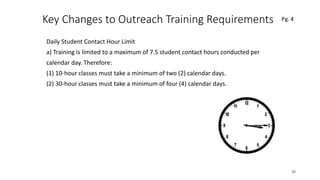
Daily Student Contact Hour Limit
a) Training is limited to a maximum of 7.5 student contact hours conducted per
calendar day. Therefore:
(1) 10-hour classes must take a minimum of two (2) calendar days.
(2) 30-hour classes must take a minimum of four (4) calendar days.
20
Key Changes to Outreach Training Requirements
.
21
.A 10-minute break is required for every two (2) consecutive hours of
training (including student contact hours and time spent on
administrative matters or tests), and
a 30-minute lunch or meal break is required for every six (6) hours of
training (including student contact hours and time spent on
administrative matters such as attendance or tests).
Training is not allowed during lunch or meals, or other break periods.
Pg. 5
Key Changes to Outreach Training Requirements
.
22
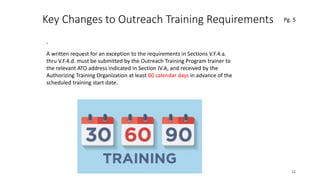
.A written request for an exception to the requirements in Sections V.F.4.a.
thru V.F.4.d. must be submitted by the Outreach Training Program trainer to
the relevant ATO address indicated in Section IV.A, and received by the
Authorizing Training Organization at least 60 calendar days in advance of the
scheduled training start date.
Pg. 5
Key Changes to Outreach Training Requirements
.
23
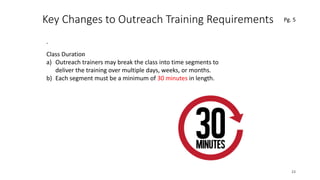
.Class Duration
a) Outreach trainers may break the class into time segments to
deliver the training over multiple days, weeks, or months.
b) Each segment must be a minimum of 30 minutes in length.
Pg. 5
Key Changes to Outreach Training Requirements
.
24
.Each Outreach Training Program class must be completed within six
(6) months of its start date.
Pg. 6
Key Changes to Outreach Training Requirements
.
25
.Class Style
a) Outreach Training Program training must include workshops, case studies,
exercises, and demonstrations that involve student participation and
interaction.
b) Videos cannot comprise more than 25% of the instructional time spent in
Outreach Training Program training.
Pg. 6
Key Changes to Outreach Training Requirements
Student Verification.
Outreach trainers must employ every reasonable effort to verify the identity of
each individual attending their Outreach Training Program training.
26
.
Pg. 6
Key Changes to Outreach Training Requirements
Providing 10-hour Students Additional Training to Receive a 30-hour Card.
Outreach trainers may provide 20 additional hours to 10-hour students and
receive 30-hour cards under the following conditions:
a) The same Outreach Training Program trainer must conduct all the Outreach
Training Program training (10- and additional 20-hours).
b) All the Outreach Training Program training must be completed (from the start
of the 10-hour class, to the end of the 30-hour class) within six (6)
consecutive months.
c) The original 10-hour card must be returned to the Authorizing Training
Organization for the student to receive the 30-hour card.
27
.
Pg. 6
Key Changes to Outreach Training Requirements
An Outreach Training Program trainer may not treat a General Industry 10-hour
class as a combination General Industry 10-hour class and Construction 10-hour
class because the Outreach Program Trainer combined like-portions and
subsequently taught all the other required portions of both 10-hour classes in a
single training.
28
.
Pg. 6
Key Changes to Outreach Training Requirements
Makeup Training
Student Eligibility. For a student to be eligible for makeup training, the
student must have completed at least 50% of the contact hours during
the original class offering.
The Outreach Training Program trainer must schedule makeup training,
and makeup training must be completed, within six (6) months of the
start of the training course,
Makeup training may be performed by the primary Outreach Training
Program trainer or by another Outreach Training Program trainer who
assists the primary Outreach Training Program.
Students may complete the makeup training with a guest trainer who
conducted the particular missed training portion, as long as this part
of the training is coordinated by the primary Outreach Training
Program trainer and all other requirements in Section V.M. are
followed.
29
.
Pg. 7
Key Changes to Outreach Training Requirements
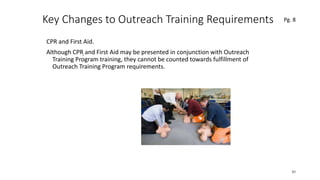
CPR and First Aid.
Although CPR and First Aid may be presented in conjunction with Outreach
Training Program training, they cannot be counted towards fulfillment of
Outreach Training Program requirements.
30
.
Pg. 8
Key Changes to Outreach Training Requirements
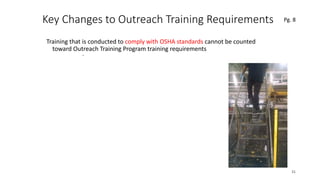
Training that is conducted to comply with OSHA standards cannot be counted
toward Outreach Training Program training requirements
31
.
Pg. 8
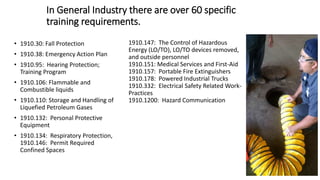
In General Industry there are over 60 specific
training requirements.
• 1910.30: Fall Protection
• 1910.38: Emergency Action Plan
• 1910.95: Hearing Protection;
Training Program
• 1910.106: Flammable and
Combustible liquids
• 1910.110: Storage and Handling of
Liquefied Petroleum Gases
• 1910.132: Personal Protective
Equipment
• 1910.134: Respiratory Protection,
1910.146: Permit Required
Confined Spaces
1910.147: The Control of Hazardous
Energy (LO/TO), LO/TO devices removed,
and outside personnel
1910.151: Medical Services and First-Aid
1910.157: Portable Fire Extinguishers
1910.178: Powered Industrial Trucks
1910.332: Electrical Safety Related Work-
Practices
1910.1200: Hazard Communication
Key Changes to Outreach Training Requirements
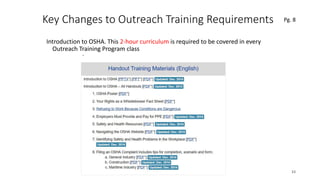
Introduction to OSHA. This 2-hour curriculum is required to be covered in every
Outreach Training Program class
33
.
Pg. 8
Key Changes to Outreach Training Requirements
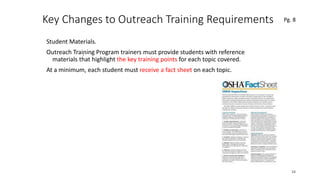
Student Materials.
Outreach Training Program trainers must provide students with reference
materials that highlight the key training points for each topic covered.
At a minimum, each student must receive a fact sheet on each topic.
34
.
Pg. 8
Key Changes to Outreach Training Requirements
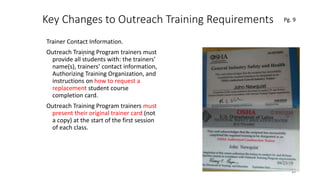
Trainer Contact Information.
Outreach Training Program trainers must
provide all students with: the trainers’
name(s), trainers’ contact information,
Authorizing Training Organization, and
instructions on how to request a
replacement student course
completion card.
Outreach Training Program trainers must
present their original trainer card (not
a copy) at the start of the first session
of each class.
35
.
Pg. 9
Key Changes to Outreach Training Requirements
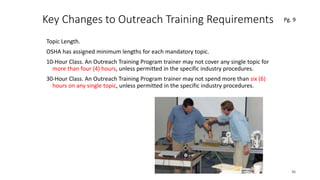
Topic Length.
OSHA has assigned minimum lengths for each mandatory topic.
10-Hour Class. An Outreach Training Program trainer may not cover any single topic for
more than four (4) hours, unless permitted in the specific industry procedures.
30-Hour Class. An Outreach Training Program trainer may not spend more than six (6)
hours on any single topic, unless permitted in the specific industry procedures.
36
.
Pg. 9
Key Changes to Outreach Training Requirements
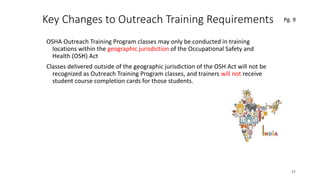
OSHA Outreach Training Program classes may only be conducted in training
locations within the geographic jurisdiction of the Occupational Safety and
Health (OSH) Act
Classes delivered outside of the geographic jurisdiction of the OSH Act will not be
recognized as Outreach Training Program classes, and trainers will not receive
student course completion cards for those students.
37
.
Pg. 9
Key Changes to Outreach Training Requirements
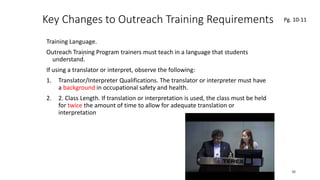
Training Language.
Outreach Training Program trainers must teach in a language that students
understand.
If using a translator or interpret, observe the following:
1. Translator/Interpreter Qualifications. The translator or interpreter must have
a background in occupational safety and health.
2. 2. Class Length. If translation or interpretation is used, the class must be held
for twice the amount of time to allow for adequate translation or
interpretation
38
.
Pg. 10-11
Key Changes to Outreach Training Requirements
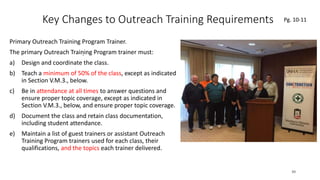
Primary Outreach Training Program Trainer.
The primary Outreach Training Program trainer must:
a) Design and coordinate the class.
b) Teach a minimum of 50% of the class, except as indicated
in Section V.M.3., below.
c) Be in attendance at all times to answer questions and
ensure proper topic coverage, except as indicated in
Section V.M.3., below, and ensure proper topic coverage.
d) Document the class and retain class documentation,
including student attendance.
e) Maintain a list of guest trainers or assistant Outreach
Training Program trainers used for each class, their
qualifications, and the topics each trainer delivered.
39
.
Pg. 10-11
Key Changes to Outreach Training Requirements
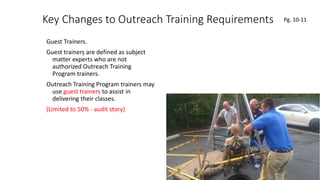
Guest Trainers.
Guest trainers are defined as subject
matter experts who are not
authorized Outreach Training
Program trainers.
Outreach Training Program trainers may
use guest trainers to assist in
delivering their classes.
(Limited to 50% - audit story)
40
.
Pg. 10-11
Key Changes to Outreach Training Requirements
Assistant Outreach Training Program Trainers.
When assistant Outreach Training Program trainers are used, the primary Outreach
Training Program trainer must teach and be in attendance for at least 20% of the
class, and must coordinate, document, and retain records of the training sessions.
The assistant Outreach Training Program trainers must be authorized in the specific
industry course being delivered.
At least one Outreach Training Program authorized trainer must be in attendance at all
times.
CSC got this changed.
41
.
Pg. 10-11
Key Changes to Outreach Training Requirements
Minimum Class Size
OSHA intends for Outreach Training Program training to be participatory.
For this reason, OSHA requires Outreach Training Program trainers to teach at
least three (3) students per class, except as noted below
42
.
Pg. 11
Key Changes to Outreach Training Requirements
Maximum Class Size.
1. Outreach Training Program classes are limited to a maximum of 40 students.
43
.
Pg. 12
Key Changes to Outreach Training Requirements
Records Retention.
Outreach Training Program trainers must retain Outreach Training Program class
records for five (5) years.
OSHA reserves the right to request copies of class records for verification
purposes at any time. (paper audit)
Please note that failure to keep or provide these records may result in corrective
action, up to and including the revocation of Outreach Training Program trainer
status.
44
.
Pg. 13
Key Changes to Outreach Training Requirements
Daily Student Sign-In Sheets.
Separate sign-in sheets must be completed for each day of the course.
Printed or typed first and last names must appear adjacent to the students’
signatures.
Each sign-in sheet must also contain the course name, date and time of the course
sessions, and include the training location(s) name, and city, and state.
The instructors’ printed first and last names and signatures must also appear on
the daily student sign-in sheets.
45
.
Pg. 13
Key Changes to Outreach Training Requirements
Detailed Topic Outline.
The outline must indicate the course title, location,
and the specific date and time period (e.g. 1
p.m. to 2 p.m.) of every topic, and include all
breaks and meal periods.
The primary and assistant Outreach Training
Program trainers and any guest trainers (see
Section V.M.), must be listed on the topic outline
next to the topic(s) they instructed.
46
.
Pg. 13
Key Changes to Outreach Training Requirements
Outreach Training Program Report (OTPR).
A copy of the official Outreach Training Program
Report (OTPR) submitted to request student
course completion cards must include:
the list of student names;
the list of topics taught; and
the cumulative class time spent on each topic.
47
.
Pg. 13
Key Changes to Outreach Training Requirements
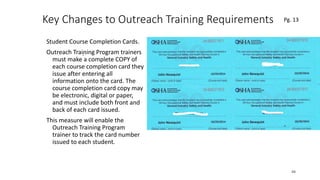
Student Course Completion Cards.
Outreach Training Program trainers
must make a complete COPY of
each course completion card they
issue after entering all
information onto the card. The
course completion card copy may
be electronic, digital or paper,
and must include both front and
back of each card issued.
This measure will enable the
Outreach Training Program
trainer to track the card number
issued to each student.
48
.
Pg. 13
Key Changes to Outreach Training Requirements
Guest trainers.
A list containing the name of each guest trainer, the specific topics and times
covered by each guest trainer, and their qualifications
49
.
Pg. 13
Brent Bryden brings 32 years of manufacturing safety and
environmental health experience.
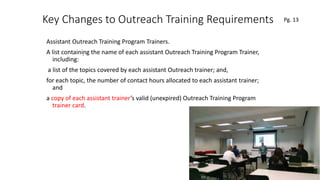
Key Changes to Outreach Training Requirements
Assistant Outreach Training Program Trainers.
A list containing the name of each assistant Outreach Training Program Trainer,
including:
a list of the topics covered by each assistant Outreach trainer; and,
for each topic, the number of contact hours allocated to each assistant trainer;
and
a copy of each assistant trainer’s valid (unexpired) Outreach Training Program
trainer card.
50
.
Pg. 13
Key Changes to Outreach Training Requirements
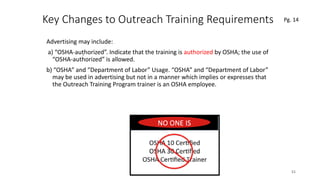
Advertising may include:
a) “OSHA-authorized”. Indicate that the training is authorized by OSHA; the use of
“OSHA-authorized” is allowed.
b) “OSHA” and “Department of Labor” Usage. “OSHA” and “Department of Labor”
may be used in advertising but not in a manner which implies or expresses that
the Outreach Training Program trainer is an OSHA employee.
51
.
Pg. 14
Key Changes to Outreach Training Requirements
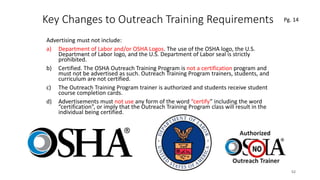
Advertising must not include:
a) Department of Labor and/or OSHA Logos. The use of the OSHA logo, the U.S.
Department of Labor logo, and the U.S. Department of Labor seal is strictly
prohibited.
b) Certified. The OSHA Outreach Training Program is not a certification program and
must not be advertised as such. Outreach Training Program trainers, students, and
curriculum are not certified.
c) The Outreach Training Program trainer is authorized and students receive student
course completion cards.
d) Advertisements must not use any form of the word “certify” including the word
“certification”, or imply that the Outreach Training Program class will result in the
individual being certified.
52
.
Pg. 14
Key Changes to Outreach Training Requirements
Advertising must not include:
a) OSHA “Approved”. OSHA does not “approve” trainers or classes. Advertising
cannot state, imply or suggest that Outreach Training Program training or
Outreach Training Program trainers are approved by OSHA.
b) Outreach Training Program trainers cannot conduct OSHA trainer courses.
Outreach Training Program trainers must not refer to an Outreach Training
Program class as an OSHA trainer course or an Outreach Training Program trainer
course.
c) OSHA Outreach Training Program trainer courses may only be conducted by the
Authorizing Training Organization, which is either the OSHA Training Institute (OTI)
or an OTI Education Center (see www.osha.gov/otiec).
d) Use of “Train-the-Trainer.” Outreach Training Program trainers must not combine
the use of “OSHA” and “Train-the-Trainer” in advertising.
e) Students who complete an OSHA Outreach Training Program class are not
recognized as Outreach Training Program trainers and are not entitled to receive
student course completion cards for students they may train.
f) Outreach Training Program trainers cannot state that Outreach Training Program
training is OSHA compliant, or that it meets the requirements in any OSHA
standard.
53
.
Pg. 15
Key Changes to Outreach Training Requirements
Outreach Training Program classes must be conducted in-person, unless a written
exception is obtained from OSHA or the trainer’s Authorizing Training
Organization
Online Training. Authorized Outreach trainers may not conduct online Outreach
Training Program classes.
Only OSHA-authorized online Outreach training providers may conduct online
Outreach Training Program classes.
Video Conferencing. OSHA’s preferred delivery method is through standard in
person classroom instruction. Outreach Training Program training conducted
through a remote site video conferencing or other live, interactive instruction
that is not standard in-person classroom instruction is not allowed unless OSHA
or the relevant Authorizing Training Organization has granted a written
exception for the conduct of such training.
54
.
Pg. 15
Key Changes to Outreach Training Requirements
• OSHA-authorized online Outreach training
• General Industry 10 hour:
• AdvanceOnline – www.advanceonline.com,
• CareerSafe – www.careersafeonline.com (Youth),
• ClickSafety – www.clicksafety.com,
• PureSafety – www.Puresafetyondemand.com,
• Summit Training Source – http://www.hsi.com/osha1030,
• 360Training – www.360training.com, and
• University of South Florida – www.usfoticenter.org.
• General Industry 30 hour:
• Summit Training Source – http://www.hsi.com/osha1030,
• 360Training – www.360training.com, and
• University of South Florida – www.usfoticenter.org.
55
.
Pg. 15
Key Changes to Outreach Training Requirements
Industry Sector-Specific Emphasis Training.
Organizations interested in developing industry sector-specific emphasis training
courses must submit a written request to the OSHA Directorate of Training and
Education.
56
.
Pg. 17
Key Changes to Outreach Training Requirements
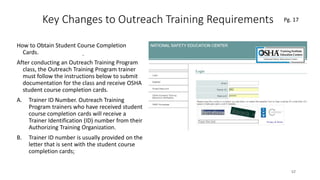
How to Obtain Student Course Completion
Cards.
After conducting an Outreach Training Program
class, the Outreach Training Program trainer
must follow the instructions below to submit
documentation for the class and receive OSHA
student course completion cards.
A. Trainer ID Number. Outreach Training
Program trainers who have received student
course completion cards will receive a
Trainer Identification (ID) number from their
Authorizing Training Organization.
B. Trainer ID number is usually provided on the
letter that is sent with the student course
completion cards;
57
.
Pg. 17
Key Changes to Outreach Training Requirements
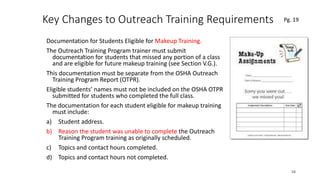
Documentation for Students Eligible for Makeup Training.
The Outreach Training Program trainer must submit
documentation for students that missed any portion of a class
and are eligible for future makeup training (see Section V.G.).
This documentation must be separate from the OSHA Outreach
Training Program Report (OTPR).
Eligible students’ names must not be included on the OSHA OTPR
submitted for students who completed the full class.
The documentation for each student eligible for makeup training
must include:
a) Student address.
b) Reason the student was unable to complete the Outreach
Training Program training as originally scheduled.
c) Topics and contact hours completed.
d) Topics and contact hours not completed.
58
.
Pg. 19
Key Changes to Outreach Training Requirements
Makeup Training.
The primary Outreach Training Program trainer must provide the following
information for a card request upon completion of makeup training:
a) A copy of the original OSHA Outreach Training Program Report (OTPR)
submitted for students who completed the full class. The name(s) of the
student(s) who completed the makeup training must not be included on the
original OTPR submitted for students who completed the full class.
b) Documentation of student(s) participation in the original class, including a
clear indication of topics and contact hours trained and missed.
c) A new OSHA Outreach Training Program Report that notes the end date of the
makeup training, the name(s) of the student(s) who completed the makeup
training and a complete, cumulative list of the topics and contact hours
trained.
59
.
Pg. 19
Key Changes to Outreach Training Requirements
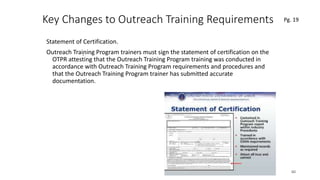
Statement of Certification.
Outreach Training Program trainers must sign the statement of certification on the
OTPR attesting that the Outreach Training Program training was conducted in
accordance with Outreach Training Program requirements and procedures and
that the Outreach Training Program trainer has submitted accurate
documentation.
60
.
Pg. 19
Key Changes to Outreach Training Requirements
Time Limit on Submitting Training Documentation.
Outreach Training Program trainers must submit documentation of training within
30 calendar days of class completion.
If class documentation is submitted via hard copy, the postmark will be used to
determine the timeliness of the request.
61
.
Pg. 19
Key Changes to Outreach Training Requirements
Report Classes Individually.
Report each class separately – do not combine multiple classes in one report.
This condition does not apply in cases where a 10-hour class is used to fulfil
requirements toward a 30-hour class in the same industry
62
.
Pg. 19
Key Changes to Outreach Training Requirements
Trainer Card.
Each Outreach Training Program trainer must maintain physical possession of his
or her Outreach Training Program trainer card. This card serves as proof of the
trainer’s Outreach Training Program trainer status.
The trainer must display their Outreach Training Program trainer card at the
beginning of each Outreach class they conduct, and upon student request.
In the event of loss, damage, theft, name change, misprint etc., Outreach Training
Program trainers must promptly contact their Authorizing Training Organization
to receive a replacement Outreach Training Program trainer card.
A replacement fee may be charged by the Authorizing Training Organization for a
replacement card.
A trainer on suspension (or whose authorization has been revoked) may not use
their trainer card to misrepresent his or her current Outreach Training Program
trainer status.
63
.
Pg. 20
Key Changes to Outreach Training Requirements
Non-Receipt of Batch of Student Cards.
Where an Authorizing Training Organization issues a batch of student course
completion cards for an Outreach Training Program class to an Outreach
Training Program trainer, and the trainer asserts that he or she did not receive
the batch, the trainer shall not request a new set of cards more than 90
calendar days after the class end date.
If the trainer makes such a request, a new set of cards will not be issued.
However, if the trainer requests a new set of cards 90 or fewer calendar days
after the course end date, a new set of cards will be issued, provided the trainer
sends the following documentation to the Authorizing Training Organization:
(1) Student sign-in sheets for each day of the class
(2) Student contact information
(3) Topic outline which indicates the specific timing of all topics, mealtimes and
breaks (e.g., 1 p.m. to 2 p.m.)
(4) A signed statement agreeing to pay fees associated with future student
course completion card deliveries if the batch is replaced, to cover the cost of
certified delivery
64
.
Pg. 21
Key Changes to Outreach Training Requirements
Replacement Requestor.
Replacements on behalf of the student may be requested by an organization that
maintains a duplicate copy of the Outreach Training Program trainer’s records.
However, the limitation of only one (1) replacement card per student per class
remains in effect.
65
.
Pg. 21
Key Changes to Outreach Training Requirements
Student Course Completion Cards and Certificates
A. Distribution of Student Course Completion Cards
B. Outreach Training Program trainers must ensure all student course
completion cards are received by students within 90 calendar days of the
course end date
66
.
Pg. 21
Key Changes to Outreach Training Requirements
Student Course Completion Cards and Certificates
A. Outreach Training Program trainers must issue student course completion
cards directly to the student, regardless of who paid for the training.
B. Cards must be sent to the student’s address on record.
C. Outreach Training Program trainers who fail to comply with this requirement
may be subject to corrective action by OSHA, up to and including revocation
of Outreach Training Program trainer status.
67
.
Pg. 22
Key Changes to Outreach Training Requirements
Receipt of Student Course Completion Cards.
To ensure student course completion cards are received by students within 90
calendar days of the course end date:
1. Outreach Training Program trainers must submit class documentation to their
Authorizing Training Organization within 30 calendar days of class completion.
2. Authorizing Training Organizations must process a course completion card
request within 30 calendar days of receipt from the requestor.
3. Outreach Training Program trainers must provide student course completion
cards to students within 30 calendar days of receipt from the Authorizing
Training Organization but no later than 90 calendar days after class
completion.
68
.
Pg. 22
Key Changes to Outreach Training Requirements
Class Certificates.
Outreach Training Program trainers are encouraged, but not required, to provide
training certificates to students at the end of the training class.
This helps students provide evidence that they completed the training before they
receive their student course completion cards
69
.
Pg. 23
Key Changes to Outreach Training Requirements
Advance Notice of Training.
Outreach Training Program trainers are required to provide one-time or ongoing
advance notice of scheduled Outreach training and advance notice of
cancellation of scheduled Outreach training to their Authorizing Training
Organization upon request by either OSHA or the Authorizing Training
Organization.
If an Outreach Training Program trainer does not comply with or provide the
information requested, the Authorizing Training Organization will not issue
student course completion cards for the training(s) for which notice was not
provided or incomplete.
The Outreach Training Program trainer may be subject to corrective action by
OSHA, up to and including revocation of their Outreach Training Program trainer
status, for noncompliance with advance notification requirements.
70
.
Pg. 23
Key Changes to Outreach Training Requirements
Training Observations.
A training observation may include verification of class timing, student
attendance, topic coverage, assistant Outreach Training Program trainers and
guest trainers, and other OSHA Outreach Training Program requirements.
Outreach Training Program trainers must permit unscheduled training monitoring
visits from OSHA or OTI Education Center representatives.
71
.
Pg. 23
Key Changes to Outreach Training Requirements
Record Audits.
A record audit may require any or all of the items noted in Section V.P.
If a trainer does not respond to a record audit request by the stated due date, the
Authorizing Training Organization will not issue student course completion cards
and the trainer may be subject to corrective action by OSHA
72
.
Pg. 25
Key Changes to Outreach Training Requirements
OSHA Outreach Training Program Trainer Watch List.
OSHA maintains a list of each individual whose status as an OSHA Outreach
Training Program trainer has been suspended or revoked as a result of failure to
comply with the Outreach Training Program requirements and procedures
(see https://www.osha.gov/dte/outreach/watchlist.html).
It is the responsibility of each Outreach Training Program trainer to be aware of
the Outreach Training Program trainers on the Watch List.
Individuals may not conduct OSHA Outreach Training Program training, or attend
OSHA Outreach Training Program trainer courses, while their trainer
authorization is suspended or revoked.
73
.
Pg. 24
Breakdown of Topic
Hours
by Class Type
74
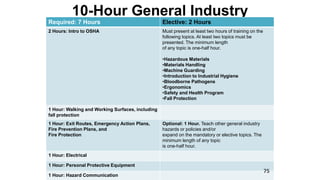
10-Hour General Industry
Required: 7 Hours Elective: 2 Hours
2 Hours: Intro to OSHA Must present at least two hours of training on the
following topics. At least two topics must be
presented. The minimum length
of any topic is one-half hour.
•Hazardous Materials
•Materials Handling
•Machine Guarding
•Introduction to Industrial Hygiene
•Bloodborne Pathogens
•Ergonomics
•Safety and Health Program
•Fall Protection
1 Hour: Walking and Working Surfaces, including
fall protection
1 Hour: Exit Routes, Emergency Action Plans,
Fire Prevention Plans, and
Fire Protection
Optional: 1 Hour. Teach other general industry
hazards or policies and/or
expand on the mandatory or elective topics. The
minimum length of any topic
is one-half hour.
1 Hour: Electrical
1 Hour: Personal Protective Equipment
1 Hour: Hazard Communication
75
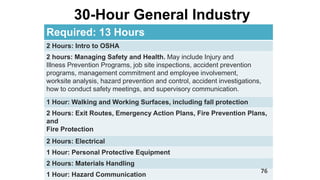
Required: 13 Hours
2 Hours: Intro to OSHA
2 hours: Managing Safety and Health. May include Injury and
Illness Prevention Programs, job site inspections, accident prevention
programs, management commitment and employee involvement,
worksite analysis, hazard prevention and control, accident investigations,
how to conduct safety meetings, and supervisory communication.
1 Hour: Walking and Working Surfaces, including fall protection
2 Hours: Exit Routes, Emergency Action Plans, Fire Prevention Plans,
and
Fire Protection
2 Hours: Electrical
1 Hour: Personal Protective Equipment
2 Hours: Materials Handling
1 Hour: Hazard Communication
30-Hour General Industry
76
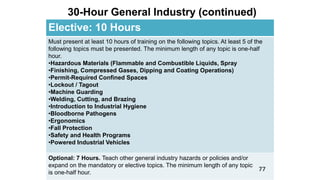
Elective: 10 Hours
Must present at least 10 hours of training on the following topics. At least 5 of the
following topics must be presented. The minimum length of any topic is one-half
hour.
•Hazardous Materials (Flammable and Combustible Liquids, Spray
•Finishing, Compressed Gases, Dipping and Coating Operations)
•Permit-Required Confined Spaces
•Lockout / Tagout
•Machine Guarding
•Welding, Cutting, and Brazing
•Introduction to Industrial Hygiene
•Bloodborne Pathogens
•Ergonomics
•Fall Protection
•Safety and Health Programs
•Powered Industrial Vehicles
Optional: 7 Hours. Teach other general industry hazards or policies and/or
expand on the mandatory or elective topics. The minimum length of any topic
is one-half hour.
30-Hour General Industry (continued)
77
Do you have any
QUESTIONS?
78

Outreach Training Requirements 2017 new

  • 1.
  • 2.
    National Safety EducationCenter Northern Illinois University 590 Garden Road, EB 130 Dekalb, IL 60115-2854 Phone: (815) 753-6902 Fax: (815) 753-4203 2 Nancy Grych Program Coordinator Phone: (815) 753-6902 Email: nsec@niu.edu Joe Kauzlarich Outreach Card Distribution Clerk Phone: (815) 753-6904 Email: nsec_outreach@niu.edu Pettee Guerrero Director Phone: (815) 753-6903 Email: pguerrero1@niu.edu
  • 3.
    Topics to becovered… Breakdown of Topic Hours by Class Type NSEC Policies and Contact Information New Outreach Requirements New Outreach Training Requirements 3
  • 4.
  • 5.
    Key Changes toOutreach Training Requirements 5 For OSHA Authorized Outreach Trainers OSHA Outreach Training Program training does not meet the training requirements contained in any OSHA standard. Some states and local jurisdictions have enacted laws mandating Outreach Training Program training, and some employers and unions require workers to have this training to work on job sites or to fulfill their own safety training goals. Pg. 1
  • 6.
    States Requiring 10/30Hour Cards • New York State – 10 public work projects of $250,000 or more. 5 years recert. • Massachusetts – 10 hour construction • New Hampshire 10 - publicly projects of $100,000 or more • Connecticut - 10 - public project over $100,000. • Rhode Island - 10 - public project over $100,000 • Florida - All construction employees are required to take OSHA-authorized training prior to employment on any Miami-Dade County public or private contract valued in excess of $1,000,000. • West Virginia -Workers on any public improvement project with a total cost in excess of $500,000 are required to take OSHA- authorized training. • Missouri – 10 - public bodies for construction of public works • Nevada - All construction workers in the state to undergo a 10-hour. All Supervisors on a construction site to undergo a 30-hour safety training course (OSHA-30) approved by OSHA at least once every five years • Pennsylvania - All employees (10-hour) and at least one supervisory employee (30-hour) of licensed contractors are required to take OSHA-authorized training if they are performing permitted construction or demolition work within the city of Philadelphia.
  • 7.
    Key Changes toOutreach Training Requirements 7 Outreach Training Program trainers are required to complete a trainer update course every four (4) years. Pg. 2
  • 8.
    Key Changes toOutreach Training Requirements 8 If a trainer’s authorization status has expired, the trainer has a 90 calendar day grace period after their expiration date to take the trainer update course or the applicable industry trainer course. During the grace period, the trainer will be unable to conduct Outreach Training Program training and receive student course completion cards. After the grace period ends, a trainer’s authorization status may be reinstated only by retaking the applicable industry trainer course and meeting applicable course prerequisites Pg. 2 Extensions to the grace period will not be granted. (except military deployment).
  • 9.
    Key Changes toOutreach Training Requirements 9 Trainers may be affiliated with only one Authorizing Training Organization per industry (e.g., a trainer may be authorized through one ATO for Construction, and authorized through another ATO for General Industry. Example. NSEC – General Industry Red Rocks – Construction Pg. 2
  • 10.
    Key Changes toOutreach Training Requirements 10 Statement of Compliance •Authorized trainers must sign a Statement of Compliance with their authorizing training organization verifying that the training they conduct will be in accordance with Outreach Training Program requirements and procedures. •The Statement of Compliance must be submitted to the organization where the most recent trainer course or update course was completed. •The Statement of Compliance is located in the New Program Requirements: Appendix A •The Statement of Compliance must be on file before a trainer can receive cards, effective immediately. Pg. 3
  • 11.
    Statement of Compliance Icertify that I will conduct all outreach training classes in accordance with the OSHA Outreach Training Program requirements. I understand that it is my responsibility to ensure that I meet the requirements of the most recent edition of the OSHA Outreach Training Program requirements and related procedures. I will maintain the training records as required by the requirements and procedures and I will provide these records to the OSHA Directorate of Training and Education (or its designee) upon request. I understand that I will be subject to immediate dismissal from the Outreach Training Program if I provide information that is not true, complete and correct. I further understand that providing false information may subject me to civil and criminal penalties under Federal law, including 18 U.S.C. Sec. 1001 and 29 U.S.C. 666(g), which provides criminal penalties for making any false statement, representation or certification. 11
  • 12.
    Key Changes toOutreach Training Requirements Trainers must conduct themselves professionally at all times during the training, at meal and/or other break periods, in financial dealings with their students or customers, and during interactions with OTI Education Center staff and instructors Lost card? Never got card? Host has not paid you? 12 Pg. 4
  • 13.
    Key Changes toOutreach Training Requirements Inappropriate Behavior, Activities, or Lack of Professionalism. This includes such inappropriate behavior as: a) Serving alcohol. b) Suggesting how to circumvent OSHA regulations. c) Discriminatory or defamatory remarks regarding OSHA or any individual or group of individuals. d) Telling jokes that could be considered offensive, insulting, humiliating, or Demeaning (Avoid politics, sex, and religion) 13
  • 14.
    Key Changes toOutreach Training Requirements Improper Class Setting. This includes holding training at a place not conducive to learning. 14
  • 15.
    Key Changes toOutreach Training Requirements Failure to Handle the Payment and Refund of Course Tuition and Fees in a Professional Manner. This includes failing to reimburse full course tuition and fees within five (5) business days of cancelling a class, or, if the trainer reschedules the cancelled class, failing to reimburse full course tuition and fees to each student that does not affirmatively agree, within 10 business days of the class cancellation, to attend the rescheduled class.. 15
  • 16.
    Key Changes toOutreach Training Requirements Double Scheduling. Outreach Training Program trainers may not schedule multiple classes projected to occur concurrently or at the same time. OSHA 10/30, OSHA 7500 16
  • 17.
    Key Changes toOutreach Training Requirements Students are defined as those attending a class. Trainers are not considered students. Therefore, the Outreach trainer must not include their name on the student roster 17
  • 18.
    Key Changes toOutreach Training Requirements Attendance. To receive a course completion card, the student must attend the entire class and complete all class requirements, including all requisite topics and the minimum number of contact hours No 90% Common Audit finding in paper audits. 18
  • 19.
    Key Changes toOutreach Training Requirements Student Contact Hours. Student contact hours refer to time spent covering course content. Student contact hours do not include breaks for meals or other breaks, or time spent on administrative matters such as attendance or tests. 19
  • 20.
    Key Changes toOutreach Training Requirements Daily Student Contact Hour Limit a) Training is limited to a maximum of 7.5 student contact hours conducted per calendar day. Therefore: (1) 10-hour classes must take a minimum of two (2) calendar days. (2) 30-hour classes must take a minimum of four (4) calendar days. 20
  • 21.
    Key Changes toOutreach Training Requirements . 21 .A 10-minute break is required for every two (2) consecutive hours of training (including student contact hours and time spent on administrative matters or tests), and a 30-minute lunch or meal break is required for every six (6) hours of training (including student contact hours and time spent on administrative matters such as attendance or tests). Training is not allowed during lunch or meals, or other break periods. Pg. 5
  • 22.
    Key Changes toOutreach Training Requirements . 22 .A written request for an exception to the requirements in Sections V.F.4.a. thru V.F.4.d. must be submitted by the Outreach Training Program trainer to the relevant ATO address indicated in Section IV.A, and received by the Authorizing Training Organization at least 60 calendar days in advance of the scheduled training start date. Pg. 5
  • 23.
    Key Changes toOutreach Training Requirements . 23 .Class Duration a) Outreach trainers may break the class into time segments to deliver the training over multiple days, weeks, or months. b) Each segment must be a minimum of 30 minutes in length. Pg. 5
  • 24.
    Key Changes toOutreach Training Requirements . 24 .Each Outreach Training Program class must be completed within six (6) months of its start date. Pg. 6
  • 25.
    Key Changes toOutreach Training Requirements . 25 .Class Style a) Outreach Training Program training must include workshops, case studies, exercises, and demonstrations that involve student participation and interaction. b) Videos cannot comprise more than 25% of the instructional time spent in Outreach Training Program training. Pg. 6
  • 26.
    Key Changes toOutreach Training Requirements Student Verification. Outreach trainers must employ every reasonable effort to verify the identity of each individual attending their Outreach Training Program training. 26 . Pg. 6
  • 27.
    Key Changes toOutreach Training Requirements Providing 10-hour Students Additional Training to Receive a 30-hour Card. Outreach trainers may provide 20 additional hours to 10-hour students and receive 30-hour cards under the following conditions: a) The same Outreach Training Program trainer must conduct all the Outreach Training Program training (10- and additional 20-hours). b) All the Outreach Training Program training must be completed (from the start of the 10-hour class, to the end of the 30-hour class) within six (6) consecutive months. c) The original 10-hour card must be returned to the Authorizing Training Organization for the student to receive the 30-hour card. 27 . Pg. 6
  • 28.
    Key Changes toOutreach Training Requirements An Outreach Training Program trainer may not treat a General Industry 10-hour class as a combination General Industry 10-hour class and Construction 10-hour class because the Outreach Program Trainer combined like-portions and subsequently taught all the other required portions of both 10-hour classes in a single training. 28 . Pg. 6
  • 29.
    Key Changes toOutreach Training Requirements Makeup Training Student Eligibility. For a student to be eligible for makeup training, the student must have completed at least 50% of the contact hours during the original class offering. The Outreach Training Program trainer must schedule makeup training, and makeup training must be completed, within six (6) months of the start of the training course, Makeup training may be performed by the primary Outreach Training Program trainer or by another Outreach Training Program trainer who assists the primary Outreach Training Program. Students may complete the makeup training with a guest trainer who conducted the particular missed training portion, as long as this part of the training is coordinated by the primary Outreach Training Program trainer and all other requirements in Section V.M. are followed. 29 . Pg. 7
  • 30.
    Key Changes toOutreach Training Requirements CPR and First Aid. Although CPR and First Aid may be presented in conjunction with Outreach Training Program training, they cannot be counted towards fulfillment of Outreach Training Program requirements. 30 . Pg. 8
  • 31.
    Key Changes toOutreach Training Requirements Training that is conducted to comply with OSHA standards cannot be counted toward Outreach Training Program training requirements 31 . Pg. 8
  • 32.
    In General Industrythere are over 60 specific training requirements. • 1910.30: Fall Protection • 1910.38: Emergency Action Plan • 1910.95: Hearing Protection; Training Program • 1910.106: Flammable and Combustible liquids • 1910.110: Storage and Handling of Liquefied Petroleum Gases • 1910.132: Personal Protective Equipment • 1910.134: Respiratory Protection, 1910.146: Permit Required Confined Spaces 1910.147: The Control of Hazardous Energy (LO/TO), LO/TO devices removed, and outside personnel 1910.151: Medical Services and First-Aid 1910.157: Portable Fire Extinguishers 1910.178: Powered Industrial Trucks 1910.332: Electrical Safety Related Work- Practices 1910.1200: Hazard Communication
  • 33.
    Key Changes toOutreach Training Requirements Introduction to OSHA. This 2-hour curriculum is required to be covered in every Outreach Training Program class 33 . Pg. 8
  • 34.
    Key Changes toOutreach Training Requirements Student Materials. Outreach Training Program trainers must provide students with reference materials that highlight the key training points for each topic covered. At a minimum, each student must receive a fact sheet on each topic. 34 . Pg. 8
  • 35.
    Key Changes toOutreach Training Requirements Trainer Contact Information. Outreach Training Program trainers must provide all students with: the trainers’ name(s), trainers’ contact information, Authorizing Training Organization, and instructions on how to request a replacement student course completion card. Outreach Training Program trainers must present their original trainer card (not a copy) at the start of the first session of each class. 35 . Pg. 9
  • 36.
    Key Changes toOutreach Training Requirements Topic Length. OSHA has assigned minimum lengths for each mandatory topic. 10-Hour Class. An Outreach Training Program trainer may not cover any single topic for more than four (4) hours, unless permitted in the specific industry procedures. 30-Hour Class. An Outreach Training Program trainer may not spend more than six (6) hours on any single topic, unless permitted in the specific industry procedures. 36 . Pg. 9
  • 37.
    Key Changes toOutreach Training Requirements OSHA Outreach Training Program classes may only be conducted in training locations within the geographic jurisdiction of the Occupational Safety and Health (OSH) Act Classes delivered outside of the geographic jurisdiction of the OSH Act will not be recognized as Outreach Training Program classes, and trainers will not receive student course completion cards for those students. 37 . Pg. 9
  • 38.
    Key Changes toOutreach Training Requirements Training Language. Outreach Training Program trainers must teach in a language that students understand. If using a translator or interpret, observe the following: 1. Translator/Interpreter Qualifications. The translator or interpreter must have a background in occupational safety and health. 2. 2. Class Length. If translation or interpretation is used, the class must be held for twice the amount of time to allow for adequate translation or interpretation 38 . Pg. 10-11
  • 39.
    Key Changes toOutreach Training Requirements Primary Outreach Training Program Trainer. The primary Outreach Training Program trainer must: a) Design and coordinate the class. b) Teach a minimum of 50% of the class, except as indicated in Section V.M.3., below. c) Be in attendance at all times to answer questions and ensure proper topic coverage, except as indicated in Section V.M.3., below, and ensure proper topic coverage. d) Document the class and retain class documentation, including student attendance. e) Maintain a list of guest trainers or assistant Outreach Training Program trainers used for each class, their qualifications, and the topics each trainer delivered. 39 . Pg. 10-11
  • 40.
    Key Changes toOutreach Training Requirements Guest Trainers. Guest trainers are defined as subject matter experts who are not authorized Outreach Training Program trainers. Outreach Training Program trainers may use guest trainers to assist in delivering their classes. (Limited to 50% - audit story) 40 . Pg. 10-11
  • 41.
    Key Changes toOutreach Training Requirements Assistant Outreach Training Program Trainers. When assistant Outreach Training Program trainers are used, the primary Outreach Training Program trainer must teach and be in attendance for at least 20% of the class, and must coordinate, document, and retain records of the training sessions. The assistant Outreach Training Program trainers must be authorized in the specific industry course being delivered. At least one Outreach Training Program authorized trainer must be in attendance at all times. CSC got this changed. 41 . Pg. 10-11
  • 42.
    Key Changes toOutreach Training Requirements Minimum Class Size OSHA intends for Outreach Training Program training to be participatory. For this reason, OSHA requires Outreach Training Program trainers to teach at least three (3) students per class, except as noted below 42 . Pg. 11
  • 43.
    Key Changes toOutreach Training Requirements Maximum Class Size. 1. Outreach Training Program classes are limited to a maximum of 40 students. 43 . Pg. 12
  • 44.
    Key Changes toOutreach Training Requirements Records Retention. Outreach Training Program trainers must retain Outreach Training Program class records for five (5) years. OSHA reserves the right to request copies of class records for verification purposes at any time. (paper audit) Please note that failure to keep or provide these records may result in corrective action, up to and including the revocation of Outreach Training Program trainer status. 44 . Pg. 13
  • 45.
    Key Changes toOutreach Training Requirements Daily Student Sign-In Sheets. Separate sign-in sheets must be completed for each day of the course. Printed or typed first and last names must appear adjacent to the students’ signatures. Each sign-in sheet must also contain the course name, date and time of the course sessions, and include the training location(s) name, and city, and state. The instructors’ printed first and last names and signatures must also appear on the daily student sign-in sheets. 45 . Pg. 13
  • 46.
    Key Changes toOutreach Training Requirements Detailed Topic Outline. The outline must indicate the course title, location, and the specific date and time period (e.g. 1 p.m. to 2 p.m.) of every topic, and include all breaks and meal periods. The primary and assistant Outreach Training Program trainers and any guest trainers (see Section V.M.), must be listed on the topic outline next to the topic(s) they instructed. 46 . Pg. 13
  • 47.
    Key Changes toOutreach Training Requirements Outreach Training Program Report (OTPR). A copy of the official Outreach Training Program Report (OTPR) submitted to request student course completion cards must include: the list of student names; the list of topics taught; and the cumulative class time spent on each topic. 47 . Pg. 13
  • 48.
    Key Changes toOutreach Training Requirements Student Course Completion Cards. Outreach Training Program trainers must make a complete COPY of each course completion card they issue after entering all information onto the card. The course completion card copy may be electronic, digital or paper, and must include both front and back of each card issued. This measure will enable the Outreach Training Program trainer to track the card number issued to each student. 48 . Pg. 13
  • 49.
    Key Changes toOutreach Training Requirements Guest trainers. A list containing the name of each guest trainer, the specific topics and times covered by each guest trainer, and their qualifications 49 . Pg. 13 Brent Bryden brings 32 years of manufacturing safety and environmental health experience.
  • 50.
    Key Changes toOutreach Training Requirements Assistant Outreach Training Program Trainers. A list containing the name of each assistant Outreach Training Program Trainer, including: a list of the topics covered by each assistant Outreach trainer; and, for each topic, the number of contact hours allocated to each assistant trainer; and a copy of each assistant trainer’s valid (unexpired) Outreach Training Program trainer card. 50 . Pg. 13
  • 51.
    Key Changes toOutreach Training Requirements Advertising may include: a) “OSHA-authorized”. Indicate that the training is authorized by OSHA; the use of “OSHA-authorized” is allowed. b) “OSHA” and “Department of Labor” Usage. “OSHA” and “Department of Labor” may be used in advertising but not in a manner which implies or expresses that the Outreach Training Program trainer is an OSHA employee. 51 . Pg. 14
  • 52.
    Key Changes toOutreach Training Requirements Advertising must not include: a) Department of Labor and/or OSHA Logos. The use of the OSHA logo, the U.S. Department of Labor logo, and the U.S. Department of Labor seal is strictly prohibited. b) Certified. The OSHA Outreach Training Program is not a certification program and must not be advertised as such. Outreach Training Program trainers, students, and curriculum are not certified. c) The Outreach Training Program trainer is authorized and students receive student course completion cards. d) Advertisements must not use any form of the word “certify” including the word “certification”, or imply that the Outreach Training Program class will result in the individual being certified. 52 . Pg. 14
  • 53.
    Key Changes toOutreach Training Requirements Advertising must not include: a) OSHA “Approved”. OSHA does not “approve” trainers or classes. Advertising cannot state, imply or suggest that Outreach Training Program training or Outreach Training Program trainers are approved by OSHA. b) Outreach Training Program trainers cannot conduct OSHA trainer courses. Outreach Training Program trainers must not refer to an Outreach Training Program class as an OSHA trainer course or an Outreach Training Program trainer course. c) OSHA Outreach Training Program trainer courses may only be conducted by the Authorizing Training Organization, which is either the OSHA Training Institute (OTI) or an OTI Education Center (see www.osha.gov/otiec). d) Use of “Train-the-Trainer.” Outreach Training Program trainers must not combine the use of “OSHA” and “Train-the-Trainer” in advertising. e) Students who complete an OSHA Outreach Training Program class are not recognized as Outreach Training Program trainers and are not entitled to receive student course completion cards for students they may train. f) Outreach Training Program trainers cannot state that Outreach Training Program training is OSHA compliant, or that it meets the requirements in any OSHA standard. 53 . Pg. 15
  • 54.
    Key Changes toOutreach Training Requirements Outreach Training Program classes must be conducted in-person, unless a written exception is obtained from OSHA or the trainer’s Authorizing Training Organization Online Training. Authorized Outreach trainers may not conduct online Outreach Training Program classes. Only OSHA-authorized online Outreach training providers may conduct online Outreach Training Program classes. Video Conferencing. OSHA’s preferred delivery method is through standard in person classroom instruction. Outreach Training Program training conducted through a remote site video conferencing or other live, interactive instruction that is not standard in-person classroom instruction is not allowed unless OSHA or the relevant Authorizing Training Organization has granted a written exception for the conduct of such training. 54 . Pg. 15
  • 55.
    Key Changes toOutreach Training Requirements • OSHA-authorized online Outreach training • General Industry 10 hour: • AdvanceOnline – www.advanceonline.com, • CareerSafe – www.careersafeonline.com (Youth), • ClickSafety – www.clicksafety.com, • PureSafety – www.Puresafetyondemand.com, • Summit Training Source – http://www.hsi.com/osha1030, • 360Training – www.360training.com, and • University of South Florida – www.usfoticenter.org. • General Industry 30 hour: • Summit Training Source – http://www.hsi.com/osha1030, • 360Training – www.360training.com, and • University of South Florida – www.usfoticenter.org. 55 . Pg. 15
  • 56.
    Key Changes toOutreach Training Requirements Industry Sector-Specific Emphasis Training. Organizations interested in developing industry sector-specific emphasis training courses must submit a written request to the OSHA Directorate of Training and Education. 56 . Pg. 17
  • 57.
    Key Changes toOutreach Training Requirements How to Obtain Student Course Completion Cards. After conducting an Outreach Training Program class, the Outreach Training Program trainer must follow the instructions below to submit documentation for the class and receive OSHA student course completion cards. A. Trainer ID Number. Outreach Training Program trainers who have received student course completion cards will receive a Trainer Identification (ID) number from their Authorizing Training Organization. B. Trainer ID number is usually provided on the letter that is sent with the student course completion cards; 57 . Pg. 17
  • 58.
    Key Changes toOutreach Training Requirements Documentation for Students Eligible for Makeup Training. The Outreach Training Program trainer must submit documentation for students that missed any portion of a class and are eligible for future makeup training (see Section V.G.). This documentation must be separate from the OSHA Outreach Training Program Report (OTPR). Eligible students’ names must not be included on the OSHA OTPR submitted for students who completed the full class. The documentation for each student eligible for makeup training must include: a) Student address. b) Reason the student was unable to complete the Outreach Training Program training as originally scheduled. c) Topics and contact hours completed. d) Topics and contact hours not completed. 58 . Pg. 19
  • 59.
    Key Changes toOutreach Training Requirements Makeup Training. The primary Outreach Training Program trainer must provide the following information for a card request upon completion of makeup training: a) A copy of the original OSHA Outreach Training Program Report (OTPR) submitted for students who completed the full class. The name(s) of the student(s) who completed the makeup training must not be included on the original OTPR submitted for students who completed the full class. b) Documentation of student(s) participation in the original class, including a clear indication of topics and contact hours trained and missed. c) A new OSHA Outreach Training Program Report that notes the end date of the makeup training, the name(s) of the student(s) who completed the makeup training and a complete, cumulative list of the topics and contact hours trained. 59 . Pg. 19
  • 60.
    Key Changes toOutreach Training Requirements Statement of Certification. Outreach Training Program trainers must sign the statement of certification on the OTPR attesting that the Outreach Training Program training was conducted in accordance with Outreach Training Program requirements and procedures and that the Outreach Training Program trainer has submitted accurate documentation. 60 . Pg. 19
  • 61.
    Key Changes toOutreach Training Requirements Time Limit on Submitting Training Documentation. Outreach Training Program trainers must submit documentation of training within 30 calendar days of class completion. If class documentation is submitted via hard copy, the postmark will be used to determine the timeliness of the request. 61 . Pg. 19
  • 62.
    Key Changes toOutreach Training Requirements Report Classes Individually. Report each class separately – do not combine multiple classes in one report. This condition does not apply in cases where a 10-hour class is used to fulfil requirements toward a 30-hour class in the same industry 62 . Pg. 19
  • 63.
    Key Changes toOutreach Training Requirements Trainer Card. Each Outreach Training Program trainer must maintain physical possession of his or her Outreach Training Program trainer card. This card serves as proof of the trainer’s Outreach Training Program trainer status. The trainer must display their Outreach Training Program trainer card at the beginning of each Outreach class they conduct, and upon student request. In the event of loss, damage, theft, name change, misprint etc., Outreach Training Program trainers must promptly contact their Authorizing Training Organization to receive a replacement Outreach Training Program trainer card. A replacement fee may be charged by the Authorizing Training Organization for a replacement card. A trainer on suspension (or whose authorization has been revoked) may not use their trainer card to misrepresent his or her current Outreach Training Program trainer status. 63 . Pg. 20
  • 64.
    Key Changes toOutreach Training Requirements Non-Receipt of Batch of Student Cards. Where an Authorizing Training Organization issues a batch of student course completion cards for an Outreach Training Program class to an Outreach Training Program trainer, and the trainer asserts that he or she did not receive the batch, the trainer shall not request a new set of cards more than 90 calendar days after the class end date. If the trainer makes such a request, a new set of cards will not be issued. However, if the trainer requests a new set of cards 90 or fewer calendar days after the course end date, a new set of cards will be issued, provided the trainer sends the following documentation to the Authorizing Training Organization: (1) Student sign-in sheets for each day of the class (2) Student contact information (3) Topic outline which indicates the specific timing of all topics, mealtimes and breaks (e.g., 1 p.m. to 2 p.m.) (4) A signed statement agreeing to pay fees associated with future student course completion card deliveries if the batch is replaced, to cover the cost of certified delivery 64 . Pg. 21
  • 65.
    Key Changes toOutreach Training Requirements Replacement Requestor. Replacements on behalf of the student may be requested by an organization that maintains a duplicate copy of the Outreach Training Program trainer’s records. However, the limitation of only one (1) replacement card per student per class remains in effect. 65 . Pg. 21
  • 66.
    Key Changes toOutreach Training Requirements Student Course Completion Cards and Certificates A. Distribution of Student Course Completion Cards B. Outreach Training Program trainers must ensure all student course completion cards are received by students within 90 calendar days of the course end date 66 . Pg. 21
  • 67.
    Key Changes toOutreach Training Requirements Student Course Completion Cards and Certificates A. Outreach Training Program trainers must issue student course completion cards directly to the student, regardless of who paid for the training. B. Cards must be sent to the student’s address on record. C. Outreach Training Program trainers who fail to comply with this requirement may be subject to corrective action by OSHA, up to and including revocation of Outreach Training Program trainer status. 67 . Pg. 22
  • 68.
    Key Changes toOutreach Training Requirements Receipt of Student Course Completion Cards. To ensure student course completion cards are received by students within 90 calendar days of the course end date: 1. Outreach Training Program trainers must submit class documentation to their Authorizing Training Organization within 30 calendar days of class completion. 2. Authorizing Training Organizations must process a course completion card request within 30 calendar days of receipt from the requestor. 3. Outreach Training Program trainers must provide student course completion cards to students within 30 calendar days of receipt from the Authorizing Training Organization but no later than 90 calendar days after class completion. 68 . Pg. 22
  • 69.
    Key Changes toOutreach Training Requirements Class Certificates. Outreach Training Program trainers are encouraged, but not required, to provide training certificates to students at the end of the training class. This helps students provide evidence that they completed the training before they receive their student course completion cards 69 . Pg. 23
  • 70.
    Key Changes toOutreach Training Requirements Advance Notice of Training. Outreach Training Program trainers are required to provide one-time or ongoing advance notice of scheduled Outreach training and advance notice of cancellation of scheduled Outreach training to their Authorizing Training Organization upon request by either OSHA or the Authorizing Training Organization. If an Outreach Training Program trainer does not comply with or provide the information requested, the Authorizing Training Organization will not issue student course completion cards for the training(s) for which notice was not provided or incomplete. The Outreach Training Program trainer may be subject to corrective action by OSHA, up to and including revocation of their Outreach Training Program trainer status, for noncompliance with advance notification requirements. 70 . Pg. 23
  • 71.
    Key Changes toOutreach Training Requirements Training Observations. A training observation may include verification of class timing, student attendance, topic coverage, assistant Outreach Training Program trainers and guest trainers, and other OSHA Outreach Training Program requirements. Outreach Training Program trainers must permit unscheduled training monitoring visits from OSHA or OTI Education Center representatives. 71 . Pg. 23
  • 72.
    Key Changes toOutreach Training Requirements Record Audits. A record audit may require any or all of the items noted in Section V.P. If a trainer does not respond to a record audit request by the stated due date, the Authorizing Training Organization will not issue student course completion cards and the trainer may be subject to corrective action by OSHA 72 . Pg. 25
  • 73.
    Key Changes toOutreach Training Requirements OSHA Outreach Training Program Trainer Watch List. OSHA maintains a list of each individual whose status as an OSHA Outreach Training Program trainer has been suspended or revoked as a result of failure to comply with the Outreach Training Program requirements and procedures (see https://www.osha.gov/dte/outreach/watchlist.html). It is the responsibility of each Outreach Training Program trainer to be aware of the Outreach Training Program trainers on the Watch List. Individuals may not conduct OSHA Outreach Training Program training, or attend OSHA Outreach Training Program trainer courses, while their trainer authorization is suspended or revoked. 73 . Pg. 24
  • 74.
  • 75.
    10-Hour General Industry Required:7 Hours Elective: 2 Hours 2 Hours: Intro to OSHA Must present at least two hours of training on the following topics. At least two topics must be presented. The minimum length of any topic is one-half hour. •Hazardous Materials •Materials Handling •Machine Guarding •Introduction to Industrial Hygiene •Bloodborne Pathogens •Ergonomics •Safety and Health Program •Fall Protection 1 Hour: Walking and Working Surfaces, including fall protection 1 Hour: Exit Routes, Emergency Action Plans, Fire Prevention Plans, and Fire Protection Optional: 1 Hour. Teach other general industry hazards or policies and/or expand on the mandatory or elective topics. The minimum length of any topic is one-half hour. 1 Hour: Electrical 1 Hour: Personal Protective Equipment 1 Hour: Hazard Communication 75
  • 76.
    Required: 13 Hours 2Hours: Intro to OSHA 2 hours: Managing Safety and Health. May include Injury and Illness Prevention Programs, job site inspections, accident prevention programs, management commitment and employee involvement, worksite analysis, hazard prevention and control, accident investigations, how to conduct safety meetings, and supervisory communication. 1 Hour: Walking and Working Surfaces, including fall protection 2 Hours: Exit Routes, Emergency Action Plans, Fire Prevention Plans, and Fire Protection 2 Hours: Electrical 1 Hour: Personal Protective Equipment 2 Hours: Materials Handling 1 Hour: Hazard Communication 30-Hour General Industry 76
  • 77.
    Elective: 10 Hours Mustpresent at least 10 hours of training on the following topics. At least 5 of the following topics must be presented. The minimum length of any topic is one-half hour. •Hazardous Materials (Flammable and Combustible Liquids, Spray •Finishing, Compressed Gases, Dipping and Coating Operations) •Permit-Required Confined Spaces •Lockout / Tagout •Machine Guarding •Welding, Cutting, and Brazing •Introduction to Industrial Hygiene •Bloodborne Pathogens •Ergonomics •Fall Protection •Safety and Health Programs •Powered Industrial Vehicles Optional: 7 Hours. Teach other general industry hazards or policies and/or expand on the mandatory or elective topics. The minimum length of any topic is one-half hour. 30-Hour General Industry (continued) 77
  • 78.
    Do you haveany QUESTIONS? 78

Editor's Notes

  • #7 https://www.usfosha.com/osha-articles/osha-construction-industry-training-becomes-mandatory.aspx