Presented By
Things Simplified
( A New Perspective )

 Quebec bridge is a rail, road and pedestrian bridge situated on the St.
Lawrence River, Quebec, Canada.
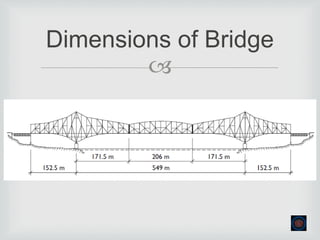
 It was at time of construction the longest cantilever bridge in the world with
clear span of 1800 ft.
 The bridge construction was finally completed in 1917 after two failures or
tragedies to bridge the harsh icy waters of the St. Lawrence river.
 First collapse occurred on August 26, 1907. Second collapse occurred almost
after a decade on September 11, 1916
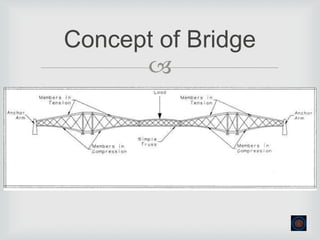
 Quebec bridge is a cantilever truss bridge with two spans cantilever from both
sides and simple span suspended in between.
Quebec Bridge

 The story of the bridge begins back in 1887 with the formation of Quebec
Bridge company which came up with the proposal to erect the bridge over the
river to increase business traffic in the city of Quebec and places nearby.
 Various proposals for the bridge were submitted out of which The Phoenix
Bridge Company’s proposal was selected which called for a cantilever bridge
of 150 feet in height above the high water mark.
 Theodore Cooper, a well-known American bridge designer, was selected as
the project’s consulting engineer by the Quebec Bridge company. He endorsed
the Phoenix design as the “best and the cheapest” of those submitted,
although he decided to lengthen the centre span from 1,600 to 1,800 feet in
order to eliminate the uncertainty of constructing piers in such deep water,
lessen the effects of ice, and shorten the time of construction of the piers.
History

Dimensions of Bridge

Concept of Bridge

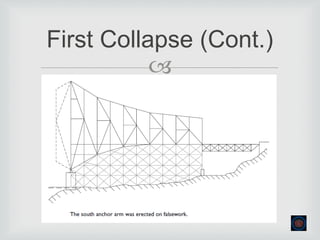
 As soon as the south anchor arm was completed (in early 1906) the assembly of
the cantilever arm could begin (the falsework was then also moved to the other
side of the river for the construction of the north anchor arm).
 Using the anchor arm as a counterweight – securely anchored at the end for
the uplift forces – the main span was being erected using the cantilever
technique (one half from either side of the river).
 At just about this point in the construction (in early 1906) it was discovered that
the amount of steel material delivered to the bridge site considerably
exceeded the originally estimated amount. It was because no correction for
self weight of the structure was made when the span length was increased from
488m to 549 m. Cooper however, decided to forge ahead and not introduce
any changes.
First Collapse

First Collapse (Cont.)

First Collapse (Cont.)
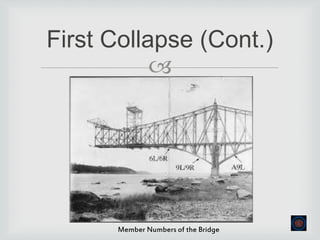
Member Numbers of the Bridge

 Cooper due to his ill health, worked out of his New York City office and did not
make visits to the site during the erection of the superstructure.
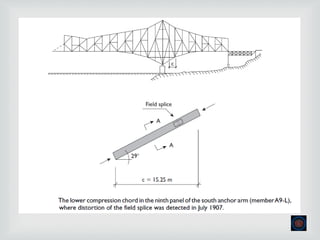
 In mid summer of 1907 the first signs of distress in the steel superstructure
began to show – a field splice in the ninth panel lower compression chord on
the left-hand side of the anchor arm (member A9-L) had become distorted.
First Collapse (Cont.)

First Collapse (Cont.)
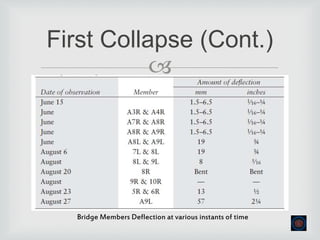
Bridge Members Deflection at various instants of time

 As the lower chords of the anchor arm initially were subjected to tension –
when the falsework was removed and the span became simply supported – and
the normal force soon changed to compression as the cantilever arm grew
outwards, it was decided to temporarily use bolts in order to allow for the
structure (the anchor arm) to develop all of its deformations before riveting the
plates tight together.
 The anchor arm was quite simply judged to be allowed to adjust itself to the
changing load, otherwise secondary constraints could have been developed.
However, by taking this measure the buckling strength of the lower
compression chords became affected negatively. Besides having observed local
distortion of the plates in the field splice, it was discovered in the beginning of
August 1907 that chord A9-L was slightly bent out-of-plane as well.
First Collapse (Cont.)


 At the end of August – when the cantilever had been extended further out over
the river, increasing the stresses even more in the truss members – it was found
that the out of plane bending of chord A9-L had increased from some 20mm to
alarmingly 57 mm.
 Even though this deformation – representing an out-of-plane deflection of
L/305 (the length L of the member being 17.44 m) – is hard to detect by the
naked eye, it was a clear signal that something was quite wrong.
First Collapse (Cont.)

 Realizing the danger McLure immediately travelled to New York on the 27
August to consult with Cooper (telephoning was judged to be too risky – there
was always the possibility that the telephone operator would listen in and
reveal the situation to the newspapers).
 Cooper, realizing the danger of the situation, wanting the construction to
come to an immediate halt, telegraphed to the Phoenix Bridge Company: “Add
no more load till after due consideration of facts’’.
 However, the contractor (i.e. the Phoenix Bridge Company) was under great
pressure not to delay the construction, so the work continued by unfortunately
moving an erection crane one step further out on the cantilever.
First Collapse (Cont.)

 In late afternoon of 29 August 1907 – just some 15 minutes before the working
day was over – the entire bridge collapsed, starting with the buckling failure of
the A9-L lower chord of the south anchor arm. Of the 86 workmen that were on
the bridge at the time of the collapse 75 were killed.
 The A9L bottom compression chord, which was already bent, gave way under
the increasing weight of the bridge. The load transferred to the opposite A9R
chord, which also buckled. The piers were the only part of the structure that
survived.
First Collapse (Cont.)

 In spite of the enormity of the accident, it was decided that the project must be
completed. In 1908, a board of engineers was appointed that arranged for and
supervised the design and erection of a new bridge. Except for the piers,
nothing from the previous structure was recoverable.
 In April 1911, the contract was awarded to the St. Lawrence Bridge Company
of Montreal. As before, the design called for a cantilever-type bridge, but it
differed from the previous one with the lower chords of the cantilever arms
several times stronger. One important innovation that added strength to the
bridge was the K-truss design.
Second Collapse

 Construction of the bridge started in 1913, and eventually the two approach
spans, the anchor arms and cantilevers went up on either side of the river. By
1916, the bridge was nearly completed.
 All that remained was the job of hoisting the mammoth centre span that would
be connected to the cantilever arms. The 5,100-ton span had been built and
was sitting in Sillery Cove, approximately 3 1/2 miles from the bridge site.
 On the morning of Sept. 11, the workmen faced a difficult task in moving the
span upstream, but all went well with that part of the job. The span was carried
on scows that were guided by tugs. It was a slow process, but eventually the
span was manoeuvred into position between the cantilever arms where huge
lifting hangers, attached to the ends of the arms, raised it by hydraulic means
off the scows. The span was to be lifted two feet at a time in a repeat operation
until it was in place between the two arms.
Second Collapse (Cont.)

 At 10:50 a.m, soon after they returned to work, something went terribly wrong.
The southwest corner of the span tore away and sagged. A few seconds later,
the other ends pulled off their supports and the whole span came loose and
disappeared into the river. Thirteen men were carried to their deaths and
several others were injured.
 The investigation by the board of engineers determined that the span did not
buckle as Larocque and others claimed. Rather, the loss resulted from the
failure of a casting in the erection equipment that temporarily supported the
southwest corner of the span.
Second Collapse (Cont.)

 On Sept. 20, 1917, the suspended span was lifted into position and fastened to
the cantilever arms. At last, the world’s longest cantilever bridge was
completed and the first train crossed it in October. Two months later it was
opened to regular trains, vehicle and pedestrian traffic.
 In 1919, the Prince of Wales officially opened the Quebec Bridge to the public.
Final Completion

 An underestimation of the self-weight of the structure
 Temporary splicing of the chords using bolts
 The load carrying capacity had been overestimated resulting in weak cross-
sections
 The stabilizing bars (the crossing diagonals and horizontals) were not strong
enough to resist out-of-plane buckling of the compression chords
Major Causes of Failure

 The collapse of the bridge finally led to the development of Canadian design
specifications for bridge structures.
 Engineering design is necessary for the means and methods of lifting
operations.
 The responsibility of execution and design of such an important structure must
not be left in the hands of one person.
Lessons Learned
Any Query, ask
in
comments
Thanks for your
Attention
Have a Nice Day

 Quebec Bridge Collapse
https://www.youtube.com/watch?v=xk1xEctDK0k
 Quebec Bridge Second Collapse
https://www.youtube.com/watch?v=bCrZCzuf72A
Video References

Quebec Bridge Collapse - A Case Study

  • 1.
  • 2.
      Quebec bridgeis a rail, road and pedestrian bridge situated on the St. Lawrence River, Quebec, Canada.  It was at time of construction the longest cantilever bridge in the world with clear span of 1800 ft.  The bridge construction was finally completed in 1917 after two failures or tragedies to bridge the harsh icy waters of the St. Lawrence river.  First collapse occurred on August 26, 1907. Second collapse occurred almost after a decade on September 11, 1916  Quebec bridge is a cantilever truss bridge with two spans cantilever from both sides and simple span suspended in between. Quebec Bridge
  • 3.
      The storyof the bridge begins back in 1887 with the formation of Quebec Bridge company which came up with the proposal to erect the bridge over the river to increase business traffic in the city of Quebec and places nearby.  Various proposals for the bridge were submitted out of which The Phoenix Bridge Company’s proposal was selected which called for a cantilever bridge of 150 feet in height above the high water mark.  Theodore Cooper, a well-known American bridge designer, was selected as the project’s consulting engineer by the Quebec Bridge company. He endorsed the Phoenix design as the “best and the cheapest” of those submitted, although he decided to lengthen the centre span from 1,600 to 1,800 feet in order to eliminate the uncertainty of constructing piers in such deep water, lessen the effects of ice, and shorten the time of construction of the piers. History
  • 4.
  • 5.
  • 6.
      As soonas the south anchor arm was completed (in early 1906) the assembly of the cantilever arm could begin (the falsework was then also moved to the other side of the river for the construction of the north anchor arm).  Using the anchor arm as a counterweight – securely anchored at the end for the uplift forces – the main span was being erected using the cantilever technique (one half from either side of the river).  At just about this point in the construction (in early 1906) it was discovered that the amount of steel material delivered to the bridge site considerably exceeded the originally estimated amount. It was because no correction for self weight of the structure was made when the span length was increased from 488m to 549 m. Cooper however, decided to forge ahead and not introduce any changes. First Collapse
  • 7.
  • 8.
     First Collapse (Cont.) MemberNumbers of the Bridge
  • 9.
      Cooper dueto his ill health, worked out of his New York City office and did not make visits to the site during the erection of the superstructure.  In mid summer of 1907 the first signs of distress in the steel superstructure began to show – a field splice in the ninth panel lower compression chord on the left-hand side of the anchor arm (member A9-L) had become distorted. First Collapse (Cont.)
  • 10.
     First Collapse (Cont.) BridgeMembers Deflection at various instants of time
  • 11.
      As thelower chords of the anchor arm initially were subjected to tension – when the falsework was removed and the span became simply supported – and the normal force soon changed to compression as the cantilever arm grew outwards, it was decided to temporarily use bolts in order to allow for the structure (the anchor arm) to develop all of its deformations before riveting the plates tight together.  The anchor arm was quite simply judged to be allowed to adjust itself to the changing load, otherwise secondary constraints could have been developed. However, by taking this measure the buckling strength of the lower compression chords became affected negatively. Besides having observed local distortion of the plates in the field splice, it was discovered in the beginning of August 1907 that chord A9-L was slightly bent out-of-plane as well. First Collapse (Cont.)
  • 12.
  • 13.
      At theend of August – when the cantilever had been extended further out over the river, increasing the stresses even more in the truss members – it was found that the out of plane bending of chord A9-L had increased from some 20mm to alarmingly 57 mm.  Even though this deformation – representing an out-of-plane deflection of L/305 (the length L of the member being 17.44 m) – is hard to detect by the naked eye, it was a clear signal that something was quite wrong. First Collapse (Cont.)
  • 14.
      Realizing thedanger McLure immediately travelled to New York on the 27 August to consult with Cooper (telephoning was judged to be too risky – there was always the possibility that the telephone operator would listen in and reveal the situation to the newspapers).  Cooper, realizing the danger of the situation, wanting the construction to come to an immediate halt, telegraphed to the Phoenix Bridge Company: “Add no more load till after due consideration of facts’’.  However, the contractor (i.e. the Phoenix Bridge Company) was under great pressure not to delay the construction, so the work continued by unfortunately moving an erection crane one step further out on the cantilever. First Collapse (Cont.)
  • 15.
      In lateafternoon of 29 August 1907 – just some 15 minutes before the working day was over – the entire bridge collapsed, starting with the buckling failure of the A9-L lower chord of the south anchor arm. Of the 86 workmen that were on the bridge at the time of the collapse 75 were killed.  The A9L bottom compression chord, which was already bent, gave way under the increasing weight of the bridge. The load transferred to the opposite A9R chord, which also buckled. The piers were the only part of the structure that survived. First Collapse (Cont.)
  • 16.
      In spiteof the enormity of the accident, it was decided that the project must be completed. In 1908, a board of engineers was appointed that arranged for and supervised the design and erection of a new bridge. Except for the piers, nothing from the previous structure was recoverable.  In April 1911, the contract was awarded to the St. Lawrence Bridge Company of Montreal. As before, the design called for a cantilever-type bridge, but it differed from the previous one with the lower chords of the cantilever arms several times stronger. One important innovation that added strength to the bridge was the K-truss design. Second Collapse
  • 17.
      Construction ofthe bridge started in 1913, and eventually the two approach spans, the anchor arms and cantilevers went up on either side of the river. By 1916, the bridge was nearly completed.  All that remained was the job of hoisting the mammoth centre span that would be connected to the cantilever arms. The 5,100-ton span had been built and was sitting in Sillery Cove, approximately 3 1/2 miles from the bridge site.  On the morning of Sept. 11, the workmen faced a difficult task in moving the span upstream, but all went well with that part of the job. The span was carried on scows that were guided by tugs. It was a slow process, but eventually the span was manoeuvred into position between the cantilever arms where huge lifting hangers, attached to the ends of the arms, raised it by hydraulic means off the scows. The span was to be lifted two feet at a time in a repeat operation until it was in place between the two arms. Second Collapse (Cont.)
  • 18.
      At 10:50a.m, soon after they returned to work, something went terribly wrong. The southwest corner of the span tore away and sagged. A few seconds later, the other ends pulled off their supports and the whole span came loose and disappeared into the river. Thirteen men were carried to their deaths and several others were injured.  The investigation by the board of engineers determined that the span did not buckle as Larocque and others claimed. Rather, the loss resulted from the failure of a casting in the erection equipment that temporarily supported the southwest corner of the span. Second Collapse (Cont.)
  • 19.
      On Sept.20, 1917, the suspended span was lifted into position and fastened to the cantilever arms. At last, the world’s longest cantilever bridge was completed and the first train crossed it in October. Two months later it was opened to regular trains, vehicle and pedestrian traffic.  In 1919, the Prince of Wales officially opened the Quebec Bridge to the public. Final Completion
  • 20.
      An underestimationof the self-weight of the structure  Temporary splicing of the chords using bolts  The load carrying capacity had been overestimated resulting in weak cross- sections  The stabilizing bars (the crossing diagonals and horizontals) were not strong enough to resist out-of-plane buckling of the compression chords Major Causes of Failure
  • 21.
      The collapseof the bridge finally led to the development of Canadian design specifications for bridge structures.  Engineering design is necessary for the means and methods of lifting operations.  The responsibility of execution and design of such an important structure must not be left in the hands of one person. Lessons Learned
  • 22.
  • 23.
  • 24.
      Quebec BridgeCollapse https://www.youtube.com/watch?v=xk1xEctDK0k  Quebec Bridge Second Collapse https://www.youtube.com/watch?v=bCrZCzuf72A Video References