Mechanism Of Slope Failure
GAGAN GUPTA
16152004, M.Tech (IIT-BHU)
TYPES OF FAILURE
• PLANE FAILURE
• WEDGE FAILURE
• CIRCULAR FAILURE
• TOPPLING FAILURE
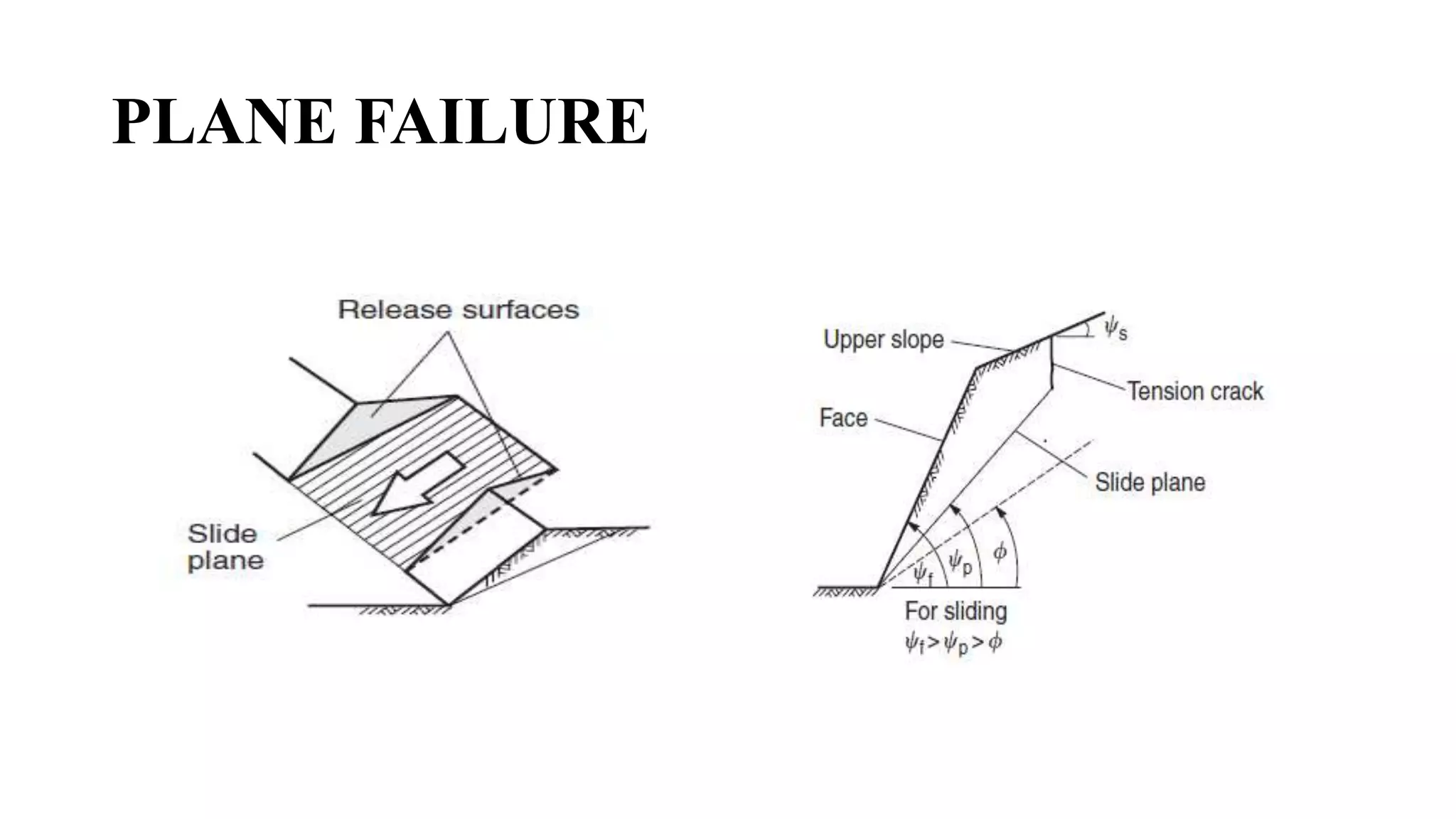
PLANE FAILURE
• The plane on which sliding occurs must strike parallel or nearly
parallel (within approximately ±20◦) to the slope face.
• The sliding plane must “daylight” in the slope face, which means that
the dip of the plane must be less than the dip of the slope face, that is,
ψp < ψf
• The dip of the sliding plane must be greater than the angle of friction
of this plane, that is, ψp > φ.
• The upper end of the sliding surface either intersects the upper slope,
or terminates in a tension crack.
• Release surfaces that provide negligible resistance to sliding must be
present in the rock mass to define the lateral boundaries of the slide.
General conditions for plane failure
WEDGE FAILURE
General conditions for wedge failure
• The dip of the line of intersection must be greater than angle of
internal friction.
• The dip of the line of intersection is smaller than dip of slope face.
• The two sets of discontinuities must intersect each other.
• The sliding will take place along the dip of intersection of two
discontinuities if the dip of the line of intersection daylights into the
slope face and less than dip of the slope face.
CIRCULAR FAILURE
• Closely fractured or highly weathered rock.
• The slide surface is free to find the line of least resistance through the
slope.
• when the individual particles in a soil or rock mass are very small
compared with the size of the slope.
TYPES
• Slope failure: In this type of failure, the arc of the rupture surface
meets the slope above the toe of the slope. This happens when the
slope angle is very high and the soil close to the toe posses the high
strength.
• Toe failure: In this type of failure, the arc of the rupture surface meets
the slope at the toe, at medium slope angle.
• Base failure: In this type of failure, the arc of the failure passes below
the toe and in to base of the slope. This happens when the slope angle
is low and the soil below the base is softer and more plastic than the
soil above the base.
SLOPE FAILURE
TOE FAILURE
BASE FAILURE
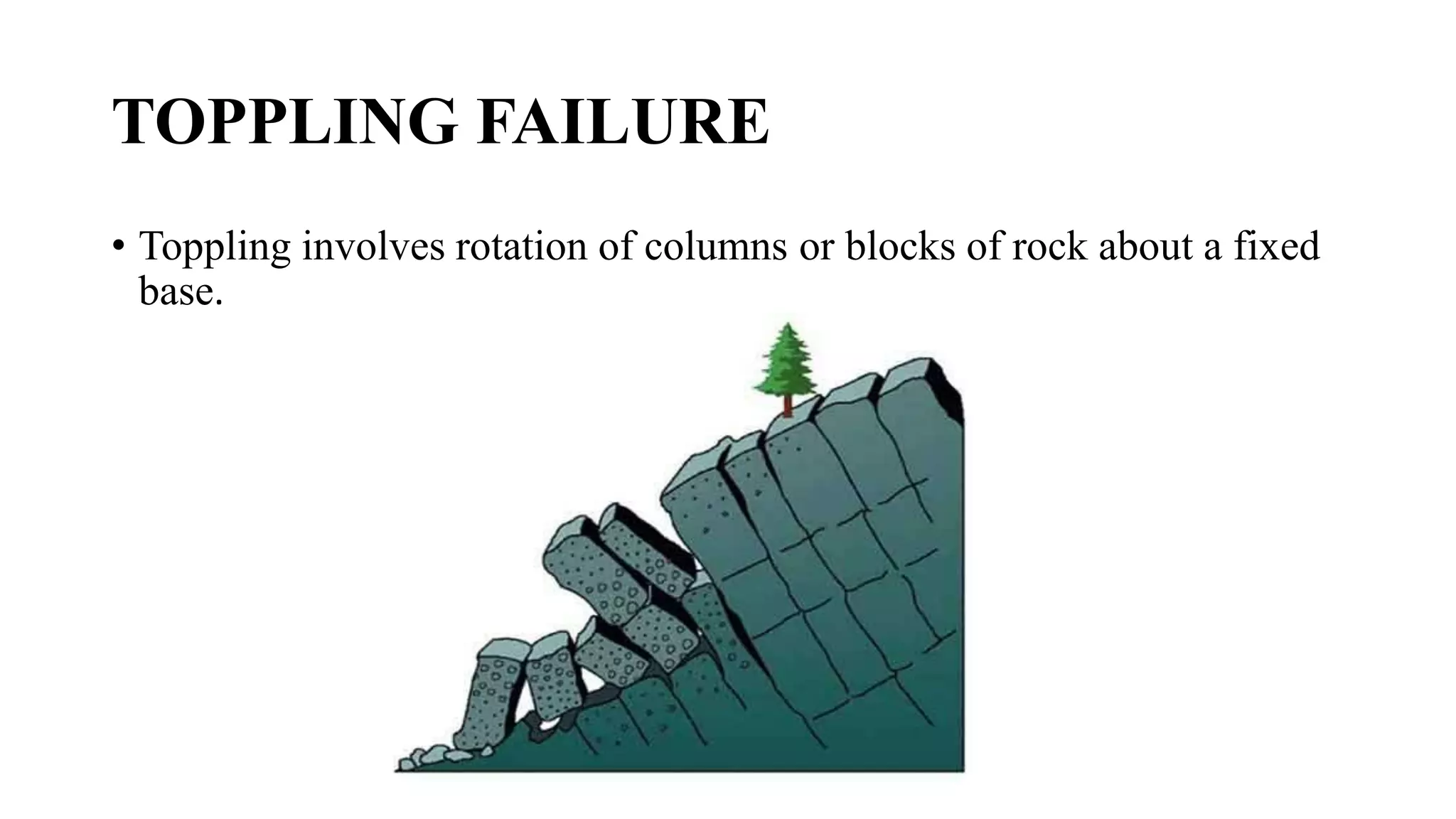
TOPPLING FAILURE
• Toppling involves rotation of columns or blocks of rock about a fixed
base.
TYPES
BLOCK TOPPLING(a)
when individual columns in a strong rock are formed by a set of
discontinuities dipping steeply into the face. A second set of widely spaced
orthogonal joints defines the column height.
FLEXURAL TOPPLING(b)
continuous columns of rock, separated by well developed, steeply dipping
discontinuities, breaking in flexure as they bend forward. Typical geological
conditions in which this type of failure may occur are thinly bedded shale and
slate in which orthogonal jointing is not well developed.
BLOCK-FLEXURAL TOPPLING(c)
It this long columns that are divided by numerous cross joints.
Toppling of columns in this case results from accumulated
displacements on the cross-joints. Because of the large number of small
movements in this type of topple, there are fewer tension cracks than in
flexural toppling, and fewer edge-to-face contacts and voids than in
block toppling.
Thank you

Slope Failure Mechanism

  • 1.
    Mechanism Of SlopeFailure GAGAN GUPTA 16152004, M.Tech (IIT-BHU)
  • 2.
    TYPES OF FAILURE •PLANE FAILURE • WEDGE FAILURE • CIRCULAR FAILURE • TOPPLING FAILURE
  • 3.
  • 4.
    • The planeon which sliding occurs must strike parallel or nearly parallel (within approximately ±20◦) to the slope face. • The sliding plane must “daylight” in the slope face, which means that the dip of the plane must be less than the dip of the slope face, that is, ψp < ψf • The dip of the sliding plane must be greater than the angle of friction of this plane, that is, ψp > φ. • The upper end of the sliding surface either intersects the upper slope, or terminates in a tension crack. • Release surfaces that provide negligible resistance to sliding must be present in the rock mass to define the lateral boundaries of the slide. General conditions for plane failure
  • 5.
  • 6.
    General conditions forwedge failure • The dip of the line of intersection must be greater than angle of internal friction. • The dip of the line of intersection is smaller than dip of slope face. • The two sets of discontinuities must intersect each other. • The sliding will take place along the dip of intersection of two discontinuities if the dip of the line of intersection daylights into the slope face and less than dip of the slope face.
  • 7.
    CIRCULAR FAILURE • Closelyfractured or highly weathered rock. • The slide surface is free to find the line of least resistance through the slope. • when the individual particles in a soil or rock mass are very small compared with the size of the slope.
  • 9.
    TYPES • Slope failure:In this type of failure, the arc of the rupture surface meets the slope above the toe of the slope. This happens when the slope angle is very high and the soil close to the toe posses the high strength. • Toe failure: In this type of failure, the arc of the rupture surface meets the slope at the toe, at medium slope angle. • Base failure: In this type of failure, the arc of the failure passes below the toe and in to base of the slope. This happens when the slope angle is low and the soil below the base is softer and more plastic than the soil above the base.
  • 10.
  • 11.
    TOPPLING FAILURE • Topplinginvolves rotation of columns or blocks of rock about a fixed base.
  • 12.
    TYPES BLOCK TOPPLING(a) when individualcolumns in a strong rock are formed by a set of discontinuities dipping steeply into the face. A second set of widely spaced orthogonal joints defines the column height. FLEXURAL TOPPLING(b) continuous columns of rock, separated by well developed, steeply dipping discontinuities, breaking in flexure as they bend forward. Typical geological conditions in which this type of failure may occur are thinly bedded shale and slate in which orthogonal jointing is not well developed.
  • 14.
    BLOCK-FLEXURAL TOPPLING(c) It thislong columns that are divided by numerous cross joints. Toppling of columns in this case results from accumulated displacements on the cross-joints. Because of the large number of small movements in this type of topple, there are fewer tension cracks than in flexural toppling, and fewer edge-to-face contacts and voids than in block toppling.
  • 15.