Gandhinagar Institute of
Technology
Presentation on
SLOPE PROTECTION WORKS
Civil Engineering Department
Presented By :
Raj Shah(140120106104) Submitted to
Prof. Mili Bhavsar
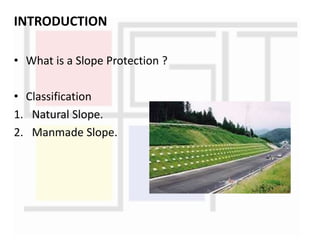
INTRODUCTION
• What is a Slope Protection ?
• Classification
1. Natural Slope.
2. Manmade Slope.
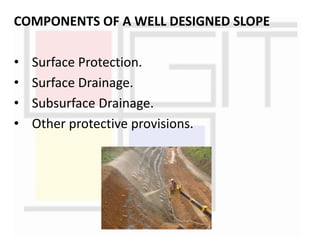
COMPONENTS OF A WELL DESIGNED SLOPE
• Surface Protection.
• Surface Drainage.
• Subsurface Drainage.
• Other protective provisions.
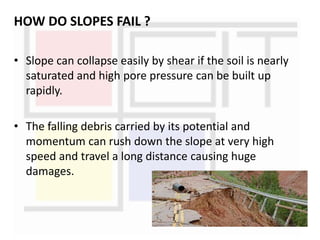
HOW DO SLOPES FAIL ?
• Slope can collapse easily by shear if the soil is nearly
saturated and high pore pressure can be built up
rapidly.
• The falling debris carried by its potential and
momentum can rush down the slope at very high
speed and travel a long distance causing huge
damages.
FACTORS AFFECTING STABILITY OF SLOPES
• Topography and its surrounding physical conditions.
• Geological conditions such as the nature and the depth
of its subsoil, degree of decomposition , or location of
fracture etc.
• Shear strength of the slope-forming materials.
• Surface and ground water condition.
• External loading and surcharges.
• STABILITY OF SLOPES CAN BE ACHIEVED BY
FOLLOWING METHODS
• A surface drain system that is capable to discharge all
the storm water within the catchment area affecting
slope in a designated period of time.
• A surface drain system usually consists of:
- surface channel
- stepped or trapezoidal channel
- catch pit or sand trap.
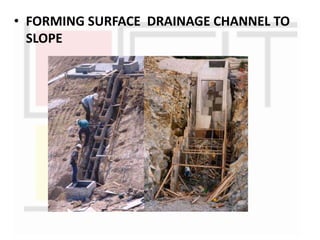
• FORMING SURFACE DRAINAGE CHANNEL TO
SLOPE
• CONSTRUCTING GABION WALL
• PROTECTION AND TREATMENT TO ROCK SLOPE
• Scaling – Manual method of removing loose rocks and
boulders from exposed rock surfaces.
• CONSTRUCT BUTRESS SUPPORT
• This is a concrete or masonry gravity structure to
retain the rock mass.
•
• MESHING
• Slope mesh is a commonly used method to protect
people and structures from rock fall, as well as other
geohazards.
• Installing a mesh system involves drilling anchors,
installing the posts and support cables, securing the
mesh netting onto the system, and stitching and
weaving the mesh panels together.
• SHORTCRETING
• Applying concrete in pressure to weak rocks and
fractured rocks.
• DOWEL
• A hole is drilled and steel bars are anchored usually
25mm to 35 mm diameter and 1 to 3 m long, to
stabilize a weak zone. The hole is grouted afterwards.
• ROCK-BOLT NAIL
• The tensioned bars are inserted into rock forming a
short anchorage zone in rock so that an unstable slope
being reinforced.
• Rocks bolts are 25 to 40 mm in diameter , 3 to 6 m
long and tensile working load of 100KN
• FORMING SOIL NAIL AND ROCK BOLTS
• SLOPE PROTECTION WORKS FOR SOFT
SURFACE
• Hydro seeding
Turfing Plant Growth
• NYLON MESH FOR SUB-SURFACE DRAINAGE
AND TO REINFORCE THE ROOT OF GRASS
TURFING A SLOPING SURFACE
1ST Month
2nd Month
3rd Month
4th Month
• REFRENCES
• http://www.slopestabilization.com
• https://www.maccaferri.com/ph/solutions/slope-
protection
Slope Protection works

Slope Protection works

  • 1.
    Gandhinagar Institute of Technology Presentationon SLOPE PROTECTION WORKS Civil Engineering Department Presented By : Raj Shah(140120106104) Submitted to Prof. Mili Bhavsar
  • 2.
    INTRODUCTION • What isa Slope Protection ? • Classification 1. Natural Slope. 2. Manmade Slope.
  • 3.
    COMPONENTS OF AWELL DESIGNED SLOPE • Surface Protection. • Surface Drainage. • Subsurface Drainage. • Other protective provisions.
  • 4.
    HOW DO SLOPESFAIL ? • Slope can collapse easily by shear if the soil is nearly saturated and high pore pressure can be built up rapidly. • The falling debris carried by its potential and momentum can rush down the slope at very high speed and travel a long distance causing huge damages.
  • 5.
    FACTORS AFFECTING STABILITYOF SLOPES • Topography and its surrounding physical conditions. • Geological conditions such as the nature and the depth of its subsoil, degree of decomposition , or location of fracture etc. • Shear strength of the slope-forming materials. • Surface and ground water condition. • External loading and surcharges.
  • 6.
    • STABILITY OFSLOPES CAN BE ACHIEVED BY FOLLOWING METHODS • A surface drain system that is capable to discharge all the storm water within the catchment area affecting slope in a designated period of time. • A surface drain system usually consists of: - surface channel - stepped or trapezoidal channel - catch pit or sand trap.
  • 7.
    • FORMING SURFACEDRAINAGE CHANNEL TO SLOPE
  • 8.
  • 9.
    • PROTECTION ANDTREATMENT TO ROCK SLOPE • Scaling – Manual method of removing loose rocks and boulders from exposed rock surfaces.
  • 10.
    • CONSTRUCT BUTRESSSUPPORT • This is a concrete or masonry gravity structure to retain the rock mass. •
  • 11.
    • MESHING • Slopemesh is a commonly used method to protect people and structures from rock fall, as well as other geohazards. • Installing a mesh system involves drilling anchors, installing the posts and support cables, securing the mesh netting onto the system, and stitching and weaving the mesh panels together.
  • 13.
    • SHORTCRETING • Applyingconcrete in pressure to weak rocks and fractured rocks.
  • 14.
    • DOWEL • Ahole is drilled and steel bars are anchored usually 25mm to 35 mm diameter and 1 to 3 m long, to stabilize a weak zone. The hole is grouted afterwards. • ROCK-BOLT NAIL • The tensioned bars are inserted into rock forming a short anchorage zone in rock so that an unstable slope being reinforced. • Rocks bolts are 25 to 40 mm in diameter , 3 to 6 m long and tensile working load of 100KN
  • 15.
    • FORMING SOILNAIL AND ROCK BOLTS
  • 16.
    • SLOPE PROTECTIONWORKS FOR SOFT SURFACE • Hydro seeding Turfing Plant Growth
  • 17.
    • NYLON MESHFOR SUB-SURFACE DRAINAGE AND TO REINFORCE THE ROOT OF GRASS
  • 18.
  • 19.
  • 20.
  • 22.
    • REFRENCES • http://www.slopestabilization.com •https://www.maccaferri.com/ph/solutions/slope- protection