Prepared by:
RAJARSHI PATTY
B.Tech, M.Tech (CE&M)
CIVIL Engineering.
TUNNELING
&
ROCK DRILLING EQUIPMENTS
Tunnelling
Definition:
• Tunnels are artificial underground passages
opened at both ends constructed for different
purposes.
• Required for highways,railways, sewerage,
water supply, public utilities and canals.
RAJARSHIPATTY
HISTORY
• The oldest tunnel was constructed4000 years
ago in ancient Babylon to underpassthe bed
of river Euphrates and to establish an
undergroundconnection between the royal
palace and Temple of Jove.
• The length of the tunnel was 1 km and it was
built with the considerable cross-section
dimensionsof 3.6 m by 4.5 m
RAJARSHIPATTY
REASONS TO BUILD A TUNNEL
• To avoid an obstacle such as a mountain.
• To overcome a water obstacle.
• Built to connect between military posts so the
movement between them will not be visible
for the enemy.
• built for infrastructure like electricity cables,
water, communicationand sewerage to avoid
damage and disruption above ground.
RAJARSHIPATTY
ADVANTAGES OF TUNNELING
• Tunnels are more economical than open cuts beyond
certain depths.
• Tunnels avoid disturbing or interfering with surface life
and traffic during construction.
• Tunnels prove to be cheaper than bridges or open cuts
to carry public utility services like water, sewer and gas.
• If tunnels are provided with easy gradients, the cost of
hauling is decreased
• In case of aerial warfare and bombing of cities, the
tunnels would grant better protection as compared to
bridges.
RAJARSHIPATTY
TYPES OF TUNNELS
Mountain Tunnel:
a) Drilling and blasting (D&B) method
b) Tunnel Boring Machine (TBM) method
RAJARSHIPATTY
TYPES OF TUNNELS
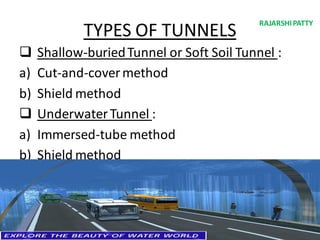
 Shallow-buriedTunnel or Soft Soil Tunnel :
a) Cut-and-covermethod
b) Shield method
 UnderwaterTunnel :
a) Immersed-tube method
b) Shield method
RAJARSHIPATTY
TUNNEL CONSTRUCTION METHODS
• ClassicalMethod
• Cut & Cover Method
• Drill & Blast
• Tunnel boring Machine (TBM)
• Immersed Tunnel
• Tunnel Jacking
• Other Methods
RAJARSHIPATTY
INSTRUMENTS USED IN TUNNEL
CONSTRUCTION
 Crawler Excavator
 Wheel Loaders
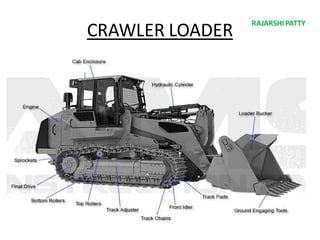
 Crawler Loaders
 Tunnel Boring Machines (TBMs)
 Immersed Tube
 Different types Drilling & Blasting
Equipments
RAJARSHIPATTY
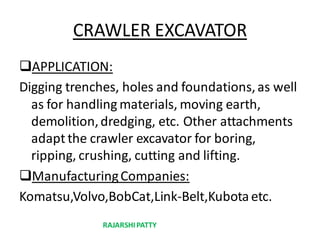
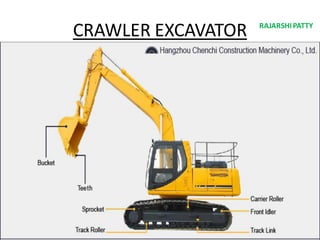
CRAWLER EXCAVATOR
APPLICATION:
Digging trenches, holes and foundations,as well
as for handling materials, moving earth,
demolition,dredging, etc. Other attachments
adapt the crawler excavator for boring,
ripping, crushing, cutting and lifting.
ManufacturingCompanies:
Komatsu,Volvo,BobCat,Link-Belt,Kubota etc.
RAJARSHIPATTY
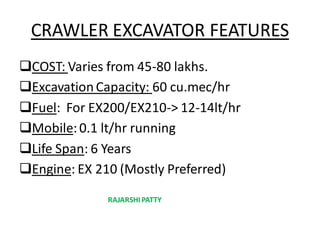
CRAWLER EXCAVATOR FEATURES
COST: Varies from 45-80 lakhs.
ExcavationCapacity: 60 cu.mec/hr
Fuel: For EX200/EX210-> 12-14lt/hr
Mobile:0.1 lt/hr running
Life Span: 6 Years
Engine: EX 210 (Mostly Preferred)
RAJARSHIPATTY
CRAWLER EXCAVATOR RAJARSHIPATTY
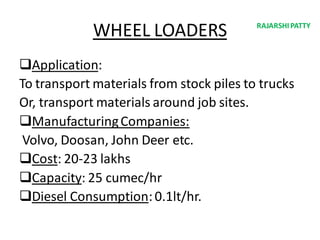
WHEEL LOADERS
Application:
To transport materials from stock piles to trucks
Or, transport materials around job sites.
ManufacturingCompanies:
Volvo, Doosan, John Deer etc.
Cost: 20-23 lakhs
Capacity: 25 cumec/hr
Diesel Consumption:0.1lt/hr.
RAJARSHIPATTY
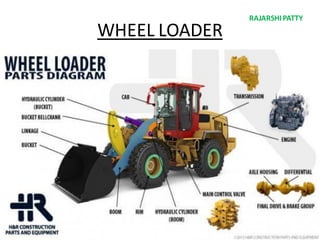
WHEEL LOADER
RAJARSHIPATTY
CRAWLER LOADER
RAJARSHIPATTY
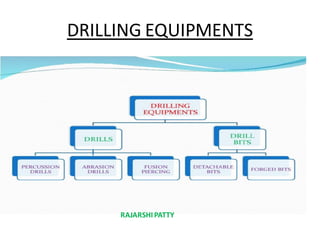
DRILLING EQUIPMENTS
RAJARSHIPATTY
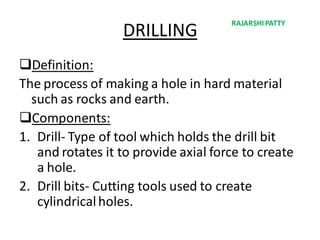
DRILLING
Definition:
The process of making a hole in hard material
such as rocks and earth.
Components:
1. Drill- Type of tool which holds the drill bit
and rotates it to provide axial force to create
a hole.
2. Drill bits- Cutting tools used to create
cylindricalholes.
RAJARSHIPATTY
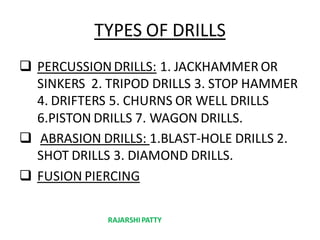
TYPES OF DRILLS
 PERCUSSIONDRILLS: 1. JACKHAMMER OR
SINKERS 2. TRIPOD DRILLS 3. STOP HAMMER
4. DRIFTERS 5. CHURNS OR WELL DRILLS
6.PISTON DRILLS 7. WAGON DRILLS.
 ABRASION DRILLS: 1.BLAST-HOLE DRILLS 2.
SHOT DRILLS 3. DIAMOND DRILLS.
 FUSION PIERCING
RAJARSHIPATTY
PERCUSION DRILLS
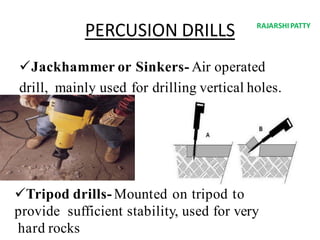
Jackhammer or Sinkers- Air operated
drill, mainly used for drilling vertical holes.
Tripod drills- Mounted on tripod to
provide sufficient stability, used for very
hard rocks
RAJARSHIPATTY
TYES OF DRILLS:
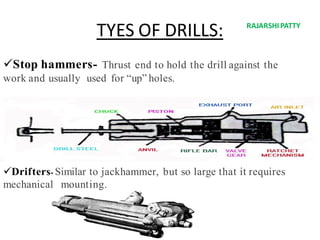
Stop hammers- Thrust end to hold the drill against the
work and usually used for “up” holes.
Drifters- Similar to jackhammer, but so large that it requires
mechanical mounting.
RAJARSHIPATTY
 Churns or Well drills-
Reciprocating Drill consisting of
a long steel bit mechanically
lifted and dropped to disintegrate
the rock.
 Piston drills- Drill rod is securely
fastened to the piston and travels
the full length of thepiston
stroke.
 Wagon drills-Drifter mounted
on a mast supported by two or
more wheels used to drill holes
at any angle from down to
slightly above horizontal.
RAJARSHIPATTY
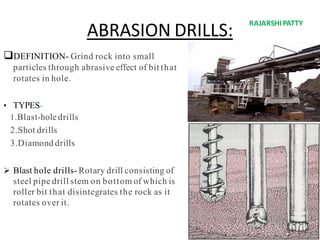
ABRASION DRILLS:
DEFINITION- Grind rock into small
particles through abrasive effect of bit that
rotates in hole.
• TYPES-
1.Blast-holedrills
2.Shot drills
3.Diamond drills
 Blast hole drills- Rotary drill consisting of
steel pipe drill stem on bottom of which is
roller bit that disintegrates the rock as it
rotates over it.
RAJARSHIPATTY
ABRASION DRILLS TYPES
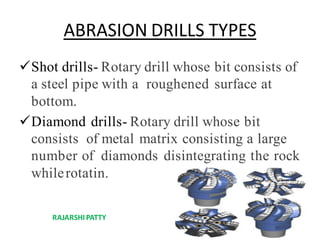
Shot drills- Rotary drill whose bit consists of
a steel pipe with a roughened surface at
bottom.
Diamond drills- Rotary drill whose bit
consists of metal matrix consisting a large
number of diamonds disintegrating the rock
whilerotatin.
RAJARSHIPATTY
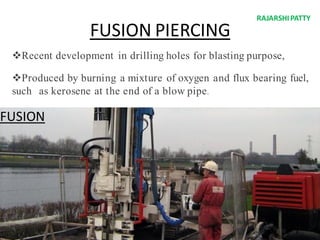
FUSION PIERCING
FUSION
Recent development in drilling holes for blasting purpose,
Produced by burning a mixture of oxygen and flux bearing fuel,
such as kerosene at the end of a blow pipe.
RAJARSHIPATTY
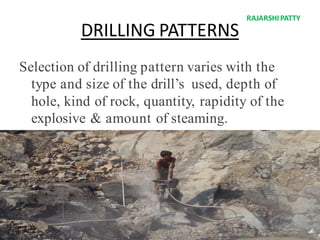
DRILLING PATTERNS
Selection of drilling pattern varies with the
type and size of the drill’s used, depth of
hole, kind of rock, quantity, rapidity of the
explosive & amount of steaming.
RAJARSHIPATTY
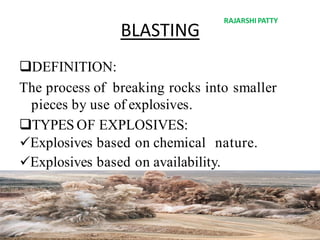
BLASTING
DEFINITION:
The process of breaking rocks into smaller
pieces by use of explosives.
TYPES OF EXPLOSIVES:
Explosives based on chemical nature.
Explosives based on availability.
RAJARSHI PATTY
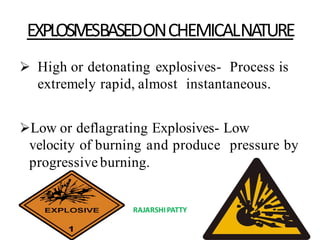
EXPLOSIVESBASEDONCHEMICALNATURE
 High or detonating explosives- Process is
extremely rapid, almost instantaneous.
Low or deflagrating Explosives- Low
velocity of burning and produce pressure by
progressiveburning.
RAJARSHIPATTY
EXPLOSIVE BASED ON AVAILABILITY
Powder explosive:
Slow burning , slow acting and low strength explosives
made either from potash nitrate or sodium nitrate.
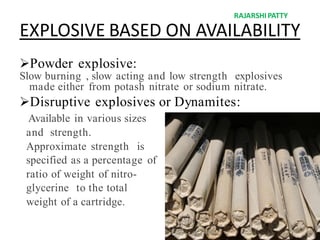
Disruptive explosives or Dynamites:
Available in various sizes
and strength.
Approximate strength is
specified as a percentage of
ratio of weight of nitro-
glycerine to the total
weight of a cartridge.
RAJARSHIPATTY
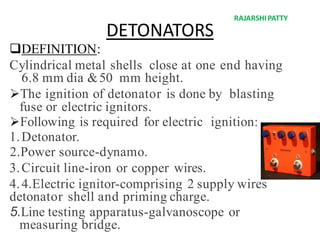
DETONATORS
DEFINITION:
Cylindrical metal shells close at one end having
6.8 mm dia &50 mm height.
The ignition of detonator is done by blasting
fuse or electric ignitors.
Following is required for electric ignition:
1.Detonator.
2.Power source-dynamo.
3.Circuit line-iron or copper wires.
4.4.Electric ignitor-comprising 2 supply wires
detonator shell and priming charge.
5.Line testing apparatus-galvanoscope or
measuring bridge.
RAJARSHIPATTY
TOOLS FOR BLASTING
1.Dipper 2.Priming needle 3.Tamping bar etc.
Dipper: Used to drill hole to the required
depth
Priming Needle: Used to maintain the hole
while tamping.
Tamping Bar: Used to tamp the material
while refilling the blast hole.
RAJARSHIPATTY
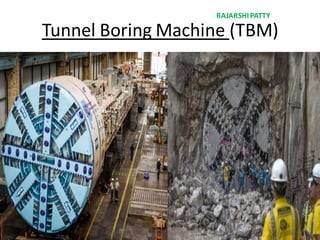
Tunnel Boring Machine (TBM)
RAJARSHIPATTY
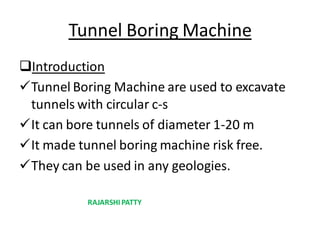
Tunnel Boring Machine
Introduction
Tunnel Boring Machine are used to excavate
tunnels with circular c-s
It can bore tunnels of diameter 1-20 m
It made tunnel boring machine risk free.
They can be used in any geologies.
RAJARSHI PATTY
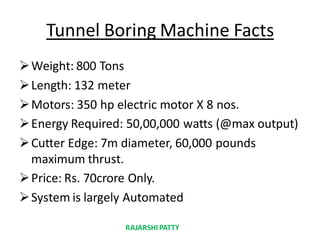
Tunnel Boring Machine Facts
Weight: 800 Tons
Length: 132 meter
Motors: 350 hp electric motor X 8 nos.
Energy Required: 50,00,000 watts (@max output)
Cutter Edge: 7m diameter, 60,000 pounds
maximum thrust.
Price: Rs. 70crore Only.
System is largely Automated
RAJARSHIPATTY
Facts Of TBM
Manufacturing Companies:
1) RobbinsIndia Pvt. Ltd.
2) MitsubishiMotors
3) KawasakiHeavy Industries Engine Ltd.
4) Herrenknecht Tunnelling System Ltd.
5) Hyundai Engineering Ltd.
• Excavating Rate: 50- 60 feet/ Day
• Power: 18,600 KW
• Rotating Speed: 10m
RAJARSHI PATTY
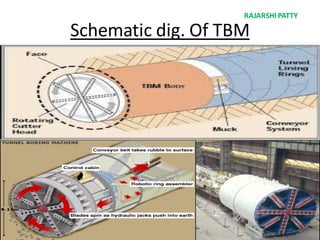
TBM Sections
• Cutting Head
• Main Drive
• Screw Conveyor
• Ground Conditioningsystem
• Sealing System
• Grout Injection
• Erector & Segment Handling
RAJARSHIPATTY
Schematic dig. Of TBM
RAJARSHIPATTY
Different Parts OF TBM
RAJARSHIPATTY
Different Parts & Functions of TBM
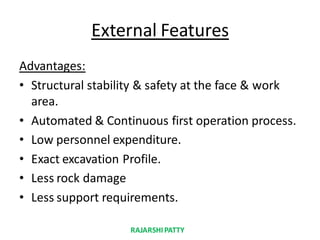
External Features
Advantages:
• Structural stability & safety at the face & work
area.
• Automated & Continuous first operation process.
• Low personnel expenditure.
• Exact excavation Profile.
• Less rock damage
• Less support requirements.
RAJARSHIPATTY
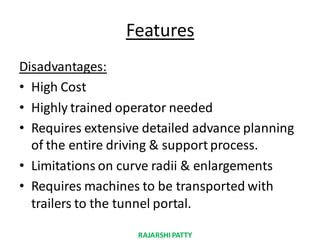
Features
Disadvantages:
• High Cost
• Highly trained operator needed
• Requires extensive detailed advance planning
of the entire driving & support process.
• Limitations on curve radii & enlargements
• Requires machines to be transported with
trailers to the tunnel portal.
RAJARSHIPATTY
Tunneling & Drilling Equipments

Tunneling & Drilling Equipments

  • 1.
    Prepared by: RAJARSHI PATTY B.Tech,M.Tech (CE&M) CIVIL Engineering. TUNNELING & ROCK DRILLING EQUIPMENTS
  • 2.
    Tunnelling Definition: • Tunnels areartificial underground passages opened at both ends constructed for different purposes. • Required for highways,railways, sewerage, water supply, public utilities and canals. RAJARSHIPATTY
  • 3.
    HISTORY • The oldesttunnel was constructed4000 years ago in ancient Babylon to underpassthe bed of river Euphrates and to establish an undergroundconnection between the royal palace and Temple of Jove. • The length of the tunnel was 1 km and it was built with the considerable cross-section dimensionsof 3.6 m by 4.5 m RAJARSHIPATTY
  • 4.
    REASONS TO BUILDA TUNNEL • To avoid an obstacle such as a mountain. • To overcome a water obstacle. • Built to connect between military posts so the movement between them will not be visible for the enemy. • built for infrastructure like electricity cables, water, communicationand sewerage to avoid damage and disruption above ground. RAJARSHIPATTY
  • 5.
    ADVANTAGES OF TUNNELING •Tunnels are more economical than open cuts beyond certain depths. • Tunnels avoid disturbing or interfering with surface life and traffic during construction. • Tunnels prove to be cheaper than bridges or open cuts to carry public utility services like water, sewer and gas. • If tunnels are provided with easy gradients, the cost of hauling is decreased • In case of aerial warfare and bombing of cities, the tunnels would grant better protection as compared to bridges. RAJARSHIPATTY
  • 6.
    TYPES OF TUNNELS MountainTunnel: a) Drilling and blasting (D&B) method b) Tunnel Boring Machine (TBM) method RAJARSHIPATTY
  • 7.
    TYPES OF TUNNELS Shallow-buriedTunnel or Soft Soil Tunnel : a) Cut-and-covermethod b) Shield method  UnderwaterTunnel : a) Immersed-tube method b) Shield method RAJARSHIPATTY
  • 8.
    TUNNEL CONSTRUCTION METHODS •ClassicalMethod • Cut & Cover Method • Drill & Blast • Tunnel boring Machine (TBM) • Immersed Tunnel • Tunnel Jacking • Other Methods RAJARSHIPATTY
  • 9.
    INSTRUMENTS USED INTUNNEL CONSTRUCTION  Crawler Excavator  Wheel Loaders  Crawler Loaders  Tunnel Boring Machines (TBMs)  Immersed Tube  Different types Drilling & Blasting Equipments RAJARSHIPATTY
  • 10.
    CRAWLER EXCAVATOR APPLICATION: Digging trenches,holes and foundations,as well as for handling materials, moving earth, demolition,dredging, etc. Other attachments adapt the crawler excavator for boring, ripping, crushing, cutting and lifting. ManufacturingCompanies: Komatsu,Volvo,BobCat,Link-Belt,Kubota etc. RAJARSHIPATTY
  • 11.
    CRAWLER EXCAVATOR FEATURES COST:Varies from 45-80 lakhs. ExcavationCapacity: 60 cu.mec/hr Fuel: For EX200/EX210-> 12-14lt/hr Mobile:0.1 lt/hr running Life Span: 6 Years Engine: EX 210 (Mostly Preferred) RAJARSHIPATTY
  • 12.
  • 13.
    WHEEL LOADERS Application: To transportmaterials from stock piles to trucks Or, transport materials around job sites. ManufacturingCompanies: Volvo, Doosan, John Deer etc. Cost: 20-23 lakhs Capacity: 25 cumec/hr Diesel Consumption:0.1lt/hr. RAJARSHIPATTY
  • 14.
  • 15.
  • 16.
  • 17.
    DRILLING Definition: The process ofmaking a hole in hard material such as rocks and earth. Components: 1. Drill- Type of tool which holds the drill bit and rotates it to provide axial force to create a hole. 2. Drill bits- Cutting tools used to create cylindricalholes. RAJARSHIPATTY
  • 18.
    TYPES OF DRILLS PERCUSSIONDRILLS: 1. JACKHAMMER OR SINKERS 2. TRIPOD DRILLS 3. STOP HAMMER 4. DRIFTERS 5. CHURNS OR WELL DRILLS 6.PISTON DRILLS 7. WAGON DRILLS.  ABRASION DRILLS: 1.BLAST-HOLE DRILLS 2. SHOT DRILLS 3. DIAMOND DRILLS.  FUSION PIERCING RAJARSHIPATTY
  • 19.
    PERCUSION DRILLS Jackhammer orSinkers- Air operated drill, mainly used for drilling vertical holes. Tripod drills- Mounted on tripod to provide sufficient stability, used for very hard rocks RAJARSHIPATTY
  • 20.
    TYES OF DRILLS: Stophammers- Thrust end to hold the drill against the work and usually used for “up” holes. Drifters- Similar to jackhammer, but so large that it requires mechanical mounting. RAJARSHIPATTY
  • 21.
     Churns orWell drills- Reciprocating Drill consisting of a long steel bit mechanically lifted and dropped to disintegrate the rock.  Piston drills- Drill rod is securely fastened to the piston and travels the full length of thepiston stroke.  Wagon drills-Drifter mounted on a mast supported by two or more wheels used to drill holes at any angle from down to slightly above horizontal. RAJARSHIPATTY
  • 22.
    ABRASION DRILLS: DEFINITION- Grindrock into small particles through abrasive effect of bit that rotates in hole. • TYPES- 1.Blast-holedrills 2.Shot drills 3.Diamond drills  Blast hole drills- Rotary drill consisting of steel pipe drill stem on bottom of which is roller bit that disintegrates the rock as it rotates over it. RAJARSHIPATTY
  • 23.
    ABRASION DRILLS TYPES Shotdrills- Rotary drill whose bit consists of a steel pipe with a roughened surface at bottom. Diamond drills- Rotary drill whose bit consists of metal matrix consisting a large number of diamonds disintegrating the rock whilerotatin. RAJARSHIPATTY
  • 24.
    FUSION PIERCING FUSION Recent developmentin drilling holes for blasting purpose, Produced by burning a mixture of oxygen and flux bearing fuel, such as kerosene at the end of a blow pipe. RAJARSHIPATTY
  • 25.
    DRILLING PATTERNS Selection ofdrilling pattern varies with the type and size of the drill’s used, depth of hole, kind of rock, quantity, rapidity of the explosive & amount of steaming. RAJARSHIPATTY
  • 26.
    BLASTING DEFINITION: The process ofbreaking rocks into smaller pieces by use of explosives. TYPES OF EXPLOSIVES: Explosives based on chemical nature. Explosives based on availability. RAJARSHI PATTY
  • 27.
    EXPLOSIVESBASEDONCHEMICALNATURE  High ordetonating explosives- Process is extremely rapid, almost instantaneous. Low or deflagrating Explosives- Low velocity of burning and produce pressure by progressiveburning. RAJARSHIPATTY
  • 28.
    EXPLOSIVE BASED ONAVAILABILITY Powder explosive: Slow burning , slow acting and low strength explosives made either from potash nitrate or sodium nitrate. Disruptive explosives or Dynamites: Available in various sizes and strength. Approximate strength is specified as a percentage of ratio of weight of nitro- glycerine to the total weight of a cartridge. RAJARSHIPATTY
  • 29.
    DETONATORS DEFINITION: Cylindrical metal shellsclose at one end having 6.8 mm dia &50 mm height. The ignition of detonator is done by blasting fuse or electric ignitors. Following is required for electric ignition: 1.Detonator. 2.Power source-dynamo. 3.Circuit line-iron or copper wires. 4.4.Electric ignitor-comprising 2 supply wires detonator shell and priming charge. 5.Line testing apparatus-galvanoscope or measuring bridge. RAJARSHIPATTY
  • 30.
    TOOLS FOR BLASTING 1.Dipper2.Priming needle 3.Tamping bar etc. Dipper: Used to drill hole to the required depth Priming Needle: Used to maintain the hole while tamping. Tamping Bar: Used to tamp the material while refilling the blast hole. RAJARSHIPATTY
  • 31.
    Tunnel Boring Machine(TBM) RAJARSHIPATTY
  • 32.
    Tunnel Boring Machine Introduction TunnelBoring Machine are used to excavate tunnels with circular c-s It can bore tunnels of diameter 1-20 m It made tunnel boring machine risk free. They can be used in any geologies. RAJARSHI PATTY
  • 33.
    Tunnel Boring MachineFacts Weight: 800 Tons Length: 132 meter Motors: 350 hp electric motor X 8 nos. Energy Required: 50,00,000 watts (@max output) Cutter Edge: 7m diameter, 60,000 pounds maximum thrust. Price: Rs. 70crore Only. System is largely Automated RAJARSHIPATTY
  • 34.
    Facts Of TBM ManufacturingCompanies: 1) RobbinsIndia Pvt. Ltd. 2) MitsubishiMotors 3) KawasakiHeavy Industries Engine Ltd. 4) Herrenknecht Tunnelling System Ltd. 5) Hyundai Engineering Ltd. • Excavating Rate: 50- 60 feet/ Day • Power: 18,600 KW • Rotating Speed: 10m RAJARSHI PATTY
  • 35.
    TBM Sections • CuttingHead • Main Drive • Screw Conveyor • Ground Conditioningsystem • Sealing System • Grout Injection • Erector & Segment Handling RAJARSHIPATTY
  • 36.
    Schematic dig. OfTBM RAJARSHIPATTY
  • 37.
    Different Parts OFTBM RAJARSHIPATTY
  • 38.
    Different Parts &Functions of TBM
  • 39.
    External Features Advantages: • Structuralstability & safety at the face & work area. • Automated & Continuous first operation process. • Low personnel expenditure. • Exact excavation Profile. • Less rock damage • Less support requirements. RAJARSHIPATTY
  • 40.
    Features Disadvantages: • High Cost •Highly trained operator needed • Requires extensive detailed advance planning of the entire driving & support process. • Limitations on curve radii & enlargements • Requires machines to be transported with trailers to the tunnel portal. RAJARSHIPATTY