Lubrication
Introduction
Lubricants are a special category of materials, usually in
either liquid or semi-solid state, applied between two or
more moving parts in order to reduce the friction between
them as well as dissipate the heat produced in them.
General Description of Lubricants
Lubricants are solid, liquid or semi-solid materials applied
between moving parts to make their movement friction
free. Right from the day of their discovery, a wide variety
of lubricants have been used, depending upon the
requirements of the application. The most commonly used
lubricants are grease, oils, graphite etc. These materials,
when applied over mechanical parts, allow easy movement
of another component over it. This helps to prevent the
damage caused by abrasion and friction as well as uneven
expansion of the components due to heat.
Methods of Lubrication
The lubricants form a thin-film or thick-film over the surface
of the components between which it is applied. When the
parts move, the thick film aids in easy movement by
providing a smooth surface. Also, they absorb friction and
heat that is generated between moving parts. The difference
between thick and thin films is that thick films completely
separate the two moving layers while thin-films maintain
some contact between the moving parts. Thin-film
lubrication is used when the loads are heavy whereas a thick-
film is used for high-speed machines, especially
reciprocating and oscillating types.
LUBRICATING OILS
• Oil lubricants are liquid lubricants which are mainly used in
automobiles and industrial machines which require a
continuous and rather controlled supply of lubricants to the
system. Some of them are:
• Animal and Vegetable Oils
• Mineral Oils
• Blended Oils
ANIMAL AND VEGETABLE OIL
• Animal oils are extracted from crude fat by Rendering process
in which the enclosing tissue is broken by treatment with
steam.
• Lard oil and Neats foot oil are the example of Animal oil.
• Vegetable oils such as cotton seed oil and castor oil are
obtained by crushing the seeds.
• Castor Oil and Olive Oil are the examples of vegetable oil.
Vegetable Lubricants
•Examples of vegetable lubricants are:
–Castor oil
–Olive oil
–Cottonseed oil
•Animal and vegetable oils have a lower
coefficient of friction than most mineral oils but
they rapidly wear away steel
MINERAL OR PETROLEUM OILS
• These are low molecular weight hydrocarbons with about 12-
50 carbon atoms. Mineral oil are obtained by distillation of
petroleum. These are widely used as they are cheap, available
in abundance. Only drawback is that oiliness of these oils is
less. However addition of oelic acid and stearic acid increases
the oiliness of mineral oil.
PURIFICATION OF MINERAL OIL
Dewaxing: It means removal of wax presence of which
increase the pour point so lubricant can not be used at low
temperature. For dewaxing, oil is mixed with propane and
then refrigerated for the precipitation of wax. Wax is then
removed from oil by passing the oil wax suspension through a
centrifugal working at 1700 rpm. To recover the solution
distillation is done.
Acid Refining: Impurities like asphaltic and napthenic
acid is removed by acid refining in which dewaxed oil is
treated with conc. H2SO4. Impurities either get dissolved in
acid or converted into tarry sludges. Sludge is removed by
filtration.
Solvent Refining: It involves mixing of oil with nitrobenzene
or some other solvent(like dichloro ethyl ether or mixture of
propane and cresol or sulphur dioxide and benzene). Solvent is
such in which oil immiscible but impurities are highly soluble.
After proper mixing with such solvent, the oil is left undisturbed
for some time so that liquid separates into two layers. ‘Solvent
Layer’ containing impurities and ‘Oil Layer’ free from
impurities. By distillation of solvent layer impurities can be
separate out to get pure solvent.
Synthetic Lubricants
•Because of the high operating temperatures of
gas-turbine engines, it became necessary to
develop lubricants which would retain their
characteristics at temperatures that cause
petroleum lubricants to evaporate and break
down
•Synthetic lubricants do not break down easily
and do not produce coke or other deposits
BLENDED OILS
• Characterstics(like decrease the pour point or increase the
anti oxidation ability or change in viscosity index) of
lubricating oil can be improved by adding some additives, the
oil obtained after the addition of additives is called blended
oil.
• An additive is a material that either impart a new desired
property to lubricant oil or enhance the degree of property
already possess by oil.
TYPES OF ADDITIVE
• Chemically Active Additives: These are those which
chemically interact with metals(to form protective film) and
with polar oxidation and degradation products. Dispersants,
Detergents Anti-Wear agents,oxidation inhibitors, Rust and
Corrosion inhibitors are the examples of chemically active
additives.
• Chemically Inert Additives: These are those which
improve the physical properties. These include viscosity index
improvers, foam inhibitors, Pour point depressents,
demulsifiers and emulsifiers etc.
2. Classification of lubricants according
to their physical state
•Solid
•Semi-solid
•Liquid
Solid Lubricants
Solid lubricants e.g., graphite, are in the form of powders
and can be applied on machine surfaces where they orient
themselves parallel to the surface. When the machine parts
move, the graphite particles or lamellas shave over each
other, reducing the friction over the machine parts. In
graphite lubricant sprays, a thin film of the lubricant is
sprayed using the sprayer over the machine surface. After
some time, the sprayed lubricant forms a thin coating or
film over the surface, which protects the moving parts from
friction and heat.
Semi-solid Lubricants
Greases are commonly used semi-solid lubricants. They are used
when liquid lubricants such as lubricating oils cannot be
supplied continuously during the operation of the moving
machine parts. Greases of various types are available with
varying operating temperatures, moisture resistance, and
stability over oxidation, etc. Grease actually consists of a base
lubricant such as oil, a thickening agent whose job is to keep the
lubricant in semi-solid state and additives to improve the
performance of the lubricant. They are used in applications
requiring low viscosity and are easier to store and handle.
Grease is ideal for open gears, chain and cable mechanisms, high
temperature and extreme pressure applications.
Liquid Lubricants
Oil lubricants are liquid lubricants which are mainly used in
automobiles and industrial machines which require a
continuous and rather controlled supply of lubricants to the
system. Some of them are:
•Hydraulic Oils
•Way Oils
•Spindle Oils
Lubricating Oil Properties
•Flash Point
•Viscosity
•Cloud Point
•Pour Point
•Carbon-Residue Test
•Ash Test
•Precipitation Number
•Corrosion and Neutralization
Number
•Oiliness
•Extreme-Pressure (Hypoid)
Lubricants
•Chemical and Physical
Stability
Flash Point
The flash point of an oil is the temperature to which the
oil must be heated in order to give off enough vapor to
form a combustible mixture above the surface that will
momentarily flash or burn when the vapor is brought
into contact with a very small flame
Viscosity
•Viscosity is technically defined as the fluid friction
of an oil
•To put it more simply, it is the resistance an oil
offers to flowing
•Heavy-bodied oil is high in viscosity and pours or
flows slowly
CloudPoint
The cloud point is the temperature at which the separation of wax
becomes visible in certain oils under prescribed testing conditions
When such oils are tested, the cloud point is slightly above the
solidification point
Pour Point
•The pour point of an oil is the temperature at
which the oil will just flow without disturbance
when chilled
ANILINE POINT
• It is the minimum equilibrium solution temperature for equal
volume of aniline and oil sample.
• Determined by mixing equal volume of aniline and oil sample
in test tube. Heat it to get homogeneous solution. Then
allowed to cool it and note the temp. at which oil and aniline
phases separate out that temp. is called as Aniline point.
• Lower aniline point means higher percentage of aromatic
hydrocarbons which means more are the chances of
deterioration of oil when it comes in contact with rubber
sealing, packing etc.
ASH TEST
The ash test is an extension of the carbon-residue test
If an unused oil leaves almost no ash, it is regarded as pure
The ash content is a percentage (by weight) of the residue
after all carbon and all carbonaceous matter have been
evaporated and burned
Carbon-Residue Test
•The purpose of the carbon-residue test is to
study the carbon-forming properties of a
lubricating oil
•There are two methods:
–The Ramsbottom carbon-residue test
–The Conradson test
Precipitation Number
•The precipitation number recommended by the
ASTM is the number of milliliters of precipitate
formed when 10 mL of lubricating oil is mixed
with 90 mL of petroleum naphtha under specific
conditions and then centrifuged.
Applications of Lubricants
• Lubricate parts like gears, chains, wheels, bearings etc.
• Lubricate the piston movement in engine cylinders.
• Lubricate the vanes of turbines and blowers.
• Cool engines and pumps by dissipating heat effectively.
• Lubricate and cool compressors.
• Lubricate spring systems and rollers.
Lubrication
Of
Roller Bearings
Tasks of Roller Bearings
reducing friction
transfer of loads
guiding rotating parts
Friction in Roller Bearings
small portion of rolling friction
but considerable share of sliding friction at:
roller bearing rings
cages and / or
rolling elements against each other
Kinds of Lubrication
of Roller Bearings
9,5% by oils 0,5% by solid lubricants only
90% by greases
The most important Parameters for
selecting the suitable Lubricant
revolution or DN - factor
D = external bearing diameter [mm]
d = internal bearing diameter [mm]
n = revolution per minute [rpm]
dm= medium bearing diameter [mm] = ———
D + d
2
DN = ——— • nD + d
2
temperature range
Lubrication by greases
Grease pump
Contamination may
cause bearing failures.
Seals protect to a large
extent from outside contaminations.
Frequent relubrication is required when
the hazard of grease contamination exists.
Same applies if the grease should seal also
against penetrating moisture.
Contamination penetrating through
labyrinth channels.
Newly supplied grease pushes out both
used up and contaminated grease
through the labyrinth packing seals.
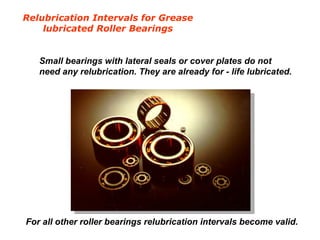
Relubrication Intervals for Grease
lubricated Roller Bearings
Small bearings with lateral seals or cover plates do not
need any relubrication. They are already for - life lubricated.
For all other roller bearings relubrication intervals become valid.
Guidelines for
Relubrication Intervalls
10 000
6 000
4 000
3 000
2 000
1 500
1 000
500
300
200
150
100
50
20 000
15 000
10 000
7 500
5 000
2 500
1 500
1 000
750
500
250
20 000
15 000
10 000
5 000
3 000
2 000
1 500
1 000
500
100 200 500 1 000 2 000 5 000 10 000
n [U/min]
tfa
tfb
tfcLubrication interval,
given by service hours
tfa = radial ball bearing
tfb = cylindrical roller bearing / needle bearing
tfc = self aligning roller bearing / taper rolling bearing / axial roller bearing
massive cylindrical roller bearing (0,2 tfc), axial cylindrical roller
bearing (0,5 tfc)
500 420 360 280 240 200 160 120 100 80 60
40
20
d=10
Example: A deep-groove ball bearing with an internal diameter
d= 100mm running at a speed of n = 1000 rpm. The operating
temperature lies between 60 and 70 °C.
Which is the expected relubrication interval?
The vertical in point n= 1000 rpm on the abscissa
cuts the curve for d= 100mm. From there the horizontal leads
to the outer left-hand scale (deep- groove ball bearings)
indicating a relubrication interval of 10000 service hours
Correction of Relubrication Intervals
The assessed intervals are valid only for:
bearings in stationary machines
normal load
ageing-proofed greases
temperature < + 70°C at the outer ring
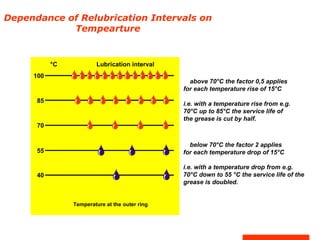
Dependance of Relubrication Intervals on
Tempearture
100
85
70
55
40
Lubrication interval°C
Temperature at the outer ring
above 70°C the factor 0,5 applies
for each temperature rise of 15°C
i.e. with a temperature rise from e.g.
70°C up to 85°C the service life of
the grease is cut by half.
below 70°C the factor 2 applies
for each temperature drop of 15°C
i.e. with a temperature drop from e.g.
70°C down to 55 °C the service life of the
grease is doubled.
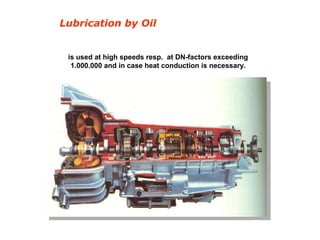
Lubrication by Oil
is used at high speeds resp. at DN-factors exceeding
1.000.000 and in case heat conduction is necessary.
Oil bath lubrication
Suitable only for bearings with low speeds.
During stand-stills the oil level should not
quite reach the middle of the rolling element
at the bottom. .
Oil injection lubrication
At high speed it becomes necessary,
that the air turbulence circulating with
the bearing is penetrated by the oil.
This is ensured by injecting oil under
high pressure (min.15 m/s) from the side
into the bearing.
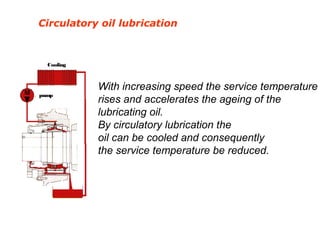
Circulatory oil lubrication
With increasing speed the service temperature
rises and accelerates the ageing of the
lubricating oil.
By circulatory lubrication the
oil can be cooled and consequently
the service temperature be reduced.
Cooling
pump
Lubrication with Solid Lubricants
Deep groove ball bearings with increased clearance
required at:
high temperatures > + 200 °C
high temperature variations
low speed
Lubrication with Solid Lubricants -
Exsample
Lubrication by Solid
Lubricants only
at temperatures > + 200 °C
OKS 230 MoS2-High Temperature Paste
(for thin-film lubrication during assembly and maintenance)
in connection with
OKS 310 MoS2-High-Temperature Lubricant
(for relubrication during operation)
The carrying fluid evaporates residue-free above 200°C and
dry MoS2 films remain, which assure lubrication up to 450°C.
Kiln-car bearings in the ceramics and brick industry
Bibliography
www.google.com
Wikipedia.org
Sciencemania.com
Thanks…

Lubrication

  • 1.
  • 2.
    Introduction Lubricants are aspecial category of materials, usually in either liquid or semi-solid state, applied between two or more moving parts in order to reduce the friction between them as well as dissipate the heat produced in them.
  • 3.
    General Description ofLubricants Lubricants are solid, liquid or semi-solid materials applied between moving parts to make their movement friction free. Right from the day of their discovery, a wide variety of lubricants have been used, depending upon the requirements of the application. The most commonly used lubricants are grease, oils, graphite etc. These materials, when applied over mechanical parts, allow easy movement of another component over it. This helps to prevent the damage caused by abrasion and friction as well as uneven expansion of the components due to heat.
  • 4.
    Methods of Lubrication Thelubricants form a thin-film or thick-film over the surface of the components between which it is applied. When the parts move, the thick film aids in easy movement by providing a smooth surface. Also, they absorb friction and heat that is generated between moving parts. The difference between thick and thin films is that thick films completely separate the two moving layers while thin-films maintain some contact between the moving parts. Thin-film lubrication is used when the loads are heavy whereas a thick- film is used for high-speed machines, especially reciprocating and oscillating types.
  • 5.
    LUBRICATING OILS • Oillubricants are liquid lubricants which are mainly used in automobiles and industrial machines which require a continuous and rather controlled supply of lubricants to the system. Some of them are: • Animal and Vegetable Oils • Mineral Oils • Blended Oils
  • 6.
    ANIMAL AND VEGETABLEOIL • Animal oils are extracted from crude fat by Rendering process in which the enclosing tissue is broken by treatment with steam. • Lard oil and Neats foot oil are the example of Animal oil. • Vegetable oils such as cotton seed oil and castor oil are obtained by crushing the seeds. • Castor Oil and Olive Oil are the examples of vegetable oil.
  • 7.
    Vegetable Lubricants •Examples ofvegetable lubricants are: –Castor oil –Olive oil –Cottonseed oil •Animal and vegetable oils have a lower coefficient of friction than most mineral oils but they rapidly wear away steel
  • 8.
    MINERAL OR PETROLEUMOILS • These are low molecular weight hydrocarbons with about 12- 50 carbon atoms. Mineral oil are obtained by distillation of petroleum. These are widely used as they are cheap, available in abundance. Only drawback is that oiliness of these oils is less. However addition of oelic acid and stearic acid increases the oiliness of mineral oil.
  • 9.
    PURIFICATION OF MINERALOIL Dewaxing: It means removal of wax presence of which increase the pour point so lubricant can not be used at low temperature. For dewaxing, oil is mixed with propane and then refrigerated for the precipitation of wax. Wax is then removed from oil by passing the oil wax suspension through a centrifugal working at 1700 rpm. To recover the solution distillation is done. Acid Refining: Impurities like asphaltic and napthenic acid is removed by acid refining in which dewaxed oil is treated with conc. H2SO4. Impurities either get dissolved in acid or converted into tarry sludges. Sludge is removed by filtration.
  • 10.
    Solvent Refining: Itinvolves mixing of oil with nitrobenzene or some other solvent(like dichloro ethyl ether or mixture of propane and cresol or sulphur dioxide and benzene). Solvent is such in which oil immiscible but impurities are highly soluble. After proper mixing with such solvent, the oil is left undisturbed for some time so that liquid separates into two layers. ‘Solvent Layer’ containing impurities and ‘Oil Layer’ free from impurities. By distillation of solvent layer impurities can be separate out to get pure solvent.
  • 11.
    Synthetic Lubricants •Because ofthe high operating temperatures of gas-turbine engines, it became necessary to develop lubricants which would retain their characteristics at temperatures that cause petroleum lubricants to evaporate and break down •Synthetic lubricants do not break down easily and do not produce coke or other deposits
  • 12.
    BLENDED OILS • Characterstics(likedecrease the pour point or increase the anti oxidation ability or change in viscosity index) of lubricating oil can be improved by adding some additives, the oil obtained after the addition of additives is called blended oil. • An additive is a material that either impart a new desired property to lubricant oil or enhance the degree of property already possess by oil.
  • 13.
    TYPES OF ADDITIVE •Chemically Active Additives: These are those which chemically interact with metals(to form protective film) and with polar oxidation and degradation products. Dispersants, Detergents Anti-Wear agents,oxidation inhibitors, Rust and Corrosion inhibitors are the examples of chemically active additives. • Chemically Inert Additives: These are those which improve the physical properties. These include viscosity index improvers, foam inhibitors, Pour point depressents, demulsifiers and emulsifiers etc.
  • 14.
    2. Classification oflubricants according to their physical state •Solid •Semi-solid •Liquid
  • 15.
    Solid Lubricants Solid lubricantse.g., graphite, are in the form of powders and can be applied on machine surfaces where they orient themselves parallel to the surface. When the machine parts move, the graphite particles or lamellas shave over each other, reducing the friction over the machine parts. In graphite lubricant sprays, a thin film of the lubricant is sprayed using the sprayer over the machine surface. After some time, the sprayed lubricant forms a thin coating or film over the surface, which protects the moving parts from friction and heat.
  • 16.
    Semi-solid Lubricants Greases arecommonly used semi-solid lubricants. They are used when liquid lubricants such as lubricating oils cannot be supplied continuously during the operation of the moving machine parts. Greases of various types are available with varying operating temperatures, moisture resistance, and stability over oxidation, etc. Grease actually consists of a base lubricant such as oil, a thickening agent whose job is to keep the lubricant in semi-solid state and additives to improve the performance of the lubricant. They are used in applications requiring low viscosity and are easier to store and handle. Grease is ideal for open gears, chain and cable mechanisms, high temperature and extreme pressure applications.
  • 17.
    Liquid Lubricants Oil lubricantsare liquid lubricants which are mainly used in automobiles and industrial machines which require a continuous and rather controlled supply of lubricants to the system. Some of them are: •Hydraulic Oils •Way Oils •Spindle Oils
  • 18.
    Lubricating Oil Properties •FlashPoint •Viscosity •Cloud Point •Pour Point •Carbon-Residue Test •Ash Test •Precipitation Number •Corrosion and Neutralization Number •Oiliness •Extreme-Pressure (Hypoid) Lubricants •Chemical and Physical Stability
  • 19.
    Flash Point The flashpoint of an oil is the temperature to which the oil must be heated in order to give off enough vapor to form a combustible mixture above the surface that will momentarily flash or burn when the vapor is brought into contact with a very small flame
  • 20.
    Viscosity •Viscosity is technicallydefined as the fluid friction of an oil •To put it more simply, it is the resistance an oil offers to flowing •Heavy-bodied oil is high in viscosity and pours or flows slowly CloudPoint The cloud point is the temperature at which the separation of wax becomes visible in certain oils under prescribed testing conditions When such oils are tested, the cloud point is slightly above the solidification point
  • 21.
    Pour Point •The pourpoint of an oil is the temperature at which the oil will just flow without disturbance when chilled
  • 22.
    ANILINE POINT • Itis the minimum equilibrium solution temperature for equal volume of aniline and oil sample. • Determined by mixing equal volume of aniline and oil sample in test tube. Heat it to get homogeneous solution. Then allowed to cool it and note the temp. at which oil and aniline phases separate out that temp. is called as Aniline point. • Lower aniline point means higher percentage of aromatic hydrocarbons which means more are the chances of deterioration of oil when it comes in contact with rubber sealing, packing etc.
  • 23.
    ASH TEST The ashtest is an extension of the carbon-residue test If an unused oil leaves almost no ash, it is regarded as pure The ash content is a percentage (by weight) of the residue after all carbon and all carbonaceous matter have been evaporated and burned
  • 24.
    Carbon-Residue Test •The purposeof the carbon-residue test is to study the carbon-forming properties of a lubricating oil •There are two methods: –The Ramsbottom carbon-residue test –The Conradson test
  • 25.
    Precipitation Number •The precipitationnumber recommended by the ASTM is the number of milliliters of precipitate formed when 10 mL of lubricating oil is mixed with 90 mL of petroleum naphtha under specific conditions and then centrifuged.
  • 26.
    Applications of Lubricants •Lubricate parts like gears, chains, wheels, bearings etc. • Lubricate the piston movement in engine cylinders. • Lubricate the vanes of turbines and blowers. • Cool engines and pumps by dissipating heat effectively. • Lubricate and cool compressors. • Lubricate spring systems and rollers.
  • 27.
  • 28.
    Tasks of RollerBearings reducing friction transfer of loads guiding rotating parts
  • 29.
    Friction in RollerBearings small portion of rolling friction but considerable share of sliding friction at: roller bearing rings cages and / or rolling elements against each other
  • 30.
    Kinds of Lubrication ofRoller Bearings 9,5% by oils 0,5% by solid lubricants only 90% by greases
  • 31.
    The most importantParameters for selecting the suitable Lubricant revolution or DN - factor D = external bearing diameter [mm] d = internal bearing diameter [mm] n = revolution per minute [rpm] dm= medium bearing diameter [mm] = ——— D + d 2 DN = ——— • nD + d 2 temperature range
  • 32.
    Lubrication by greases Greasepump Contamination may cause bearing failures. Seals protect to a large extent from outside contaminations. Frequent relubrication is required when the hazard of grease contamination exists. Same applies if the grease should seal also against penetrating moisture. Contamination penetrating through labyrinth channels. Newly supplied grease pushes out both used up and contaminated grease through the labyrinth packing seals.
  • 33.
    Relubrication Intervals forGrease lubricated Roller Bearings Small bearings with lateral seals or cover plates do not need any relubrication. They are already for - life lubricated. For all other roller bearings relubrication intervals become valid.
  • 34.
    Guidelines for Relubrication Intervalls 10000 6 000 4 000 3 000 2 000 1 500 1 000 500 300 200 150 100 50 20 000 15 000 10 000 7 500 5 000 2 500 1 500 1 000 750 500 250 20 000 15 000 10 000 5 000 3 000 2 000 1 500 1 000 500 100 200 500 1 000 2 000 5 000 10 000 n [U/min] tfa tfb tfcLubrication interval, given by service hours tfa = radial ball bearing tfb = cylindrical roller bearing / needle bearing tfc = self aligning roller bearing / taper rolling bearing / axial roller bearing massive cylindrical roller bearing (0,2 tfc), axial cylindrical roller bearing (0,5 tfc) 500 420 360 280 240 200 160 120 100 80 60 40 20 d=10 Example: A deep-groove ball bearing with an internal diameter d= 100mm running at a speed of n = 1000 rpm. The operating temperature lies between 60 and 70 °C. Which is the expected relubrication interval? The vertical in point n= 1000 rpm on the abscissa cuts the curve for d= 100mm. From there the horizontal leads to the outer left-hand scale (deep- groove ball bearings) indicating a relubrication interval of 10000 service hours
  • 35.
    Correction of RelubricationIntervals The assessed intervals are valid only for: bearings in stationary machines normal load ageing-proofed greases temperature < + 70°C at the outer ring
  • 36.
    Dependance of RelubricationIntervals on Tempearture 100 85 70 55 40 Lubrication interval°C Temperature at the outer ring above 70°C the factor 0,5 applies for each temperature rise of 15°C i.e. with a temperature rise from e.g. 70°C up to 85°C the service life of the grease is cut by half. below 70°C the factor 2 applies for each temperature drop of 15°C i.e. with a temperature drop from e.g. 70°C down to 55 °C the service life of the grease is doubled.
  • 37.
    Lubrication by Oil isused at high speeds resp. at DN-factors exceeding 1.000.000 and in case heat conduction is necessary.
  • 38.
    Oil bath lubrication Suitableonly for bearings with low speeds. During stand-stills the oil level should not quite reach the middle of the rolling element at the bottom. .
  • 39.
    Oil injection lubrication Athigh speed it becomes necessary, that the air turbulence circulating with the bearing is penetrated by the oil. This is ensured by injecting oil under high pressure (min.15 m/s) from the side into the bearing.
  • 40.
    Circulatory oil lubrication Withincreasing speed the service temperature rises and accelerates the ageing of the lubricating oil. By circulatory lubrication the oil can be cooled and consequently the service temperature be reduced. Cooling pump
  • 41.
    Lubrication with SolidLubricants Deep groove ball bearings with increased clearance required at: high temperatures > + 200 °C high temperature variations low speed
  • 42.
    Lubrication with SolidLubricants - Exsample Lubrication by Solid Lubricants only at temperatures > + 200 °C OKS 230 MoS2-High Temperature Paste (for thin-film lubrication during assembly and maintenance) in connection with OKS 310 MoS2-High-Temperature Lubricant (for relubrication during operation) The carrying fluid evaporates residue-free above 200°C and dry MoS2 films remain, which assure lubrication up to 450°C. Kiln-car bearings in the ceramics and brick industry
  • 43.
  • 44.