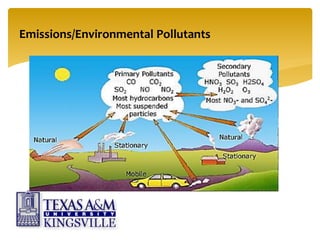
Emissions/Environmental Pollutants
SO2 Historical Trends (1900 – 2000) & Effects
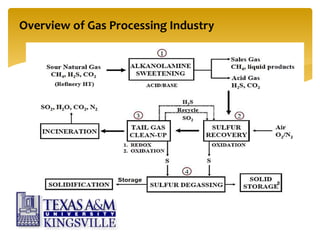
Overview of Gas Processing Industry
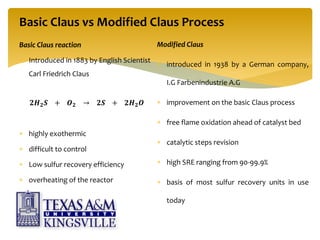
Basic Claus vs Modified Claus Process
Basic Claus reaction
 Introduced in 1883 by English Scientist
Carl Friedrich Claus
𝟐𝑯 𝟐 𝑺 + 𝑶 𝟐 → 𝟐𝑺 + 𝟐𝑯 𝟐 𝑶
 highly exothermic
 difficult to control
 Low sulfur recovery efficiency
 overheating of the reactor
Modified Claus
 introduced in 1938 by a German company,
I.G Farbenindustrie A.G
 improvement on the basic Claus process
 free flame oxidation ahead of catalyst bed
 catalytic steps revision
 high SRE ranging from 90-99.9%
 basis of most sulfur recovery units in use
today
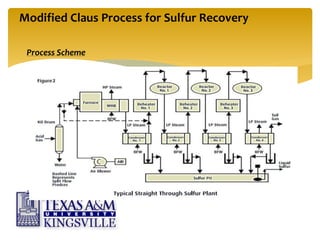
Process Scheme
Modified Claus Process for Sulfur Recovery
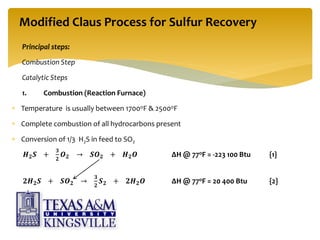
Principal steps:
Combustion Step
Catalytic Steps
1. Combustion (Reaction Furnace)
 Temperature is usually between 1700oF & 2500oF
 Complete combustion of all hydrocarbons present
 Conversion of 1/3 H2S in feed to SO2
𝑯 𝟐 𝑺 +
𝟑
𝟐
𝑶 𝟐 → 𝑺𝑶 𝟐 + 𝑯 𝟐 𝑶 ∆H @ 77oF = -223 100 Btu {1}
𝟐𝑯 𝟐 𝑺 + 𝑺𝑶 𝟐 →
𝟑
𝟐
𝑺 𝟐 + 𝟐𝑯 𝟐 𝑶 ∆H @ 77oF = 20 400 Btu {2}
Modified Claus Process for Sulfur Recovery
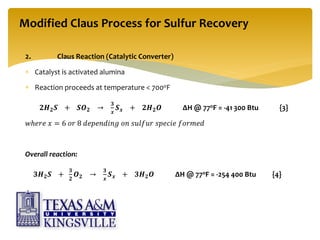
2. Claus Reaction (Catalytic Converter)
 Catalyst is activated alumina
 Reaction proceeds at temperature < 700oF
𝟐𝑯 𝟐 𝑺 + 𝑺𝑶 𝟐 →
𝟑
𝒙
𝑺 𝒙 + 𝟐𝑯 𝟐 𝑶 ∆H @ 77oF = -41 300 Btu {3}
𝑤ℎ𝑒𝑟𝑒 𝑥 = 6 𝑜𝑟 8 𝑑𝑒𝑝𝑒𝑛𝑑𝑖𝑛𝑔 𝑜𝑛 𝑠𝑢𝑙𝑓𝑢𝑟 𝑠𝑝𝑒𝑐𝑖𝑒 𝑓𝑜𝑟𝑚𝑒𝑑
Overall reaction:
𝟑𝑯 𝟐 𝑺 +
𝟑
𝟐
𝑶 𝟐 →
𝟑
𝒙
𝑺 𝒙 + 𝟑𝑯 𝟐 𝑶 ∆H @ 77oF = -254 400 Btu {4}
Modified Claus Process for Sulfur Recovery
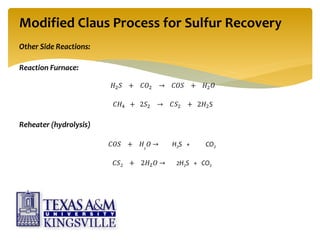
Other Side Reactions:
Reaction Furnace:
𝐻2 𝑆 + 𝐶𝑂2 → 𝐶𝑂𝑆 + 𝐻2 𝑂
𝐶𝐻4 + 2𝑆2 → 𝐶𝑆2 + 2𝐻2S
Reheater (hydrolysis)
𝐶𝑂𝑆 + 𝐻2
𝑂 → H2S + CO2
𝐶𝑆2 + 2𝐻2 𝑂 → 2H2S + CO2
Modified Claus Process for Sulfur Recovery
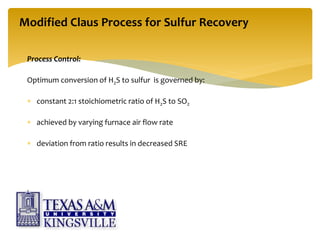
Process Control:
Optimum conversion of H2S to sulfur is governed by:
 constant 2:1 stoichiometric ratio of H2S to SO2
 achieved by varying furnace air flow rate
 deviation from ratio results in decreased SRE
Modified Claus Process for Sulfur Recovery
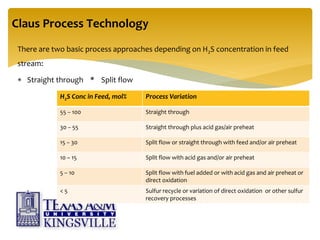
There are two basic process approaches depending on H2S concentration in feed
stream:
 Straight through * Split flow
Claus Process Technology
H2S Conc in Feed, mol% Process Variation
55 – 100 Straight through
30 – 55 Straight through plus acid gas/air preheat
15 – 30 Split flow or straight through with feed and/or air preheat
10 – 15 Split flow with acid gas and/or air preheat
5 – 10 Split flow with fuel added or with acid gas and air preheat or
direct oxidation
< 5 Sulfur recycle or variation of direct oxidation or other sulfur
recovery processes
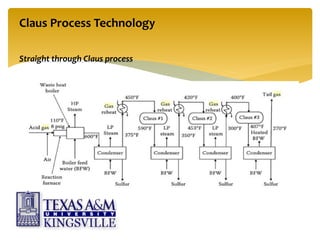
Straight through Claus process
Claus Process Technology
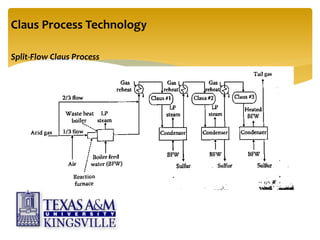
Split-Flow Claus Process
Claus Process Technology
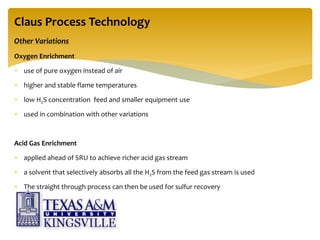
Other Variations
Oxygen Enrichment
 use of pure oxygen instead of air
 higher and stable flame temperatures
 low H2S concentration feed and smaller equipment use
 used in combination with other variations
Acid Gas Enrichment
 applied ahead of SRU to achieve richer acid gas stream
 a solvent that selectively absorbs all the H2S from the feed gas stream is used
 The straight through process can then be used for sulfur recovery
Claus Process Technology
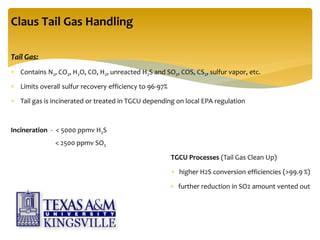
Tail Gas:
 Contains N2, CO2, H2O, CO, H2, unreacted H2S and SO2, COS, CS2, sulfur vapor, etc.
 Limits overall sulfur recovery efficiency to 96-97%
 Tail gas is incinerated or treated in TGCU depending on local EPA regulation
Incineration - < 5000 ppmv H2S
< 2500 ppmv SO2
TGCU Processes (Tail Gas Clean Up)
 higher H2S conversion efficiencies (>99.9 %)
 further reduction in SO2 amount vented out
Claus Tail Gas Handling
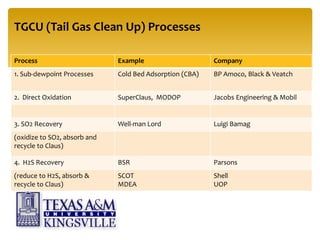
TGCU (Tail Gas Clean Up) Processes
Process Example Company
1. Sub-dewpoint Processes Cold Bed Adsorption (CBA) BP Amoco, Black & Veatch
2. Direct Oxidation SuperClaus, MODOP Jacobs Engineering & Mobil
3. SO2 Recovery Well-man Lord Luigi Bamag
(oxidize to SO2, absorb and
recycle to Claus)
4. H2S Recovery BSR Parsons
(reduce to H2S, absorb &
recycle to Claus)
SCOT
MDEA
Shell
UOP
video clip
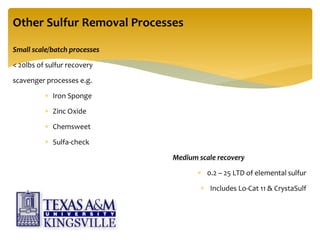
Other Sulfur Removal Processes
Small scale/batch processes
< 20lbs of sulfur recovery
scavenger processes e.g.
 Iron Sponge
 Zinc Oxide
 Chemsweet
 Sulfa-check
Medium scale recovery
 0.2 – 25 LTD of elemental sulfur
 Includes Lo-Cat 11 & CrystaSulf
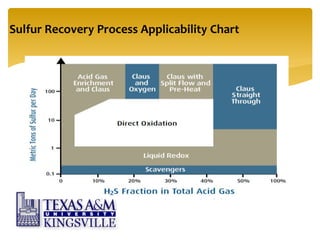
Sulfur Recovery Process Applicability Chart
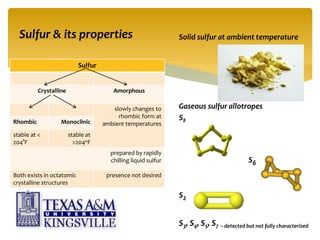
Sulfur & its properties
Solid at ambient temperatures
Solid sulfur at ambient temperature
Gaseous sulfur allotropes
S8
S6
S2
S3, S4, S5, S7 – detected but not fully characterized
Sulfur
Crystalline Amorphous
slowly changes to
rhombic form at
ambient temperaturesRhombic Monoclinic
stable at <
204°F
stable at
>204oF
prepared by rapidly
chilling liquid sulfur
Both exists in octatomic
crystalline structures
presence not desired
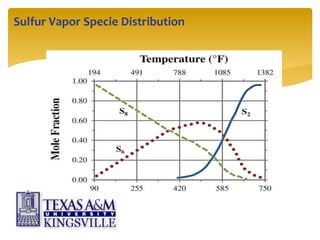
Sulfur Vapor Specie Distribution
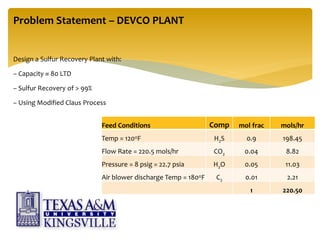
Design a Sulfur Recovery Plant with:
– Capacity ≈ 80 LTD
– Sulfur Recovery of > 99%
– Using Modified Claus Process
Problem Statement – DEVCO PLANT
Feed Conditions Comp mol frac mols/hr
Temp = 120oF H2S 0.9 198.45
Flow Rate = 220.5 mols/hr CO2 0.04 8.82
Pressure = 8 psig = 22.7 psia H2O 0.05 11.03
Air blower discharge Temp = 180oF C2 0.01 2.21
1 220.50
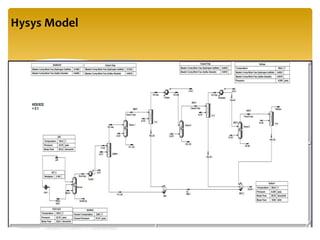
Hysys Model
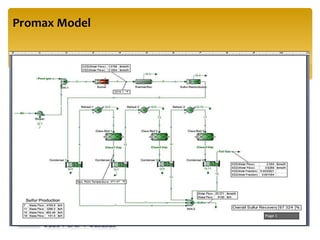
Promax Model
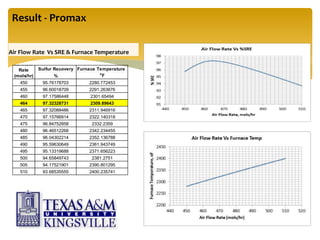
Result - Promax
Sulfur Recovery Furnace Temperature
%
o
F
450 95.76178703 2280.772453
455 96.60018709 2291.263676
460 97.17586448 2301.65494
464 97.32328731 2309.89643
465 97.32088486 2311.946916
470 97.15766914 2322.140318
475 96.84752858 2332.2359
480 96.46512268 2342.234455
485 96.04302214 2352.136788
490 95.59630649 2361.943749
495 95.13319688 2371.656223
500 94.65849743 2381.2751
505 94.17521901 2390.801295
510 93.68535555 2400.235741
Air Flow
Rate
(mols/hr)
Air Flow Rate Vs SRE & Furnace Temperature
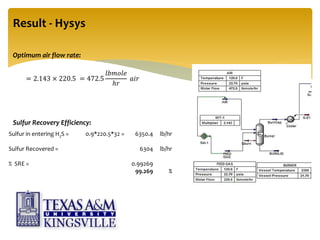
Result - Hysys
Optimum air flow rate:
= 2.143 × 220.5 = 472.5
𝑙𝑏𝑚𝑜𝑙𝑒
ℎ𝑟
𝑎𝑖𝑟
Sulfur Recovery Efficiency:
Sulfur in entering H2S = 0.9*220.5*32 = 6350.4 lb/hr
Sulfur Recovered = 6304 lb/hr
% SRE = 0.99269
99.269 %
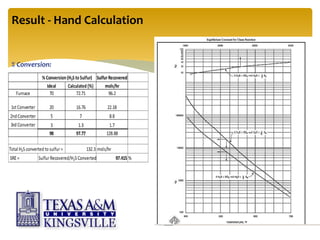
Result - Hand Calculation
% Conversion:
Result – Hand Calculation
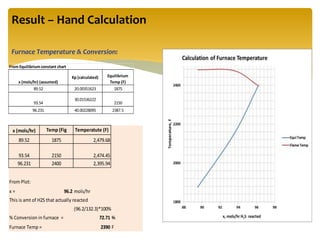
Furnace Temperature & Conversion:
From Equilibrium constant chart
x (mols/hr) (assumed)
Kp (calculated) Equilibrium
Temp (F)
89.52 20.00351623 1875
93.54
30.01536222
2150
96.231 40.00228095 2387.5
x (mols/hr)
Equilibrium
Temp (Fig
Flame
Temperatute (F)
89.52 1875 2,479.68
93.54 2150 2,474.45
96.231 2400 2,395.94
From Plot:
x = 96.2 mols/hr
This is amt of H2S that actually reacted
(96.2/132.3)*100%
% Conversion in furnace = 72.71 %
Furnace Temp = 2390 F
Result – Hand Calculation
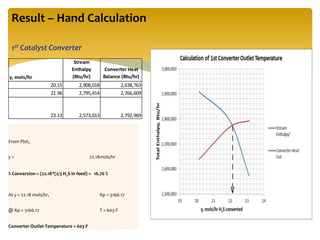
y, mols/hr
Stream
Enthalpy
(Btu/hr)
Converter Heat
Balance (Btu/hr)
20.15 2,908,018 2,638,763
21.96 2,795,414 2,766,609
23.13 2,573,013 2,792,969
From Plot,
y = 22.18mols/hr
% Conversion = (22.18*(2/3 H2S in feed) = 16.76 %
At y = 22.18 mols/hr, Kp = 3166.17
@ Kp = 3166.17 T = 603 F
Converter Outlet Temperature = 603 F
1st Catalyst Converter
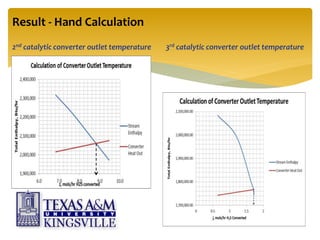
Result - Hand Calculation
2nd catalytic converter outlet temperature 3rd catalytic converter outlet temperature
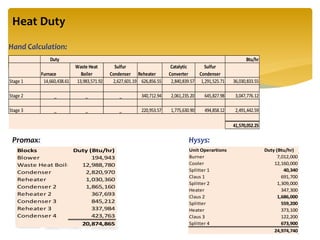
Heat Duty
Promax: Hysys:
Hand Calculation:
Blocks Duty (Btu/hr)
Blower 194,943
Waste Heat Boiler 12,988,780
Condenser 2,820,970
Reheater 1,030,360
Condenser 2 1,865,160
Reheater 2 367,693
Condenser 3 845,212
Reheater 3 337,984
Condenser 4 423,763
20,874,865
Unit Operartions Duty (Btu/hr)
Burner 7,012,000
Cooler 12,160,000
Splitter 1 40,340
Claus 1 691,700
Splitter 2 1,309,000
Heater 347,300
Claus 2 1,686,000
Splitter 559,200
Heater 373,100
Claus 3 122,200
Splitter 4 673,900
24,974,740
Duty Btu/hr
Furnace
Waste Heat
Boiler
Sulfur
Condenser Reheater
Catalytic
Converter
Sulfur
Condenser
Stage 1 14,660,438.61 13,983,571.92 2,627,601.19 626,856.55 2,840,839.57 1,291,525.71 36,030,833.55
Stage 2 _ _ _ 340,712.94 2,061,235.20 645,827.98 3,047,776.12
Stage 3 _ _ _ 220,953.57 1,775,630.90 494,858.12 2,491,442.59
41,570,052.25
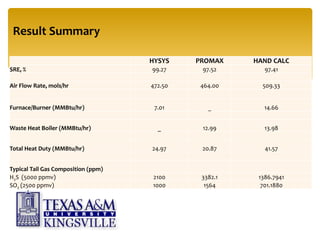
Result Summary
HYSYS PROMAX HAND CALC
SRE, % 99.27 97.52 97.41
Air Flow Rate, mols/hr 472.50 464.00 509.33
Furnace/Burner (MMBtu/hr) 7.01 _ 14.66
Waste Heat Boiler (MMBtu/hr) _ 12.99 13.98
Total Heat Duty (MMBtu/hr) 24.97 20.87 41.57
Typical Tail Gas Composition (ppm)
H2S (5000 ppmv) 2100 3382.1 1386.7941
SO2 (2500 ppmv) 1000 1564 701.1880

SULFUR RECOVERY UNIT DESIGN

  • 2.
  • 3.
    SO2 Historical Trends(1900 – 2000) & Effects
  • 4.
    Overview of GasProcessing Industry
  • 5.
    Basic Claus vsModified Claus Process Basic Claus reaction  Introduced in 1883 by English Scientist Carl Friedrich Claus 𝟐𝑯 𝟐 𝑺 + 𝑶 𝟐 → 𝟐𝑺 + 𝟐𝑯 𝟐 𝑶  highly exothermic  difficult to control  Low sulfur recovery efficiency  overheating of the reactor Modified Claus  introduced in 1938 by a German company, I.G Farbenindustrie A.G  improvement on the basic Claus process  free flame oxidation ahead of catalyst bed  catalytic steps revision  high SRE ranging from 90-99.9%  basis of most sulfur recovery units in use today
  • 6.
    Process Scheme Modified ClausProcess for Sulfur Recovery
  • 7.
    Principal steps: Combustion Step CatalyticSteps 1. Combustion (Reaction Furnace)  Temperature is usually between 1700oF & 2500oF  Complete combustion of all hydrocarbons present  Conversion of 1/3 H2S in feed to SO2 𝑯 𝟐 𝑺 + 𝟑 𝟐 𝑶 𝟐 → 𝑺𝑶 𝟐 + 𝑯 𝟐 𝑶 ∆H @ 77oF = -223 100 Btu {1} 𝟐𝑯 𝟐 𝑺 + 𝑺𝑶 𝟐 → 𝟑 𝟐 𝑺 𝟐 + 𝟐𝑯 𝟐 𝑶 ∆H @ 77oF = 20 400 Btu {2} Modified Claus Process for Sulfur Recovery
  • 8.
    2. Claus Reaction(Catalytic Converter)  Catalyst is activated alumina  Reaction proceeds at temperature < 700oF 𝟐𝑯 𝟐 𝑺 + 𝑺𝑶 𝟐 → 𝟑 𝒙 𝑺 𝒙 + 𝟐𝑯 𝟐 𝑶 ∆H @ 77oF = -41 300 Btu {3} 𝑤ℎ𝑒𝑟𝑒 𝑥 = 6 𝑜𝑟 8 𝑑𝑒𝑝𝑒𝑛𝑑𝑖𝑛𝑔 𝑜𝑛 𝑠𝑢𝑙𝑓𝑢𝑟 𝑠𝑝𝑒𝑐𝑖𝑒 𝑓𝑜𝑟𝑚𝑒𝑑 Overall reaction: 𝟑𝑯 𝟐 𝑺 + 𝟑 𝟐 𝑶 𝟐 → 𝟑 𝒙 𝑺 𝒙 + 𝟑𝑯 𝟐 𝑶 ∆H @ 77oF = -254 400 Btu {4} Modified Claus Process for Sulfur Recovery
  • 9.
    Other Side Reactions: ReactionFurnace: 𝐻2 𝑆 + 𝐶𝑂2 → 𝐶𝑂𝑆 + 𝐻2 𝑂 𝐶𝐻4 + 2𝑆2 → 𝐶𝑆2 + 2𝐻2S Reheater (hydrolysis) 𝐶𝑂𝑆 + 𝐻2 𝑂 → H2S + CO2 𝐶𝑆2 + 2𝐻2 𝑂 → 2H2S + CO2 Modified Claus Process for Sulfur Recovery
  • 10.
    Process Control: Optimum conversionof H2S to sulfur is governed by:  constant 2:1 stoichiometric ratio of H2S to SO2  achieved by varying furnace air flow rate  deviation from ratio results in decreased SRE Modified Claus Process for Sulfur Recovery
  • 11.
    There are twobasic process approaches depending on H2S concentration in feed stream:  Straight through * Split flow Claus Process Technology H2S Conc in Feed, mol% Process Variation 55 – 100 Straight through 30 – 55 Straight through plus acid gas/air preheat 15 – 30 Split flow or straight through with feed and/or air preheat 10 – 15 Split flow with acid gas and/or air preheat 5 – 10 Split flow with fuel added or with acid gas and air preheat or direct oxidation < 5 Sulfur recycle or variation of direct oxidation or other sulfur recovery processes
  • 12.
    Straight through Clausprocess Claus Process Technology
  • 13.
  • 14.
    Other Variations Oxygen Enrichment use of pure oxygen instead of air  higher and stable flame temperatures  low H2S concentration feed and smaller equipment use  used in combination with other variations Acid Gas Enrichment  applied ahead of SRU to achieve richer acid gas stream  a solvent that selectively absorbs all the H2S from the feed gas stream is used  The straight through process can then be used for sulfur recovery Claus Process Technology
  • 15.
    Tail Gas:  ContainsN2, CO2, H2O, CO, H2, unreacted H2S and SO2, COS, CS2, sulfur vapor, etc.  Limits overall sulfur recovery efficiency to 96-97%  Tail gas is incinerated or treated in TGCU depending on local EPA regulation Incineration - < 5000 ppmv H2S < 2500 ppmv SO2 TGCU Processes (Tail Gas Clean Up)  higher H2S conversion efficiencies (>99.9 %)  further reduction in SO2 amount vented out Claus Tail Gas Handling
  • 16.
    TGCU (Tail GasClean Up) Processes Process Example Company 1. Sub-dewpoint Processes Cold Bed Adsorption (CBA) BP Amoco, Black & Veatch 2. Direct Oxidation SuperClaus, MODOP Jacobs Engineering & Mobil 3. SO2 Recovery Well-man Lord Luigi Bamag (oxidize to SO2, absorb and recycle to Claus) 4. H2S Recovery BSR Parsons (reduce to H2S, absorb & recycle to Claus) SCOT MDEA Shell UOP
  • 17.
  • 18.
    Other Sulfur RemovalProcesses Small scale/batch processes < 20lbs of sulfur recovery scavenger processes e.g.  Iron Sponge  Zinc Oxide  Chemsweet  Sulfa-check Medium scale recovery  0.2 – 25 LTD of elemental sulfur  Includes Lo-Cat 11 & CrystaSulf
  • 19.
    Sulfur Recovery ProcessApplicability Chart
  • 20.
    Sulfur & itsproperties Solid at ambient temperatures Solid sulfur at ambient temperature Gaseous sulfur allotropes S8 S6 S2 S3, S4, S5, S7 – detected but not fully characterized Sulfur Crystalline Amorphous slowly changes to rhombic form at ambient temperaturesRhombic Monoclinic stable at < 204°F stable at >204oF prepared by rapidly chilling liquid sulfur Both exists in octatomic crystalline structures presence not desired
  • 21.
    Sulfur Vapor SpecieDistribution
  • 22.
    Design a SulfurRecovery Plant with: – Capacity ≈ 80 LTD – Sulfur Recovery of > 99% – Using Modified Claus Process Problem Statement – DEVCO PLANT Feed Conditions Comp mol frac mols/hr Temp = 120oF H2S 0.9 198.45 Flow Rate = 220.5 mols/hr CO2 0.04 8.82 Pressure = 8 psig = 22.7 psia H2O 0.05 11.03 Air blower discharge Temp = 180oF C2 0.01 2.21 1 220.50
  • 23.
  • 24.
  • 25.
    Result - Promax SulfurRecovery Furnace Temperature % o F 450 95.76178703 2280.772453 455 96.60018709 2291.263676 460 97.17586448 2301.65494 464 97.32328731 2309.89643 465 97.32088486 2311.946916 470 97.15766914 2322.140318 475 96.84752858 2332.2359 480 96.46512268 2342.234455 485 96.04302214 2352.136788 490 95.59630649 2361.943749 495 95.13319688 2371.656223 500 94.65849743 2381.2751 505 94.17521901 2390.801295 510 93.68535555 2400.235741 Air Flow Rate (mols/hr) Air Flow Rate Vs SRE & Furnace Temperature
  • 26.
    Result - Hysys Optimumair flow rate: = 2.143 × 220.5 = 472.5 𝑙𝑏𝑚𝑜𝑙𝑒 ℎ𝑟 𝑎𝑖𝑟 Sulfur Recovery Efficiency: Sulfur in entering H2S = 0.9*220.5*32 = 6350.4 lb/hr Sulfur Recovered = 6304 lb/hr % SRE = 0.99269 99.269 %
  • 27.
    Result - HandCalculation % Conversion:
  • 28.
    Result – HandCalculation Furnace Temperature & Conversion: From Equilibrium constant chart x (mols/hr) (assumed) Kp (calculated) Equilibrium Temp (F) 89.52 20.00351623 1875 93.54 30.01536222 2150 96.231 40.00228095 2387.5 x (mols/hr) Equilibrium Temp (Fig Flame Temperatute (F) 89.52 1875 2,479.68 93.54 2150 2,474.45 96.231 2400 2,395.94 From Plot: x = 96.2 mols/hr This is amt of H2S that actually reacted (96.2/132.3)*100% % Conversion in furnace = 72.71 % Furnace Temp = 2390 F
  • 29.
    Result – HandCalculation y, mols/hr Stream Enthalpy (Btu/hr) Converter Heat Balance (Btu/hr) 20.15 2,908,018 2,638,763 21.96 2,795,414 2,766,609 23.13 2,573,013 2,792,969 From Plot, y = 22.18mols/hr % Conversion = (22.18*(2/3 H2S in feed) = 16.76 % At y = 22.18 mols/hr, Kp = 3166.17 @ Kp = 3166.17 T = 603 F Converter Outlet Temperature = 603 F 1st Catalyst Converter
  • 30.
    Result - HandCalculation 2nd catalytic converter outlet temperature 3rd catalytic converter outlet temperature
  • 31.
    Heat Duty Promax: Hysys: HandCalculation: Blocks Duty (Btu/hr) Blower 194,943 Waste Heat Boiler 12,988,780 Condenser 2,820,970 Reheater 1,030,360 Condenser 2 1,865,160 Reheater 2 367,693 Condenser 3 845,212 Reheater 3 337,984 Condenser 4 423,763 20,874,865 Unit Operartions Duty (Btu/hr) Burner 7,012,000 Cooler 12,160,000 Splitter 1 40,340 Claus 1 691,700 Splitter 2 1,309,000 Heater 347,300 Claus 2 1,686,000 Splitter 559,200 Heater 373,100 Claus 3 122,200 Splitter 4 673,900 24,974,740 Duty Btu/hr Furnace Waste Heat Boiler Sulfur Condenser Reheater Catalytic Converter Sulfur Condenser Stage 1 14,660,438.61 13,983,571.92 2,627,601.19 626,856.55 2,840,839.57 1,291,525.71 36,030,833.55 Stage 2 _ _ _ 340,712.94 2,061,235.20 645,827.98 3,047,776.12 Stage 3 _ _ _ 220,953.57 1,775,630.90 494,858.12 2,491,442.59 41,570,052.25
  • 32.
    Result Summary HYSYS PROMAXHAND CALC SRE, % 99.27 97.52 97.41 Air Flow Rate, mols/hr 472.50 464.00 509.33 Furnace/Burner (MMBtu/hr) 7.01 _ 14.66 Waste Heat Boiler (MMBtu/hr) _ 12.99 13.98 Total Heat Duty (MMBtu/hr) 24.97 20.87 41.57 Typical Tail Gas Composition (ppm) H2S (5000 ppmv) 2100 3382.1 1386.7941 SO2 (2500 ppmv) 1000 1564 701.1880