





LUBRICANTS
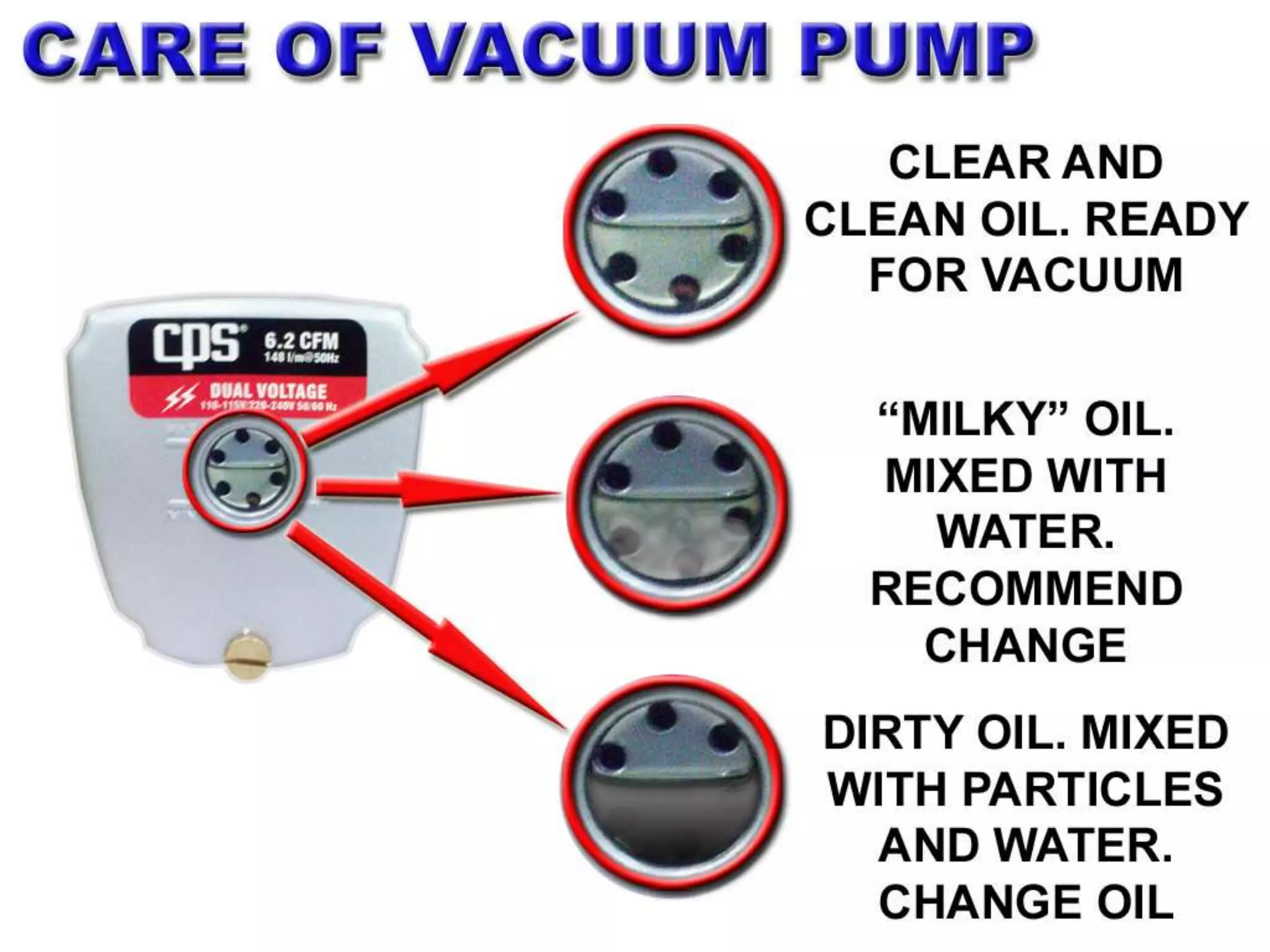
LUBRICATION (OIL)


Lubrication is the process by which the moving parts
such as bearings in the compressor are kept separate
by a film of oil to maximize performance and reduce
wear and tear.



Create a Fluid seal



Acts a coolant in compressor



Dampens noise in compressor crankcase
IMPORTANT OIL FUNCTIONS
Refrigerant oil must adequately perform
four basic functions
 Lubricate
 Scaling

off the high side from the low side
 Transferring heat
IMPORTANT OIL FUNCTIONS


Damper compressor noise



Oils should be chemically stable
It should not react chemically with its






Refrigerants contained in the system
Metals
Motor insulation

Also it should not react readily to the presence of
normal contaminants




Non condensable
Moisture
Flux/ wax
REFRIGERATION SYSTEM
LUBRICATION


As the name suggests, refrigeration system
lubrication lubricates the system using Mineral
Oil, Polyalkylene Glycol, Alkyl benzene and
Polyol Ester depending on the type of
refrigerant being used. It also has the following
functions:
LUBRICATION (OIL)
Viscosity…how thick or thin the oil is
 Floc point…the point at which the wax will separate
from the oil
 Pour point…the temperature at which it ceases to
flow
 Dielectric strength…a measure of a oils resistance to
electrical current
 Colour… refining to a lighter coloured oil
 Specific gravity…weight
 Neutralization number…organic acid content

LUBRICATION (OIL)
Oxidation resistance… resist water and O2
 Moisture content…dryness of oil
 Chemical stability… in presence or metal or
refrigerants will chemicals
in the oils attack the metal and ref.
 Flash point… the temperature at which the oil
vapour flash burns
 Fire point…the temperature at which the oil
maintains combustion

OIL DEFINITIONS


Hygroscopic
A Hygroscopic oil is one that easily absorbs &
releases moisture (has a high affinity for water).
 Most refrigerant oils are hygroscopic
 An oil sample should be taken and analyzed if a
system has had a major component failure.

OIL DEFINITIONS


Viscosity


The resistance that the oil offers to flow. High
viscosity means a thick oil, low viscosity means a
thin oil. The body of the oil or its ability to perform
a lubricating function. Sometimes referred to as the
thickness of the oil.
OIL DEFINITIONS


Material Compatibility


The oil or refrigerant must not react, swell, shrink,
deteriorate, weaken, pit, or extrude any materials
used in refrigeration equipment.
OIL DEFINITIONS


Chemical Stability


An oil’s ability to perform for an extended life
without breaking down or chemically reacting with
other materials.
OIL DEFINITIONS


Dielectric strength


An oil’s relative electrical resistance to electrical
current.
CONCLUSION


In general, there is no “best” oil. Follow
manufacturers’ recommendations for best
performance.
CONTAMINANTS
Refrigerant Contamination


There are four types of contamination that can
occur in any refrigeration equipment which will
hinder performance, efficiency and in extreme
cases, system failure and damage of components
which will be costly to repair and replace:
Refrigerant Contamination






Air Contamination
Oil Contamination
Water/Acid Contamination
Cross Contamination with other Refrigerants.
(mixture of incompatible refrigerant)
Air / Non Condensable
Contamination


Air or Non-Condensable gas is one of the most
difficult contaminants to remove from an
operating system.



Air in a system can cause excessive head pressure
and higher operating temperatures. It also causes
loss of heat transfer efficiencies by acting as an
insulator around heat exchanger tubes.
Air / Non Condensable
Contamination


This translates into higher utility costs, degradation
of lubricant effectiveness, and premature
compressor problems like increased compressor
temperatures and pressures, reduced cooling
capacity, increased compressor pressure ratios,
potential compressor overheating, and finally,
compressor motor burn-out.
Air / Non Condensable
Contamination


Typically, a pressure more than 20 PSI above the
saturation pressure indicates that a noncondensable gas problem may exist. If noncondensable gases are trapped in the
system, recovering vapour from the condenser
should remove these non-condensable gasses and
reduce the pressure discrepancy.
Air / Non Condensable
Contamination


Purging the system with nitrogen gas after
removing the refrigerant using a recovery
machine is also another service option. In
addition, purging is best used with high efficiency
purge unit or to reclaim the refrigerant after
recovery.
Moisture/ Acid Contamination


The moisture and refrigerant combine to form acids
that can destroy motor windings and result in motor
burnout.



Oil sludge and particulates can clog coalescing oil filters
and metering devices. Any water in the system will
most likely freeze in the expansion valve because this is
the point where refrigerant is cooled by the evaporation
occurring as a result of the sudden pressure drop, and
the expansion device also represents the smallest
passageway in the overall system. This is the reason
why liquid line filter-driers are typically located just
upstream of the expansion device.
Moisture/ Acid Contamination


When this situation occurs, it is necessary to not only
clean the refrigerant, but it is also imperative that the
refrigeration system be totally dehydrated to remove all
traces of water. It is usually desirable to also flush the
system to remove rust and other particulates that may
have developed while the refrigeration system was
being repaired.
Oil Contamination


Over time it is very common for oil to migrate from the
compressor. Oil accumulates in the evaporator and
insulates the tubes. This inhibits maximum heat transfer
and reduces system efficiency. Studies indicate that for
every 1% of oil in the evaporator, a system loses 2%
efficiency.
Oil Contamination


This translates into reduced comfort, higher utility
costs, or both. The typical way of dealing with oil
contamination is decontaminate the refrigerant with an
oil purge unit or charge with new refrigerant after
removal of the existing charge with a recovery machine.



For large systems like chillers, an oil purging unit is
sometimes installed as a continuous prevention of oil
contamination.
Cross Contamination


This type of contamination may result if the system is
mistakenly charged with:






An incompatible refrigerant for the system.
Improper charging of blends resulting in incorrect
proportional mixture.
An already contaminated refrigerant

In such cases, the refrigerant is recovered using
recovery machine, purged of oil and contaminants and
dehydrated prior to charging with clean refrigerant after
checking the system for leaks and doing the necessary
repair job.
SAFETY
PROCEDURES
RECOVERY
RECYCLE
RECLAIM
RECOVERY
Refrigerant recovery means to remove
refrigerant in any condition from an appliance
and store it in an EXTERNAL CONTAINER.
Refrigerant recovery takes place mainly at three
major stages of equipment lifetime.
When To Perform Recovery






during servicing when part or complete
refrigerant charge shall be removed of
the system,
when the system is converted to be run
with a new refrigerant,
At equipment disposal
RECYCLE
To clean refrigerant for reuse by separating
the oil from the refrigerant and removing
moisture by passing it through one or more
filter driers
Current recovery machines have filters that
remove contaminants from the refrigerants
including acids that will enable the refrigerant to
be reused.
RECLAIM
To process refrigerant to a level
equal to new product standards as
determined by chemical analysis.
Reclaimed refrigerant must meet
standards set forth in ARI 700 before
it can be resold.
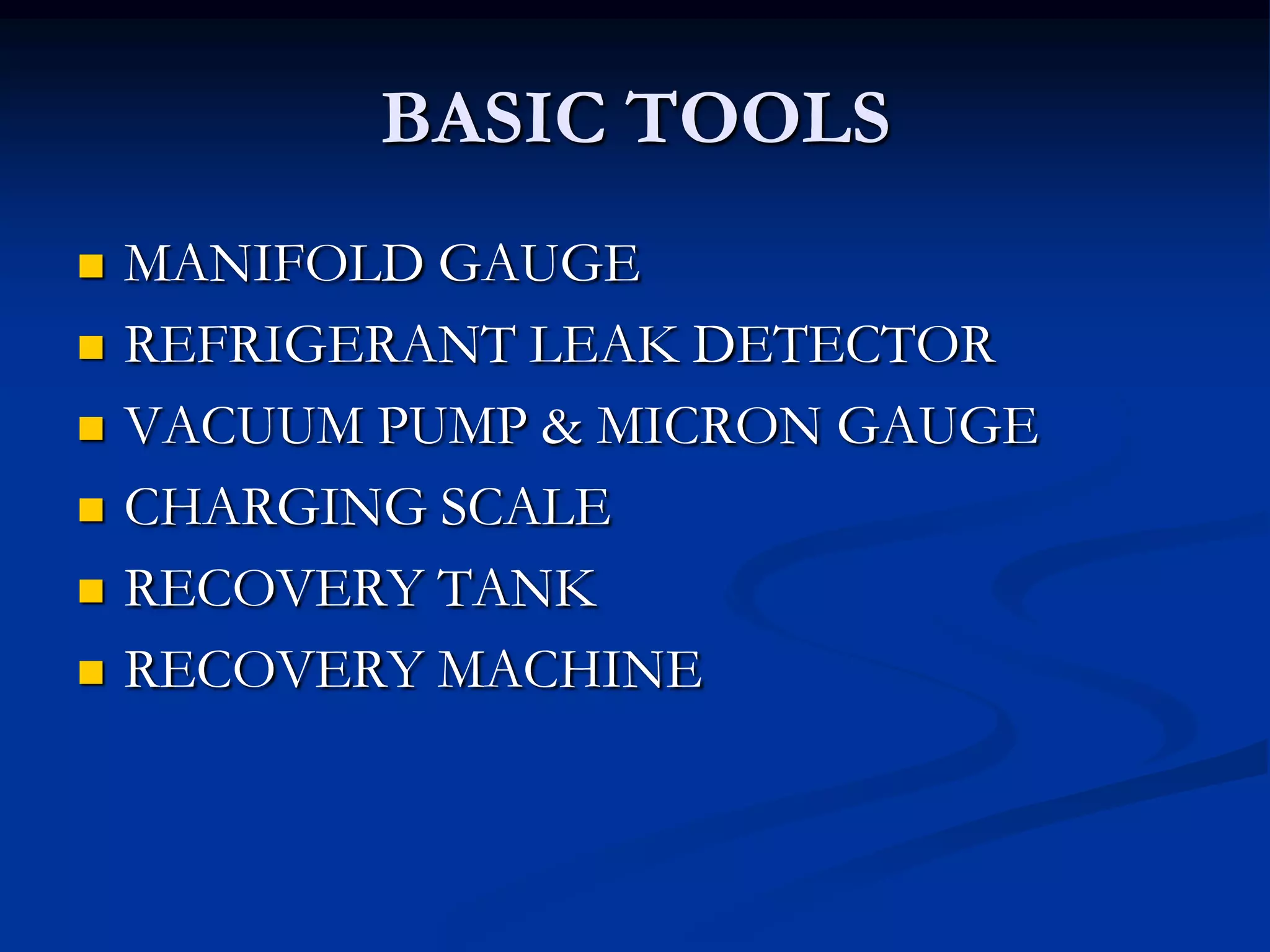
BASIC TOOLS








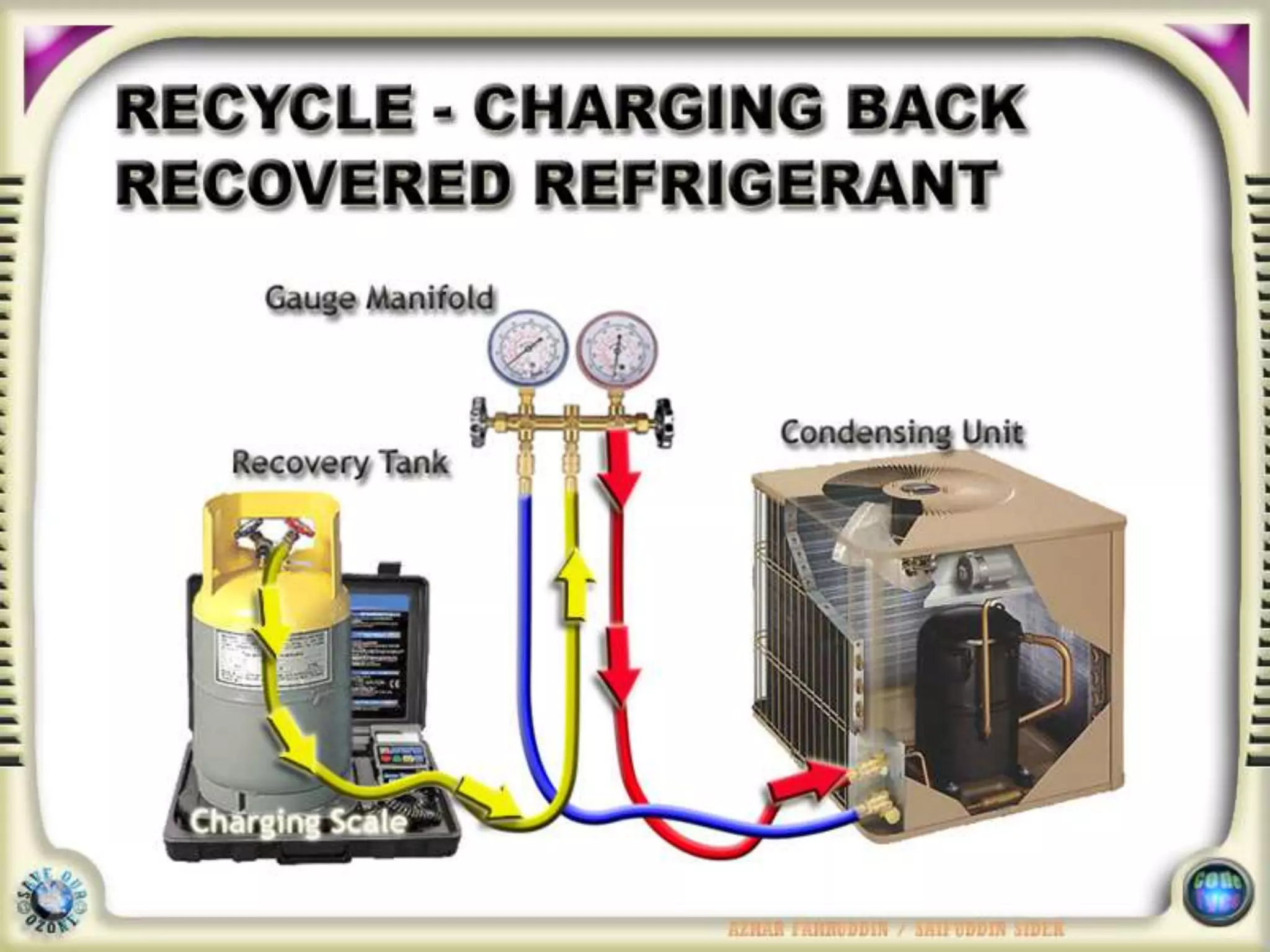
MANIFOLD GAUGE
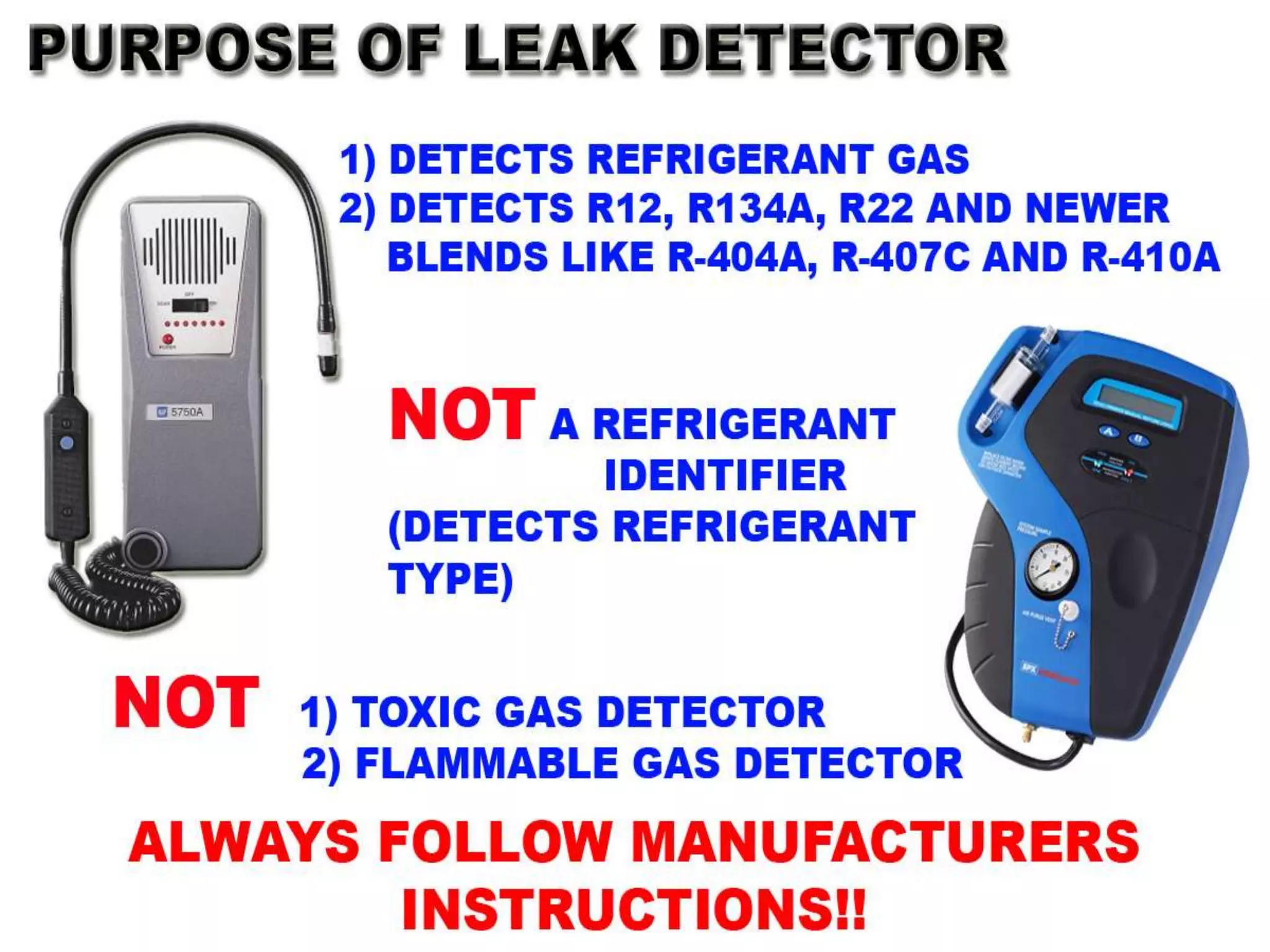
REFRIGERANT LEAK DETECTOR
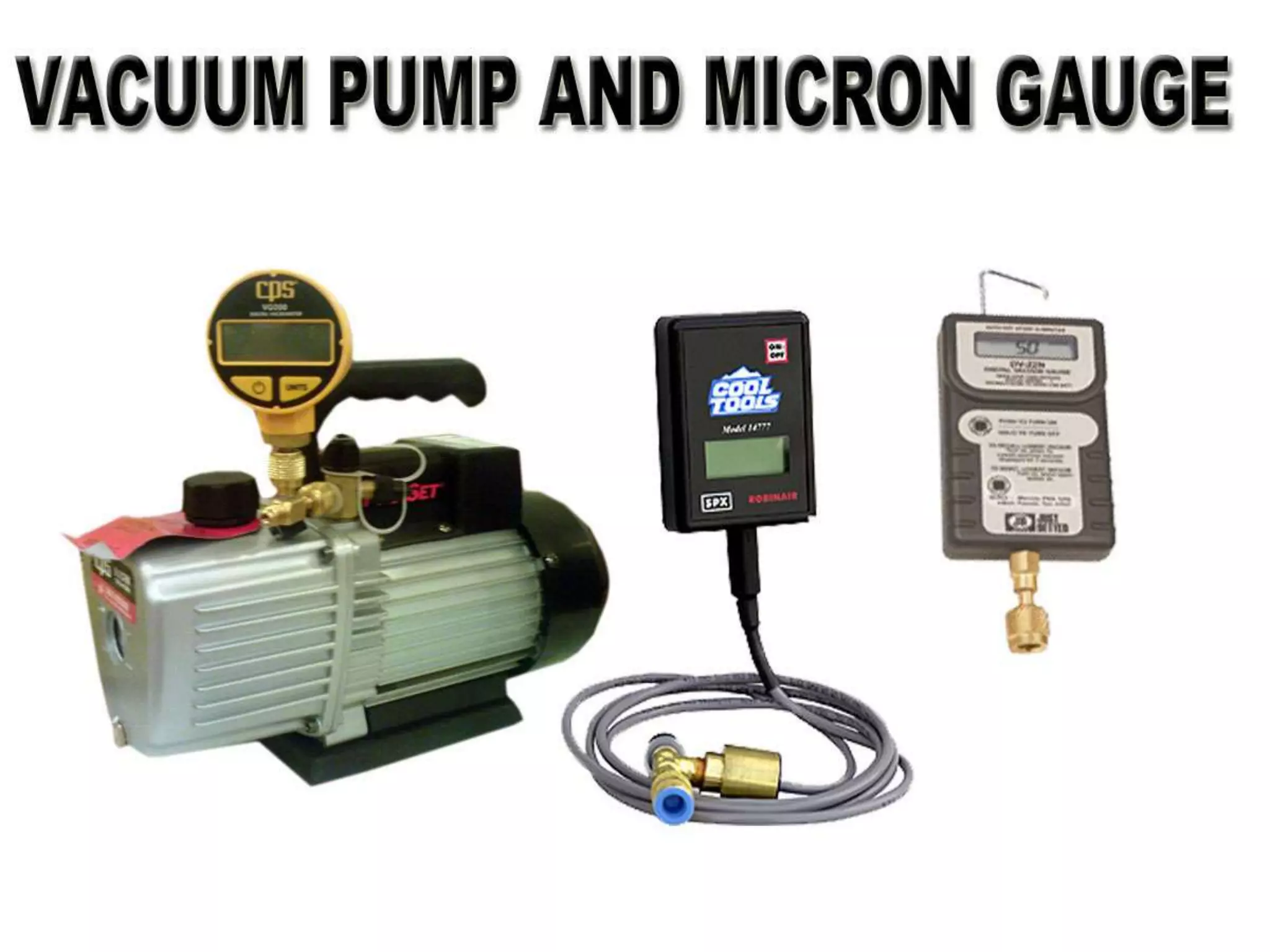
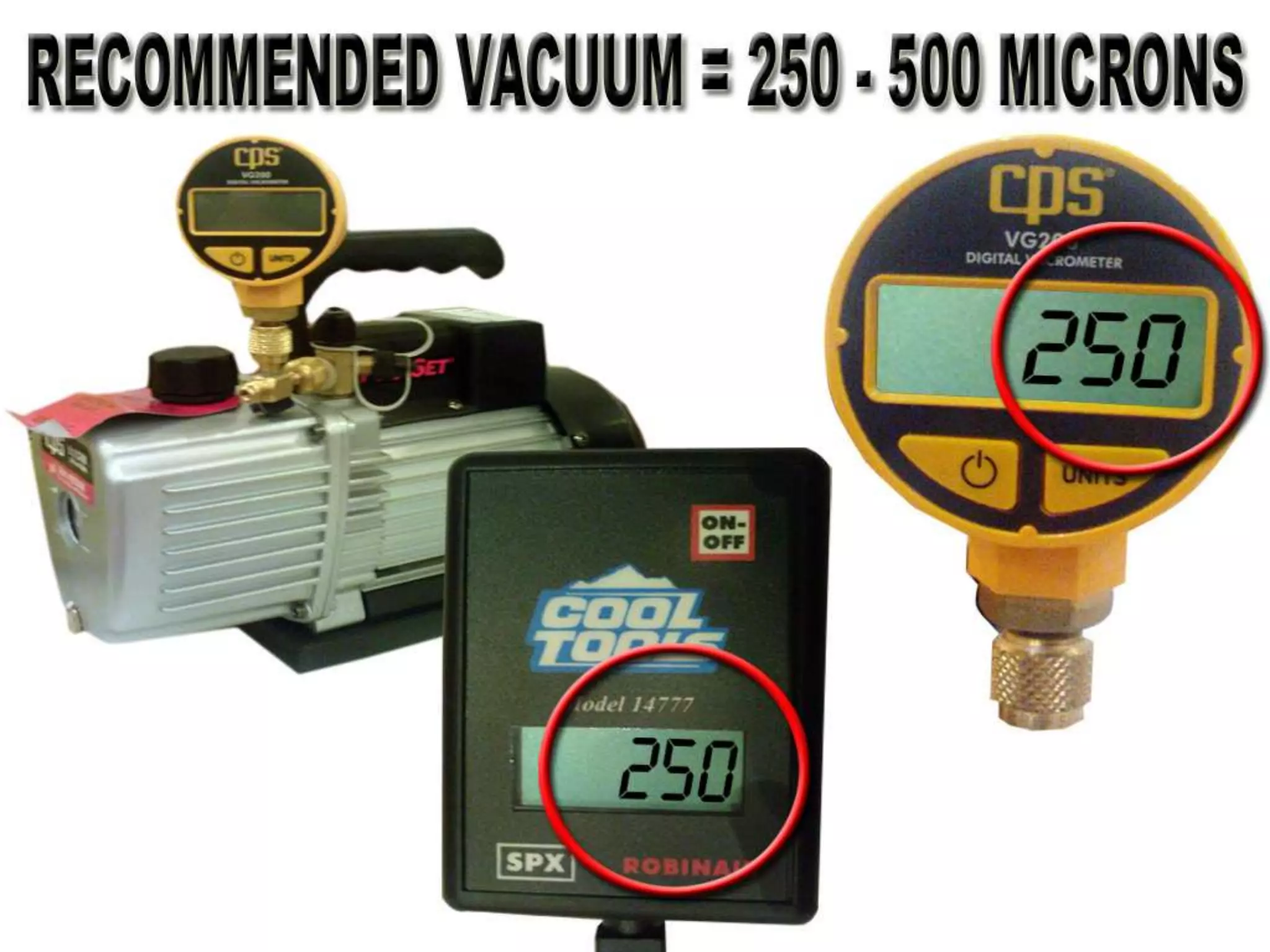
VACUUM PUMP & MICRON GAUGE
CHARGING SCALE
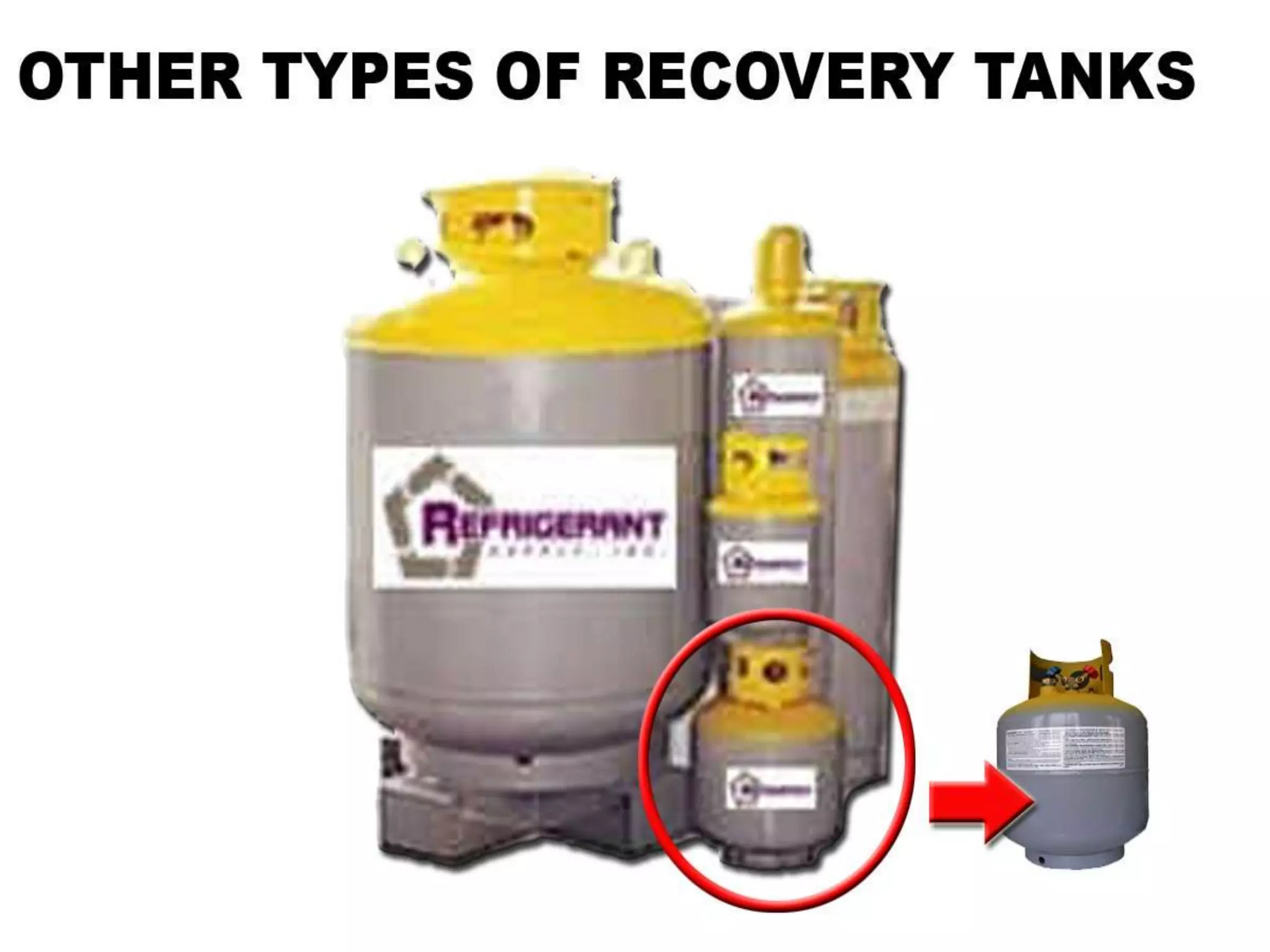
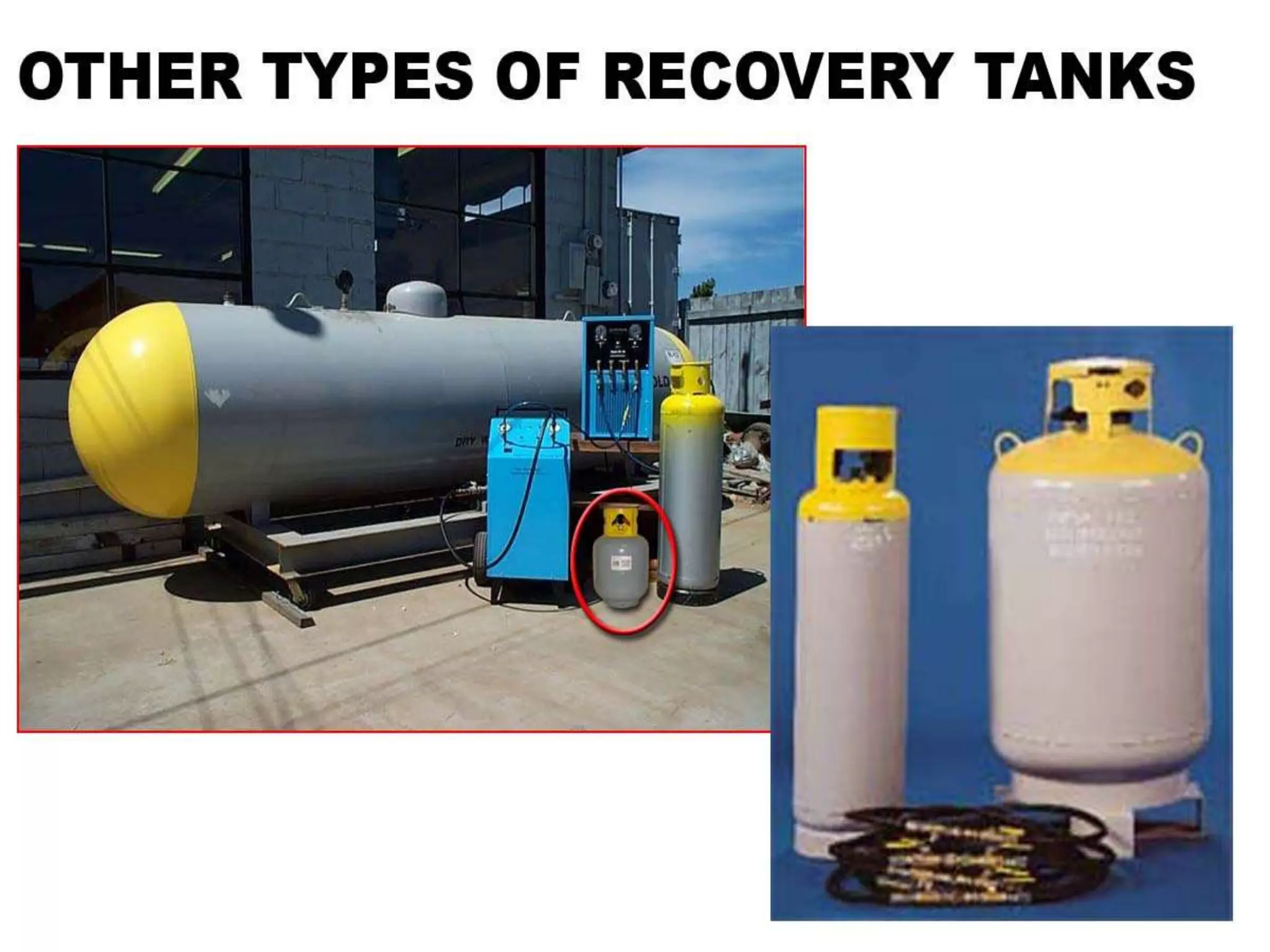
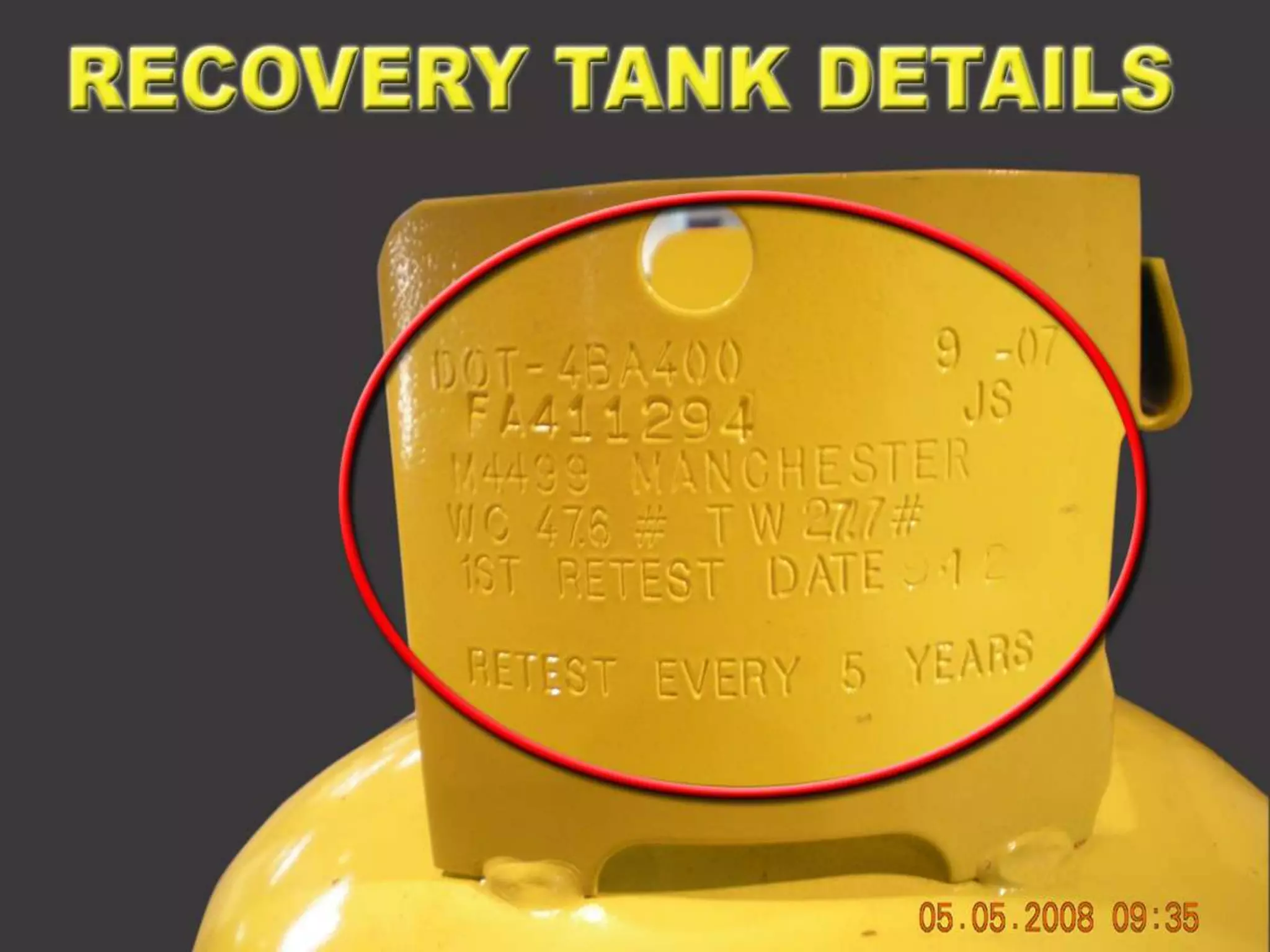
RECOVERY TANK
RECOVERY MACHINE


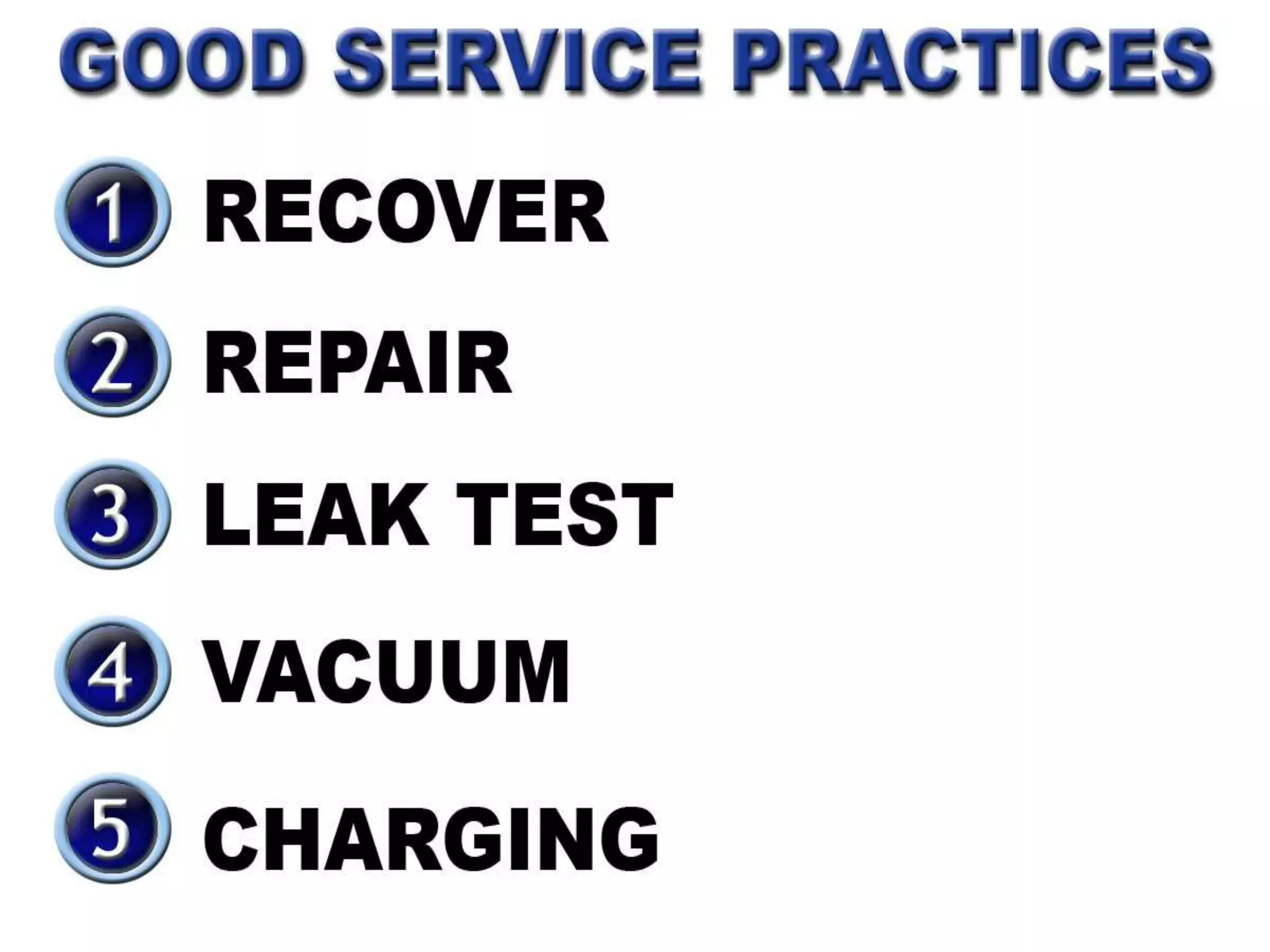
Insert topic Good Service practices
NEW SYSTEM
REQUIREMENTS


INSERT THE VARIOUS MANIFOLD
GRAPHICS




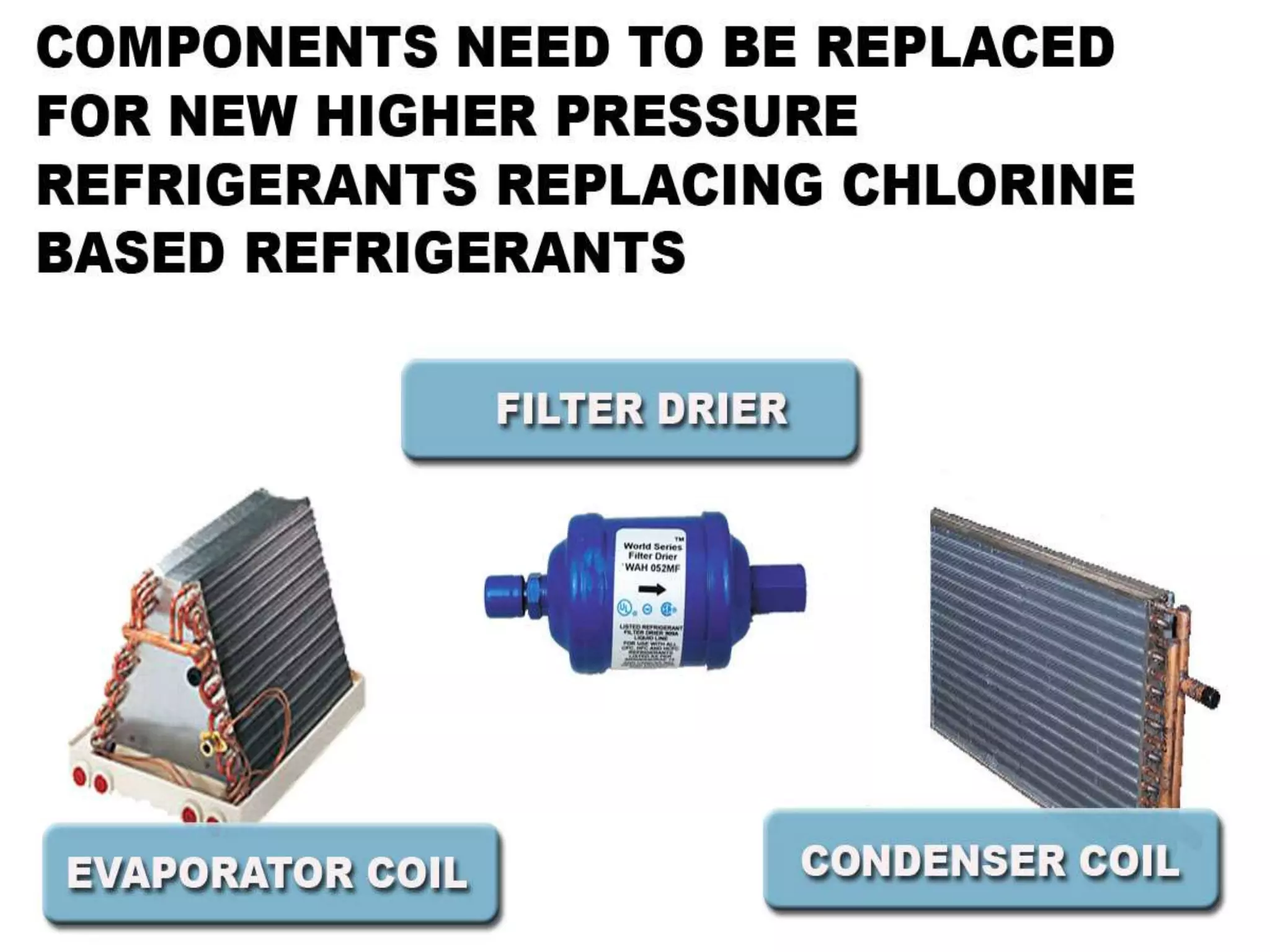
Talk about new refrigerants replacing CFC and
HCFC like 134a and 400 series which operates
at higher pressure.
Gauge manifold to cater for these new
refrigerants should be used.
RECOMMENDED
TOOLS


Insert more detailed gauge reading
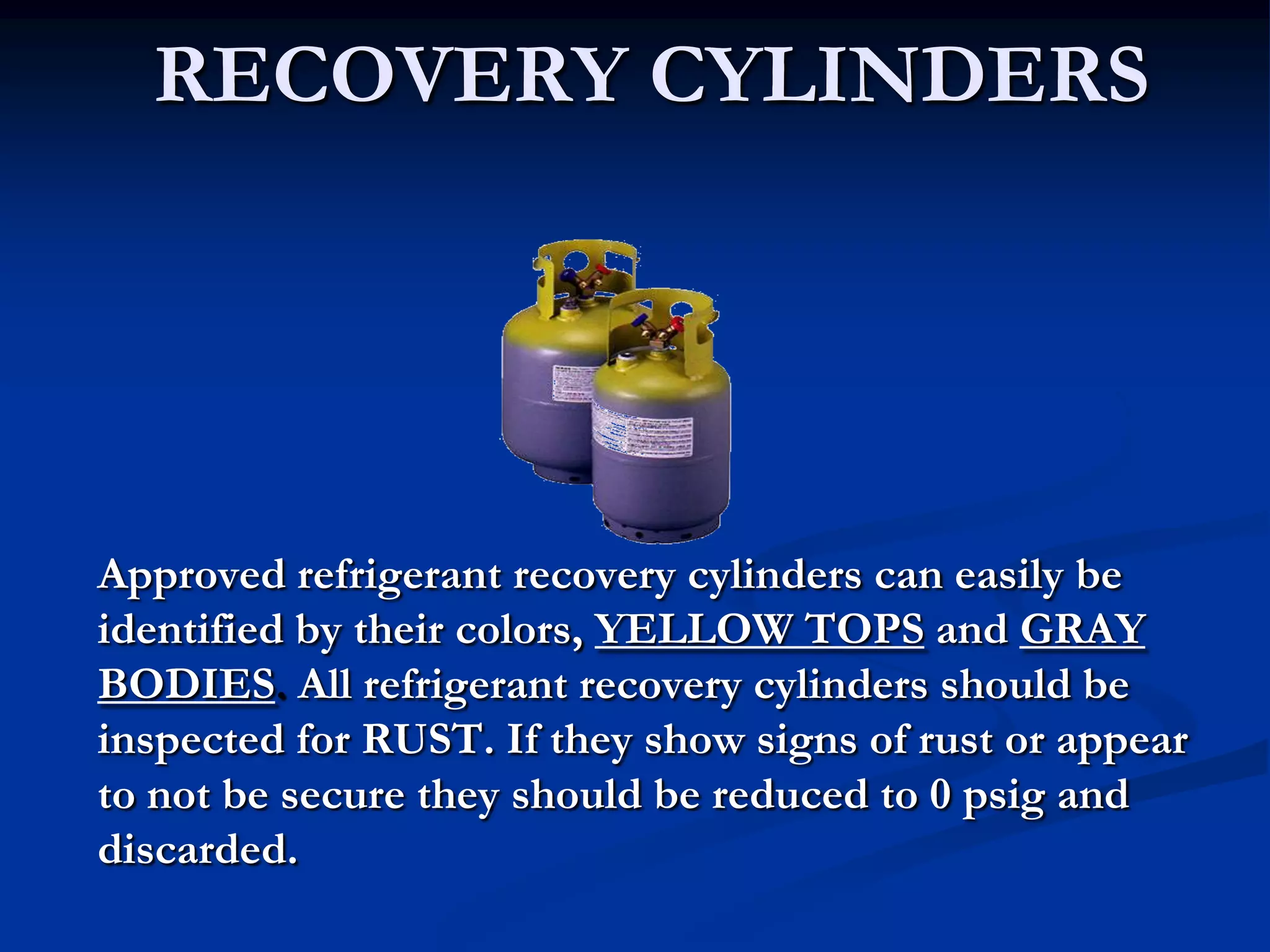
RECOVERY CYLINDERS

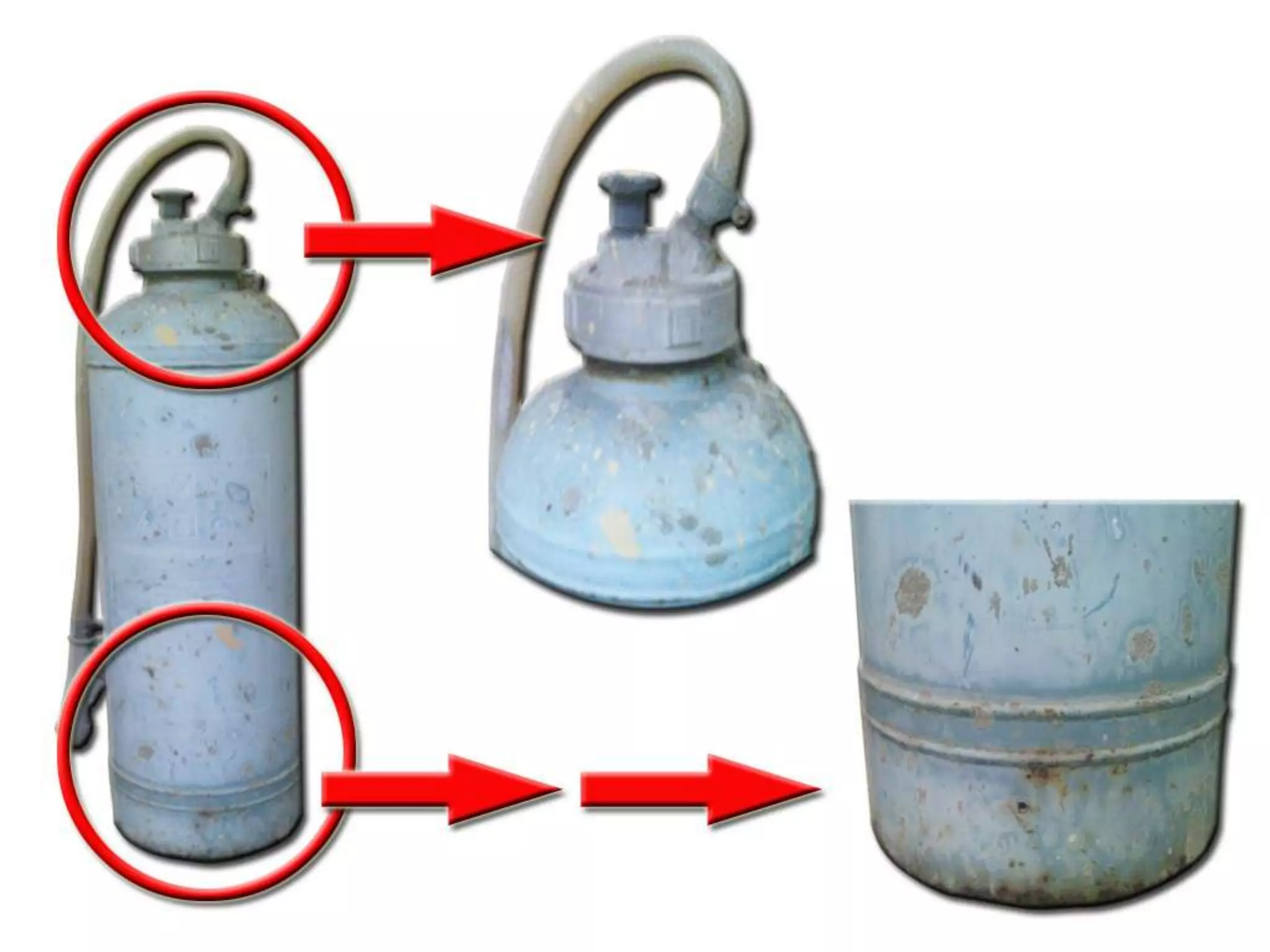
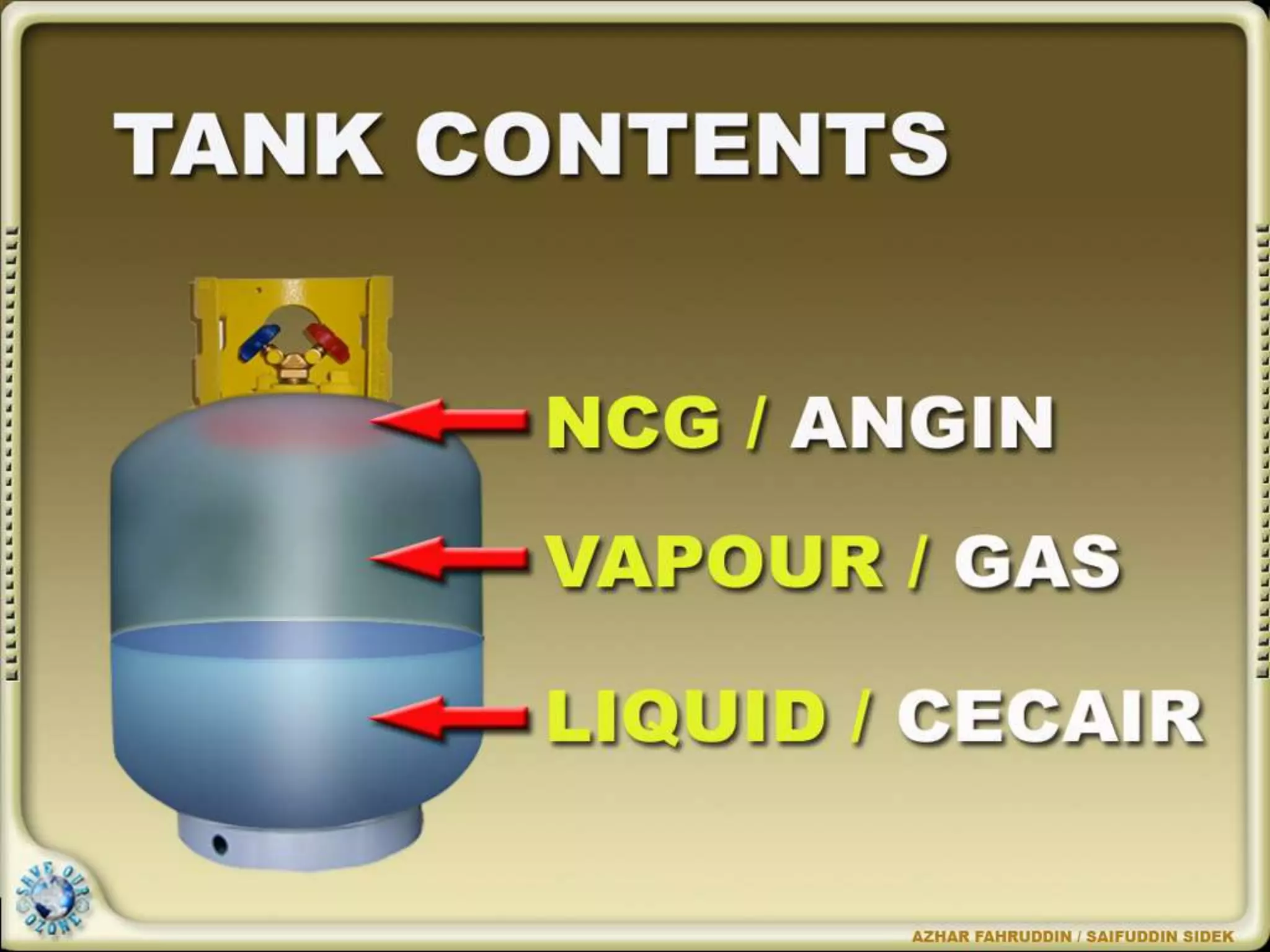
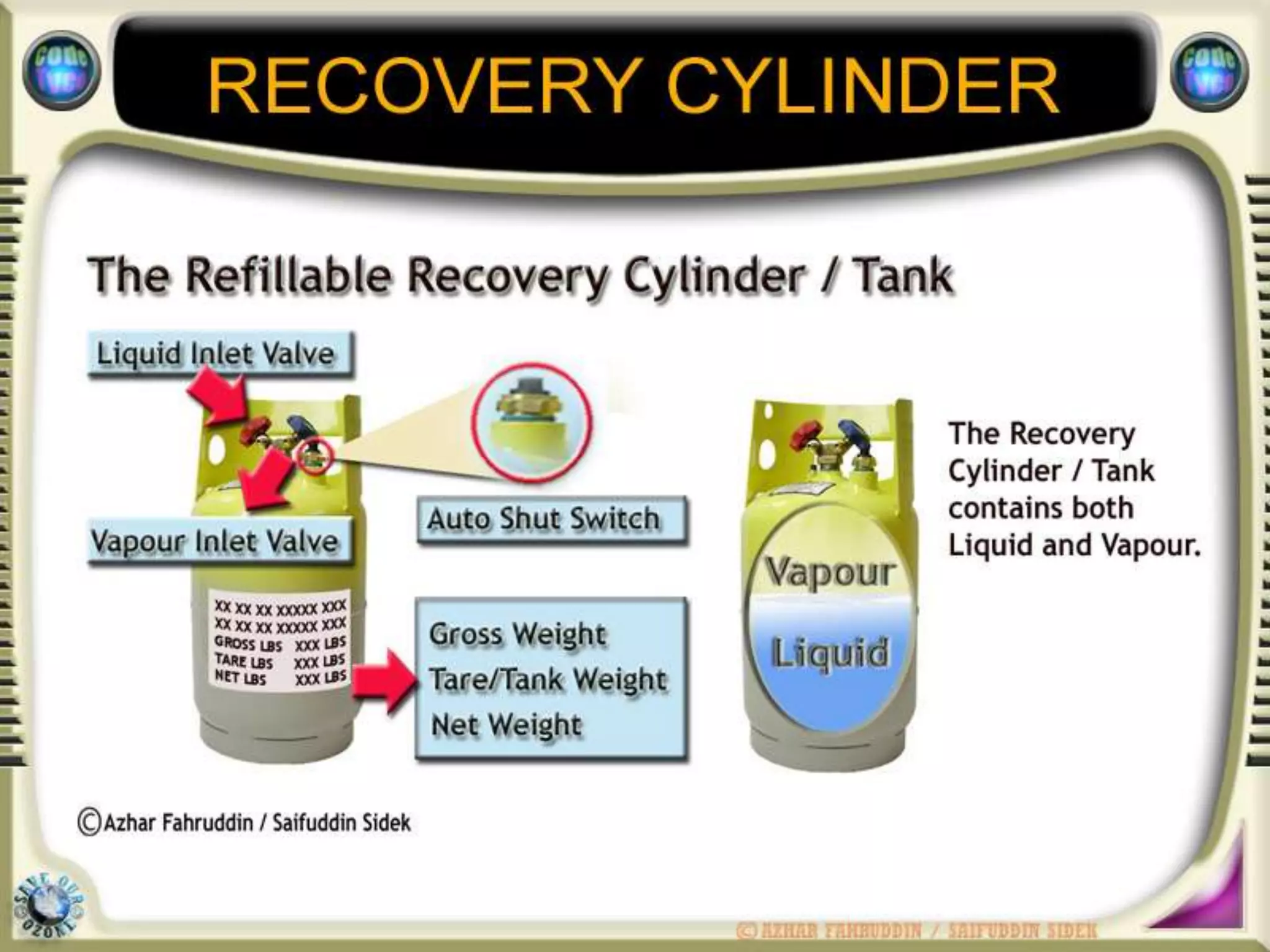
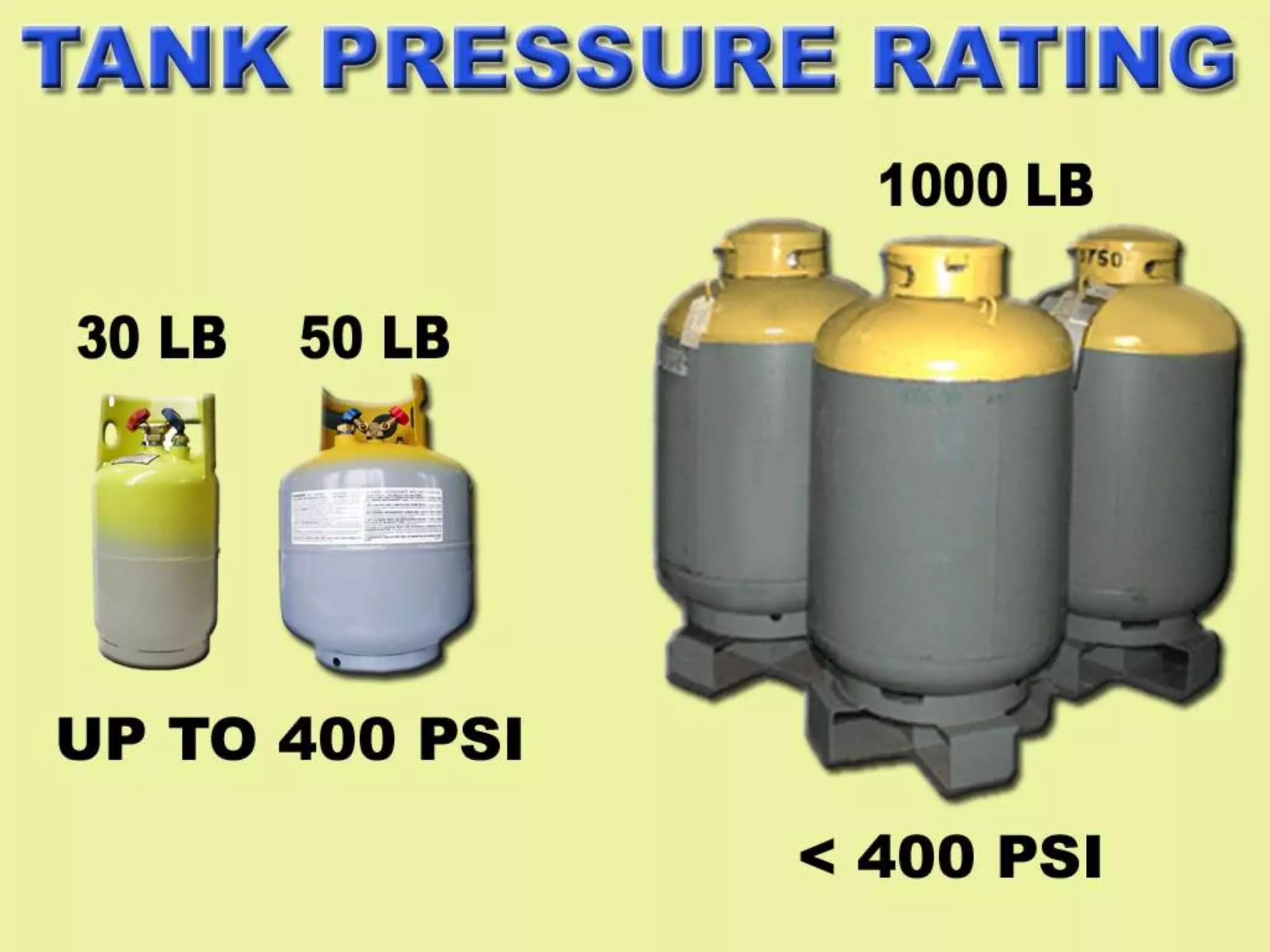
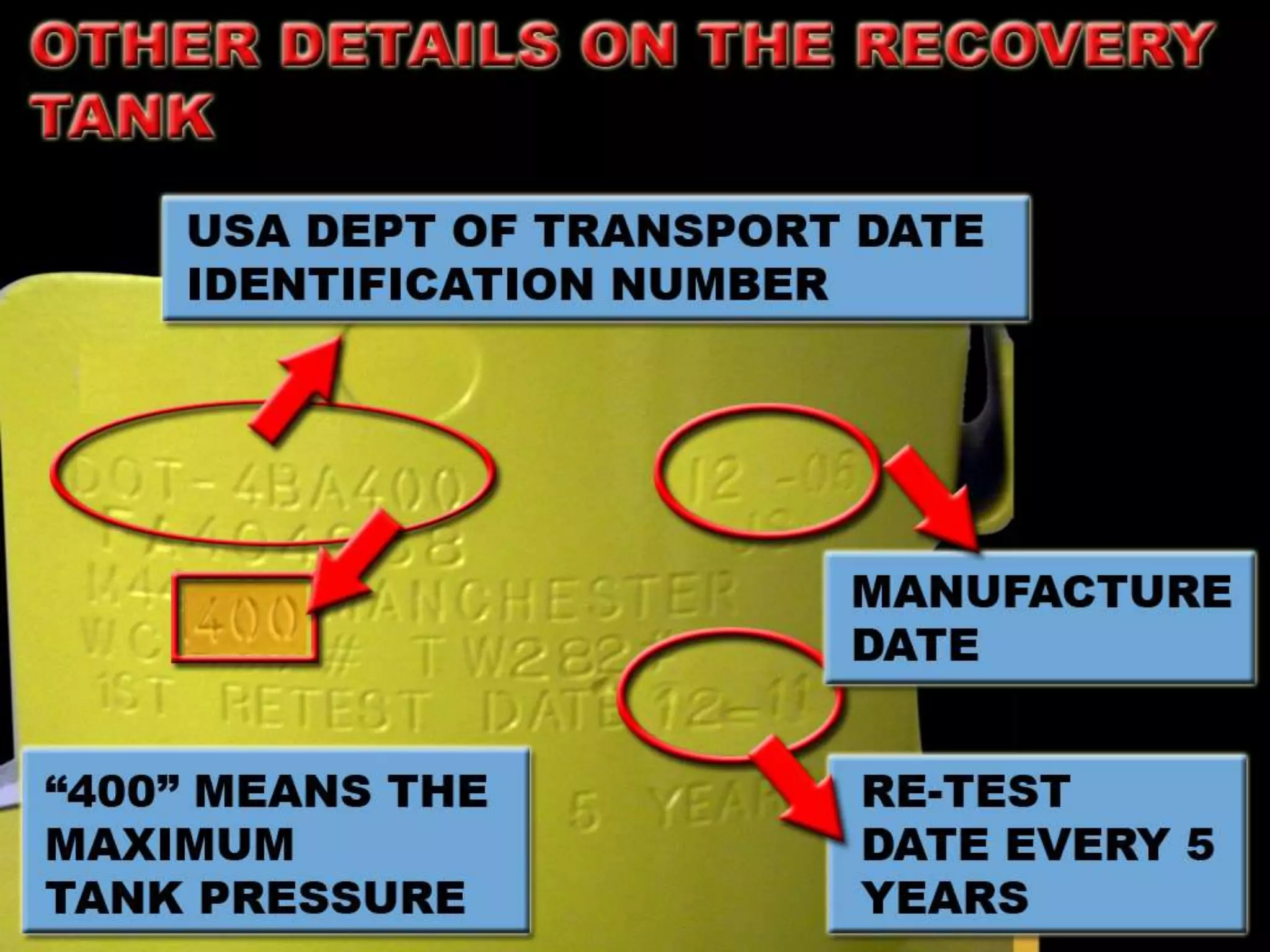
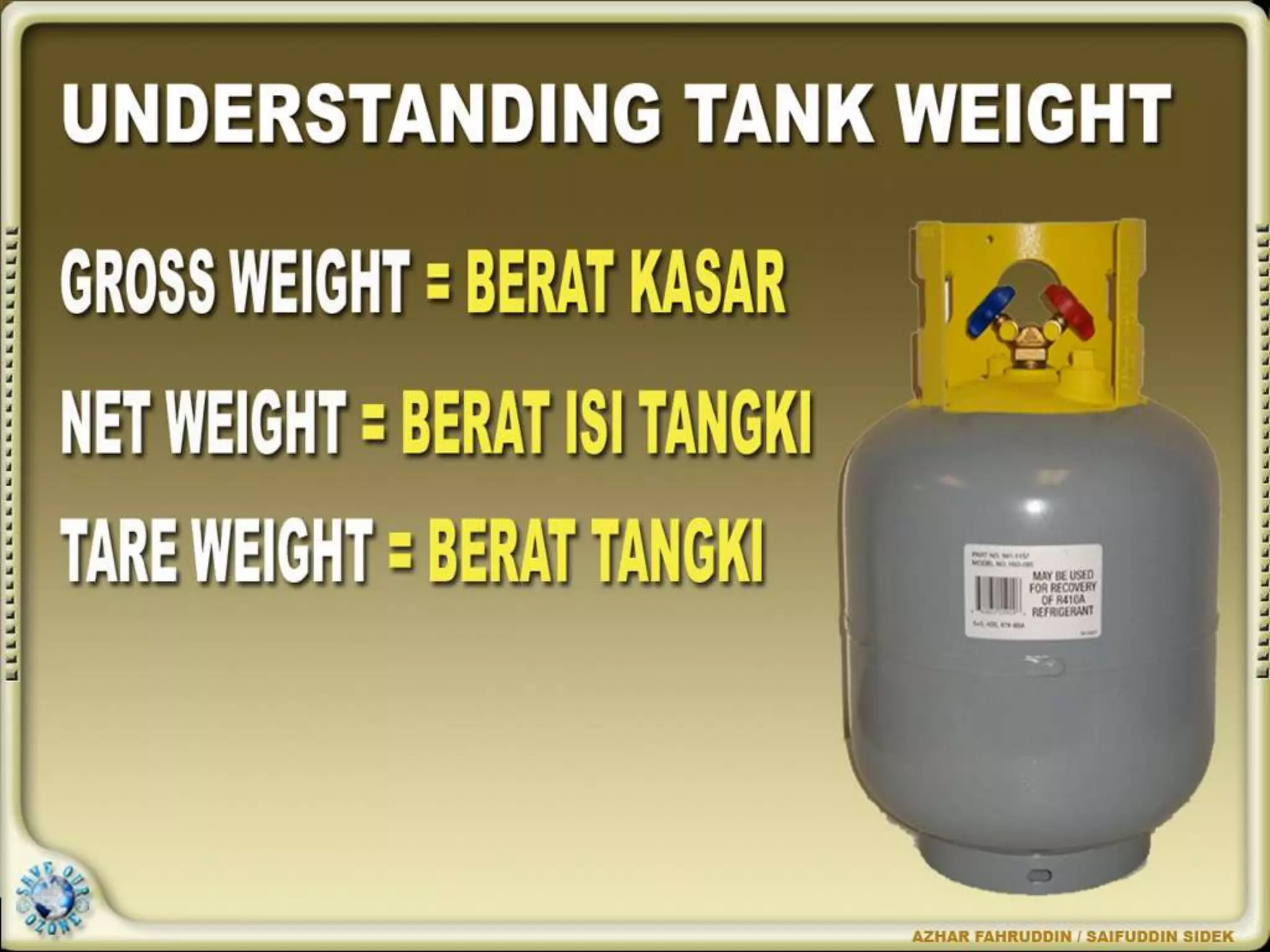
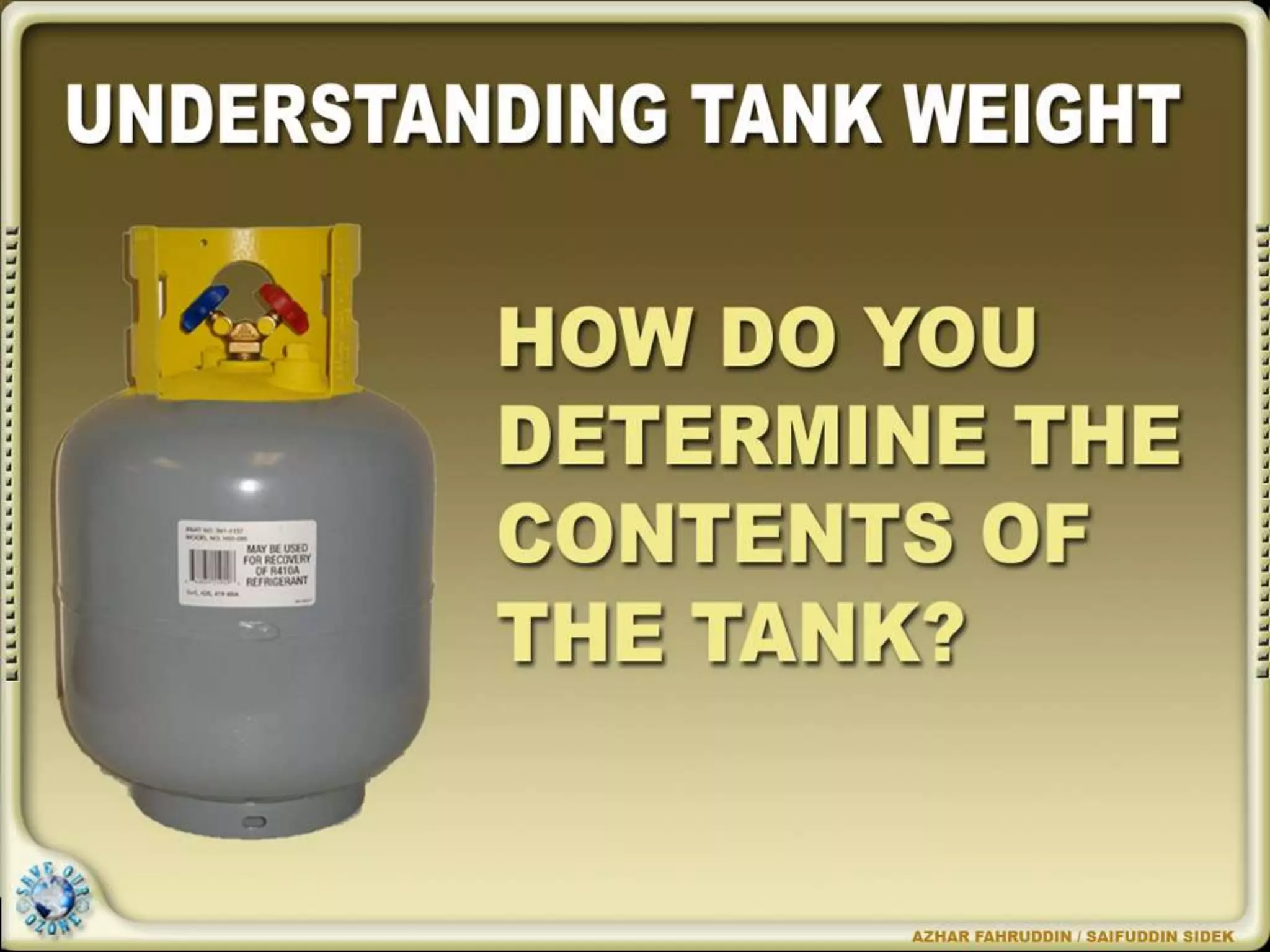
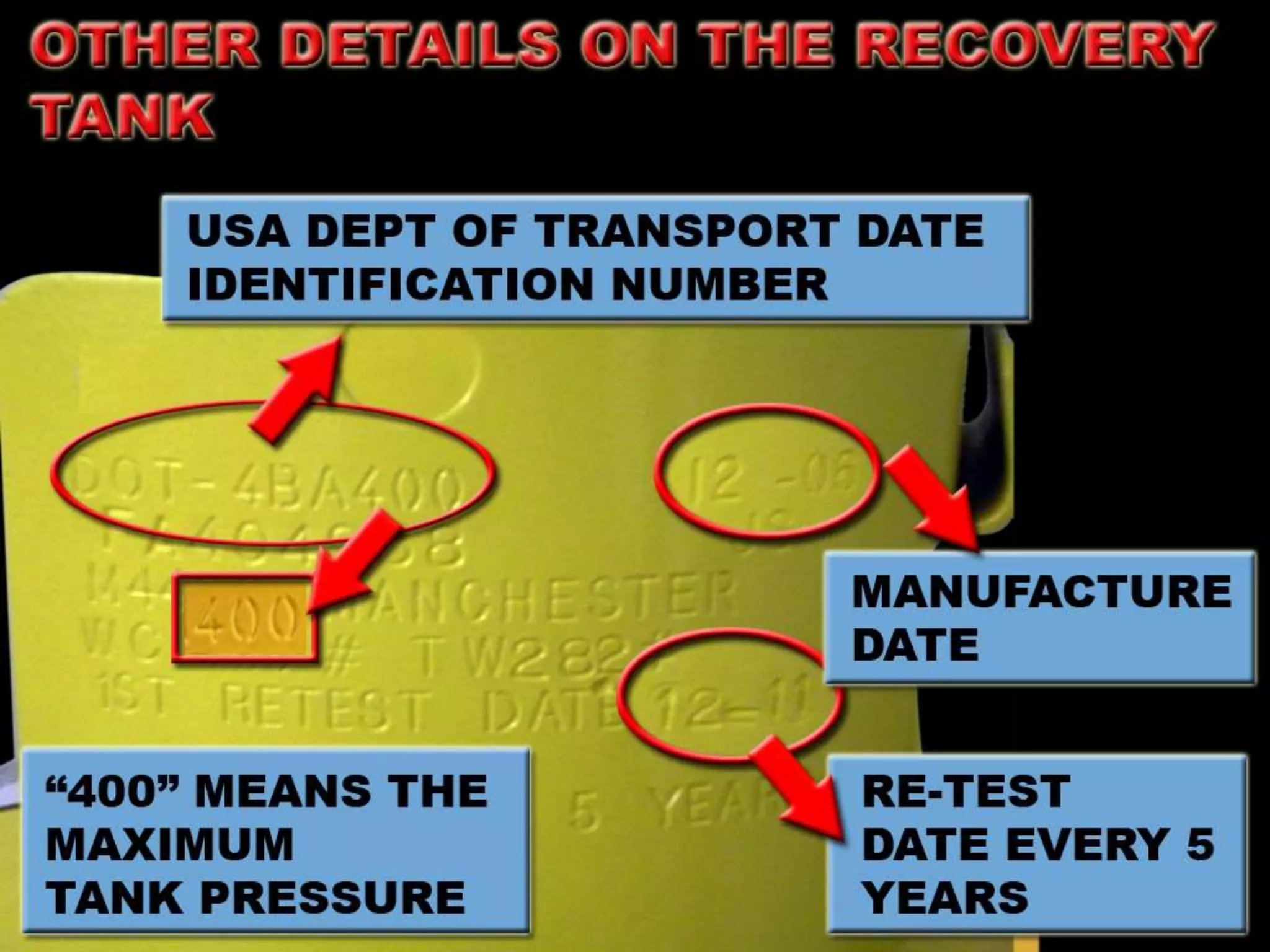
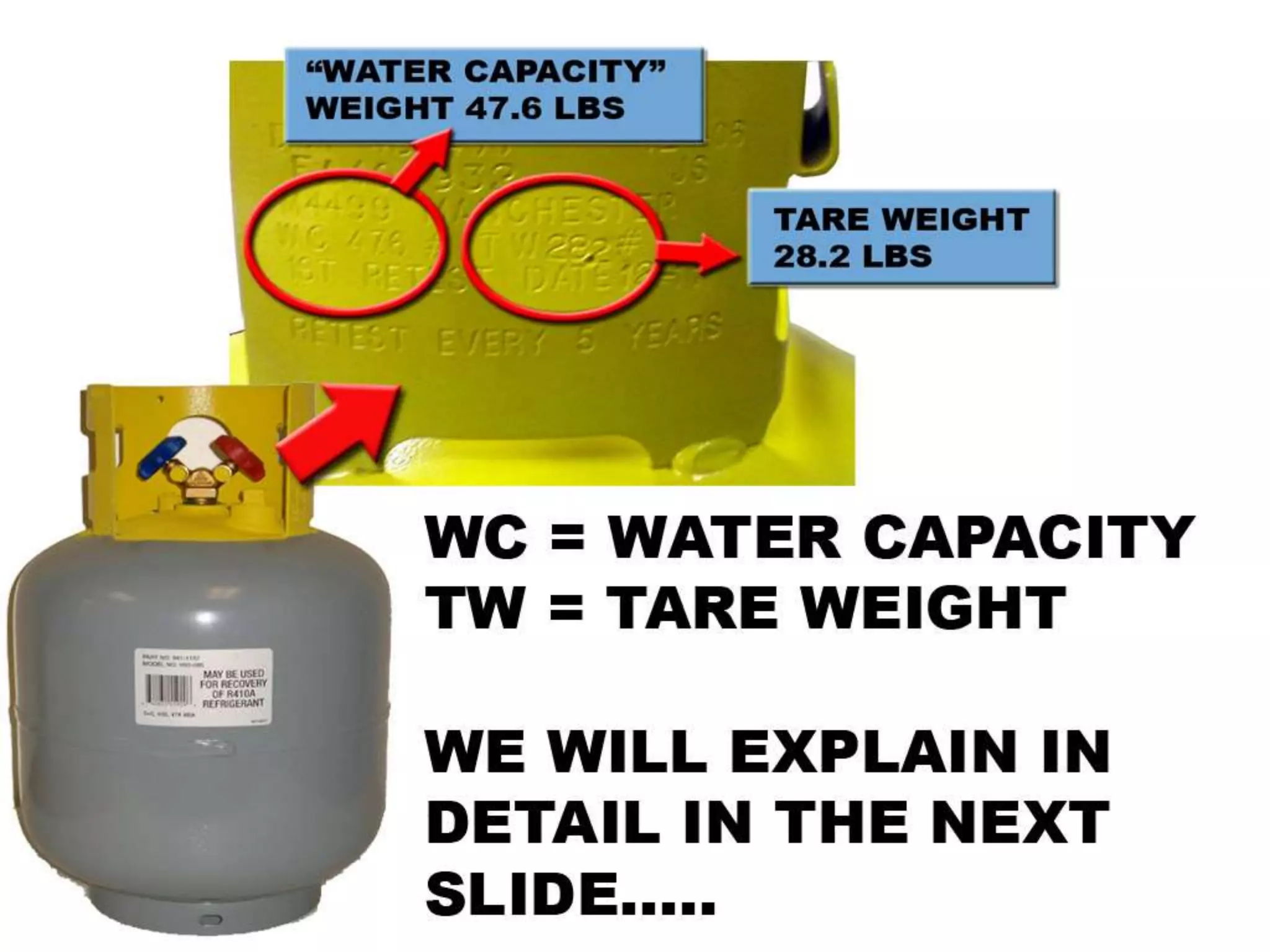
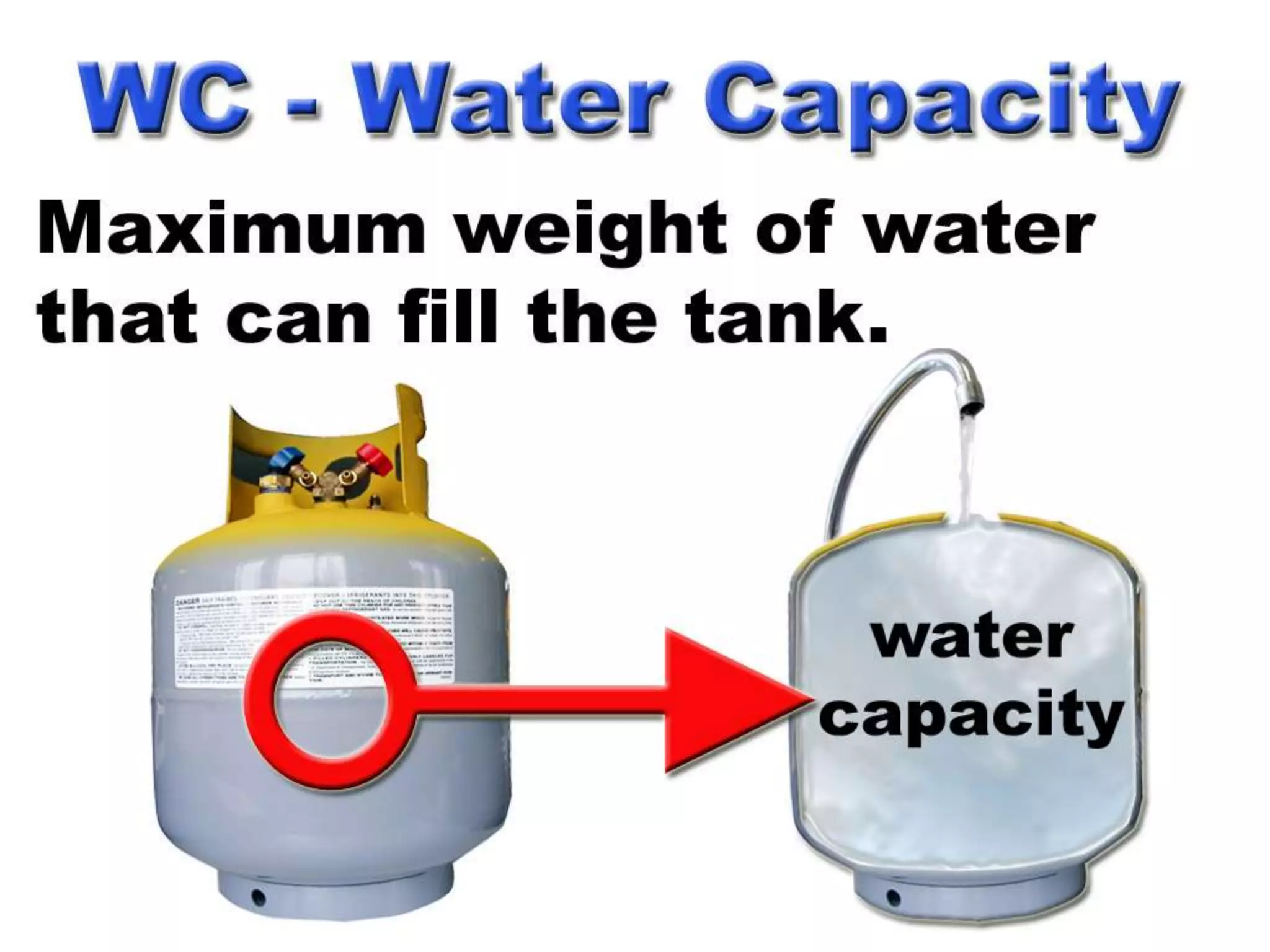
Approved refrigerant recovery cylinders can easily be
identified by their colors, YELLOW TOPS and GRAY
BODIES. All refrigerant recovery cylinders should be
inspected for RUST. If they show signs of rust or appear
to not be secure they should be reduced to 0 psig and
discarded.


Tunjuk tank besar
O
E
TANK SAFETY CALCULATION


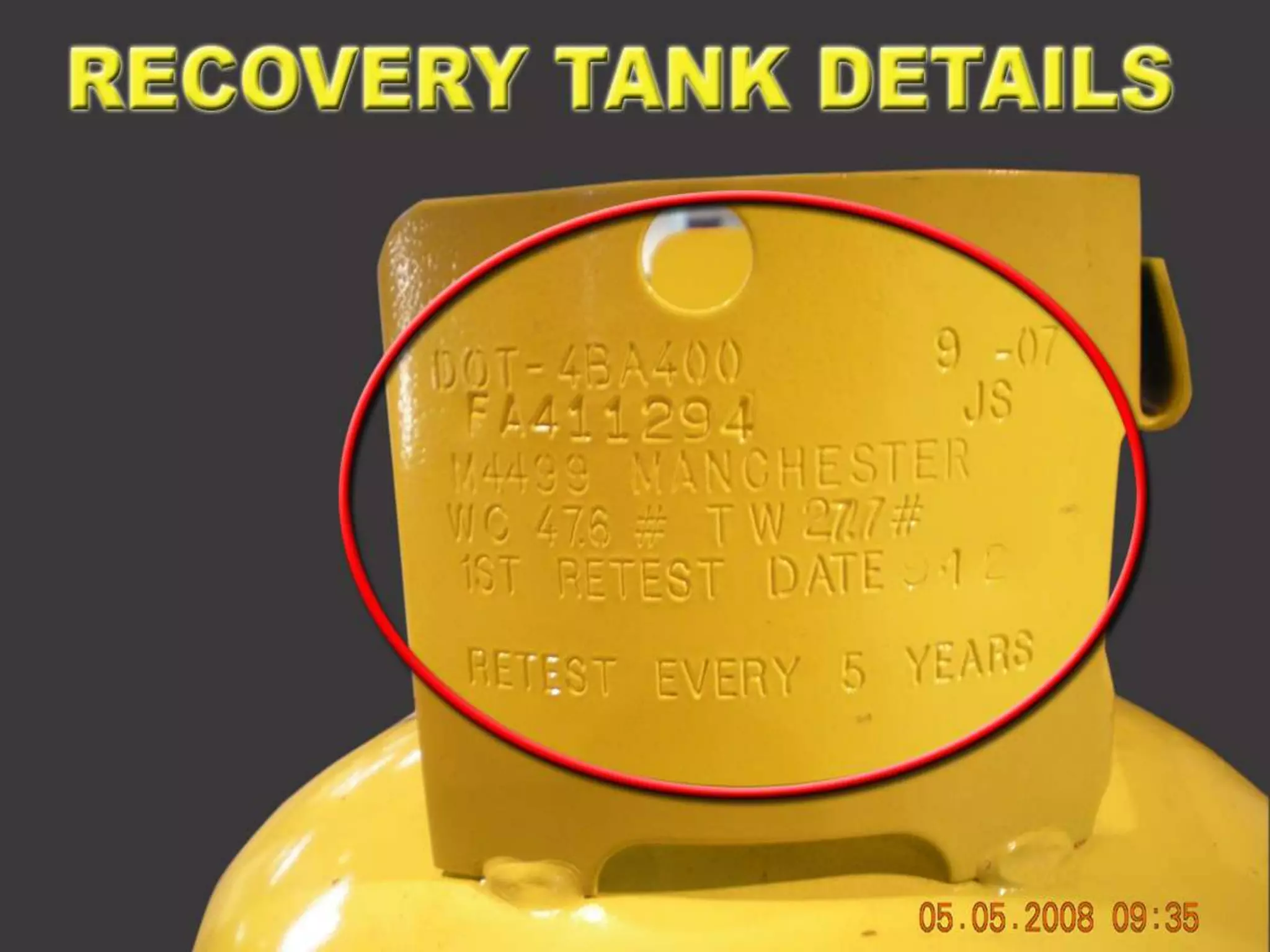
WE HAVE A RECOVERY TANK WITH A
SPECIFICATION OF BA300
Q1: WHAT IS THE TEST PRESSURE?
 Q2: WHAT IS THE RELIEF PRESSURE?

TANK SAFETY CALCULATION


TEST PRESSURE
= SERVICE PRESSURE X 2
 = 300 X 2 = 600 PSI




RELIEF PRESSURE
= 75% X TEST PRESSURE
 = 75% X 600 PSI = 450 PSI

TANK SAFETY CALCULATION




Q3: CAN R22 GAS BE KEPT IN A BA300
TANK?
ANSWER:
TAKE THE PRESSURE OF R22 AT 130F
TEMPERATURE FROM THE PT CHART
 R22 PRESSURE AT 130F IS 297 PSI
 THIS PRESSURE MUST BE LESS THAN 5/4 X
SERVICE PRESSURE OF BA300 TANK

TANK SAFETY CALCULATION








THEREFORE:
5/4 X 300 (SERVICE PRESSURE OF BA300
TANK) => (5 X 300)/4 = 375 PSI
375 PSI IS MORE THAN THE PRESSURE
OF R22 AT 130F THAT IS 297 PSI
SO, R22 CAN BE SAFELY KEPT INSIDE A
BA300 TANK
TANK SAFETY CALCULATION




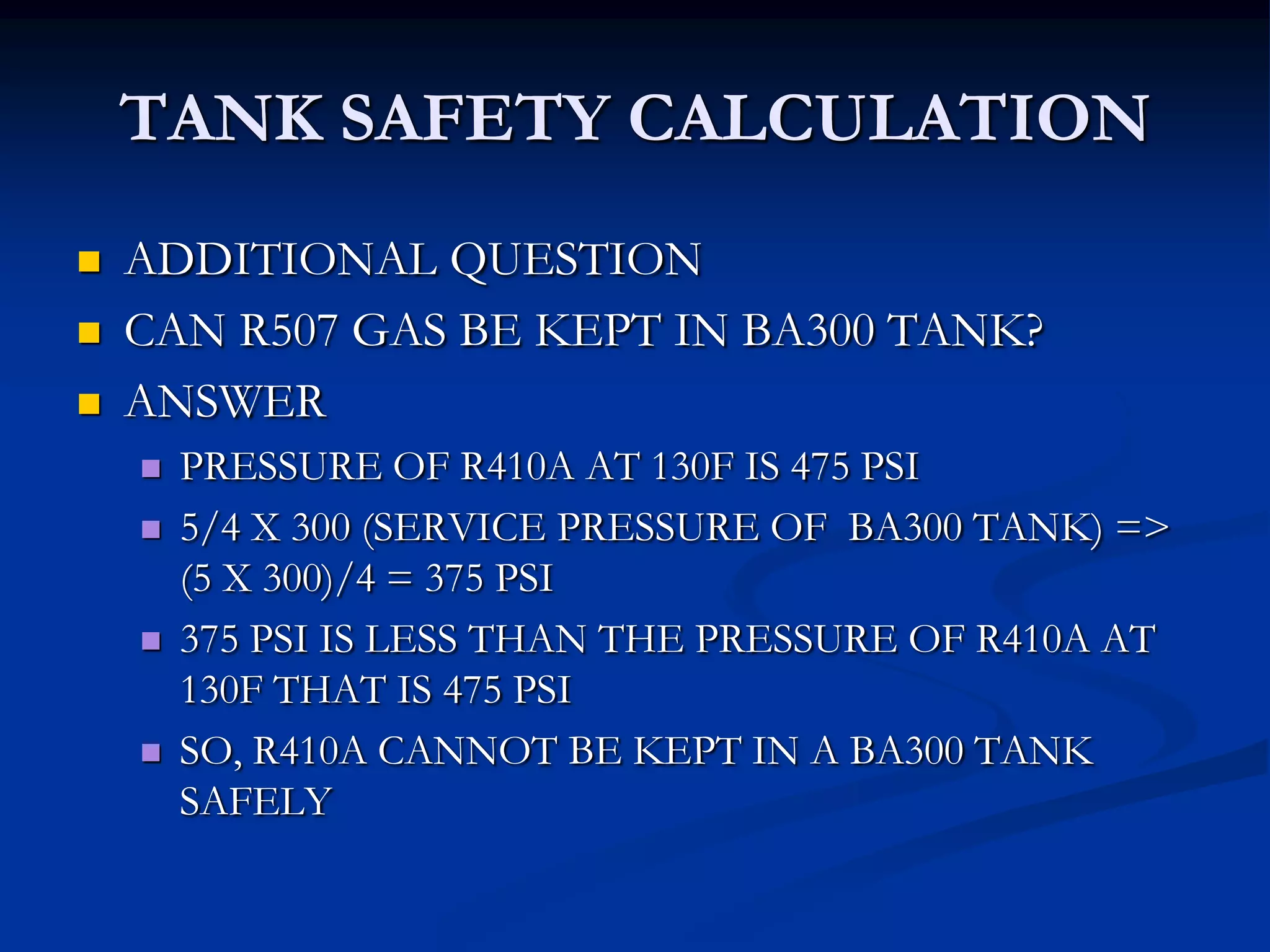
ADDITIONAL QUESTION
CAN R507 GAS BE KEPT IN BA300 TANK?
ANSWER







PRESSURE OF R507 AT 130F IS 368 PSI
5/4 X 300 (SERVICE PRESSURE OF BA300 TANK) =>
(5 X 300)/4 = 375 PSI
375 PSI IS MORE THAN THE PRESSURE OF R507 AT
130F THAT IS 368 PSI
SO, R507 CAN BE SAFELY KEPT INSIDE A BA300
TANK
TANK SAFETY CALCULATION




ADDITIONAL QUESTION
CAN R507 GAS BE KEPT IN BA300 TANK?
ANSWER







PRESSURE OF R410A AT 130F IS 475 PSI
5/4 X 300 (SERVICE PRESSURE OF BA300 TANK) =>
(5 X 300)/4 = 375 PSI
375 PSI IS LESS THAN THE PRESSURE OF R410A AT
130F THAT IS 475 PSI
SO, R410A CANNOT BE KEPT IN A BA300 TANK
SAFELY
THANK YOU

Penyaman udara dan penyejukbekuan

  • 1.
  • 2.
    LUBRICATION (OIL)  Lubrication isthe process by which the moving parts such as bearings in the compressor are kept separate by a film of oil to maximize performance and reduce wear and tear.  Create a Fluid seal  Acts a coolant in compressor  Dampens noise in compressor crankcase
  • 3.
    IMPORTANT OIL FUNCTIONS Refrigerantoil must adequately perform four basic functions  Lubricate  Scaling off the high side from the low side  Transferring heat
  • 4.
    IMPORTANT OIL FUNCTIONS  Dampercompressor noise   Oils should be chemically stable It should not react chemically with its     Refrigerants contained in the system Metals Motor insulation Also it should not react readily to the presence of normal contaminants    Non condensable Moisture Flux/ wax
  • 5.
    REFRIGERATION SYSTEM LUBRICATION  As thename suggests, refrigeration system lubrication lubricates the system using Mineral Oil, Polyalkylene Glycol, Alkyl benzene and Polyol Ester depending on the type of refrigerant being used. It also has the following functions:
  • 6.
    LUBRICATION (OIL) Viscosity…how thickor thin the oil is  Floc point…the point at which the wax will separate from the oil  Pour point…the temperature at which it ceases to flow  Dielectric strength…a measure of a oils resistance to electrical current  Colour… refining to a lighter coloured oil  Specific gravity…weight  Neutralization number…organic acid content 
  • 7.
    LUBRICATION (OIL) Oxidation resistance…resist water and O2  Moisture content…dryness of oil  Chemical stability… in presence or metal or refrigerants will chemicals in the oils attack the metal and ref.  Flash point… the temperature at which the oil vapour flash burns  Fire point…the temperature at which the oil maintains combustion 
  • 8.
    OIL DEFINITIONS  Hygroscopic A Hygroscopicoil is one that easily absorbs & releases moisture (has a high affinity for water).  Most refrigerant oils are hygroscopic  An oil sample should be taken and analyzed if a system has had a major component failure. 
  • 9.
    OIL DEFINITIONS  Viscosity  The resistancethat the oil offers to flow. High viscosity means a thick oil, low viscosity means a thin oil. The body of the oil or its ability to perform a lubricating function. Sometimes referred to as the thickness of the oil.
  • 10.
    OIL DEFINITIONS  Material Compatibility  Theoil or refrigerant must not react, swell, shrink, deteriorate, weaken, pit, or extrude any materials used in refrigeration equipment.
  • 11.
    OIL DEFINITIONS  Chemical Stability  Anoil’s ability to perform for an extended life without breaking down or chemically reacting with other materials.
  • 12.
    OIL DEFINITIONS  Dielectric strength  Anoil’s relative electrical resistance to electrical current.
  • 13.
    CONCLUSION  In general, thereis no “best” oil. Follow manufacturers’ recommendations for best performance.
  • 14.
  • 15.
    Refrigerant Contamination  There arefour types of contamination that can occur in any refrigeration equipment which will hinder performance, efficiency and in extreme cases, system failure and damage of components which will be costly to repair and replace:
  • 16.
    Refrigerant Contamination     Air Contamination OilContamination Water/Acid Contamination Cross Contamination with other Refrigerants. (mixture of incompatible refrigerant)
  • 17.
    Air / NonCondensable Contamination  Air or Non-Condensable gas is one of the most difficult contaminants to remove from an operating system.  Air in a system can cause excessive head pressure and higher operating temperatures. It also causes loss of heat transfer efficiencies by acting as an insulator around heat exchanger tubes.
  • 18.
    Air / NonCondensable Contamination  This translates into higher utility costs, degradation of lubricant effectiveness, and premature compressor problems like increased compressor temperatures and pressures, reduced cooling capacity, increased compressor pressure ratios, potential compressor overheating, and finally, compressor motor burn-out.
  • 19.
    Air / NonCondensable Contamination  Typically, a pressure more than 20 PSI above the saturation pressure indicates that a noncondensable gas problem may exist. If noncondensable gases are trapped in the system, recovering vapour from the condenser should remove these non-condensable gasses and reduce the pressure discrepancy.
  • 20.
    Air / NonCondensable Contamination  Purging the system with nitrogen gas after removing the refrigerant using a recovery machine is also another service option. In addition, purging is best used with high efficiency purge unit or to reclaim the refrigerant after recovery.
  • 21.
    Moisture/ Acid Contamination  Themoisture and refrigerant combine to form acids that can destroy motor windings and result in motor burnout.  Oil sludge and particulates can clog coalescing oil filters and metering devices. Any water in the system will most likely freeze in the expansion valve because this is the point where refrigerant is cooled by the evaporation occurring as a result of the sudden pressure drop, and the expansion device also represents the smallest passageway in the overall system. This is the reason why liquid line filter-driers are typically located just upstream of the expansion device.
  • 22.
    Moisture/ Acid Contamination  Whenthis situation occurs, it is necessary to not only clean the refrigerant, but it is also imperative that the refrigeration system be totally dehydrated to remove all traces of water. It is usually desirable to also flush the system to remove rust and other particulates that may have developed while the refrigeration system was being repaired.
  • 23.
    Oil Contamination  Over timeit is very common for oil to migrate from the compressor. Oil accumulates in the evaporator and insulates the tubes. This inhibits maximum heat transfer and reduces system efficiency. Studies indicate that for every 1% of oil in the evaporator, a system loses 2% efficiency.
  • 24.
    Oil Contamination  This translatesinto reduced comfort, higher utility costs, or both. The typical way of dealing with oil contamination is decontaminate the refrigerant with an oil purge unit or charge with new refrigerant after removal of the existing charge with a recovery machine.  For large systems like chillers, an oil purging unit is sometimes installed as a continuous prevention of oil contamination.
  • 25.
    Cross Contamination  This typeof contamination may result if the system is mistakenly charged with:     An incompatible refrigerant for the system. Improper charging of blends resulting in incorrect proportional mixture. An already contaminated refrigerant In such cases, the refrigerant is recovered using recovery machine, purged of oil and contaminants and dehydrated prior to charging with clean refrigerant after checking the system for leaks and doing the necessary repair job.
  • 26.
  • 40.
  • 41.
    RECOVERY Refrigerant recovery meansto remove refrigerant in any condition from an appliance and store it in an EXTERNAL CONTAINER. Refrigerant recovery takes place mainly at three major stages of equipment lifetime.
  • 42.
    When To PerformRecovery    during servicing when part or complete refrigerant charge shall be removed of the system, when the system is converted to be run with a new refrigerant, At equipment disposal
  • 43.
    RECYCLE To clean refrigerantfor reuse by separating the oil from the refrigerant and removing moisture by passing it through one or more filter driers Current recovery machines have filters that remove contaminants from the refrigerants including acids that will enable the refrigerant to be reused.
  • 46.
    RECLAIM To process refrigerantto a level equal to new product standards as determined by chemical analysis. Reclaimed refrigerant must meet standards set forth in ARI 700 before it can be resold.
  • 65.
    BASIC TOOLS       MANIFOLD GAUGE REFRIGERANTLEAK DETECTOR VACUUM PUMP & MICRON GAUGE CHARGING SCALE RECOVERY TANK RECOVERY MACHINE
  • 66.
     Insert topic GoodService practices
  • 77.
  • 78.
     INSERT THE VARIOUSMANIFOLD GRAPHICS
  • 79.
      Talk about newrefrigerants replacing CFC and HCFC like 134a and 400 series which operates at higher pressure. Gauge manifold to cater for these new refrigerants should be used.
  • 87.
  • 96.
  • 106.
    RECOVERY CYLINDERS Approved refrigerantrecovery cylinders can easily be identified by their colors, YELLOW TOPS and GRAY BODIES. All refrigerant recovery cylinders should be inspected for RUST. If they show signs of rust or appear to not be secure they should be reduced to 0 psig and discarded.
  • 108.
  • 113.
  • 115.
  • 119.
    TANK SAFETY CALCULATION  WEHAVE A RECOVERY TANK WITH A SPECIFICATION OF BA300 Q1: WHAT IS THE TEST PRESSURE?  Q2: WHAT IS THE RELIEF PRESSURE? 
  • 120.
    TANK SAFETY CALCULATION  TESTPRESSURE = SERVICE PRESSURE X 2  = 300 X 2 = 600 PSI   RELIEF PRESSURE = 75% X TEST PRESSURE  = 75% X 600 PSI = 450 PSI 
  • 121.
    TANK SAFETY CALCULATION   Q3:CAN R22 GAS BE KEPT IN A BA300 TANK? ANSWER: TAKE THE PRESSURE OF R22 AT 130F TEMPERATURE FROM THE PT CHART  R22 PRESSURE AT 130F IS 297 PSI  THIS PRESSURE MUST BE LESS THAN 5/4 X SERVICE PRESSURE OF BA300 TANK 
  • 122.
    TANK SAFETY CALCULATION     THEREFORE: 5/4X 300 (SERVICE PRESSURE OF BA300 TANK) => (5 X 300)/4 = 375 PSI 375 PSI IS MORE THAN THE PRESSURE OF R22 AT 130F THAT IS 297 PSI SO, R22 CAN BE SAFELY KEPT INSIDE A BA300 TANK
  • 123.
    TANK SAFETY CALCULATION    ADDITIONALQUESTION CAN R507 GAS BE KEPT IN BA300 TANK? ANSWER     PRESSURE OF R507 AT 130F IS 368 PSI 5/4 X 300 (SERVICE PRESSURE OF BA300 TANK) => (5 X 300)/4 = 375 PSI 375 PSI IS MORE THAN THE PRESSURE OF R507 AT 130F THAT IS 368 PSI SO, R507 CAN BE SAFELY KEPT INSIDE A BA300 TANK
  • 124.
    TANK SAFETY CALCULATION    ADDITIONALQUESTION CAN R507 GAS BE KEPT IN BA300 TANK? ANSWER     PRESSURE OF R410A AT 130F IS 475 PSI 5/4 X 300 (SERVICE PRESSURE OF BA300 TANK) => (5 X 300)/4 = 375 PSI 375 PSI IS LESS THAN THE PRESSURE OF R410A AT 130F THAT IS 475 PSI SO, R410A CANNOT BE KEPT IN A BA300 TANK SAFELY
  • 155.