Selecting a Research Topic 
Jamie Dwyer 
Visiting Assistant Information 
Services Librarian 
jamied@uic.edu 
http://library.uic.edu
Research “Cycle”: Ideal 
(1) Develop topic 
(2) Locate resources 
(4) Apply information 
& Cite sources 
(3) Interpret 
& Evaluate 
information
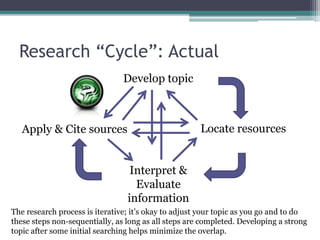
Research “Cycle”: Actual 
Develop topic 
Locate resources 
Interpret & 
Evaluate 
information 
Apply & Cite sources 
The research process is iterative; it’s okay to adjust your topic as you go and to do 
these steps non-sequentially, as long as all steps are completed. Developing a strong 
topic after some initial searching helps minimize the overlap.
Developing a Research Topic 
Keep these key elements in mind: 
• Interest (choose something you’ll enjoy researching!) 
• Scope (breadth and depth of a topic) 
• Time (pick something you can successfully address in the given 
time constraints/due dates) 
• Clarity (know what you’re looking for; refine/adjust as needed) 
• Assignment (follow directions from your professor on topic & 
paper requirements!)
Steps to Refining a Research Topic 
Use these strategies to come up with a research topic 
1. Background Reading (For an overview of the 
topic, this will help you realize the scope) 
2. Narrow/Adapt Topic (Is there enough 
information on your topic? Too little?) 
3. Retrospective Research (Explore the topic in-depth, 
for a historical perspective) 
4. Contemporary Research (Look at current 
issues) 
Adapted from CSU Libraries “Topic Selection Tips” by Naomi Lederer 
http://lib.colostate.edu/howto/toptip.html
1. Background Reading 
• Get an overview of your topic 
• Encyclopedias (aka Wikipedia) for basic 
information and major concepts. 
• Textbooks, instructor’s lectures, professional 
organizations, etc. 
Developing a topic involves lots of skimming! 
Be sure to keep track of potentially useful sources 
as you develop your topic.
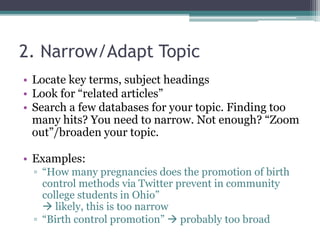
2. Narrow/Adapt Topic 
• Locate key terms, subject headings 
• Look for “related articles” 
• Search a few databases for your topic. Finding too 
many hits? You need to narrow. Not enough? “Zoom 
out”/broaden your topic. 
• Examples: 
▫ “How many pregnancies does the promotion of birth 
control methods via Twitter prevent in community 
college students in Ohio” 
 likely, this is too narrow 
▫ “Birth control promotion”  probably too broad
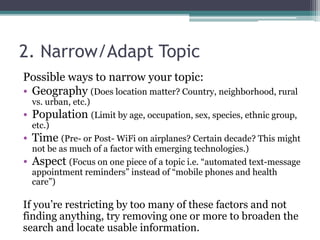
2. Narrow/Adapt Topic 
Possible ways to narrow your topic: 
• Geography (Does location matter? Country, neighborhood, rural 
vs. urban, etc.) 
• Population (Limit by age, occupation, sex, species, ethnic group, 
etc.) 
• Time (Pre- or Post- WiFi on airplanes? Certain decade? This might 
not be as much of a factor with emerging technologies.) 
• Aspect (Focus on one piece of a topic i.e. “automated text-message 
appointment reminders” instead of “mobile phones and health 
care”) 
If you’re restricting by too many of these factors and not 
finding anything, try removing one or more to broaden the 
search and locate usable information.
3. Retrospective Search 
Useful for in-depth papers: 
• Seminal articles/papers/books/research on the 
topic? 
• Big names studying this topic? 
• When did it first appear? 
• “Historical view”
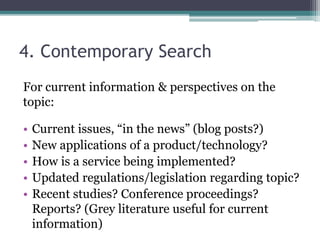
4. Contemporary Search 
For current information & perspectives on the 
topic: 
• Current issues, “in the news” (blog posts?) 
• New applications of a product/technology? 
• How is a service being implemented? 
• Updated regulations/legislation regarding topic? 
• Recent studies? Conference proceedings? 
Reports? (Grey literature useful for current 
information)
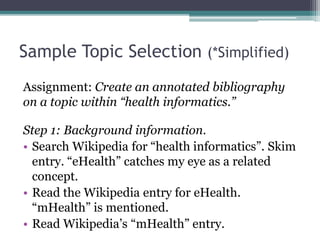
Sample Topic Selection (*Simplified) 
Assignment: Create an annotated bibliography 
on a topic within “health informatics.” 
Step 1: Background information. 
• Search Wikipedia for “health informatics”. Skim 
entry. “eHealth” catches my eye as a related 
concept. 
• Read the Wikipedia entry for eHealth. 
“mHealth” is mentioned. 
• Read Wikipedia’s “mHealth” entry.
Sample Topic Selection (*Simplified) 
Assignment: Create an annotated bibliography 
on a topic within “health informatics.” 
Step 2: Narrow/Adapt Topic. 
• mHealth and remote monitoring  mobile apps 
monitoring health  Current barriers to using 
mobile apps by clinicians and patients to 
remotely monitor chronic diseases 
• Search in databases during each phase to ensure 
relevant results & information availability
Sample Topic Selection (*Simplified) 
Topic: Current barriers to using mobile apps by 
clinicians and patients to remotely monitor 
chronic diseases 
Step 3: Retrospective Search. 
• First mobile app approved for use? 
• Big companies? 
• Technology (sensors, etc.)? (Availability?) 
• Mobile phone usage/stats might be useful too.
Sample Topic Selection (*Simplified) 
Topic: Current barriers to using mobile apps by 
clinicians and patients to remotely monitor 
chronic diseases 
Step 4: Contemporary Search. 
• Health insurance compliance/coverage as a 
factor? 
• Current cost/cost-effectiveness? Usage? 
• Technology (sensors, etc.)? (Availability? Users-adaptations 
of clinicians vs. patients?) 
• Mobile phone usage statistics?
Sample Topic Selection (*Simplified) 
Topic: Current barriers to using mobile apps by 
clinicians and patients to remotely monitor chronic 
diseases 
We have a focused topic and we know the information 
we are looking for. 
Other aspects to this topic might include: 
• Government regulation/laws 
• Specific populations (older vs. young adults) 
• Accuracy of devices 
• Geography-specific (US only, urban vs. rural, etc.) 
• Condition-specific (diabetes, asthma, etc.)

Selecting a Research Topic

  • 1.
    Selecting a ResearchTopic Jamie Dwyer Visiting Assistant Information Services Librarian jamied@uic.edu http://library.uic.edu
  • 2.
    Research “Cycle”: Ideal (1) Develop topic (2) Locate resources (4) Apply information & Cite sources (3) Interpret & Evaluate information
  • 3.
    Research “Cycle”: Actual Develop topic Locate resources Interpret & Evaluate information Apply & Cite sources The research process is iterative; it’s okay to adjust your topic as you go and to do these steps non-sequentially, as long as all steps are completed. Developing a strong topic after some initial searching helps minimize the overlap.
  • 4.
    Developing a ResearchTopic Keep these key elements in mind: • Interest (choose something you’ll enjoy researching!) • Scope (breadth and depth of a topic) • Time (pick something you can successfully address in the given time constraints/due dates) • Clarity (know what you’re looking for; refine/adjust as needed) • Assignment (follow directions from your professor on topic & paper requirements!)
  • 5.
    Steps to Refininga Research Topic Use these strategies to come up with a research topic 1. Background Reading (For an overview of the topic, this will help you realize the scope) 2. Narrow/Adapt Topic (Is there enough information on your topic? Too little?) 3. Retrospective Research (Explore the topic in-depth, for a historical perspective) 4. Contemporary Research (Look at current issues) Adapted from CSU Libraries “Topic Selection Tips” by Naomi Lederer http://lib.colostate.edu/howto/toptip.html
  • 6.
    1. Background Reading • Get an overview of your topic • Encyclopedias (aka Wikipedia) for basic information and major concepts. • Textbooks, instructor’s lectures, professional organizations, etc. Developing a topic involves lots of skimming! Be sure to keep track of potentially useful sources as you develop your topic.
  • 7.
    2. Narrow/Adapt Topic • Locate key terms, subject headings • Look for “related articles” • Search a few databases for your topic. Finding too many hits? You need to narrow. Not enough? “Zoom out”/broaden your topic. • Examples: ▫ “How many pregnancies does the promotion of birth control methods via Twitter prevent in community college students in Ohio”  likely, this is too narrow ▫ “Birth control promotion”  probably too broad
  • 8.
    2. Narrow/Adapt Topic Possible ways to narrow your topic: • Geography (Does location matter? Country, neighborhood, rural vs. urban, etc.) • Population (Limit by age, occupation, sex, species, ethnic group, etc.) • Time (Pre- or Post- WiFi on airplanes? Certain decade? This might not be as much of a factor with emerging technologies.) • Aspect (Focus on one piece of a topic i.e. “automated text-message appointment reminders” instead of “mobile phones and health care”) If you’re restricting by too many of these factors and not finding anything, try removing one or more to broaden the search and locate usable information.
  • 9.
    3. Retrospective Search Useful for in-depth papers: • Seminal articles/papers/books/research on the topic? • Big names studying this topic? • When did it first appear? • “Historical view”
  • 10.
    4. Contemporary Search For current information & perspectives on the topic: • Current issues, “in the news” (blog posts?) • New applications of a product/technology? • How is a service being implemented? • Updated regulations/legislation regarding topic? • Recent studies? Conference proceedings? Reports? (Grey literature useful for current information)
  • 11.
    Sample Topic Selection(*Simplified) Assignment: Create an annotated bibliography on a topic within “health informatics.” Step 1: Background information. • Search Wikipedia for “health informatics”. Skim entry. “eHealth” catches my eye as a related concept. • Read the Wikipedia entry for eHealth. “mHealth” is mentioned. • Read Wikipedia’s “mHealth” entry.
  • 12.
    Sample Topic Selection(*Simplified) Assignment: Create an annotated bibliography on a topic within “health informatics.” Step 2: Narrow/Adapt Topic. • mHealth and remote monitoring  mobile apps monitoring health  Current barriers to using mobile apps by clinicians and patients to remotely monitor chronic diseases • Search in databases during each phase to ensure relevant results & information availability
  • 13.
    Sample Topic Selection(*Simplified) Topic: Current barriers to using mobile apps by clinicians and patients to remotely monitor chronic diseases Step 3: Retrospective Search. • First mobile app approved for use? • Big companies? • Technology (sensors, etc.)? (Availability?) • Mobile phone usage/stats might be useful too.
  • 14.
    Sample Topic Selection(*Simplified) Topic: Current barriers to using mobile apps by clinicians and patients to remotely monitor chronic diseases Step 4: Contemporary Search. • Health insurance compliance/coverage as a factor? • Current cost/cost-effectiveness? Usage? • Technology (sensors, etc.)? (Availability? Users-adaptations of clinicians vs. patients?) • Mobile phone usage statistics?
  • 15.
    Sample Topic Selection(*Simplified) Topic: Current barriers to using mobile apps by clinicians and patients to remotely monitor chronic diseases We have a focused topic and we know the information we are looking for. Other aspects to this topic might include: • Government regulation/laws • Specific populations (older vs. young adults) • Accuracy of devices • Geography-specific (US only, urban vs. rural, etc.) • Condition-specific (diabetes, asthma, etc.)