Yuri Belfali
Gender differences in
Education
through the lens of PISA
Francesca Borgonovi
Educational attainment
Measured in the most common metric - years
of schooling - the industrialised world
essentially closed the educational gender gap in
the 1960s
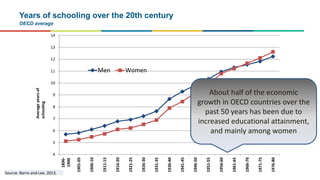
Years of schooling over the 20th century
OECD average
4
5
6
7
8
9
10
11
12
13
14
1896-
1900
1901-05
1906-10
1911-15
1916-20
1921-25
1926-30
1931-35
1936-40
1941-45
1946-50
1951-55
1956-60
1961-65
1966-70
1971-75
1976-80
Men Women
Averageyearsof
schooling
About half of the economic
growth in OECD countries over the
past 50 years has been due to
increased educational attainment,
and mainly among women
Source: Barro and Lee, 2013.
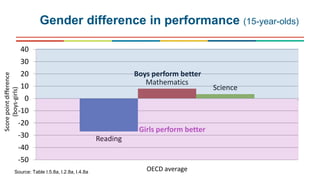
Gender difference in performance (15-year-olds)
Reading
Mathematics
Science
-50
-40
-30
-20
-10
0
10
20
30
40
OECD average
Scorepointdifference
(boys-girls)
Boys perform better
Girls perform better
Source: Table I.5.8a, I.2.8a, I.4.8a
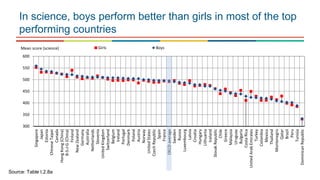
In science, boys perform better than girls in most of the top
performing countries
300
350
400
450
500
550
600
Singapore
Japan
Estonia
ChineseTaipei
Canada
HongKong(China)
B-S-J-G(China)
Finland
NewZealand
Germany
Australia
Netherlands
Slovenia
UnitedKingdom
Switzerland
Belgium
Ireland
Portugal
Denmark
Poland
Austria
Norway
UnitedStates
CzechRepublic
Spain
France
OECDaverage
Sweden
Russia
Luxembourg
Latvia
Croatia
Hungary
Lithuania
Iceland
SlovakRepublic
Chile
Greece
Malaysia
Uruguay
Bulgaria
CostaRica
UnitedArabEmirates
Turkey
Colombia
Mexico
Thailand
Montenegro
Qatar
Brazil
Peru
Tunisia
DominicanRepublic
Girls BoysMean score (science)
Source: Table I.2.8a
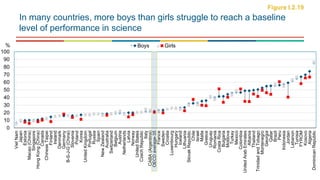
In many countries, more boys than girls struggle to reach a baseline
level of performance in science
Figure I.2.19
0
10
20
30
40
50
60
70
80
90
100
DominicanRepublic
Algeria
Kosovo
FYROM
Tunisia
Lebanon
Jordan
Indonesia
Peru
Brazil
Qatar
Georgia
Montenegro
TrinidadandTobago
Thailand
Albania
UnitedArabEmirates
Colombia
Mexico
Turkey
Moldova
Bulgaria
CostaRica
Romania
Uruguay
Greece
Malta
Israel
Chile
SlovakRepublic
Lithuania
Iceland
Hungary
Luxembourg
Croatia
Sweden
France
OECDaverage-35
CABA(Argentina)
Italy
CzechRepublic
UnitedStates
Norway
Latvia
Netherlands
Austria
Belgium
Switzerland
Australia
NewZealand
Spain
Russia
Portugal
UnitedKingdom
Korea
Poland
Slovenia
B-S-J-G(China)
Germany
Denmark
Ireland
Finland
ChineseTaipei
Canada
HongKong(China)
Singapore
Macao(China)
Estonia
Japan
VietNam
% Boys Girls
0
5
10
15
20
25
30
DominicanRepublic
Kosovo
Algeria
Tunisia
Indonesia
Jordan
Peru
CostaRica
Mexico
FYROM
Albania
Turkey
Thailand
Colombia
Montenegro
Lebanon
Moldova
Romania
Brazil
Georgia
TrinidadandTobago
Chile
Uruguay
Qatar
Greece
Bulgaria
UnitedArabEmirates
Latvia
CABA(Argentina)
Iceland
SlovakRepublic
Lithuania
Russia
Croatia
Hungary
Italy
Spain
Israel
Malta
Denmark
HongKong(China)
Luxembourg
VietNam
OECDaverage-35
Poland
Ireland
CzechRepublic
Norway
France
Sweden
Portugal
UnitedStates
Macao(China)
Austria
Slovenia
Belgium
Switzerland
UnitedKingdom
Korea
Germany
Australia
Netherlands
Finland
Canada
NewZealand
Estonia
B-S-J-G(China)
ChineseTaipei
Japan
Singapore
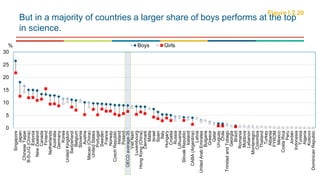
% Boys Girls
But in a majority of countries a larger share of boys performs at the top
in science.
Figure I.2.20
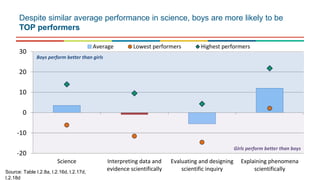
Despite similar average performance in science, boys are more likely to be
TOP performers
-20
-10
0
10
20
30
Science Interpreting data and
evidence scientifically
Evaluating and designing
scientific inquiry
Explaining phenomena
scientifically
Average Lowest performers Highest performers
Boys perform better than girls
Girls perform better than boys
Source: Table I.2.8a, I.2.16d, I.2.17d,
I.2.18d
99 Aptitude, behaviour, confidence
Despite major progress in closing gender gaps, we
need to find new ways to address the social and
emotional aspects of opening children’s minds to
their abilities and future careers
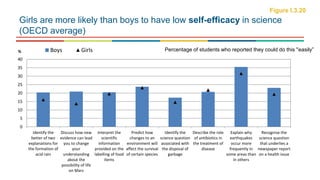
Girls are more likely than boys to have low self-efficacy in science
(OECD average)
0
5
10
15
20
25
30
35
40
Recognise the
science question
that underlies a
newspaper report
on a health issue
Explain why
earthquakes
occur more
frequently in
some areas than
in others
Describe the role
of antibiotics in
the treatment of
disease
Identify the
science question
associated with
the disposal of
garbage
Predict how
changes to an
environment will
affect the survival
of certain species
Interpret the
scientific
information
provided on the
labelling of food
items
Discuss how new
evidence can lead
you to change
your
understanding
about the
possibility of life
on Mars
Identify the
better of two
explanations for
the formation of
acid rain
% Boys Girls
Figure I.3.20
Percentage of students who reported they could do this "easily”
0
10
20
30
40
50
60
70
80
I often worry that it will
be difficult for me in
mathematics classes
I get very tense when I
have to do
mathematics
homework
I get very nervous
doing mathematics
problems
I feel helpless when
doing a mathematics
problem
I worry that I will get
poor marks in
mathematics
% Boys Girls
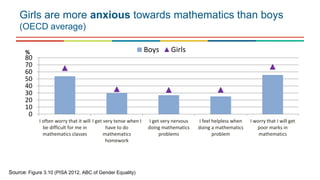
Girls are more anxious towards mathematics than boys
(OECD average)
Source: Figure 3.10 (PISA 2012, ABC of Gender Equality)
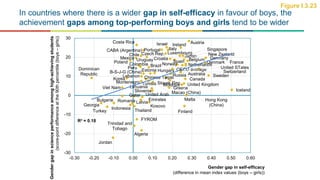
In countries where there is a wider gap in self-efficacy in favour of boys, the
achievement gaps among top-performing boys and girls tend to be wider
Figure I.3.23
OECD average
CABA (Argentina)
Costa Rica
Sweden
Bulgaria Romania
Jordan
Luxembourg
Viet Nam
Uruguay
Poland
United STates
Norway
Chile
Denmark
Hungary
Italy
Czech Rep.
AustraliaB-S-J-G (China)
Turkey
Georgia
Chinese Taipei
Mexico
Portugal
Iceland
Russia
Korea
Hong Kong
(China)
Qatar
Japan
Belgium
Israel
Trinidad and
Tobago
Croatia
Lithuania
FYROM
United Arab
Emirates
Montenegro
Algeria
Ireland
Indonesia
Greece
New Zealand
Colombia
Tunisia
Peru
Macao (China)
Spain
Switzerland
Malta
Estonia
Lebanon
Dominican
Republic
Netherlands
Germany
Singapore
Slovak Rep.
Austria
Canada
United Kingdom
Slovenia
France
Brazil
Kosovo
FinlandThailand
Latvia
Moldova
R² = 0.18
-30
-20
-10
0
10
20
30
-0.30 -0.20 -0.10 0.00 0.10 0.20 0.30 0.40 0.50 0.60
Gendergapinscienceperformanceamonghigh-achievingstudents
(score-pointdifferenceatthe90thpercentile(boys–girls))
Gender gap in self-efficacy
(difference in mean index values (boys – girls))
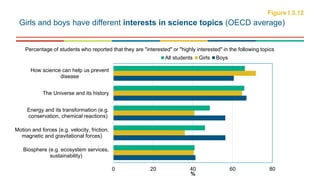
Girls and boys have different interests in science topics (OECD average)
Figure I.3.12
0 20 40 60 80
Biosphere (e.g. ecosystem services,
sustainability)
Motion and forces (e.g. velocity, friction,
magnetic and gravitational forces)
Energy and its transformation (e.g.
conservation, chemical reactions)
The Universe and its history
How science can help us prevent
disease
%
All students Girls Boys
Percentage of students who reported that they are "interested" or "highly interested" in the following topics
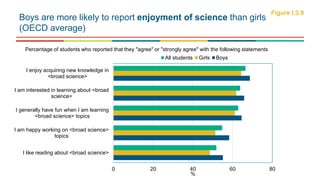
Boys are more likely to report enjoyment of science than girls
(OECD average)
Figure I.3.9
0 20 40 60 80
I like reading about <broad science>
I am happy working on <broad science>
topics
I generally have fun when I am learning
<broad science> topics
I am interested in learning about <broad
science>
I enjoy acquiring new knowledge in
<broad science>
%
All students Girls Boys
Percentage of students who reported that they "agree" or "strongly agree" with the following statements
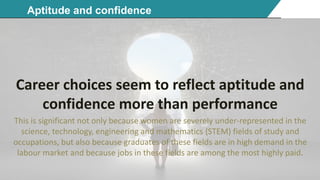
1515 Aptitude and confidence
Career choices seem to reflect aptitude and
confidence more than performance
This is significant not only because women are severely under-represented in the
science, technology, engineering and mathematics (STEM) fields of study and
occupations, but also because graduates of these fields are in high demand in the
labour market and because jobs in these fields are among the most highly paid.
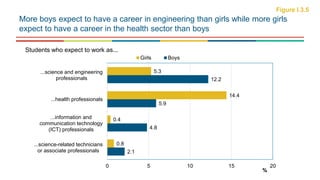
More boys expect to have a career in engineering than girls while more girls
expect to have a career in the health sector than boys
Figure I.3.5
5.3
14.4
0.4
0.8
12.2
5.9
4.8
2.1
0 5 10 15 20
...science and engineering
professionals
...health professionals
...information and
communication technology
(ICT) professionals
...science-related technicians
or associate professionals
%
Girls Boys
Students who expect to work as...
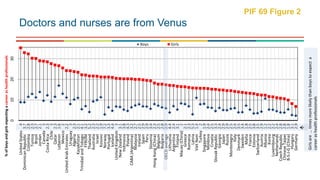
Doctors and nurses are from Venus
0102030
UnitedStates4
DominicanRepublic3.7
Colombia2.8
Tunisia2.3
Brazil2.7
Jordan2.1
Canada3
CostaRica2.3
Chile3
Qatar2.3
Lebanon1.6
Mexico2
UnitedArabEmirates2.2
Uruguay3
Algeria2.3
Kazakhstan2.1
TrinidadandTobago4.1
FYROM3.2
Thailand5.2
Australia2.3
Israel2.2
Kosovo1.9
Norway7.2
Portugal3.3
Iceland4.4
UnitedKingdom3
NewZealand3.1
Indonesia3.8
Poland4.3
CABA(Argentina)3.2
Malaysia2.7
Ireland2.5
Spain2.9
Peru2.9
Slovenia3.4
HongKong(China)2.3
Belgium2.5
Bulgaria2.8
OECDaverage2.9
Lithuania4.4
Argentina2.4
Finland3.1
Macao(China)2
Greece2.1
Romania2.3
Latvia5.3
VietNam1.4
Turkey2
Singapore1.9
Moldova2.4
Croatia2.5
SlovakRepublic3.3
Georgia2.4
Japan2.9
Russia2.9
Montenegro2.5
Italy2.4
Denmark3.5
Sweden3.4
Malta1.8
France2.5
Estonia3.8
Switzerland3.5
Austria2.9
Albania1.2
Korea2.2
Luxembourg2.2
Netherlands2.4
CzechRepublic2.8
ChineseTaipei2.8
B-S-J-G(China)1.8
Hungary3.1
Germany2.9
%ofboysandgirlsexpectingacareerashealthprofessionals
Boys Girls
Girlsare...timesmorelikelythanboystoexpecta
careerashealthprofessionals
PIF 69 Figure 2
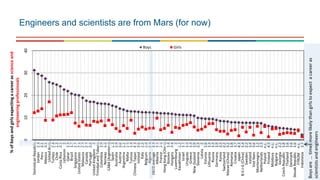
Engineers and scientists are from Mars (for now)010203040
DominicanRepublic…
Jordan2.3
Peru2.1
Mexico3.1
UnitedArab…
Turkey2.8
Chile2.3
CostaRica2.1
Lebanon2
Qatar1.9
Brazil1.7
Singapore2.7
UnitedStates3.3
Malaysia2.3
Canada2.7
Portugal2.6
UnitedKingdom2
TrinidadandTobago…
Colombia1.9
Norway2.5
CABA(Argentina)…
Spain2.3
Australia2.9
Austria3.6
Argentina2.1
Malta2.5
Tunisia1.4
ChineseTaipei4.3
Ireland2.6
Italy2.2
Belgium2.6
Algeria2.4
OECDaverage2.4
Albania1.2
France2.6
HongKong(China)…
Kosovo1.8
Hungary3.4
Luxembourg2
Kazakhstan2.2
Israel1.7
Uruguay1.6
Greece1.4
NewZealand1.9
Slovenia2.3
Latvia2
Estonia1.6
Lithuania1.3
Russia1.3
Germany1.9
Korea2.2
Switzerland2.2
Macao(China)3.2
Romania1.8
Croatia1.7
Japan4.3
B-S-J-G(China)1.4
Sweden2.2
Iceland1.4
VietNam3.6
Montenegro1.2
Netherlands2.3
Polandn.s.
Finland4.5
Moldovan.s.
Bulgarian.s.
Georgia2.2
CzechRepublic1.8
Thailand1.6
Denmark1.6
SlovakRepublic1.6
FYROMn.s.
Indonesia1.7
%ofboysandgirlsexpectingacareerasscienceand
engineeringprofessinoals
Boys Girls
Boys are ... times more likely than girls to expect a career as scientists and engineers
Boysare...timesmorelikelythangirlstoexpectacareeras
scientistsandengineers
1919 Closing the gaps
What's needed is neither extensive
nor expensive reform but a concerted effort
by parents, teachers and employers
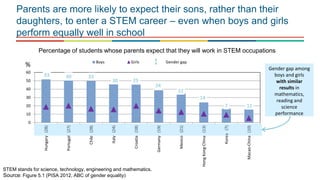
What parents can do
33 30 33
30 25
24
22
14
7 11
0
10
20
30
40
50
60
Hungary(28)
Portugal(27)
Chile(28)
Italy(24)
Croatia(18)
Germany(19)
Mexico(21)
HongKong-China(13)
Korea(7)
Macao-China(10)
Boys Girls Gender gap
%
Parents are more likely to expect their sons, rather than their
daughters, to enter a STEM career – even when boys and girls
perform equally well in school
Source: Figure 5.1 (PISA 2012, ABC of gender equality)
Gender gap among
boys and girls
with similar
results in
mathematics,
reading and
science
performance
STEM stands for science, technology, engineering and mathematics.
Percentage of students whose parents expect that they will work in STEM occupations
0
2
4
6
8
10
12
14
16
Shanghai-China-1.2
RussianFederation…
Kazakhstan-1.2
Singapore-2.6
Italy-3.1
Ireland-1.2
Romania-1.8
Estonia-2.2
VietNam
Spain-1.8
Australia-1.0
Hungary-1.6
Lithuania-2.8
Poland-2.6
HongKong-China…
UnitedArab…
UnitedStates-1.8
Latvia-2.1
Albania
Netherlands-1.6
Colombia-0.6
Peru-1.0
Mexico-0.6
Macao-China-1.9
Croatia-2.2
Bulgaria-1.7
Belgium-1.7
ChineseTaipei-1.4
Canada-1.8
Greece-1.4
Thailand-2.0
Indonesia-0.9
Malaysia-1.0
Norway-1.0
OECDaverage-1.3
UnitedKingdom-…
France-1.7
Qatar-0.3
Uruguay-1.1
Luxembourg-1.1
Israel-1.2
Austria-1.2
Germany-1.7
NewZealand-1.0
Denmark-1.2
Turkey-1.1
Jordan-1.1
Iceland-0.9
Japan-0.6
Serbia-1.8
Montenegro-1.8
Switzerland-1.1
Tunisia-0.3
Argentina-0.6
CostaRica-0.4
Portugal-1.2
Chile-0.5
Slovenia-1.2
Liechtenstein
Brazil-0.5
Sweden-1.1
Korea
CzechRepublic-0.9
SlovakRepublic-1.4
Finland-1.1
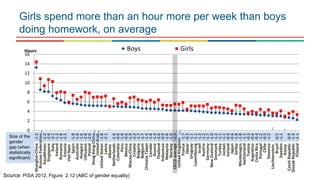
Hours Boys Girls
Girls spend more than an hour more per week than boys
doing homework, on average
Source: PISA 2012, Figure 2.12 (ABC of gender equality)
Size of the
gender
gap (when
statistically
significant)
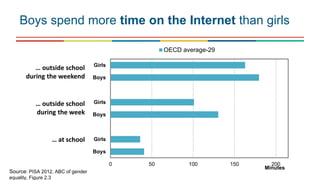
Boys spend more time on the Internet than girls
Source: PISA 2012, ABC of gender
equality, Figure 2.3
0 50 100 150 200
Boys
Girls
Boys
Girls
Boys
Girls
Minutes
OECD average-29
… at school
… outside school
during the week
… outside school
during the weekend
2323 Closing the gaps
What's needed is neither extensive
nor expensive reform but a concerted effort
by parents, teachers and employers
What teachers can do
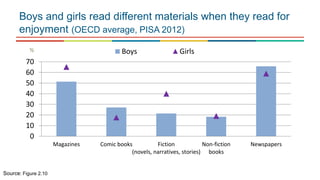
0
10
20
30
40
50
60
70
Magazines Comic books Fiction
(novels, narratives, stories)
Non-fiction
books
Newspapers
Boys Girls%
Boys and girls read different materials when they read for
enjoyment (OECD average, PISA 2012)
Source: Figure 2.10
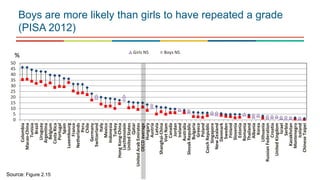
0
5
10
15
20
25
30
35
40
45
50
Colombia
Macao-China
Tunisia
Brazil
Uruguay
Argentina
Belgium
CostaRica
Portugal
Spain
Luxembourg
France
Netherlands
Peru
Chile
Germany
Switzerland
Italy
Mexico
Indonesia
Turkey
HongKong-China
Liechtenstein
UnitedStates
Qatar
UnitedArabEmirates
OECDaverage
Hungary
Austria
Latvia
Shanghai-China
VietNam
Canada
Jordan
Ireland
Australia
SlovakRepublic
Bulgaria
Greece
Poland
CzechRepublic
Singapore
NewZealand
Denmark
Sweden
Finland
Slovenia
Estonia
Romania
Thailand
Albania
Korea
Lithuania
RussianFederation
Croatia
UnitedKingdom
Israel
Serbia
Kazakhstan
Montenegro
Iceland
ChineseTaipei
Girls NS Boys NS
%
Boys are more likely than girls to have repeated a grade
(PISA 2012)
Source: Figure 2.15
-12
-10
-8
-6
-4
-2
0
Albania
Iceland
Greece
Spain
Israel
OECDaverage
UnitedStates
Chile
Denmark
France
Indonesia
Peru
Bulgaria
Macedonia(FYR)
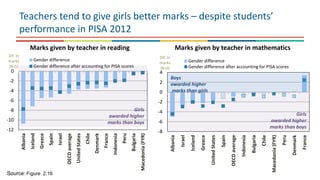
Marks given by teacher in reading
Gender difference
Gender difference after accounting for PISA scores
Dif. in
marks
(B-G)
Teachers tend to give girls better marks – despite students’
performance in PISA 2012
Source: Figure 2.16
-8
-6
-4
-2
0
2
4
Albania
Israel
Iceland
Greece
UnitedStates
Spain
OECDaverage
Indonesia
Bulgaria
Chile
Macedonia(FYR)
Peru
Denmark
France
Marks given by teacher in mathematics
Gender difference
Gender difference after accounting for PISA scores
Dif. in
marks
(B-G)
Boys
awarded higher
marks than girls
Girls
awarded higher
marks than boys
Girls
awarded higher
marks than boys
2727 Closing the gaps
What's needed is neither extensive
nor expensive reform but a concerted effort
by parents, teachers and employers
What employers can do
0
10
20
30
40
50
60
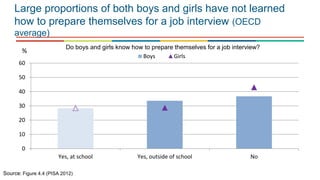
Yes, at school Yes, outside of school No
Boys Girls
%
Large proportions of both boys and girls have not learned
how to prepare themselves for a job interview (OECD
average)
Source: Figure 4.4 (PISA 2012)
Do boys and girls know how to prepare themselves for a job interview?
0
10
20
30
40
50
60
70
80
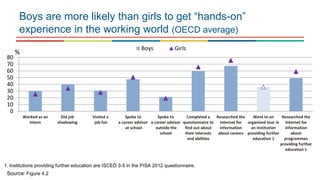
Worked as an
intern
Did job
shadowing
Visited a
job fair
Spoke to
a career advisor
at school
Spoke to
a career advisor
outside the
school
Completed a
questionnaire to
find out about
their interests
and abilities
Researched the
Internet for
information
about careers
Went to an
organised tour in
an institution
providing further
education 1
Researched the
Internet for
information
about
programmes
providing further
education 1
Boys Girls
%
Boys are more likely than girls to get “hands-on”
experience in the working world (OECD average)
Source: Figure 4.2
1. Institutions providing further education are ISCED 3-5 in the PISA 2012 questionnaire.
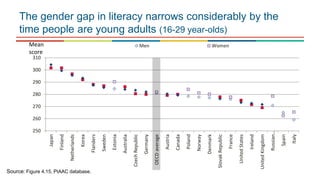
250
260
270
280
290
300
310
Japan
Finland
Netherlands
Korea
Flanders
Sweden
Estonia
Australia
CzechRepublic
Germany
OECDaverage
Austria
Canada
Poland
Norway
Denmark
SlovakRepublic
France
UnitedStates
Ireland
UnitedKingdom
Russian…
Spain
Italy
Men WomenMean
score
The gender gap in literacy narrows considerably by the
time people are young adults (16-29 year-olds)
Source: Figure 4.15, PIAAC database.
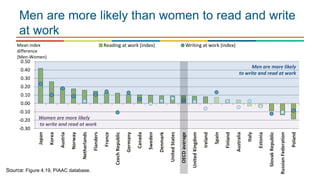
-0.30
-0.20
-0.10
0.00
0.10
0.20
0.30
0.40
0.50
Japan
Korea
Austria
Norway
Netherlands
Flanders
France
CzechRepublic
Germany
Canada
Sweden
Denmark
UnitedStates
OECDaverage
UnitedKingdom
Ireland
Spain
Finland
Australia
Italy
Estonia
SlovakRepublic
RussianFederation
Poland
Reading at work (index) Writing at work (index)Mean index
difference
(Men-Women)
Men are more likely than women to read and write
at work
Source: Figure 4.19, PIAAC database.
Men are more likely
to write and read at work
Women are more likely
to write and read at work
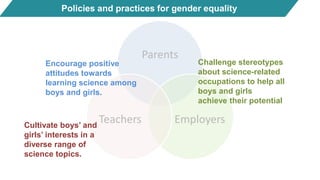
Parents
EmployersTeachers
Challenge stereotypes
about science-related
occupations to help all
boys and girls
achieve their potential
Encourage positive
attitudes towards
learning science among
boys and girls.
Cultivate boys’ and
girls’ interests in a
diverse range of
science topics.
Policies and practices for gender equality
THANK YOU
Find out more about PISA at
www. oecd.org/pisa
• All national and international publications
• The complete micro-level database

Gender Differences in Education

Editor's Notes

  • #23 Option 2, with countries that can be selected, but we cannot see if dif between boys and girls is significant.
  • #30 NOT ALL COUNTRIES HAVE AVAILABLE INFORMATION BECAUSE IT IS EC QUESTIONNAIRE!
  • #31 Slide 43 of the gender report (symbol for Women in Italy added)