LIBRARY RESOURCES &
SEARCH TIPS
Jamie Dwyer
Research Coach (aka Librarian)
jamied@uic.edu
Objectives
• Navigate to appropriate library resources
• Distinguish between types of scientific literature
• Use criteria to evaluate an information source
• Apply keywords to search PubMed effectively
• Describe the basics of AMA Style
• Explain the value of citation management software
Audience Question:
How can I find resources for Nutrition research?
Lion
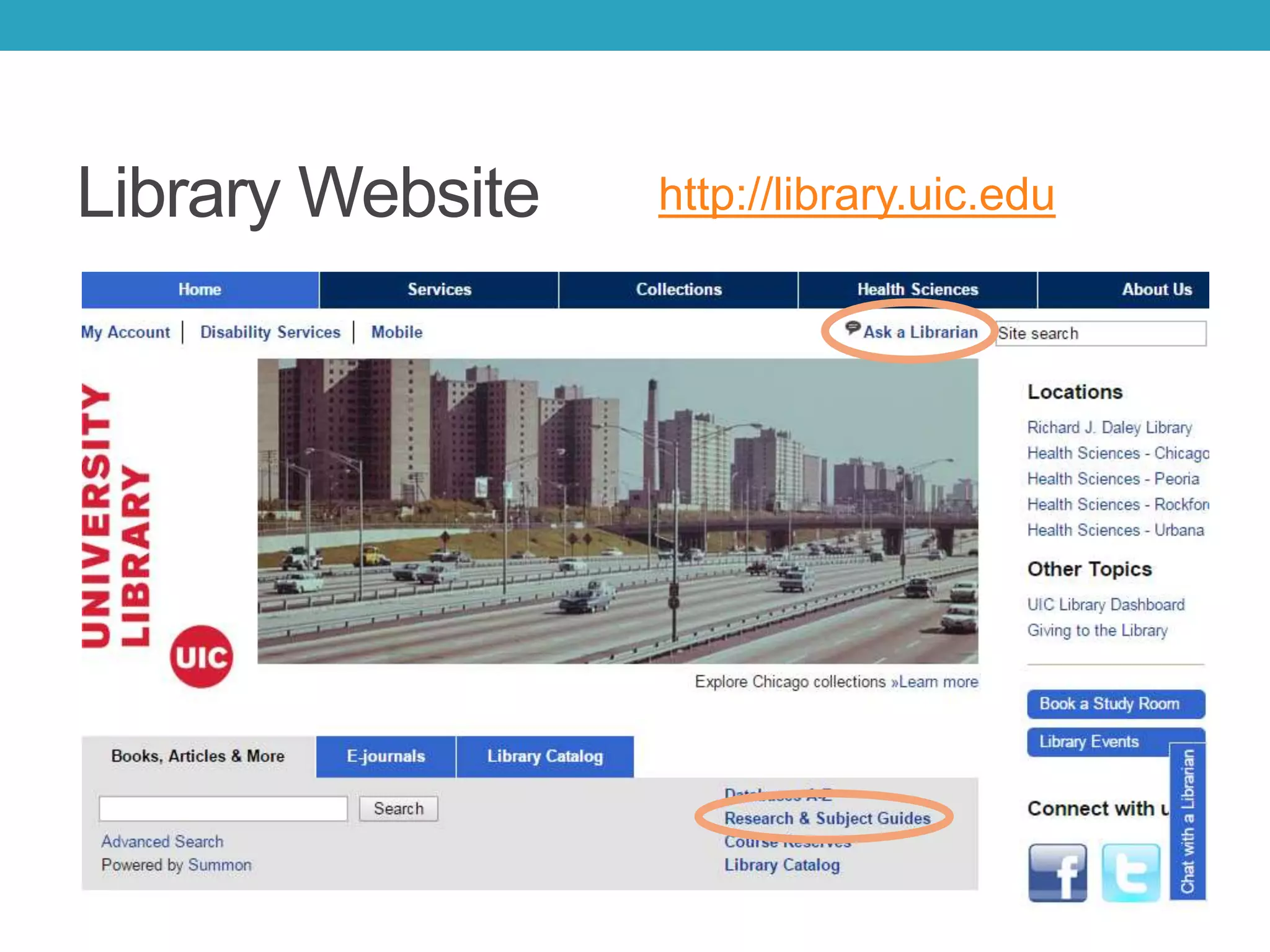
Library Website http://library.uic.edu
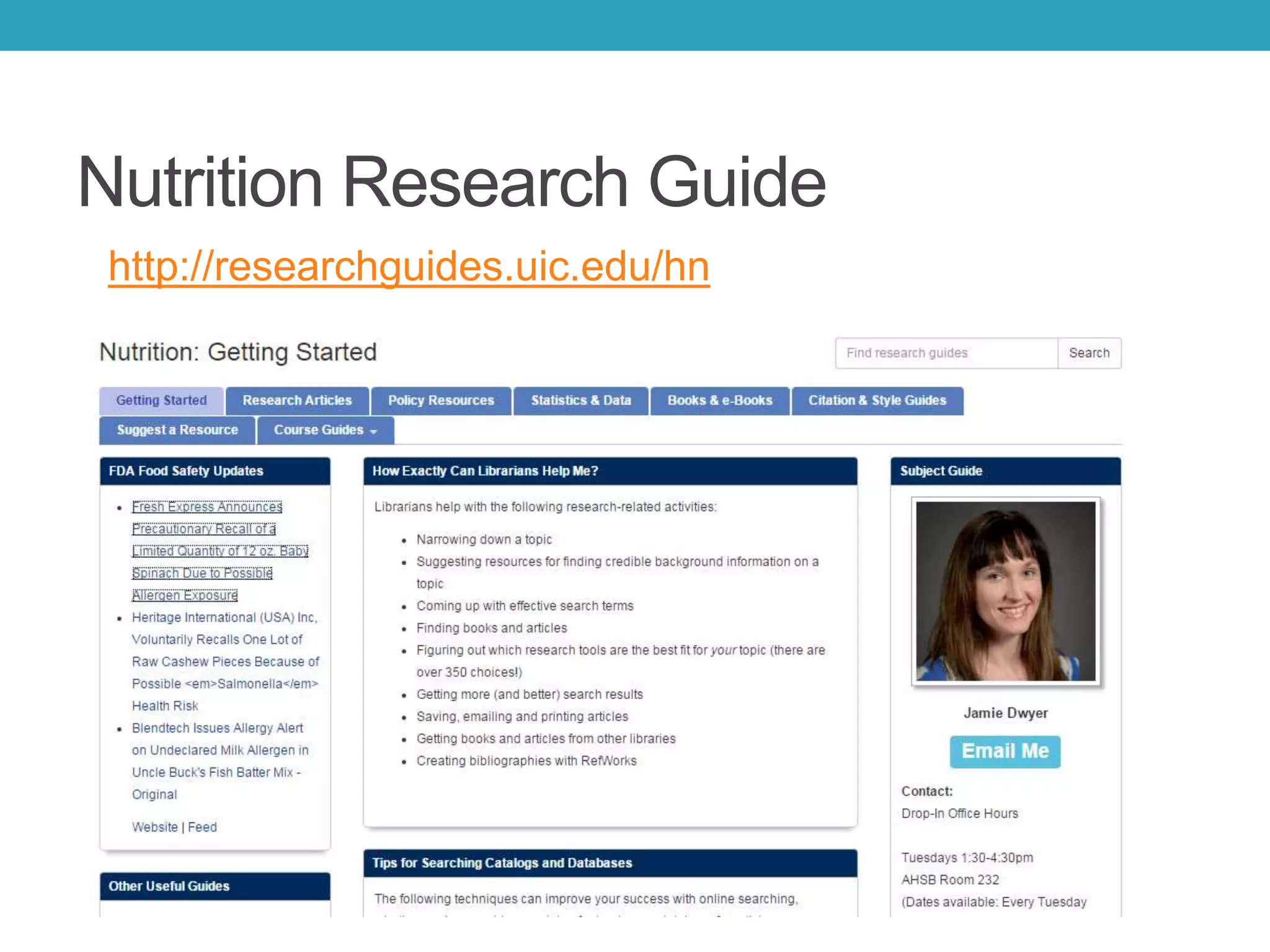
Nutrition Research Guide
http://researchguides.uic.edu/hn
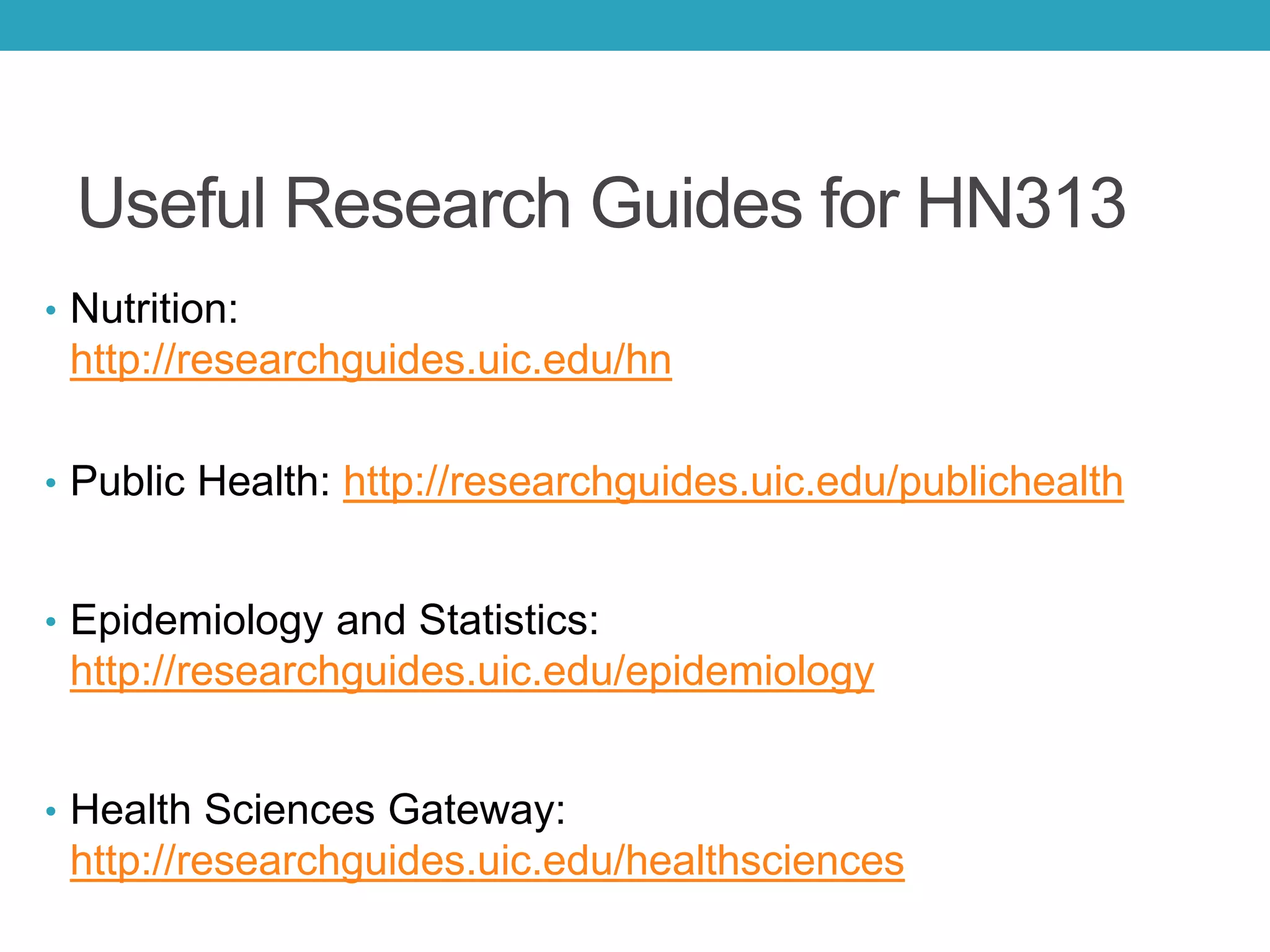
Useful Research Guides for HN313
• Nutrition:
http://researchguides.uic.edu/hn
• Public Health: http://researchguides.uic.edu/publichealth
• Epidemiology and Statistics:
http://researchguides.uic.edu/epidemiology
• Health Sciences Gateway:
http://researchguides.uic.edu/healthsciences
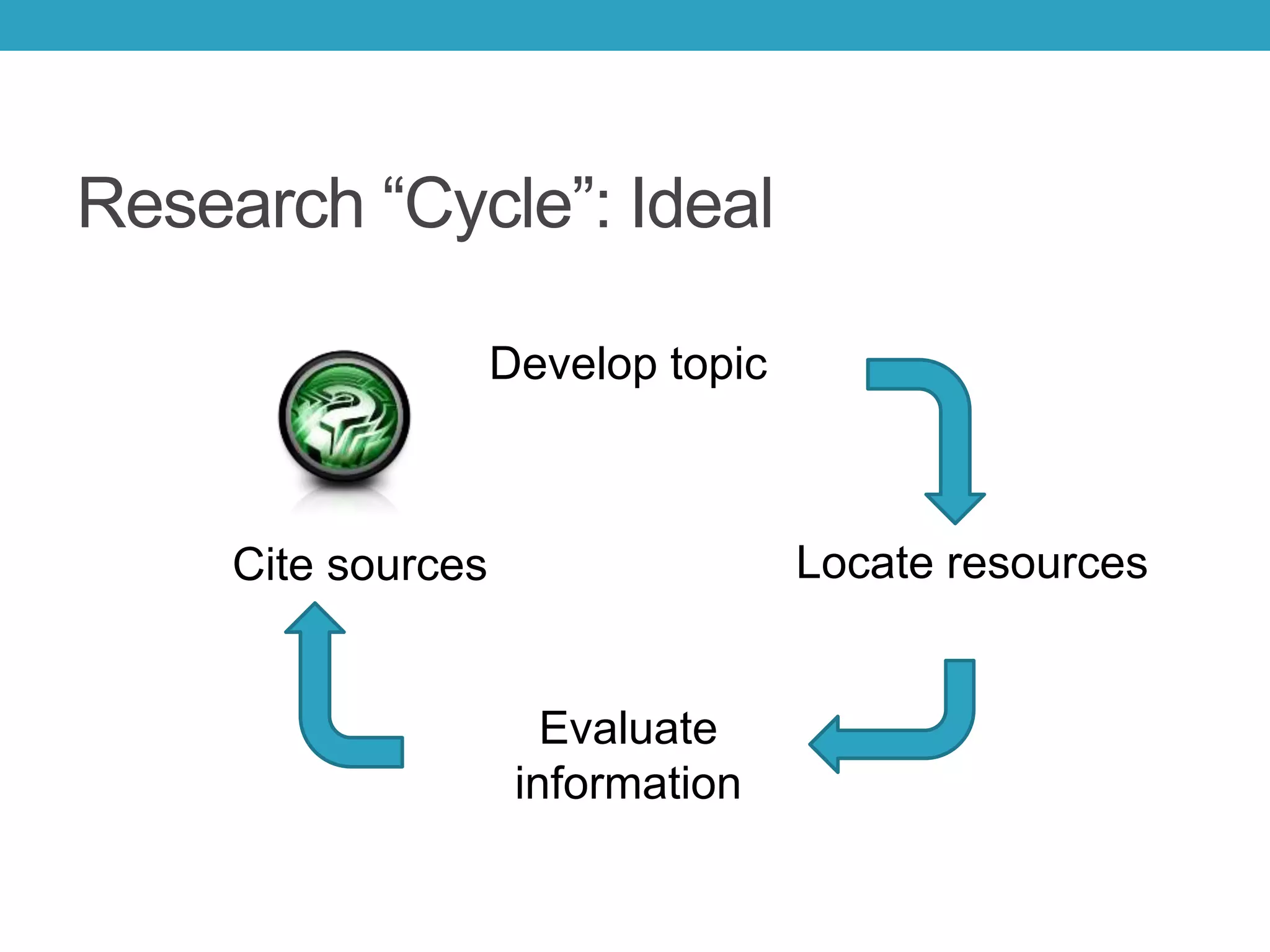
Research “Cycle”: Ideal
Develop topic
Locate resources
Evaluate
information
Cite sources
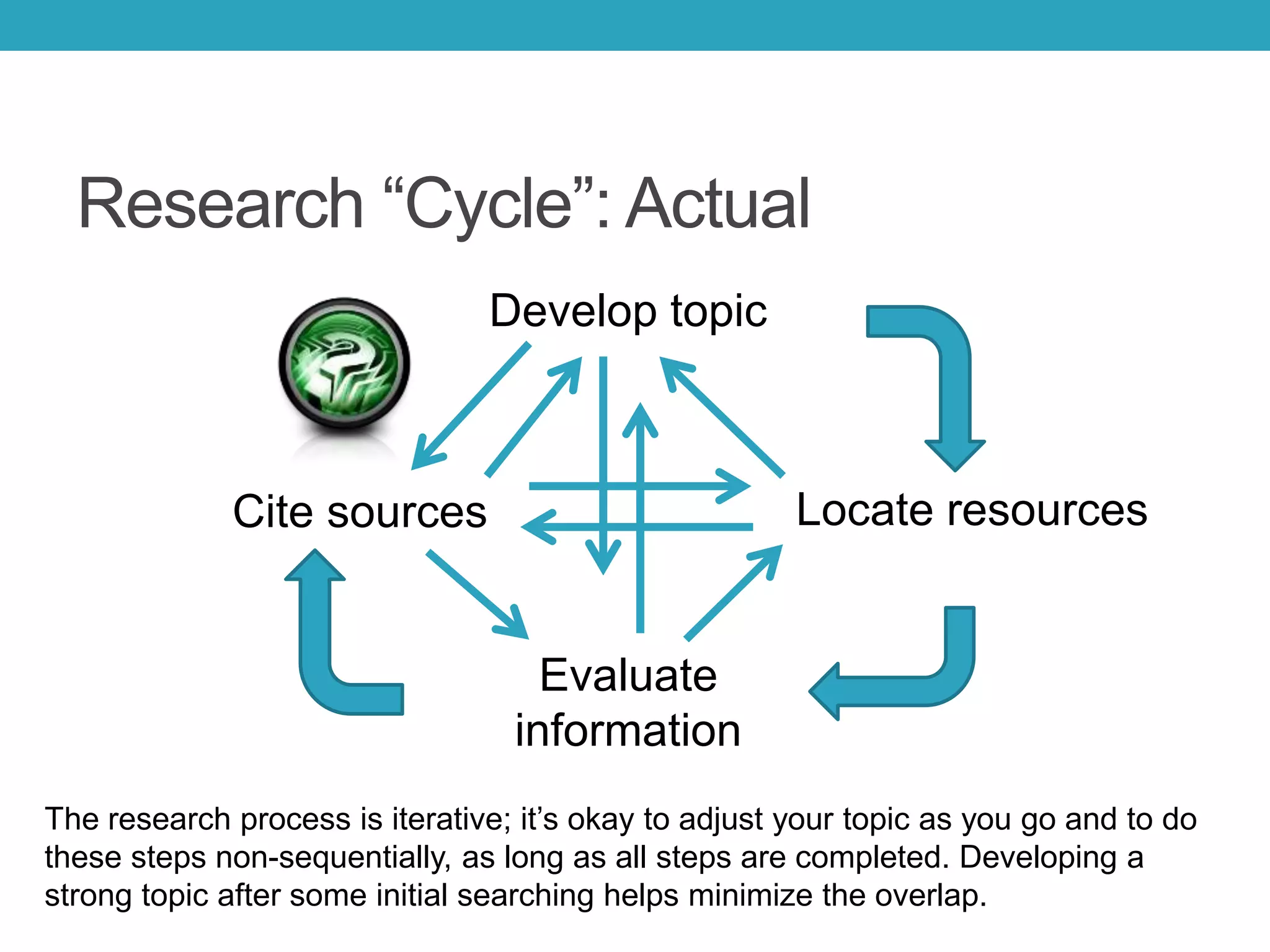
Research “Cycle”: Actual
Develop topic
Locate resources
Evaluate
information
Cite sources
The research process is iterative; it’s okay to adjust your topic as you go and to do
these steps non-sequentially, as long as all steps are completed. Developing a
strong topic after some initial searching helps minimize the overlap.
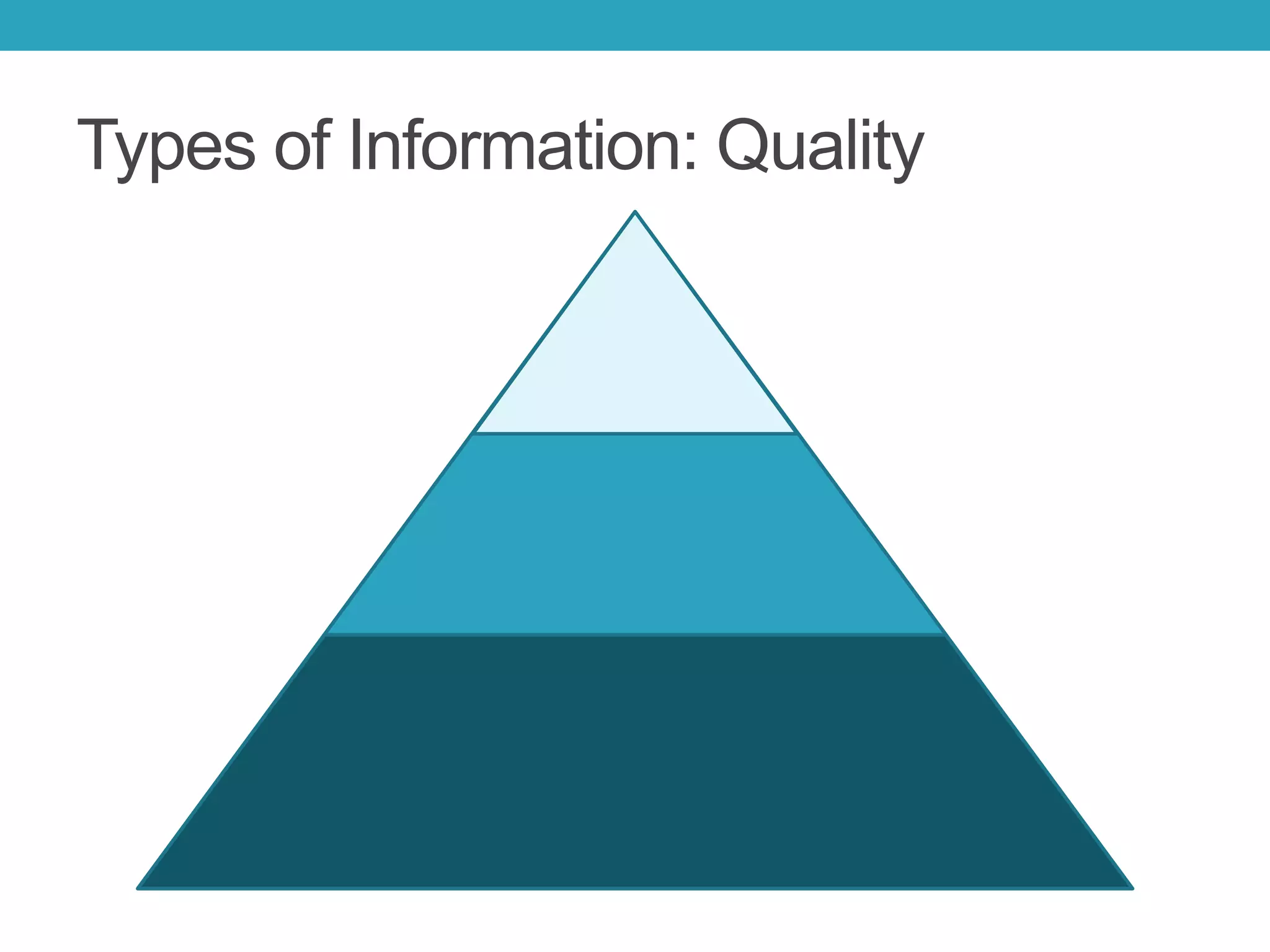
Types of Information: Quality
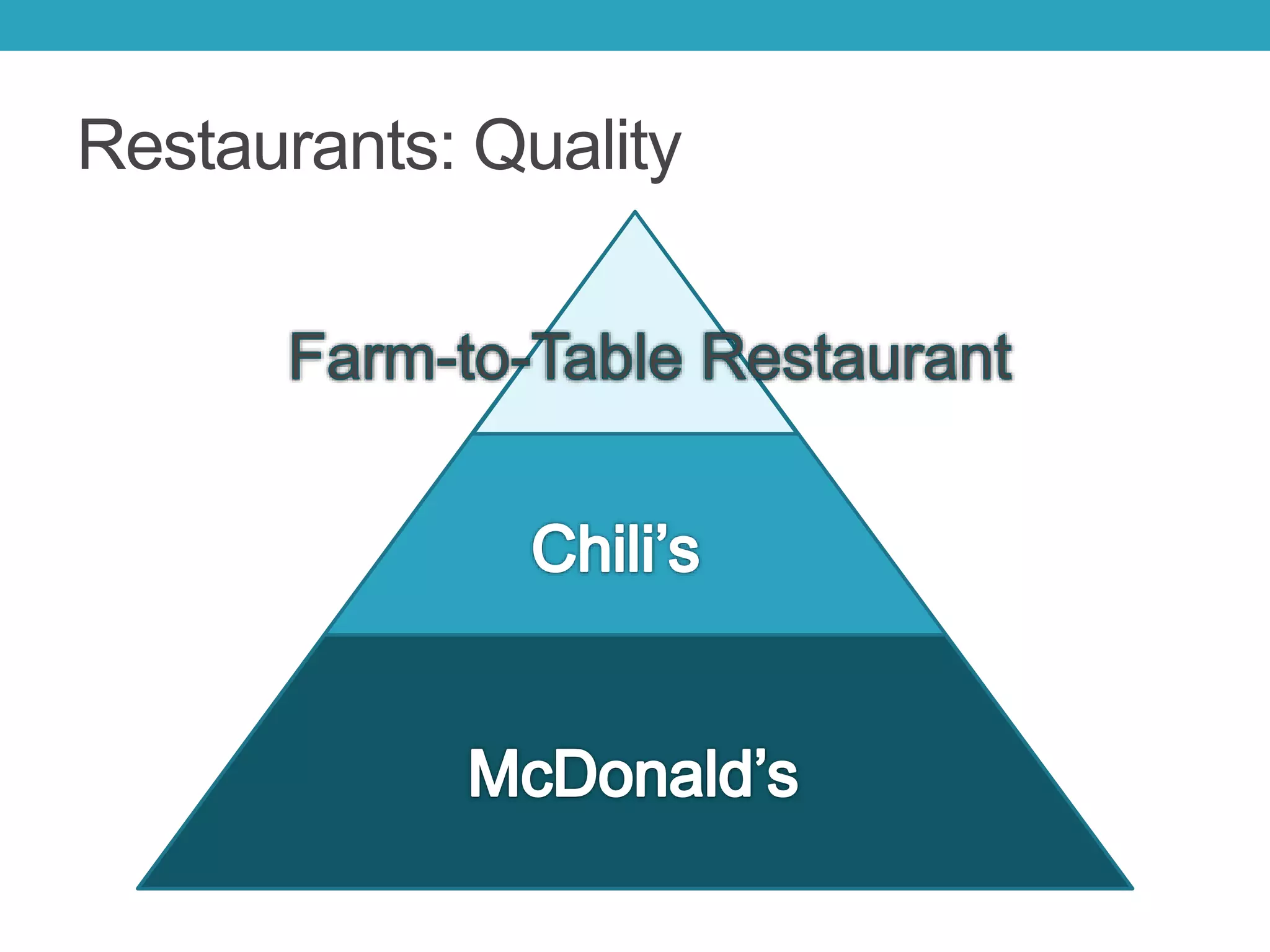
Restaurants: Quality
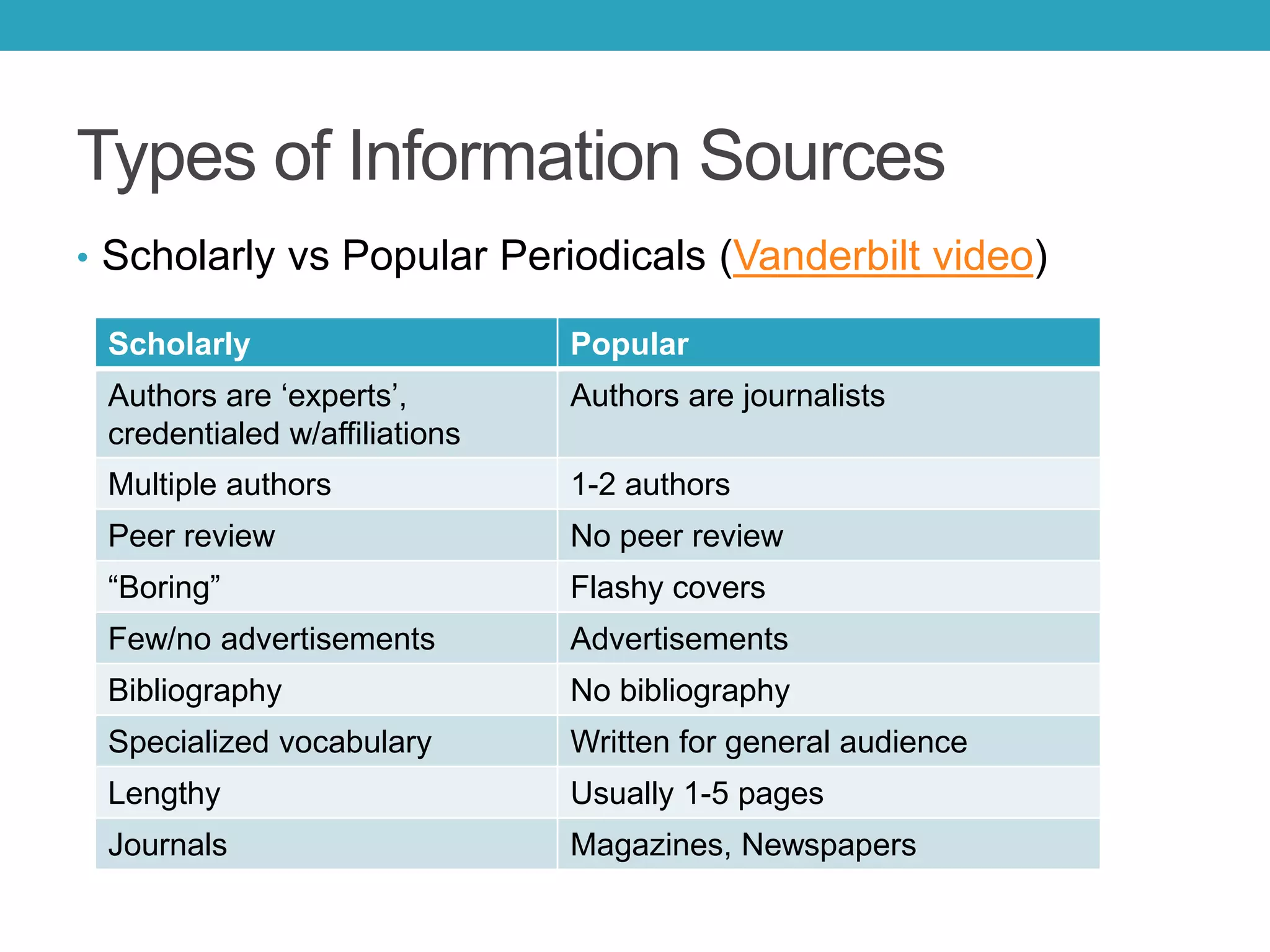
Types of Information Sources
• Scholarly vs Popular Periodicals (Vanderbilt video)
Scholarly Popular
Authors are ‘experts’,
credentialed w/affiliations
Authors are journalists
Multiple authors 1-2 authors
Peer review No peer review
“Boring” Flashy covers
Few/no advertisements Advertisements
Bibliography No bibliography
Specialized vocabulary Written for general audience
Lengthy Usually 1-5 pages
Journals Magazines, Newspapers
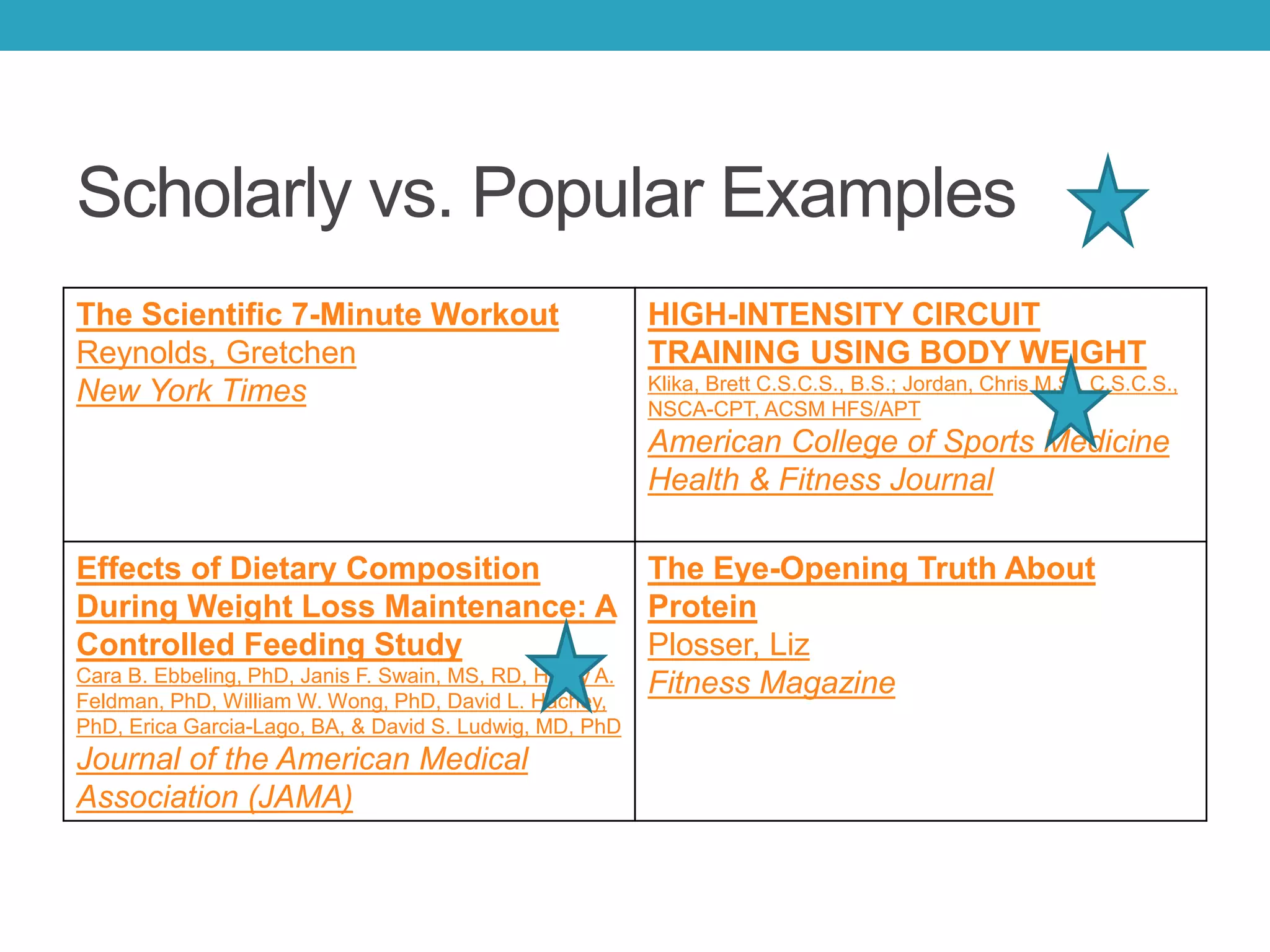
Scholarly vs. Popular Examples
The Scientific 7-Minute Workout
Reynolds, Gretchen
New York Times
HIGH-INTENSITY CIRCUIT
TRAINING USING BODY WEIGHT
Klika, Brett C.S.C.S., B.S.; Jordan, Chris M.S., C.S.C.S.,
NSCA-CPT, ACSM HFS/APT
American College of Sports Medicine
Health & Fitness Journal
Effects of Dietary Composition
During Weight Loss Maintenance: A
Controlled Feeding Study
Cara B. Ebbeling, PhD, Janis F. Swain, MS, RD, Henry A.
Feldman, PhD, William W. Wong, PhD, David L. Hachey,
PhD, Erica Garcia-Lago, BA, & David S. Ludwig, MD, PhD
Journal of the American Medical
Association (JAMA)
The Eye-Opening Truth About
Protein
Plosser, Liz
Fitness Magazine
Debate Assignment Example
• Which side (Pro or Con) has included more
scholarly work?
(Live Poll)
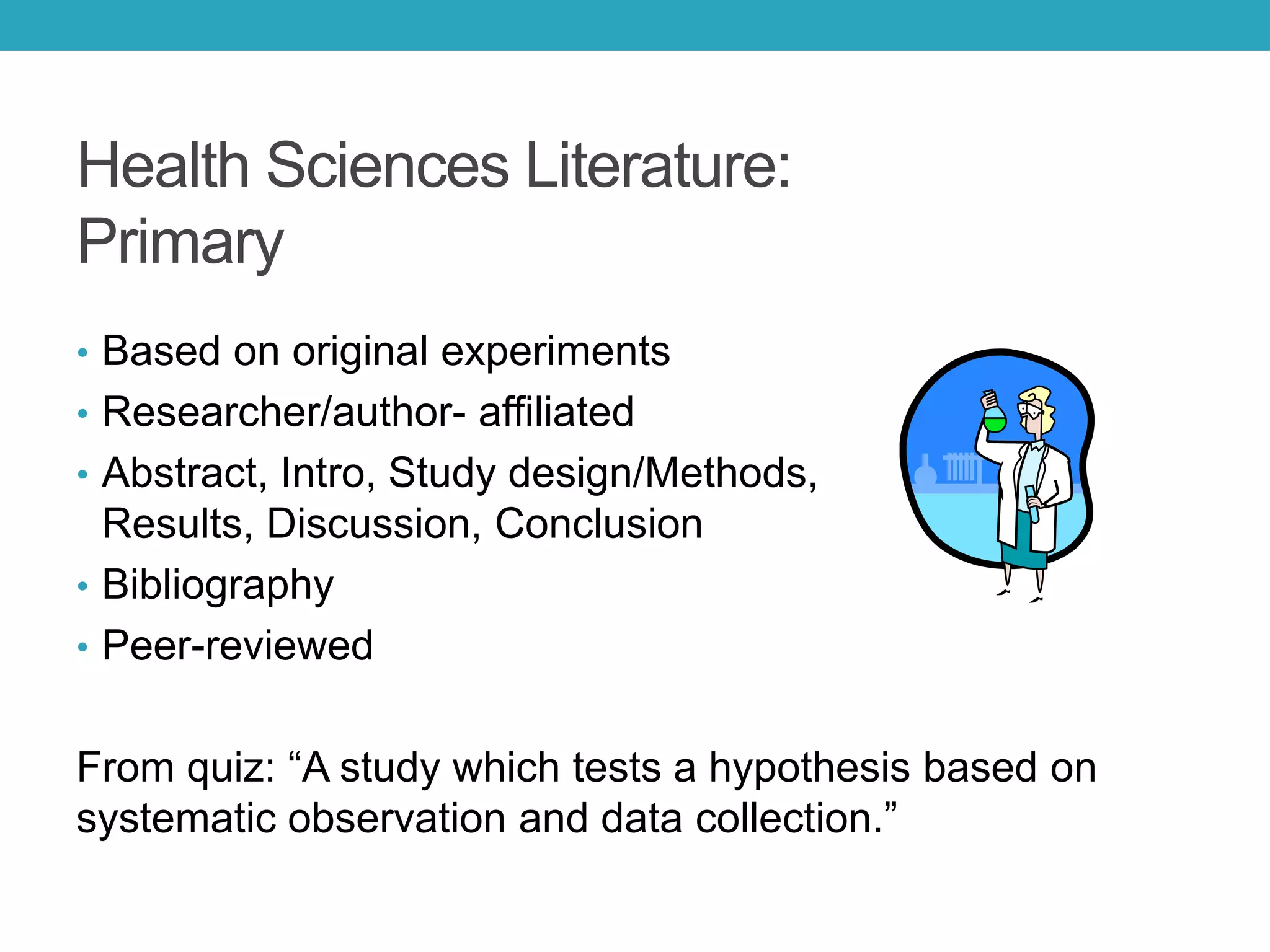
Health Sciences Literature:
Primary
• Based on original experiments
• Researcher/author- affiliated
• Abstract, Intro, Study design/Methods,
Results, Discussion, Conclusion
• Bibliography
• Peer-reviewed
From quiz: “A study which tests a hypothesis based on
systematic observation and data collection.”
Health Sciences Literature:
Secondary
• Synthesized information from original experiments
• Researcher/author- affiliated
• “Review”
• Focused question
• Bibliography
• Peer-reviewed
• Literature Review
From quiz: “Summarize, synthesize, and evaluate what the
scientific community has discovered about a specific topic
or question.”
Primary & Secondary Literature
• Primary (original materials by researchers)
• Original research articles- Clinical trial reports, cohort
studies, case series
• Theses, conference proceedings/papers, reports,
patents
• Secondary (interpretation/evaluation/synthesis)
• Systematic reviews, meta-analyses, evidence
summary, practice guidelines
Tertiary Literature
• Provides an overview of key research findings
• Good for background information
• Don’t often include substantial in-text citations
but sometimes have a bibliography
• Usually written for a more general audience
(popular)
• Examples include:
• Textbooks
• Encyclopedias
• Magazines, Newspapers
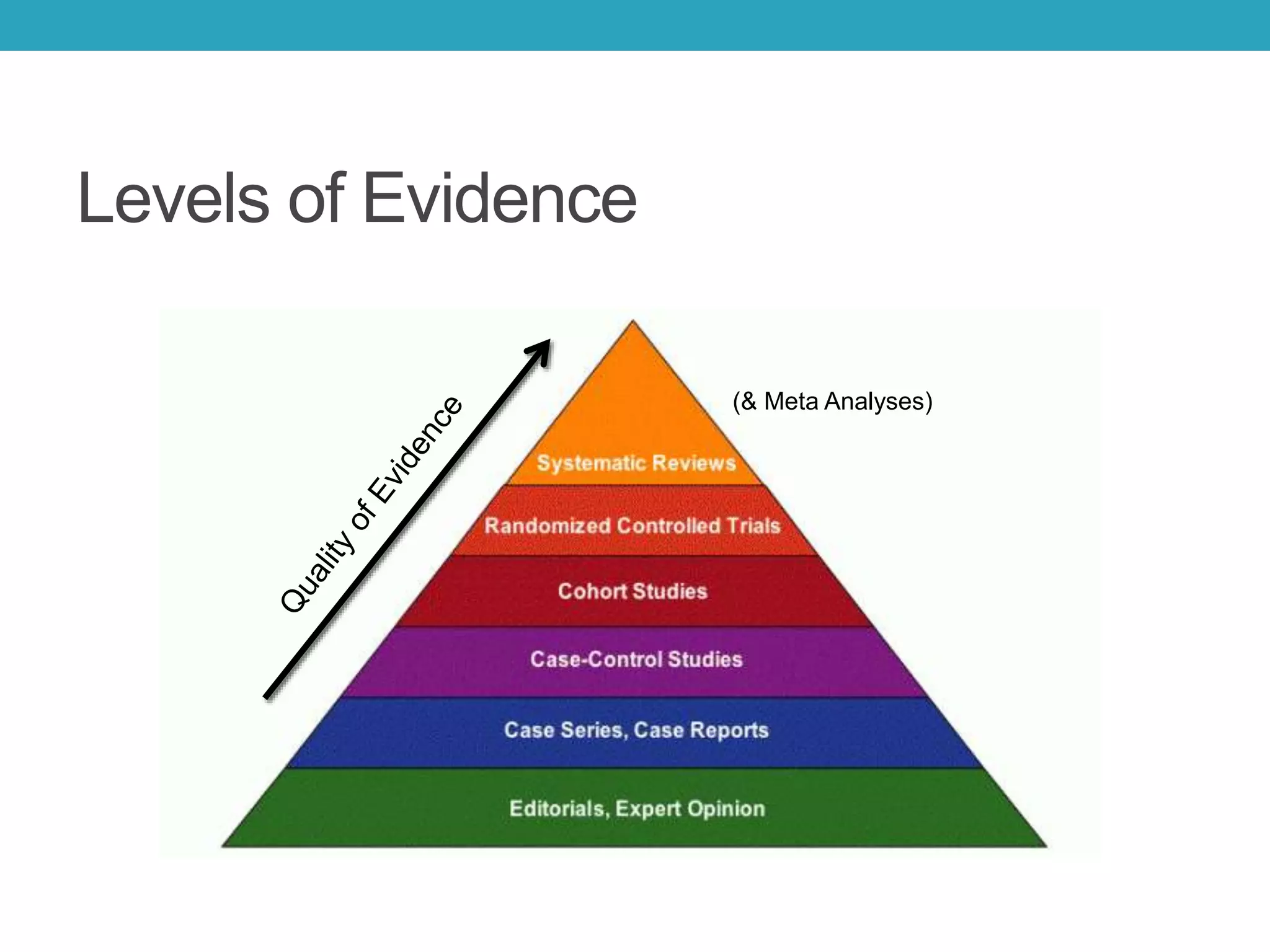
Levels of Evidence
(& Meta Analyses)
Debate Assignment Example
The following is from the reference list for the Pro side:
Contribution of food prices and diet cost to socioeconomic
disparities in diet quality and health: a systematic review
and analysis.
Nutrition Reviews
• Would you consider this to be primary, secondary, or
tertiary literature?
(Live Poll)
Debate Assignment Example
The following is from the reference list for the Pro side:
In Defense of Farm Subsidies
Stone Soup
• Would you consider this to be primary, secondary, or
tertiary literature?
(Live Poll)
Reading Scientific Literature
1. Develop a question
2. Skimming is okay first pass!
3. Abstract, Intro, Conclusion, Figures
4. Methods, Discussion
5. Read over more closely
6. Evaluate quality of study
Three methods:
https://www.youtube.com/watch?v=3SmOq6gENPM
https://www.youtube.com/watch?v=SKxm2HF_-k0
https://www.youtube.com/watch?v=EEVftUdfKtQ
Reading Scientific Literature
Questions to ask as you read critically:
• What is the argument/thesis?
• Are the methods appropriate to answer the question being
asked?
• Was the study completed effectively?
• What answers did the researchers find? Are these
findings presented accurately?
• How does this fit into your research question?
Evaluation Criteria
C.R.A.A.P.
• Currency
• Relevance
• Authority
• Accuracy
• Purpose
CSU-Chico Tutorial
CSU-Chico Handout
The 5 W’s
• Who
• What
• When
• Where
• Why
• (How)
CRAAP Handout Activity
• Looking at one of the two articles you have, work with a
partner to work through the list for Accuracy & Purpose.
• Jot down any concerns you have or any strengths you
see in the article.
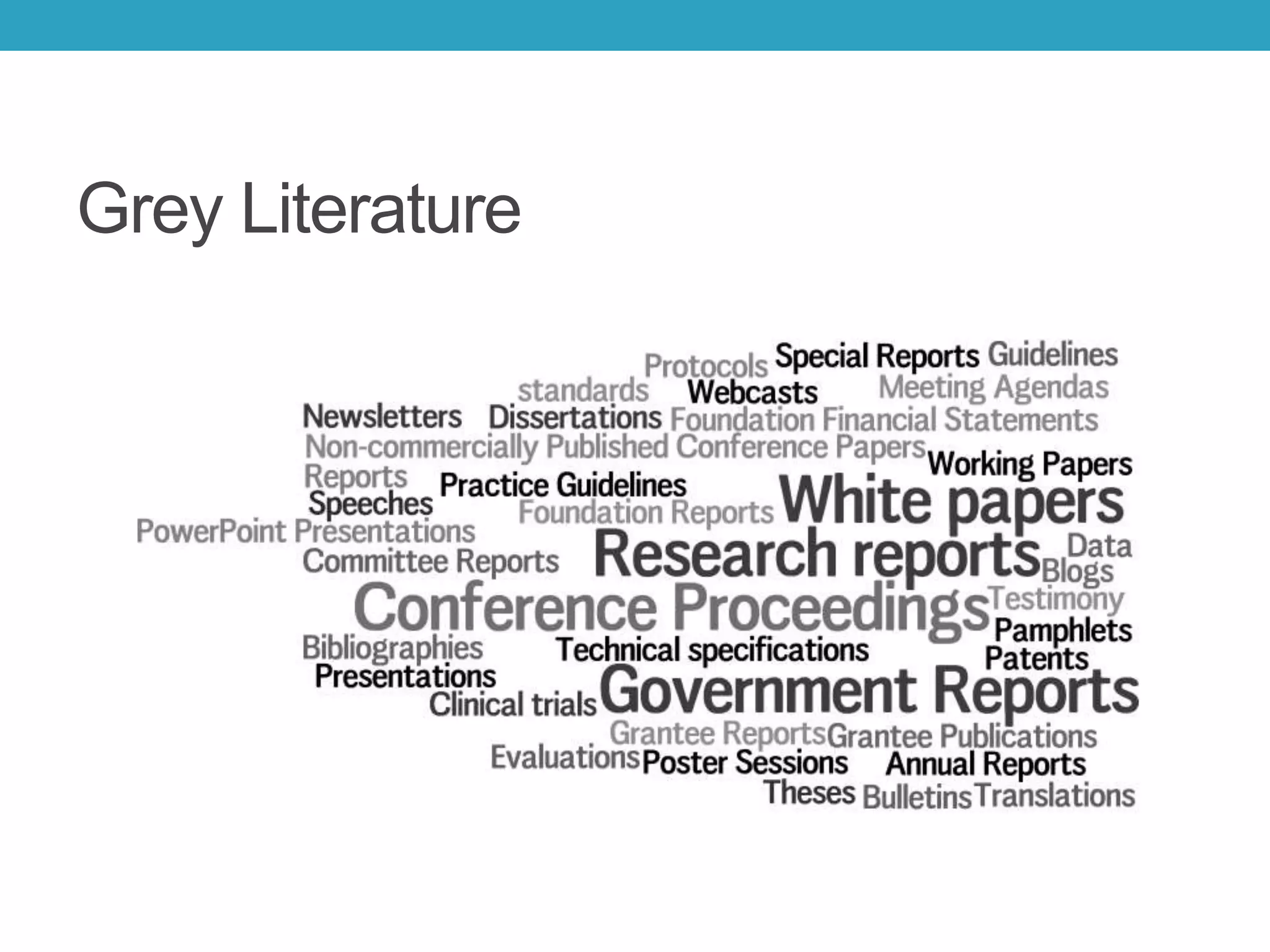
Grey Literature
Grey Literature
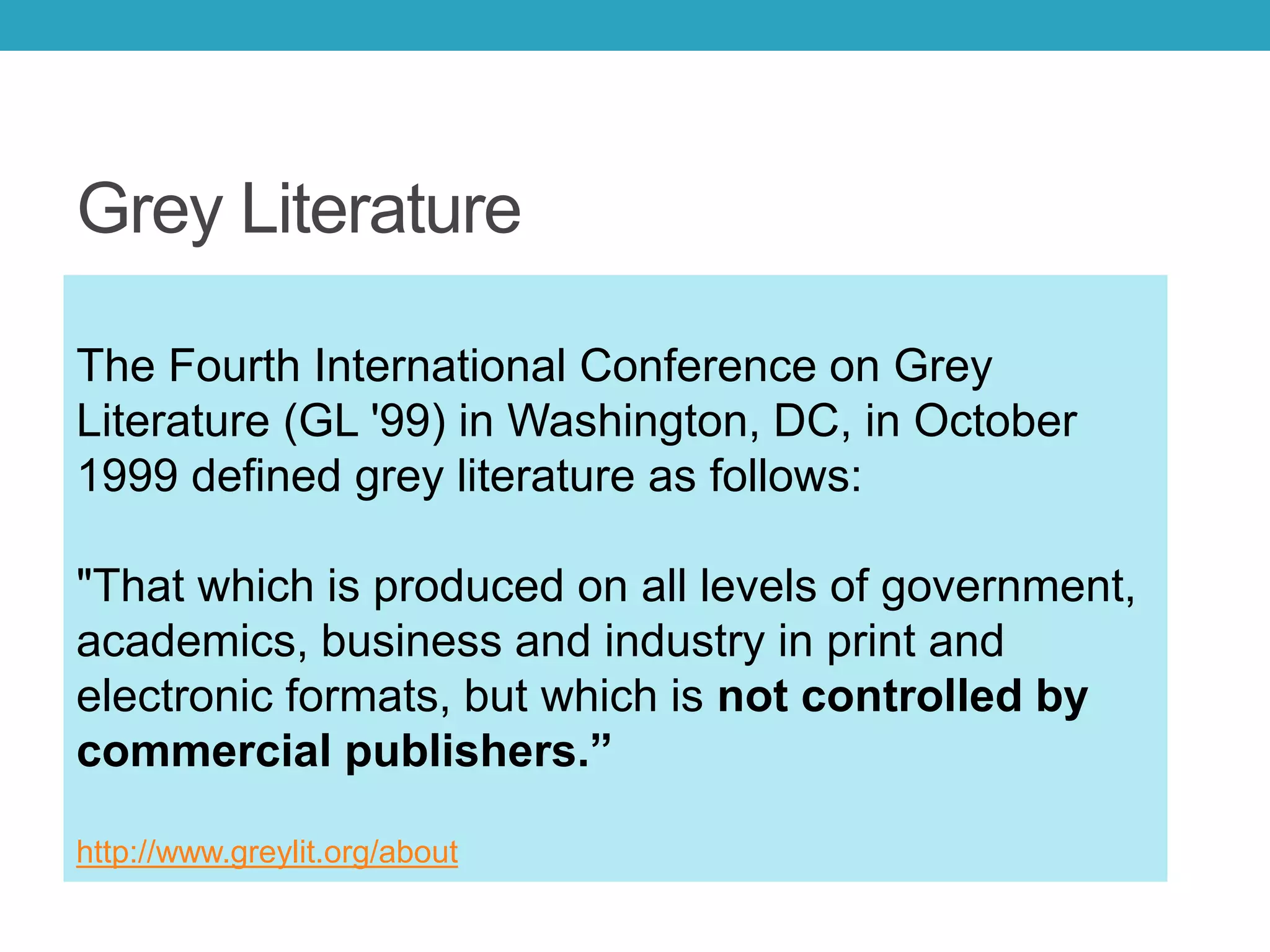
The Fourth International Conference on Grey
Literature (GL '99) in Washington, DC, in October
1999 defined grey literature as follows:
"That which is produced on all levels of government,
academics, business and industry in print and
electronic formats, but which is not controlled by
commercial publishers.”
http://www.greylit.org/about
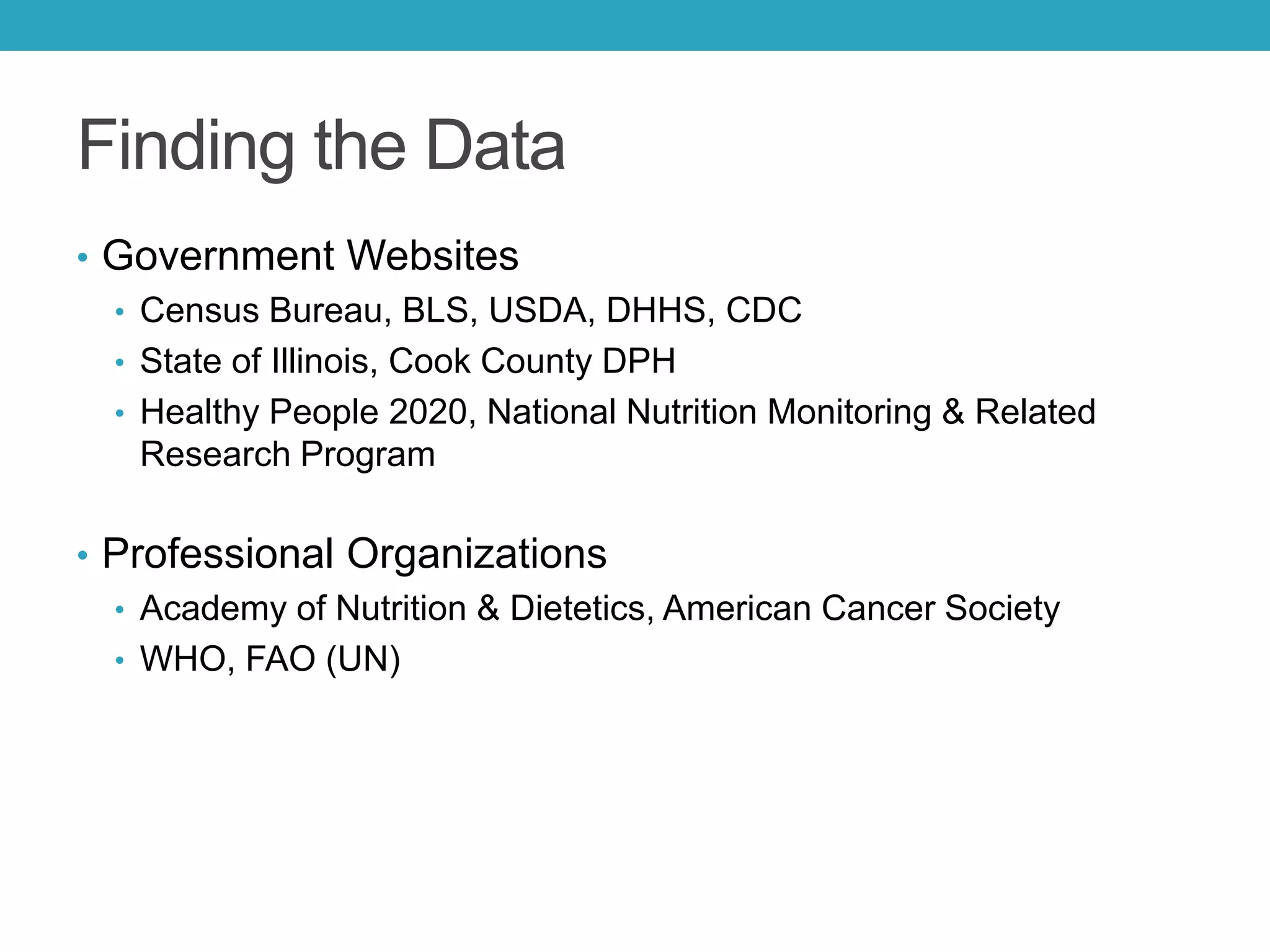
Finding the Data
• Government Websites
• Census Bureau, BLS, USDA, DHHS, CDC
• State of Illinois, Cook County DPH
• Healthy People 2020, National Nutrition Monitoring & Related
Research Program
• Professional Organizations
• Academy of Nutrition & Dietetics, American Cancer Society
• WHO, FAO (UN)
Finding the Data: Policy Tracking
CDC Chronic Disease State Policy Tracking System
CQ: Congressional Quarterly Researcher
Urban Institute Health Policy Center
Additional resources on HN Guide: Policy Resources
Searching the Literature
• Topic development
• Too narrow? Too broad?
• Keywords
• Key search terms, synonyms
• Search strategy
• Types of information sources? Where to look?
• Evaluation
• CRAAP test (Currency, Relevancy, Authority, Accuracy, Purpose)
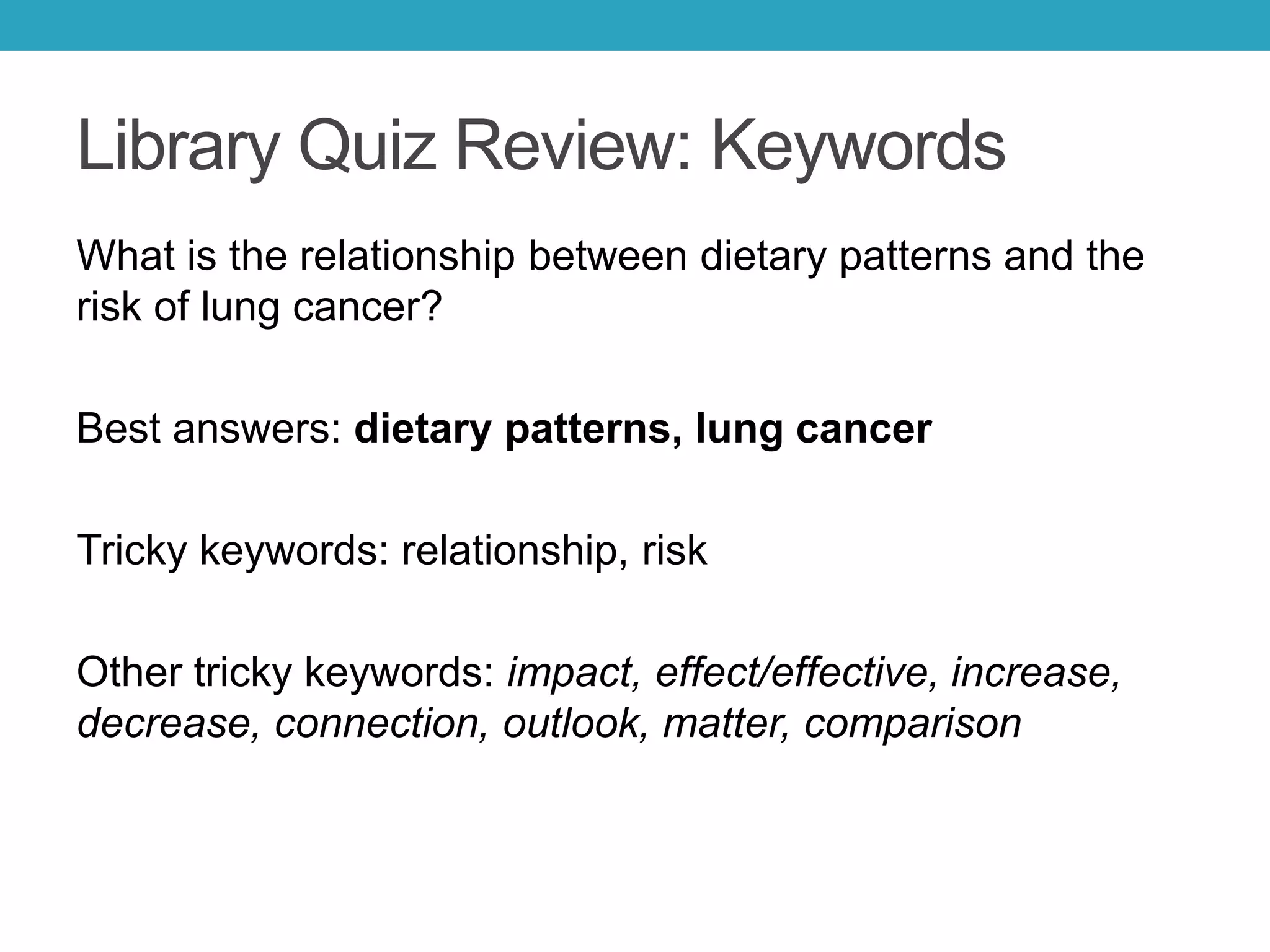
Library Quiz Review: Keywords
What is the relationship between dietary patterns and the
risk of lung cancer?
Best answers: dietary patterns, lung cancer
Tricky keywords: relationship, risk
Other tricky keywords: impact, effect/effective, increase,
decrease, connection, outlook, matter, comparison
Audience Question:
How can I keep track of my search terms?
Monkey
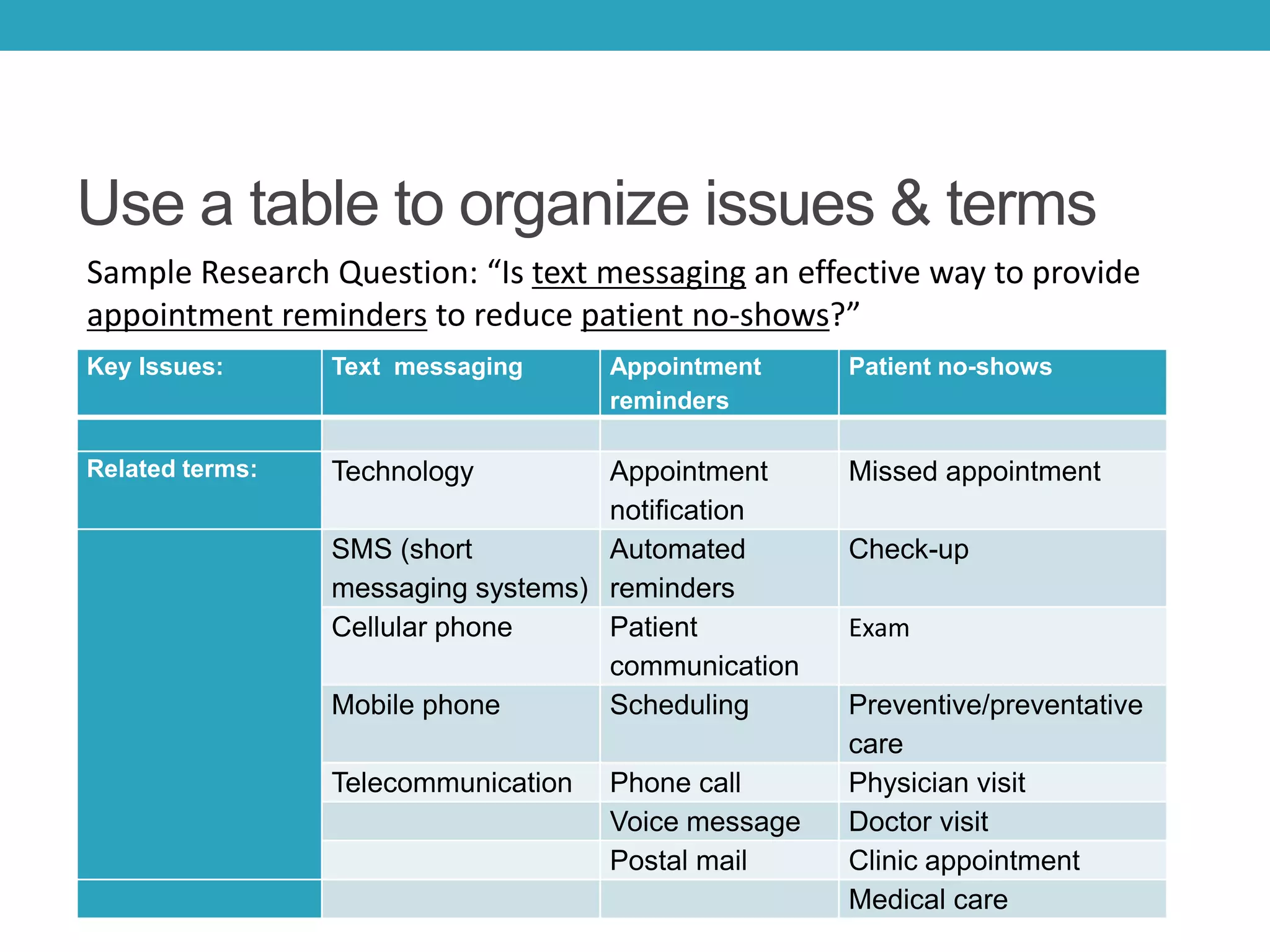
Use a table to organize issues & terms
Key Issues: Text messaging Appointment
reminders
Patient no-shows
Related terms: Technology Appointment
notification
Missed appointment
SMS (short
messaging systems)
Automated
reminders
Check-up
Cellular phone Patient
communication
Exam
Mobile phone Scheduling Preventive/preventative
care
Telecommunication Phone call Physician visit
Voice message Doctor visit
Postal mail Clinic appointment
Medical care
Sample Research Question: “Is text messaging an effective way to provide
appointment reminders to reduce patient no-shows?”
Where to look
• Who would be researching/writing about this topic?
(Industry, government, professional organizations,
academic researchers…)
• What types of information would be useful? (Statistics,
policy, guidelines, research articles, newspaper articles)
• Use the HN Research Guide to access relevant
databases/ information resources.
Citation Databases
• Index citations (and some full text) of journal articles,
books, newspapers, trade journals, etc.
• ProQuest, EBSCOHost are platforms that include many
databases within them
• When in doubt, read the descriptions & Ask a Librarian if
you get stuck!
• What about Google Scholar?
• Does not index all journal articles on the internet. Many are behind
paywalls and do not live on the “open web.”
• Can be useful in identifying useful research articles, particularly for
multi- or interdisciplinary topics.
• Not a one-stop shop. No single database should be searched!
• Start at Library Website for full text.
Pre-test review
• If you were looking for scholarly journal articles on the
relationship between dietary patterns and risk of lung
cancer, which databases would you consult?
• Best Answers:
• PubMed (Over 24 million MEDLINE citations)
• CINAHL (Nursing & Allied Health)
• EMBASE (Great for drug information, scope beyond US)
Other top mentions:
• JSTOR (Some health sciences journals, best as ‘archive’)
• Academic Search Complete (Multidisciplinary, good for overview)
Controlled vocabulary
• “Preferred” terms unique to each database
• Thesaurus, Headings, Terms, Vocabulary
• Standardize terminology across all articles
• Nursing vs. Breastfeeding
• Social Media vs. Internet
• Kneecap vs. Patella
• Articles are indexed (“tagged”) with subject headings to
help you determine relevancy.
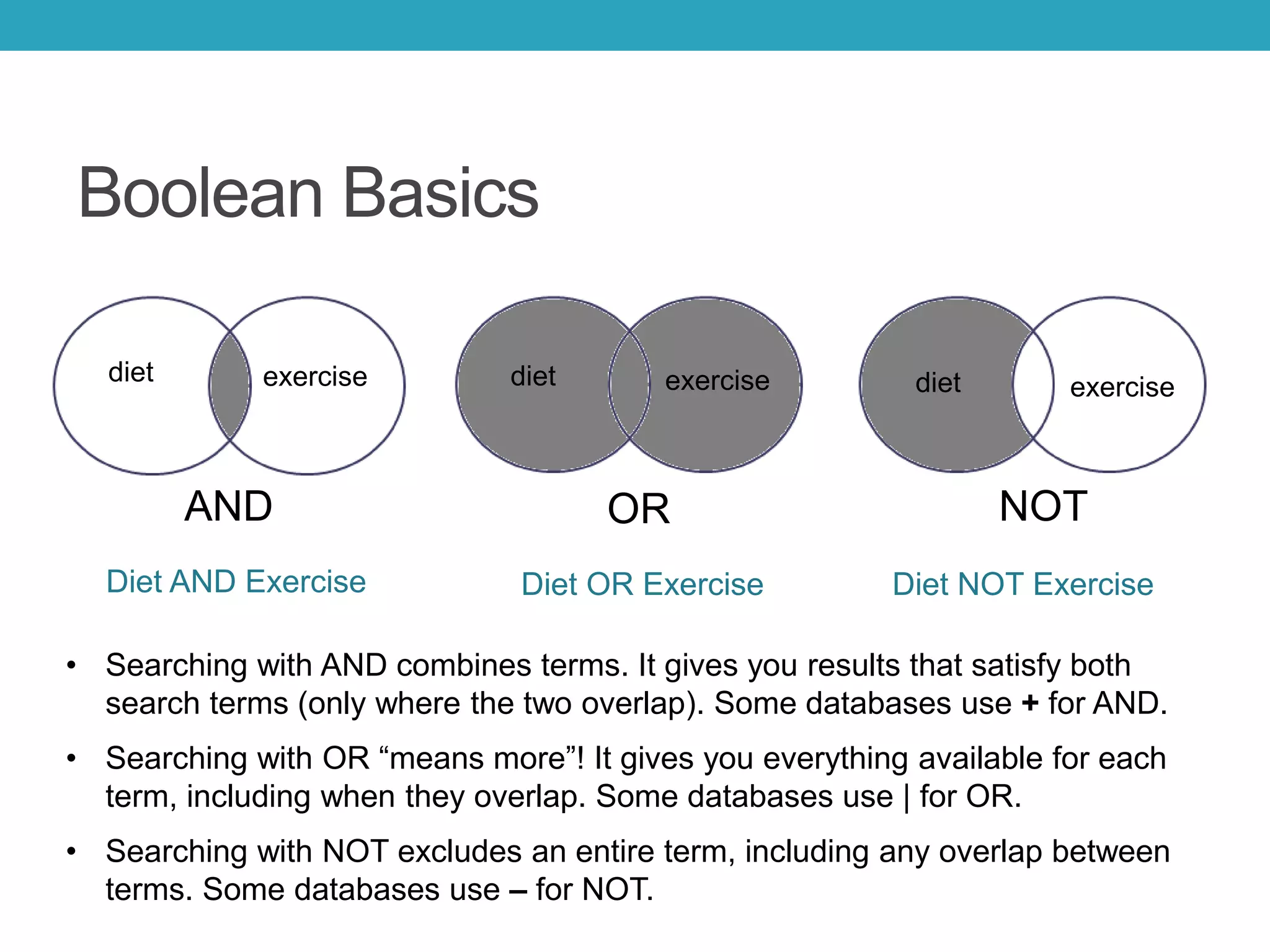
Boolean Basics
diet exercise
OR
Diet OR ExerciseDiet AND Exercise
AND
diet exercise
Diet NOT Exercise
NOT
diet exercise
• Searching with AND combines terms. It gives you results that satisfy both
search terms (only where the two overlap). Some databases use + for AND.
• Searching with OR “means more”! It gives you everything available for each
term, including when they overlap. Some databases use | for OR.
• Searching with NOT excludes an entire term, including any overlap between
terms. Some databases use – for NOT.
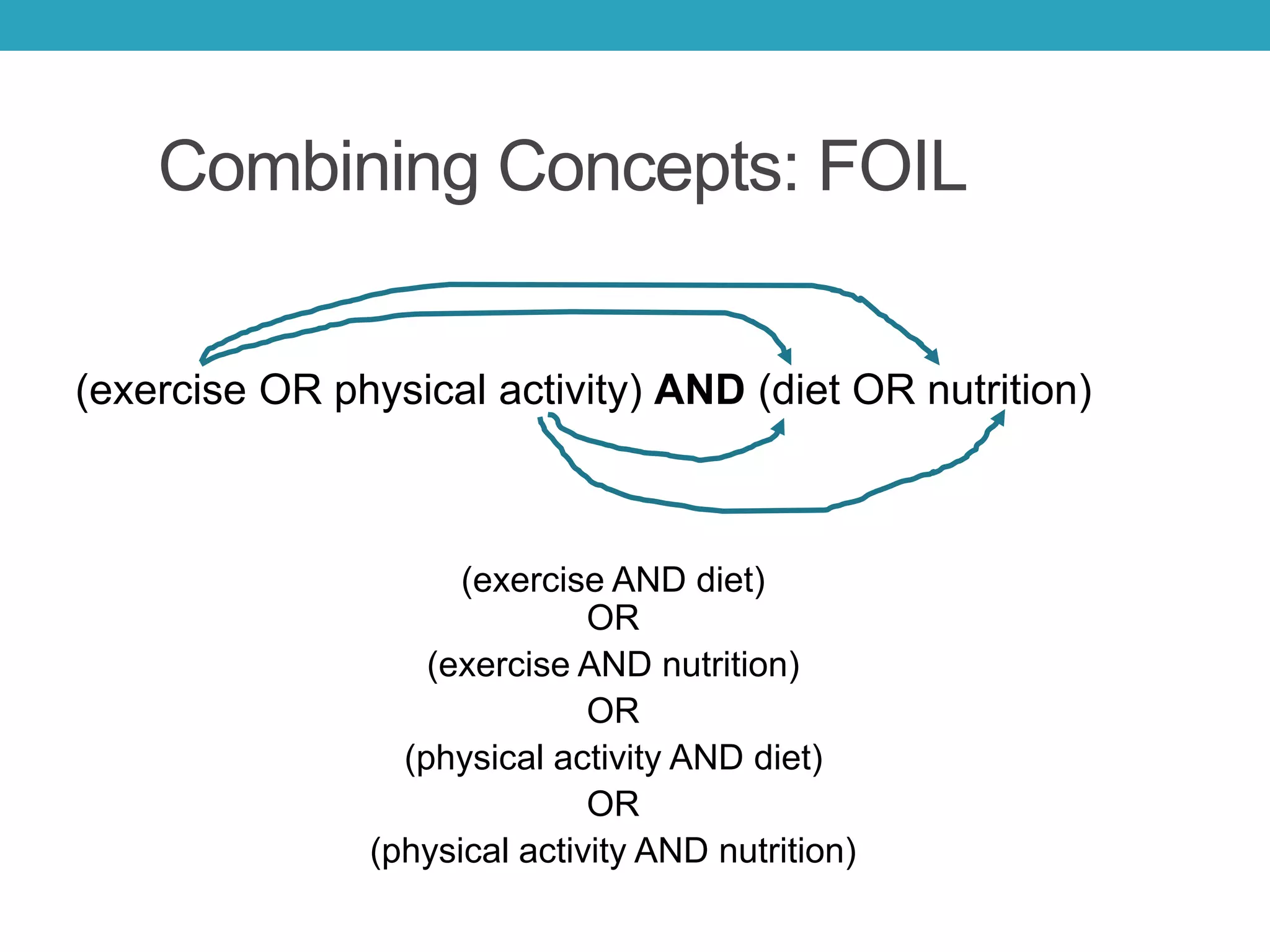
Combining Concepts: FOIL
(exercise OR physical activity) AND (diet OR nutrition)
(exercise AND diet)
OR
(exercise AND nutrition)
OR
(physical activity AND diet)
OR
(physical activity AND nutrition)
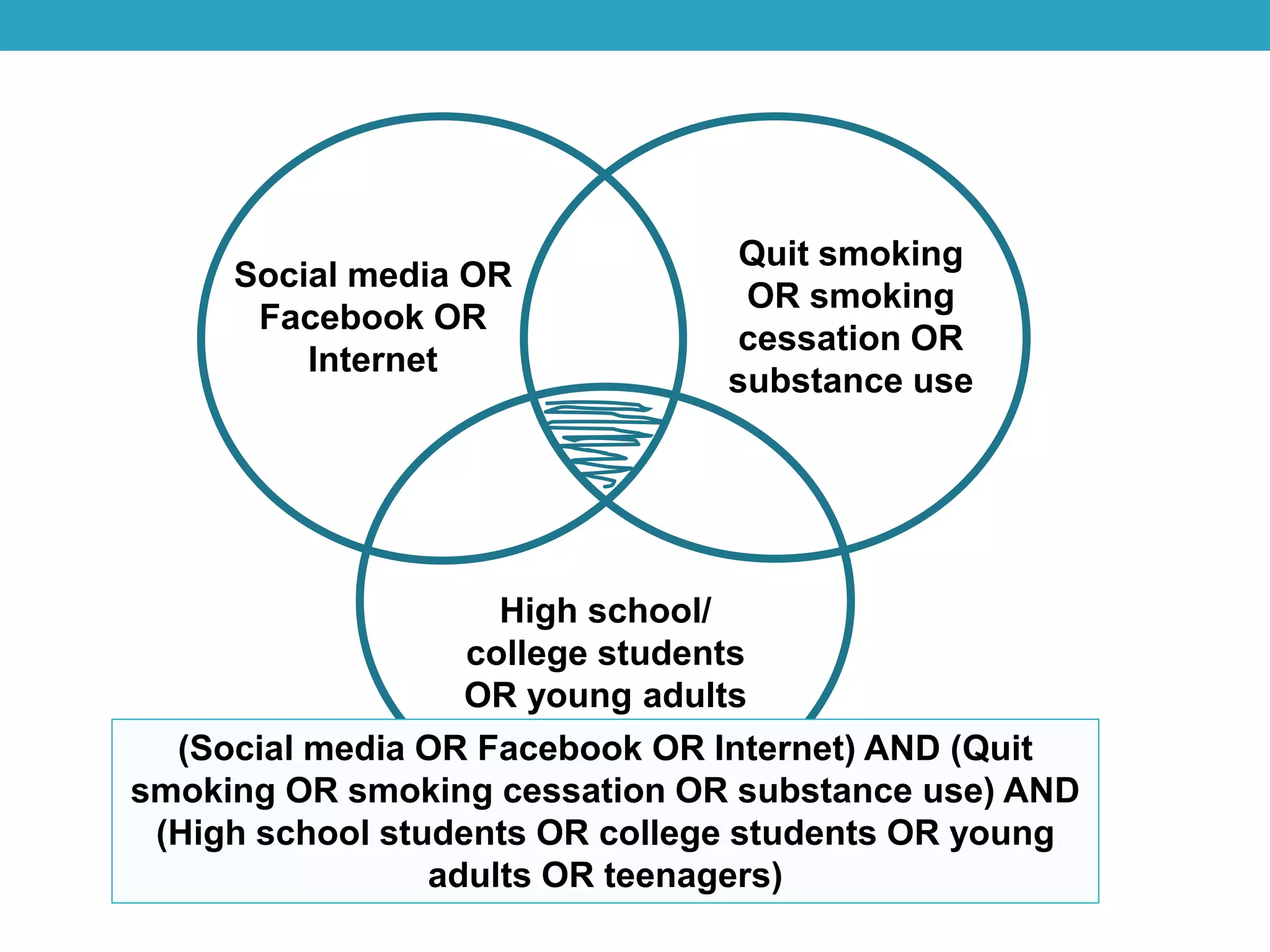
Social media OR
Facebook OR
Internet
Quit smoking
OR smoking
cessation OR
substance use
High school/
college students
OR young adults
OR teenager(Social media OR Facebook OR Internet) AND (Quit
smoking OR smoking cessation OR substance use) AND
(High school students OR college students OR young
adults OR teenagers)
Database Searching Tools
• Keyword vs. Controlled Vocabulary
Your term/database term, often “subject headings.” Mix &
match.
• Limits/Filters
Year published, language, study type, age groups, etc.
• Related Citations
“If you like this you might also like this” suggestions from
databases.
• Reference Lists
Resources used by ideal article; articles citing ideal article
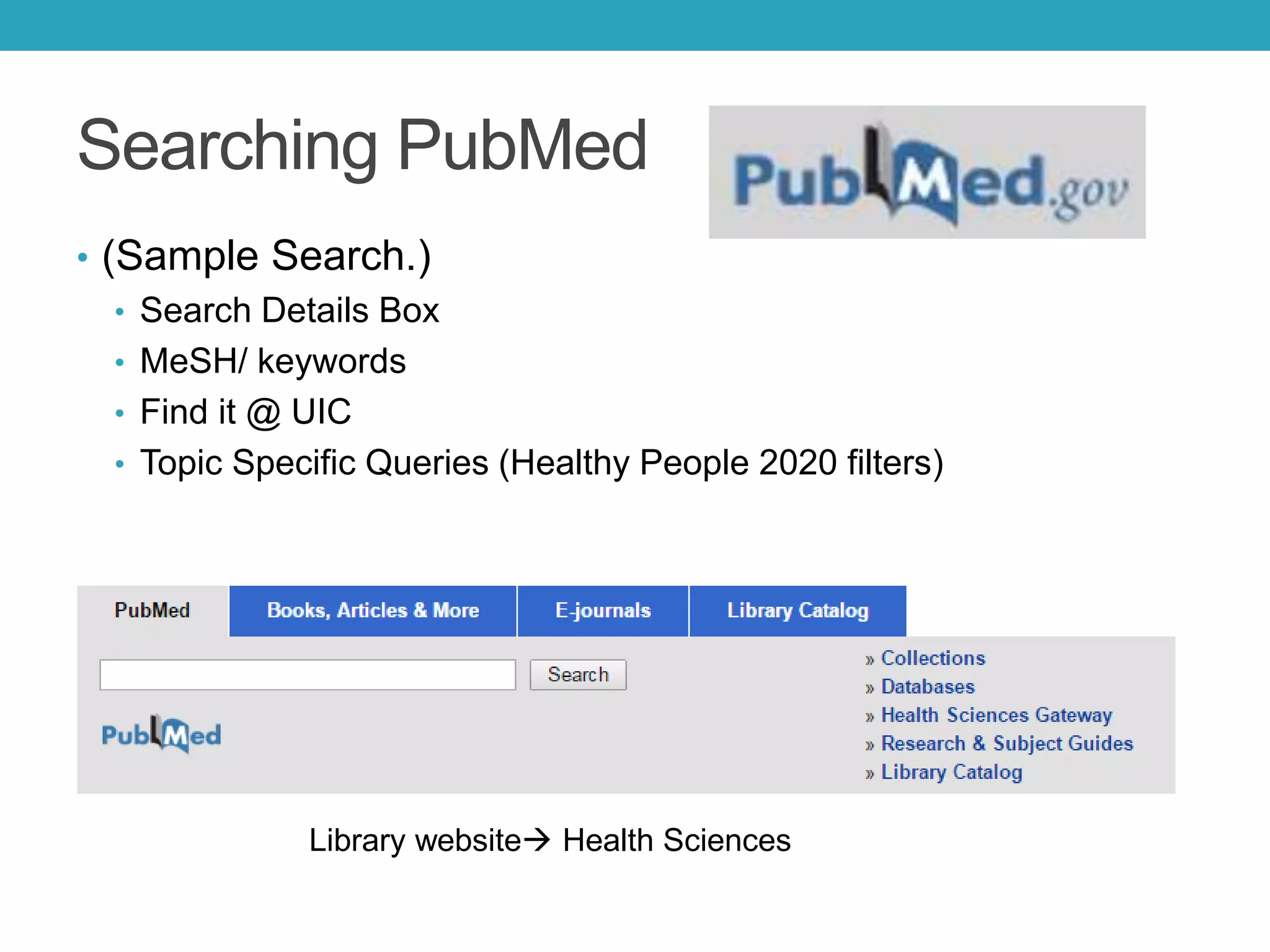
Searching PubMed
• (Sample Search.)
• Search Details Box
• MeSH/ keywords
• Find it @ UIC
• Topic Specific Queries (Healthy People 2020 filters)
Library website Health Sciences
Audience Question:
How can I be sure I’ll get full-text articles at home?
Leopard
Start at Library Website
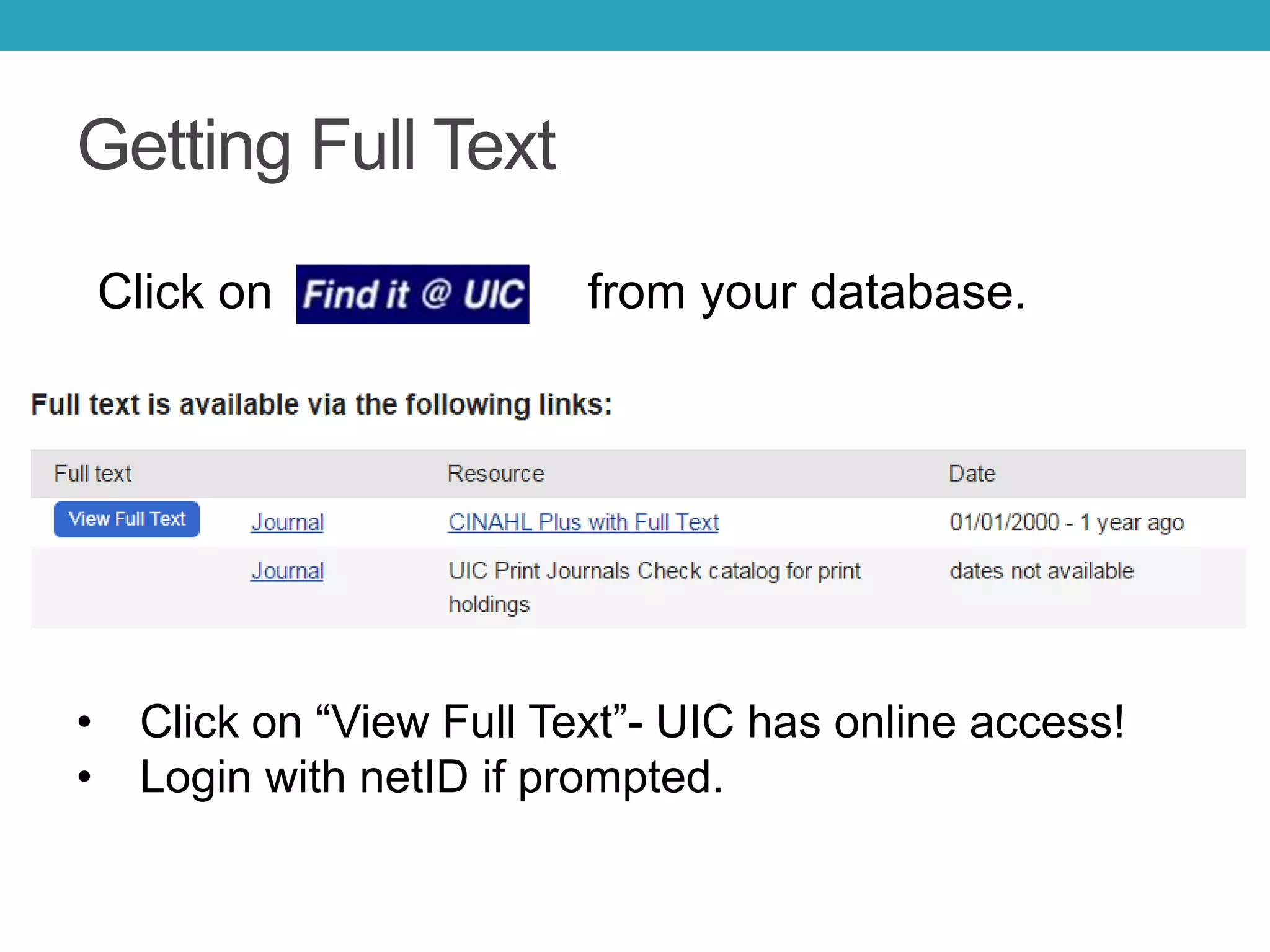
Getting Full Text
• Click on “View Full Text”- UIC has online access!
• Login with netID if prompted.
Click on from your database.
Getting Full Text
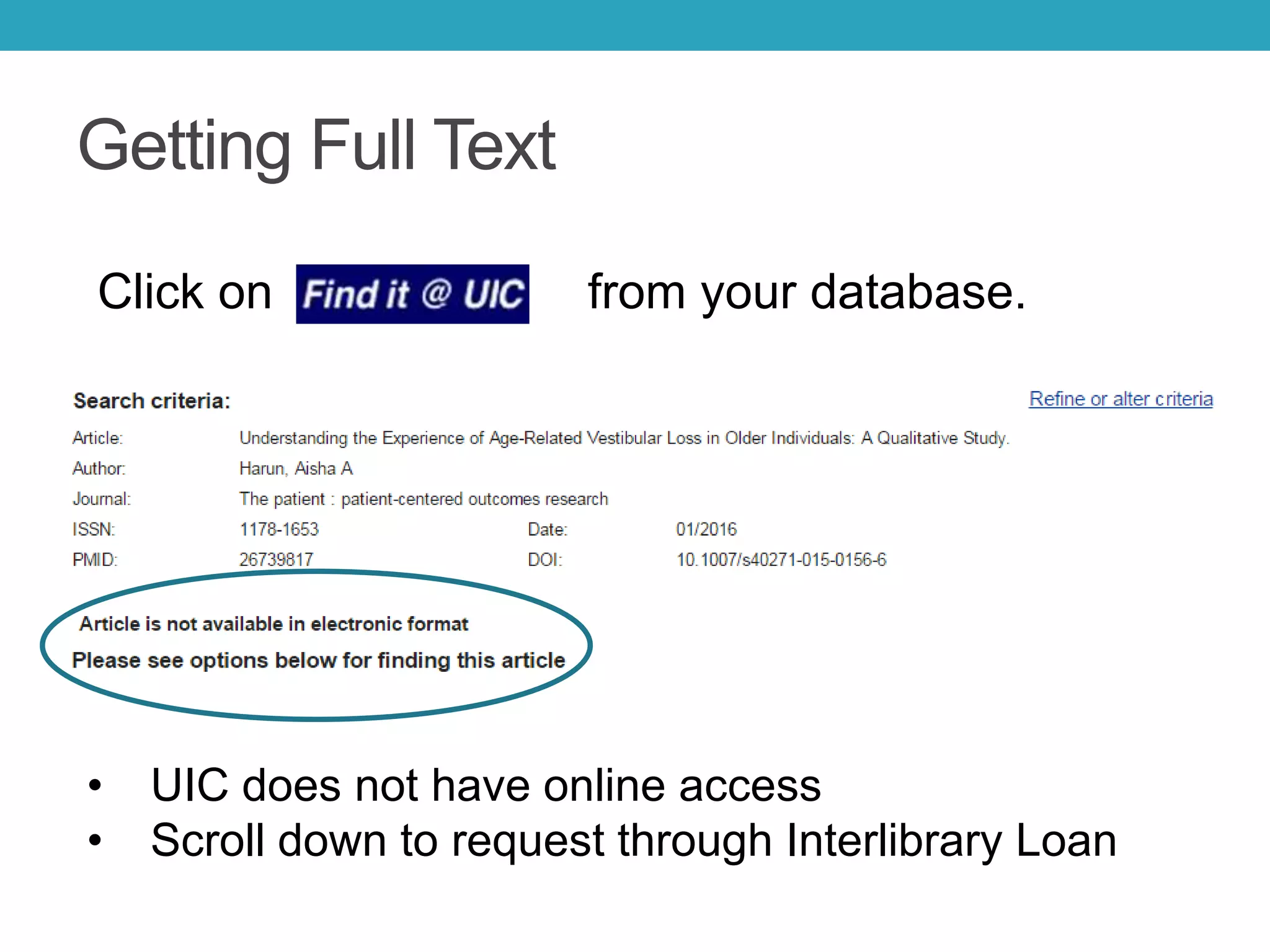
Click on from your database.
• UIC does not have online access
• Scroll down to request through Interlibrary Loan
Interlibrary Loan (ILLiad)
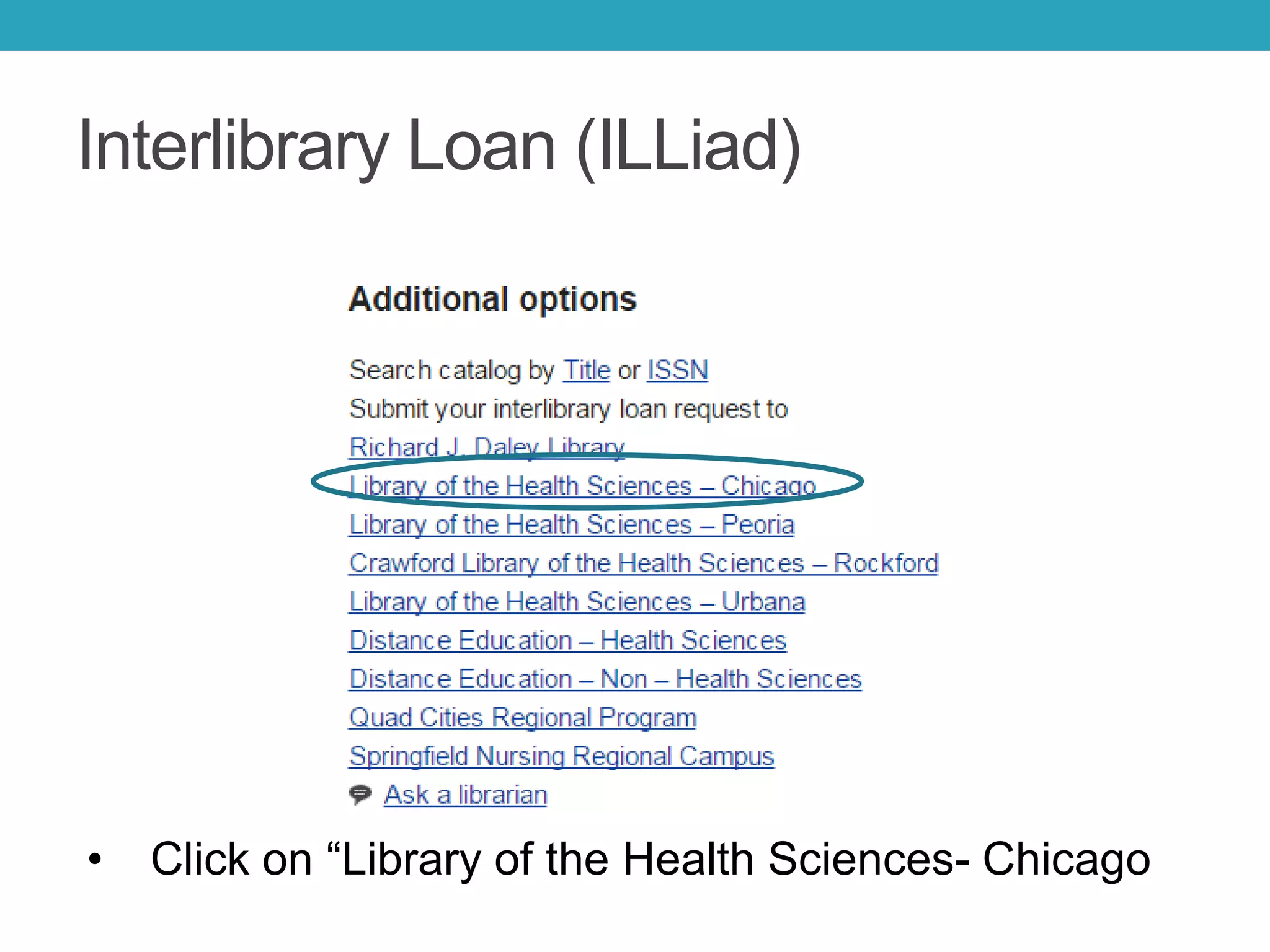
• Click on “Library of the Health Sciences- Chicago
Interlibrary Loan (ILLiad)
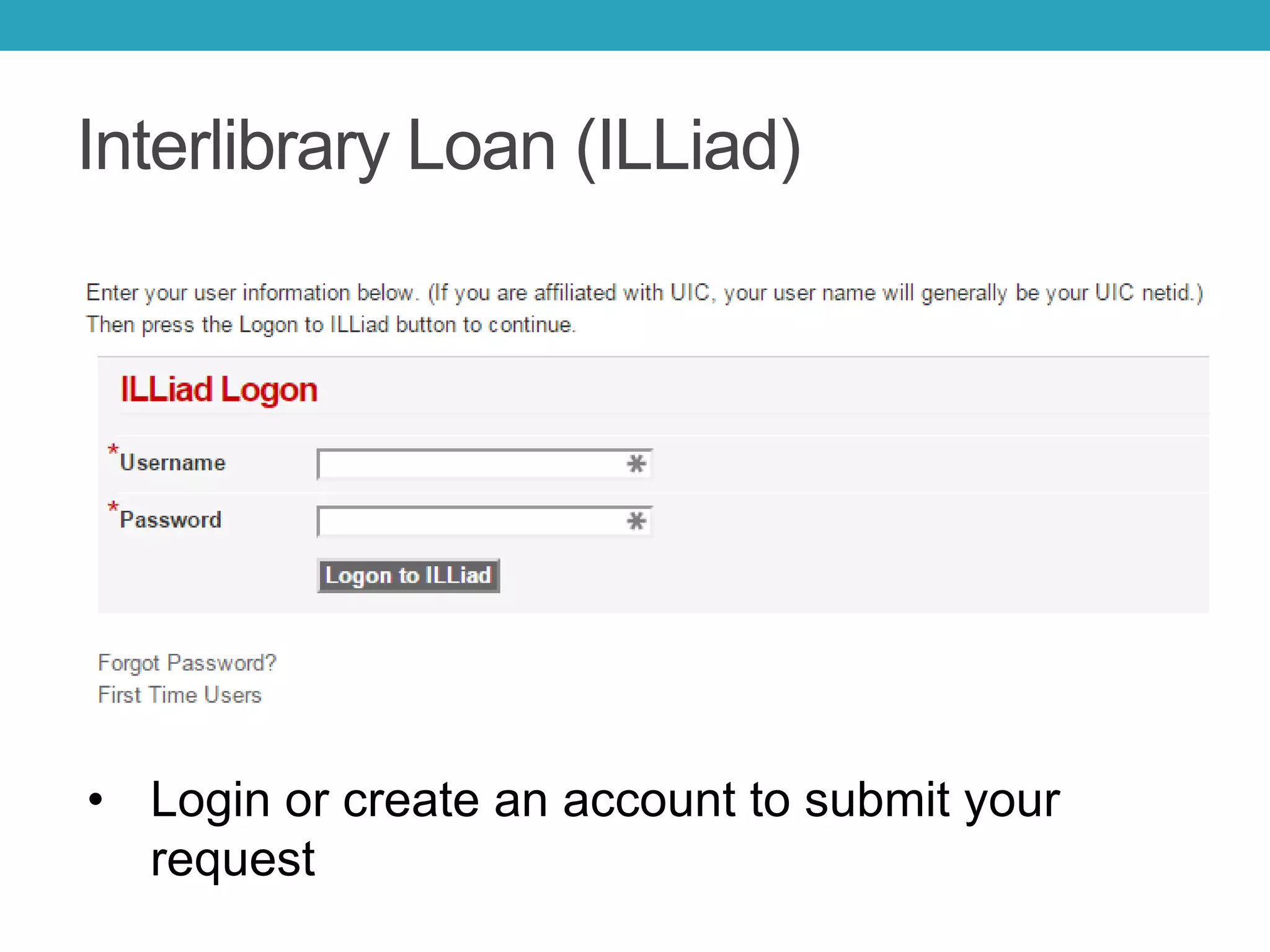
• Login or create an account to submit your
request
Interlibrary Loan (ILLiad)
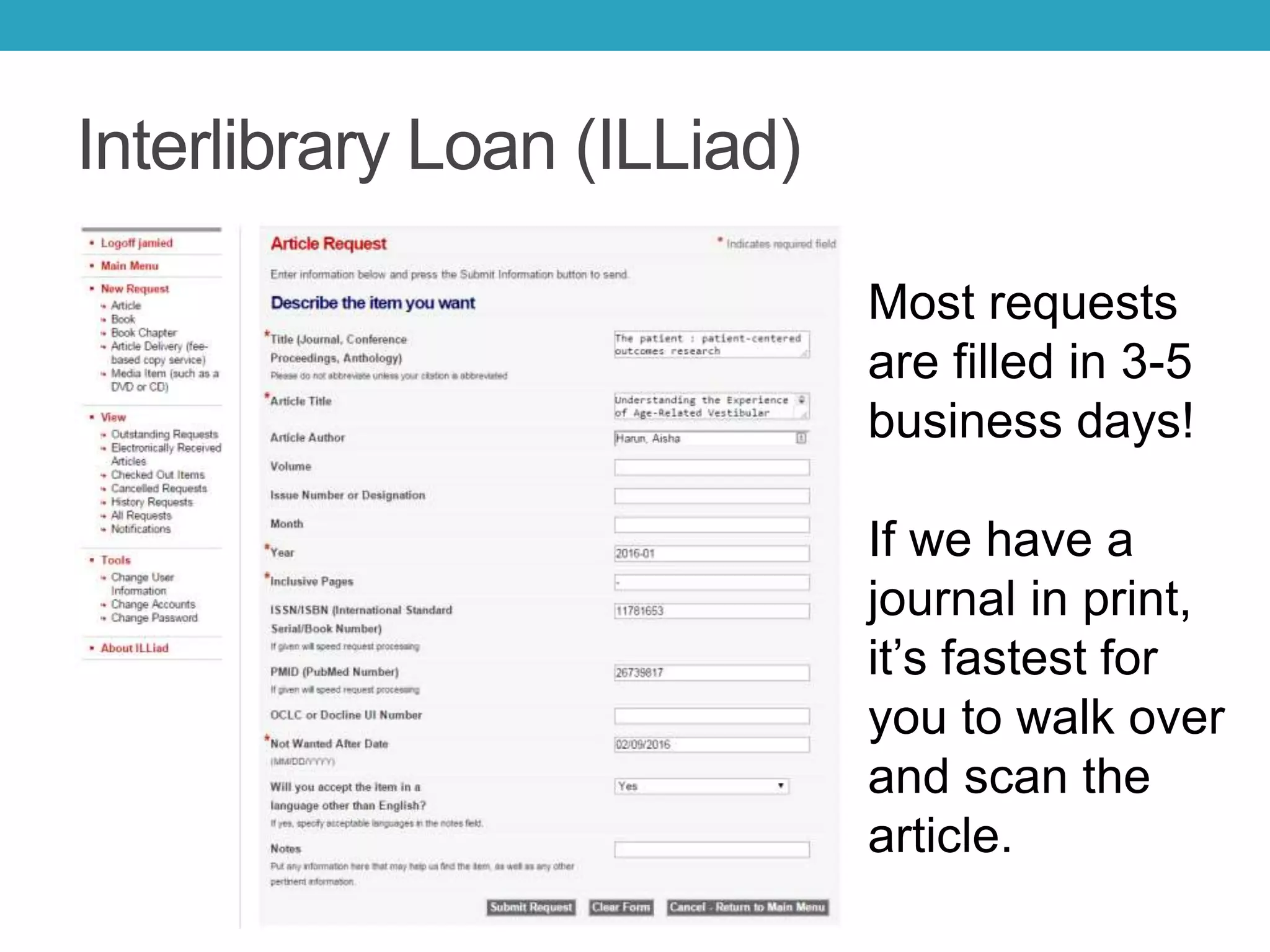
Most requests
are filled in 3-5
business days!
If we have a
journal in print,
it’s fastest for
you to walk over
and scan the
article.
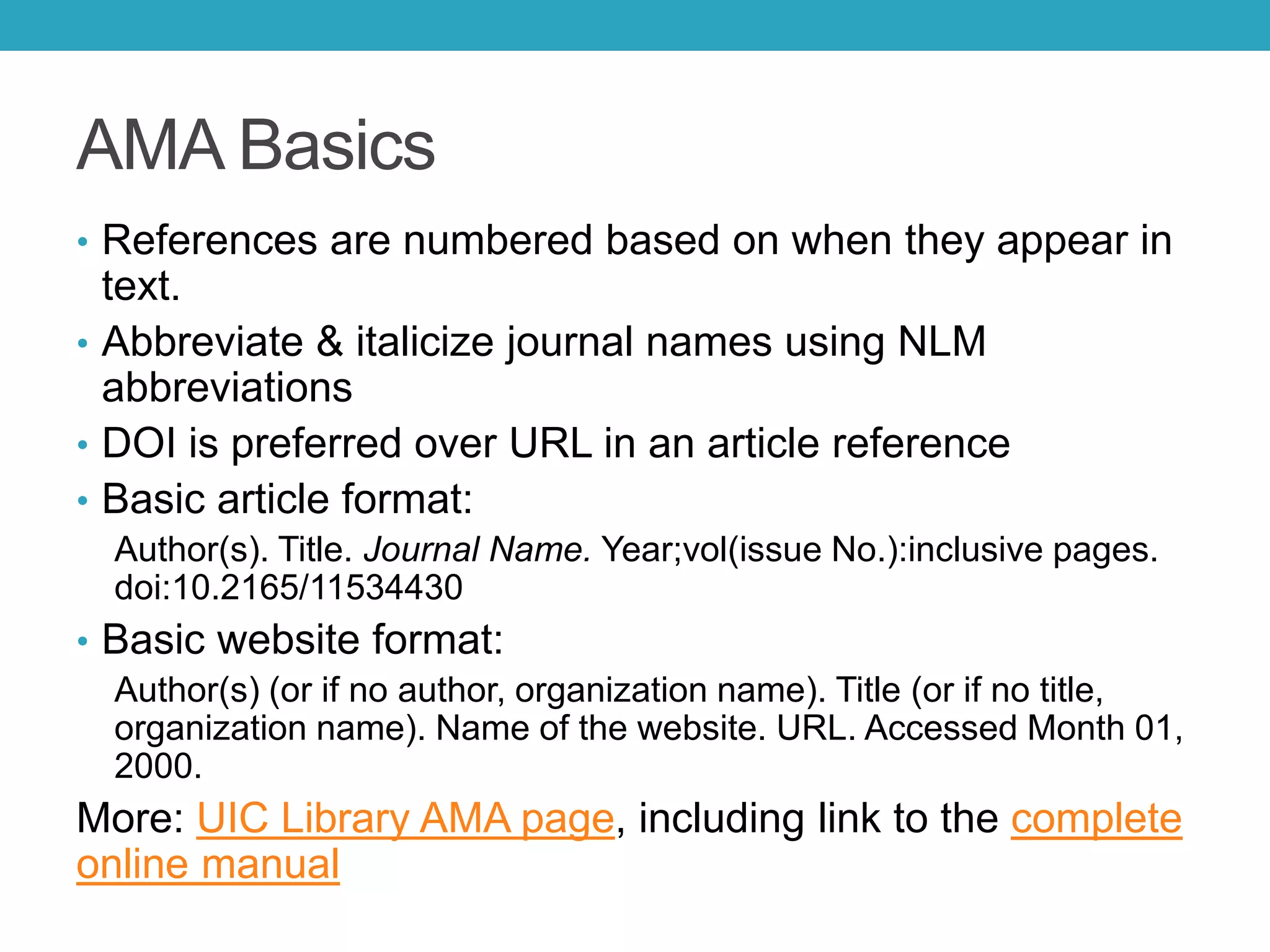
AMA Basics
• References are numbered based on when they appear in
text.
• Abbreviate & italicize journal names using NLM
abbreviations
• DOI is preferred over URL in an article reference
• Basic article format:
Author(s). Title. Journal Name. Year;vol(issue No.):inclusive pages.
doi:10.2165/11534430
• Basic website format:
Author(s) (or if no author, organization name). Title (or if no title,
organization name). Name of the website. URL. Accessed Month 01,
2000.
More: UIC Library AMA page, including link to the complete
online manual
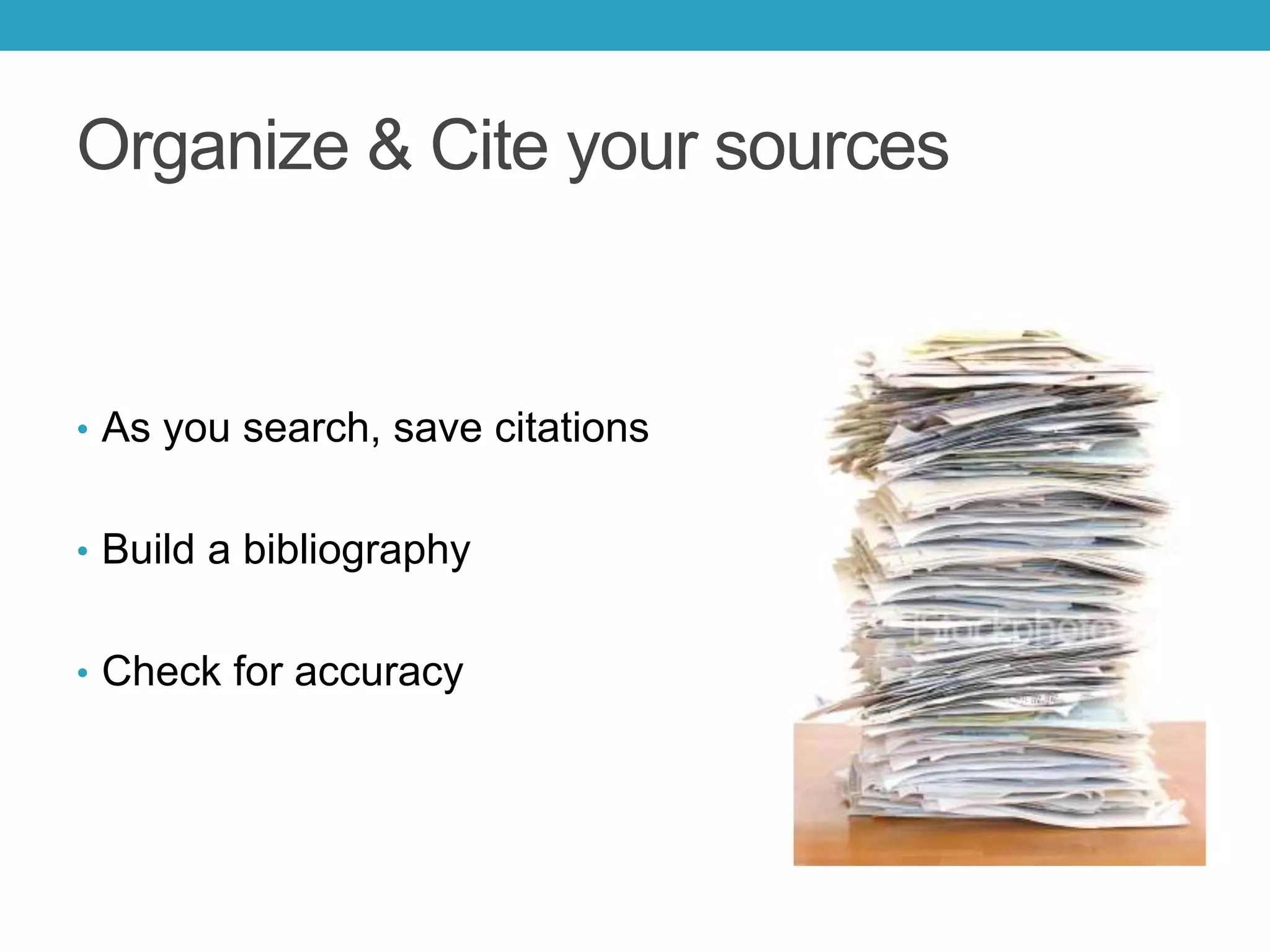
Organize & Cite your sources
• As you search, save citations
• Build a bibliography
• Check for accuracy
Audience Question:
Is there a tool that can help me manage & format my
references?
Tiger
Stay organized: Citation managers
• RefWorks, Zotero, EndNote
• Save article citations & build bibliographies
• Library help: http://researchguides.uic.edu/refworks
RefWorks (Beta) Demo
• Organize citations
• Annotate PDFs
• Build bibliographies
• Plug-in for Word & Google Docs for in-text citations
• Drag & drop PDFs
• Library help: http://researchguides.uic.edu/refworks
Need Help?
There’s a lot more information about library resources and
searching! I’ll be back on February 4th, but you can also:
• Contact Jamie (jamied@uic.edu)
AHSB Room 232, Tuesday afternoons
• Drop by the library (at Polk & Wood)
• Watch a tutorial or attend an online workshop
THANK YOU!
Jamie Dwyer
Research Coach (aka Librarian)
jamied@uic.edu
Please complete evaluations on your way out!

HN313 Library Lecture Jan 26

  • 1.
    LIBRARY RESOURCES & SEARCHTIPS Jamie Dwyer Research Coach (aka Librarian) jamied@uic.edu
  • 2.
    Objectives • Navigate toappropriate library resources • Distinguish between types of scientific literature • Use criteria to evaluate an information source • Apply keywords to search PubMed effectively • Describe the basics of AMA Style • Explain the value of citation management software
  • 3.
    Audience Question: How canI find resources for Nutrition research? Lion
  • 4.
  • 5.
  • 6.
    Useful Research Guidesfor HN313 • Nutrition: http://researchguides.uic.edu/hn • Public Health: http://researchguides.uic.edu/publichealth • Epidemiology and Statistics: http://researchguides.uic.edu/epidemiology • Health Sciences Gateway: http://researchguides.uic.edu/healthsciences
  • 7.
    Research “Cycle”: Ideal Developtopic Locate resources Evaluate information Cite sources
  • 8.
    Research “Cycle”: Actual Developtopic Locate resources Evaluate information Cite sources The research process is iterative; it’s okay to adjust your topic as you go and to do these steps non-sequentially, as long as all steps are completed. Developing a strong topic after some initial searching helps minimize the overlap.
  • 9.
  • 10.
  • 11.
    Types of InformationSources • Scholarly vs Popular Periodicals (Vanderbilt video) Scholarly Popular Authors are ‘experts’, credentialed w/affiliations Authors are journalists Multiple authors 1-2 authors Peer review No peer review “Boring” Flashy covers Few/no advertisements Advertisements Bibliography No bibliography Specialized vocabulary Written for general audience Lengthy Usually 1-5 pages Journals Magazines, Newspapers
  • 12.
    Scholarly vs. PopularExamples The Scientific 7-Minute Workout Reynolds, Gretchen New York Times HIGH-INTENSITY CIRCUIT TRAINING USING BODY WEIGHT Klika, Brett C.S.C.S., B.S.; Jordan, Chris M.S., C.S.C.S., NSCA-CPT, ACSM HFS/APT American College of Sports Medicine Health & Fitness Journal Effects of Dietary Composition During Weight Loss Maintenance: A Controlled Feeding Study Cara B. Ebbeling, PhD, Janis F. Swain, MS, RD, Henry A. Feldman, PhD, William W. Wong, PhD, David L. Hachey, PhD, Erica Garcia-Lago, BA, & David S. Ludwig, MD, PhD Journal of the American Medical Association (JAMA) The Eye-Opening Truth About Protein Plosser, Liz Fitness Magazine
  • 13.
    Debate Assignment Example •Which side (Pro or Con) has included more scholarly work? (Live Poll)
  • 14.
    Health Sciences Literature: Primary •Based on original experiments • Researcher/author- affiliated • Abstract, Intro, Study design/Methods, Results, Discussion, Conclusion • Bibliography • Peer-reviewed From quiz: “A study which tests a hypothesis based on systematic observation and data collection.”
  • 15.
    Health Sciences Literature: Secondary •Synthesized information from original experiments • Researcher/author- affiliated • “Review” • Focused question • Bibliography • Peer-reviewed • Literature Review From quiz: “Summarize, synthesize, and evaluate what the scientific community has discovered about a specific topic or question.”
  • 16.
    Primary & SecondaryLiterature • Primary (original materials by researchers) • Original research articles- Clinical trial reports, cohort studies, case series • Theses, conference proceedings/papers, reports, patents • Secondary (interpretation/evaluation/synthesis) • Systematic reviews, meta-analyses, evidence summary, practice guidelines
  • 17.
    Tertiary Literature • Providesan overview of key research findings • Good for background information • Don’t often include substantial in-text citations but sometimes have a bibliography • Usually written for a more general audience (popular) • Examples include: • Textbooks • Encyclopedias • Magazines, Newspapers
  • 18.
    Levels of Evidence (&Meta Analyses)
  • 19.
    Debate Assignment Example Thefollowing is from the reference list for the Pro side: Contribution of food prices and diet cost to socioeconomic disparities in diet quality and health: a systematic review and analysis. Nutrition Reviews • Would you consider this to be primary, secondary, or tertiary literature? (Live Poll)
  • 20.
    Debate Assignment Example Thefollowing is from the reference list for the Pro side: In Defense of Farm Subsidies Stone Soup • Would you consider this to be primary, secondary, or tertiary literature? (Live Poll)
  • 21.
    Reading Scientific Literature 1.Develop a question 2. Skimming is okay first pass! 3. Abstract, Intro, Conclusion, Figures 4. Methods, Discussion 5. Read over more closely 6. Evaluate quality of study Three methods: https://www.youtube.com/watch?v=3SmOq6gENPM https://www.youtube.com/watch?v=SKxm2HF_-k0 https://www.youtube.com/watch?v=EEVftUdfKtQ
  • 22.
    Reading Scientific Literature Questionsto ask as you read critically: • What is the argument/thesis? • Are the methods appropriate to answer the question being asked? • Was the study completed effectively? • What answers did the researchers find? Are these findings presented accurately? • How does this fit into your research question?
  • 23.
    Evaluation Criteria C.R.A.A.P. • Currency •Relevance • Authority • Accuracy • Purpose CSU-Chico Tutorial CSU-Chico Handout The 5 W’s • Who • What • When • Where • Why • (How)
  • 24.
    CRAAP Handout Activity •Looking at one of the two articles you have, work with a partner to work through the list for Accuracy & Purpose. • Jot down any concerns you have or any strengths you see in the article.
  • 25.
  • 26.
    Grey Literature The FourthInternational Conference on Grey Literature (GL '99) in Washington, DC, in October 1999 defined grey literature as follows: "That which is produced on all levels of government, academics, business and industry in print and electronic formats, but which is not controlled by commercial publishers.” http://www.greylit.org/about
  • 27.
    Finding the Data •Government Websites • Census Bureau, BLS, USDA, DHHS, CDC • State of Illinois, Cook County DPH • Healthy People 2020, National Nutrition Monitoring & Related Research Program • Professional Organizations • Academy of Nutrition & Dietetics, American Cancer Society • WHO, FAO (UN)
  • 28.
    Finding the Data:Policy Tracking CDC Chronic Disease State Policy Tracking System CQ: Congressional Quarterly Researcher Urban Institute Health Policy Center Additional resources on HN Guide: Policy Resources
  • 29.
    Searching the Literature •Topic development • Too narrow? Too broad? • Keywords • Key search terms, synonyms • Search strategy • Types of information sources? Where to look? • Evaluation • CRAAP test (Currency, Relevancy, Authority, Accuracy, Purpose)
  • 30.
    Library Quiz Review:Keywords What is the relationship between dietary patterns and the risk of lung cancer? Best answers: dietary patterns, lung cancer Tricky keywords: relationship, risk Other tricky keywords: impact, effect/effective, increase, decrease, connection, outlook, matter, comparison
  • 31.
    Audience Question: How canI keep track of my search terms? Monkey
  • 32.
    Use a tableto organize issues & terms Key Issues: Text messaging Appointment reminders Patient no-shows Related terms: Technology Appointment notification Missed appointment SMS (short messaging systems) Automated reminders Check-up Cellular phone Patient communication Exam Mobile phone Scheduling Preventive/preventative care Telecommunication Phone call Physician visit Voice message Doctor visit Postal mail Clinic appointment Medical care Sample Research Question: “Is text messaging an effective way to provide appointment reminders to reduce patient no-shows?”
  • 33.
    Where to look •Who would be researching/writing about this topic? (Industry, government, professional organizations, academic researchers…) • What types of information would be useful? (Statistics, policy, guidelines, research articles, newspaper articles) • Use the HN Research Guide to access relevant databases/ information resources.
  • 34.
    Citation Databases • Indexcitations (and some full text) of journal articles, books, newspapers, trade journals, etc. • ProQuest, EBSCOHost are platforms that include many databases within them • When in doubt, read the descriptions & Ask a Librarian if you get stuck! • What about Google Scholar? • Does not index all journal articles on the internet. Many are behind paywalls and do not live on the “open web.” • Can be useful in identifying useful research articles, particularly for multi- or interdisciplinary topics. • Not a one-stop shop. No single database should be searched! • Start at Library Website for full text.
  • 35.
    Pre-test review • Ifyou were looking for scholarly journal articles on the relationship between dietary patterns and risk of lung cancer, which databases would you consult? • Best Answers: • PubMed (Over 24 million MEDLINE citations) • CINAHL (Nursing & Allied Health) • EMBASE (Great for drug information, scope beyond US) Other top mentions: • JSTOR (Some health sciences journals, best as ‘archive’) • Academic Search Complete (Multidisciplinary, good for overview)
  • 36.
    Controlled vocabulary • “Preferred”terms unique to each database • Thesaurus, Headings, Terms, Vocabulary • Standardize terminology across all articles • Nursing vs. Breastfeeding • Social Media vs. Internet • Kneecap vs. Patella • Articles are indexed (“tagged”) with subject headings to help you determine relevancy.
  • 37.
    Boolean Basics diet exercise OR DietOR ExerciseDiet AND Exercise AND diet exercise Diet NOT Exercise NOT diet exercise • Searching with AND combines terms. It gives you results that satisfy both search terms (only where the two overlap). Some databases use + for AND. • Searching with OR “means more”! It gives you everything available for each term, including when they overlap. Some databases use | for OR. • Searching with NOT excludes an entire term, including any overlap between terms. Some databases use – for NOT.
  • 38.
    Combining Concepts: FOIL (exerciseOR physical activity) AND (diet OR nutrition) (exercise AND diet) OR (exercise AND nutrition) OR (physical activity AND diet) OR (physical activity AND nutrition)
  • 39.
    Social media OR FacebookOR Internet Quit smoking OR smoking cessation OR substance use High school/ college students OR young adults OR teenager(Social media OR Facebook OR Internet) AND (Quit smoking OR smoking cessation OR substance use) AND (High school students OR college students OR young adults OR teenagers)
  • 40.
    Database Searching Tools •Keyword vs. Controlled Vocabulary Your term/database term, often “subject headings.” Mix & match. • Limits/Filters Year published, language, study type, age groups, etc. • Related Citations “If you like this you might also like this” suggestions from databases. • Reference Lists Resources used by ideal article; articles citing ideal article
  • 41.
    Searching PubMed • (SampleSearch.) • Search Details Box • MeSH/ keywords • Find it @ UIC • Topic Specific Queries (Healthy People 2020 filters) Library website Health Sciences
  • 42.
    Audience Question: How canI be sure I’ll get full-text articles at home? Leopard Start at Library Website
  • 43.
    Getting Full Text •Click on “View Full Text”- UIC has online access! • Login with netID if prompted. Click on from your database.
  • 44.
    Getting Full Text Clickon from your database. • UIC does not have online access • Scroll down to request through Interlibrary Loan
  • 45.
    Interlibrary Loan (ILLiad) •Click on “Library of the Health Sciences- Chicago
  • 46.
    Interlibrary Loan (ILLiad) •Login or create an account to submit your request
  • 47.
    Interlibrary Loan (ILLiad) Mostrequests are filled in 3-5 business days! If we have a journal in print, it’s fastest for you to walk over and scan the article.
  • 48.
    AMA Basics • Referencesare numbered based on when they appear in text. • Abbreviate & italicize journal names using NLM abbreviations • DOI is preferred over URL in an article reference • Basic article format: Author(s). Title. Journal Name. Year;vol(issue No.):inclusive pages. doi:10.2165/11534430 • Basic website format: Author(s) (or if no author, organization name). Title (or if no title, organization name). Name of the website. URL. Accessed Month 01, 2000. More: UIC Library AMA page, including link to the complete online manual
  • 49.
    Organize & Citeyour sources • As you search, save citations • Build a bibliography • Check for accuracy
  • 50.
    Audience Question: Is therea tool that can help me manage & format my references? Tiger
  • 51.
    Stay organized: Citationmanagers • RefWorks, Zotero, EndNote • Save article citations & build bibliographies • Library help: http://researchguides.uic.edu/refworks
  • 52.
    RefWorks (Beta) Demo •Organize citations • Annotate PDFs • Build bibliographies • Plug-in for Word & Google Docs for in-text citations • Drag & drop PDFs • Library help: http://researchguides.uic.edu/refworks
  • 53.
    Need Help? There’s alot more information about library resources and searching! I’ll be back on February 4th, but you can also: • Contact Jamie (jamied@uic.edu) AHSB Room 232, Tuesday afternoons • Drop by the library (at Polk & Wood) • Watch a tutorial or attend an online workshop
  • 54.
    THANK YOU! Jamie Dwyer ResearchCoach (aka Librarian) jamied@uic.edu Please complete evaluations on your way out!