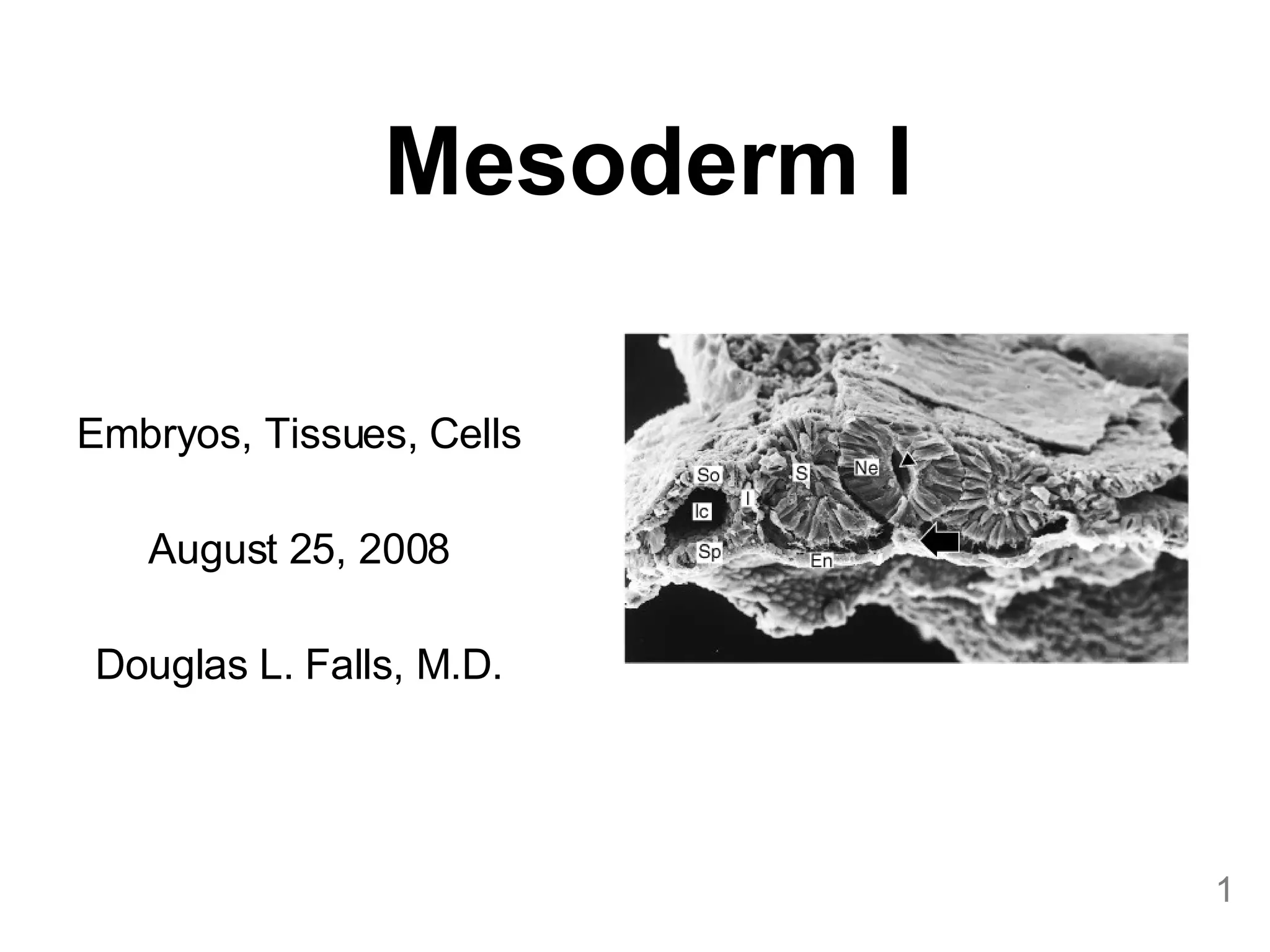
Mesoderm I Embryos, Tissues, Cells August 25, 2008 Douglas L. Falls, M.D.
Mesoderm I / II: Reading Carlson  (2004)  Human Embryology and Developmental Biology  (3 rd  edition) Reference:  ch 6  p108-118  early mesoderm development including somite development and  early circulatory system development ch 6  p122-126  overview of structure of 4 wk human embryo) ch 6  fig 6-25 (p125) flow chart organ/tissue origin from germ layers) ch 9  p193-206, especially p195-196 and 204-206  muscular system development) ch 9  p185-193  skeletal development)
Mesoderm I:  Learning objectives Students should be able to describe:  the origin of the mesodermal germ layer the early division of the mesoderm into paraxial, intermediate mesoderm, and lateral mesoderm and the split of lateral mesoderm into splanchnic and somatic mesoderm the major fates of the mesoderm Re muscle: in outline, a lineage tracing method used to determine the developmental origin of limb muscle the major steps in development of a skeletal muscle fiber from a mononucleate myoblast the developmental basis of slow versus fast twitch muscle the difference between skeletal versus cardiac and smooth muscle development with respect to myoblast fusion Re bone:  The two mechanisms of bone formation Students should be able to define, use in context, and provide examples of all words on the slides titled “Vocabulary”.
Embryology education resource: Endowment for Human Development WWW site Excellent source of human embryology education materials Some available in multiple languages http://www.ehd.org/ DVD: The Biology of Prenatal Development In class we will watch Ch2, Ch5-->29 of DVD Script can be downloaded:  http://www.ehd.org/pdf/BPD%204-26-2006%20English.pdf Suggest begin with: Prenatal overview (and take the quizzes?) Prenatal timeline Prenatal slide shows Movie theater
Vocabulary coelom  –  Etymology: German, from Greek  koilōma  cavity, from  koilos  Date: 1875  :   the usually epithelium-lined space between the body wall and the digestive tract of metazoans above the lower worms  splanchnic   Etymology: New Latin  splanchnicus,  from Greek  splanchnikos,  from  splanchna,  plural, viscera; akin to Greek  splēn  spleen Date: 1681 of or relating to the viscera  :   visceral viscus (plural: viscera; adj = visceral)  an internal organ of the body;  especially   :  one (as the heart, liver, or intestine) located in the great cavity of the trunk proper  somatic of or relating to the wall of the body  :   parietal   parietal   of or relating to the walls of a part or cavity  axial relating to or situated in the central part of the body, in the head and trunk as distinguished from the limbs,  e.g.,  axial skeleton.  C
Vocabulary Somite –  Etymology: International Scientific Vocabulary, from Greek  sōma  body Date: 1869   one of the longitudinal series of segments into which the body of many animals is divided  Names of the 3 paired veins that drain into the tubular heart of a 4 wk embryo vitelline –  Etymology: Middle English, from Medieval Latin  vitellinus,  from Latin  vitellus  egg yolk Date: 15th century  cardinal  Etymology: Middle English, from Late Latin  cardinalis,  from Latin, serving as a hinge, from  cardin-, cardo  hinge Date: 14th century  of basic importance  :   main ,  chief ,  primary  <a  cardinal  principle>  umbilical  Date: 1541  of, relating to, or used at the navel
Learning objectives:  Mesoderm I Students should be able to describe:  the origin of the mesodermal germ layer the early division of the mesoderm into paraxial, intermediate mesoderm, and lateral mesoderm and the split of lateral mesoderm into splanchnic and somatic mesoderm the major fates of the mesoderm Re muscle: in outline, a lineage tracing method used to determine the developmental origin of limb muscle the major steps in development of a skeletal muscle fiber from a mononucleate myoblast the developmental basis of slow versus fast twitch muscle Re bone:  The two mechanisms of bone formation Students should be able to define, use in context, and provide examples of all words on the slides titled “Vocabulary”.
Epiblast cells that do migrate down (ventrally) through the primitive streak during later stages of gastrulation constitute the  mesoderm  layer ( dull red  in 16 day image at lower right ) day 16 14-15 days 16 days 2 wks
Human embryo during gastrulation Carlson Fig. 5-4 (p86)+ 5-5 (p87)  transverse  section
Derivatives of the bilaminar embryo Carlson Fig. 5-1 (p84)  Laminae of bilaminar embryo Extraembryonic mesoderm
Though early on you were a quite flat disk,  now are a doughnut http://www.abdn.ac.uk/langling/resources/usflimgs.html [And what is in the middle?]
only “embryonic tissues” in this figure No “extraembryonic” last week #1 last week #2 this lecture Carlson 6-25 (p125)
Development of mesoderm (visualized in transverse sections) Paraxial mesoderm Organizes into  somites Somites give rise to axial skeleton, axial muscles, limb muscles, dermis. Intermediate mesoderm Gives rise to urogenital system Lateral mesoderm heart (endo, epi, pericardium) blood endothelium (lining of blood vessels) wall of gut wall of respiratory tract lining of body cavities
Major subdivisions of the mesoderm Sadler 3-4 (p19)  “ parietal” (wall) layer “ visceral” (organ) layer
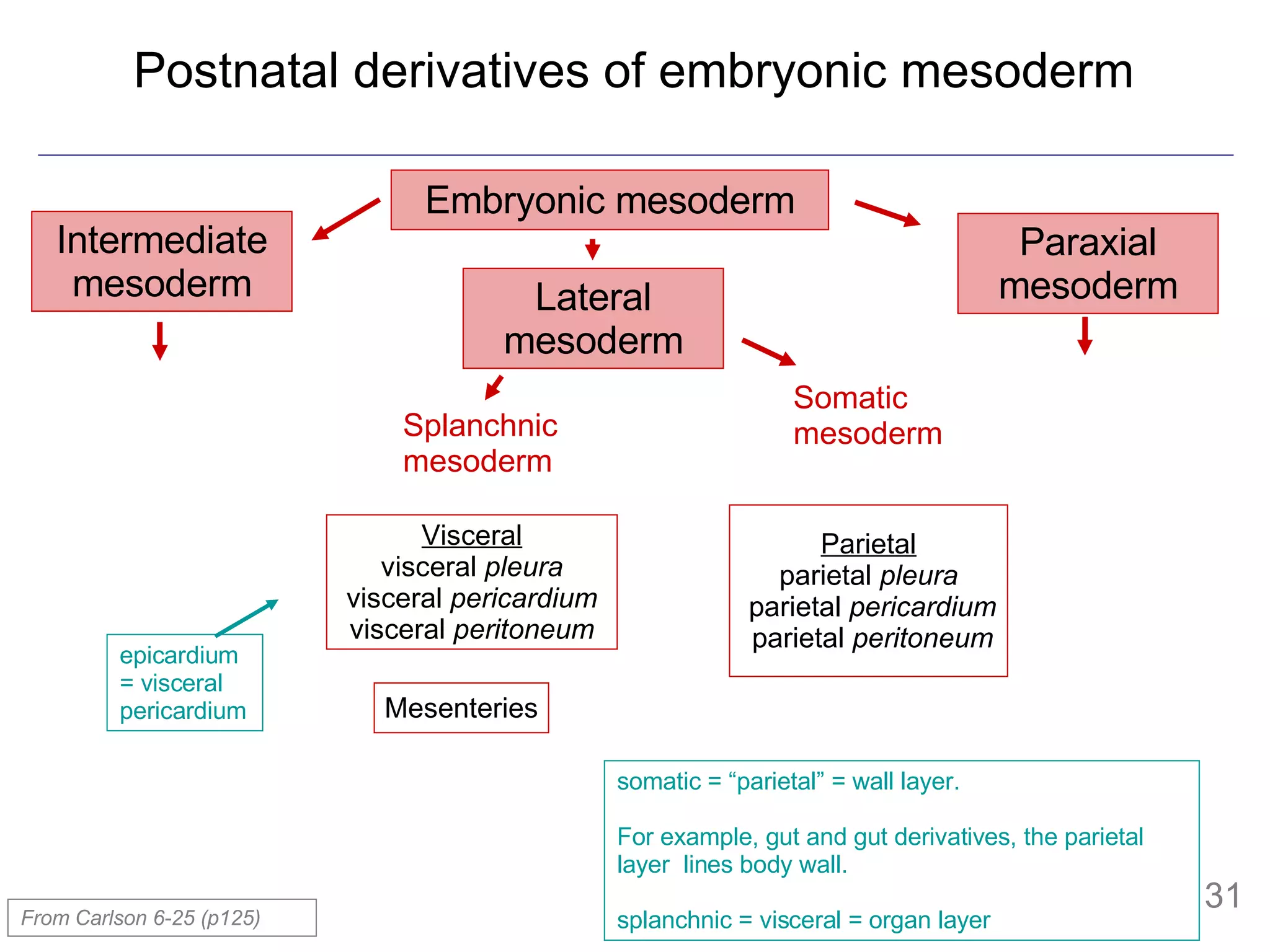
Postnatal derivatives of embryonic mesoderm From Carlson 6-25 (p125) Embryonic mesoderm Intermediate mesoderm Urogenital system (kidney, ureter,  not bladder adrenal cortex gonads not gametes) Vagina, uterus,  uterine tubes Dermis  of skin Skeleton  (axial,  not limb ) Lateral mesoderm Paraxial mesoderm Muscles  (axial & limb) Splanchnic mesoderm Somatic mesoderm Skeleton ( not axial , limb) Parietal pleura pericardium peritoneum Visceral pleura peritoneum Mesenteries Blood cells,  blood vessel  endothelium,  endocardium Respiratory tract wall Gut wall Epicardium Myocardium somatic = “parietal” = wall layer. For gut and gut derivatives, the parietal layer  lines body wall.  splanchnic = visceral = organ layer epicardium= visceral pericardium
Cross section of intestine: Endodermally-derived inner lining (a “muscosa”) Mesodermally-derived muscle layers and outer lining Ectodermally-derived nerve plexuses  = mesoderm-derived component of intestinal wall Also mesoderm-derived, but not part of wall
Learning objectives:  Mesoderm I Students should be able to describe:  the origin of the mesodermal germ layer the early division of the mesoderm into paraxial, intermediate mesoderm, and lateral mesoderm and the split of lateral mesoderm into splanchnic and somatic mesoderm the major fates of the mesoderm Re muscle: in outline, a lineage tracing method used to determine the developmental origin of limb muscle the major steps in development of a skeletal muscle fiber from a mononucleate myoblast the developmental basis of slow versus fast twitch muscle Re bone:  The two mechanisms of bone formation Students should be able to define, use in context, and provide examples of all words on the slides titled “Vocabulary”.
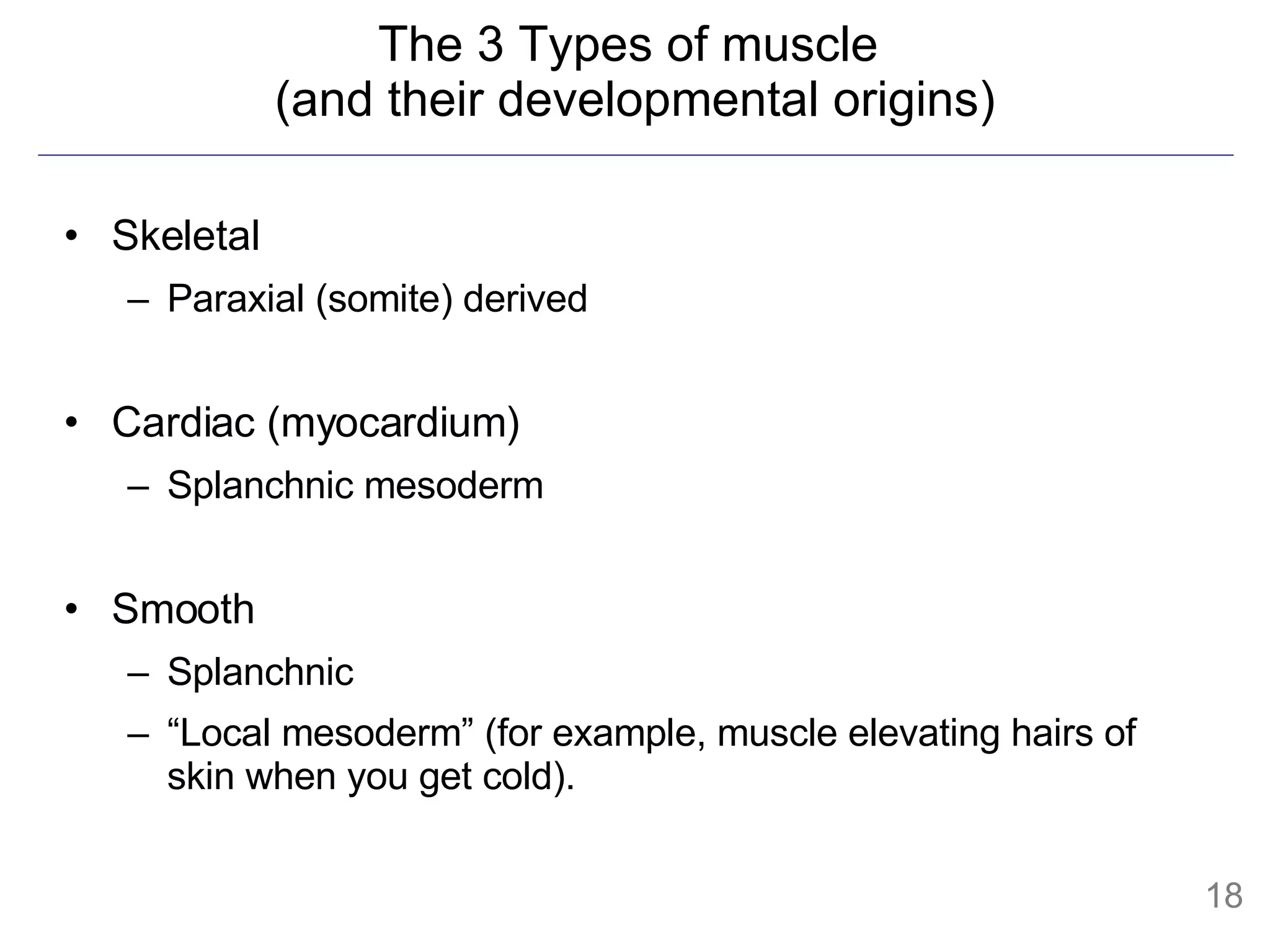
The 3 Types of muscle  (and their developmental origins) Skeletal Paraxial (somite) derived Cardiac (myocardium) Splanchnic mesoderm Smooth Splanchnic  “ Local mesoderm” (for example, muscle elevating hairs of skin when you get cold).
Mesodermal origin of muscle From Carlson 6-25 (p125) Embryonic mesoderm Intermediate mesoderm Urogenital system (kidney, ureter,  not bladder adrenal cortex gonads not gametes) Vagina, uterus,  uterine tubes Dermis  of skin Skeleton  (axial, not limb) Lateral mesoderm Paraxial mesoderm Muscles  (axial & limb) Splanchnic mesoderm Somatic mesoderm Skeleton (not axial, limb) Parietal pleura pericardium peritoneum Visceral pleura peritoneum Mesenteries Blood cells,  blood vessel  endothelium,  endocardium Respiratory tract wall Gut wall Epicardium Myocardium skeletal cardiac smooth
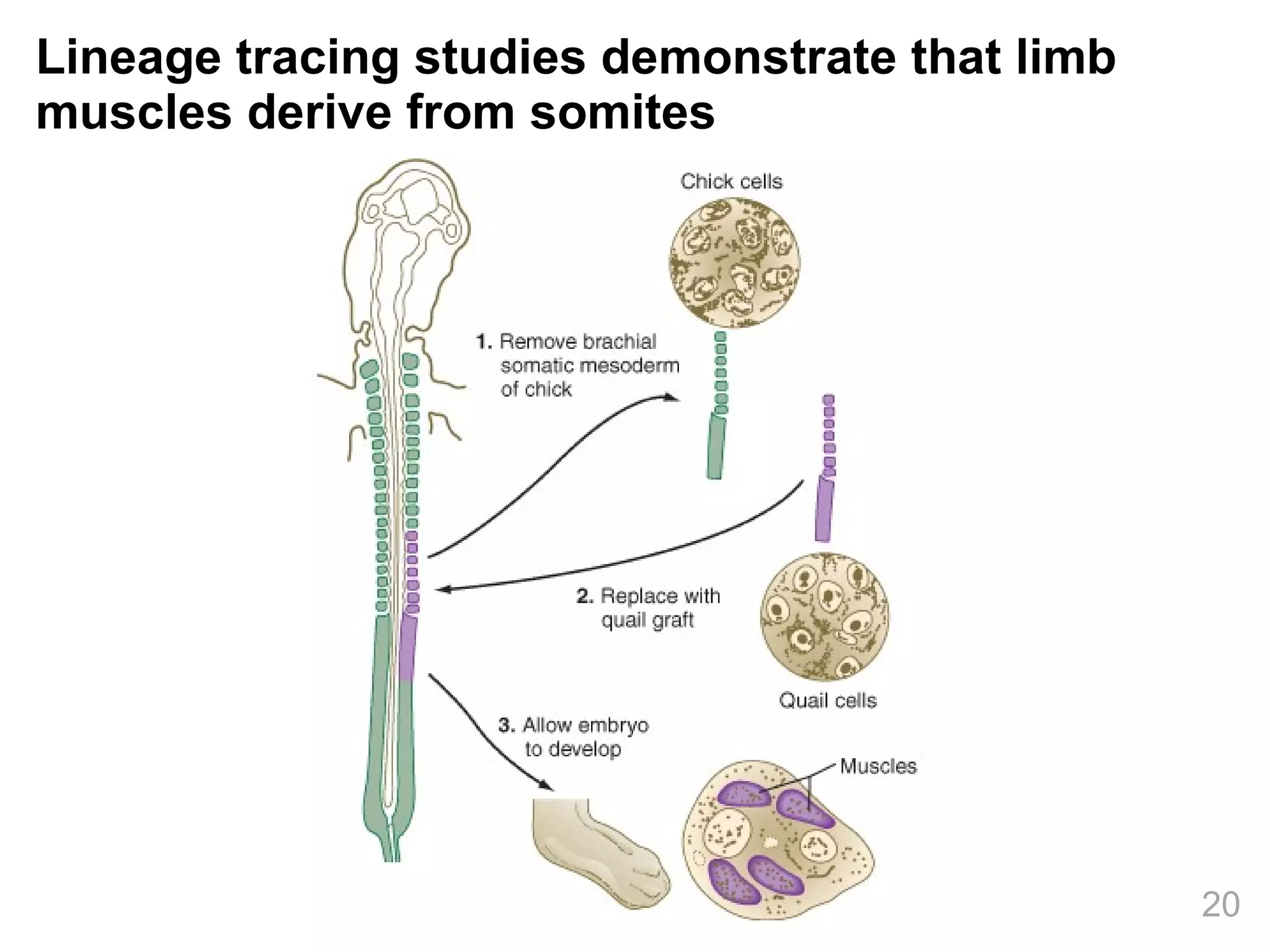
Lineage tracing studies demonstrate that limb muscles derive from somites
Major steps in developmental progression by which skeletal muscle fibers are formed include: satellite cell = muscle stem cell? Myoblasts leave the cell cycle Postmitotic myoblasts fuse to form myotube  A muscle fiber is a  multinucleate syncytium  formed by fusion of multiple mononucleate myoblasts Assembly of contractile units (sarcomeres). The contractile apparatus pushes nuclei to the edge Growth of fiber (“hypertrophy”) involving fusion of satellite cells
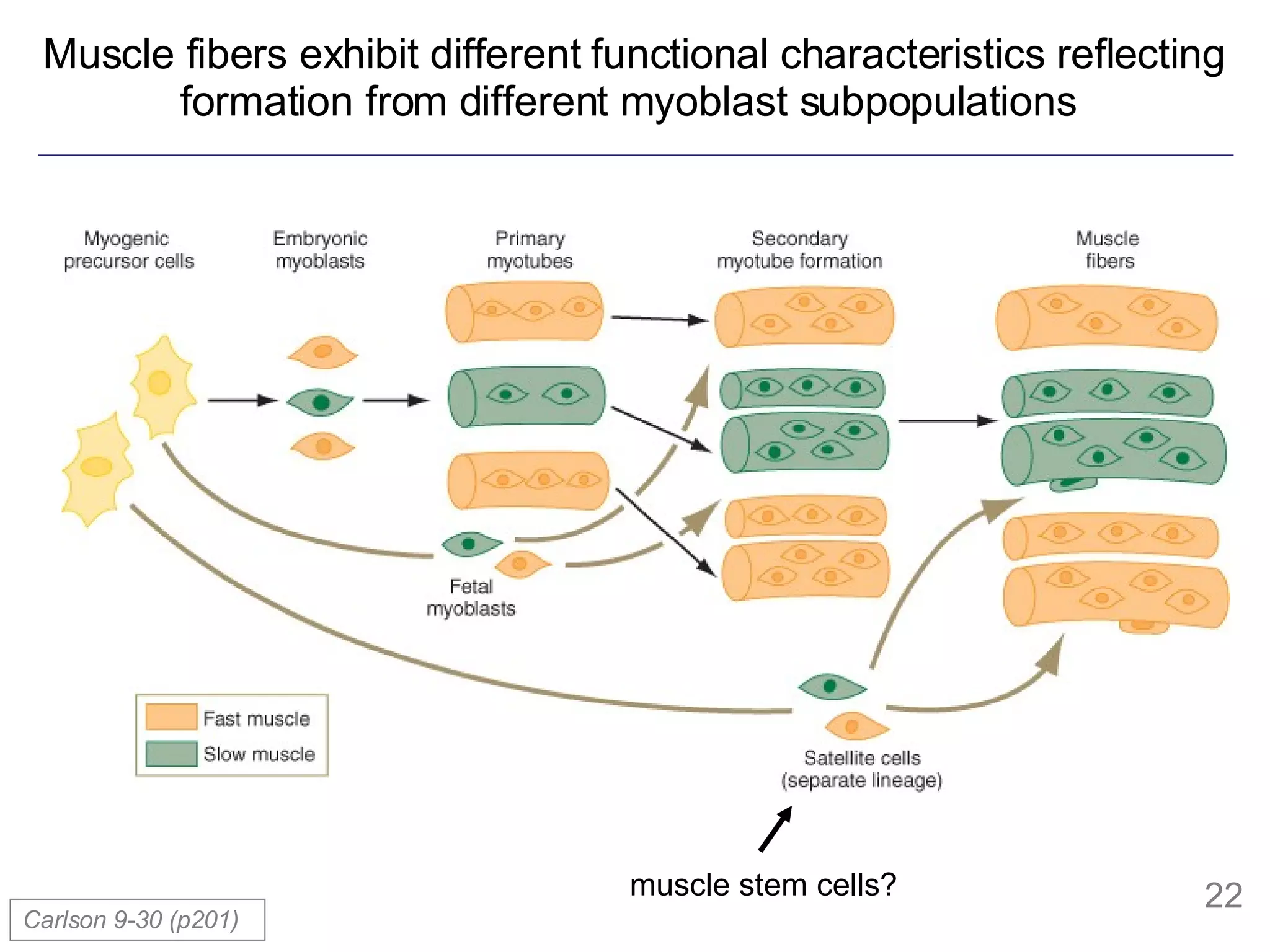
Muscle fibers exhibit different functional characteristics reflecting formation from different myoblast subpopulations  Carlson 9-30 (p201)  muscle stem cells?
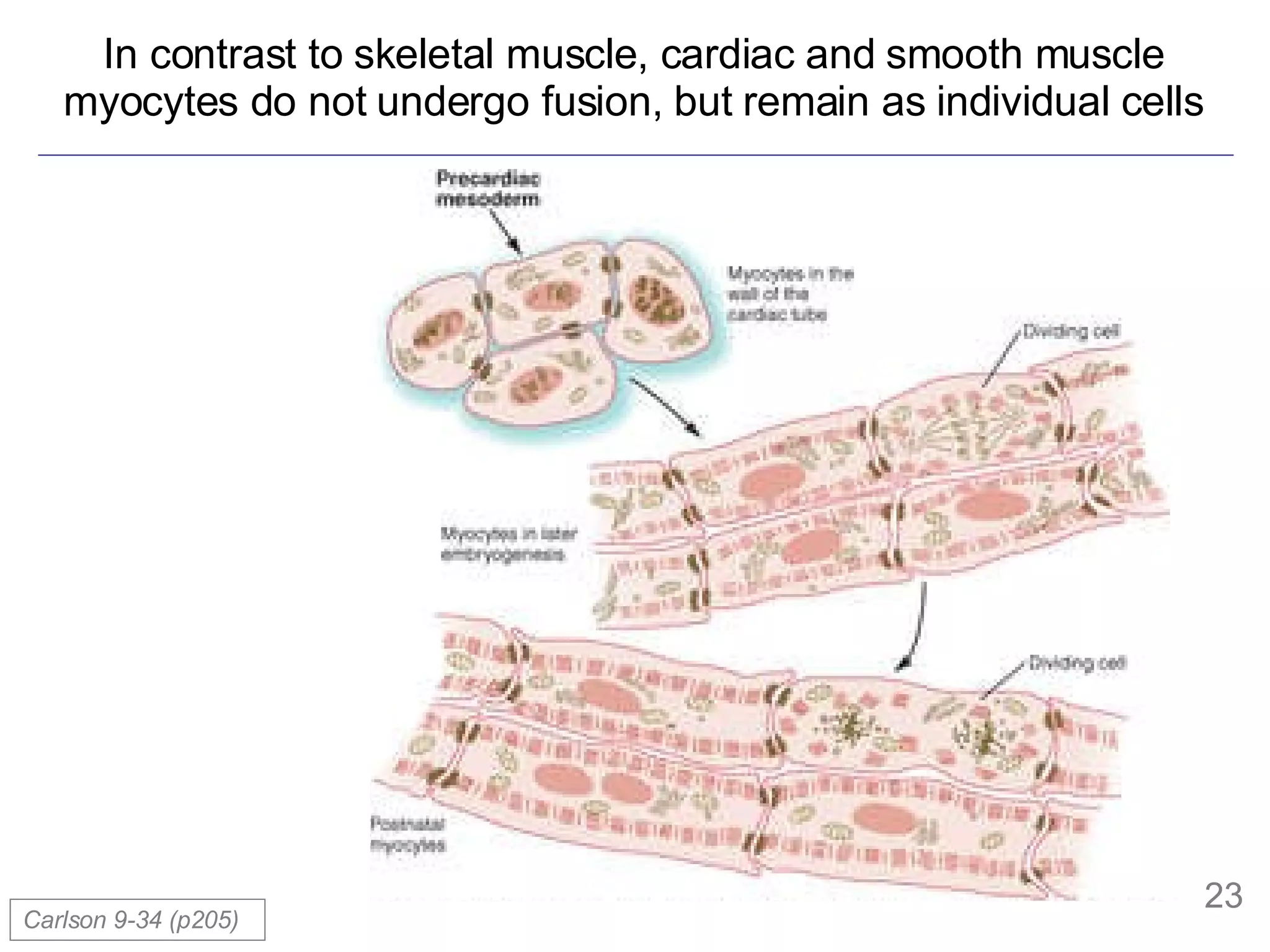
In contrast to skeletal muscle, cardiac and smooth muscle myocytes do not undergo fusion, but remain as individual cells Carlson 9-34 (p205)
Learning objectives:  Mesoderm I Students should be able to describe:  the origin of the mesodermal germ layer the early division of the mesoderm into paraxial, intermediate mesoderm, and lateral mesoderm and the split of lateral mesoderm into splanchnic and somatic mesoderm the major fates of the mesoderm Re muscle: in outline, a lineage tracing method used to determine the developmental origin of limb muscle the major steps in development of a skeletal muscle fiber from a mononucleate myoblast the developmental basis of slow versus fast twitch muscle Re bone:  The two mechanisms of bone formation Students should be able to define, use in context, and provide examples of all words on the slides titled “Vocabulary”.
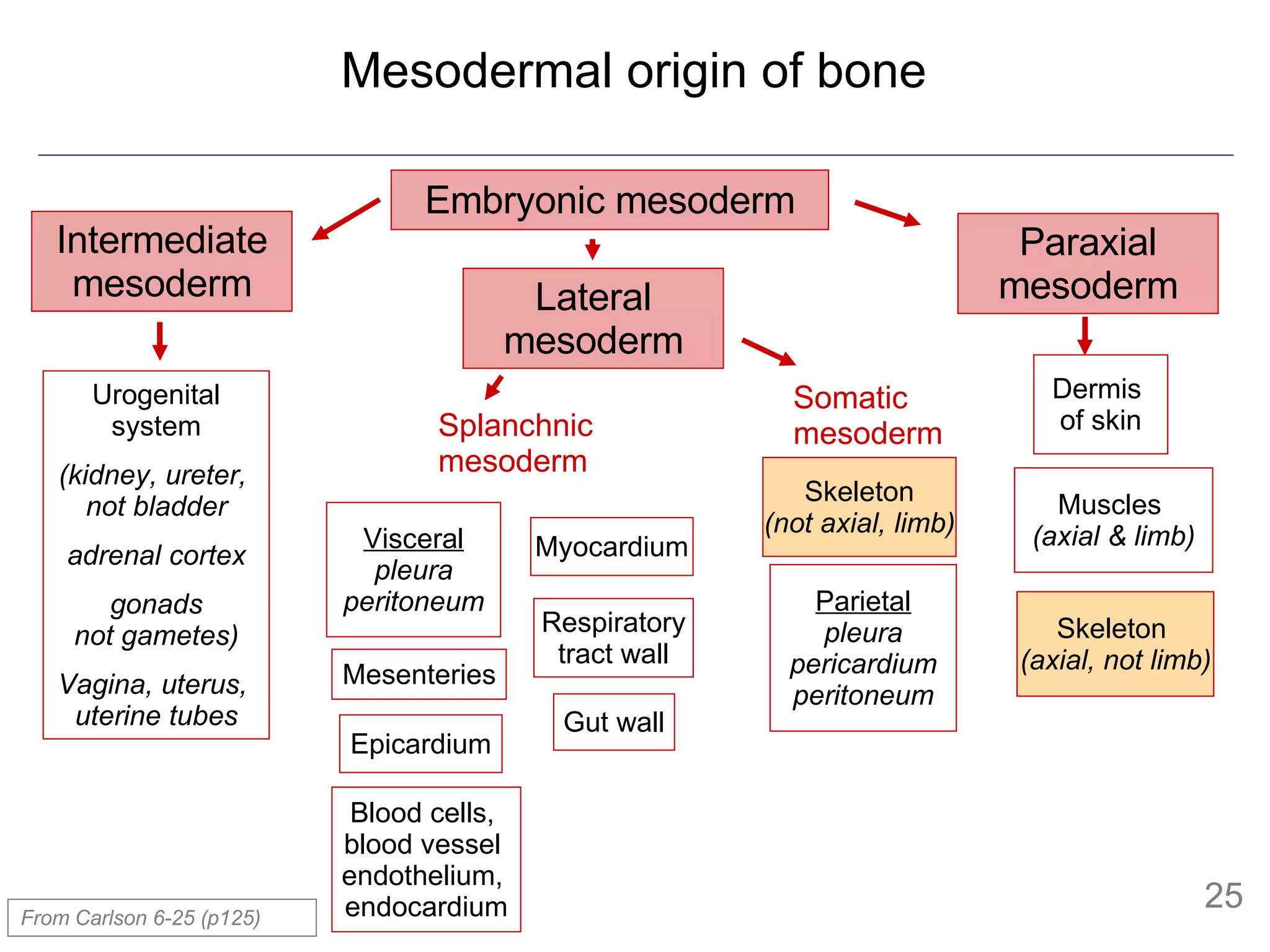
Mesodermal origin of bone From Carlson 6-25 (p125) Embryonic mesoderm Intermediate mesoderm Urogenital system (kidney, ureter,  not bladder adrenal cortex gonads not gametes) Vagina, uterus,  uterine tubes Dermis  of skin Skeleton  (axial, not limb) Lateral mesoderm Paraxial mesoderm Muscles  (axial & limb) Splanchnic mesoderm Somatic mesoderm Skeleton (not axial, limb) Parietal pleura pericardium peritoneum Visceral pleura peritoneum Mesenteries Blood cells,  blood vessel  endothelium,  endocardium Respiratory tract wall Gut wall Epicardium Myocardium
Two major types of bone formation Endochondral ossification illustrated at R Cartilage model of bone forms first At specific periods during embryogenesis, this cartilage is replaced by true bone Most bones Intramembranous bone formation Direct ossification of mesenchymal cells without an intermediate cartilagenous stage Superficial bones of face and skull
Learning objectives:  Mesoderm I Students should be able to describe:  the origin of the mesodermal germ layer the early division of the mesoderm into paraxial, intermediate mesoderm, and lateral mesoderm and the split of lateral mesoderm into splanchnic and somatic mesoderm the major fates of the mesoderm Re muscle: in outline, a lineage tracing method used to determine the developmental origin of limb muscle the major steps in development of a skeletal muscle fiber from a mononucleate myoblast the developmental basis of slow versus fast twitch muscle Re bone:  The two mechanisms of bone formation Students should be able to define, use in context, and provide examples of all words on the slides titled “Vocabulary”.
The  End
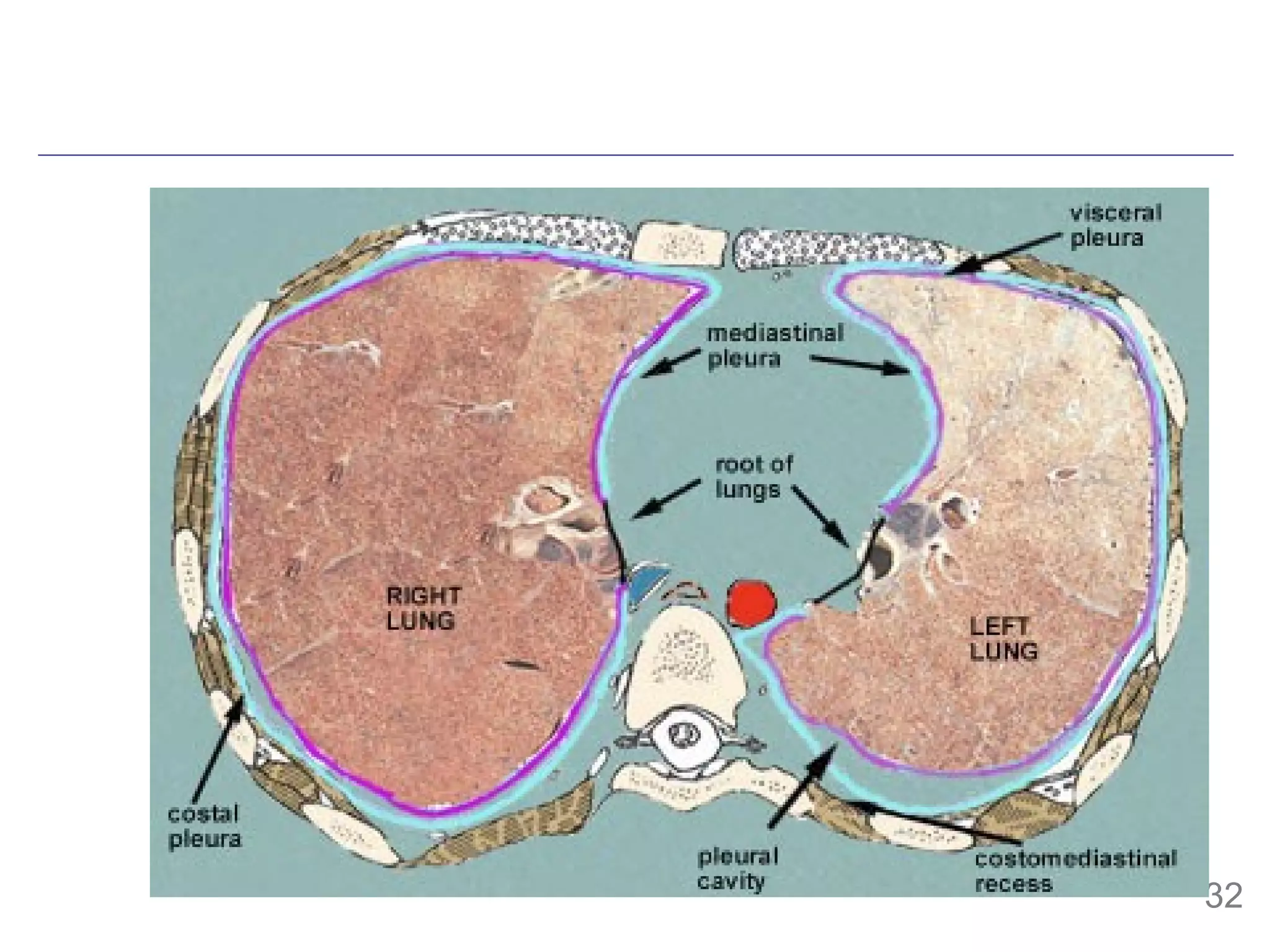
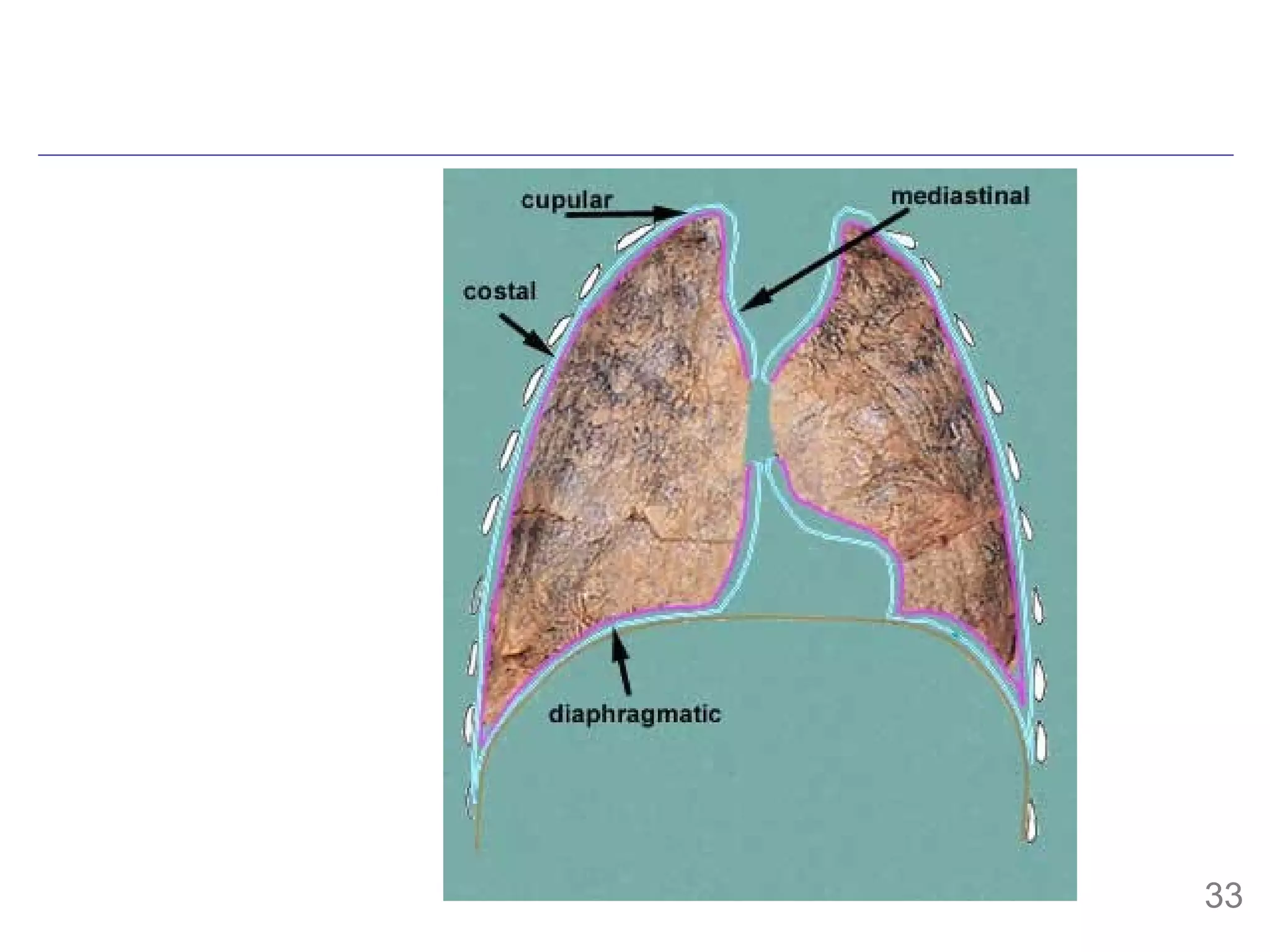
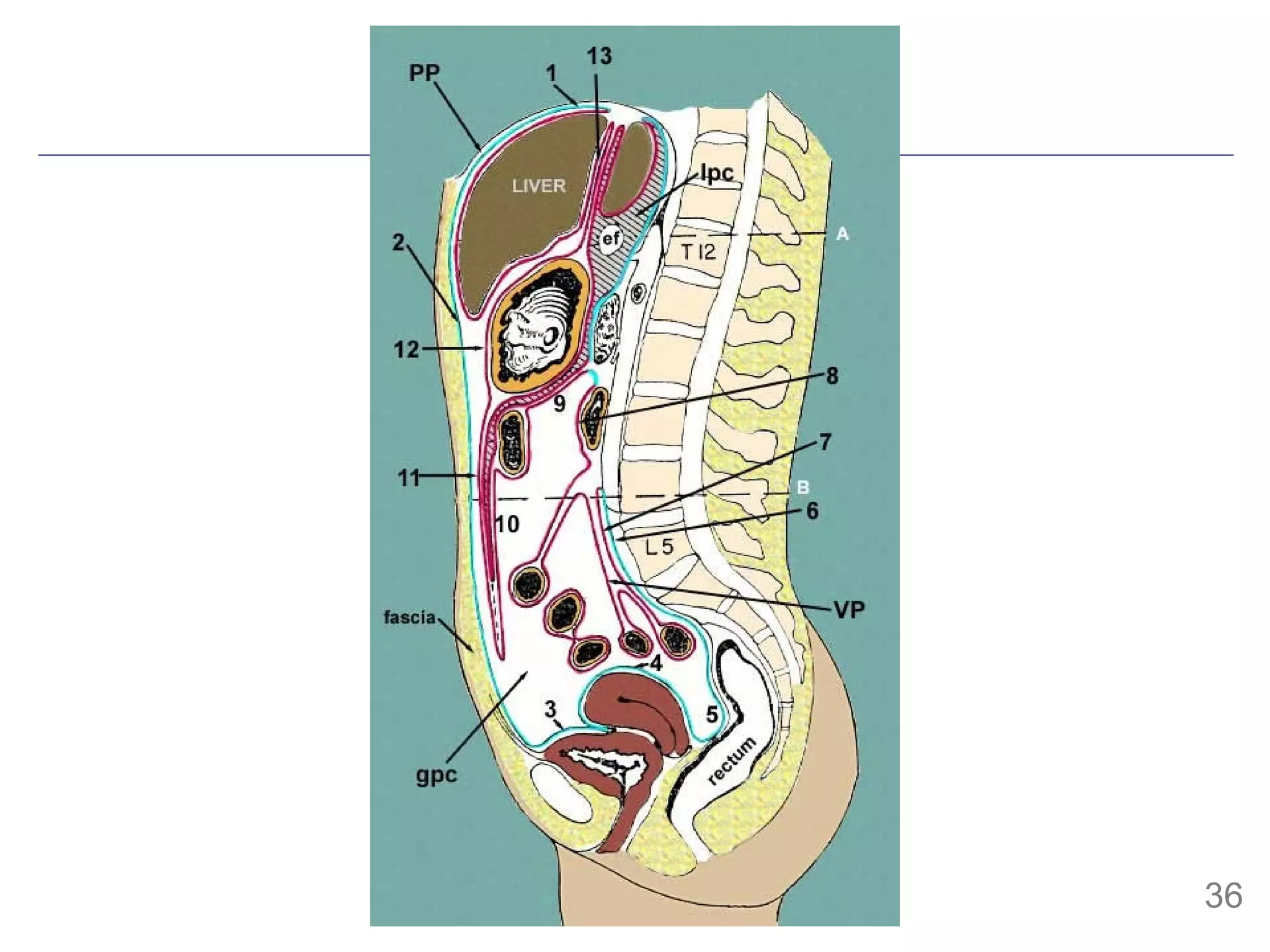
Appendix: formation of the body cavities Following slides will be much clearer after you have had anatomy. For purposes of ETC quizzes, you don’t need to know anything about body cavities (or their lining membranes):  peritioneal cavity (visceral and parietal peritoneum) pleural cavity (visceral and parietal pleura) pericardial cavity (visceral and parietal pericardium)
Postnatal derivatives of embryonic mesoderm From Carlson 6-25 (p125) Embryonic mesoderm Intermediate mesoderm Urogenital system (kidney, ureter,  not bladder adrenal cortex gonads not gametes) Vagina, uterus,  uterine tubes Dermis  of skin Skeleton  (axial,  not limb ) Lateral mesoderm Paraxial mesoderm Muscles  (axial & limb) Splanchnic mesoderm Somatic mesoderm Skeleton ( not axial , limb) Parietal pleura pericardium peritoneum Visceral pleura peritoneum Mesenteries Blood cells,  blood vessel  endothelium,  endocardium Respiratory tract wall Gut wall Epicardium Myocardium somatic = “parietal” = wall layer. For gut and gut derivatives, the parietal layer  lines body wall.  splanchnic = visceral = organ layer epicardium= visceral pericardium
Postnatal derivatives of embryonic mesoderm From Carlson 6-25 (p125) Embryonic mesoderm Intermediate mesoderm Lateral mesoderm Paraxial mesoderm Splanchnic mesoderm Somatic mesoderm Parietal parietal  pleura   parietal  pericardium   parietal  peritoneum Visceral visceral  pleura visceral  pericardium visceral  peritoneum Mesenteries somatic = “parietal” = wall layer.  For example, gut and gut derivatives, the parietal layer  lines body wall.  splanchnic = visceral = organ layer epicardium= visceral pericardium
mesentery mesentery  (mes en-ter- ) [TA]  A double layer of peritoneum attached to the abdominal wall and enclosing in its fold a portion or all of one of the abdominal viscera, conveying to it its vessels and nerves.  The fan-shaped fold of peritoneum suspending the greater part of the small intestines (jejunum and ileum) and attaching it to the posterior abdominal wall at the root of the mesentery (radix mesenterii). Syn:  mesenterium dorsale commune ,  mesostenium   Syn:  mesenterium  TA  [Mod. L.  mesenterium,  fr. G.  mesenterion,  fr. G.  mesos,  middle, +  enteron,  intestine] Stedman’s
Mesoderm I

Mesoderm I

  • 1.
    Mesoderm I Embryos,Tissues, Cells August 25, 2008 Douglas L. Falls, M.D.
  • 2.
    Mesoderm I /II: Reading Carlson (2004) Human Embryology and Developmental Biology (3 rd edition) Reference: ch 6 p108-118 early mesoderm development including somite development and early circulatory system development ch 6 p122-126 overview of structure of 4 wk human embryo) ch 6 fig 6-25 (p125) flow chart organ/tissue origin from germ layers) ch 9 p193-206, especially p195-196 and 204-206 muscular system development) ch 9 p185-193 skeletal development)
  • 3.
    Mesoderm I: Learning objectives Students should be able to describe: the origin of the mesodermal germ layer the early division of the mesoderm into paraxial, intermediate mesoderm, and lateral mesoderm and the split of lateral mesoderm into splanchnic and somatic mesoderm the major fates of the mesoderm Re muscle: in outline, a lineage tracing method used to determine the developmental origin of limb muscle the major steps in development of a skeletal muscle fiber from a mononucleate myoblast the developmental basis of slow versus fast twitch muscle the difference between skeletal versus cardiac and smooth muscle development with respect to myoblast fusion Re bone: The two mechanisms of bone formation Students should be able to define, use in context, and provide examples of all words on the slides titled “Vocabulary”.
  • 4.
    Embryology education resource:Endowment for Human Development WWW site Excellent source of human embryology education materials Some available in multiple languages http://www.ehd.org/ DVD: The Biology of Prenatal Development In class we will watch Ch2, Ch5-->29 of DVD Script can be downloaded: http://www.ehd.org/pdf/BPD%204-26-2006%20English.pdf Suggest begin with: Prenatal overview (and take the quizzes?) Prenatal timeline Prenatal slide shows Movie theater
  • 5.
    Vocabulary coelom – Etymology: German, from Greek koilōma cavity, from koilos Date: 1875 :   the usually epithelium-lined space between the body wall and the digestive tract of metazoans above the lower worms splanchnic Etymology: New Latin splanchnicus, from Greek splanchnikos, from splanchna, plural, viscera; akin to Greek splēn spleen Date: 1681 of or relating to the viscera :   visceral viscus (plural: viscera; adj = visceral) an internal organ of the body; especially :  one (as the heart, liver, or intestine) located in the great cavity of the trunk proper somatic of or relating to the wall of the body :   parietal parietal   of or relating to the walls of a part or cavity axial relating to or situated in the central part of the body, in the head and trunk as distinguished from the limbs, e.g., axial skeleton. C
  • 6.
    Vocabulary Somite – Etymology: International Scientific Vocabulary, from Greek sōma body Date: 1869   one of the longitudinal series of segments into which the body of many animals is divided Names of the 3 paired veins that drain into the tubular heart of a 4 wk embryo vitelline – Etymology: Middle English, from Medieval Latin vitellinus, from Latin vitellus egg yolk Date: 15th century cardinal Etymology: Middle English, from Late Latin cardinalis, from Latin, serving as a hinge, from cardin-, cardo hinge Date: 14th century of basic importance :   main , chief , primary <a cardinal principle> umbilical Date: 1541 of, relating to, or used at the navel
  • 7.
    Learning objectives: Mesoderm I Students should be able to describe: the origin of the mesodermal germ layer the early division of the mesoderm into paraxial, intermediate mesoderm, and lateral mesoderm and the split of lateral mesoderm into splanchnic and somatic mesoderm the major fates of the mesoderm Re muscle: in outline, a lineage tracing method used to determine the developmental origin of limb muscle the major steps in development of a skeletal muscle fiber from a mononucleate myoblast the developmental basis of slow versus fast twitch muscle Re bone: The two mechanisms of bone formation Students should be able to define, use in context, and provide examples of all words on the slides titled “Vocabulary”.
  • 8.
    Epiblast cells thatdo migrate down (ventrally) through the primitive streak during later stages of gastrulation constitute the mesoderm layer ( dull red in 16 day image at lower right ) day 16 14-15 days 16 days 2 wks
  • 9.
    Human embryo duringgastrulation Carlson Fig. 5-4 (p86)+ 5-5 (p87) transverse section
  • 10.
    Derivatives of thebilaminar embryo Carlson Fig. 5-1 (p84) Laminae of bilaminar embryo Extraembryonic mesoderm
  • 11.
    Though early onyou were a quite flat disk, now are a doughnut http://www.abdn.ac.uk/langling/resources/usflimgs.html [And what is in the middle?]
  • 12.
    only “embryonic tissues”in this figure No “extraembryonic” last week #1 last week #2 this lecture Carlson 6-25 (p125)
  • 13.
    Development of mesoderm(visualized in transverse sections) Paraxial mesoderm Organizes into somites Somites give rise to axial skeleton, axial muscles, limb muscles, dermis. Intermediate mesoderm Gives rise to urogenital system Lateral mesoderm heart (endo, epi, pericardium) blood endothelium (lining of blood vessels) wall of gut wall of respiratory tract lining of body cavities
  • 14.
    Major subdivisions ofthe mesoderm Sadler 3-4 (p19) “ parietal” (wall) layer “ visceral” (organ) layer
  • 15.
    Postnatal derivatives ofembryonic mesoderm From Carlson 6-25 (p125) Embryonic mesoderm Intermediate mesoderm Urogenital system (kidney, ureter, not bladder adrenal cortex gonads not gametes) Vagina, uterus, uterine tubes Dermis of skin Skeleton (axial, not limb ) Lateral mesoderm Paraxial mesoderm Muscles (axial & limb) Splanchnic mesoderm Somatic mesoderm Skeleton ( not axial , limb) Parietal pleura pericardium peritoneum Visceral pleura peritoneum Mesenteries Blood cells, blood vessel endothelium, endocardium Respiratory tract wall Gut wall Epicardium Myocardium somatic = “parietal” = wall layer. For gut and gut derivatives, the parietal layer lines body wall. splanchnic = visceral = organ layer epicardium= visceral pericardium
  • 16.
    Cross section ofintestine: Endodermally-derived inner lining (a “muscosa”) Mesodermally-derived muscle layers and outer lining Ectodermally-derived nerve plexuses = mesoderm-derived component of intestinal wall Also mesoderm-derived, but not part of wall
  • 17.
    Learning objectives: Mesoderm I Students should be able to describe: the origin of the mesodermal germ layer the early division of the mesoderm into paraxial, intermediate mesoderm, and lateral mesoderm and the split of lateral mesoderm into splanchnic and somatic mesoderm the major fates of the mesoderm Re muscle: in outline, a lineage tracing method used to determine the developmental origin of limb muscle the major steps in development of a skeletal muscle fiber from a mononucleate myoblast the developmental basis of slow versus fast twitch muscle Re bone: The two mechanisms of bone formation Students should be able to define, use in context, and provide examples of all words on the slides titled “Vocabulary”.
  • 18.
    The 3 Typesof muscle (and their developmental origins) Skeletal Paraxial (somite) derived Cardiac (myocardium) Splanchnic mesoderm Smooth Splanchnic “ Local mesoderm” (for example, muscle elevating hairs of skin when you get cold).
  • 19.
    Mesodermal origin ofmuscle From Carlson 6-25 (p125) Embryonic mesoderm Intermediate mesoderm Urogenital system (kidney, ureter, not bladder adrenal cortex gonads not gametes) Vagina, uterus, uterine tubes Dermis of skin Skeleton (axial, not limb) Lateral mesoderm Paraxial mesoderm Muscles (axial & limb) Splanchnic mesoderm Somatic mesoderm Skeleton (not axial, limb) Parietal pleura pericardium peritoneum Visceral pleura peritoneum Mesenteries Blood cells, blood vessel endothelium, endocardium Respiratory tract wall Gut wall Epicardium Myocardium skeletal cardiac smooth
  • 20.
    Lineage tracing studiesdemonstrate that limb muscles derive from somites
  • 21.
    Major steps indevelopmental progression by which skeletal muscle fibers are formed include: satellite cell = muscle stem cell? Myoblasts leave the cell cycle Postmitotic myoblasts fuse to form myotube A muscle fiber is a multinucleate syncytium formed by fusion of multiple mononucleate myoblasts Assembly of contractile units (sarcomeres). The contractile apparatus pushes nuclei to the edge Growth of fiber (“hypertrophy”) involving fusion of satellite cells
  • 22.
    Muscle fibers exhibitdifferent functional characteristics reflecting formation from different myoblast subpopulations Carlson 9-30 (p201) muscle stem cells?
  • 23.
    In contrast toskeletal muscle, cardiac and smooth muscle myocytes do not undergo fusion, but remain as individual cells Carlson 9-34 (p205)
  • 24.
    Learning objectives: Mesoderm I Students should be able to describe: the origin of the mesodermal germ layer the early division of the mesoderm into paraxial, intermediate mesoderm, and lateral mesoderm and the split of lateral mesoderm into splanchnic and somatic mesoderm the major fates of the mesoderm Re muscle: in outline, a lineage tracing method used to determine the developmental origin of limb muscle the major steps in development of a skeletal muscle fiber from a mononucleate myoblast the developmental basis of slow versus fast twitch muscle Re bone: The two mechanisms of bone formation Students should be able to define, use in context, and provide examples of all words on the slides titled “Vocabulary”.
  • 25.
    Mesodermal origin ofbone From Carlson 6-25 (p125) Embryonic mesoderm Intermediate mesoderm Urogenital system (kidney, ureter, not bladder adrenal cortex gonads not gametes) Vagina, uterus, uterine tubes Dermis of skin Skeleton (axial, not limb) Lateral mesoderm Paraxial mesoderm Muscles (axial & limb) Splanchnic mesoderm Somatic mesoderm Skeleton (not axial, limb) Parietal pleura pericardium peritoneum Visceral pleura peritoneum Mesenteries Blood cells, blood vessel endothelium, endocardium Respiratory tract wall Gut wall Epicardium Myocardium
  • 26.
    Two major typesof bone formation Endochondral ossification illustrated at R Cartilage model of bone forms first At specific periods during embryogenesis, this cartilage is replaced by true bone Most bones Intramembranous bone formation Direct ossification of mesenchymal cells without an intermediate cartilagenous stage Superficial bones of face and skull
  • 27.
    Learning objectives: Mesoderm I Students should be able to describe: the origin of the mesodermal germ layer the early division of the mesoderm into paraxial, intermediate mesoderm, and lateral mesoderm and the split of lateral mesoderm into splanchnic and somatic mesoderm the major fates of the mesoderm Re muscle: in outline, a lineage tracing method used to determine the developmental origin of limb muscle the major steps in development of a skeletal muscle fiber from a mononucleate myoblast the developmental basis of slow versus fast twitch muscle Re bone: The two mechanisms of bone formation Students should be able to define, use in context, and provide examples of all words on the slides titled “Vocabulary”.
  • 28.
  • 29.
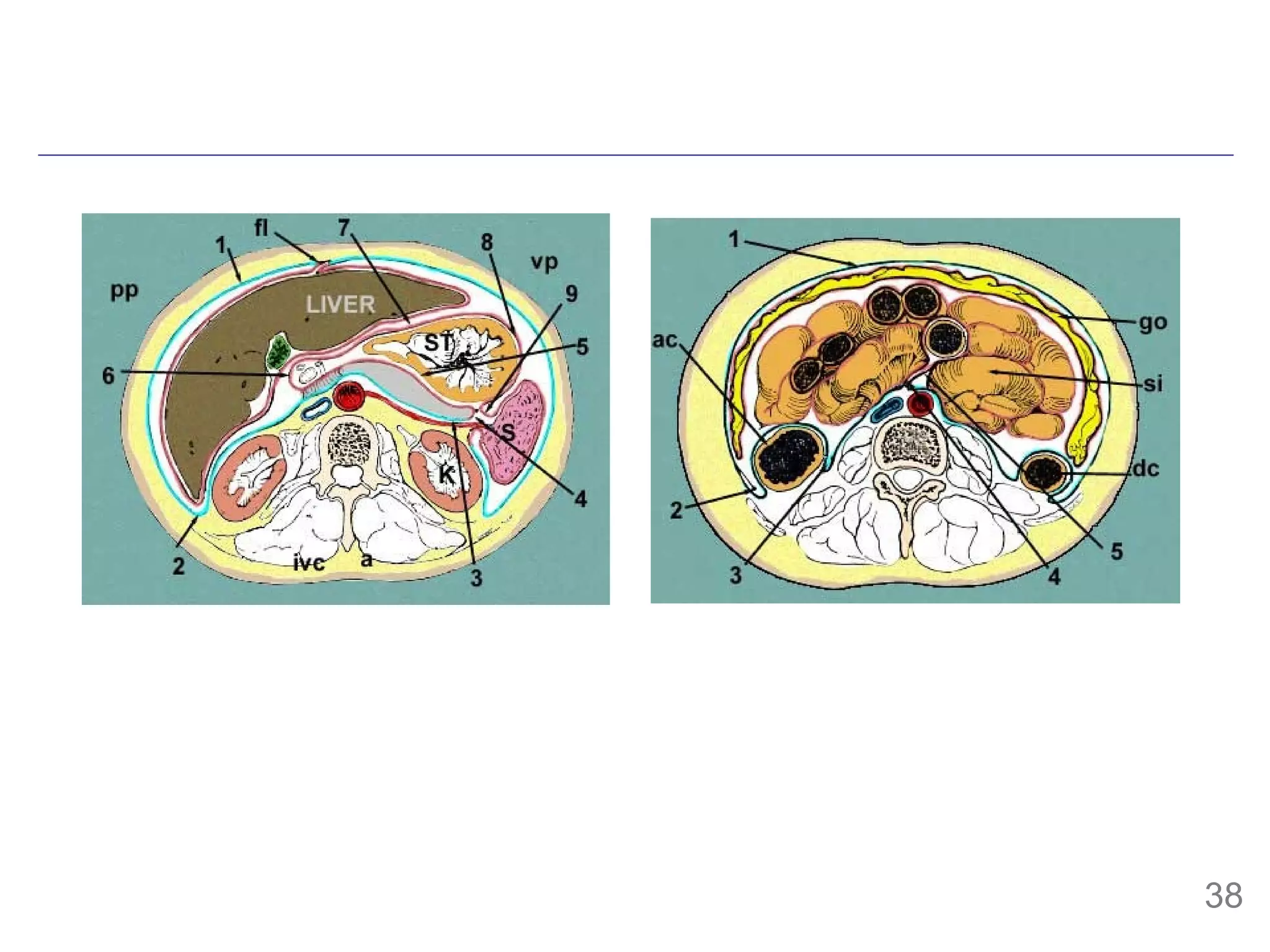
    Appendix: formation ofthe body cavities Following slides will be much clearer after you have had anatomy. For purposes of ETC quizzes, you don’t need to know anything about body cavities (or their lining membranes): peritioneal cavity (visceral and parietal peritoneum) pleural cavity (visceral and parietal pleura) pericardial cavity (visceral and parietal pericardium)
  • 30.
    Postnatal derivatives ofembryonic mesoderm From Carlson 6-25 (p125) Embryonic mesoderm Intermediate mesoderm Urogenital system (kidney, ureter, not bladder adrenal cortex gonads not gametes) Vagina, uterus, uterine tubes Dermis of skin Skeleton (axial, not limb ) Lateral mesoderm Paraxial mesoderm Muscles (axial & limb) Splanchnic mesoderm Somatic mesoderm Skeleton ( not axial , limb) Parietal pleura pericardium peritoneum Visceral pleura peritoneum Mesenteries Blood cells, blood vessel endothelium, endocardium Respiratory tract wall Gut wall Epicardium Myocardium somatic = “parietal” = wall layer. For gut and gut derivatives, the parietal layer lines body wall. splanchnic = visceral = organ layer epicardium= visceral pericardium
  • 31.
    Postnatal derivatives ofembryonic mesoderm From Carlson 6-25 (p125) Embryonic mesoderm Intermediate mesoderm Lateral mesoderm Paraxial mesoderm Splanchnic mesoderm Somatic mesoderm Parietal parietal pleura parietal pericardium parietal peritoneum Visceral visceral pleura visceral pericardium visceral peritoneum Mesenteries somatic = “parietal” = wall layer. For example, gut and gut derivatives, the parietal layer lines body wall. splanchnic = visceral = organ layer epicardium= visceral pericardium
  • 37.
    mesentery mesentery (mes en-ter- ) [TA] A double layer of peritoneum attached to the abdominal wall and enclosing in its fold a portion or all of one of the abdominal viscera, conveying to it its vessels and nerves. The fan-shaped fold of peritoneum suspending the greater part of the small intestines (jejunum and ileum) and attaching it to the posterior abdominal wall at the root of the mesentery (radix mesenterii). Syn: mesenterium dorsale commune , mesostenium Syn: mesenterium TA [Mod. L. mesenterium, fr. G. mesenterion, fr. G. mesos, middle, + enteron, intestine] Stedman’s

Editor's Notes

  • #2 Sources used in preparing these lectures include: Carlson (2004) Human embryology and developmental biology, 3rd Edition. St. Louis, Mo.: Mosby. Dye (2002) Dictionary of developmental biology and embryology. New York: Wiley-Liss. Moore (2003) The developing human : clinically oriented embryology, 7th . Edition. Philadelphia, Pa.: Saunders. [Emory lib has 7 th on reserve; actually, I used the 6 th edition, 1998. This was the source I used the least. ] Sadler (2005) Langman&apos;s essential medical embryology. Philadelphia: Lippincott Williams &amp; Wilkins. [Unfortunately Emory lib appears not to have this. I may ask them to get it -- clear, concise exposition. Also includes a glossary &amp; many scanning EMs. Alas, no problems. ] Wolpert (2002) Principles of development, 2nd Edition. Oxford: Oxford University Press. [Experimental/molecular embryology: not clinically oriented.] Image from Sadler Fig. 3-4 (p19)