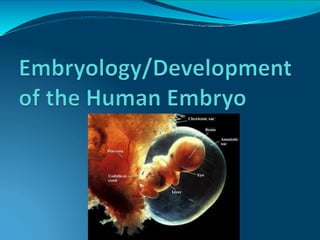
What is embryology?
The study of developmental events that
occurduring the prenatal stage .
The branch of biology and medicine
concerned with the study of embryos
and theirdevelopment.
Embryonic period vs. Fetal period
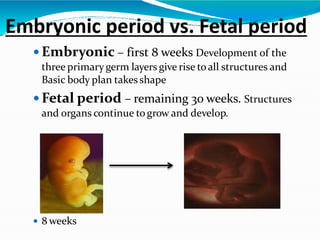
 Embryonic – first 8 weeks Development of the
three primary germ layers give rise toall structures and
Basic body plan takes shape
 Fetal period – remaining 30 weeks. Structures
and organs continue togrow and develop.
 8 weeks
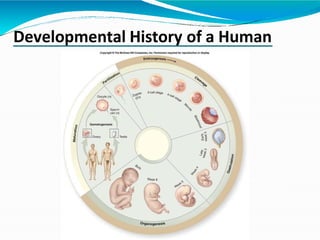
Developmental History of a Human
Stages of Development
Embryogenesis
1. Fertilization
2. Cleavage
3.Gastrulation
4.Organogenesis
5.Maturation
Fertilization
 The process of fusion or union of the
spermatozoon with the mature ovum is known as
conception / fertilizaiton/impregnantation.
 Which produced the fertilized single mono-
nucleated cell called the zygote.
Embryogenesis: Theformation
and developmentof an embryo.
1. Cleavage is a series of rapid mitotic
divisions (withoutcell growth)
2.Gastrulation : is a phase early in the
embryonic development of most animals/human
being, during which the single-layered blastula is
reorganized into a trilaminar ("three-layered")
structure known as thegastrula. These threegerm
layers are known as the ectoderm, mesoderm, and
endoderm.
3.Organogenesis: The production and
developmentof theorgans of an animal or plant.
Maturation
• Maturation is the terminal event of embryogenesis. In
zygotic embryogenesis.
• Maturation is characterized by attainment of mature
embryo morphology, accumulation of storage
carbohydrates, lipids and proteins, reduction in water
content and a gradual decline or cessation of metabolism.
DEVELOPMENT OF THE
MUSCULOSKELETAL
SYSTEM
Development of the Skeletal System
Source of Origin:
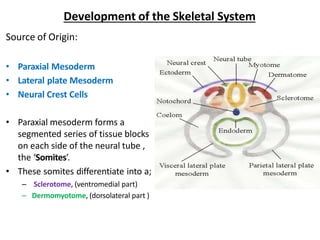
• Paraxial Mesoderm
• Lateral plate Mesoderm
• Neural Crest Cells
• Paraxial mesoderm forms a
segmented series of tissue blocks
on each side of the neural tube ,
the ‘Somites’.
• These somites differentiate into a;
– Sclerotome, (ventromedial part)
– Dermomyotome, (dorsolateral part )
The Embryonic connective tissue
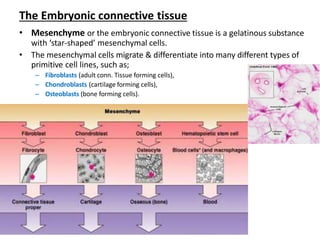
• Mesenchyme or the embryonic connective tissue is a gelatinous substance
with ‘star-shaped’ mesenchymal cells.
• The mesenchymal cells migrate & differentiate into many different types of
primitive cell lines, such as;
– Fibroblasts (adult conn. Tissue forming cells),
– Chondroblasts (cartilage forming cells),
– Osteoblasts (bone forming cells).
Origins of the Axial & Appendicular Skeleton
• The mesenchyme in the paraxial mesoderm will
transform into Osteoblasts that will form the bony
elements of the vertebral column (e.g. body,
transverse process, spinous process etc).
• The mesenchyme in the somatopleuric mesoderm
will transform into osteoblasts that will form the
Pelvic & Pectoral girdles and also the bones of
upper & lower limbs.
Ossification
“The process of bone formation is known as ossification”
Bone develops during the intra uterine life through two types of
ossifications;
• Membranous type, in which the mesenchymal tissue
(jelly-like) will directly transform into bone. (e.g. flat
bones of skull)
• Intra-cartilagenous type, in which the mesenchymal tissue
first give rise to a hyaline cartilage model of the bone, then the
osteoblasts will convert that model into bone (e.g. long bones,
irregular bones like vertebrae etc)
Development of Skull (Intramembranous Ossification)
The skull is divided into two parts;
• Neurocranium which forms a
protective covering around
the brain is derived from the
‘occipital somites’
– Membranous Neurocranium is
composed of flat bones of the
cranial vault.
– Cartilagenous Neurocranium is
composed of the irregular
bones of the base of skull
• Viscerocranium which forms
the skeleton of the face is
derived from the ‘Neural
crest cells’.
Intracartilagenous Ossification
Mostly seen in the long bones of limbs.
• First a hyaline cartilage model is formed in the mesenchyme
• Then a primary ossification center appears in the ‘diaphysis’ of
the model.
• Bone formation/laying starts from the center in both upward &
downward direction.
• Almost all primary centers of ossification appear before birth.
• Most of the secondary centers appear after birth.
• The part of a long ossified from Primary center is the ‘Diaphysis’
• The part of a long bone ossified from a secondary center is the
‘Epiphysis’
The fusion between the diaphysis and epiphysis does not occur
till puberty
Development of the Limb Buds
• The limb buds become visible as outpocketings from the ventrolateral
body wall of the embryo in the beginning of 5th week.
• In the 6th wk, the terminal portion of the limb buds becomes falttened to
form hand plates & foot plates and are separated from the proximal
segment by a circular constriction (the future wrist crease & ankle crease)
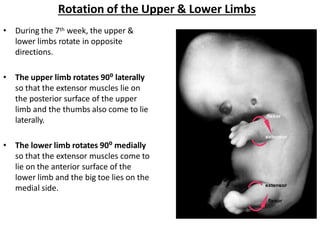
Rotation of the Upper & Lower Limbs
• During the 7th week, the upper &
lower limbs rotate in opposite
directions.
• The upper limb rotates 90⁰ laterally
so that the extensor muscles lie on
the posterior surface of the upper
limb and the thumbs also come to lie
laterally.
• The lower limb rotates 90⁰ medially
so that the extensor muscles come to
lie on the anterior surface of the
lower limb and the big toe lies on the
medial side.
Skeletal system Anomaly
Achondroplasia:
• Caused by a disturbance in the
‘endochondral/intracartilagenous’
ossification in the ‘epiphyseal/growth
plates’ of the long bones.
• The result is Dwarfism.
• Both extremities are short but head is of
normal size.
Development of the Muscular System
The entire muscular system of the body develops from the
Mesoderm (except for the muscles of Iris, which are derived
from the ectoderm of the optic cups).
The smooth muscles of
gastrointestinal tract
develop from the
Splanchnic mesoderm
surrounding the gut tube .
The cardiac muscles of the
heart develops from the
splanchnic mesoderm
surrounding the primitive
heart tube.
Development of the Axial Musculature
• The Somites develop
from Paraxial mesoderm
give rise to the skeletal
musculature of axial
skeleton, body wall,
limbs, and head.
• From the occipital region
down, somites form and
differentiate into the
‘sclerotome and
dermomyotome.
Myogenesis (Development of muscle fibers)
Cells of the myotome (Satellite cells) in
the body wall and limb regions split and
become elongated, spindle-shaped
‘myoblasts’.
Multiple myoblasts fuse together and
form multinucleated muscle fibers.
By the end of 3rd month of IUL, cross striations, a typical feature of
skeletal muscles appear
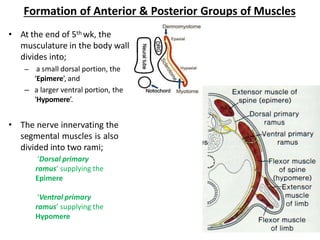
Formation of Anterior & Posterior Groups of Muscles
• At the end of 5th wk, the
musculature in the body wall
divides into;
– a small dorsal portion, the
‘Epimere’, and
– a larger ventral portion, the
‘Hypomere’.
• The nerve innervating the
segmental muscles is also
divided into two rami;
‘Dorsal primary
ramus’ supplying the
Epimere
‘Ventral primary
ramus’ supplying the
Hypomere
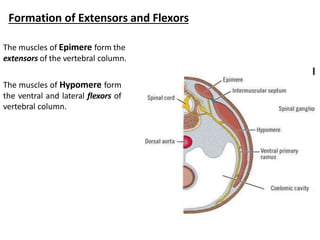
The muscles of Epimere form the
extensors of the vertebral column.
The muscles of Hypomere form
the ventral and lateral flexors of
vertebral column.
Formation of Extensors and Flexors
The Hypomere splits into three
layers;
In the thorax, these layers are
represented by External & Internal
intercostals and Transversus
thoracic muscles.
In the Abdomen, these are
represented by External & Internal
Obliques and Transversus
abdominis muscles.
Development of the Limb Musculature
• The first indication of limb musculature is found in the 7th wk
of development as a condensation of mesenchyme near the
base of each limb bud.
• This mesenchyme is derived from the dermomyotome cells of
somites.
• The upper limb buds lie
opposite the lower five
cervical and upper two
thoracic segments
• The lower limb buds lie
opposite lower four lumbar
and upper two sacral
segments
• As soon as the buds are formed, the neighboring spinal nerves
penetrate into the mesenchyme.
• At first they enter with isolated dorsal and ventral branches.
• Soon these branches unite to form large dorsal and ventral
nerves.
• Thus in a developing upper limb;
– Radial nerve which supplies the extensors (posterior/dorsal
muscles), is formed by dorsal segmental branches.
– Ulnar and Median nerves, which supply the flexors
(anterior/ventral muscles), are formed by ventral segmental
branches
Dermatomal Pattern
• The spinal nerves not only play
an important role in the
differentiation & motor
innervation of the limb
musculature, but also provide
the sensory innervation for
the dermatomes.
• Although the original
dermatomal pattern changes
with growth of extremities, an
orderly sequence can still be
recognized in the adult.

anatomy 1.pptx

  • 2.
    What is embryology? Thestudy of developmental events that occurduring the prenatal stage . The branch of biology and medicine concerned with the study of embryos and theirdevelopment.
  • 3.
    Embryonic period vs.Fetal period  Embryonic – first 8 weeks Development of the three primary germ layers give rise toall structures and Basic body plan takes shape  Fetal period – remaining 30 weeks. Structures and organs continue togrow and develop.  8 weeks
  • 4.
  • 5.
    Stages of Development Embryogenesis 1.Fertilization 2. Cleavage 3.Gastrulation 4.Organogenesis 5.Maturation
  • 6.
    Fertilization  The processof fusion or union of the spermatozoon with the mature ovum is known as conception / fertilizaiton/impregnantation.  Which produced the fertilized single mono- nucleated cell called the zygote.
  • 7.
    Embryogenesis: Theformation and developmentofan embryo. 1. Cleavage is a series of rapid mitotic divisions (withoutcell growth)
  • 8.
    2.Gastrulation : isa phase early in the embryonic development of most animals/human being, during which the single-layered blastula is reorganized into a trilaminar ("three-layered") structure known as thegastrula. These threegerm layers are known as the ectoderm, mesoderm, and endoderm. 3.Organogenesis: The production and developmentof theorgans of an animal or plant.
  • 9.
    Maturation • Maturation isthe terminal event of embryogenesis. In zygotic embryogenesis. • Maturation is characterized by attainment of mature embryo morphology, accumulation of storage carbohydrates, lipids and proteins, reduction in water content and a gradual decline or cessation of metabolism.
  • 10.
  • 12.
    Development of theSkeletal System Source of Origin: • Paraxial Mesoderm • Lateral plate Mesoderm • Neural Crest Cells • Paraxial mesoderm forms a segmented series of tissue blocks on each side of the neural tube , the ‘Somites’. • These somites differentiate into a; – Sclerotome, (ventromedial part) – Dermomyotome, (dorsolateral part )
  • 13.
    The Embryonic connectivetissue • Mesenchyme or the embryonic connective tissue is a gelatinous substance with ‘star-shaped’ mesenchymal cells. • The mesenchymal cells migrate & differentiate into many different types of primitive cell lines, such as; – Fibroblasts (adult conn. Tissue forming cells), – Chondroblasts (cartilage forming cells), – Osteoblasts (bone forming cells).
  • 14.
    Origins of theAxial & Appendicular Skeleton • The mesenchyme in the paraxial mesoderm will transform into Osteoblasts that will form the bony elements of the vertebral column (e.g. body, transverse process, spinous process etc). • The mesenchyme in the somatopleuric mesoderm will transform into osteoblasts that will form the Pelvic & Pectoral girdles and also the bones of upper & lower limbs.
  • 15.
    Ossification “The process ofbone formation is known as ossification” Bone develops during the intra uterine life through two types of ossifications; • Membranous type, in which the mesenchymal tissue (jelly-like) will directly transform into bone. (e.g. flat bones of skull) • Intra-cartilagenous type, in which the mesenchymal tissue first give rise to a hyaline cartilage model of the bone, then the osteoblasts will convert that model into bone (e.g. long bones, irregular bones like vertebrae etc)
  • 16.
    Development of Skull(Intramembranous Ossification) The skull is divided into two parts; • Neurocranium which forms a protective covering around the brain is derived from the ‘occipital somites’ – Membranous Neurocranium is composed of flat bones of the cranial vault. – Cartilagenous Neurocranium is composed of the irregular bones of the base of skull • Viscerocranium which forms the skeleton of the face is derived from the ‘Neural crest cells’.
  • 17.
    Intracartilagenous Ossification Mostly seenin the long bones of limbs. • First a hyaline cartilage model is formed in the mesenchyme • Then a primary ossification center appears in the ‘diaphysis’ of the model. • Bone formation/laying starts from the center in both upward & downward direction. • Almost all primary centers of ossification appear before birth. • Most of the secondary centers appear after birth. • The part of a long ossified from Primary center is the ‘Diaphysis’ • The part of a long bone ossified from a secondary center is the ‘Epiphysis’ The fusion between the diaphysis and epiphysis does not occur till puberty
  • 19.
    Development of theLimb Buds • The limb buds become visible as outpocketings from the ventrolateral body wall of the embryo in the beginning of 5th week. • In the 6th wk, the terminal portion of the limb buds becomes falttened to form hand plates & foot plates and are separated from the proximal segment by a circular constriction (the future wrist crease & ankle crease)
  • 20.
    Rotation of theUpper & Lower Limbs • During the 7th week, the upper & lower limbs rotate in opposite directions. • The upper limb rotates 90⁰ laterally so that the extensor muscles lie on the posterior surface of the upper limb and the thumbs also come to lie laterally. • The lower limb rotates 90⁰ medially so that the extensor muscles come to lie on the anterior surface of the lower limb and the big toe lies on the medial side.
  • 21.
    Skeletal system Anomaly Achondroplasia: •Caused by a disturbance in the ‘endochondral/intracartilagenous’ ossification in the ‘epiphyseal/growth plates’ of the long bones. • The result is Dwarfism. • Both extremities are short but head is of normal size.
  • 22.
    Development of theMuscular System The entire muscular system of the body develops from the Mesoderm (except for the muscles of Iris, which are derived from the ectoderm of the optic cups). The smooth muscles of gastrointestinal tract develop from the Splanchnic mesoderm surrounding the gut tube . The cardiac muscles of the heart develops from the splanchnic mesoderm surrounding the primitive heart tube.
  • 23.
    Development of theAxial Musculature • The Somites develop from Paraxial mesoderm give rise to the skeletal musculature of axial skeleton, body wall, limbs, and head. • From the occipital region down, somites form and differentiate into the ‘sclerotome and dermomyotome.
  • 24.
    Myogenesis (Development ofmuscle fibers) Cells of the myotome (Satellite cells) in the body wall and limb regions split and become elongated, spindle-shaped ‘myoblasts’. Multiple myoblasts fuse together and form multinucleated muscle fibers. By the end of 3rd month of IUL, cross striations, a typical feature of skeletal muscles appear
  • 25.
    Formation of Anterior& Posterior Groups of Muscles • At the end of 5th wk, the musculature in the body wall divides into; – a small dorsal portion, the ‘Epimere’, and – a larger ventral portion, the ‘Hypomere’. • The nerve innervating the segmental muscles is also divided into two rami; ‘Dorsal primary ramus’ supplying the Epimere ‘Ventral primary ramus’ supplying the Hypomere
  • 26.
    The muscles ofEpimere form the extensors of the vertebral column. The muscles of Hypomere form the ventral and lateral flexors of vertebral column. Formation of Extensors and Flexors
  • 27.
    The Hypomere splitsinto three layers; In the thorax, these layers are represented by External & Internal intercostals and Transversus thoracic muscles. In the Abdomen, these are represented by External & Internal Obliques and Transversus abdominis muscles.
  • 28.
    Development of theLimb Musculature • The first indication of limb musculature is found in the 7th wk of development as a condensation of mesenchyme near the base of each limb bud. • This mesenchyme is derived from the dermomyotome cells of somites.
  • 29.
    • The upperlimb buds lie opposite the lower five cervical and upper two thoracic segments • The lower limb buds lie opposite lower four lumbar and upper two sacral segments
  • 30.
    • As soonas the buds are formed, the neighboring spinal nerves penetrate into the mesenchyme. • At first they enter with isolated dorsal and ventral branches. • Soon these branches unite to form large dorsal and ventral nerves. • Thus in a developing upper limb; – Radial nerve which supplies the extensors (posterior/dorsal muscles), is formed by dorsal segmental branches. – Ulnar and Median nerves, which supply the flexors (anterior/ventral muscles), are formed by ventral segmental branches
  • 31.
    Dermatomal Pattern • Thespinal nerves not only play an important role in the differentiation & motor innervation of the limb musculature, but also provide the sensory innervation for the dermatomes. • Although the original dermatomal pattern changes with growth of extremities, an orderly sequence can still be recognized in the adult.