ATAM
(An Architecture Tradeoff Analysis Method)
1
Dr. Himanshu Hora
SRMS College of Engineering & Technology, Bareilly
An architecture Tradeoff Analysis Method
 ATAM is designed to elicit the business goals for the
system as well as for the architecture.
 ATAM is so named because it reveals how well an
architecture satisfies particular quality goals and it
provides insight into how quality goals interact-that
is, how they tradeoff.
ATAM is a comprehensive way to evaluate a
software architecture.
Participants in ATAM
 The evaluation team.
 Project decision makers.
 Architecture stakeholders.
Evaluation team includes:-
• Team leader
• Evaluation leader
• Scenario scribe
• Proceedings scribe
• Timekeeper
• Process observer
• Process enforcer
• Questioner
Stakeholders include:-
 developers, testers.
 users,
 builders of systems interacting with this one
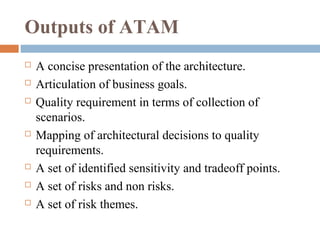
Outputs of ATAM
 A concise presentation of the architecture.
 Articulation of business goals.
 Quality requirement in terms of collection of
scenarios.
 Mapping of architectural decisions to quality
requirements.
 A set of identified sensitivity and tradeoff points.
 A set of risks and non risks.
 A set of risk themes.
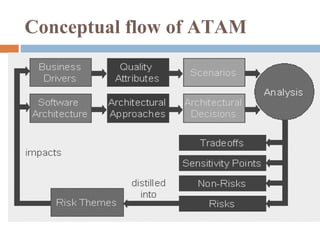
Conceptual flow of ATAM
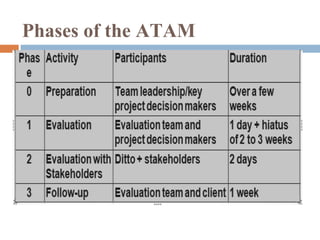
Phases of the ATAM
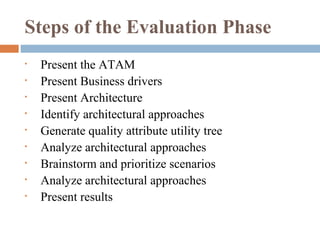
Steps of the Evaluation Phase
• Present the ATAM
• Present Business drivers
• Present Architecture
• Identify architectural approaches
• Generate quality attribute utility tree
• Analyze architectural approaches
• Brainstorm and prioritize scenarios
• Analyze architectural approaches
• Present results
ThankYou
Dr. Himanshu Hora
SRMS College of Engineering & Technology, Bareilly

ATAM

  • 1.
    ATAM (An Architecture TradeoffAnalysis Method) 1 Dr. Himanshu Hora SRMS College of Engineering & Technology, Bareilly
  • 2.
    An architecture TradeoffAnalysis Method  ATAM is designed to elicit the business goals for the system as well as for the architecture.  ATAM is so named because it reveals how well an architecture satisfies particular quality goals and it provides insight into how quality goals interact-that is, how they tradeoff. ATAM is a comprehensive way to evaluate a software architecture.
  • 3.
    Participants in ATAM The evaluation team.  Project decision makers.  Architecture stakeholders.
  • 4.
    Evaluation team includes:- •Team leader • Evaluation leader • Scenario scribe • Proceedings scribe • Timekeeper • Process observer • Process enforcer • Questioner
  • 5.
    Stakeholders include:-  developers,testers.  users,  builders of systems interacting with this one
  • 6.
    Outputs of ATAM A concise presentation of the architecture.  Articulation of business goals.  Quality requirement in terms of collection of scenarios.  Mapping of architectural decisions to quality requirements.  A set of identified sensitivity and tradeoff points.  A set of risks and non risks.  A set of risk themes.
  • 7.
  • 8.
  • 9.
    Steps of theEvaluation Phase • Present the ATAM • Present Business drivers • Present Architecture • Identify architectural approaches • Generate quality attribute utility tree • Analyze architectural approaches • Brainstorm and prioritize scenarios • Analyze architectural approaches • Present results
  • 10.
    ThankYou Dr. Himanshu Hora SRMSCollege of Engineering & Technology, Bareilly