Brain Anatomy Slides courtesy of Dr. Maria Rubio


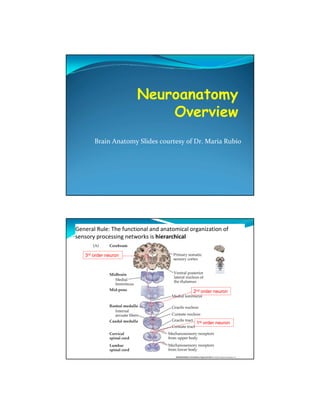
General Rule: The functional and anatomical organization of
sensory processing networks is hierarchical

   3rd order neuron


                                             2nd order neuron


                                              1st order neuron
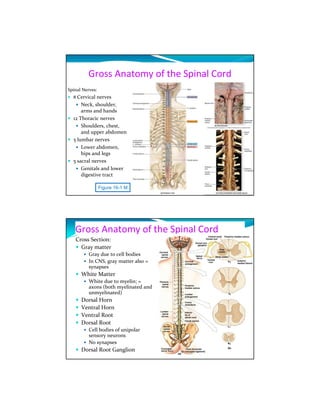
Gross Anatomy of the Spinal Cord
Spinal Nerves:
  8 Cervical nerves
      Neck, shoulder,
      arms and hands
  12 Thoracic nerves
      Shoulders, chest,
      and upper abdomen
  5 lumbar nerves
      Lower abdomen,
      hips and legs
  5 sacral nerves
      Genitals and lower
      digestive tract

                 Figure 16-1 M          Figure 13-2


   Gross Anatomy of the Spinal Cord
   Cross Section:
     Gray matter
          Gray due to cell bodies
          In CNS, gray matter also =
          synapses
      White Matter
          White due to myelin; =
          axons (both myelinated and
          unmyelinated)
      Dorsal Horn
      Ventral Horn
      Ventral Root
      Dorsal Root
          Cell bodies of unipolar
          sensory neurons
          No synapses
      Dorsal Root Ganglion
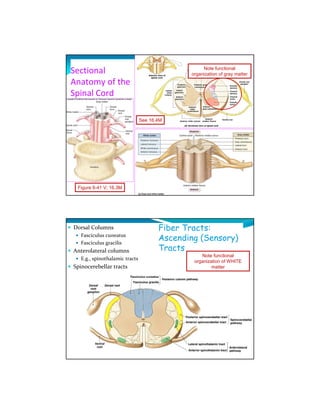
Note functional
Sectional                                     organization of gray matter
Anatomy of the
Spinal Cord

                                See 16.4M


 Figure 6-41 V; 16.3M


Dorsal Columns                         Fiber Tracts:
   Fasciculus cuneatus
   Fasciculus gracilis
                                       Ascending (Sensory)
Anterolateral columns                  Tracts
                                                  Note functional
   E.g., spinothalamic tracts
                                               organization of WHITE
Spinocerebellar tracts                                 matter
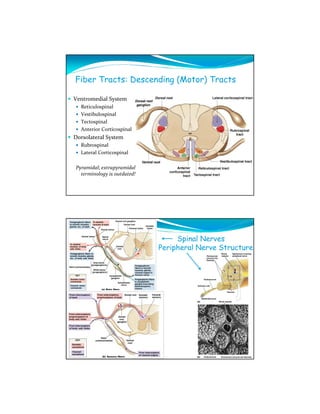
Fiber Tracts: Descending (Motor) Tracts

Ventromedial System
  Reticulospinal
  Vestibulospinal
  Tectospinal
  Anterior Corticospinal
Dorsolateral System
  Rubrospinal
  Lateral Corticospinal

Pyramidal; extrapyramidal
  terminology is outdated!


                                  Spinal Nerves
                             Peripheral Nerve Structure
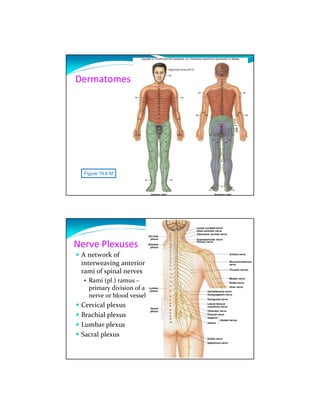
Dermatomes


  Figure 16.6 M


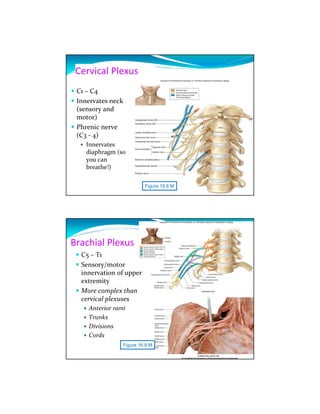
Nerve Plexuses
 A network of
 interweaving anterior
 rami of spinal nerves
    Rami (pl.) ramus –
    primary division of a
    nerve or blood vessel
 Cervical plexus
 Brachial plexus
 Lumbar plexus
 Sacral plexus
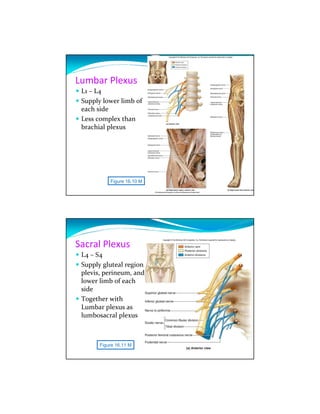
Cervical Plexus
 C1 – C4
 Innervates neck
 (sensory and
 motor)
 Phrenic nerve
 (C3 - 4)
    Innervates
    diaphragm (so
    you can
    breathe!)

                         Figure 16.8 M


Brachial Plexus
  C5 – T1
  Sensory/motor
  innervation of upper
  extremity
  More complex than
  cervical plexuses
    Anterior rami
    Trunks
    Divisions
    Cords
                Figure 16.9 M
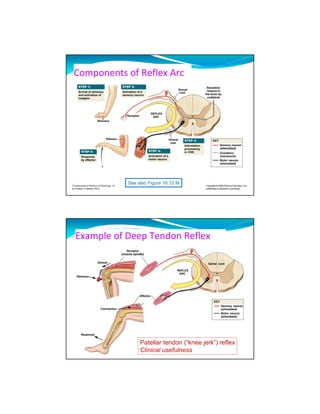
Lumbar Plexus
 L1 – L4
 Supply lower limb of
 each side
 Less complex than
 brachial plexus


           Figure 16.10 M


Sacral Plexus
 L4 – S4
 Supply gluteal region,
 plevis, perineum, and
 lower limb of each
 side
 Together with
 Lumbar plexus as
 lumbosacral plexus


       Figure 16.11 M
Components of Reflex Arc


           See also Figure 16.12 M


Example of Deep Tendon Reflex


                Patellar tendon (“knee jerk”) reflex
                Clinical usefulness
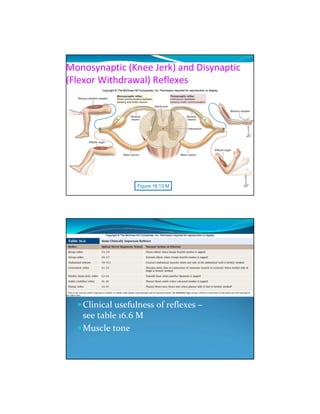
Monosynaptic (Knee Jerk) and Disynaptic
(Flexor Withdrawal) Reflexes


                  Figure 16.13 M


   Clinical usefulness of reflexes –
   see table 16.6 M
   Muscle tone
Slides courtesy of Dr.
                          Maria Rubio


Sagittal Plane


                   Coronal Plane
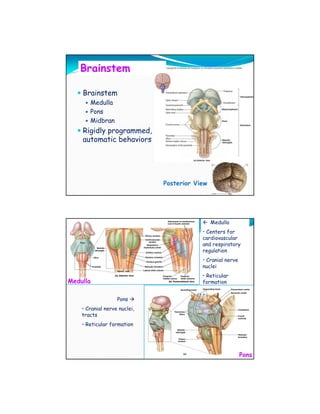
Brainstem

    Brainstem
       Medulla
       Pons
       Midbran
    Rigidly programmed,
    automatic behaviors


                              Posterior View


                                               Medulla
                                          • Centers for
                                          cardiovascular
                                          and respiratory
                                          regulation
                                          • Cranial nerve
                                          nuclei
                                          • Reticular
Medulla                                   formation


                   Pons
    • Cranial nerve nuclei,
    tracts
    • Reticular formation


                                                            Pons
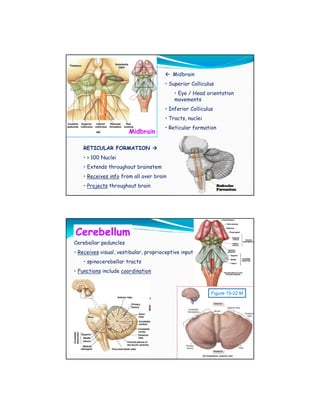
Midbrain
                                      • Superior Colliculus
                                          • Eye / Head orientation
                                          movements
                                      • Inferior Colliculus
                                      • Tracts, nuclei
                                      • Reticular formation
                       Midbrain

    RETICULAR FORMATION
    • > 100 Nuclei
    • Extends throughout brainstem
    • Receives info from all over brain
    • Projects throughout brain


Cerebellum
Cerebellar peduncles
• Receives visual, vestibular, proprioceptive input
    • spinocerebellar tracts
• Functions include coordination


                                                          Figure 15-22 M
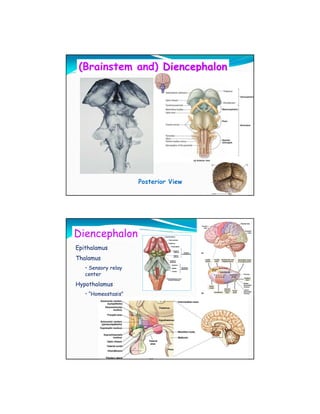
(Brainstem and) Diencephalon


                     Posterior View


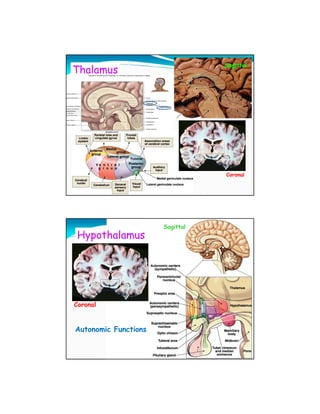
Diencephalon
Epithalamus
Thalamus
   • Sensory relay
   center
Hypothalamus
   • “Homeostasis”
Sagittal
Thalamus


                                 Coronal


                      Sagittal
Hypothalamus


Coronal


Autonomic Functions
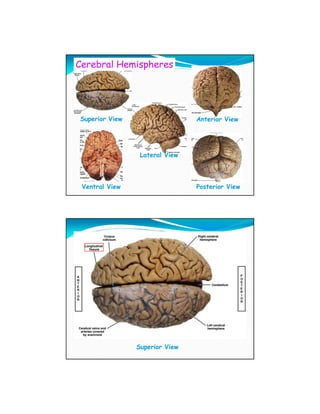
Cerebral Hemispheres


Superior View                   Anterior View


                 Lateral View


 Ventral View                   Posterior View


                Superior View
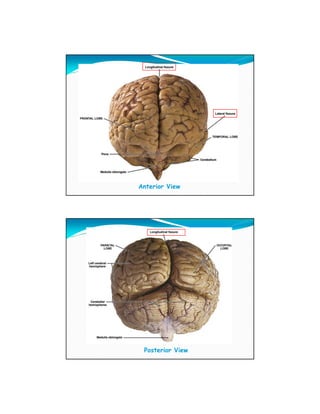
Anterior View


 Posterior View
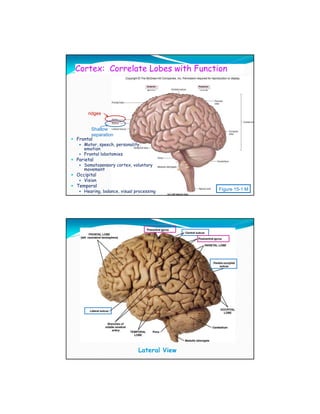
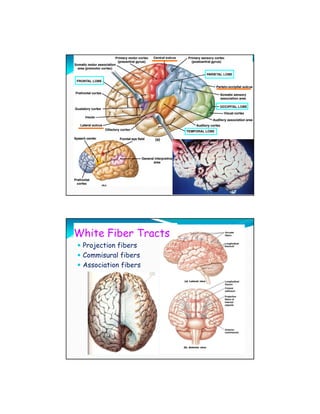
Cortex: Correlate Lobes with Function


     ridges


      Shallow
      separation
Frontal
   Motor, speech, personality,
   emotion
   Frontal lobotomies
Parietal
   Somatosensory cortex, voluntary
   movement
Occipital
   Vision
Temporal
   Hearing, balance, visual processing      Figure 15-1 M


                             Lateral View
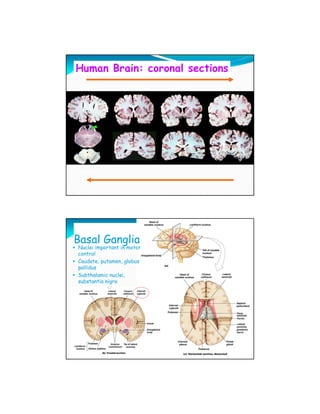
White Fiber Tracts
 Projection fibers
 Commisural fibers
 Association fibers
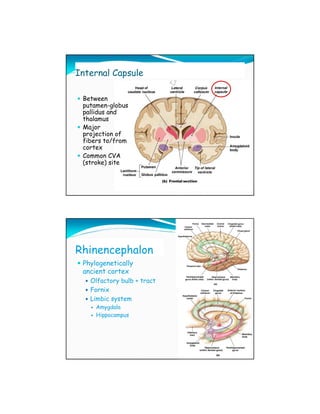
Human Brain: coronal sections
 Frontal


 Caudal


Basal Ganglia
Nuclei important in motor
control
Caudate, putamen, globus
pallidus
Subthalamic nuclei,
substantia nigra
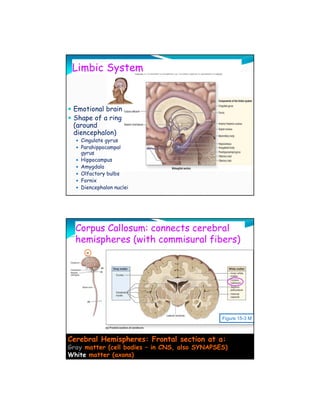
Internal Capsule

 Between
 putamen-globus
 pallidus and
 thalamus
 Major
 projection of
 fibers to/from
 cortex
 Common CVA
 (stroke) site


Rhinencephalon
 Phylogenetically
 ancient cortex
   Olfactory bulb + tract
   Fornix
   Limbic system
     Amygdala
     Hippocampus
Limbic System


 Emotional brain
 Shape of a ring
 (around
 diencephalon)
    Cingulate gyrus
    Parahippocampal
    gyrus
    Hippocampus
    Amygdala
    Olfactory bulbs
    Fornix
    Diencephalon nuclei


  Corpus Callosum: connects cerebral
  hemispheres (with commisural fibers)


                                               Figure 15-3 M


Cerebral Hemispheres: Frontal section at a:
Gray matter (cell bodies – in CNS, also SYNAPSES)
White matter (axons)
Figure 15-3 M


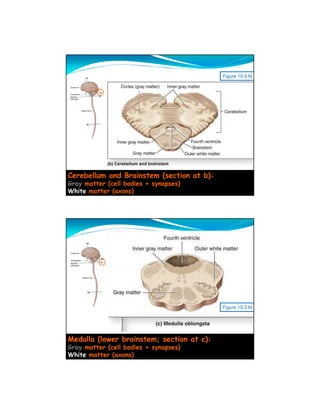
Cerebellum and Brainstem (section at b):
Gray matter (cell bodies + synapses)
White matter (axons)


                                           Figure 15-3 M


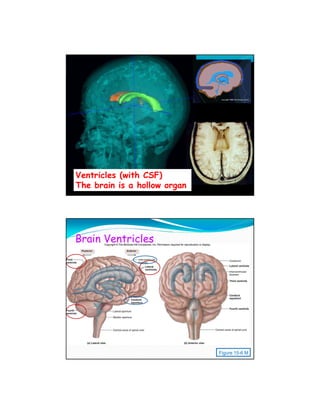
Medulla (lower brainstem; section at c):
Gray matter (cell bodies + synapses)
White matter (axons)
Figure 15-3 M


Spinal Cord (section at d):
Gray matter (cell bodies + synapses)
White matter (axons)


                                  Cranial Nerves


                                       See lecture outline for
                                       functions of each.


                                         Ventral View
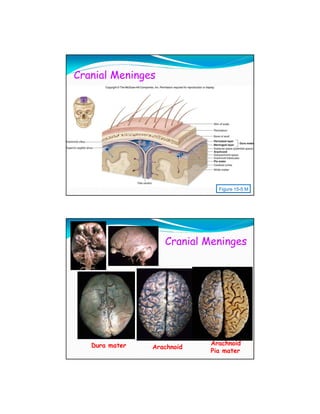
Ventricles (with CSF)
                   Research Martin Styner


The brain is a hollow organ


Brain Ventricles


                                            Figure 15-6 M
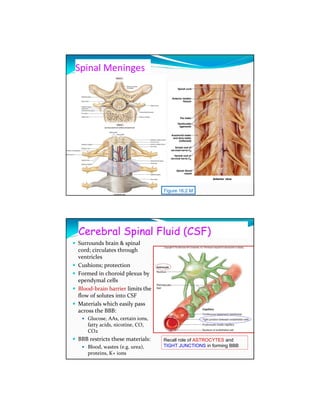
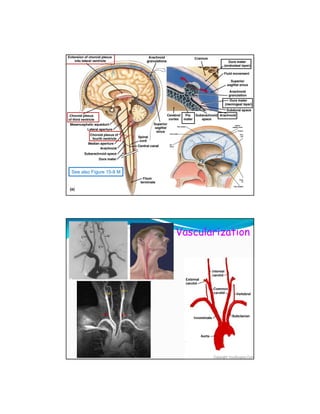
Cranial Meninges


                              Figure 15-5 M


                   Cranial Meninges


   Dura mater               Arachnoid
                Arachnoid
                            Pia mater
Spinal Meninges


                                  Figure 16.2 M            Figure 13–3


Cerebral Spinal Fluid (CSF)
Surrounds brain & spinal
cord; circulates through
ventricles
Cushions; protection
Formed in choroid plexus by
ependymal cells
Blood-brain barrier limits the
flow of solutes into CSF
Materials which easily pass
across the BBB:
    Glucose, AAs, certain ions,
    fatty acids, nicotine, CO,
    CO2
BBB restricts these materials:    Recall role of ASTROCYTES and
    Blood, wastes (e.g. urea),    TIGHT JUNCTIONS in forming BBB
    proteins, K+ ions
See also Figure 15-8 M


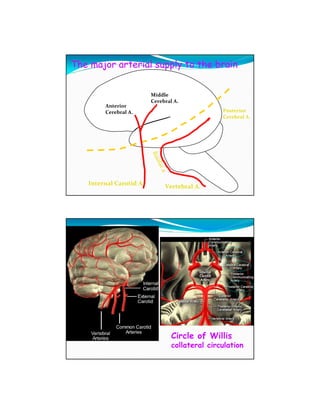
                         Vascularization
The major arterial supply to the brain


                         Middle
                         Cerebral A.
        Anterior
        Cerebral A.                                 Posterior
                                                    Cerebral A.


                         Bas
                            ilar
                             a


   Internal Carotid A.
                                   Vertebral A.


                                     Circle of Willis
                                     collateral circulation
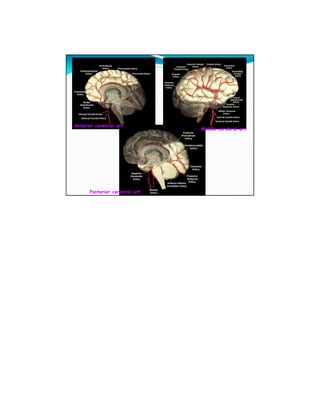
Anterior cerebral art.
                                Middle cerebral art.


      Posterior cerebral art.

Cns Anatomy Slides

  • 1.
    Brain Anatomy Slidescourtesy of Dr. Maria Rubio General Rule: The functional and anatomical organization of sensory processing networks is hierarchical 3rd order neuron 2nd order neuron 1st order neuron
  • 2.
    Gross Anatomy ofthe Spinal Cord Spinal Nerves: 8 Cervical nerves Neck, shoulder, arms and hands 12 Thoracic nerves Shoulders, chest, and upper abdomen 5 lumbar nerves Lower abdomen, hips and legs 5 sacral nerves Genitals and lower digestive tract Figure 16-1 M Figure 13-2 Gross Anatomy of the Spinal Cord Cross Section: Gray matter Gray due to cell bodies In CNS, gray matter also = synapses White Matter White due to myelin; = axons (both myelinated and unmyelinated) Dorsal Horn Ventral Horn Ventral Root Dorsal Root Cell bodies of unipolar sensory neurons No synapses Dorsal Root Ganglion
  • 3.
    Note functional Sectional organization of gray matter Anatomy of the Spinal Cord See 16.4M Figure 6-41 V; 16.3M Dorsal Columns Fiber Tracts: Fasciculus cuneatus Fasciculus gracilis Ascending (Sensory) Anterolateral columns Tracts Note functional E.g., spinothalamic tracts organization of WHITE Spinocerebellar tracts matter
  • 4.
    Fiber Tracts: Descending(Motor) Tracts Ventromedial System Reticulospinal Vestibulospinal Tectospinal Anterior Corticospinal Dorsolateral System Rubrospinal Lateral Corticospinal Pyramidal; extrapyramidal terminology is outdated! Spinal Nerves Peripheral Nerve Structure
  • 5.
    Dermatomes Figure16.6 M Nerve Plexuses A network of interweaving anterior rami of spinal nerves Rami (pl.) ramus – primary division of a nerve or blood vessel Cervical plexus Brachial plexus Lumbar plexus Sacral plexus
  • 6.
    Cervical Plexus C1– C4 Innervates neck (sensory and motor) Phrenic nerve (C3 - 4) Innervates diaphragm (so you can breathe!) Figure 16.8 M Brachial Plexus C5 – T1 Sensory/motor innervation of upper extremity More complex than cervical plexuses Anterior rami Trunks Divisions Cords Figure 16.9 M
  • 7.
    Lumbar Plexus L1– L4 Supply lower limb of each side Less complex than brachial plexus Figure 16.10 M Sacral Plexus L4 – S4 Supply gluteal region, plevis, perineum, and lower limb of each side Together with Lumbar plexus as lumbosacral plexus Figure 16.11 M
  • 8.
    Components of ReflexArc See also Figure 16.12 M Example of Deep Tendon Reflex Patellar tendon (“knee jerk”) reflex Clinical usefulness
  • 9.
    Monosynaptic (Knee Jerk)and Disynaptic (Flexor Withdrawal) Reflexes Figure 16.13 M Clinical usefulness of reflexes – see table 16.6 M Muscle tone
  • 10.
    Slides courtesy ofDr. Maria Rubio Sagittal Plane Coronal Plane
  • 11.
    Brainstem Brainstem Medulla Pons Midbran Rigidly programmed, automatic behaviors Posterior View Medulla • Centers for cardiovascular and respiratory regulation • Cranial nerve nuclei • Reticular Medulla formation Pons • Cranial nerve nuclei, tracts • Reticular formation Pons
  • 12.
    Midbrain • Superior Colliculus • Eye / Head orientation movements • Inferior Colliculus • Tracts, nuclei • Reticular formation Midbrain RETICULAR FORMATION • > 100 Nuclei • Extends throughout brainstem • Receives info from all over brain • Projects throughout brain Cerebellum Cerebellar peduncles • Receives visual, vestibular, proprioceptive input • spinocerebellar tracts • Functions include coordination Figure 15-22 M
  • 13.
    (Brainstem and) Diencephalon Posterior View Diencephalon Epithalamus Thalamus • Sensory relay center Hypothalamus • “Homeostasis”
  • 14.
    Sagittal Thalamus Coronal Sagittal Hypothalamus Coronal Autonomic Functions
  • 15.
    Cerebral Hemispheres Superior View Anterior View Lateral View Ventral View Posterior View Superior View
  • 16.
  • 17.
    Cortex: Correlate Lobeswith Function ridges Shallow separation Frontal Motor, speech, personality, emotion Frontal lobotomies Parietal Somatosensory cortex, voluntary movement Occipital Vision Temporal Hearing, balance, visual processing Figure 15-1 M Lateral View
  • 18.
    White Fiber Tracts Projection fibers Commisural fibers Association fibers
  • 19.
    Human Brain: coronalsections Frontal Caudal Basal Ganglia Nuclei important in motor control Caudate, putamen, globus pallidus Subthalamic nuclei, substantia nigra
  • 20.
    Internal Capsule Between putamen-globus pallidus and thalamus Major projection of fibers to/from cortex Common CVA (stroke) site Rhinencephalon Phylogenetically ancient cortex Olfactory bulb + tract Fornix Limbic system Amygdala Hippocampus
  • 21.
    Limbic System Emotionalbrain Shape of a ring (around diencephalon) Cingulate gyrus Parahippocampal gyrus Hippocampus Amygdala Olfactory bulbs Fornix Diencephalon nuclei Corpus Callosum: connects cerebral hemispheres (with commisural fibers) Figure 15-3 M Cerebral Hemispheres: Frontal section at a: Gray matter (cell bodies – in CNS, also SYNAPSES) White matter (axons)
  • 22.
    Figure 15-3 M Cerebellumand Brainstem (section at b): Gray matter (cell bodies + synapses) White matter (axons) Figure 15-3 M Medulla (lower brainstem; section at c): Gray matter (cell bodies + synapses) White matter (axons)
  • 23.
    Figure 15-3 M SpinalCord (section at d): Gray matter (cell bodies + synapses) White matter (axons) Cranial Nerves See lecture outline for functions of each. Ventral View
  • 24.
    Ventricles (with CSF) Research Martin Styner The brain is a hollow organ Brain Ventricles Figure 15-6 M
  • 25.
    Cranial Meninges Figure 15-5 M Cranial Meninges Dura mater Arachnoid Arachnoid Pia mater
  • 26.
    Spinal Meninges Figure 16.2 M Figure 13–3 Cerebral Spinal Fluid (CSF) Surrounds brain & spinal cord; circulates through ventricles Cushions; protection Formed in choroid plexus by ependymal cells Blood-brain barrier limits the flow of solutes into CSF Materials which easily pass across the BBB: Glucose, AAs, certain ions, fatty acids, nicotine, CO, CO2 BBB restricts these materials: Recall role of ASTROCYTES and Blood, wastes (e.g. urea), TIGHT JUNCTIONS in forming BBB proteins, K+ ions
  • 27.
    See also Figure15-8 M Vascularization
  • 28.
    The major arterialsupply to the brain Middle Cerebral A. Anterior Cerebral A. Posterior Cerebral A. Bas ilar a Internal Carotid A. Vertebral A. Circle of Willis collateral circulation
  • 29.
    Anterior cerebral art. Middle cerebral art. Posterior cerebral art.