Functional Anatomy & Physiology
Dr. Ra’ed Ahmed
MBChB, FIBMS
Neurologist March 31 - 2015
Lec. 1
09.00 AM
1
Functions of the Nervous System
1. Sensory input – gathering information
To monitor changes occurring inside and
outside the body (changes = stimuli).
2. Integration –
to process and interpret sensory input
and decide if action is needed.
3. Motor output
A response to integrated stimuli.
The response activates muscles or glands.2
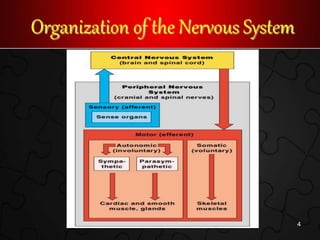
Structural Classification of the Nervous
System
 Central nervous system (CNS)
Brain
Spinal cord
 Peripheral nervous system (PNS)
Nerve outside the brain and spinal cord
3
Organization of the Nervous System
4
Nervous Tissue: Support Cells (Neuroglia or
Glia) of CNS
 Astrocytes (largest of neuroglia)
 Abundant, star-shaped cells
 Brace neurons
 Form barrier
between capillaries
and neurons
 Control the chemical
environment of
the brain (CNS)
5
Nervous Tissue: Support Cells
 Microglia (CNS)
 Spider-like phagocytes
 Dispose of debris
 Ependymal cells
(CNS)
 Line cavities of the
brain and spinal cord
 Circulate
cerebrospinal
fluid
6
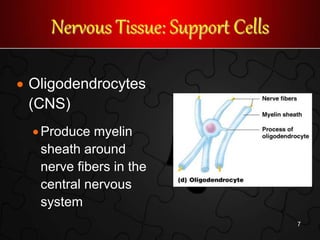
Nervous Tissue: Support Cells
 Oligodendrocytes
(CNS)
Produce myelin
sheath around
nerve fibers in the
central nervous
system
7
Support Cells of the PNS
 Satellite cells
Protect neuron cell bodies
 Schwann cells
Form myelin sheath in the peripheral
nervous system
Figure 7.3e
8
Neuron Anatomy
Slide 7.9b
 Cell body : nucleus
large nucleolus
 Dendrites – conduct
impulses toward the
cell body
 Axons – conduct
impulses away from
the cell body
Figure 7.4a
9
10
Central Nervous System (CNS)
 CNS develops from the embryonic
neural tube
The neural tube becomes the
brain and spinal cord
The opening of the neural tube
becomes the ventricles
Four chambers within the brain
Filled with cerebrospinal fluid 11
Brain
 Part of CNS that lies within the cranial
vault, the encephalon.
 Its hemispheric surface is convoluted and
has gyri and sulci
 Weighs 350 g in the newborn and 1400 g
in the adult.
 The male brain is on average slightly
heavier than the female brain
12
Regions of the Brain
 Cerebral
hemispheres
 Diencephalon
 Brain stem
 Cerebellum
13
Lobes of the Brain
14
Frontal lobes:
• Reasoning,abstraction,concentration
• Control of voluntary eye
movements.
• Motor control of speech in the
dominant hemisphere.
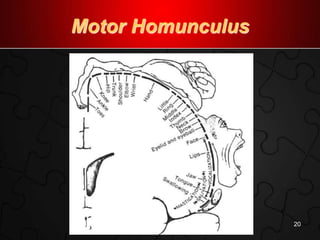
• Motor Cortex
• Urinary continence.
• Emotion and personality
Parietal lobes:
• Sensory cortex – define size,
weight, texture and consistency
(contralateral).
• Sensation is localised, and
modalities of touch, pressure and
position are identified.
• Awareness of the parts of your body.
• Dominant is involved in ideomotor
praxis
• Non-dominant – visuospatial
information
Temporal lobes:
• Primary auditory receptive areas.
handle visual perception and olfaction.
• Learning and memory, emotional
affect.
• Dominant temporal lobe influences
comprehension of speech.
• Nondominant temporal lobe
mediates prosody and spatial
information
Occipital lobes:
• Primary visual cortex.
• Visual association areas.
• Visual perception.
• Some visual reflexes (i.e. visual
fixation).
• Involuntary smooth eye movements
Brodmann’s areas : mapping the cortical areas
of the brain.
19
Motor Homunculus
20
Sensory Homunculus
21
Layers of the Cerebrum
 Gray matter
Outer layer
Composed
mostly of
neuron cell
bodies
 White matter
Fiber tracts
inside the gray
matter
Figure 7.13a
22
Basal Ganglia
 large masses of gray matter deep within
the cerebral hemispheres.
 Include the caudate, putamen, and
globus pallidus that lie lateral to the
thalamus.
 Functionally, substantia nigra (SN) and
the subthalamic nucleus.
 Motor control includes the preparation for
and execution of cortically initiated
movement
23
24
Diencephalon
 Sits on top of the brain stem
 Enclosed by the cerebral hemispheres
 Made of four parts
Thalamus
Hypothalamus
Epithalamus (roof of the third ventricle
Houses the pineal body, choroid plexus)
Subthalamus
25
Diencephalon
Figure 7.15
26
Thalamus
 Surrounds the third ventricle.
 The relay station for sensory impulses.
 Transfers impulses to the correct part of
the cortex for localization and
interpretation.
27
Hypothalamus
 Under the thalamus.
 Important autonomic nervous system
center
Helps to regulate body temperature
Controls water balance
Regulates metabolism, appetite control.
An important part of the limbic system
(emotions) 28
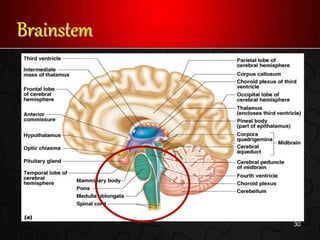
Brain Stem
 It is a small, narrow region connecting
the spinal cord with the rest of the brain
 Parts of the brain stem
Midbrain
Pons
Medulla oblongata
29
Brainstem
30
Midbrain
 located between the diencephalon
and the pons.
 Mostly composed of tracts of nerve
fibers
Reflex centers for vision and hearing
Cerebral aquaduct – 3rd-4th ventricles
31
Pons
 pons means “bridge” in Latin
 The bulging center part of the brainstem
 Mostly composed of fiber tracts
 Includes nuclei involved in the control of
breathing
32
Medulla Oblongata
 The lowest part of the brain stem
 Merges into the spinal cord
 Includes important fiber tracts
 Contains important control centers
Heart rate control
Blood pressure regulation
Breathing
Swallowing
Vomiting 33
34
Cranial nerves on the anterior surface of the
brain.
Cerebellum or "small brain"
 Located in the posterior cranial fossa
 Attached to the brainstem by three
cerebellar peduncles
 Forms the roof of the fourth ventricle
 Anatomically divided into the two
hemispheres, the midline vermis and the
flocculonodulus ,consists of folia and
fissures on its surface
 Provides involuntary coordination of body
movements
35
36
Protection of the Central Nervous System
 Scalp and skin
 Skull and vertebral column
 Meninges
 CSF
 BBB
37
SKULL
 22 bones in total, 8 make up the cranium,
other 14 facial bones.
 Cranium is that part of the
skull that encloses the brain
 3 components within
the cranium have a balance
(80% brain ,
10% blood ,10% CSF).
38
Meninges
 Dura mater " hard mother"
Double-layered external covering
Periosteum – attached to surface of the
skull
Meningeal layer – outer covering of the
brain
Folds inward in several areas (falx
cerebri, tentorium cerebelli & falx
cerebelli) 39
Meninges
 Arachnoid layer " spider"
Middle layer ,extremely thin ,
nonvascular
Web-like, loosely encloses the brain
 Pia mater:
 Inner most, delicate highly vascular
 Intimately adhere to the brain substance
 Spaces of the meninges: extradural,
subdural and subarachnoid.
40
Cerebrospinal Fluid CSF
 Similar to blood plasma composition
 Formed by the choroid plexus
 Reabsorbed into the venous blood
flow via the arachnoid villi
 Produces at a rate (~ 500mL/day) and
total volume (~ 150mL)
 Buoyancy , Protection ,Transport of
nutrients, Removal of waste products 41
Ventricles and Location of the
Cerebrospinal Fluid
Figure 7.17b
42
43
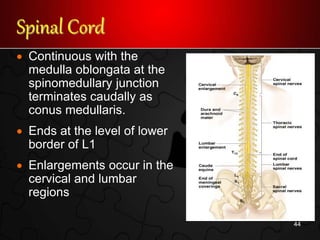
Spinal Cord
 Continuous with the
medulla oblongata at the
spinomedullary junction
terminates caudally as
conus medullaris.
 Ends at the level of lower
border of L1
 Enlargements occur in the
cervical and lumbar
regions
44
Spinal Cord cont.
 lies within subarachnoid space and covered by
three meningeal coats (pia , arachnoid and dura
mater).
 Averges, in length, 45 cm in males and 42 cm in
females
 Weighs about 30 g , comprising 2% of the adult
brain weight
 The spinal cord comprises
31 segments defined by
31 pairs of spinal nerves 45
PNS : Spinal Nerves
Figure 7.22a 46
APPROACH TO THE PATIENT
WITH NEUROLOGIC DISEASE
 Where is the lesion?
 What is the lesion?
 Meridians of Longitude= motor, sensory
pathways (location, function, decussation)
–Corticospinal
–Spinothalamic
–Dorsal column – Medial Lemniscus
 Parallels of Latitude( Cortex---muscle)
What are the most important
regions for anatomic localization?
 Cortical Brain
 Subcortical Brain
 Brainstem
 Cerebellum
 Spinal Cord
 Root
 Peripheral Nerve
 Neuromuscular Junction
 Muscle
How are symptoms localized to
these neuroanatomic regions?
Neurologic Examination:
1- Higher Cortical Function
2- Cranial Nerves
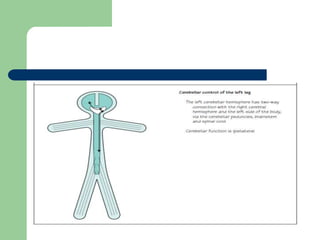
3- Cerebellar Function
4- Motor
5- Sensory
6- Deep Tendon Reflexes
7- Pathologic Reflexes
Characteristic of upper motor
neurone lesions: UMNL
 • No wasting, but from disuse;
 • Increased tone “Spasticity” of clasp-knife
type;
 • Weakness most evident in anti-gravity
muscles;
 • Increased reflexes and clonus;
 • Extensor plantar responses.
Characteristics of lower motor
neurone lesions: LMNL
 • Wasting “pronounced” ;
 • Fasciculation;
 • Decreased tone (i.e. flaccidity);
 • Weakness;
 • Decreased or absent reflexes;
 • Flexor plantar responses.
Corticospinal Tracts
Pain & Temperature
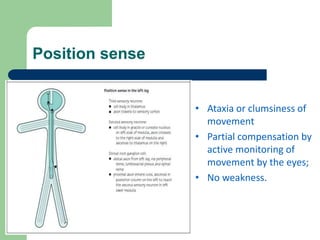
Position sense
• Ataxia or clumsiness of
movement
• Partial compensation by
active monitoring of
movement by the eyes;
• No weakness.
Patterns of sensory deficit
Clinical features of Cortical Brain
lesion
 Dominant (usually left) hemisphere is “aphasia”
 Nondominant (usually right) hemisphere,
usually causes visual-spatial problems.
 Cortical sensory loss such as two-point
discrimination, stereognosis, and
graphesthesia.
 Seizures are almost always cortical in origin.
 Incomplete hemiparesis, affecting the face and
arm, but not the leg.
Clinical features of Subcortical
Brain lesion
 Higher Cortical Function: normal
 Cranial Nerves: visual field cuts
 Cerebellar Function: usually normal
 Motor: weakness in face=arm=leg ,UMNL
 Sensory: sensory abnormalities in
face=arm=leg
 Deep Tendon Reflexes: hemi-hyper-reflexia
 Pathologic Reflexes: extensor planter reflex
Clinical features of Brainstem
disease
The brain stem is essentially the spinal cord with
embedded cranial nerves.
 Cranial nerve signs: diplopia, decreased
strength or sensation over the face, dizziness,
deafness, dysarthria, dysphagia
 Long tract signs: hemiparesis UMNL or
hemisensory loss
 Crossed signs or Bilateral findings
Clinical features of Cerebellar
disease
A. Incoordination of muscle activity:
 • in the head: nystagmus, dysarthria;
 • in the arms: finger–nose ataxia, kinetic
(intention) tremor, difficulty with rapid alternating
movements (dysdiadochokinesia);
 • in the legs: heel–knee–shin ataxia, gait ataxia,
falls.
B. Hypotonia ,no Weakness, Sensory: normal
DTRs normal ,Pathologic Reflexes: none
Clinical features of Spinal cord
disease
 Atriad of symptoms (Sensory level,Spastic
weakness & Bowel and bladder problems)
 Distal weakness greater than proximal
weakness (UMN signs below the lesion)
 Increased tone (spasticity)
 Increased reflexes ,Clonus
 Extensor plantar response
 Absent superficial reflexes
 No significant atrophy or fasciculations
Clinical features of Root diseases
(Radiculopathies)
 Pain is the hallmark of root disease
 Weakness, while asymmetric, may be either
proximal or distal, depending on which roots are
involved
 O E = LMN findings
 Atrophy and fasciculations.
 Tone is normal or decreased, and hypo- to a-
reflexia if the root carries a reflex.
 Sensory loss occurs in a dermatomal
Clinical features of Peripheral
neuropathies
 Weakness leg, arm : distal predominant
 Sensory changes : distal predominant
 OE
 Distal, often asymmetric weakness with atrophy,
fasciculations
 Muscle tone is often decreased. loss of distal
reflexes, Mute responses to plantar stimulation
 Sensory loss
Clinical features of Neuromuscular
junction disease
 “Fatigability” “Fluctuation” the hallmark of
NMJ
 Proximal symmetric weakness
 Weakness is often extremely proximal,
involving muscles of the face, eyes
(ptosis), and jaw.
 Muscles are normal in size, without
atrophy or fasciculations, with normal tone
and reflexes.
 No sensory loss.
 positive response to anticholinesterase.
Clinical features of Muscle disease
 Proximal symmetric leg & arm weakness
without sensory loss.
 OE
 Muscles : normal in size, without atrophy
 no fasciculation;
 Tone : normal or reduced;
 Reflexes : normal or reduced.
what is the lesion?
Happy Reading !
THANK YOU
76

1 functional anatomy & physiology final

  • 1.
    Functional Anatomy &Physiology Dr. Ra’ed Ahmed MBChB, FIBMS Neurologist March 31 - 2015 Lec. 1 09.00 AM 1
  • 2.
    Functions of theNervous System 1. Sensory input – gathering information To monitor changes occurring inside and outside the body (changes = stimuli). 2. Integration – to process and interpret sensory input and decide if action is needed. 3. Motor output A response to integrated stimuli. The response activates muscles or glands.2
  • 3.
    Structural Classification ofthe Nervous System  Central nervous system (CNS) Brain Spinal cord  Peripheral nervous system (PNS) Nerve outside the brain and spinal cord 3
  • 4.
    Organization of theNervous System 4
  • 5.
    Nervous Tissue: SupportCells (Neuroglia or Glia) of CNS  Astrocytes (largest of neuroglia)  Abundant, star-shaped cells  Brace neurons  Form barrier between capillaries and neurons  Control the chemical environment of the brain (CNS) 5
  • 6.
    Nervous Tissue: SupportCells  Microglia (CNS)  Spider-like phagocytes  Dispose of debris  Ependymal cells (CNS)  Line cavities of the brain and spinal cord  Circulate cerebrospinal fluid 6
  • 7.
    Nervous Tissue: SupportCells  Oligodendrocytes (CNS) Produce myelin sheath around nerve fibers in the central nervous system 7
  • 8.
    Support Cells ofthe PNS  Satellite cells Protect neuron cell bodies  Schwann cells Form myelin sheath in the peripheral nervous system Figure 7.3e 8
  • 9.
    Neuron Anatomy Slide 7.9b Cell body : nucleus large nucleolus  Dendrites – conduct impulses toward the cell body  Axons – conduct impulses away from the cell body Figure 7.4a 9
  • 10.
  • 11.
    Central Nervous System(CNS)  CNS develops from the embryonic neural tube The neural tube becomes the brain and spinal cord The opening of the neural tube becomes the ventricles Four chambers within the brain Filled with cerebrospinal fluid 11
  • 12.
    Brain  Part ofCNS that lies within the cranial vault, the encephalon.  Its hemispheric surface is convoluted and has gyri and sulci  Weighs 350 g in the newborn and 1400 g in the adult.  The male brain is on average slightly heavier than the female brain 12
  • 13.
    Regions of theBrain  Cerebral hemispheres  Diencephalon  Brain stem  Cerebellum 13
  • 14.
    Lobes of theBrain 14
  • 15.
    Frontal lobes: • Reasoning,abstraction,concentration •Control of voluntary eye movements. • Motor control of speech in the dominant hemisphere. • Motor Cortex • Urinary continence. • Emotion and personality
  • 16.
    Parietal lobes: • Sensorycortex – define size, weight, texture and consistency (contralateral). • Sensation is localised, and modalities of touch, pressure and position are identified. • Awareness of the parts of your body. • Dominant is involved in ideomotor praxis • Non-dominant – visuospatial information
  • 17.
    Temporal lobes: • Primaryauditory receptive areas. handle visual perception and olfaction. • Learning and memory, emotional affect. • Dominant temporal lobe influences comprehension of speech. • Nondominant temporal lobe mediates prosody and spatial information
  • 18.
    Occipital lobes: • Primaryvisual cortex. • Visual association areas. • Visual perception. • Some visual reflexes (i.e. visual fixation). • Involuntary smooth eye movements
  • 19.
    Brodmann’s areas :mapping the cortical areas of the brain. 19
  • 20.
  • 21.
  • 22.
    Layers of theCerebrum  Gray matter Outer layer Composed mostly of neuron cell bodies  White matter Fiber tracts inside the gray matter Figure 7.13a 22
  • 23.
    Basal Ganglia  largemasses of gray matter deep within the cerebral hemispheres.  Include the caudate, putamen, and globus pallidus that lie lateral to the thalamus.  Functionally, substantia nigra (SN) and the subthalamic nucleus.  Motor control includes the preparation for and execution of cortically initiated movement 23
  • 24.
  • 25.
    Diencephalon  Sits ontop of the brain stem  Enclosed by the cerebral hemispheres  Made of four parts Thalamus Hypothalamus Epithalamus (roof of the third ventricle Houses the pineal body, choroid plexus) Subthalamus 25
  • 26.
  • 27.
    Thalamus  Surrounds thethird ventricle.  The relay station for sensory impulses.  Transfers impulses to the correct part of the cortex for localization and interpretation. 27
  • 28.
    Hypothalamus  Under thethalamus.  Important autonomic nervous system center Helps to regulate body temperature Controls water balance Regulates metabolism, appetite control. An important part of the limbic system (emotions) 28
  • 29.
    Brain Stem  Itis a small, narrow region connecting the spinal cord with the rest of the brain  Parts of the brain stem Midbrain Pons Medulla oblongata 29
  • 30.
  • 31.
    Midbrain  located betweenthe diencephalon and the pons.  Mostly composed of tracts of nerve fibers Reflex centers for vision and hearing Cerebral aquaduct – 3rd-4th ventricles 31
  • 32.
    Pons  pons means“bridge” in Latin  The bulging center part of the brainstem  Mostly composed of fiber tracts  Includes nuclei involved in the control of breathing 32
  • 33.
    Medulla Oblongata  Thelowest part of the brain stem  Merges into the spinal cord  Includes important fiber tracts  Contains important control centers Heart rate control Blood pressure regulation Breathing Swallowing Vomiting 33
  • 34.
    34 Cranial nerves onthe anterior surface of the brain.
  • 35.
    Cerebellum or "smallbrain"  Located in the posterior cranial fossa  Attached to the brainstem by three cerebellar peduncles  Forms the roof of the fourth ventricle  Anatomically divided into the two hemispheres, the midline vermis and the flocculonodulus ,consists of folia and fissures on its surface  Provides involuntary coordination of body movements 35
  • 36.
  • 37.
    Protection of theCentral Nervous System  Scalp and skin  Skull and vertebral column  Meninges  CSF  BBB 37
  • 38.
    SKULL  22 bonesin total, 8 make up the cranium, other 14 facial bones.  Cranium is that part of the skull that encloses the brain  3 components within the cranium have a balance (80% brain , 10% blood ,10% CSF). 38
  • 39.
    Meninges  Dura mater" hard mother" Double-layered external covering Periosteum – attached to surface of the skull Meningeal layer – outer covering of the brain Folds inward in several areas (falx cerebri, tentorium cerebelli & falx cerebelli) 39
  • 40.
    Meninges  Arachnoid layer" spider" Middle layer ,extremely thin , nonvascular Web-like, loosely encloses the brain  Pia mater:  Inner most, delicate highly vascular  Intimately adhere to the brain substance  Spaces of the meninges: extradural, subdural and subarachnoid. 40
  • 41.
    Cerebrospinal Fluid CSF Similar to blood plasma composition  Formed by the choroid plexus  Reabsorbed into the venous blood flow via the arachnoid villi  Produces at a rate (~ 500mL/day) and total volume (~ 150mL)  Buoyancy , Protection ,Transport of nutrients, Removal of waste products 41
  • 42.
    Ventricles and Locationof the Cerebrospinal Fluid Figure 7.17b 42
  • 43.
  • 44.
    Spinal Cord  Continuouswith the medulla oblongata at the spinomedullary junction terminates caudally as conus medullaris.  Ends at the level of lower border of L1  Enlargements occur in the cervical and lumbar regions 44
  • 45.
    Spinal Cord cont. lies within subarachnoid space and covered by three meningeal coats (pia , arachnoid and dura mater).  Averges, in length, 45 cm in males and 42 cm in females  Weighs about 30 g , comprising 2% of the adult brain weight  The spinal cord comprises 31 segments defined by 31 pairs of spinal nerves 45
  • 46.
    PNS : SpinalNerves Figure 7.22a 46
  • 47.
    APPROACH TO THEPATIENT WITH NEUROLOGIC DISEASE  Where is the lesion?  What is the lesion?  Meridians of Longitude= motor, sensory pathways (location, function, decussation) –Corticospinal –Spinothalamic –Dorsal column – Medial Lemniscus  Parallels of Latitude( Cortex---muscle)
  • 48.
    What are themost important regions for anatomic localization?  Cortical Brain  Subcortical Brain  Brainstem  Cerebellum  Spinal Cord  Root  Peripheral Nerve  Neuromuscular Junction  Muscle
  • 49.
    How are symptomslocalized to these neuroanatomic regions? Neurologic Examination: 1- Higher Cortical Function 2- Cranial Nerves 3- Cerebellar Function 4- Motor 5- Sensory 6- Deep Tendon Reflexes 7- Pathologic Reflexes
  • 51.
    Characteristic of uppermotor neurone lesions: UMNL  • No wasting, but from disuse;  • Increased tone “Spasticity” of clasp-knife type;  • Weakness most evident in anti-gravity muscles;  • Increased reflexes and clonus;  • Extensor plantar responses.
  • 52.
    Characteristics of lowermotor neurone lesions: LMNL  • Wasting “pronounced” ;  • Fasciculation;  • Decreased tone (i.e. flaccidity);  • Weakness;  • Decreased or absent reflexes;  • Flexor plantar responses.
  • 54.
  • 55.
  • 56.
    Position sense • Ataxiaor clumsiness of movement • Partial compensation by active monitoring of movement by the eyes; • No weakness.
  • 57.
  • 58.
    Clinical features ofCortical Brain lesion  Dominant (usually left) hemisphere is “aphasia”  Nondominant (usually right) hemisphere, usually causes visual-spatial problems.  Cortical sensory loss such as two-point discrimination, stereognosis, and graphesthesia.  Seizures are almost always cortical in origin.  Incomplete hemiparesis, affecting the face and arm, but not the leg.
  • 61.
    Clinical features ofSubcortical Brain lesion  Higher Cortical Function: normal  Cranial Nerves: visual field cuts  Cerebellar Function: usually normal  Motor: weakness in face=arm=leg ,UMNL  Sensory: sensory abnormalities in face=arm=leg  Deep Tendon Reflexes: hemi-hyper-reflexia  Pathologic Reflexes: extensor planter reflex
  • 62.
    Clinical features ofBrainstem disease The brain stem is essentially the spinal cord with embedded cranial nerves.  Cranial nerve signs: diplopia, decreased strength or sensation over the face, dizziness, deafness, dysarthria, dysphagia  Long tract signs: hemiparesis UMNL or hemisensory loss  Crossed signs or Bilateral findings
  • 64.
    Clinical features ofCerebellar disease A. Incoordination of muscle activity:  • in the head: nystagmus, dysarthria;  • in the arms: finger–nose ataxia, kinetic (intention) tremor, difficulty with rapid alternating movements (dysdiadochokinesia);  • in the legs: heel–knee–shin ataxia, gait ataxia, falls. B. Hypotonia ,no Weakness, Sensory: normal DTRs normal ,Pathologic Reflexes: none
  • 67.
    Clinical features ofSpinal cord disease  Atriad of symptoms (Sensory level,Spastic weakness & Bowel and bladder problems)  Distal weakness greater than proximal weakness (UMN signs below the lesion)  Increased tone (spasticity)  Increased reflexes ,Clonus  Extensor plantar response  Absent superficial reflexes  No significant atrophy or fasciculations
  • 69.
    Clinical features ofRoot diseases (Radiculopathies)  Pain is the hallmark of root disease  Weakness, while asymmetric, may be either proximal or distal, depending on which roots are involved  O E = LMN findings  Atrophy and fasciculations.  Tone is normal or decreased, and hypo- to a- reflexia if the root carries a reflex.  Sensory loss occurs in a dermatomal
  • 72.
    Clinical features ofPeripheral neuropathies  Weakness leg, arm : distal predominant  Sensory changes : distal predominant  OE  Distal, often asymmetric weakness with atrophy, fasciculations  Muscle tone is often decreased. loss of distal reflexes, Mute responses to plantar stimulation  Sensory loss
  • 73.
    Clinical features ofNeuromuscular junction disease  “Fatigability” “Fluctuation” the hallmark of NMJ  Proximal symmetric weakness  Weakness is often extremely proximal, involving muscles of the face, eyes (ptosis), and jaw.  Muscles are normal in size, without atrophy or fasciculations, with normal tone and reflexes.  No sensory loss.  positive response to anticholinesterase.
  • 74.
    Clinical features ofMuscle disease  Proximal symmetric leg & arm weakness without sensory loss.  OE  Muscles : normal in size, without atrophy  no fasciculation;  Tone : normal or reduced;  Reflexes : normal or reduced.
  • 75.
    what is thelesion?
  • 76.