www.Examville.com
Online practice tests, live classes, tutoring, study guides
Q&A, premium content and more.
The AbdominalThe Abdominal
RegionRegion
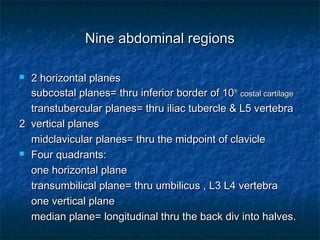
Nine abdominal regionsNine abdominal regions
 2 horizontal planes2 horizontal planes
subcostal planes= thru inferior border of 10subcostal planes= thru inferior border of 10thth
costal cartilagecostal cartilage
transtubercular planes= thru iliac tubercle & L5 vertebratranstubercular planes= thru iliac tubercle & L5 vertebra
2 vertical planes2 vertical planes
midclavicular planes= thru the midpoint of claviclemidclavicular planes= thru the midpoint of clavicle
 Four quadrants:Four quadrants:
one horizontal planeone horizontal plane
transumbilical plane= thru umbilicus , L3 L4 vertebratransumbilical plane= thru umbilicus , L3 L4 vertebra
one vertical planeone vertical plane
median plane= longitudinal thru the back div into halves.median plane= longitudinal thru the back div into halves.
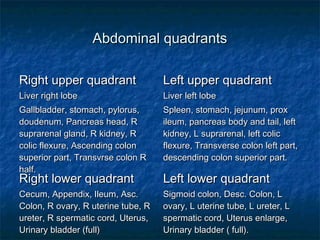
Abdominal quadrantsAbdominal quadrants
Right upper quadrantRight upper quadrant Left upper quadrantLeft upper quadrant
Liver right lobeLiver right lobe
Gallbladder, stomach, pylorus,Gallbladder, stomach, pylorus,
doudenum, Pancreas head, Rdoudenum, Pancreas head, R
suprarenal gland, R kidney, Rsuprarenal gland, R kidney, R
colic flexure, Ascending coloncolic flexure, Ascending colon
superior part, Transvrse colon Rsuperior part, Transvrse colon R
half.half.
Liver left lobeLiver left lobe
Spleen, stomach, jejunum, proxSpleen, stomach, jejunum, prox
ileum, pancreas body and tail, leftileum, pancreas body and tail, left
kidney, L suprarenal, left colickidney, L suprarenal, left colic
flexure, Transverse colon left part,flexure, Transverse colon left part,
descending colon superior part.descending colon superior part.
Right lower quadrantRight lower quadrant Left lower quadrantLeft lower quadrant
Cecum, Appendix, Ileum, Asc.Cecum, Appendix, Ileum, Asc.
Colon, R ovary, R uterine tube, RColon, R ovary, R uterine tube, R
ureter, R spermatic cord, Uterus,ureter, R spermatic cord, Uterus,
Urinary bladder (full)Urinary bladder (full)
Sigmoid colon, Desc. Colon, LSigmoid colon, Desc. Colon, L
ovary, L uterine tube, L ureter, Lovary, L uterine tube, L ureter, L
spermatic cord, Uterus enlarge,spermatic cord, Uterus enlarge,
Urinary bladder ( full).Urinary bladder ( full).
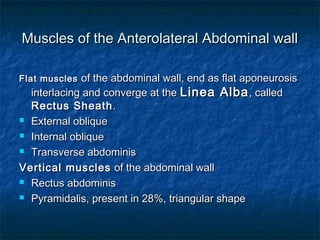
Muscles of the Anterolateral Abdominal wallMuscles of the Anterolateral Abdominal wall
Flat musclesFlat muscles of the abdominal wall, end as flat aponeurosisof the abdominal wall, end as flat aponeurosis
interlacing and converge at theinterlacing and converge at the Linea AlbaLinea Alba, called, called
Rectus SheathRectus Sheath..
 External obliqueExternal oblique
 Internal obliqueInternal oblique
 Transverse abdominisTransverse abdominis
Vertical musclesVertical muscles of the abdominal wallof the abdominal wall
 Rectus abdominisRectus abdominis
 Pyramidalis, present in 28%, triangular shapePyramidalis, present in 28%, triangular shape
Contents of Rectus sheathContents of Rectus sheath
 Superior epigastric arterySuperior epigastric artery
 Inferior epigastric arteryInferior epigastric artery
 Epigastric VeinsEpigastric Veins
 Lymphatic vesselsLymphatic vessels
 Ventral primary rami of T7-T12Ventral primary rami of T7-T12
Case # 1Case # 1
 ““A 75-year-old man receiving long-term warfarinA 75-year-old man receiving long-term warfarin
therapy developed a lower respiratory tracttherapy developed a lower respiratory tract
infection with paroxysmal coughing that wasinfection with paroxysmal coughing that was
treated with oral amoxicillin 250 mg/clavulanatetreated with oral amoxicillin 250 mg/clavulanate
potassium 125 mg TID for 7 days. In the 3 dayspotassium 125 mg TID for 7 days. In the 3 days
after completing antibiotic treatment, heafter completing antibiotic treatment, he
developed increasingly severe lower abdominaldeveloped increasingly severe lower abdominal
pain that was clinically diagnosed as RSH”.pain that was clinically diagnosed as RSH”.
 This case is reported to highlight the potentialThis case is reported to highlight the potential
interaction between warfarin andinteraction between warfarin and
amoxicillin/clavulanate potassium andamoxicillin/clavulanate potassium and
subsequent RSH formation via Pharmacokineticsubsequent RSH formation via Pharmacokinetic
or Pharmacodynamic.or Pharmacodynamic.
Case # 2Case # 2
 A 26-year-old male presented with the history of lowerA 26-year-old male presented with the history of lower
abdominal pain, fever, vomiting and increasing swelling overabdominal pain, fever, vomiting and increasing swelling over
the lower abdomen for the last one week. He had laparoscopicthe lower abdomen for the last one week. He had laparoscopic
appendectomy elsewhere three weeks ago and was dischargedappendectomy elsewhere three weeks ago and was discharged
home on the third postoperative day. He had been feelinghome on the third postoperative day. He had been feeling
unwell with lower abdominal pain since his discharge from theunwell with lower abdominal pain since his discharge from the
hospital and was given a week's course of antibiotics andhospital and was given a week's course of antibiotics and
analgesic in a private clinic. His abdominal examinationanalgesic in a private clinic. His abdominal examination
revealed: the laparoscopic port site scar noticed at therevealed: the laparoscopic port site scar noticed at the
umbilicus, left iliac fossa and the suprapubic area, generalizedumbilicus, left iliac fossa and the suprapubic area, generalized
abdominal tenderness and guarding, visible and palpableabdominal tenderness and guarding, visible and palpable
spherical mass in the left side of abdomen occupying the leftspherical mass in the left side of abdomen occupying the left
paraumbilical and suprapubic area with signs of inflammation.paraumbilical and suprapubic area with signs of inflammation.
Laboratory tests showed leukocytosis and neutrophilia.Laboratory tests showed leukocytosis and neutrophilia.
Coagulation profile was within the normal range. An abdominalCoagulation profile was within the normal range. An abdominal
ultrasound revealed air fluid level in the left anterior abdominalultrasound revealed air fluid level in the left anterior abdominal
wall with a cavity 9 x 5 cm in size suggestive of an abscess.wall with a cavity 9 x 5 cm in size suggestive of an abscess.
The CT scan of the abdomen showed extraperitoneal collection,The CT scan of the abdomen showed extraperitoneal collection,
lnoculation with air pockets in the left lower rectus sheath,lnoculation with air pockets in the left lower rectus sheath,
rectus muscle was infiltrated. The collection was displacing therectus muscle was infiltrated. The collection was displacing the
urinary bladder with no intraperitoenal communication and nourinary bladder with no intraperitoenal communication and no
intraperitoneal fluid collection. A diagnosis of rectus sheathintraperitoneal fluid collection. A diagnosis of rectus sheath
abscess was made.abscess was made.
 The wound was debrided and left open with secondary suturingThe wound was debrided and left open with secondary suturing
done after two weeks. Culture grewdone after two weeks. Culture grew Escheria coliEscheria coli ..
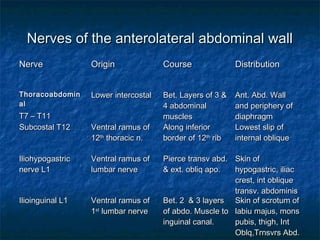
Nerves of the anterolateral abdominal wallNerves of the anterolateral abdominal wall
NerveNerve OriginOrigin CourseCourse DistributionDistribution
ThoracoabdominThoracoabdomin
alal
T7 – T11T7 – T11
Lower intercostalLower intercostal Bet. Layers of 3 &Bet. Layers of 3 &
4 abdominal4 abdominal
musclesmuscles
Ant. Abd. WallAnt. Abd. Wall
and periphery ofand periphery of
diaphragmdiaphragm
Subcostal T12Subcostal T12 Ventral ramus ofVentral ramus of
1212thth
thoracic n.thoracic n.
Along inferiorAlong inferior
border of 12border of 12thth
ribrib
Lowest slip ofLowest slip of
internal obliqueinternal oblique
IliohypogastricIliohypogastric
nerve L1nerve L1
Ventral ramus ofVentral ramus of
lumbar nervelumbar nerve
Pierce transv abd.Pierce transv abd.
& ext. obliq apo.& ext. obliq apo.
Skin ofSkin of
hypogastric, iliachypogastric, iliac
crest, int obliquecrest, int oblique
transv. abdoministransv. abdominis
Ilioinguinal L1Ilioinguinal L1 Ventral ramus ofVentral ramus of
11stst
lumbar nervelumbar nerve
Bet. 2 & 3 layersBet. 2 & 3 layers
of abdo. Muscle toof abdo. Muscle to
inguinal canal.inguinal canal.
Skin of scrotum ofSkin of scrotum of
labiu majus, monslabiu majus, mons
pubis, thigh, Intpubis, thigh, Int
Oblq,Trnsvrs Abd.Oblq,Trnsvrs Abd.
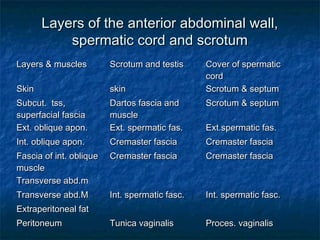
Layers of the anterior abdominal wall,Layers of the anterior abdominal wall,
spermatic cord and scrotumspermatic cord and scrotum
Layers & musclesLayers & muscles Scrotum and testisScrotum and testis Cover of spermaticCover of spermatic
cordcord
SkinSkin skinskin Scrotum & septumScrotum & septum
Subcut. tss,Subcut. tss,
superfacial fasciasuperfacial fascia
Dartos fascia andDartos fascia and
musclemuscle
Scrotum & septumScrotum & septum
Ext. oblique apon.Ext. oblique apon. Ext. spermatic fas.Ext. spermatic fas. Ext.spermatic fas.Ext.spermatic fas.
Int. oblique apon.Int. oblique apon. Cremaster fasciaCremaster fascia Cremaster fasciaCremaster fascia
Fascia of int. obliqueFascia of int. oblique
musclemuscle
Cremaster fasciaCremaster fascia Cremaster fasciaCremaster fascia
Transverse abd.mTransverse abd.m
Transverse abd.MTransverse abd.M Int. spermatic fasc.Int. spermatic fasc. Int. spermatic fasc.Int. spermatic fasc.
Extraperitoneal fatExtraperitoneal fat
PeritoneumPeritoneum Tunica vaginalisTunica vaginalis Proces. vaginalisProces. vaginalis
Arteries of the anterolateral abdominal wallArteries of the anterolateral abdominal wall
ArteryArtery OriginOrigin CourseCourse DistributionDistribution
SuperiorSuperior
epigastricepigastric
Int. thoracic art.Int. thoracic art. Rectus sheath toRectus sheath to
rectus abdominisrectus abdominis
Rectus abd.Rectus abd.
Anterolateral abd.Anterolateral abd.
Inferior epigastricInferior epigastric Ext, iliac arteryExt, iliac artery Rectus sheath toRectus sheath to
Rectus abdominisRectus abdominis
samesame
DeepDeep
circumflex iliaccircumflex iliac
Ex. Iliac arteryEx. Iliac artery Abd wall toAbd wall to
inguinal ligamentinguinal ligament
samesame
SuperficialSuperficial
Circumflex iliacCircumflex iliac
Femoral arteryFemoral artery Superficial fasciaSuperficial fascia
along inguinalalong inguinal
ligamentligament
Subcu tss andSubcu tss and
abd wallabd wall
SuperficialSuperficial
epigastricepigastric
Femoral arteryFemoral artery Subcu tss andSubcu tss and
suprapubicsuprapubic
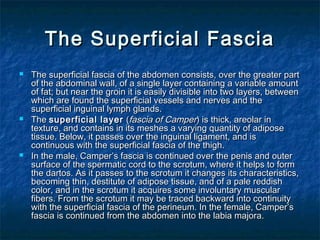
The Superficial FasciaThe Superficial Fascia
 The superficial fascia of the abdomen consists, over the greater partThe superficial fascia of the abdomen consists, over the greater part
of the abdominal wall, of a single layer containing a variable amountof the abdominal wall, of a single layer containing a variable amount
of fat; but near the groin it is easily divisible into two layers, betweenof fat; but near the groin it is easily divisible into two layers, between
which are found the superficial vessels and nerves and thewhich are found the superficial vessels and nerves and the
superficial inguinal lymph glands.superficial inguinal lymph glands.    
 TheThe superficial layersuperficial layer ((fascia of Camperfascia of Camper) is thick, areolar in) is thick, areolar in
texture, and contains in its meshes a varying quantity of adiposetexture, and contains in its meshes a varying quantity of adipose
tissue. Below, it passes over the inguinal ligament, and istissue. Below, it passes over the inguinal ligament, and is
continuous with the superficial fascia of the thigh.continuous with the superficial fascia of the thigh.
 In the male, Camper’s fascia is continued over the penis and outerIn the male, Camper’s fascia is continued over the penis and outer
surface of the spermatic cord to the scrotum, where it helps to formsurface of the spermatic cord to the scrotum, where it helps to form
the dartos. As it passes to the scrotum it changes its characteristics,the dartos. As it passes to the scrotum it changes its characteristics,
becoming thin, destitute of adipose tissue, and of a pale reddishbecoming thin, destitute of adipose tissue, and of a pale reddish
color, and in the scrotum it acquires some involuntary muscularcolor, and in the scrotum it acquires some involuntary muscular
fibers. From the scrotum it may be traced backward into continuityfibers. From the scrotum it may be traced backward into continuity
with the superficial fascia of the perineum. In the female, Camper’swith the superficial fascia of the perineum. In the female, Camper’s
fascia is continued from the abdomen into the labia majora.fascia is continued from the abdomen into the labia majora.      
TheThe deep layerdeep layer
    ((fascia of Scarpafascia of Scarpa) is thinner and more membranous in character) is thinner and more membranous in character
than the superficial, and contains a considerable quantity of yellowthan the superficial, and contains a considerable quantity of yellow
elastic fibers.elastic fibers.
 It is loosely connected by areolar tissue to the aponeurosis of theIt is loosely connected by areolar tissue to the aponeurosis of the
Obliquus externus abdominis, but in the middle line it is moreObliquus externus abdominis, but in the middle line it is more
intimately adherent to the linea alba and to the symphysis pubis,intimately adherent to the linea alba and to the symphysis pubis,
and is prolonged on to the dorsum of the penis, forming theand is prolonged on to the dorsum of the penis, forming the
fundiform ligament; above, it is continuous with the superficial fasciafundiform ligament; above, it is continuous with the superficial fascia
over the rest of the trunk; below and laterally, it blends with theover the rest of the trunk; below and laterally, it blends with the
fascia lata of the thigh a little below the inguinal ligament; mediallyfascia lata of the thigh a little below the inguinal ligament; medially
and below, it is continued over the penis and spermatic cord to theand below, it is continued over the penis and spermatic cord to the
scrotum, where it helps to form the dartos.scrotum, where it helps to form the dartos.
 From the scrotum it may be traced backward into continuity with theFrom the scrotum it may be traced backward into continuity with the
deep layer of the superficial fascia of the perineum (deep layer of the superficial fascia of the perineum (fascia offascia of
CollesColles). In the female, it is continued into the labia majora and). In the female, it is continued into the labia majora and
thence to the fascia of Colles.thence to the fascia of Colles.

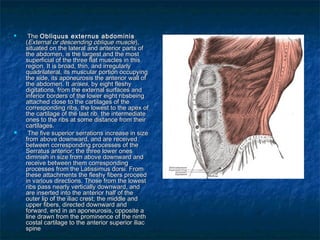
  TheThe Obliquus externus abdominisObliquus externus abdominis
((External or descending oblique muscleExternal or descending oblique muscle),),
situated on the lateral and anterior parts ofsituated on the lateral and anterior parts of
the abdomen, is the largest and the mostthe abdomen, is the largest and the most
superficial of the three flat muscles in thissuperficial of the three flat muscles in this
region. It is broad, thin, and irregularlyregion. It is broad, thin, and irregularly
quadrilateral, its muscular portion occupyingquadrilateral, its muscular portion occupying
the side, its aponeurosis the anterior wall ofthe side, its aponeurosis the anterior wall of
the abdomen. Itthe abdomen. It arises,arises, by eight fleshyby eight fleshy
digitations, from the external surfaces anddigitations, from the external surfaces and
inferior borders of the lower eight ribsbeinginferior borders of the lower eight ribsbeing
attached close to the cartilages of theattached close to the cartilages of the
corresponding ribs, the lowest to the apex ofcorresponding ribs, the lowest to the apex of
the cartilage of the last rib, the intermediatethe cartilage of the last rib, the intermediate
ones to the ribs at some distance from theirones to the ribs at some distance from their
cartilages.cartilages.
 The five superior serrations increase in sizeThe five superior serrations increase in size
from above downward, and are receivedfrom above downward, and are received
between corresponding processes of thebetween corresponding processes of the
Serratus anterior; the three lower onesSerratus anterior; the three lower ones
diminish in size from above downward anddiminish in size from above downward and
receive between them correspondingreceive between them corresponding
processes from the Latissimus dorsi. Fromprocesses from the Latissimus dorsi. From
these attachments the fleshy fibers proceedthese attachments the fleshy fibers proceed
in various directions. Those from the lowestin various directions. Those from the lowest
ribs pass nearly vertically downward, andribs pass nearly vertically downward, and
are inserted into the anterior half of theare inserted into the anterior half of the
outer lip of the iliac crest; the middle andouter lip of the iliac crest; the middle and
upper fibers, directed downward andupper fibers, directed downward and
forward, end in an aponeurosis, opposite aforward, end in an aponeurosis, opposite a
line drawn from the prominence of the ninthline drawn from the prominence of the ninth
costal cartilage to the anterior superior iliaccostal cartilage to the anterior superior iliac
spinespine
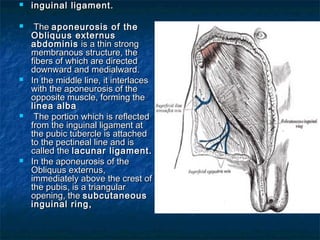
 inguinal ligament.inguinal ligament.
   TheThe aponeurosis of theaponeurosis of the
Obliquus externusObliquus externus
abdominisabdominis is a thin strongis a thin strong
membranous structure, themembranous structure, the
fibers of which are directedfibers of which are directed
downward and medialward.downward and medialward.
 In the middle line, it interlacesIn the middle line, it interlaces
with the aponeurosis of thewith the aponeurosis of the
opposite muscle, forming theopposite muscle, forming the
linea albalinea alba
 The portion which is reflectedThe portion which is reflected
from the inguinal ligament atfrom the inguinal ligament at
the pubic tubercle is attachedthe pubic tubercle is attached
to the pectineal line and isto the pectineal line and is
called thecalled the lacunar ligament.lacunar ligament.
 In the aponeurosis of theIn the aponeurosis of the
Obliquus externus,Obliquus externus,
immediately above the crest ofimmediately above the crest of
the pubis, is a triangularthe pubis, is a triangular
opening, theopening, the subcutaneoussubcutaneous
inguinal ring,inguinal ring,
Inguinal ligamentsInguinal ligaments
 The Inguinal LigamentThe Inguinal Ligament
((ligamentum inguinaleligamentum inguinale
[[PoupartiPouparti];]; Poupart’sPoupart’s
ligamentligament))The inguinal ligament is theThe inguinal ligament is the
lower border of the aponeurosis of thelower border of the aponeurosis of the
Obliquus externus,Obliquus externus,
 The Lacunar LigamentThe Lacunar Ligament
((ligamentum lacunareligamentum lacunare
[[GimbernatiGimbernati];]; Gimbernat’sGimbernat’s
ligamentligament)) The lacunar ligament isThe lacunar ligament is
that part of the aponeurosis of thethat part of the aponeurosis of the
Obliquus externus which is reflectedObliquus externus which is reflected
backward and lateralward, and isbackward and lateralward, and is
attached to the pectineal line.attached to the pectineal line.
It is about 1.25 cm. long, larger in theIt is about 1.25 cm. long, larger in the
male than in the female, almostmale than in the female, almost
horizontal in direction in the erecthorizontal in direction in the erect
posture, and of a triangular form withposture, and of a triangular form with
the base directed lateralward.the base directed lateralward.
 ((ligamentum inguinale reflexumligamentum inguinale reflexum [[CollesiCollesi];]; triangulartriangular
fasciafascia).).—The reflected inguinal ligament is a layer of tendinous—The reflected inguinal ligament is a layer of tendinous
fibers of a triangular shape, formed by an expansion from thefibers of a triangular shape, formed by an expansion from the
lacunar ligament and the inferior crus of the subcutaneous inguinallacunar ligament and the inferior crus of the subcutaneous inguinal
ring.ring.
 interlaces with the ligament of the other side of the linea albainterlaces with the ligament of the other side of the linea alba
   Ligament of Cooper.Ligament of Cooper. ——
It extends lateralward from the base of the lacunar ligament alongIt extends lateralward from the base of the lacunar ligament along
the pectineal line, to which it is attached. It is strengthened by thethe pectineal line, to which it is attached. It is strengthened by the
pectineal fascia, and by a lateral expansion from the lowerpectineal fascia, and by a lateral expansion from the lower
attachment of the linea alba (attachment of the linea alba (adminiculum lineæ albæadminiculum lineæ albæ).).      
 Variations.Variations.—The Obliquus externus may show decrease or—The Obliquus externus may show decrease or
doubling of its attachments to the ribs; addition slips from lumbardoubling of its attachments to the ribs; addition slips from lumbar
aponeurosis; doubling between lower ribs and ilium or inguinalaponeurosis; doubling between lower ribs and ilium or inguinal
ligament. Rarely tendinous inscriptions occur.ligament. Rarely tendinous inscriptions occur.
 TheThe Obliquus internus abdominisObliquus internus abdominis
 ((Internal or ascending obliqueInternal or ascending oblique
musclemuscle) thinner and smaller) thinner and smaller
than the Obliquus externus,than the Obliquus externus,
beneath which it lies, is of anbeneath which it lies, is of an
irregularly quadrilateral form,irregularly quadrilateral form,
and situated at the lateral andand situated at the lateral and
anterior parts of the abdomen.anterior parts of the abdomen.
 ItIt arises,arises, by fleshy fibers, fromby fleshy fibers, from
the lateral half of the groovedthe lateral half of the grooved
upper surface of the inguinalupper surface of the inguinal
ligament, iliac crest, lumboligament, iliac crest, lumbo
dorsal fascia.dorsal fascia.
 inserted,inserted, conjointly with thoseconjointly with those
of the Transversus, into theof the Transversus, into the
crest of the pubis and medialcrest of the pubis and medial
part of the pectineal linepart of the pectineal line
behind the lacunar ligament,behind the lacunar ligament,
forming what is known as theforming what is known as the
inguinal aponeurotic falx.inguinal aponeurotic falx.
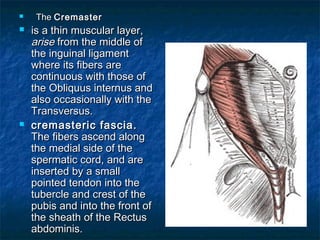
     TheThe CremasterCremaster
 is a thin muscular layer,is a thin muscular layer,
arisearise from the middle offrom the middle of
the inguinal ligamentthe inguinal ligament
where its fibers arewhere its fibers are
continuous with those ofcontinuous with those of
the Obliquus internus andthe Obliquus internus and
also occasionally with thealso occasionally with the
Transversus.Transversus.
 cremasteric fascia.cremasteric fascia.
The fibers ascend alongThe fibers ascend along
the medial side of thethe medial side of the
spermatic cord, and arespermatic cord, and are
inserted by a smallinserted by a small
pointed tendon into thepointed tendon into the
tubercle and crest of thetubercle and crest of the
pubis and into the front ofpubis and into the front of
the sheath of the Rectusthe sheath of the Rectus
abdominis.abdominis.
Transversus abdominisTransversus abdominis
((Transversalis muscleTransversalis muscle) so) so
called from the directioncalled from the direction
of its fibers, is the mostof its fibers, is the most
internal of the flatinternal of the flat
muscles of the abdomen,muscles of the abdomen,
being placed immediatelybeing placed immediately
beneath the Obliquusbeneath the Obliquus
internus.internus.
 ItIt arises,arises, from the lateralfrom the lateral
third of the inguinalthird of the inguinal
ligament, the iliac crest,ligament, the iliac crest,
from the inner surfaces offrom the inner surfaces of
the cartilages of the lowerthe cartilages of the lower
six ribssix ribs
 Inserted,Inserted, into the crest ofinto the crest of
the pubis and pectinealthe pubis and pectineal
line, forming the inguinalline, forming the inguinal
aponeurotic falx.aponeurotic falx.
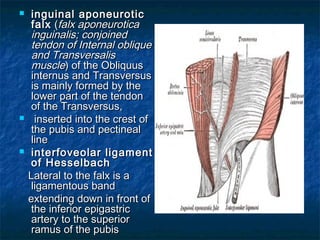
 inguinal aponeuroticinguinal aponeurotic
falxfalx ((falx aponeuroticafalx aponeurotica
inguinalis; conjoinedinguinalis; conjoined
tendon of Internal obliquetendon of Internal oblique
and Transversalisand Transversalis
musclemuscle) of the Obliquus) of the Obliquus
internus and Transversusinternus and Transversus
is mainly formed by theis mainly formed by the
lower part of the tendonlower part of the tendon
of the Transversus,of the Transversus,
 inserted into the crest ofinserted into the crest of
the pubis and pectinealthe pubis and pectineal
lineline
 interfoveolar ligamentinterfoveolar ligament
of Hesselbachof Hesselbach
Lateral to the falx is aLateral to the falx is a
ligamentous bandligamentous band
extending down in front ofextending down in front of
the inferior epigastricthe inferior epigastric
artery to the superiorartery to the superior
ramus of the pubisramus of the pubis
Abdominal muscleAbdominal muscle
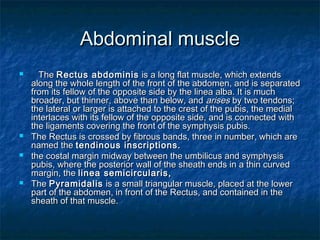
       TheThe Rectus abdominisRectus abdominis is a long flat muscle, which extendsis a long flat muscle, which extends
along the whole length of the front of the abdomen, and is separatedalong the whole length of the front of the abdomen, and is separated
from its fellow of the opposite side by the linea alba. It is muchfrom its fellow of the opposite side by the linea alba. It is much
broader, but thinner, above than below, andbroader, but thinner, above than below, and arisesarises by two tendons;by two tendons;
the lateral or larger is attached to the crest of the pubis, the medialthe lateral or larger is attached to the crest of the pubis, the medial
interlaces with its fellow of the opposite side, and is connected withinterlaces with its fellow of the opposite side, and is connected with
the ligaments covering the front of the symphysis pubis.the ligaments covering the front of the symphysis pubis.
 The Rectus is crossed by fibrous bands, three in number, which areThe Rectus is crossed by fibrous bands, three in number, which are
named thenamed the tendinous inscriptions.tendinous inscriptions.
 the costal margin midway between the umbilicus and symphysisthe costal margin midway between the umbilicus and symphysis
pubis, where the posterior wall of the sheath ends in a thin curvedpubis, where the posterior wall of the sheath ends in a thin curved
margin, themargin, the linea semicircularis,linea semicircularis,
 TheThe PyramidalisPyramidalis is a small triangular muscle, placed at the loweris a small triangular muscle, placed at the lower
part of the abdomen, in front of the Rectus, and contained in thepart of the abdomen, in front of the Rectus, and contained in the
sheath of that muscle.sheath of that muscle.
www.Examville.com
Online practice tests, live classes, tutoring, study guides
Q&A, premium content and more.
Nerves of the abdominal wallNerves of the abdominal wall
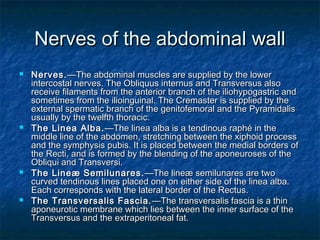
 Nerves.Nerves.—The abdominal muscles are supplied by the lower—The abdominal muscles are supplied by the lower
intercostal nerves. The Obliquus internus and Transversus alsointercostal nerves. The Obliquus internus and Transversus also
receive filaments from the anterior branch of the iliohypogastric andreceive filaments from the anterior branch of the iliohypogastric and
sometimes from the ilioinguinal. The Cremaster is supplied by thesometimes from the ilioinguinal. The Cremaster is supplied by the
external spermatic branch of the genitofemoral and the Pyramidalisexternal spermatic branch of the genitofemoral and the Pyramidalis
usually by the twelfth thoracic.usually by the twelfth thoracic.      
 The Linea Alba.The Linea Alba. —The linea alba is a tendinous raphé in the—The linea alba is a tendinous raphé in the
middle line of the abdomen, stretching between the xiphoid processmiddle line of the abdomen, stretching between the xiphoid process
and the symphysis pubis. It is placed between the medial borders ofand the symphysis pubis. It is placed between the medial borders of
the Recti, and is formed by the blending of the aponeuroses of thethe Recti, and is formed by the blending of the aponeuroses of the
Obliqui and Transversi.Obliqui and Transversi.
 The Lineæ Semilunares.The Lineæ Semilunares. —The lineæ semilunares are two—The lineæ semilunares are two
curved tendinous lines placed one on either side of the linea alba.curved tendinous lines placed one on either side of the linea alba.
Each corresponds with the lateral border of the Rectus.Each corresponds with the lateral border of the Rectus.
 The Transversalis Fascia.The Transversalis Fascia. —The transversalis fascia is a thin—The transversalis fascia is a thin
aponeurotic membrane which lies between the inner surface of theaponeurotic membrane which lies between the inner surface of the
Transversus and the extraperitoneal fat.Transversus and the extraperitoneal fat.
 The Abdominal Inguinal RingThe Abdominal Inguinal Ring
((annulus inguinalisannulus inguinalis
abdominis; internal or deepabdominis; internal or deep
abdominal ringabdominal ring ).).—The—The
abdominal inguinal ring is situatedabdominal inguinal ring is situated
in the transversalis fascia, midwayin the transversalis fascia, midway
between the anterior superior iliacbetween the anterior superior iliac
spine and the symphysis pubis,spine and the symphysis pubis,
and about 1.25 cm. above theand about 1.25 cm. above the
inguinal ligamentinguinal ligament
 The Inguinal Canal (The Inguinal Canal ( canaliscanalis
inguinalis; spermatic canalinguinalis; spermatic canal ).).
—The inguinal canal contains the—The inguinal canal contains the
spermatic cord and the ilioinguinalspermatic cord and the ilioinguinal
nerve in the male, and the roundnerve in the male, and the round
ligament of the uterus and theligament of the uterus and the
ilioinguinal nerve in the female.ilioinguinal nerve in the female.
 The Deep Crural Arch.The Deep Crural Arch. ——
Curving over the external iliacCurving over the external iliac
vessels, at the spot where theyvessels, at the spot where they
become femoral, on the abdominalbecome femoral, on the abdominal
side of the inguinal ligaments andside of the inguinal ligaments and
loosely connected with it, is aloosely connected with it, is a
thickened band of fibers called thethickened band of fibers called the
deep crural arch.deep crural arch.
PeritoniumPeritonium
 Extraperitoneal Connective Tissue.Extraperitoneal Connective Tissue. —Between the inner—Between the inner
surface of the general layer of the fascia which lines the interior ofsurface of the general layer of the fascia which lines the interior of
the abdominal and pelvic cavities, and the peritoneum, there is athe abdominal and pelvic cavities, and the peritoneum, there is a
considerable amount of connective tissue, termed theconsiderable amount of connective tissue, termed the
extraperitonealextraperitoneal oror subperitoneal connective tissue.subperitoneal connective tissue.       
 TheThe parietal portionparietal portion lines the cavity in varying quantities inlines the cavity in varying quantities in
different situations. It is especially abundant on the posterior wall ofdifferent situations. It is especially abundant on the posterior wall of
the abdomen, and particularly around the kidneys, where it containsthe abdomen, and particularly around the kidneys, where it contains
much fat. On the anterior wall of the abdomen, except in the publicmuch fat. On the anterior wall of the abdomen, except in the public
region, and on the lateral wall above the iliac crest, it is scanty, andregion, and on the lateral wall above the iliac crest, it is scanty, and
here the transversalis fascia is more closely connected with thehere the transversalis fascia is more closely connected with the
peritoneum. There is a considerable amount of extraperitonealperitoneum. There is a considerable amount of extraperitoneal
connective tissue in the pelvis.connective tissue in the pelvis.  
 TheThe visceral portionvisceral portion follows the course of the branches of thefollows the course of the branches of the
abdominal aorta between the layers of the mesenterics and otherabdominal aorta between the layers of the mesenterics and other
folds of peritoneum which connect the various viscera to thefolds of peritoneum which connect the various viscera to the
abdominal wall. The two portions are directly continuous with eachabdominal wall. The two portions are directly continuous with each
other.other.      
The Posterior Muscles of theThe Posterior Muscles of the
AbdomenAbdomen
 Psoas major.Psoas major.
Iliacus. Psoas minor.Iliacus. Psoas minor.
Quadratus lumborum.  The Psoas major, the Psoas minor, and theQuadratus lumborum.  The Psoas major, the Psoas minor, and the
Iliacus, with the fasciæ covering them, will be described with theIliacus, with the fasciæ covering them, will be described with the
muscles of the lower extremity.muscles of the lower extremity.
 TheThe Quadratus lumborumQuadratus lumborum is irregularly quadrilateral in shape,is irregularly quadrilateral in shape,
and broader below than above. Itand broader below than above. It arisesarises by aponeurotic fibers fromby aponeurotic fibers from
the iliolumbar ligament and the adjacent portion of the iliac crest forthe iliolumbar ligament and the adjacent portion of the iliac crest for
about 5 cm., and isabout 5 cm., and is insertedinserted into the lower border of the last ribinto the lower border of the last rib
 Nerve Supply.Nerve Supply. —The twelfth thoracic and first and second lumbar—The twelfth thoracic and first and second lumbar
nerves supply this muscle.nerves supply this muscle.
 Actions.Actions.—The Quadratus lumborum draws down the last rib, and—The Quadratus lumborum draws down the last rib, and
acts as a muscle of inspiration by helping to fix the origin of theacts as a muscle of inspiration by helping to fix the origin of the
diaphragm.diaphragm.
It’s FREE to join.
http://www.examville.com

Abdominal anatomy

  • 1.
    www.Examville.com Online practice tests,live classes, tutoring, study guides Q&A, premium content and more.
  • 2.
  • 3.
    Nine abdominal regionsNineabdominal regions  2 horizontal planes2 horizontal planes subcostal planes= thru inferior border of 10subcostal planes= thru inferior border of 10thth costal cartilagecostal cartilage transtubercular planes= thru iliac tubercle & L5 vertebratranstubercular planes= thru iliac tubercle & L5 vertebra 2 vertical planes2 vertical planes midclavicular planes= thru the midpoint of claviclemidclavicular planes= thru the midpoint of clavicle  Four quadrants:Four quadrants: one horizontal planeone horizontal plane transumbilical plane= thru umbilicus , L3 L4 vertebratransumbilical plane= thru umbilicus , L3 L4 vertebra one vertical planeone vertical plane median plane= longitudinal thru the back div into halves.median plane= longitudinal thru the back div into halves.
  • 4.
    Abdominal quadrantsAbdominal quadrants Rightupper quadrantRight upper quadrant Left upper quadrantLeft upper quadrant Liver right lobeLiver right lobe Gallbladder, stomach, pylorus,Gallbladder, stomach, pylorus, doudenum, Pancreas head, Rdoudenum, Pancreas head, R suprarenal gland, R kidney, Rsuprarenal gland, R kidney, R colic flexure, Ascending coloncolic flexure, Ascending colon superior part, Transvrse colon Rsuperior part, Transvrse colon R half.half. Liver left lobeLiver left lobe Spleen, stomach, jejunum, proxSpleen, stomach, jejunum, prox ileum, pancreas body and tail, leftileum, pancreas body and tail, left kidney, L suprarenal, left colickidney, L suprarenal, left colic flexure, Transverse colon left part,flexure, Transverse colon left part, descending colon superior part.descending colon superior part. Right lower quadrantRight lower quadrant Left lower quadrantLeft lower quadrant Cecum, Appendix, Ileum, Asc.Cecum, Appendix, Ileum, Asc. Colon, R ovary, R uterine tube, RColon, R ovary, R uterine tube, R ureter, R spermatic cord, Uterus,ureter, R spermatic cord, Uterus, Urinary bladder (full)Urinary bladder (full) Sigmoid colon, Desc. Colon, LSigmoid colon, Desc. Colon, L ovary, L uterine tube, L ureter, Lovary, L uterine tube, L ureter, L spermatic cord, Uterus enlarge,spermatic cord, Uterus enlarge, Urinary bladder ( full).Urinary bladder ( full).
  • 5.
    Muscles of theAnterolateral Abdominal wallMuscles of the Anterolateral Abdominal wall Flat musclesFlat muscles of the abdominal wall, end as flat aponeurosisof the abdominal wall, end as flat aponeurosis interlacing and converge at theinterlacing and converge at the Linea AlbaLinea Alba, called, called Rectus SheathRectus Sheath..  External obliqueExternal oblique  Internal obliqueInternal oblique  Transverse abdominisTransverse abdominis Vertical musclesVertical muscles of the abdominal wallof the abdominal wall  Rectus abdominisRectus abdominis  Pyramidalis, present in 28%, triangular shapePyramidalis, present in 28%, triangular shape
  • 6.
    Contents of RectussheathContents of Rectus sheath  Superior epigastric arterySuperior epigastric artery  Inferior epigastric arteryInferior epigastric artery  Epigastric VeinsEpigastric Veins  Lymphatic vesselsLymphatic vessels  Ventral primary rami of T7-T12Ventral primary rami of T7-T12
  • 7.
    Case # 1Case# 1  ““A 75-year-old man receiving long-term warfarinA 75-year-old man receiving long-term warfarin therapy developed a lower respiratory tracttherapy developed a lower respiratory tract infection with paroxysmal coughing that wasinfection with paroxysmal coughing that was treated with oral amoxicillin 250 mg/clavulanatetreated with oral amoxicillin 250 mg/clavulanate potassium 125 mg TID for 7 days. In the 3 dayspotassium 125 mg TID for 7 days. In the 3 days after completing antibiotic treatment, heafter completing antibiotic treatment, he developed increasingly severe lower abdominaldeveloped increasingly severe lower abdominal pain that was clinically diagnosed as RSH”.pain that was clinically diagnosed as RSH”.  This case is reported to highlight the potentialThis case is reported to highlight the potential interaction between warfarin andinteraction between warfarin and amoxicillin/clavulanate potassium andamoxicillin/clavulanate potassium and subsequent RSH formation via Pharmacokineticsubsequent RSH formation via Pharmacokinetic or Pharmacodynamic.or Pharmacodynamic.
  • 8.
    Case # 2Case# 2  A 26-year-old male presented with the history of lowerA 26-year-old male presented with the history of lower abdominal pain, fever, vomiting and increasing swelling overabdominal pain, fever, vomiting and increasing swelling over the lower abdomen for the last one week. He had laparoscopicthe lower abdomen for the last one week. He had laparoscopic appendectomy elsewhere three weeks ago and was dischargedappendectomy elsewhere three weeks ago and was discharged home on the third postoperative day. He had been feelinghome on the third postoperative day. He had been feeling unwell with lower abdominal pain since his discharge from theunwell with lower abdominal pain since his discharge from the hospital and was given a week's course of antibiotics andhospital and was given a week's course of antibiotics and analgesic in a private clinic. His abdominal examinationanalgesic in a private clinic. His abdominal examination revealed: the laparoscopic port site scar noticed at therevealed: the laparoscopic port site scar noticed at the umbilicus, left iliac fossa and the suprapubic area, generalizedumbilicus, left iliac fossa and the suprapubic area, generalized abdominal tenderness and guarding, visible and palpableabdominal tenderness and guarding, visible and palpable spherical mass in the left side of abdomen occupying the leftspherical mass in the left side of abdomen occupying the left paraumbilical and suprapubic area with signs of inflammation.paraumbilical and suprapubic area with signs of inflammation. Laboratory tests showed leukocytosis and neutrophilia.Laboratory tests showed leukocytosis and neutrophilia. Coagulation profile was within the normal range. An abdominalCoagulation profile was within the normal range. An abdominal ultrasound revealed air fluid level in the left anterior abdominalultrasound revealed air fluid level in the left anterior abdominal wall with a cavity 9 x 5 cm in size suggestive of an abscess.wall with a cavity 9 x 5 cm in size suggestive of an abscess. The CT scan of the abdomen showed extraperitoneal collection,The CT scan of the abdomen showed extraperitoneal collection, lnoculation with air pockets in the left lower rectus sheath,lnoculation with air pockets in the left lower rectus sheath, rectus muscle was infiltrated. The collection was displacing therectus muscle was infiltrated. The collection was displacing the urinary bladder with no intraperitoenal communication and nourinary bladder with no intraperitoenal communication and no intraperitoneal fluid collection. A diagnosis of rectus sheathintraperitoneal fluid collection. A diagnosis of rectus sheath abscess was made.abscess was made.  The wound was debrided and left open with secondary suturingThe wound was debrided and left open with secondary suturing done after two weeks. Culture grewdone after two weeks. Culture grew Escheria coliEscheria coli ..
  • 9.
    Nerves of theanterolateral abdominal wallNerves of the anterolateral abdominal wall NerveNerve OriginOrigin CourseCourse DistributionDistribution ThoracoabdominThoracoabdomin alal T7 – T11T7 – T11 Lower intercostalLower intercostal Bet. Layers of 3 &Bet. Layers of 3 & 4 abdominal4 abdominal musclesmuscles Ant. Abd. WallAnt. Abd. Wall and periphery ofand periphery of diaphragmdiaphragm Subcostal T12Subcostal T12 Ventral ramus ofVentral ramus of 1212thth thoracic n.thoracic n. Along inferiorAlong inferior border of 12border of 12thth ribrib Lowest slip ofLowest slip of internal obliqueinternal oblique IliohypogastricIliohypogastric nerve L1nerve L1 Ventral ramus ofVentral ramus of lumbar nervelumbar nerve Pierce transv abd.Pierce transv abd. & ext. obliq apo.& ext. obliq apo. Skin ofSkin of hypogastric, iliachypogastric, iliac crest, int obliquecrest, int oblique transv. abdoministransv. abdominis Ilioinguinal L1Ilioinguinal L1 Ventral ramus ofVentral ramus of 11stst lumbar nervelumbar nerve Bet. 2 & 3 layersBet. 2 & 3 layers of abdo. Muscle toof abdo. Muscle to inguinal canal.inguinal canal. Skin of scrotum ofSkin of scrotum of labiu majus, monslabiu majus, mons pubis, thigh, Intpubis, thigh, Int Oblq,Trnsvrs Abd.Oblq,Trnsvrs Abd.
  • 10.
    Layers of theanterior abdominal wall,Layers of the anterior abdominal wall, spermatic cord and scrotumspermatic cord and scrotum Layers & musclesLayers & muscles Scrotum and testisScrotum and testis Cover of spermaticCover of spermatic cordcord SkinSkin skinskin Scrotum & septumScrotum & septum Subcut. tss,Subcut. tss, superfacial fasciasuperfacial fascia Dartos fascia andDartos fascia and musclemuscle Scrotum & septumScrotum & septum Ext. oblique apon.Ext. oblique apon. Ext. spermatic fas.Ext. spermatic fas. Ext.spermatic fas.Ext.spermatic fas. Int. oblique apon.Int. oblique apon. Cremaster fasciaCremaster fascia Cremaster fasciaCremaster fascia Fascia of int. obliqueFascia of int. oblique musclemuscle Cremaster fasciaCremaster fascia Cremaster fasciaCremaster fascia Transverse abd.mTransverse abd.m Transverse abd.MTransverse abd.M Int. spermatic fasc.Int. spermatic fasc. Int. spermatic fasc.Int. spermatic fasc. Extraperitoneal fatExtraperitoneal fat PeritoneumPeritoneum Tunica vaginalisTunica vaginalis Proces. vaginalisProces. vaginalis
  • 11.
    Arteries of theanterolateral abdominal wallArteries of the anterolateral abdominal wall ArteryArtery OriginOrigin CourseCourse DistributionDistribution SuperiorSuperior epigastricepigastric Int. thoracic art.Int. thoracic art. Rectus sheath toRectus sheath to rectus abdominisrectus abdominis Rectus abd.Rectus abd. Anterolateral abd.Anterolateral abd. Inferior epigastricInferior epigastric Ext, iliac arteryExt, iliac artery Rectus sheath toRectus sheath to Rectus abdominisRectus abdominis samesame DeepDeep circumflex iliaccircumflex iliac Ex. Iliac arteryEx. Iliac artery Abd wall toAbd wall to inguinal ligamentinguinal ligament samesame SuperficialSuperficial Circumflex iliacCircumflex iliac Femoral arteryFemoral artery Superficial fasciaSuperficial fascia along inguinalalong inguinal ligamentligament Subcu tss andSubcu tss and abd wallabd wall SuperficialSuperficial epigastricepigastric Femoral arteryFemoral artery Subcu tss andSubcu tss and suprapubicsuprapubic
  • 12.
    The Superficial FasciaTheSuperficial Fascia  The superficial fascia of the abdomen consists, over the greater partThe superficial fascia of the abdomen consists, over the greater part of the abdominal wall, of a single layer containing a variable amountof the abdominal wall, of a single layer containing a variable amount of fat; but near the groin it is easily divisible into two layers, betweenof fat; but near the groin it is easily divisible into two layers, between which are found the superficial vessels and nerves and thewhich are found the superficial vessels and nerves and the superficial inguinal lymph glands.superficial inguinal lymph glands.      TheThe superficial layersuperficial layer ((fascia of Camperfascia of Camper) is thick, areolar in) is thick, areolar in texture, and contains in its meshes a varying quantity of adiposetexture, and contains in its meshes a varying quantity of adipose tissue. Below, it passes over the inguinal ligament, and istissue. Below, it passes over the inguinal ligament, and is continuous with the superficial fascia of the thigh.continuous with the superficial fascia of the thigh.  In the male, Camper’s fascia is continued over the penis and outerIn the male, Camper’s fascia is continued over the penis and outer surface of the spermatic cord to the scrotum, where it helps to formsurface of the spermatic cord to the scrotum, where it helps to form the dartos. As it passes to the scrotum it changes its characteristics,the dartos. As it passes to the scrotum it changes its characteristics, becoming thin, destitute of adipose tissue, and of a pale reddishbecoming thin, destitute of adipose tissue, and of a pale reddish color, and in the scrotum it acquires some involuntary muscularcolor, and in the scrotum it acquires some involuntary muscular fibers. From the scrotum it may be traced backward into continuityfibers. From the scrotum it may be traced backward into continuity with the superficial fascia of the perineum. In the female, Camper’swith the superficial fascia of the perineum. In the female, Camper’s fascia is continued from the abdomen into the labia majora.fascia is continued from the abdomen into the labia majora.      
  • 13.
    TheThe deep layerdeeplayer     ((fascia of Scarpafascia of Scarpa) is thinner and more membranous in character) is thinner and more membranous in character than the superficial, and contains a considerable quantity of yellowthan the superficial, and contains a considerable quantity of yellow elastic fibers.elastic fibers.  It is loosely connected by areolar tissue to the aponeurosis of theIt is loosely connected by areolar tissue to the aponeurosis of the Obliquus externus abdominis, but in the middle line it is moreObliquus externus abdominis, but in the middle line it is more intimately adherent to the linea alba and to the symphysis pubis,intimately adherent to the linea alba and to the symphysis pubis, and is prolonged on to the dorsum of the penis, forming theand is prolonged on to the dorsum of the penis, forming the fundiform ligament; above, it is continuous with the superficial fasciafundiform ligament; above, it is continuous with the superficial fascia over the rest of the trunk; below and laterally, it blends with theover the rest of the trunk; below and laterally, it blends with the fascia lata of the thigh a little below the inguinal ligament; mediallyfascia lata of the thigh a little below the inguinal ligament; medially and below, it is continued over the penis and spermatic cord to theand below, it is continued over the penis and spermatic cord to the scrotum, where it helps to form the dartos.scrotum, where it helps to form the dartos.  From the scrotum it may be traced backward into continuity with theFrom the scrotum it may be traced backward into continuity with the deep layer of the superficial fascia of the perineum (deep layer of the superficial fascia of the perineum (fascia offascia of CollesColles). In the female, it is continued into the labia majora and). In the female, it is continued into the labia majora and thence to the fascia of Colles.thence to the fascia of Colles.
  • 14.
       TheThe Obliquus externusabdominisObliquus externus abdominis ((External or descending oblique muscleExternal or descending oblique muscle),), situated on the lateral and anterior parts ofsituated on the lateral and anterior parts of the abdomen, is the largest and the mostthe abdomen, is the largest and the most superficial of the three flat muscles in thissuperficial of the three flat muscles in this region. It is broad, thin, and irregularlyregion. It is broad, thin, and irregularly quadrilateral, its muscular portion occupyingquadrilateral, its muscular portion occupying the side, its aponeurosis the anterior wall ofthe side, its aponeurosis the anterior wall of the abdomen. Itthe abdomen. It arises,arises, by eight fleshyby eight fleshy digitations, from the external surfaces anddigitations, from the external surfaces and inferior borders of the lower eight ribsbeinginferior borders of the lower eight ribsbeing attached close to the cartilages of theattached close to the cartilages of the corresponding ribs, the lowest to the apex ofcorresponding ribs, the lowest to the apex of the cartilage of the last rib, the intermediatethe cartilage of the last rib, the intermediate ones to the ribs at some distance from theirones to the ribs at some distance from their cartilages.cartilages.  The five superior serrations increase in sizeThe five superior serrations increase in size from above downward, and are receivedfrom above downward, and are received between corresponding processes of thebetween corresponding processes of the Serratus anterior; the three lower onesSerratus anterior; the three lower ones diminish in size from above downward anddiminish in size from above downward and receive between them correspondingreceive between them corresponding processes from the Latissimus dorsi. Fromprocesses from the Latissimus dorsi. From these attachments the fleshy fibers proceedthese attachments the fleshy fibers proceed in various directions. Those from the lowestin various directions. Those from the lowest ribs pass nearly vertically downward, andribs pass nearly vertically downward, and are inserted into the anterior half of theare inserted into the anterior half of the outer lip of the iliac crest; the middle andouter lip of the iliac crest; the middle and upper fibers, directed downward andupper fibers, directed downward and forward, end in an aponeurosis, opposite aforward, end in an aponeurosis, opposite a line drawn from the prominence of the ninthline drawn from the prominence of the ninth costal cartilage to the anterior superior iliaccostal cartilage to the anterior superior iliac spinespine
  • 15.
     inguinal ligament.inguinalligament.    TheThe aponeurosis of theaponeurosis of the Obliquus externusObliquus externus abdominisabdominis is a thin strongis a thin strong membranous structure, themembranous structure, the fibers of which are directedfibers of which are directed downward and medialward.downward and medialward.  In the middle line, it interlacesIn the middle line, it interlaces with the aponeurosis of thewith the aponeurosis of the opposite muscle, forming theopposite muscle, forming the linea albalinea alba  The portion which is reflectedThe portion which is reflected from the inguinal ligament atfrom the inguinal ligament at the pubic tubercle is attachedthe pubic tubercle is attached to the pectineal line and isto the pectineal line and is called thecalled the lacunar ligament.lacunar ligament.  In the aponeurosis of theIn the aponeurosis of the Obliquus externus,Obliquus externus, immediately above the crest ofimmediately above the crest of the pubis, is a triangularthe pubis, is a triangular opening, theopening, the subcutaneoussubcutaneous inguinal ring,inguinal ring,
  • 16.
    Inguinal ligamentsInguinal ligaments The Inguinal LigamentThe Inguinal Ligament ((ligamentum inguinaleligamentum inguinale [[PoupartiPouparti];]; Poupart’sPoupart’s ligamentligament))The inguinal ligament is theThe inguinal ligament is the lower border of the aponeurosis of thelower border of the aponeurosis of the Obliquus externus,Obliquus externus,  The Lacunar LigamentThe Lacunar Ligament ((ligamentum lacunareligamentum lacunare [[GimbernatiGimbernati];]; Gimbernat’sGimbernat’s ligamentligament)) The lacunar ligament isThe lacunar ligament is that part of the aponeurosis of thethat part of the aponeurosis of the Obliquus externus which is reflectedObliquus externus which is reflected backward and lateralward, and isbackward and lateralward, and is attached to the pectineal line.attached to the pectineal line. It is about 1.25 cm. long, larger in theIt is about 1.25 cm. long, larger in the male than in the female, almostmale than in the female, almost horizontal in direction in the erecthorizontal in direction in the erect posture, and of a triangular form withposture, and of a triangular form with the base directed lateralward.the base directed lateralward.
  • 17.
     ((ligamentum inguinalereflexumligamentum inguinale reflexum [[CollesiCollesi];]; triangulartriangular fasciafascia).).—The reflected inguinal ligament is a layer of tendinous—The reflected inguinal ligament is a layer of tendinous fibers of a triangular shape, formed by an expansion from thefibers of a triangular shape, formed by an expansion from the lacunar ligament and the inferior crus of the subcutaneous inguinallacunar ligament and the inferior crus of the subcutaneous inguinal ring.ring.  interlaces with the ligament of the other side of the linea albainterlaces with the ligament of the other side of the linea alba    Ligament of Cooper.Ligament of Cooper. —— It extends lateralward from the base of the lacunar ligament alongIt extends lateralward from the base of the lacunar ligament along the pectineal line, to which it is attached. It is strengthened by thethe pectineal line, to which it is attached. It is strengthened by the pectineal fascia, and by a lateral expansion from the lowerpectineal fascia, and by a lateral expansion from the lower attachment of the linea alba (attachment of the linea alba (adminiculum lineæ albæadminiculum lineæ albæ).).        Variations.Variations.—The Obliquus externus may show decrease or—The Obliquus externus may show decrease or doubling of its attachments to the ribs; addition slips from lumbardoubling of its attachments to the ribs; addition slips from lumbar aponeurosis; doubling between lower ribs and ilium or inguinalaponeurosis; doubling between lower ribs and ilium or inguinal ligament. Rarely tendinous inscriptions occur.ligament. Rarely tendinous inscriptions occur.
  • 18.
     TheThe Obliquusinternus abdominisObliquus internus abdominis  ((Internal or ascending obliqueInternal or ascending oblique musclemuscle) thinner and smaller) thinner and smaller than the Obliquus externus,than the Obliquus externus, beneath which it lies, is of anbeneath which it lies, is of an irregularly quadrilateral form,irregularly quadrilateral form, and situated at the lateral andand situated at the lateral and anterior parts of the abdomen.anterior parts of the abdomen.  ItIt arises,arises, by fleshy fibers, fromby fleshy fibers, from the lateral half of the groovedthe lateral half of the grooved upper surface of the inguinalupper surface of the inguinal ligament, iliac crest, lumboligament, iliac crest, lumbo dorsal fascia.dorsal fascia.  inserted,inserted, conjointly with thoseconjointly with those of the Transversus, into theof the Transversus, into the crest of the pubis and medialcrest of the pubis and medial part of the pectineal linepart of the pectineal line behind the lacunar ligament,behind the lacunar ligament, forming what is known as theforming what is known as the inguinal aponeurotic falx.inguinal aponeurotic falx.
  • 19.
         TheThe CremasterCremaster is a thin muscular layer,is a thin muscular layer, arisearise from the middle offrom the middle of the inguinal ligamentthe inguinal ligament where its fibers arewhere its fibers are continuous with those ofcontinuous with those of the Obliquus internus andthe Obliquus internus and also occasionally with thealso occasionally with the Transversus.Transversus.  cremasteric fascia.cremasteric fascia. The fibers ascend alongThe fibers ascend along the medial side of thethe medial side of the spermatic cord, and arespermatic cord, and are inserted by a smallinserted by a small pointed tendon into thepointed tendon into the tubercle and crest of thetubercle and crest of the pubis and into the front ofpubis and into the front of the sheath of the Rectusthe sheath of the Rectus abdominis.abdominis.
  • 20.
    Transversus abdominisTransversus abdominis ((TransversalismuscleTransversalis muscle) so) so called from the directioncalled from the direction of its fibers, is the mostof its fibers, is the most internal of the flatinternal of the flat muscles of the abdomen,muscles of the abdomen, being placed immediatelybeing placed immediately beneath the Obliquusbeneath the Obliquus internus.internus.  ItIt arises,arises, from the lateralfrom the lateral third of the inguinalthird of the inguinal ligament, the iliac crest,ligament, the iliac crest, from the inner surfaces offrom the inner surfaces of the cartilages of the lowerthe cartilages of the lower six ribssix ribs  Inserted,Inserted, into the crest ofinto the crest of the pubis and pectinealthe pubis and pectineal line, forming the inguinalline, forming the inguinal aponeurotic falx.aponeurotic falx.
  • 21.
     inguinal aponeuroticinguinalaponeurotic falxfalx ((falx aponeuroticafalx aponeurotica inguinalis; conjoinedinguinalis; conjoined tendon of Internal obliquetendon of Internal oblique and Transversalisand Transversalis musclemuscle) of the Obliquus) of the Obliquus internus and Transversusinternus and Transversus is mainly formed by theis mainly formed by the lower part of the tendonlower part of the tendon of the Transversus,of the Transversus,  inserted into the crest ofinserted into the crest of the pubis and pectinealthe pubis and pectineal lineline  interfoveolar ligamentinterfoveolar ligament of Hesselbachof Hesselbach Lateral to the falx is aLateral to the falx is a ligamentous bandligamentous band extending down in front ofextending down in front of the inferior epigastricthe inferior epigastric artery to the superiorartery to the superior ramus of the pubisramus of the pubis
  • 22.
    Abdominal muscleAbdominal muscle       TheThe Rectus abdominisRectus abdominis is a long flat muscle, which extendsis a long flat muscle, which extends along the whole length of the front of the abdomen, and is separatedalong the whole length of the front of the abdomen, and is separated from its fellow of the opposite side by the linea alba. It is muchfrom its fellow of the opposite side by the linea alba. It is much broader, but thinner, above than below, andbroader, but thinner, above than below, and arisesarises by two tendons;by two tendons; the lateral or larger is attached to the crest of the pubis, the medialthe lateral or larger is attached to the crest of the pubis, the medial interlaces with its fellow of the opposite side, and is connected withinterlaces with its fellow of the opposite side, and is connected with the ligaments covering the front of the symphysis pubis.the ligaments covering the front of the symphysis pubis.  The Rectus is crossed by fibrous bands, three in number, which areThe Rectus is crossed by fibrous bands, three in number, which are named thenamed the tendinous inscriptions.tendinous inscriptions.  the costal margin midway between the umbilicus and symphysisthe costal margin midway between the umbilicus and symphysis pubis, where the posterior wall of the sheath ends in a thin curvedpubis, where the posterior wall of the sheath ends in a thin curved margin, themargin, the linea semicircularis,linea semicircularis,  TheThe PyramidalisPyramidalis is a small triangular muscle, placed at the loweris a small triangular muscle, placed at the lower part of the abdomen, in front of the Rectus, and contained in thepart of the abdomen, in front of the Rectus, and contained in the sheath of that muscle.sheath of that muscle.
  • 23.
    www.Examville.com Online practice tests,live classes, tutoring, study guides Q&A, premium content and more.
  • 24.
    Nerves of theabdominal wallNerves of the abdominal wall  Nerves.Nerves.—The abdominal muscles are supplied by the lower—The abdominal muscles are supplied by the lower intercostal nerves. The Obliquus internus and Transversus alsointercostal nerves. The Obliquus internus and Transversus also receive filaments from the anterior branch of the iliohypogastric andreceive filaments from the anterior branch of the iliohypogastric and sometimes from the ilioinguinal. The Cremaster is supplied by thesometimes from the ilioinguinal. The Cremaster is supplied by the external spermatic branch of the genitofemoral and the Pyramidalisexternal spermatic branch of the genitofemoral and the Pyramidalis usually by the twelfth thoracic.usually by the twelfth thoracic.        The Linea Alba.The Linea Alba. —The linea alba is a tendinous raphé in the—The linea alba is a tendinous raphé in the middle line of the abdomen, stretching between the xiphoid processmiddle line of the abdomen, stretching between the xiphoid process and the symphysis pubis. It is placed between the medial borders ofand the symphysis pubis. It is placed between the medial borders of the Recti, and is formed by the blending of the aponeuroses of thethe Recti, and is formed by the blending of the aponeuroses of the Obliqui and Transversi.Obliqui and Transversi.  The Lineæ Semilunares.The Lineæ Semilunares. —The lineæ semilunares are two—The lineæ semilunares are two curved tendinous lines placed one on either side of the linea alba.curved tendinous lines placed one on either side of the linea alba. Each corresponds with the lateral border of the Rectus.Each corresponds with the lateral border of the Rectus.  The Transversalis Fascia.The Transversalis Fascia. —The transversalis fascia is a thin—The transversalis fascia is a thin aponeurotic membrane which lies between the inner surface of theaponeurotic membrane which lies between the inner surface of the Transversus and the extraperitoneal fat.Transversus and the extraperitoneal fat.
  • 25.
     The AbdominalInguinal RingThe Abdominal Inguinal Ring ((annulus inguinalisannulus inguinalis abdominis; internal or deepabdominis; internal or deep abdominal ringabdominal ring ).).—The—The abdominal inguinal ring is situatedabdominal inguinal ring is situated in the transversalis fascia, midwayin the transversalis fascia, midway between the anterior superior iliacbetween the anterior superior iliac spine and the symphysis pubis,spine and the symphysis pubis, and about 1.25 cm. above theand about 1.25 cm. above the inguinal ligamentinguinal ligament  The Inguinal Canal (The Inguinal Canal ( canaliscanalis inguinalis; spermatic canalinguinalis; spermatic canal ).). —The inguinal canal contains the—The inguinal canal contains the spermatic cord and the ilioinguinalspermatic cord and the ilioinguinal nerve in the male, and the roundnerve in the male, and the round ligament of the uterus and theligament of the uterus and the ilioinguinal nerve in the female.ilioinguinal nerve in the female.  The Deep Crural Arch.The Deep Crural Arch. —— Curving over the external iliacCurving over the external iliac vessels, at the spot where theyvessels, at the spot where they become femoral, on the abdominalbecome femoral, on the abdominal side of the inguinal ligaments andside of the inguinal ligaments and loosely connected with it, is aloosely connected with it, is a thickened band of fibers called thethickened band of fibers called the deep crural arch.deep crural arch.
  • 26.
    PeritoniumPeritonium  Extraperitoneal ConnectiveTissue.Extraperitoneal Connective Tissue. —Between the inner—Between the inner surface of the general layer of the fascia which lines the interior ofsurface of the general layer of the fascia which lines the interior of the abdominal and pelvic cavities, and the peritoneum, there is athe abdominal and pelvic cavities, and the peritoneum, there is a considerable amount of connective tissue, termed theconsiderable amount of connective tissue, termed the extraperitonealextraperitoneal oror subperitoneal connective tissue.subperitoneal connective tissue.         TheThe parietal portionparietal portion lines the cavity in varying quantities inlines the cavity in varying quantities in different situations. It is especially abundant on the posterior wall ofdifferent situations. It is especially abundant on the posterior wall of the abdomen, and particularly around the kidneys, where it containsthe abdomen, and particularly around the kidneys, where it contains much fat. On the anterior wall of the abdomen, except in the publicmuch fat. On the anterior wall of the abdomen, except in the public region, and on the lateral wall above the iliac crest, it is scanty, andregion, and on the lateral wall above the iliac crest, it is scanty, and here the transversalis fascia is more closely connected with thehere the transversalis fascia is more closely connected with the peritoneum. There is a considerable amount of extraperitonealperitoneum. There is a considerable amount of extraperitoneal connective tissue in the pelvis.connective tissue in the pelvis.    TheThe visceral portionvisceral portion follows the course of the branches of thefollows the course of the branches of the abdominal aorta between the layers of the mesenterics and otherabdominal aorta between the layers of the mesenterics and other folds of peritoneum which connect the various viscera to thefolds of peritoneum which connect the various viscera to the abdominal wall. The two portions are directly continuous with eachabdominal wall. The two portions are directly continuous with each other.other.      
  • 27.
    The Posterior Musclesof theThe Posterior Muscles of the AbdomenAbdomen  Psoas major.Psoas major. Iliacus. Psoas minor.Iliacus. Psoas minor. Quadratus lumborum.  The Psoas major, the Psoas minor, and theQuadratus lumborum.  The Psoas major, the Psoas minor, and the Iliacus, with the fasciæ covering them, will be described with theIliacus, with the fasciæ covering them, will be described with the muscles of the lower extremity.muscles of the lower extremity.  TheThe Quadratus lumborumQuadratus lumborum is irregularly quadrilateral in shape,is irregularly quadrilateral in shape, and broader below than above. Itand broader below than above. It arisesarises by aponeurotic fibers fromby aponeurotic fibers from the iliolumbar ligament and the adjacent portion of the iliac crest forthe iliolumbar ligament and the adjacent portion of the iliac crest for about 5 cm., and isabout 5 cm., and is insertedinserted into the lower border of the last ribinto the lower border of the last rib  Nerve Supply.Nerve Supply. —The twelfth thoracic and first and second lumbar—The twelfth thoracic and first and second lumbar nerves supply this muscle.nerves supply this muscle.  Actions.Actions.—The Quadratus lumborum draws down the last rib, and—The Quadratus lumborum draws down the last rib, and acts as a muscle of inspiration by helping to fix the origin of theacts as a muscle of inspiration by helping to fix the origin of the diaphragm.diaphragm.
  • 28.
    It’s FREE tojoin. http://www.examville.com