BODY
FLUID
Dr. Farhana Atia
Associate Professor
Department of Biochemistry
Nilphamari Medical College
Nilphamari
DISTRIBUTION OF TOTAL BODY WATER
TBW ECF/ICF ratio
Male 60% of total body mass
ECF: ICF= 1:2
Female 50% (more body fat)
Newborn/
Infant
75-80% ECF= ICF
ECF> ICF (intrauterine life)
42 L in 70 kg adult
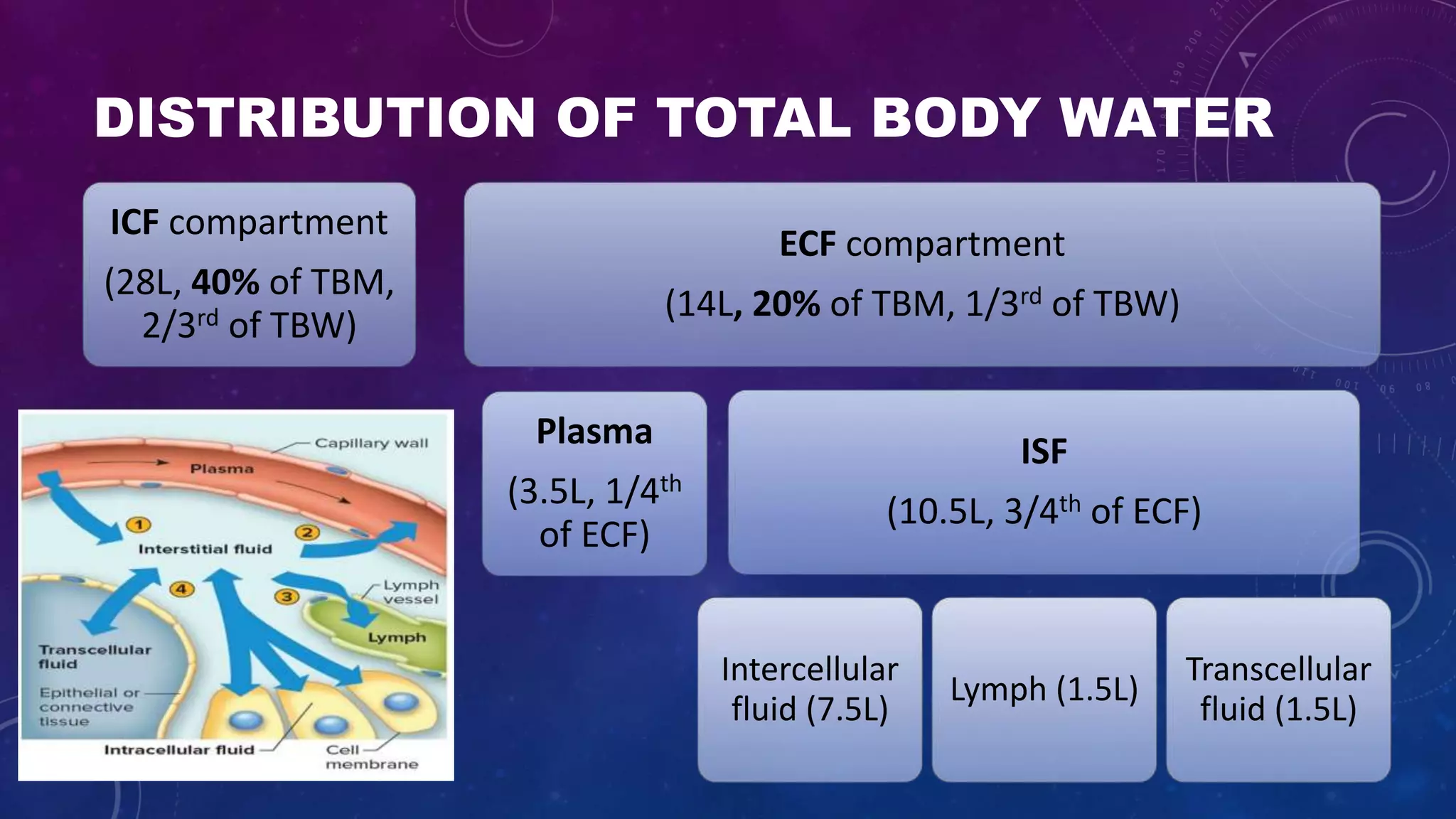
ICF compartment
(28L, 40% of TBM,
2/3rd of TBW)
ECF compartment
(14L, 20% of TBM, 1/3rd of TBW)
Plasma
(3.5L, 1/4th
of ECF)
ISF
(10.5L, 3/4th of ECF)
Intercellular
fluid (7.5L)
Lymph (1.5L)
Transcellular
fluid (1.5L)
DISTRIBUTION OF TOTAL BODY WATER
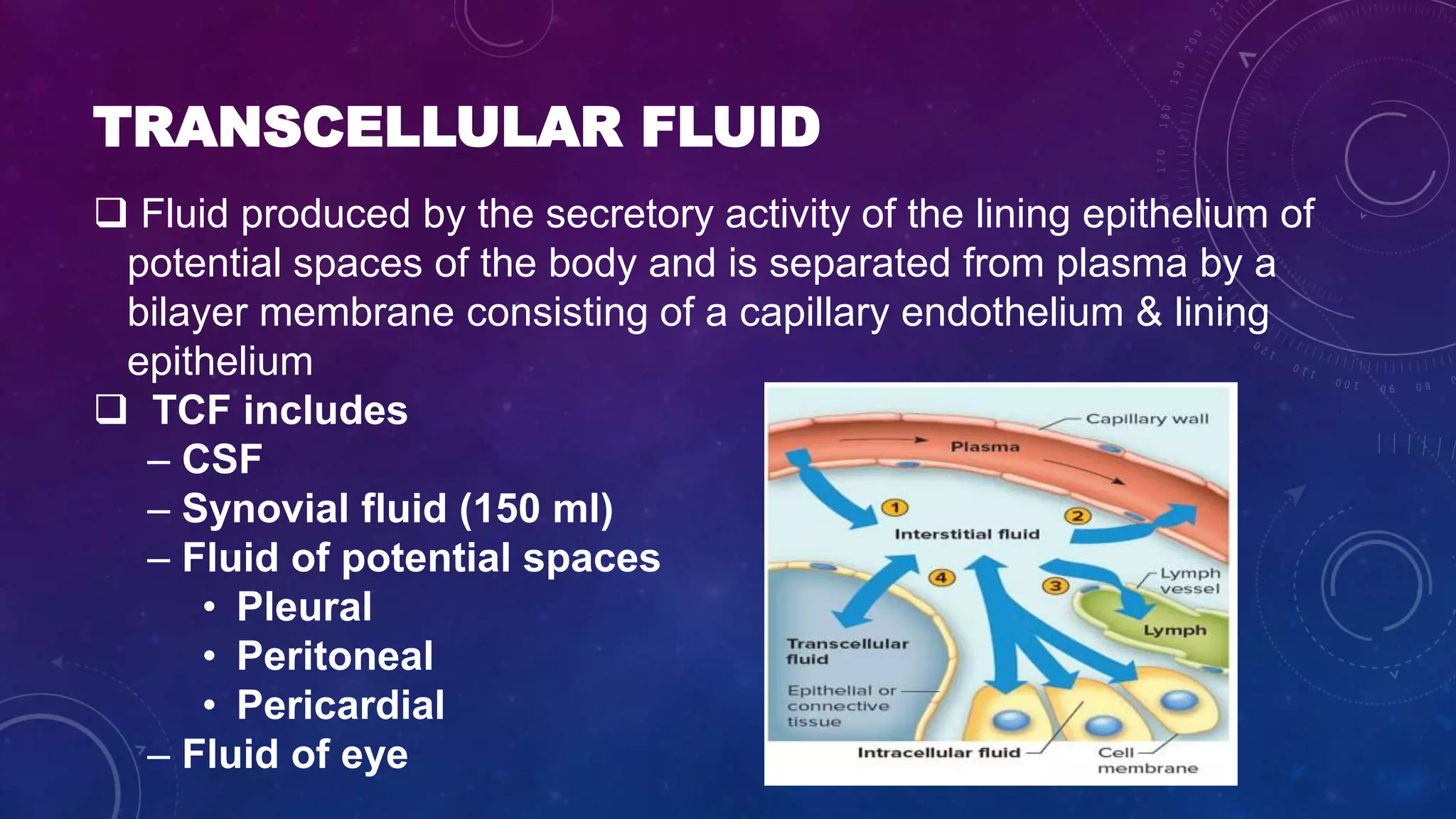
TRANSCELLULAR FLUID
 Fluid produced by the secretory activity of the lining epithelium of
potential spaces of the body and is separated from plasma by a
bilayer membrane consisting of a capillary endothelium & lining
epithelium
 TCF includes
– CSF
– Synovial fluid (150 ml)
– Fluid of potential spaces
• Pleural
• Peritoneal
• Pericardial
– Fluid of eye
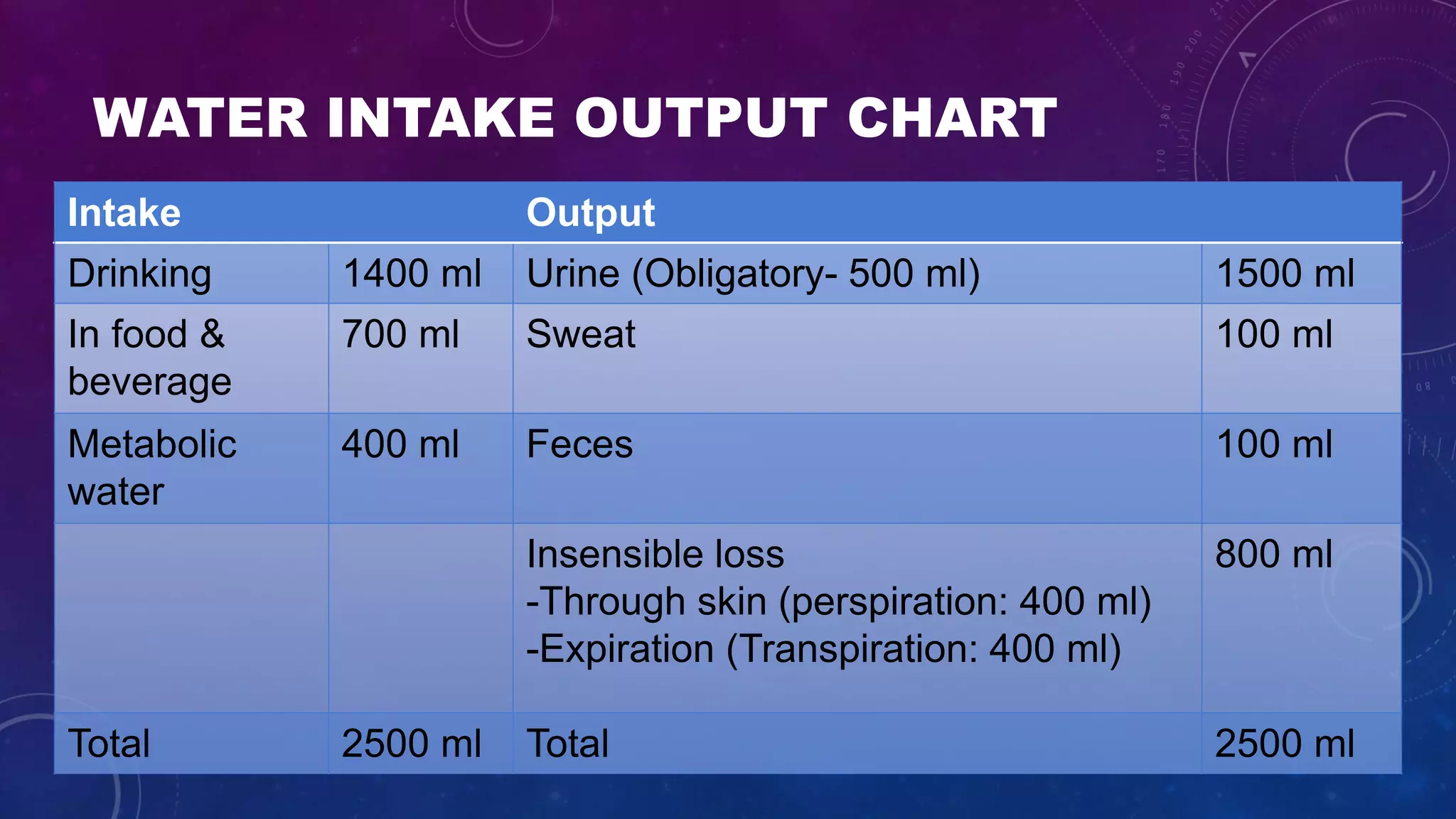
WATER INTAKE OUTPUT CHART
Intake Output
Drinking 1400 ml Urine (Obligatory- 500 ml) 1500 ml
In food &
beverage
700 ml Sweat 100 ml
Metabolic
water
400 ml Feces 100 ml
Insensible loss
-Through skin (perspiration: 400 ml)
-Expiration (Transpiration: 400 ml)
800 ml
Total 2500 ml Total 2500 ml
DAILY WATER REQUIREMENT
• Daily water requirement in ml/kg body weight for
– Adult: 40-50, Children: 100, Infant: 140
• Requirement is more in infant due to
– More basal heat production (↑ physical activity  ↑ heat
evaporation  ↑ water loss)
– The ratio of body surface area & body weight is more  ↑ water
loss through skin
– Renal concentrating power is less than adult
• Low ADH activity
• Short length of loop of Henle
Resulting high urine output in infant
WATER TURNOVER
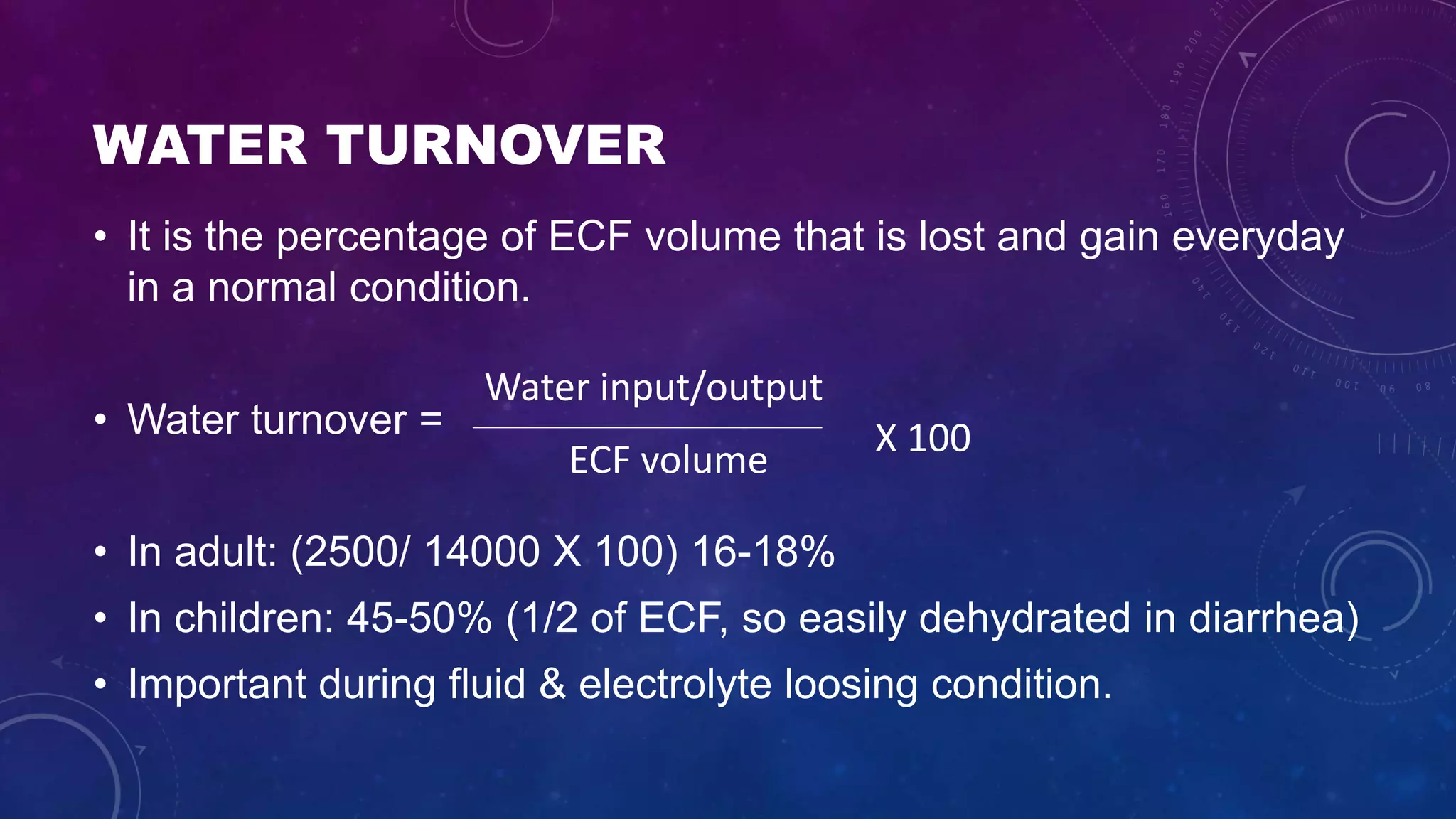
• It is the percentage of ECF volume that is lost and gain everyday
in a normal condition.
• Water turnover =
• In adult: (2500/ 14000 X 100) 16-18%
• In children: 45-50% (1/2 of ECF, so easily dehydrated in diarrhea)
• Important during fluid & electrolyte loosing condition.
Water input/output
X 100
ECF volume
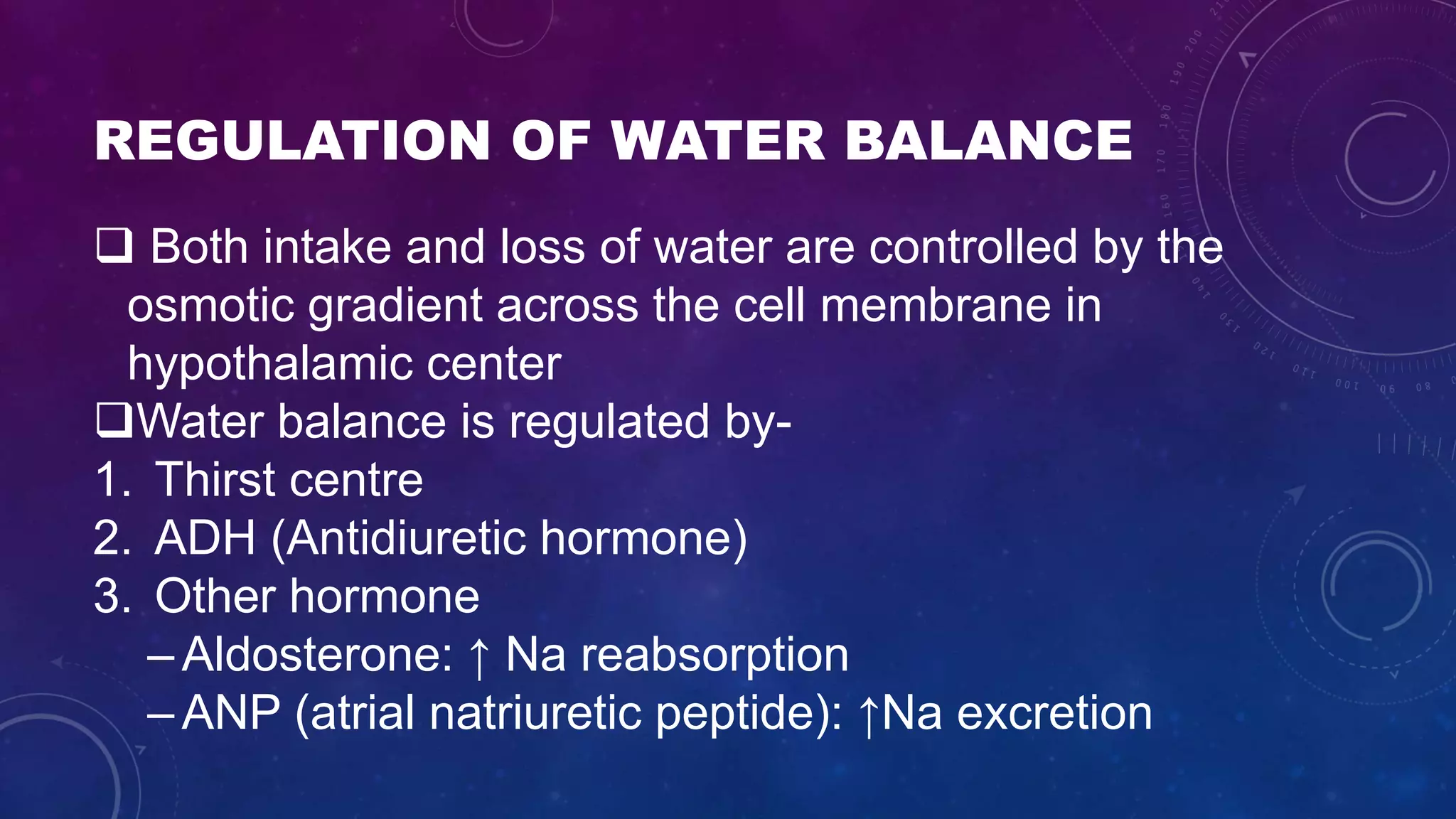
REGULATION OF WATER BALANCE
 Both intake and loss of water are controlled by the
osmotic gradient across the cell membrane in
hypothalamic center
Water balance is regulated by-
1. Thirst centre
2. ADH (Antidiuretic hormone)
3. Other hormone
–Aldosterone: ↑ Na reabsorption
–ANP (atrial natriuretic peptide): ↑Na excretion
Thirst center & ADH
Hyperosmolarity
of ECF (1-2%
increase is
sufficient)
Hypovolemia
(10% reduction
of blood
volume)
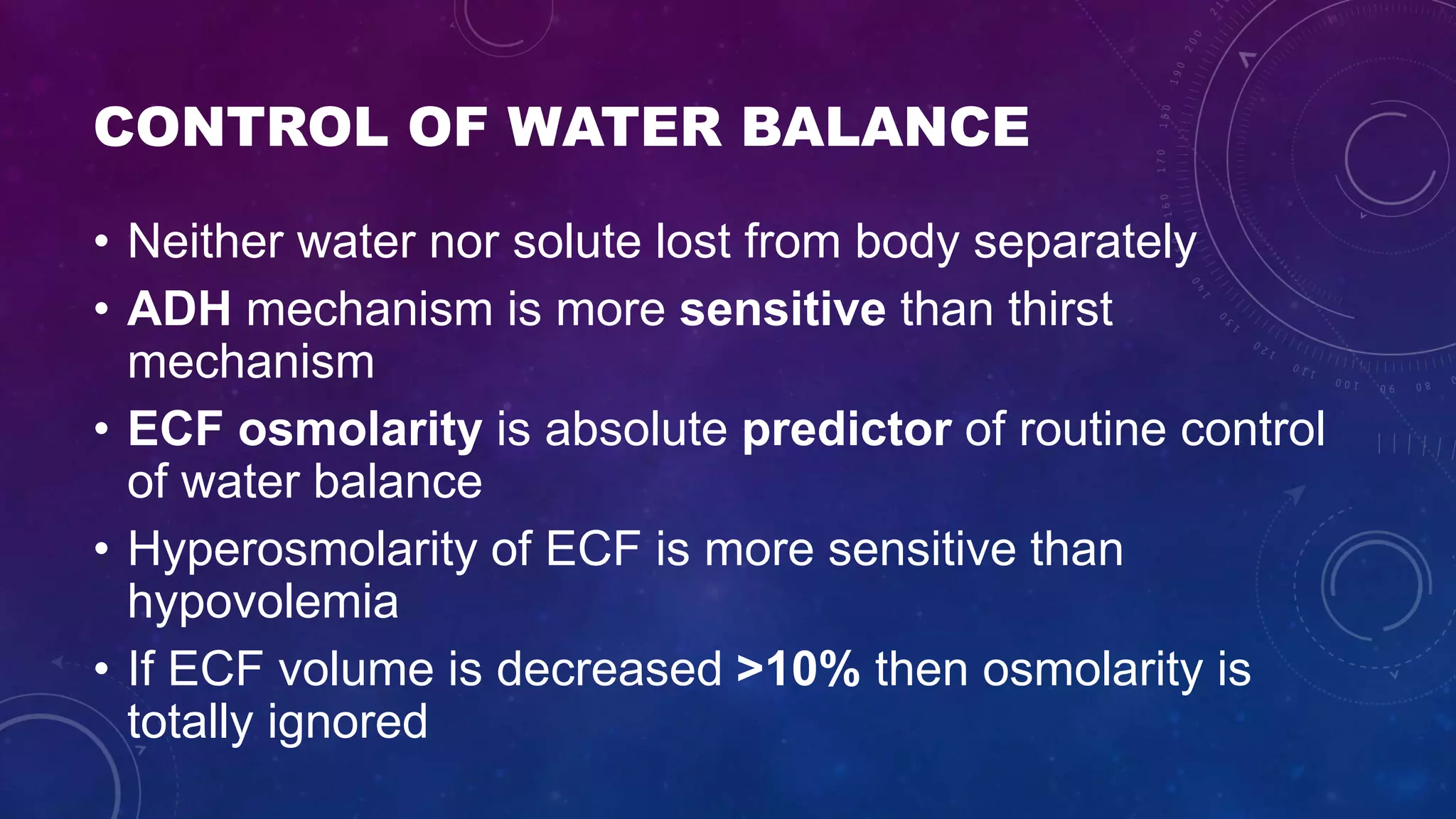
• Neither water nor solute lost from body separately
• ADH mechanism is more sensitive than thirst
mechanism
• ECF osmolarity is absolute predictor of routine control
of water balance
• Hyperosmolarity of ECF is more sensitive than
hypovolemia
• If ECF volume is decreased >10% then osmolarity is
totally ignored
CONTROL OF WATER BALANCE
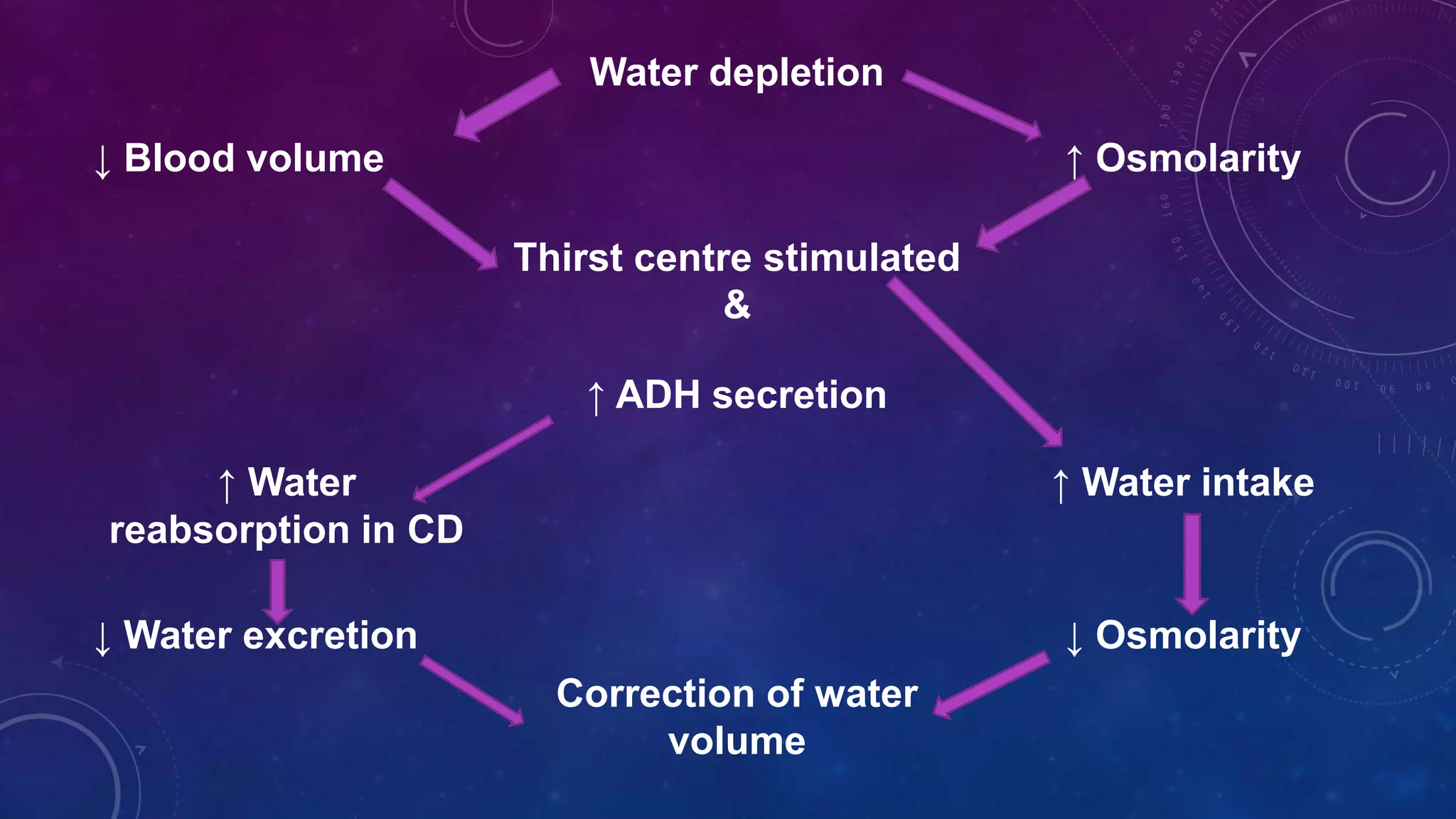
Water depletion
↓ Blood volume ↑ Osmolarity
Thirst centre stimulated
&
↑ ADH secretion
↑ Water
reabsorption in CD
↑ Water intake
↓ Water excretion ↓ Osmolarity
Correction of water
volume
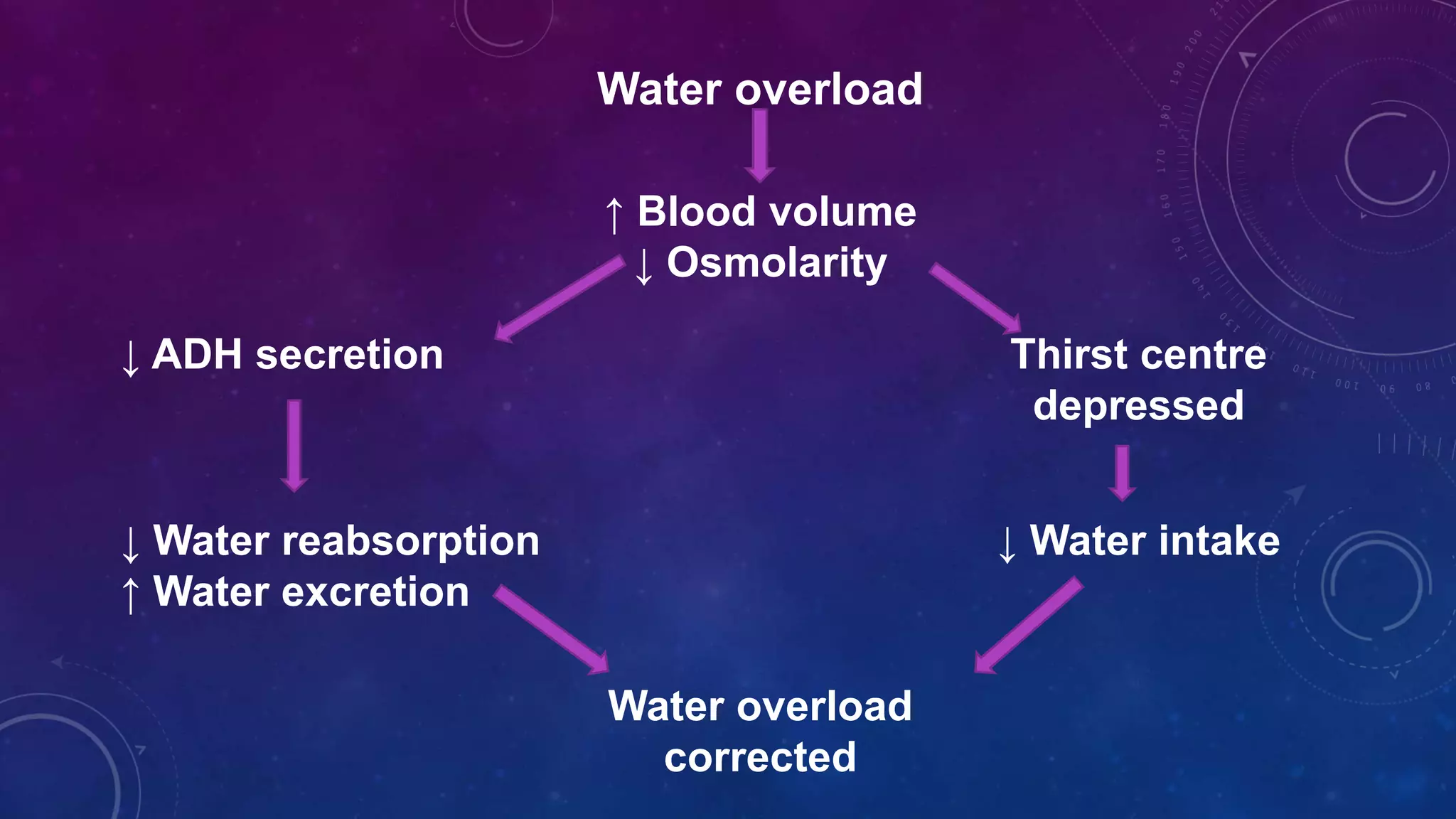
Water overload
↑ Blood volume
↓ Osmolarity
↓ ADH secretion Thirst centre
depressed
↓ Water reabsorption
↑ Water excretion
↓ Water intake
Water overload
corrected
VOLUME DISORDER
Volume contraction/
Hypovolemia
•Isotonic
•Hypotonic
•Hypertonic
Volume expansion/
Hypervolemia
•Isotonic
•Hypotonic
•Hypertonic
EFFECT OF TONICITY ON CELL VOLUME
Hypotonic Isotonic Hypertonic
ISOTONIC VOLUME CONTRACTION
Causes- Loss of isotonic fluid
1. Massive bleeding
2. Small intestinal content loss
• Small intestinal fistula
• Pancreatic/ biliary fistula
• Colostomy
• Ileostomy
3. Small intestinal obstruction & paralytic ileus
HYPOTONIC VOLUME CONTRACTION
Electrolyte loss is more than fluid loss.
1. Extra-renal cause
• Vomiting
• Excessive sweating • Diarrhea
• Extensive dermatitis • Ascites
• Peritonitis • Acute pancreatitis
• Intestinal obstruction • Burn
HYPOTONIC VOLUME CONTRACTION
Electrolyte loss is more than fluid loss
2. Renal cause
•Osmotic diuresis
-DM
-Mannitol •Adrenocortical insufficiency
•Diuretics •Metabolic acidosis
•Salt loosing nephritis •Chronic renal insufficiency
HYPERTONIC VOLUME CONTRACTION
More fluid loss than electrolytes
 Increase loss from skin
• Fever
• Hyperthyroidism
• Hot environment
 Reduce intake
• Water unavailable
• Voluntary
• Coma
• Inability to swallow
• Nausea
HYPERTONIC VOLUME CONTRACTION
 Increase loss from
respiratory tract
• Hyperventilation
• High altitude
• Fever
 Increase loss in urine
• Diabetes insipidus
• Diabetes mellitus
• Chronic nephritis
• Drugs: Lithium
• Congenital
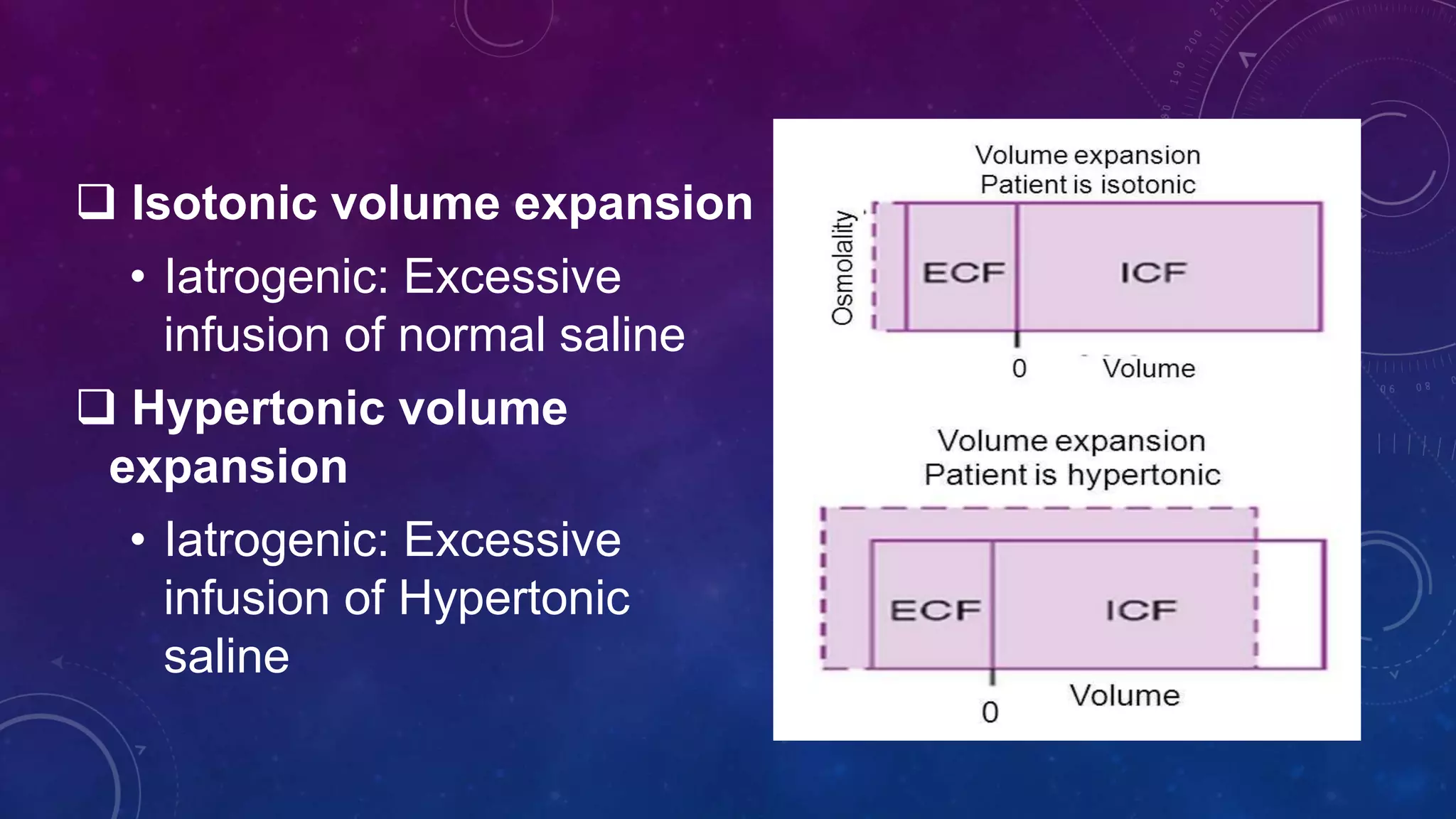
 Isotonic volume expansion
• Iatrogenic: Excessive
infusion of normal saline
 Hypertonic volume
expansion
• Iatrogenic: Excessive
infusion of Hypertonic
saline
HYPOTONIC VOLUME EXPANSION
• Congestive cardiac failure
• Chronic liver disease
• Nephrotic syndrome
• Advance renal failure
• Kwashiorkor
• Protein loosing enteropathy
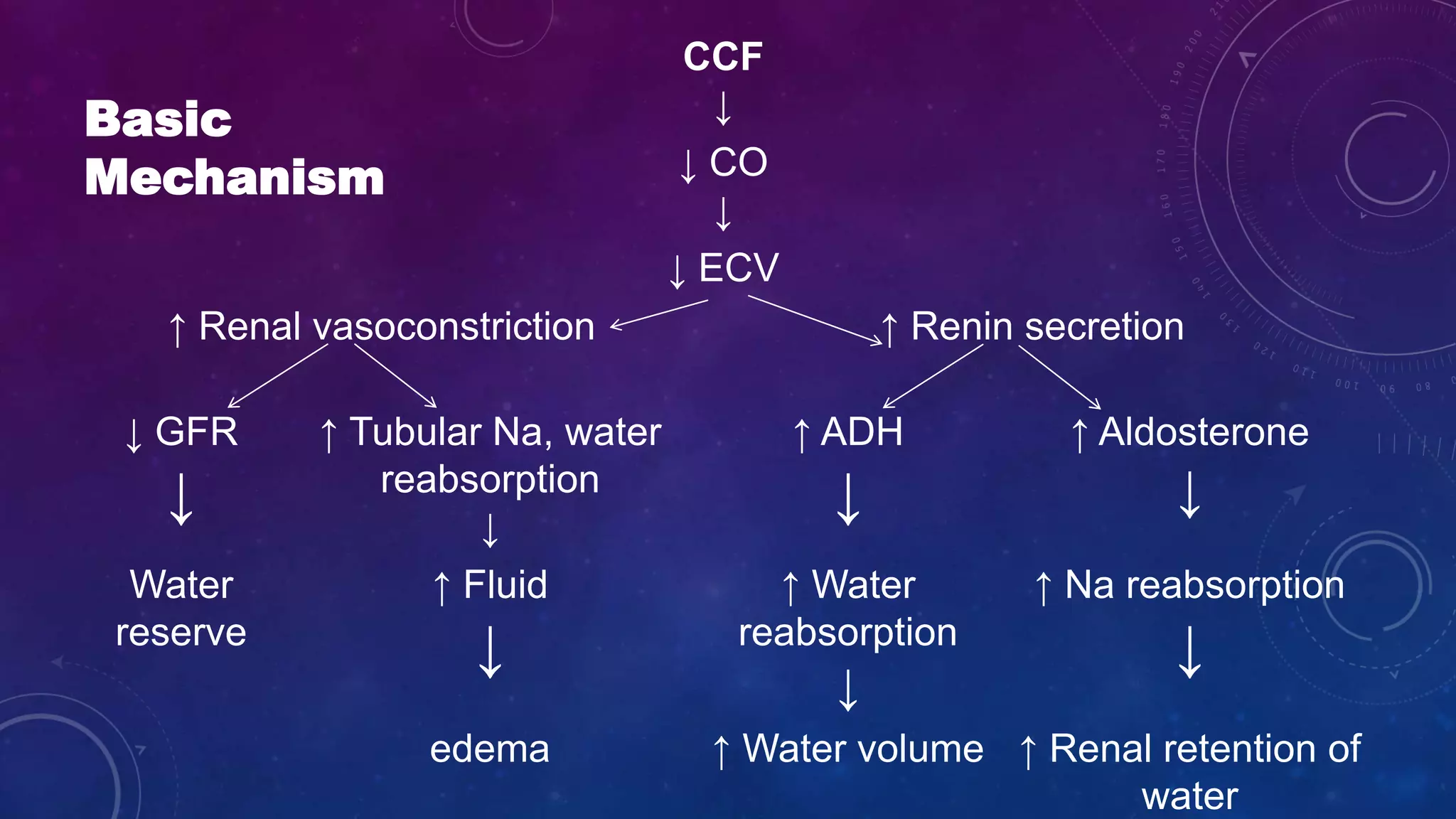
Basic
Mechanism
CCF
↓
↓ CO
↓
↓ ECV
↑ Renal vasoconstriction ↑ Renin secretion
↓ GFR
↓
↑ Tubular Na, water
reabsorption
↓
↑ ADH
↓
↑ Aldosterone
↓
Water
reserve
↑ Fluid
↓
↑ Water
reabsorption
↓
↑ Na reabsorption
↓
edema ↑ Water volume ↑ Renal retention of
water
Nephrotic syndrome
↓
Cirrhosis
↓
↓
Kwashiorkor
↓
↑ protein loss
↓
↓ protein synthesis in
liver
↓
↓ Plasma oncotic
pressure
↓ plasma oncotic
pressure
↓ Blood
volume
↓
↓CO
↓↓
Basic Mechanism
WATER INTOXICATION
• Water intoxication is a potentially fatal disturbance
in brain functions that results when the normal
balance of electrolytes in the body is pushed outside
safe limits by excessive water intake
• Mostly occurs when water is being consumed in a
high quantity without adequate electrolyte intake
CAUSES OF WATER INTOXICATION
• Excessive intake of salt free fluid
• Renal failure
• SIADH
• Psychogenic polydipsia
• Iatrogenic – Excessive infusion of parental fluid
PATHOPHYSIOLOGY OF WATER INTOXICATION
Excessive plain Water intake
↑Plasma volume
↓ osmolarity of plasma & ISF
Osmosis of water into ICF
Water intoxication (Cerebral Edema)
Body fluid homeostasis

Body fluid homeostasis

  • 1.
    BODY FLUID Dr. Farhana Atia AssociateProfessor Department of Biochemistry Nilphamari Medical College Nilphamari
  • 2.
    DISTRIBUTION OF TOTALBODY WATER TBW ECF/ICF ratio Male 60% of total body mass ECF: ICF= 1:2 Female 50% (more body fat) Newborn/ Infant 75-80% ECF= ICF ECF> ICF (intrauterine life) 42 L in 70 kg adult
  • 3.
    ICF compartment (28L, 40%of TBM, 2/3rd of TBW) ECF compartment (14L, 20% of TBM, 1/3rd of TBW) Plasma (3.5L, 1/4th of ECF) ISF (10.5L, 3/4th of ECF) Intercellular fluid (7.5L) Lymph (1.5L) Transcellular fluid (1.5L) DISTRIBUTION OF TOTAL BODY WATER
  • 4.
    TRANSCELLULAR FLUID  Fluidproduced by the secretory activity of the lining epithelium of potential spaces of the body and is separated from plasma by a bilayer membrane consisting of a capillary endothelium & lining epithelium  TCF includes – CSF – Synovial fluid (150 ml) – Fluid of potential spaces • Pleural • Peritoneal • Pericardial – Fluid of eye
  • 5.
    WATER INTAKE OUTPUTCHART Intake Output Drinking 1400 ml Urine (Obligatory- 500 ml) 1500 ml In food & beverage 700 ml Sweat 100 ml Metabolic water 400 ml Feces 100 ml Insensible loss -Through skin (perspiration: 400 ml) -Expiration (Transpiration: 400 ml) 800 ml Total 2500 ml Total 2500 ml
  • 6.
    DAILY WATER REQUIREMENT •Daily water requirement in ml/kg body weight for – Adult: 40-50, Children: 100, Infant: 140 • Requirement is more in infant due to – More basal heat production (↑ physical activity  ↑ heat evaporation  ↑ water loss) – The ratio of body surface area & body weight is more  ↑ water loss through skin – Renal concentrating power is less than adult • Low ADH activity • Short length of loop of Henle Resulting high urine output in infant
  • 7.
    WATER TURNOVER • Itis the percentage of ECF volume that is lost and gain everyday in a normal condition. • Water turnover = • In adult: (2500/ 14000 X 100) 16-18% • In children: 45-50% (1/2 of ECF, so easily dehydrated in diarrhea) • Important during fluid & electrolyte loosing condition. Water input/output X 100 ECF volume
  • 8.
    REGULATION OF WATERBALANCE  Both intake and loss of water are controlled by the osmotic gradient across the cell membrane in hypothalamic center Water balance is regulated by- 1. Thirst centre 2. ADH (Antidiuretic hormone) 3. Other hormone –Aldosterone: ↑ Na reabsorption –ANP (atrial natriuretic peptide): ↑Na excretion
  • 9.
    Thirst center &ADH Hyperosmolarity of ECF (1-2% increase is sufficient) Hypovolemia (10% reduction of blood volume)
  • 10.
    • Neither waternor solute lost from body separately • ADH mechanism is more sensitive than thirst mechanism • ECF osmolarity is absolute predictor of routine control of water balance • Hyperosmolarity of ECF is more sensitive than hypovolemia • If ECF volume is decreased >10% then osmolarity is totally ignored CONTROL OF WATER BALANCE
  • 11.
    Water depletion ↓ Bloodvolume ↑ Osmolarity Thirst centre stimulated & ↑ ADH secretion ↑ Water reabsorption in CD ↑ Water intake ↓ Water excretion ↓ Osmolarity Correction of water volume
  • 12.
    Water overload ↑ Bloodvolume ↓ Osmolarity ↓ ADH secretion Thirst centre depressed ↓ Water reabsorption ↑ Water excretion ↓ Water intake Water overload corrected
  • 13.
    VOLUME DISORDER Volume contraction/ Hypovolemia •Isotonic •Hypotonic •Hypertonic Volumeexpansion/ Hypervolemia •Isotonic •Hypotonic •Hypertonic
  • 14.
    EFFECT OF TONICITYON CELL VOLUME Hypotonic Isotonic Hypertonic
  • 15.
    ISOTONIC VOLUME CONTRACTION Causes-Loss of isotonic fluid 1. Massive bleeding 2. Small intestinal content loss • Small intestinal fistula • Pancreatic/ biliary fistula • Colostomy • Ileostomy 3. Small intestinal obstruction & paralytic ileus
  • 16.
    HYPOTONIC VOLUME CONTRACTION Electrolyteloss is more than fluid loss. 1. Extra-renal cause • Vomiting • Excessive sweating • Diarrhea • Extensive dermatitis • Ascites • Peritonitis • Acute pancreatitis • Intestinal obstruction • Burn
  • 17.
    HYPOTONIC VOLUME CONTRACTION Electrolyteloss is more than fluid loss 2. Renal cause •Osmotic diuresis -DM -Mannitol •Adrenocortical insufficiency •Diuretics •Metabolic acidosis •Salt loosing nephritis •Chronic renal insufficiency
  • 18.
    HYPERTONIC VOLUME CONTRACTION Morefluid loss than electrolytes  Increase loss from skin • Fever • Hyperthyroidism • Hot environment  Reduce intake • Water unavailable • Voluntary • Coma • Inability to swallow • Nausea
  • 19.
    HYPERTONIC VOLUME CONTRACTION Increase loss from respiratory tract • Hyperventilation • High altitude • Fever  Increase loss in urine • Diabetes insipidus • Diabetes mellitus • Chronic nephritis • Drugs: Lithium • Congenital
  • 20.
     Isotonic volumeexpansion • Iatrogenic: Excessive infusion of normal saline  Hypertonic volume expansion • Iatrogenic: Excessive infusion of Hypertonic saline
  • 21.
    HYPOTONIC VOLUME EXPANSION •Congestive cardiac failure • Chronic liver disease • Nephrotic syndrome • Advance renal failure • Kwashiorkor • Protein loosing enteropathy
  • 22.
    Basic Mechanism CCF ↓ ↓ CO ↓ ↓ ECV ↑Renal vasoconstriction ↑ Renin secretion ↓ GFR ↓ ↑ Tubular Na, water reabsorption ↓ ↑ ADH ↓ ↑ Aldosterone ↓ Water reserve ↑ Fluid ↓ ↑ Water reabsorption ↓ ↑ Na reabsorption ↓ edema ↑ Water volume ↑ Renal retention of water
  • 23.
    Nephrotic syndrome ↓ Cirrhosis ↓ ↓ Kwashiorkor ↓ ↑ proteinloss ↓ ↓ protein synthesis in liver ↓ ↓ Plasma oncotic pressure ↓ plasma oncotic pressure ↓ Blood volume ↓ ↓CO ↓↓ Basic Mechanism
  • 24.
    WATER INTOXICATION • Waterintoxication is a potentially fatal disturbance in brain functions that results when the normal balance of electrolytes in the body is pushed outside safe limits by excessive water intake • Mostly occurs when water is being consumed in a high quantity without adequate electrolyte intake
  • 25.
    CAUSES OF WATERINTOXICATION • Excessive intake of salt free fluid • Renal failure • SIADH • Psychogenic polydipsia • Iatrogenic – Excessive infusion of parental fluid
  • 26.
    PATHOPHYSIOLOGY OF WATERINTOXICATION Excessive plain Water intake ↑Plasma volume ↓ osmolarity of plasma & ISF Osmosis of water into ICF Water intoxication (Cerebral Edema)

Editor's Notes

  • #15 Hypertonic have greater concentration of solutes than plasma will move water out of cells. Solutions have lower water potential Hypotonic as lesser concentration of solutes that plasma don will move water into cells . (higher water potential). Isotonic has the same osmolality as blood plamsa . This type prevents shifting of fluid and electrolytes from intracellular fluid. solutions have equal (iso-) concentrations of substances. Water potentials are thus equal, although there will still be equal amounts of water movement in and out of the cell, the net flow is zero.